Web Portal for Photonic Technologies Using Grid
Infrastructures
Hrachya Astsatryan1, Tigran Gevorgyan2, Anna Shahinyan3
1
Institute for Informatics and Automation Problems, National Academy of Sciences, Yerevan, Armenia; 2Institute for Physical Re-searches, National Academy of Sciences, Ashtarak, Armenia; 3Yerevan State University, Yerevan,Armenia.
Email: [email protected], [email protected], [email protected]
Received September 4th, 2012; revised October 3rd, 2012; accepted October 12th, 2012
ABSTRACT
The modeling of physical processes is an integral part of scientific and technical research. In this area, the Extendible C++ Application in Quantum Technologies (ECAQT) package provides the numerical simulations and modeling of complex quantum systems in the presence of decoherence with wide applications in photonics. It allows creating models of interacting complex systems and simulates their time evolution with a number of available time-evolution drivers. Physical simulations require massive amounts of calculations are often executed on distributed computing infrastruc-tures. It is often difficult for non expert users to use such computational infrastructures or even to use advanced libraries over the infrastructures, because they often require being familiar with middleware and tools, parallel programming techniques and packages. The Parallel Grid Run-time and Application Development Environment (P-RADE) Grid Por-tal is a Grid porPor-tal solution that allows users to manage the whole life-cycle for executing a parallel application on the computing Grid infrastructures. The article describes the functionality and the structure of the web portal based on ECAQT package.
Keywords: ECAQT; ArmGrid; P-Grade; QSD; Quantum Trajectories; Wigner Function
1. Introduction
Recent years the greatly evolved area of physics is model- ing of physical processes, which is a result of progress in computer science and its effectiveness in the means of technologies. Theoretical results obtained within frame-work of computer modeling allow to have full view of systems and processes as more complicated systems do not have analytical solutions and require approximations.
In this paper, a Web portal for photonic and quantum technologies, using computational Grid infrastructures, is introduced that makes possible to solve various problems for quantum open systems. Such systems are mainly con-structed from photons, including laser fields, atom-pho- ton interactions and nonlinear optical interactions in cry- stals and describe photonic devices in the presence of imperfection effects: quantum noise, decoherence and etc. Up to now, the modeling of photonic devices on the level of their practical applications is not yet well standardized. On the other hand, progress in this area open up exciting possibilities for exploring fundamental physics as well as applications in telecommunications, signal processing and quantum information technology. The work is the logical continuation of previous works [1,2], with a tar-get to provide a research platform, which will use
trans-parency large amount of computational resources of Grid infrastructure without being aware of where input, output data and computational resources are located. This is very important, because distributed computing infrastruc- tures, particularly Grids are complicated and therefore these are difficult for scientists and researchers to use without advanced knowledge and experience.
The application has been constructed on the base of the numerical simulation method of quantum trajectories or Quantum State Diffusion (QSD) method [3]. The cor-responding library includes investigation of quantum dissipative chaos, bistability and bifurcations [4-8], quan-tum stochastic resonance [9], long-lived quanquan-tum inter-ference in periodically modulated oscillatory systems [10], engineering of Fock states and qubits in nonlinear oscillators [11] elaboration of devices generating inten-sive entangled light beams for quantum communications [12-15] as well as production of three-photon entangled states in parametric devices [16-18] and numerical simu-lation of complex quantum optical systems (see, particu-larly, interaction of an atom with bichromatic laser field [19-21], cascaded processes [22] and photonics in ion- trap systems [23]).
bos-onic quantum statistics. In the current implementation the bosonic operators cover only part of the possible ma-ter-light interactions and elaboration of the package in-volving fermion operators is now in the progress. It should be mentioned the other papers in the field of nu-merical simulation of open quantum systems based on the library of QSD approach [24-26].
Behavior of physical objects can be explained and pre-dicted with system of differential equations. In recent years quantum physics has taken on special significance and wide applications in which it is no longer possible to neglect the environment interaction: dissipation and de-coherence. In this way, the corresponding quantum sys-tems are usually treated as open syssys-tems and their time-evolution is described by a density matrix in the framework of the master equation but not on the base of a Hilbert-space vector and the Schrodinger equa-tion. In general, for the most physical systems the master equation cannot be solved analytically for arbitrary evaluation times and need to use numerical methods. But even a numerical solution of the master equation can be very hard. If a state vector requires basis vec-tors in Hilbert space to represent it, the corresponding density operator will require real numbers. This basis can often be too large even for the most powerful machines to handle, particularly, in the case if the system involves more than one degree of freedom. This problem can be overcome by unraveling the density operator evo-lution into quantum trajectories [3]. Since quantum tra-jectories represent the system as a state vector rather than a density operator, they often have a numerical advantage over solving the master equation directly, even though one has to average over many quantum trajectories to recover the solution of the master equation.
D
2 1
D
One of widely used approximations for open quantum systems is the Markovian dynamics described in terms of the Lindblad master equation for the reduced density matrix . The time-evolution in this approach is gov-erned by the Hamiltonian operator H and the Lindblad operators of the system. Thus, in the current implementa-tion QSD method is used based on the stochastic equa-tion that involves both Hamiltonian and the Lindblad operators for the state
t . The density operator using an expansion of the state vector in a trun-cated basis of Fock’s number states of a harmonic oscil-lator (photonic states) is calculated. In this way, the ECAQT library corresponding to QSD method has been applied for various physical problems [4-18].In this paper, our previous results by developing a user-friendly gridified platform based on Grid portals are expanded that are very popular for designing user inter-faces to Grids. The Grid portal build upon the familiar Web portal model offer to virtual communities of users a single point of access to computational or data resources.
The P-GRADE [27] Grid Portal is a Grid portal solution that allows users to manage the whole life-cycle for exe-cuting a parallel application on the Grid, enabling the creation, execution and monitoring of work flows through high-level Web interfaces. Being built onto the GridSphere portal framework, the P-Grade Portal hides the low level details of Grid systems with high-level, user-friendly interface that can be easily integrated with various middleware. The single sign-on feature of the portlet allows users to access Grid resources by auto-matically retrieving proxy credentials for users. The ex-periments have been carried out using computational resources of the Armenian National Grid infrastructure [28] that consists of seven Grid sites located in the lead-ing research and educational organizations of Armenia. The infrastructure is a part of the pan-European Grid infrastructure within the European Grid Initiative. Mainly the “ARMGRID.GRID.AM” multidisciplinary virtual orga- nization (VO) [29] is used, because the applications do not require any special software components to run over the infrastructure. This paper is organized as follows. Section 2 describes the structure of the suggested Web Portal. Section 3 introduces the parallelization algorithm and benchmarking results. Finally, Section 4 presents our conclusions.
2. Web Portal Structure
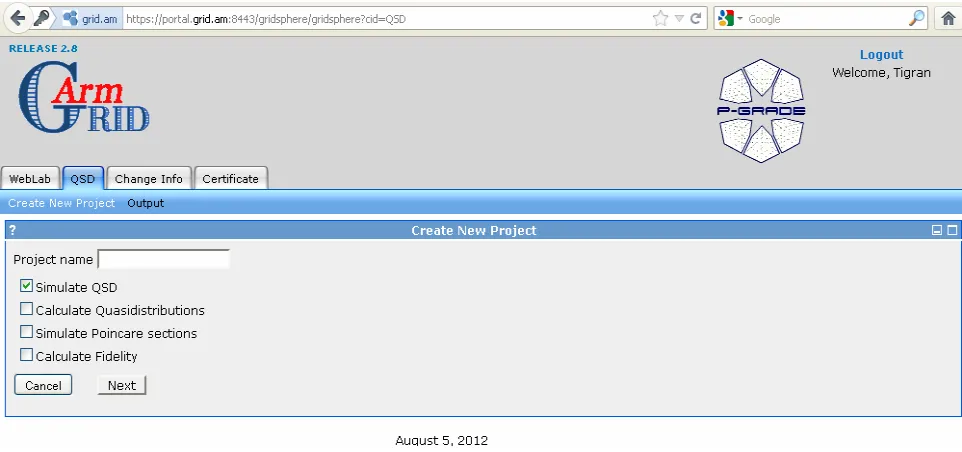
This Grid aware portal (Figure 1) is the logical continua-tion of our previous work for developing a Grid-aware Web interface for quantum optics technologies. (Figure 2).
Figure 1. Screenshot of the P-Grade web portal interface.
Figure 3. Web portal layers interconnections within the environment.
In the last step (job submission space) user should choose the output files formats, location of these files and the time interval for getting output runtime if a run time is avai- lable for this calculation. On the last step all this pa-rameters are given with default values. The job submis-sion module is the main module interacts between user and infrastructure. The module consists of the following services:
Figure 2. The structure of the web portal for photonic tech-nologies.
Hamiltonian (creation and annihilation operators, envi-ronment operators, values of the external laser field, nonlinearity of media and etc.), system’s freedom num-bers, system’s time evolution range, output time intervals, number of trajectories, number of nodes for parallel cal-culation and etc. Note that in this case the other remained algorithms are getting automatically. In the case of choosing the other remained algorithms without choosing Density Matrix algorithm, on the next step, user needs additionally to introduce the input files-density matrices.
Myproxy, which allows a grid user to delegate her/his proxy certificate;
Job matchmaker, that finds a suitable resource within the VO that matches the job requirements;
[image:3.595.309.535.339.525.2]service (JDL));
Job management service that stores all information into the mysql database, submit the job and check the status.
Balancing the calculations over a heterogeneous com-puting infrastructure such as the ArmGrid is quite chal-lenging. The job matchmaker service makes a decision based experimental results [30] using all platforms avai- lable in the ArmGrid infrastructure. The converter ser-vice makes the JDL file by indicating quantity of CPUs and size of RAMs as requirements.
After submitting the job with the help of the specific mediator object which is written in Java, job submitted requested Grid site indicated previously. This mediator object is used to establish the connection between Web Portal and calculation algorithms.
The calculation algorithms are based on ECAQT li-brary [1,2], which is given in the first step on Web Portal. The ECAQT library software package is relied on generic programming and template meta-programming. In par-ticular, the principal concept of the design of library is that all information which gets from Web Portal available at compile time should be processed as such, with the help of Mediator layer. Its design keeps abstraction and multiple code usage. ECAQT consists of three layers, GUI written in Qt, Mediator layer, Engines. The Mediator layer is created to make engines independent from GUI. This allows switching GUI implantations without changing Engines. Mediator is the interface between GUI and En-gines. The Engines layer consists of four cores: QSD, Poincare section calculation, quasi distributions, fidelity calculations. The details can be found in [1,2]. The ECAQT is called extendible as it allows changing and adding the application behavior for C++ programmers from GUI. The user can specify own format to read the input file for some engines. Particularly Fidelity engine is fully open for extensions. It has a library for pure states that can be extended by user. To extend the pure states library user should inherit from states: state class and overload generate norm() and generate state in fock basis() virtual functions. The only restriction in the current im-plementation is that the state should be represented in Fock basis.
After job submission the input parameters are parsed and source code is compiled on the specified Grid site. After parsing and compilation process the existing errors are available in an error file. If there are no error mes-sages in submission page in the Web Portal appears a message: “job is submitted”. All output information is stored in a database. Information about current job status (running, aborted or finished) and also user ID, dates of submitting, input parameters value, output files are available on the monitoring page of Web Portal. This monitoring page is grouped all information history about
user’s jobs and makes it visible graphically.
3. Parallelization Algorithm
As a rule, numerical simulations for the systems which contain more than one dimensions, or the numbers of freedom, take long time. For example, in area of photon-ics state vectors of such systems contain about 50,000 complex numbers corresponding of each QSD trajectory that takes minutes. Since at least 1000 - 5000 trajectories are required to get smooth results a full simulation takes days depending on the system freedom degree. The sug-gested QSD parallel algorithm simulates the same equa-tion many times with the same initial state and exactly with the same parameters in order to reduce execution time. The algorithm has been realized using Massage Passing Interface (MPI) and has no limitation on speci-fied processors number. We used Boost library MPI in-terface. This allows to use complex types in MPI. In order to use the complex types in Boost MPI interface, these types should be serialized according to Boost serializa-tion library.
The algorithm is scalable and efficient by avoiding some problems like synchronization and time delay in massage passing processes in inter-processors communi-cation.
In the first stage the main.cpp module calling the run() function in order to takes the input parameters including the number of trajectories (n = 5000) and the number of computational nodes (N). The MPI Comm_rank() func-tion returns the number of rank, which get run() function as a parameter. While working in parallel mode the equal number of trajectories is being simulated on different nodes (1-N) of the Grid site. After simulation the results from different processes are merged. In this way a run-time of the simulation can be reduced on many run-times, that explicitly depends on number of available nodes in the indicated Grid site. It is more significant that paral-lelization in this approach provides linear effectiveness to solve the master equation.
The procedure of parallelization has been performed as for the density matrix as well as for the arbitrary quantities of interest including the Wigner function that is a complex two-dimensional function visualizing quantum states in a phase-space. As we are interested in time-evolution of the system our aim is to calculate the Wigner functions for different time points during a given time interval. Thus, the corresponding calculation layer in our package is also parallelized in the same way. We run the program with input files for different times using different nodes.
4. Conclusion
Grid will allow users, who are not familiar with the par-allel programming technologies and software tools (Grid and Cluster middle wares, MPI, JAVA, Unix OS, Open PBS, Condor, etc.), to create and submit their requests over the portal that hides all details of the underlying distributed computing infrastructure. The portal uses open source technologies and software tools and can be easily integrated with any Grid infrastructure and a VO that supports corresponding libraries.
5. Acknowledgements
We would like to acknowledge G. Yu. Kryuchkyan for productive discussions while developing users’ interface. We also would like to acknowledge Boost, Open MPI developers.
REFERENCES
[1] H. H. Adamyan, N. H. Adamyan, N. T. Gevorgyan, T. V. Gevorgyan and G. Yu. Kryuchkyan, “Software for Nu- merical Simulations in the Field of Quantum Technolo- gies Based on Parallel Programming,” Physics of Parti- cles and Nuclei Letters, Vol. 5, No. 3, 2008, pp. 161-163. doi:10.1134/S1547477108030047
[2] T. V. Gevorgyan, A. R. Shahinyan and G. Yu. Kryuchk- yan, “Extendible C++ Application in Photonic Technolo- gies Based on Parallel Computing,” CSIT Proceedings, Yerevan, 27 September-2 October 2009, p. 367.
[3] N. Gisin and I. C. Percival, “The Quantum-State Diffu- sion Model Applied to Open Systems,” Journal of Phy- sics A: Mathematical and General, Vol. 25, No. 21, 1992, p. 5677. doi:10.1088/0305-4470/25/21/023
[4] S. T. Gevorkyan, G. Yu. Kryuchkyan and N. T. Mu- radyan, “Quantum Fluctuations in Unstable Dissipative Systems,” Physical Review A, Vol. 61, No. 4, 2000, 10 p. doi:10.1103/PhysRevA.61.043805
[5] H. H. Adamyan, S. B. Manvelyan and G. Yu. Kryuchk- yan, “Chaos in a Double Driven Dissipative Nonlinear Oscillator,” Physical ReviewE, Vol. 64, No. 4, 2001, 10 p. doi:10.1103/PhysRevE.64.046219
[6] G. Yu. Kryuchkyan and S. B. Manvelyan, “Quantum Dissipative Chaos in the Statistics of Excitation Num-bers,” Physical ReviewLetters, Vol. 88, No. 9, 2002, 4 p. doi:10.1103/PhysRevLett.88.094101
[7] G. Yu. Kryuchkyan and S. B. Manvelyan, “Sub-Pois- sonian Statistics in Order-to-Chaos Transition,” Physical Review A, Vol. 68, No. 1, 2003, 9 p.
doi:10.1103/PhysRevA.68.013823
[8] T. V. Gevorgyan, S. B. Manvelyan, A. R. Shahinyan and G. Yu. Kryuchkyan, “Dissipative Chaos in Quantum Dis- tributions,” In: G. Kryuchkyan, G. Gurzadyan and A. Papoyan, Eds., Modern Optics and Photonics: Atoms and Structured Media, World Scientific, London, 2010, pp. 60-77. doi:10.1142/9789814313278_0005
[9] H. H. Adamyan, S. B. Manvelyan and G. Yu. Kryuchk- yan, “Stochastic Resonance in Quantum Trajectories for an Anharmonic Oscillator,” Physical Review A, Vol. 63,
No. 2, 2001, 9 p. doi:10.1103/PhysRevA.63.022102
[10] T. V. Gevorgyan, A. R. Shahinyan and G. Yu. Kryuchk- yan, “Quantum Interference and Sub-Poissonian Statistics for Time-Modulated Driven Dissipative Nonlinear Oscil- lators,” Physical Review A, Vol. 79, No. 5, 2009, 9 p. doi:10.1103/PhysRevA.79.053828
[11] T. V. Gevorgyan, A. R. Shahinyan and G. Yu. Kryuchk- yan, “Generation of Fock States and Qubits in Periodi-cally Pulsed Nonlinear Oscillators,” Physical Review A, Vol. 85, No. 5, 2012, 7 p.
doi:10.1103/PhysRevA.85.053802
[12] H. H. Adamyan, N. H. Adamyan, S. B. Manvelyan and G. Yu. Kryuchkyan, “Quadrature Entanglement and Photon- Number Correlations Accompanied by Phase-Locking,”
Physical Review A, Vol. 73, No. 3, 2006, 9 p.
[13] H. H. Adamyan and G. Yu. Kryuchkyan, “Time-Modu- lated Type-II Optical Parametric Oscillator: Quantum Dy- namics and Strong Einstein-Podolsky-Rosen Entangle- ment,” Physical Review A, Vol. 74, No. 2, 2006, 12 p. doi:10.1103/PhysRevA.74.023810
[14] N. H. Adamyan, H. H. Adamyan and G. Yu. Kryuchkyan, “Time-Domain Squeezing and Quantum Distributions in the Pulsed Regime,” Physical Review A, Vol. 77, No. 2, 2008, 10 p. doi:10.1103/PhysRevA.77.023820
[15] G. Yu. Kryuchkyan and L. A. Manukyan, “Entangled Light in Transition through the Generation Threshold,”
Physical Review A, Vol. 69, No. 1, 2004, 7 p. doi:10.1103/PhysRevA.69.013813
[16] D. A. Antonosyan, T. V. Gevorgyan and G. Yu. Kryuchk- yan, “Three-Photon States in Nonlinear Crystal Superlat- tices,” Physical Review A, Vol. 83, No. 4, 2011, 13 p. doi:10.1103/PhysRevA.83.043807
[17] G. Yu. Kryuchkyan and N. T. Muradyan, “Toward the Multiphoton Parametric Oscillators,” Physical Letters A, Vol. 286, No. 2-3, 2001, pp. 113-120.
doi:10.1016/S0375-9601(00)00801-X
[18] G. Yu. Kryuchkyan, L. A. Manukyan and N. T. Mura- dyan, “Three-Photon Light in Repeated Photon Splitting,”
Optics Communication, Vol. 190, No. 1-6, 2001, pp. 245- 259. doi:10.1016/S0030-4018(01)01095-1
[19] M. Jakob and G. Yu. Kryuchkyan, “Squeezing in the Resonance Fluorescence of a Bichromatically Driven Two-Level Atom,” Physical Review A, Vol. 58, No. 1, 1998, pp. 767-770. doi:10.1103/PhysRevA.58.767
[20] G. Yu. Kryuchkyan, M. Jakob and A. S. Sargsian, “Reso- nance Fluorescence in a Bichromatic Field as a Source of Nonclassical Light,” Physical Review A, Vol. 57, No. 3, 1998, pp. 2091-2095. doi:10.1103/PhysRevA.57.2091
[21] M. Jakob and G. Yu. Kryuchkyan, “Autler-Townes Effect with Mono- and Bichromatic—Pump Fields: Reservoir Effects and Floquet-State Treatment,” Physical Review A, Vol. 57, No. 2, 1998, pp. 1355-1366.
doi:10.1103/PhysRevA.57.1355
[23] M. Jakob and G. Yu. Kryuchkyan, “Photon Correlation in an Ion-Trap System,” Physical Review A, Vol. 59, No. 3, 1999, pp. 2111-2119. doi:10.1103/PhysRevA.59.2111
[24] R. Schack and T. A. Brunn, “A C++ Library Using Quan- tum Trajectories to Solve Quantum Master Equations,”
Computer Physics Communications, Vol. 102, No. 1-3, 1997, pp. 210-228. doi:10.1016/S0010-4655(97)00019-2
[25] S. M. Tan, “A Computational Toolbox for Quantum and Atomic Optics,” Journal of Optics B: Quantum and Semiclassical Optics, Vol. 1, No. 4, 1999, p. 424.
doi:10.1088/1464-4266/1/4/312
[26] A. Vukics and H. Ritsch, “C++ QED: An Object-Oriented Framework for Wave-Function Simulations of Cavity QED Systems,” Physics and Astronomy, Vol. 44, No. 3, 2007, pp. 585-599. doi:10.1140/epjd/e2007-00210-x
[27] C. Németh, G. Dózsa, R. Lovas and P. Kacsuk, “The P-
Grade Grid Portal,” Lecture Notes in Computer Science, Springer, 2004.
[28] H. Astsatryan, Yu. Shoukouryan and V. Sahakyan, “Grid Activities in Armenia,” Proceedings of the International Conference Parallel Computing Technologies (PAVT’2009), Novgorod, 2009, pp. 465-469, ISBN: 978-5-696-03854-4.
[29] D. Kranzlmüller, J. M. de Lucas and P. Öster, “The European Grid Initiative (EGI),” Remote Instrumentation and Virtual Laboratories, Springer, 2010, pp. 61-66. http://rd.springer.com/article/10.1007/s10723-011-9185-0