Emerging Issues & Challenges in Cloud Computing—
A Hybrid Approach
Yaser Ghanam, Jennifer Ferreira, Frank Maurer
Department of Computer Science, University of Calgary, Calgary, Canada. Email: [email protected]
Received October 16th, 2012; revised November 17th, 2012; accepted November 26th, 2012
ABSTRACT
As cloud computing continues to gain more momentum in the IT industry, more issues and challenges are being re- ported by academics and practitioners. In this paper, we aim to attain an understanding of the types of issues and chal- lenges that have been emerging over the past five years and identify gaps between the focus of the literature and what practitioners deem important. A systematic literature review as well as interviews with experts have been conducted to answer our research questions. Our findings suggest that researchers have been mainly focusing on issues related to security and privacy, infrastructure, and data management. Interoperability across different service providers has also been an active area of research. Despite the significant overlap between the topics being discussed in the literature and the issues raised by the practitioners, our findings show that some issues and challenges that practitioners consider im- portant are understudied such as software related issues, and challenges pertaining to learning fast-evolving technologies.
Keywords: Cloud Computing; Issues; Challenges; Systematic Literature Review
1. Introduction
With unprecedented adoption in industry over the past few years, cloud computing continues to be one of the most vital and fast-growing models in IT. Cloud com-puting is “a model for enabling ubiquitous, convenient, on-demand network access to a shared pool of confi- gurable computing resources that can be rapidly provi- sioned and released with minimal management effort or service provider interaction [1].” Cloud computing is based upon a service-based architecture wherein services are provided mainly at the infrastructure level (e.g., vir- tual machines, storage) platform level (e.g., database, web server), or software level (e.g., email, ERP solution).
Despite the widespread adoption of cloud computing, researchers and practitioners have been actively reporting issues and challenges with this new technology. Some of the challenges seem to be fundamental such as issues with privacy and security. Other challenges such as sub- optimal performance and limited bandwidth are a natural result of pushing the boundaries of this new model to achieve more. The goal of our research is to gain an un- derstanding of the type of issues and challenges that have been emerging over the past five years. In this paper, we aim to answer three research questions:
RQ1. What issues and challenges with cloud com- puting have researches been focusing on over the past five years?
RQ2. How has the interest in different types of issues and challenges evolved over the past five years?
RQ3. Are there any gaps between the issues and chal- lenges researchers have been focusing on and the is- sues and challenges practitioners deem to be impor- tant?
In order to answer these questions, we conducted our research in two parts. The first part is a systematic litera-ture review based on the guidelines proposed by Kit- chenham [2]. The review focuses on published peer-re- viewed papers that explicitly discuss issues and chal-lenges with cloud computing. In the second part, we con- ducted in-depth interviews with experts in the field of cloud computing to solicit their opinions pertaining to is- sues and challenges.
In the following sections, we elaborate on each study separately (including the detailed research methodology, data collection strategy, results, and analysis). Then, we compare and integrate the findings of the two studies. After that, we discuss the limitations and threats to valid-ity concerning each of our studies. And finally, we draw our conclusions and discuss future work.
2. Systematic Literature Review
2.1. Search Process
confer-ence papers available in four major electronic databases namely: ACM Digital Library, IEEE Explorer, Springer-Link, and ScienceDirect. These databases were selected because they are known for including the proceedings of key conferences and journals in the area of computer science and engineering. We believe that these databases include a representative sample of the literature produced in the subject matter as pertinent to this research. Since we were only interested in recent articles, we limited our search to articles published in the year 2007 or later.
We constructed the following search query to look for articles that specifically focus on discussing issues, chal- lenges or problems in cloud computing:
(Cloud AND (issue OR issues OR challenge OR chal- lenges OR problem OR problems)).
We searched the four abovementioned databases for articles whose titles matched the search query. We used Google Scholar to conduct our queries because we found the results returned by Google Scholar to be more reli- able and accurate than most other search engines in the selected electronic databases. The search was conducted on August 28, 2012; therefore, results that were indexed after this date have not been included in this study.
To reproduce the raw set of results, the following steps are to be followed:
1) The following query should be entered into Google Scholar search engine: allintitle: issue OR issues OR challenge OR challenges OR problem OR problems
“cloud”;
2) The date range has to be set to: 2007-2012;
3) The “published in” field in the advanced search box has to be set to: IEEE OR Springer OR ACM OR Sci- enceDirect.
2.2. Inclusion and Exclusion Criteria
We included peer-reviewed journal articles and confer- ence papers that clearly focus on discussing issues, chal-lenges or problems in the cloud computing domain. Re- search papers and articles were eligible for inclusion in this review if they discussed or addressed issues and challenges facing cloud computing in general. Articles that discussed challenges in a specific application domain were not included unless the article presented the chal-lenges in a fashion that could be generalized to other domains. Detailed results on excluded articles will be provided in the results section. Because of the fast evolu- tion of cloud computing over the past decade, this review does not include research published before the year 2007. Non-English contributions were also excluded from this review.
2.3. Data Collection
For each of the papers included in our review, we have
extracted the following pieces of information:
The title;
The type of contribution;
Year of publication;
The authors’ countries;
The issues and challenges discussed in the contribu-tion;
The general topic under which the issues and chal-lenges could be categorized.
The researchers manually extracted the data from Google Scholar into a shared Excel sheet. After listing the meta-data of the papers as described above, the re-searchers went through the papers one by one to extract the pieces of information that are not readily available from the title such as the issues and challenges being discussed, and the topic under which they could be cate-gorized.
2.4. Data Filtering & Analysis
The raw set of results was filtered using a multi-step fil-tering process to account for the inclusion and exclusion criteria. The different steps and their outcomes will be explained in the results section. All the data was col- lected and formatted in a tabulated fashion to allow for analysis and charting. The following analyses were con-ducted:
The topics that were addressed in the literature and the percentage of publications that address each of the identified topics;
The number of publications in each year over the time period of interest;
The change in focus of publications over the time period of interest;
The number of publications coming from different countries;
The focus of publications coming from different countries.
2.5. Results
The initial set of results included 185 items. The list went through a filtering process as shown in Table 1.
The outcome of this process was a set of 110 items to be considered in the analysis. The final set is available in the references section from [3] to [112].
Table 1. Data filtering.
Filtering step Data analyzed Excluded results
Exclude results that do not represent a journal article or a conference paper (e.g.
book, citation, talk, abstract, panel, workshop schedule). Title 37
Exclude non-relevant results that came up in the result set due to:
˗Ambiguity in the terms used in the search string (e.g. “issue” as in “special issue”, “cloud” as in “the Land of the Long White Cloud”).
˗The word “challenges” coexisting with the term “cloud” in the same title but without being associated with it (e.g. “Using the Cloud to Facilitate Global Software Development Challenges”).
Title 16
Exclude non-English results Title, abstract, and full content1 1
Exclude application-specific papers (e.g. “Performance issues in cloud computing
for cyber-physical applications.”) Title and abstract
14 (plus 11 borderline) Exclude borderline papers if they do not discuss issues and challenges in a fashion
that could be generalized to other domains Full content 7
Total results excluded 75
Remaining results 110
2.6. Discussion Other issues, especially in public clouds, include
se-cure virtualization through effective firewalls, VM isola-tion [59], and detecisola-tion of reconnaissance scans [29]. There are security issues with long-term storage correct- ness [103] and migrating from one vendor to another based on changing needs, i.e., the problem of vendor
lock-in [87]. In this section, we present our analysis of the results
ob-tained through the systematic literature review as de- scribed earlier in the paper. We conduct each part of the analysis in light of our research questions.
RQ1. What issues and challenges with cloud
comput-ing have researches been focuscomput-ing on?
Current research has demonstrated the shortcomings of frameworks such as XML Signature, which highlight the important issue of browser security [11],[105]. Integrity, confidentiality, and non-repudiation of data can be threa- tened due to the cloud being a multi-tenancy environ- ment [30],[106]. Solutions that segregate user data, man- age identity, and governance and regulatory compliance have been investigated to address this [101]. Information leakage resulting from poor information-flow isolation requires robust solutions [31].
Looking at the collected data, we have identified 10 categories of issues that have been the focus of research in the past five years, in addition to one category of mis- cellaneous topics:
Security & privacy. This category includes organiza-tional and technical issues related to keeping cloud ser-vices at an acceptable level of information security and data privacy. This includes ensuring security and privacy of sensitive data held by banks, medical and research facilities [33]. Security and privacy issues become even more serious when governmental institutions use the cloud [32]. Despite the known need for Service Level Agreements [62] between Cloud service providers and users, standards for safety have not yet been established [64] and more research in this area would be beneficial [67]. Security and privacy of data spans issues such as authentication [62], encryption [58], and detection of malware, side channel attacks [103] and other kinds of attacks [12]—both internal and external to an enterprise [65]. There exists current research on detection and han-dling of security breaches [36] to guard against tamper-ing, loss and theft of data [98]. Further, fault tolerant mechanisms for backing up data [75],[104] are required when there are failures in the infrastructure, such as net-work outages.
As the cloud is used in more contexts, there are spe-cific issues that come with the new domains, such as us-ing cloud services in high-speed rail [66]. Further, re-search on privacy and security in the cloud has high-lighted issues when the cloud is integrated with pervasive systems [60], sensor networks [74] and grid computing [102]. As use of the cloud is scaled up to larger and lar-ger systems, such as cloud networks [61], it will become increasingly important to find effective solutions for the security and privacy challenges already highlighted at a larger scale.
Infrastructure. This category entails issues pertaining to the hardware layer used as a backbone for cloud ser-vices as well as the thin layer of software used to operate this hardware. The main issue that dominates this cate-gory is performance including topics like SaaS placement problems [23],[94], server allocation optimization [49],
1Some European conferences provide an English title and abstract for
load balancing [48] and many other [46]. Other issues are related to networking such as traffic management [25] 77,[81][111]], ubiquitous connectivity [20], network speed and cost [79], and network reliability [78]. Another group of challenges pertain to resource management in-cluding dynamic resource provisioning [18], scaling [42], and allocation [55]; as well as resource stranding and frag- mentation [1].
Furthermore, sustainability stands out as another im- portant issue given the amount of energy needed to oper- ate large-scale hardware infrastructure [42]. Quality at- tributes of the hardware infrastructure have also been an area of interest including issues like availability [27, 91,92], reliability [109], and scalability [7,96]. Other is- sues under this category include infrastructure design is- sues [13][18] and virtualization[15,88,89].
Data management. As cloud computing is enabling more data-intensive applications at the extreme scale, the demand is increasing for effective data management sys- tems [16]. One main topic in this category is data storage [19][43] and all the issues that come with it such as data federation (i.e. storage across different providers) [42],
data segmentation and recovery [28], data resiliency [109], data fragmentation and duplication [18], and data backup [75]. Other issues include data retrieval [77] and processing [5], data provenance [17], data anonymization [50], and data placement (across different data centers) [1].
Interoperability. Most research on issues and chal-lenges with cloud computing recognize interoperability as a major adoption barrier because of the risk of a ven-dor lock-in [110][87]. Amongst the many problems being discussed are: the lack of standard interfaces [19][42] and open APIs [38], and the lack of open standards for VM formats [13] and service deployment interfaces [91]. These issues result in integration difficulties between services obtained from different cloud providers as well as between cloud resources and internal legacy systems [38].
Legal issues. The notion of using cloud resources as a utility has brought about a number of legal issues. The most discussed issue in the literature we surveyed is re-lated to data placement [78]. Laws and regulations vary widely across different regions and jurisdictions as to where and how data should be stored, processed, and used [26],[39],[76]. For example, the European Union requires that all personal data be physically stored within the jurisdictions of the European Union [52]. Also, com-pliance requirements might vary in regards to the disclo-sure of data in general and sensitive data in specific (e.g. financial data, health insurance records) [13], in addition to variations in the regulations around transaction log-ging and taxation [52]. Traceability of data and altera-
tions made on it has also been reported as a legal concern [26][28]. Another important issue is the lack of compre- hensive legislation on liability in the cloud [110] as well as identity definition (i.e. users versus systems), and is-
sues related to authentication and authorization [112]. Economic challenges. This category includes issues related to the cost-benefit aspect of the cloud from a fi- nancial point of view. Some research is focused on pro- ducing cost models that reflect more accurately the actual cost of building and operating a cloud [38]. For cloud providers, the cost of the hardware infrastructure and the administrative costs associated with it are key to under- standing the economic viability and sustainability of the business [42]. Cloud providers also need to work on ef- fective monetization strategies that would provide a rea-sonable return on their investments [78]. This includes producing profitable pricing models, resource bundling options and licensing strategies [44]. Moreover, the way billing and payments are currently handled by different cloud providers lacks clarity as to what the customer is paying for in terms of type of service, quality and avail- ability which makes financial benchmarking and com- parison across different providers rather difficult [77,91]. From a cloud user’s perspective, there is the cost of migration from legacy systems to cloud-based systems- especially when huge investments have gone into build- ing the legacy systems [110]. Other issues include pre- dicting the potential cost of administering the business aspects that are hosted remotely, upgrading the network bandwidth to achieve practical performance (to use cloud resources), and reliability and backup measures [13]. For applications that are data-intensive such as media appli- cations, cost issues are exacerbated [111].
Service management. The Cloud as a service-based IT model created a number of challenges pertaining to service management. Service provisioning seems to be at the core of such challenges [80]. The literature suggests that there is an urgent need for automating service provi-sioning [15][81] and making it more dynamic [91]. Auto- matic combination of services has also been suggested [90]. Another challenge is related to the ability to provide customizable [79] and more context-aware [91] services. The authors in [27] have recognized that managing longer-standing service workflows is a major challenge considering the impact of service failure on numerous complex applications into which the service is integrated. Furthermore, managing service lifecycle and service reg-istry and subscription has proven to be challenging for various reasons [50].
[110]] which lowers consumers’ confidence in the reli-ability and availreli-ability of services and makes adoption more difficult [38]. The definition of quality in a cloud SLA is an important yet challenging aspect [97]. Ac-cording to [38], preparing SLAs requires careful consid-erations such as quality at different layers (i.e.,
infra-structure, platform, software), the tradeoff between com-plicatedness and expressiveness in the agreement, and the evaluation and feedback mechanisms that keep the SLA relevant and up-to-date. Moreover, the lack of a standard set of service level objectives and quality of service metrics makes negotiation and benchmarking rather difficult [91]. Efforts are being made by research-ers to address how an SLA should take into account ser-vice monitoring and elasticity [44] and resource provi-sioning [54].
Another challenge discussed in the literature is the quality of user experience. Especially in multimedia-in- tensive cloud services such as video streaming services [111] as well as online games [97], video quality and network delays have a huge impact on the overall ex-perience of using the cloud as perceived by end-users.
Software. Literature on software challenges in the Cloud is not abundant but it covers a wide range of topics. Mohagheghi et al. [84] discussed the challenges associ-
ated with migrating legacy systems to the cloud includ-ing: modernizing the architecture to be more service- oriented, providing a cleaner data access layer, dealing with non-functional requirements such as quality, and using agile methods in the migration process. Software evolution is another major challenge according to [85] given that it could result in service unavailability and version inconsistency in multi-tiered systems. Riungu et al. [41] discussed challenges concerning using the cloud
for software testing such as measuring the reliability of testing frameworks on the cloud, standardizing testing processes, fulfilling the 24/7 availability promise, and ac- cessing test data.
At a more technical level, challenges were identified by [14] including standardizing application interfaces, the use of data structures and concurrency models, and capturing execution stages. Moreover, software aging (i.e., growing degradation of the internal state of software
due to accumulated faults such as memory leaks) has been identified as a challenge [82]. Patidar et al. [83] dis-
cussed challenges with software development for the cloud emphasizing the complexity of the communication and coordination between software engineering and cloud providers during every stage in the software de-velopment process (i.e., requirement, design,
implemen-tation, testing).
Trust. Trust is recognized as a key obstacle in the way of adopting the Cloud and becoming dependent on its resources [28]. Challenges arise around long-term viabil-
ity (i.e., trusting that stored data will not vanish as a
re-sult of a vendor going bankrupt or getting acquired) [39], having full control over mission critical activities [38], and trusting the supply chain of a given service provider at all different levels [40]. Harsh et al. [87] discussed
trust as an issue in cloud federations since every partici-pant needs to trust that all others do filter out malicious users, follow the code of conduct, and report accurate resource usage and billing information.
Khorshed et al. [86] identified trust as a barrier to
pro-viding effective remedies against cyber-attacks in the cloud. They mentioned lack of transparency between service providers, malicious insiders, and vulnerable shared technologies as some of the trust issues that need to be addressed.
Other. Miscellaneous topics that were briefly dis-cussed in the literature as emerging challenges include modeling and simulation of cloud computing environ-ments [8], outsourcing business to cloud computing ser-vices [9], IT management [53], change management [110], and user freedom in the cloud [39].
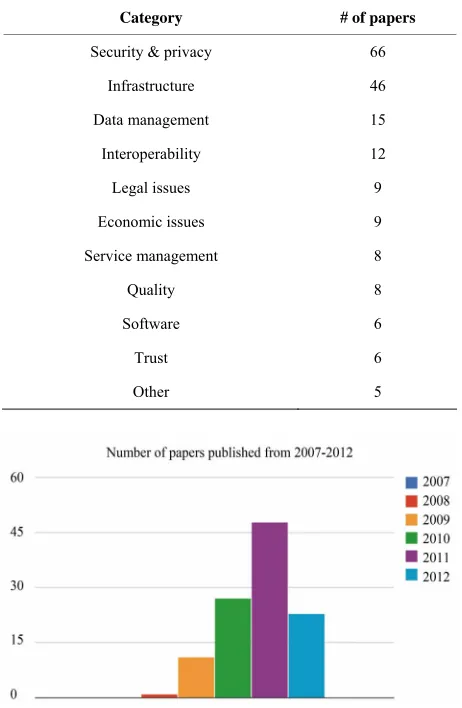
Table 2 lists all the categories and the number of pub-lications (of the ones included in our analysis) in each category. The numbers in the categories do not necessar-ily have to add up to the actual number of the papers in-cluded in our analysis because a single paper would typically discuss more than one issue.
RQ2. How has the interest in different types of issues and challenges evolved over the past five years?
Our systematic review covered the period from the year 2007 until August 2012. The number of publications in each year is shown in Figure 1.
The key observation from this analysis is that on the year 2007, we could not find papers that explicitly dis-cussed issues and challenges with cloud computing. In fact, having made this observation, we went back to look for papers that were dated before 2007 using the same search query. A total of 13 results were returned-none of them was relevant to cloud computing2. Looking at the
Year 2008, we notice only one result. Noticeably, the number of results grows steadily in the years to follow until it reaches a maximum of 48 in 2011. This number declines in the year 2012.
The sudden increase of papers after 2008 is interesting given that cloud computing was not a new concept then. However, looking at the development of cloud comput-ing as a field, we notice a few events that might have contributed to the wide-spread adoption of the concept which was also accompanied with more attention in aca-demic circles. For example, in 2006, Amazon launched Amazon Web Service (AWS) which allowed easy access to hardware resources as a utility [113]. In late 2007,
2The term “cloud” was used in the title of publications in the domains
Table 2. Categories of issues identified in the study.
Category # of papers
Security & privacy 66
Infrastructure 46
Data management 15
Interoperability 12
Legal issues 9
Economic issues 9
Service management 8
Quality 8
Software 6
Trust 6
Other 5
Figure 1. Number of papers published from 2007-2012.
IBM and Google supported a joint university initiative called the Academic Cloud Computing Initiative (ACCI) as a project aiming to enhance students’ knowledge and skills to build cloud infrastructure and address the chal-lenges of cloud computing [114]. In early 2008, Euca-lyptus became the first open-source platform for deploy-ing private clouds, and it was compatible with Amazon’s cloud service API [115]. In the same year, OpenNebula became the first open-source software for deploying pri-vate and hybrid clouds [116]. By mid-2008, a press re-lease by Gartner affirmed that “organizations are switch-ing from company-owned hardware and software assets to per-use service-based models… The projected shift to cloud computing, for example, will result in dramatic growth in IT products in some areas and in significant reductions in other areas. In general, assets will be util-ized with greater efficiency.”3
On the other hand, the sudden decline in 2012 can be attributed to two possible reasons:
1) The number of papers published in 2012 is not
accu-rate given that some proceedings may not have been indexed yet in the electronic databases we have used. Therefore, an increase in the number of papers may occur over the four months not covered by this survey (September-December), and the positive trend may continue;
2) The number of papers has already hit a maximum and we might start to observe a decline in the trend over the next few years-which might indicate saturation in the issues and challenges being identified. This like-lihood is supported by the fact that as of the date of our search, the number of papers (23) is significantly lower than where it should be at the end of 2012. Based on the linear trend obtained from the data (R2=
0.976)4, the number of papers by the end of 2012 is
projected to be about 61 if the positive trend was to continue.
Looking at the sources of publications over the past few years as illustrated in Figure 2, we notice that most publications were from the USA, followed by China and then India. Australia and the UK come next. The statis-tics here refer to the location of the first author’s institu-tion.
For example, in our survey, 25 papers originated from US institutions. Although the number of publications varies between the top 3 countries, we notice a level of consistency when we look at the topics distribution as illustrated in Figure 3. That is, in all three countries, the top three topics of interest were security and privacy, infrastructure, and data management. It is also notewor-thy that we could not find papers originating from the USA that address legal and trust issues. Meanwhile, China is lacking on the topic of quality and India is lack-ing on a number of categories.
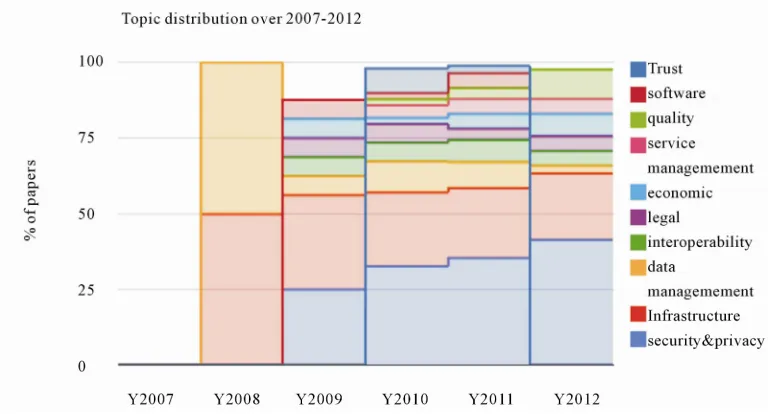
Under RQ2, we also investigate when the different
topics started to appear in the literature and when they gained the most attention. Figure 4 shows the evolution of interest across different topics from 2007 to 2012. In 2007, there were no papers in our dataset as discussed previously. The results for the year 2012 may not be re-liable given that the date of our search query was prior to the end of the year 2012.
We notice that the first topics to be explicitly dis-cussed as challenges were related to infrastructure and data management. Infrastructure continued to be an im-portant topic throughout the past five years including 2012. Attention to data management peaked in 2010 and then declined in 2011 and 2012. In 2009, security and privacy started to be a major focus and continued a steady growth throughout the past five years including 2012. This might be due to the fact that late 2008 wit-nessed a huge adoption of cloud-based services like
4This is not a very accurate number given the small number of data
points.
[image:6.595.57.288.102.456.2]Figure 2. Number of publications by country/area.
Figure 3. Topics of interest by country.
Facebook (monthly growth of 178%)5. Other topics
also started to appear in 2009 including interoperability, legal issues, economic challenges, and software chal-lenges. These topics continued to be discussed in the
years to follow. In 2010, the issue of trust started to be visible in the literature alongside quality and service management challenges. All of the abovementioned is-sues continued to appear in the Year 2011. Up until the date of our search query, there were no publications in the year 2012 dedicated to discuss challenges related to
oftware challenges or trust issues.
5Zuckerberg, Mark (August 26, 2008). “Our First 100 Million”. The
Figure 4. Topic distribution from 2007-2012.
3. Interviews
In this part of the study, we used interviews as our data collection method in order to understand issues and chal-lenges with cloud computing from a practitioners’ per-spective. At the end of this section, we identify gaps be-tween what researchers have been focusing on and what practitioners deem important.
3.1. Data Collection
The authors conducted 8 in-depth semi-structured inter-views with individuals of different teams and roles in two different organizations. Both organizations are Canadian organizations that specialize in cloud computing as an emerging technology. The first few interviewees were selected collaboratively by the researcher and liaisons in the organizations. Then, to select the next group of inter-viewees, we used snowball sampling, i.e., we used
sug-gestions from the interviewees to guide the selection process of other interviewees.
Generally, interviewees were first asked questions to describe their role and team responsibilities. Then, they were asked questions about the definition of cloud com-puting from a technical perspective, their motivation be-hind adopting the Cloud, the advantages of being part of the cloud, and the issues and challenges they or their customers have been facing with the Cloud. The views lasted between 15 and 35 minutes each. The inter-views were audio-taped and transcribed.
The data collection phase stopped when we started to get no new insights from new interviews.
3.2. Data Analysis
For the purpose of this paper, we only included the
analysis of the part on issues and challenges. The col-lected data was analyzed by iterating over the interview data to assign codes, and we refined these codes as more data was coded. By the end, we had used 30 codes in total to tag the collected data. These codes effectively reflect issues and challenges found in the data (for exam-ple: performance, portability, security). However, all of the codes were identified prior to identifying the catego-ries of challenges in the literature review.
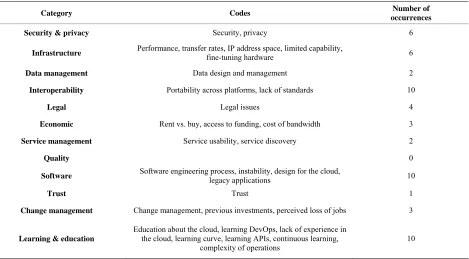
In the next step, we classified the 30 codesunder the categories developed through the literature review (as shown in Table 3). If there was no suitable category un-der which we could naturally classify a code, we created a new category. This theme of categorization and classi-fication was intended so that we could compare the find-ings in each part of the study and identify similarities and differences.
3.3. Results & Discussion
In this section, we present the results of this part of the study and we analyze them in light of the fourth research question:
RQ3. Are there any gaps between the issues and chal-lenges researchers have been focusing on and the issues and challenges practitioners deem to be important?
Table 3. Classification of issues identified in interviews with practitioners.
Category Codes Number of
occurrences
Security & privacy Security, privacy 6
Infrastructure Performance, transfer rates, IP address space, limited capability, fine-tuning hardware 6
Data management Data design and management 2
Interoperability Portability across platforms, lack of standards 10
Legal Legal issues 4
Economic Rent vs. buy, access to funding, cost of bandwidth 3
Service management Service usability, service discovery 2
Quality 0
Software Software engineering process, instability, design for the cloud, legacy applications 10
Trust Trust 1
Change management Change management, previous investments, perceived loss of jobs 3
Learning & education
Education about the cloud, learning DevOps, lack of experience in the cloud, learning curve, learning APIs, continuous learning,
complexity of operations
10
existing categories. One category from the literature re-view (namely: quality), highlighted in blue, was not as-signed any codes.
The practitioners we interviewed touched on issues related to all the categories identified in the literature re- view except for one category on Quality.
On software related issues, participants discussed por- ting legacy applications as a major challenge. As one participant stated that “you can’t just put some software that’s intended to be run on a desktop and just put it in the cloud and just automatically it’s easy to distribute.” Another participant asserted that “there is a lot of legacy applications that will not scale well in the cloud.” Insta-bility of important platforms in the Cloud such as Open-Stack has also been raised as a critical issue. One par-ticipant stated that “Sometimes [OpenStack] is just com-pletely unstable and there’s bugs in it that would just stop everything.” Another participant described the platform as “a moving target.” He continued: “Everything is mov- ing. It’s not stable.” The software engineering process itself is being challenged by new roles such as DevOps (aka. development and operations): “We definitely iden-tify as DevOps and with the stuff that we’re doing in particular, seems to be a bit more ops heavy and that doesn’t lend itself as well to Agile.” Other issues that were raised include: integration problems, development versus deployment environments, and dealing with ex-ternal and virtual resources.
On interoperability, participants brought up the issue of the lack of standards and open APIs. As one partici-
pant stated, “there’s a total lack of open APIs that a com- pany could conform to.” Another participant asserts that even for a single provider, this seems to be a major chal- lenge: “There does not seem to be an API architecture that Amazon says OK all our APIs should follow the same way-they will all work like this. They all work slightly differently and don’t always return the same re- sults in a consistent way.” Other issues under this cate- gory include moving virtual machines among different platforms, and vendor lock-in.
On security and privacy, participants assert that secu-rity and privacy are amongst the key inhibitors to adopt-ing the cloud. From a management perspective, one par-ticipant states that “management is very worried about the security of the cloud.” Nonetheless, one of the par-ticipants argued that although “privacy and security are big issues…, the cloud is safer. You have teams of peo-ple dedicated to security at these big cloud providers and they have to conform to all sorts of regulations.” Partici-pants also expressed their concerns about the privacy of any data stored abroad mainly due to legislation issues.
The interviewees also touched on other challenges such as change management and learning. While the in-terviewees mentioned three different issues under change management (i.e., Change management, previous
in-vestments, perceived loss of jobs), in our literature re-view, change management was only discussed in one paper (and therefore it was categorized under the “Mis-cellaneous” category). The learning and education aspect comes across in the result as one of the most important challenges; however, the literature does not discuss it as a challenge. This might be due to the nature of the busi-ness some of the practitioners we interviewed were in-volved in which entailed setting up and maintaining pri-vate clouds. One participant asserts that “there is defi-nitely a learning curve to using the cloud and doing De-vOps stuff.” Another participant states that “the major challenge for the developers is learning all of that knowledge that comes from the systems areas.” The fast evolution of cloud computing technologies has also been a challenge: “You have to keep learning. And as soon as you stop, at that point I think you have to find another line of work.” Other challenges under this category in-clude educating the public about the capabilities and limitations of the cloud, and the lack of sufficient exper- tise in the area of cloud computing.
[image:10.595.67.282.595.705.2]Despite the significant overlap between the identified issues in the two studies, we notice a difference in em- phasis between what we found in the literature and what our participants focused on. That is, the most three fre- quently discussed issues during the interviews were software related issues, learning and experience, and in-teroperability. We then ranked the categories based on their frequency of occurrence in the literature review as well as the practitioner interviews. Figure 5 shows the difference in ranks between the systematic literature re- view and the interviews. Green bars denote a higher rank of the category in the practitioner interviews, whereas red bars denote a higher rank in the systematic review. For example, security and privacy ranked first in our litera- ture review and dropped to fourth in the interviews. On the other hand, software ranked ninth in the literature
Figure 5. Change in rank between the systematic literature review and the interviews.
review, but jumped to first in the interviews. For catego-ries that did not show in one of the categocatego-ries, we as-sumed it ranked last.
4. Limitations & Threats to Validity
Although the literature review was conducted in a sys-tematic way, there is a number of factors that might have increased the subjectivity of the findings. First, our choice of the search string might have excluded papers that discussed issues and challenges but without neces-sarily expressing that explicitly in the title. Using the title (as opposed to the full text) in our search helped reduce noise significantly; because otherwise any paper that had the word “cloud” and the word “issue”, for example, would have been returned resulting in more than 24,000 mostly non-relevant papers. Also, our selection of spe-cific databases might have excluded good contributions in the area that exist elsewhere. The categorization proc-ess of the surveyed papers is subjective and will vary from researcher to researcher. Similarly in the interviews, coding and classification are both subjective processes. We tried to mitigate this issue by involving more than one researcher in such activities. The literature review is also limited in that it does not take into account the last few months of the year 2012—which might have resulted in an incomplete picture of trends.
Like other qualitative studies, interviews are subject to a number of biases during the data collection stage as well as the analysis stage. The interviews are mainly lim-ited due to the small number of participants and their affiliations.
5. Conclusion & Future Work
researchers have not been giving enough attention to the challenge of learning fast-evolving technologies in the cloud (e.g., virtualization tools). Also, software related issues are understudied. To fill this gap, our future work includes conducting intensive case-studies wherein we aim to understand challenges related to software design and testing in the cloud.
REFERENCES
[1] National Institute of Standard and US Department of Commerce Technology, “The NIST Definition of Cloud Computing,” 12 October 2012.
http://csrc.nist.gov/publications/nistpubs/800-145/SP800-145.pdf
[2] B. Kitchenham, “Procedures for Performing Systematic Reviews,” Technical Report TR/SE-0401, Keele Univer-sity, Lyme, and Technical Report 0400011T.1, NICTA, 2004.
[3] A. Greenberg, J. Hamilton, D. A. Maltz and P. Patel, “The Cost of a Cloud: Research Problems in Data Center Networks,” SIGCOMM Computer Communication Re- view,Vol. 39, No. 1, 2008, pp. 68-73.
doi:10.1145/1496091.1496103
[4] H. Lim, S.Babu, J. Chase and S. Parekh, “Automated Con- trol in Cloud Computing: Challenges and Opportunities,”
Proceedings of the 1st Workshop on Automated Control
for Datacenters and Clouds, New York, 19 June 2009, pp.
13-18. doi:10.1145/1555271.1555275
[5] A. Khalid and H. Mujtaba, “Data Processing Issues in Cloud Computing,” Proceedings of the 2nd International
Conference on Machine Vision (ICMV '09), Dubai, 28-30
December 2009, pp. 301-304.
[6] D. Bernstein and E. Ludvigson, “Networking Challenges and Resultant Approaches for Large Scale Cloud Con- struction,” Proceedings of the 2009 Workshops at the
Grid and Pervasive Computing Conference (GPC’09), 4-
8 May 2009, Geneva, pp. 136-142.
[7] H. J. La, S. W. Choi and S. D. Kim, “Technical Chal-lenges and Solution Space for Developing SaaS and Mash-Up Cloud Services,” Proceedings of the 2009 IEEE
International Conference on e-Business Engineering (IC-
EBE’09), Macau, 21-23 October 2009, pp. 359-364.
[8] R. Buyya, R. Ranjan and R. N. Calheiros, “Modeling and Simulation of Scalable Cloud Computing Environments and the CloudSim Toolkit: Challenges and Opportuni-ties,” International Conference on High Performance
Computing & Simulation, HPCS’09, Leipzig, 21-24 June
2009, pp. 1-11.
[9] H. M. Nezhad, B. Stephenson and S. Singhal, “Outsourc- ing Business to Cloud Computing Services: Opportunities and Challenges,” IEEE Internet Computing, Special Issue
on Cloud Computing, 6 February 2009.
http://www.hpl.hp.com/techreports/2009/HPL-2009-23.ht ml
[10] L. Gu and S.-Ch. Cheung, “Constructing and Testing Privacy-Aware Services in a Cloud Computing Environ- ment: Challenges and Opportunities,” Proceedings of the
First Asia-Pacific Symposium on Internetware (Internet-
ware’09), Beijing, 15-16 October 2009.
[11] M. Jensen, J. Schwenk, N. Gruschka and L. Iacono, “On Technical Security Issues in Cloud Computing,”
Pro-ceedings of the 2009 IEEE International Conference on
Cloud Computing (CLOUD’09), Bangalore, 21-25 Sep-
tember 2009, pp. 109-116.
[12] B. R. Kandukuri, V. R. Paturi and A. Rakshit, “Cloud Security Issues,” IEEE International Conference on Ser-
vices Computing, Bangalore, 21-25 September 2009, pp.
517-520.
[13] W. Kim, S. D. Kim, E. Lee and S. Y. Lee, “Adoption Issues for Cloud Computing,” Proceedings of the 11th International Conference on Information Integration and
Web-Based Applications & Services (iiWAS’09), 14-16
December 2009, Kuala, pp. 3-6.
[14] L. J. Mei, Z. Y. Zhang and W. K. Chan, “More Tales of Clouds: Software Engineering Research Issues from the Cloud Application Perspective,” Proceedings of the 33rd Annual IEEE International Computer Software and Ap-
plications Conference (COMPSAC’09), Seattle, 20-24
July 2009, pp.525-530.
[15] Q. Zhang, L. Cheng and R. Boutaba, “Cloud Computing: State-of-the-Art and Research Challenges,” Journal of
Internet Services and Applications, Vol. 1, No. 1, 2010,
pp. 7-18. doi:10.1007/s13174-010-0007-6
[16] D. Agrawal, A. El Abbadi, S. Antony and S. Das, “Data Management Challenges in Cloud Computing Infrastruc- tures,” Proceedings of the 6th International Conference
on Databases in Networked Information Systems (DNIS’
10),Aizu-Wakamatsu, 29-31 March 2010, pp. 1-10. [17] M. A. Sakka, B. Defude and J. Tellez, “Document Prove-
nance in the Cloud: Constraints and Challenges,” Procee-
dings of the 16th EUNICE/IFIP WG 6.6 Conference on
Networked Services and Applications: Engineering, Con-
trol and Management (EUNICE’10), Trondheim, 20-30
June 2010, pp. 107-117.
[18] P. Goyal, “Enterprise Usability of Cloud Computing En- vironments: Issues and Challenges,” Proceedings of the
19th IEEE International Workshops on Enabling Tech-
nologies: Infrastructures for Collaborative Enterprises
(WETICE’10), Larissa, 28-30 June 2012, pp. 54-59.
[19] H. Chang and E. Choi, “Challenges and Security in Cloud Computing,” Communication and Networking,
Commu-nications in Computer and Information Science, Vol. 120,
2010, pp. 214-217.
[20] G. L. Myoungand N. Crespi, “Shaping Future Service En- vironments with the Cloud and Internet of Things: Net- working Challenges and Service Evolution,” Proceedings
of the 4th International Conference on Leveraging Ap-
plications of Formal Methods, Verification, and Valida-
tion, Amirandes, 18-20 October 2010, pp. 399-410. [21] J. Q. Tan, X. H. Pan, E. Marinelli, S. Kavulya, R. Gandhi
and P. Narasimhan, “Kahuna: Problem Diagnosis for Ma- preduce-Based Cloud Computing Environments,” IEEE
Network Operations and Management Symposium (NOMS),
Osaka, 19-23 April 2010, pp. 112-119.
Cloud,” Proceeding of the 2010 IEEE World Congress on
Computational Intelligence, Barcelona, 18-23 July 2010,
pp. 600-607.
[23] Z. I. M. Yusoh and M. L. Tang, “A Cooperative Coevolu-tionary Algorithm for the Composite SaaS Placement Problem in the Cloud,” Proceedings of the 17th Interna-
tional Conference on Neural Information Processing: The-
ory and Algorithms (ICONIP’10), Sydney, 9 March 2010,
pp. 618-625.
[24] Y. Pan, S. Maini and E. Blevis, “Framing the Issues of Cloud Computing & Sustainability: A Design Perspec- tive,” Proceedings of the IEEE 2nd International Con-ference on Cloud Computing Technology and Science
(CLOUDCOM’10), Indianapolis, 30 November-3 De- cember 2010, pp. 603-608.
[25] M. Mathur, “Elucidation of Upcoming Traffic Problems in Cloud Computing,” Recent Trends in Networks and
Communications, Communications in Computer and
In-formation Science, Vol. 90, 2010, pp. 68-79.
[26] A. Khalid, “Cloud Computing: Applying Issues in Small Business,” International Conference on Signal Acquisi-
tion and Processing, Bangalore, 9-10 February 2010, pp.
278-281. doi:10.1109/ICSAP.2010.78
[27] Y. Wei and M. Blake, “Service-Oriented Computing and Cloud Computing: Challenges and Opportunities,” IEEE
Internet Computing, Vol. 14, No. 6, 2012, pp. 72-75.
doi:10.1109/MIC.2010.147
[28] P. Mathur and N. Nishchal, “Cloud Computing: New Challenge to the Entire Computer Industry,” 1st
Interna-tional Conference onParallel Distributed and Grid Com-
puting (PDGC), Solan, 28-30 October 2010, pp. 223-228.
[29] L. M. Kaufman, “Can Public-Cloud Security Meet Its Unique Challenges?” IEEE Security & Privacy, Vol. 8,
No. 4, 2010, pp. 55-57. doi:10.1109/MSP.2010.120 [30] C. Tsai, U. Lin, A. Chang and C. Chen, “Information
Security Issue of Enterprises Adopting the Application of Cloud Computing,” 6th International Conference on Net- worked Computing and Advanced Information Manage-
ment (NCM), Seoul, 16-18 August 2010, pp. 645-649.
[31] A. Kim, J. McDermott and M. Kang, “Security and Ar- chitectural Issues for National Security Cloud Comput- ing,” Proceedings of the 2010 IEEE 30th International Conference on Distributed Computing Systems Work-
shops, Genova, 21-25 June 2010, pp. 21-25.
[32] D. Wyld, “Risk in the Clouds? Security Issues Facing Government Use of Cloud Computing,” Innovations in
Computing Sciences and Software Engineering, Cape
Town, 5 May 2010, pp. 7-12. doi:10.1007/978-90-481-9112-3_2
[33] S. Ahmed and M. Y. A. Raja, “Tackling Cloud Security Issues and Forensics Model,” High-Capacity Optical Net-
works and Enabling Technologies (HONET), Cairo, 19-
21 December 2010, pp. 190-195.
[34] R. E. Johnson, “Cloud Computing Security Challenges and Methods to Remotely Augment a Cloud’s Security Posture,” 2010 International Conference onInformation
Society (i-Society), London, 28-30 June 2010, pp. 179-
181.
[35] P. Kresimir and H. Zeljko, “Cloud Computing Security
Issues and Challenges,” MIPRO, Proceedings of the 33rd
International Convention, Opatijapp, 24-28 May 2010, pp.
344-349.
[36] B. Grobauer and T. Schreck, “Towards Incident Handling in the Cloud: Challenges and Approaches,” Proceedings
of the 2010 ACM Workshop on Cloud Computing
Secu-rity Workshop, Chicago, 4-8 October 2010, pp. 77-86.
doi:10.1145/1866835.1866850
[37] H. Takabi, J. Joshi and G. Ahn, “Security and Privacy Challenges in Cloud Computing Environments,” IEEE
Security and Privacy, Vol. 8, No. 6, 2010, pp. 24-31.
doi:10.1109/MSP.2010.186
[38] T. Dillon, C. Wu and E. Chang, “Cloud Computing: Is- sues and Challenges,” 24th IEEE International Confer-
ence onAdvanced Information Networking and Applica-
tions (AINA), Perth, 20-23 April 2010, pp. 27-33.
[39] J. F. Yang and Z. B. Chen, “Cloud Computing Research and Security Issues,” International Conference on Com-
putational Intelligence and Software Engineering (CiSE),
Wuhan, 10-12 December 2010, pp. 1-3.
[40] S. Pearson and A. Benameur, “Privacy, Security and Trust Issues Arising from Cloud Computing,” IEEE Sec-
ond International Conference on Cloud Computing
Technology and Science, Indianapolis, 30 November-3
December 2010, pp. 693-702. doi:10.1109/CloudCom.2010.66
[41] L. Riungu, O. Taipale and K. Smolander, “Research Is- sues for Software Testing in the Cloud,” Proceedings of
the 2010 IEEE Second International Conference on
Cloud Computing Technology and Science, Indianapolis,
30 November-3 December 2010, pp. 557-564.
[42] T. Forell, D. Milojicic and V. Talwar, “Cloud Manage- ment: Challenges and Opportunities,” IEEE International
Symposium onParallel and Distributed Processing Work-
shops and PhD Forum, Anchorage 16-20 May 2011, pp.
881-889.
[43] K. Yang and X. Jia, “Data Storage Auditing Service in Cloud Computing: Challenges, Methods and Opportuni- ties,” World Wide Web, Vol. 15, No. 4, 2012, pp. 409-428.
doi:10.1007/s11280-011-0138-0
[44] B. Suleiman, S. Sakr, R. Jeffrey and A. Liu, “On Under- standing the Economics and Elasticity Challenges of De- ploying Business Applications on Public Cloud Infra- structure,” Internet Services and Applications, 2012, in
Press.
[45] K. Wakunuma, B. Stahl and V. Ikonen, “Cloud Comput- ing as an Emerging Technology and Its Associated Ethi-cal Issues: Experiences That May Be Shared between Europe and Africa,” IST-Africa Conference Proceedings,
Botswana, 11-13 May 2011, pp. 1-10.
[46] H. Mi, H. Wang, G. Yin, H. Cai, Q. Zhou, T. Sun and Y. Zhou, “Magnifier: Online Detection of Performance Pro- blems in Large-Scale Cloud Computing Systems,” IEEE
International Conference on Services Computing (SCC),
Washington DC, 4-9 July 2011, pp. 418-425.
[47] H. Mi, H. Wang, G. Yin, H. Cai, Q. Zhou and T. Sun, “Performance Problems Online Detection in Cloud Com- puting Systems via Analyzing Request Execution Paths,”
Conference on Dependable Systems and Networks Work-shop, Hong Kong, 27-30 June 2011, pp. 135-139. [48] B. Radojevic and M. Zagar, “Analysis of Issues with
Load Balancing Algorithms in Hosted (Cloud) Environ- ments,” MIPRO, 2011 Proceedings of the 34th Interna-
tional Convention, Opatija, 23-27 May 2011, pp. 416-420.
[49] T. Kusaka, T. Okuda, T. Ideguchi and X. Tian, “Queuing Theoretic Approach to Server Allocation Problem in Time-Delay Cloud Computing Systems,” Proceedings of
the 23rd International Teletraffic Congress, San Fran-
cisco, 6-8 September 2011, pp. 310-311.
[50] X. Sun, B. Gao, Y. Zhang, W. An, H. Cao, C. Guo and W. Sun, “Towards Delivering Analytical Solutions in Cloud: Business Models and Technical Challenges,” Proceedings
of the 2011 IEEE 8th International Conference on e-
Business Engineering (ICEBE’11), Beijing, 19-21
Octo-ber, 2011, pp. 347-351.
[51] S. S. Qureshi, T. Ahmad, K. Rafique and Shuja-ul-islam, “Mobile Cloud Computing as Future for Mobile Applica- tions: Implementation Methods and Challenging Issues,”
IEEE International Conference onCloud Computing and
Intelligence Systems, Beijing, 15-17 September 2011, pp.
467-471. doi:10.1109/CCIS.2011.6045111
[52] S. Pohorec and M. Zorman, “The Challenges of the Move from the Desktop to the Cloud,” Proceedings of the ITI
33rd International Conference on Information Technol-
ogy Interfaces (ITI), Cavtat, 27-30 June 2011, pp. 119-
124.
[53] J. O. Fito and J. Guitart, “Initial Thoughts on Business- Driven IT Management Challenges in Cloud Computing Providers,” IFIP/IEEE International Symposium on Inte-
grated Network Management (IM), Dublin, 23-27 May
2011, pp. 1070-1073.
[54] R. Buyya, S. Garg and R. Calheiros, “SLA-Oriented Re- source Provisioning for Cloud Computing: Challenges, Architecture, and Solutions,” Proceedings of the 2011 In-
ternational Conference on Cloud and Service Computing,
Hong Kong, 12-14 December 2011, pp. 1-10.
[55] P. T. Endo, A. V. de A. Palhares, N. N. Pereira, G. E. Goncalves, D. Sadok, J. Kelner, B. Melander and J. Mangs, “Resource Allocation for Distributed Cloud: Concepts and Research Challenges,” IEEENetwork, Vol. 25, No. 4,
2011, pp. 42-46. doi:10.1109/MNET.2011.5958007 [56] A. Waqar, A. Raza and H. Abbas, “User Privacy Issues in
Eucalyptus: A Private Cloud Computing Environment,”
Proceedings of the 2011 IEEE 10th International Con-
ference on Trust, Security and Privacy in Computing and
Communications (TRUSTCOM’11), 16-18 November 2011,
Changsha, pp. 927-932.
[57] K. Venugopal and L. Patnaik, “Cloud Computing Privacy Issues and User-Centric Solution,” Communications in
Computer and Information Science, Vol. 157, 2011, pp.
448-456.
[58] B. Hay, K. Nance and M. Bishop, “Storm Clouds Rising: Security Challenges for IaaS Cloud Computing,” 44th
Hawaii International Conference on System Sciences,
Koloa, 4-7 January 2011, pp. 1-7. doi:10.1109/HICSS.2011.386
[59] E. Mathisen, “Security Challenges and Solutions in Cloud
Computing,” Proceedings of the 5th IEEE International Conference on Digital Ecosystems and Technologies Con-
ference, Daejeon, 31 May-3 June 2011,pp. 208-212.
[60] B. Lagesse, “Challenges in Securing the Interface be- tween the Cloud and Pervasive Systems,” IEEE Interna-
tional Conference onPervasive Computing and Commu-
nications Workshops (PERCOM), Seattle, 21-25 March
2011, pp. 106-110.
doi:10.1109/PERCOMW.2011.5766850
[61] P. Schoo, V. Fusenig, V. Souza, M. Melo, P. Murray, H. Debar, H. Medhioub and D. Zeghlache, “Challenges for Cloud Networking Security,” Mobile Networks and Ma-
nagement, Social Informatics and Telecommunications
Engineering, Springer, New York, 2010.
[62] A. Verma and S. Kaushal, “Cloud Computing Security Issues and Challenges: A Survey,” Proceeding of Sprin- ger International Conference on Advances in Computing
and Communication, Kochi, 22-24 July 2011, pp. 445-
454.
[63] S. Pardeep, S. Sood, et al., “Security Issues in Cloud
Computing,” Communications in Computer and
Informa-tion Science, Vol. 169, 2011, pp. 36-45.
doi:10.1007/978-3-642-22577-2_5
[64] J. Wang and S. Mu, “Security Issues and Countermea- sures in Cloud Computing,” IEEE International Confer-
ence on Grey Systems and Intelligent Services (GSIS),
Nanjing, 15-18 September 2011, pp. 843-846. doi:10.1109/GSIS.2011.6043978
[65] A. Behl, “Emerging Security Challenges in Cloud Com- puting: An Insight to Cloud Security Challenges and Their Mitigation,” World Congress on Information and
Communication Technologies (WICT), Mumbai, 11-14
December 2011, pp. 217-222. doi:10.1109/WICT.2011.6141247
[66] X. Tan and B. Ai, “The Issues of Cloud Computing Secu- rity in High-Speed Railway,” International Conference
onElectronic and Mechanical Engineering and Informa-
tion Technology (EMEIT), Harbin, 12-14 August 2011,
pp. 4358-4363. doi:10.1109/EMEIT.2011.6023923 [67] J. C. Roberts and W. Al-Hamdani, “Who Can You Trust
in the Cloud? A Review of Security Issues within Cloud Computing,” Proceedings of the 2011 Information
Secu-rity Curriculum Development Conference, Kennesaw, 7-9
October 2011, pp. 15-19. doi:10.1145/2047456.2047458 [68] S. Tanimoto, M. Hiramoto, M. Iwashita, H. Sato and A.
Kanai, “Risk Management on the Security Problem in Cloud Computing,” First ACIS/JNU International Con-
ference onComputers, Networks, Systems and Industrial
Engineering (CNSI), Jeju, 23-25 May 2011, pp.147-152.
[69] B. Dhinesh, K. Venkata, Z. Mohammed, et al., “An Ana-
lysis of Security Related Issues in Cloud Computing,”
Communications in Computer and Information Science,
Vol. 168, No. 2, 2011, pp. 180-190.
[70] W. Jansen, “Cloud Hooks: Security and Privacy Issues in Cloud Computing”, 44th Hawaii International Confer-
ence on System Sciences, Koloa, 4-7 January 2011.
doi:10.1109/HICSS.2011.103
nisms,” 6th International ICST Conference on Commu-
nications and Networking in China,Harbin, 17-19 August,
2011, pp. 1240-1245.
[72] M. Morshed, M. Islam, M. Huq, M. Hossain and M. Basher, “Integration of Wireless Hand-Held Devices with the Cloud Architecture: Security and Privacy Issues,”
Proceedings of the 2011 International Conference on
P2P, Parallel, Grid, Cloud and Internet Computing, Bar-
celona, 26-28 October 2011, pp. 83-88.
[73] Z. Wang, “Security and Privacy Issues within the Cloud Computing,” International Conference onComputational
and Information Sciences (ICCIS), Chengdu, 21-23 Oc-
tober 2011, pp. 175-178. doi:10.1109/ICCIS.2011.247 [74] N. Poolsappasit, V. Kumar, S. Madria and S. Chellappan,
“Challenges in Secure Sensor-Cloud Computing,” Pro-
ceedings of the 8th VLDB International Conference on
Secure Data Management (SDM’11), Seattle, 2 Septem-
ber 2011, pp. 70-84.
[75] P. Hemant, N. P. Chawande, A. Sonule and H. Wani, “Development of Servers in Cloud Computing to Solve Issues Related to Security and Backup,” IEEE Interna- tional Conference on Cloud Computing and Intelligence
Systems (CCIS), Beijing, 15-17 September 2011, pp. 158-
163. doi:10.1109/CCIS.2011.6045052
[76] Z. Mahmood, “Data Location and Security Issues in Cloud Computing,” International Conference on Emer-
ging Intelligent Data and Web Technologies (EIDWT),
Tirana, 7-9 September 2011, pp. 49-54. doi:10.1109/EIDWT.2011.16
[77] R. Liu and I. Wassell, “Opportunities and Challenges of Wireless Sensor Networks Using Cloud Services,” Pro- ceedings of the Workshop on Internet of Things and Ser-
vice Platforms, Tokyo, 6-9 December 2011, 7 pages.
[78] K. Rafique, A. W. Tareen, M. Saeed, J. Z. Wu and S. S. Qureshi, “Cloud Computing Economics Opportunities and Challenges,” 4th IEEE International Conference on
Broadband Network and Multimedia Technology (IC-
BNMT),Shenzhen, 28-30 October 2011, pp. 401-406.
doi:10.1109/ICBNMT.2011.6155965
[79] X.-P. Zheng, “Study on the Opportunities and Challenges of the Cloud Computing for Chinese Medium-Sized and Small Enterprises,” International Conference on E-Busi-
ness and E-Government (ICEE), Shenzhen, 28-30 Octo-
ber 2011.
[80] D. Ardagna, B. Panicucci and M. Passacantando, “A Game Theoretic Formulation of the Service Provisioning Prob- lem in Cloud Systems,” Proceedings of the 20th
Interna-tional Conference on World Wide Web, Hyderabad, 28
March-1 April 2011, pp. 177-186. doi:10.1145/1963405.1963433
[81] L. Savu, “Cloud Computing: Deployment Models, Deliv- ery Models, Risks and Research Challenges,” Interna-
tional Conference on Computer and Management, Wuhan,
19-21 May 2011, pp. 1-4.
[82] J. Araujo, R. Matos, P. Maciel and R. Matias, “Software Aging Issues on the Eucalyptus Cloud Computing Infra- structure,” IEEE International Conference on Systems,
Man, and Cybernetics (SMC), Anchorage, 9-12 October
2011, pp. 1411-1416.
[83] S. Patidar, D. Rane and P. Jain, “Challenges of Software Development on Cloud Platform,” World Congress on
Information and Communication Technologies (WICT),
Mumbai, 11-14 December 2011, pp. 1009-1013. doi:10.1109/WICT.2011.6141386
[84] P. Mohagheghi and T. Sæther, “Software Engineering Challenges for Migration to the Service Cloud Paradigm: Ongoing Work in the REMICS Project,” IEEE World
Congress onServices (SERVICES), Washington DC, 4-9
July 2011, pp. 507-514. doi:10.1109/SERVICES.2011.26 [85] I. Neamtiu and T. Dumitras, “Cloud Software Upgrades:
Challenges and Opportunities,” International Workshop
on the Maintenance and Evolution of Service-Oriented
and Cloud-Based Systems, Williamsburg, 26 September
2011, pp. 1-10. doi:10.1109/MESOCA.2011.6049037 [86] M. Khorshed, A. Ali and S. Wasimi, “Trust Issues That
Create Threats for Cyber Attacks in Cloud Computing,”
IEEE 17th International Conference onParallel and Dis-
tributed Systems (ICPADS), Tainan, 7-9 December 2011,
pp. 900-905.
[87] P. Harsh, Y. Jegou, R. Cascella and C. Morin, “Contrail Virtual Execution Platform Challenges in Being Part of a Cloud Federation,” Proceedings of the 4th European
Conference on towards a Service-Based Internet
(Ser-viceWave'11), Poznan, 26-28 October 2011, pp. 50-61. [88] O. Min, C. Park, J. Lee, J. Cho and H. Kim, “Issues on
Supporting Public Cloud Virtual Machine Provisioning and Orchestration,” 13th International Conference onAd-
vanced Communication Technology, Phoenix Park, 13-16
February 2011, pp. 270-273.
[89] E. Elmroth, J. Tordsson, F. Hernández, A. Ali-Eldin, P. Svärd, M. Sedaghat and W. Li, “Self-Management Chal- lenges for Multi-Cloud Architectures,” Proceedings of the
4th European Conference on towards a Service-Based
Internet, Poznan, 26-28 October 2011, pp. 8-49.
[90] D. Nguyen, F. Lelli, M. Papazoglou and W. van den Heu- vel, “Issue in Automatic Combination of Cloud Services,”
IEEE 10th International Symposium onParallel and Dis-
tributed Processing with Applications, Leganés, 10-13
July 2012, pp. 487-493.
[91] R. Moreno-Vozmediano, R. Montero and I. Llorente, “Key Challenges in Cloud Computing to Enable the Fu- ture Internet of Services,” IEEEInternet Computing, 18
May 2012.
http://doi.ieeecomputersociety.org/10.1109/MIC.2012.69 [92] C. Pham, P. Cao, Z. Kalbarczyk and R. Iyer, “Toward a
High Availability Cloud: Techniques and Challenges,”
IEEE/IFIP 42nd International Conference onDependable
Systems and Networks Workshops (DSN-W),Boston, 25-
28 June 2012, pp. 1-6.
[93] H. Mi, H. Wang, G. Yin, H. Cai, Q. Zhou and T. Sun, “Performance Problems Diagnosis in Cloud Computing Systems by Mining Request Trace Logs,” IEEENetwork
Operations and Management Symposium, Maui, 16-20
April 2012, pp. 893-899.
[94] M. Tang, M. Yusoh and Z. Izzah, “A Parallel Cooperative Co-Evolutionary Genetic Algorithm for the Composite SaaS Placement Problem in Cloud Computing,” Lecture
225-234.
[95] B. Kantarci and H. T. Mouftah, “Minimizing the Provi- sioning Delay in the Cloud Network: Benefits, Overheads and Challenges,” IEEE Symposium on Computers and
Communications (ISCC), Cappadocia, 1-4 July 2012,pp.
806-811.
[96] R. Patibandla, S. Kurra and N. Mundukur, “A study on Scalability of Services and Privacy Issues in Cloud Com- putting,” Proceedings of the 8th International Conference
on Distributed Computing and Internet Technology (IC-
DCIT'12), Bhubaneswar, 2-4 February 2012, pp. 212-230.
[97] T. Hobfeld, R. Schatz, M. Varela and C. Timmerer, “Chal- lenges of QoE Management for Cloud Applications,”
IEEECommunications Magazine, Vol. 50, No. 4, 2012,
pp. 28-36. doi:10.1109/MCOM.2012.6178831
[98] P. You, Y. Pen, W. Liu and S. Xue, “Security Issues and Solutions in Cloud Computing,” 32nd International Con-
ference on Distributed Computing Systems Workshops,
Macau, 18-21 June 2012, pp. 573-577.
[99] W. Liu, “Research on Cloud Computing Security Prob- lem and Strategy,” 2nd International Conference onCon-
sumer Electronics, Communications and Networks, Yi-
Chang, 21-23 April 2012, pp. 1216-1219.
[100]H. Yu, N. Powell, D. Stembridge and X. Yuan, “Cloud Computing and Security Challenges,” Proceedings of the
50th Annual Southeast Regional Conference, Tuscaloosa,
29-31 March 2012, pp. 298-302.
[101]M. Srinivasan, K. Sarukesi, P. Rodrigues, M. Manoj and P. Revathy, “State-of-the-Art Cloud Computing Security Taxonomies: A Classification of Security Challenges in the Present Cloud Computing Environment,” Proceedings of the International Conference on Advances in Comput-
ing, Communications and Informatics, Chennai, 3-5 Au-
gust 2012, pp. 470-476.
[102]E. Atanassov, T. Gurov and A. Karaivanova, “Security Issues of the Combined Usage of Grid and Cloud Re- sources,” Proceedings of the 35th International Conven-
tionMIPRO, Opatija/Abbazia, 21-25 May 2012, pp. 417-
420.
[103]K. Ren, C. Wang and Q. Wang, “Security Challenges for the Public Cloud,” IEEEInternet Computing, Vol. 16, No. 1, 2012, pp. 69-73. doi:10.1109/MIC.2012.14
[104]Y. D. Zhang and Y. S. Zhang, “Cloud Computing and Cloud Security Challenges,” International Symposium on Information Technology in Medicine and Education
(ITME), Hokkaido, 3-5 August 2012, pp. 1084-1088.
[105]A. Fauzi, N. Ahmad, T. Herawan and N. Zin, “On Cloud Computing Security Issues,” In: J.-S. Pan, S.-M. Chen and N. T. Nguyen, Eds., ACIIDS, Part II. LNCS, Springer, Heidelberg, 2012, pp. 560-569.
[106]T. Takahashi, G. Blanc, Y. Kadobayashi, D. Fall, H.
Hazeyama and S. Matsuo, “Enabling Secure Multitenancy in Cloud Computing: Challenges and Approaches,” 2nd
Baltic Congress onFuture Internet Communications (BC-
FIC), Vilnius, 25-27 April 2012, pp. 72-79. doi:10.1109/BCFIC.2012.6217983
[107]J. Viega, “Cloud Security: Not a Problem,” IEEESecurity
& Privacy, Vol. 10, No. 4, 2012, p. 3.
doi:10.1109/MSP.2012.93
[108]D. Chen and H. Zhao, “Data Security and Privacy Protec- tion Issues in Cloud Computing,” International Confer-
ence onComputer Science and Electronics Engineering
(ICCSEE), Hangzhou, 23-25 March 2012, pp. 647-651.
doi:10.1109/ICCSEE.2012.193
[109]Y. Jadeja and K. Modi, “Cloud Computing-Concepts, Architecture and Challenges,” International Conference
on Computing, Electronics and Electrical Technologies
(ICCEET), Kanyakumari, 21-22 March 2012, pp. 877-
880. doi:10.1109/ICCEET.2012.6203873
[110]A. Cardoso and P. Simões, “Cloud Computing: Concepts, Technologies and Challenges, Virtual and Networked Organizations, Emergent Technologies and Tools,” Vol. 248, Springer, Berlin, 2012, pp. 127-136.
doi:10.1007/978-3-642-31800-9_14
[111]S. Dey, “Cloud Mobile Media: Opportunities, Challenges, and Directions,” International Conference onComputing,
Networking and Communications (ICNC), Maui, 30 Ja-
nuary-2 February 2012,pp. 929-933. doi:10.1109/ICCNC.2012.6167561
[112]H. Al-Aqrabi, L. Liu, J. Xu, R. Hill, N. Antonopoulos and Y. Z. Zhan, “Investigation of IT Security and Compliance Challenges in Security-as-a-Service for Cloud Comput- ing,” 15th IEEE International Symposium on Object/Com- ponent/Service-Oriented Real-Time Distributed Comput-
ing Workshops, Shenzhen, 11-13 April 2012, pp. 124-
129.
[113]C. Brooks, “Amazon’s Early Efforts at Cloud Computing Partly Accidental,” IT Knowledge Exchange, 17 June 2010.
http://itknowledgeexchange.techtarget.com/cloud-comput ing/amazons-early-efforts-at-cloud-computing-partly-acci dental/
[114]D. Farber, “The IBM-Google Connection,” CNET News, 12 October 2012.
http://news.cnet.com/8301-13953_3-9933714-80.html?ta g=nefd.top
[115]“The Eucalyptus Story,” 12 October 2012. http://www.eucalyptus.com/about/story
[116]B. Rochwerger, J. Caceres, R. Montero, et al., “The RES-ERVOIR Model and Architecture for Open Federated Cloud Computing,” IBM Journal of Research & Devel-
opment, Vol. 53, No. 4, 2009.