SNOW AVALANCHE RELEASE
A thesis presented for the degree or
doctor or philosophy 1n Chemical
engineering in the University or
Canterbury.
By
Howard
(;~onway~,_.,.~·
Avalanche occur~ence ~s closely ~elated to the local
teorolog1ca1 cond1tions which may be qu1te variable 1n
mountain topography. To investigate these conditions, and to
p~ovide.intormation to~ avalanche torecast1ng, we designed and
built a weather stat1on which is currently ~elay1ng
info~mation to a base stat1on f~om a ~emote site.
Most field tests of snow do not adequately desc~1be the
engineering properties. in this study, we wanted to design
some tests which would measure such propert1es and also
provide an est1mate ot snow slope stabllity.
Our tests ot shear and tensile strength of snow we~e
designed to s1mulate as closely as possible conditions
expected 1n a naturally occurring snow slab, and were made
in-situ using large samples. We describe several sets ot
rneasu~ements made across crownwalls arter avalanche release.
Such measurements typically showed considerable spat1al
variability and in 4 cases out ot 5, a probabilistic approach
combined with a simple force balance proviaed a satisfactory
indication of the llkelihood of failure. ~rom the results or
this analysis, we proposed a new field test to estimate
stabillty. l~is test requ1res only a snow saw and is simple
and quick to complete.
It is well known that the strength of materials depends
on strain-rate, and we made some measurements us1ng a strain
gauge in conJunction with the simple
the rates applicable during snow
field tests. Although
avalanche release are
uncertain. investigations or such properties provides an
insight into release mechanisms.
A device to measure air permeability oi snow in the fleld
was designed and built. Results tram measurements showed that
air permeability gave a good measure of snow structure which
is related to stength.
We th1nk most oi the va~iability ot snow strength
originates from ai~-flow patterns above the slope dur1ng
storms, and further studies concerning these patterns could
define the location ot weak zones withln a snow pack. ~uch
intorrnation would enhance understanding ot release mechanisms,
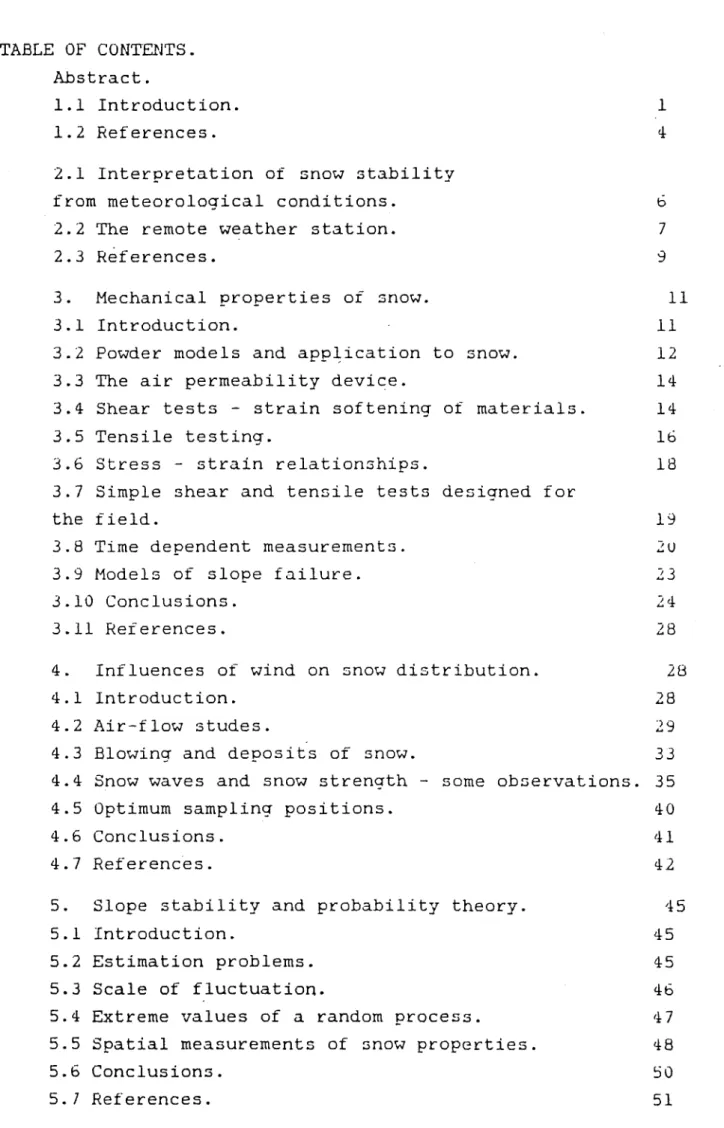
TABLE OF CONTENTS.
Abstract.
1.1 Introduction.
1.2 References.
2.1 Interpretation of snow stability
1
4
from meteorological conditions. G
2.2 The remote weather station. 7
2.3 References. 9
3. Mechanical properties of snow. 11
3.1 Introduction. ll
3.2 Powder models and app~ication to snow. 12
3.3 The air permeability device. 14
3.4 Shear tests - strain softening of materials. 14
3.5 Tensile testing. 16
3.6 Stress - strain relationships. 18
3.7 Simple shear and tensile tests designed for
the field. 19
3.8 Time dependent measurements. 2U
3.9 Models of slope failure. 23
3.10 Conclusions. 24
3.11 References. 28
4. Influences of wind on snow distribution. 28
4.1 Introduction. 28
4.2 Air-flow studes. 29
4.3 Blowing and deposits of snow. 33
4.4 Snow waves and snow strength - some observations. 35
4.5 Optimum sampling positions. 40
4.6 Conclusions. 41
4.7 References.
5. Slope stability and probability theory.
5.1 Introduction.
5.2 Estimation problems.
5.3 Scale of fluctuation.
5.4 Extreme values of a random process.
5.5 Spatial measurements of snow properties.
5.6 Conclusions.
5.7 References.
42
't5 45
45
46
'*
7 48:iO
snow.
7.
Appendices(l) Snow slope stability - a probabilistic approach.
<2>
A field test to assess snow slope stability.(3) Remote sensing of snow accumulation.
(4) Snow stability index.
(5) Air permeability as ·a textural indicator of
(6l Snow and avalanche research at Tasman Saddle - a
progress report of the winter.l984.
(7> Mountain avalanche forecasting using
meteorological data from Mt Cook village.
(8) Comparisons of weather between the Tasman Saddle
area and Mt Cook village, Winter 1982.
(9) A summary of weather and snow conditions at the
Tasman Saddle area during the winters of 1980-1982.
(10) Tasman Saddle snow studies, 1981. Insitu tests of large volumes of snow.
(ll) Tasman Saddle snow studies. 1981. Weather data
report~ winter 1981.
(12) Tasman Saddle snow studies, 1981. Air
permeability as a measure of snow structure.
ACKNOWLEDGEMENTS.
Almost all the papers and reports resulting from this
study · are jointly authored and this is a reflection of the
support I have had from many people.
Of particular note is the support of Joru1 Abraham~on Qho
firstly accepted the supervision of the project, and has since
provided positive encouragement and ideas. I am particularly
grateful to John for his perspective throughout the study.
All of the technical Gtaff of the Chemical and Process
Engineering department have at some stage been involved in
building equipment, and although much of it did not operate
for very long, it was through no fault of the manufacturing.
The continued operation of the weather station particularly is a reflection of the skill of the staff. and also Peter Squires
who with Warwick Earl and Gordon Grey designed the telemetry
link.
Friends who assisted with field measurements and made the
whole project possible include: Martin Heine. Lisle Irwin,
Barrie Thomas, Teabags, Ray Slater, Rob Young, Bert Youngman.
Digger Blue and Whist the dirty dogs quit early. Ding, Jane
Pearson, Bob Munroe, Colin and Betty Monteath, Jos Lang, Stu
Allan, Suzie Snowpit. Kevin Bochault, and Kern Johnstone. To
all these people and many others who helped along the way
thanks. '£hanks too to Tasman saddle hut who often provided
shelter from a storm.
'rhe Department of Lands and Survey \vJellington, tlew
Zealand>, University of Canterbury \Christchurch. New
Zealand>. Mountain Safety Council of New Zealand. and the Mt.
Hutt Ski Company provided financial support for the study.
Mt. Cook Airlines provided transport to the field area, and
assistance from Mt. Cook National Park staff was invaluable.
Perla Cl980) reported that in North America, approximately 10000 avalanches are reported annually to the US
Forest Service, but only about 1% of these cause structural
damage or casualties. Charlie Douglas, an early explorer in
New Zealand was quoted as saying: avalanches are like
wild. pigs they are only dangerous if you foolishly get in
their road . . . " .
In New Zealand, approximately one half of the total land
area is above tree-line in elevation, and the mountain areas
are increasingly used for recreation. Clearly, the
interaction of people and mountains poses a threat to people
from avalanches, and there is an increasing demand for safety
from this hazard both in this country and in any mountainous
country {see for example Conway,l983b and Dingwall,l976>.
Although avalanche frequency decreases rapidly with
increasing avalanche size,
triggered by people are the
relatively small avalanches
cause of most avalanche
casualties.
An
avalanche starts in the so called fracture orstarting zone. The amount of fractured snow Cie.the total
volume given by
directly related
the to
fracture the
depth and fracture area> is
influence of the avalanche.
destructive power and area of
Often the area of fractures at a
particular location is fairly uniform from one event to the
next because the surrounding topography and geometry control
the snow distribution. The change with time in the
destructive power of a particular slide path therefore depends
on the fracture depth of each event CSalm, [Buser et al.,
1985]). After flowing through the so called avalanche-path or
track, the avalanche comes to rest in the relatively flat
terrain of the run-out zone.
In a snowpack, homogeneous snow exists in layers
originating from uniform snowfall periods. The individual
layers have different physical and mechanical properties,
depending largely on a variety of meteorological conditions at
the time of deposition. The layering results in
Page 2
individual layers, or between the ground and a layer. play an
important part in snow stability, <Conway,l983a, Salm,CBuser
et al .• l985J>. Perla <1980) described a potential slab
avalanche as a relatively stiff slab of snow overlying a weak
layer tor weak interface between layersJ.
In general terms, avalanche forecasting is closely
related to weather forecasting, but release mechanisms tor
individual avalanches are still unclear. The main focus of
this study has been directed towards understanding the release
mechanisms for individual avalanches, and in particular, we
have attempted to provide some guidelines for field
measurements in assessing snowslope stability.
As previously mentioned, the· most common method of
avalanche forecasting is to interpret snow stability from past
and future weather expectations. This is also the most
indirect type of observation, and is further complicated by
mountain topography causing "local" ~...Jeather conditions which
may be significantly different from the overall weather
pattern. One aspect of our work has been to develop and build
a weather station which can be located at remote sites and
transmit weather information to a base station. We have
located such a weather station at the head of the Tasman
glacier \2320m asl) in the Mount Cook National Park, and
information about windspeed, wind direction. air temperatures
and snow accumulation is transmitted to the Mount Cook village
some 35kms away. rrhis information provides a pm.;rerful input
to the avalanche forecast which is compiled daily at the Park Headquarters.
In an effort to understand bonding mechanisms. snow
structure and time dependent properties of snow, we built four instruments:
(a) simple shear and tensile testing equipment.
(b) an air permeability device which we found gave a good
indication of snow crystal structure. We are still unclear
how this measurement relates to snow strength <see Conway and
Abrahamson,l982b,l984b).
plates to a sample of snow and applied traction across the
sample. We could also measure strain and a good estimate of
strain-rate across a sample with this instrument <Conway and
Abrahamson,l982a).·
(d) a strain gauge designed to be used
with the simple shear tests <described
Abrahamson,l984c) and which gave a measure of
across a snow sample.
in conjunction
by Conway and
shear strains
These instruments are described in more detail in
subsequent sections.
The most direct method of predicting avalanches involves
measurements related to mechanical strength. In order to
provide some guidelines for field observations regarding
snowslope stability we developed field tests which measured
shear and tensile strengths in a way which we thought
simulated conditions in
Abrahamson,l982a,l983,1984a).
a snowpack
We have made
<see Conway
these types
and of measurements across and down the boundaries of some avalanched
slopes <often slopes we had released ourselves>, at the head
of the Tasman glacier.
Because only a few tens of measurements of various snow
parameters <in particular those related to strength> can be
made in a practical time, and because there is an inherent
variation in the measured values, we have chosen to model a
snowslope by applying probability theory to a capacity/demand
(or limit equilibrium) approach. By using simplified models,
we can relate the measurements made in the· field to slope
stability. These methods and models are discussed more fully
in a subsequent section and also in Conway and Abrahamson
(1985).
We think wind transport and wind deposition of snow may
cause much of the variability of strength we have measured in
snowpacks. Section .4 includes some measurements and
Page 4
During studies at Mount Cook, we recorded snowpit
stratigraphy (including crystal type, hardness, particle
diameter, snow temperatures and density> at many sites and
some of these are summarised in the appendices. Because
neither the mechanics of metamorphic processes nor the
dependence of snow strength on snow morphology are known
quantitatively, these measurements are only indirectly useful
in assessing snowslope stability. Also recorded in the
appendices are some of our reports and papers resulting from
the study.
1 • 2 REFERENCES .
Buser, 0., Fohn, P., Good, W., Gubler,H., and Salm,
B.:Cl985) "Different methods for the assessment of avalanche
danger". Cold Regions Science and Technology, Vol.lO,
pl99-218.
;~.;conway, H. :<1983a> "Mountain avalanche forecasting using
meteorological data from Mount Cook village". Unpublished
report.
Conway, H.:<l983b) "Aspects of avalanche forecasting in
New Zealand". New Zealand Alpine Journal, Vol.36, pl64-69.
Conway, H. and Abrahamson, J.:Cl982a) "Insitu tests of
large volumes of snow". Unpublished report.
;~.;conway, H. and Abrahamson, J. :C1982b) "Air permeability
as a measure of snow structure". Unpublished report.
*Conway, H. and Abrahamson, J.:<l983) "A summary of
weather and snow conditions at the Tasman saddle area during
the winters of 1980-1982". Unpub"lished report.
*Conway, H. and Abrahamson, J.:(l984a> "Snow stability
index". Journal of Glaciology, Vol.30, No.l06, p321-327.
;~.;conway, H. and Abrahamson, J.:<l984b> "Air permeability
as a textural indicator of snow". Journal of Glaciology,
Vol.30, No:106, p328-333.
;~tConway, H. and Abrahamson, J.:Cl984c> "Snow and avalanche research at Tasman saddle - a progress report of the winter 1984.
*Conway, H. and Abrahamson,
stablity- a probabilistic approach". Glaciology.
J.:<l985> "Snow slope
Dingwall, P.R.:<l976> "Coping with the avalanche hazar-d
in New Zealand". New Zealand Alpine Jour-nal, Vol.29, p77-83.
Perla, R.I. :(1980) "Avalanche release motion and impact".
In Dynamics of Snow and Ice Masses, <S.Colbeck, ed.), chapter
1, p397 -462, Academic Press, New York.
f<Young, R., and Conway, H. ,:(1983> "Compar-isons of
weather between the Tasman saddle area and Mount Cook village
-winter 1983". Unpublir>hed repor-t.
1t References marked thus are included in the appendices of
2.1 INTERPRETATION OF SNOW STABILITY FROM ME.TE0lWL0GlCAL
CONDITIONS.
Snow stability is directly related to past and present
meteorological conditions,
formulated by combining this
weather forecasts. Buser
and often avalanche forecasts are
past information with future
et al.<l985) reviewed different
metnods for the assessment of avalanche danger and emphasised
the problems of attempting to forecast avalanche occurrence
using weather forecasts. Weather is strongly influenced by
topography, and so mountains will cause weather conditions to
vary considerably both with time and location. 1~is makes it
difficult to forecast for specific locations from another
location, especially as rapid changes of factors such as
temperature, precipitation, wind speed and direction, may also
occur during a storm affecting precipitation rates and crystal
morphology. The added uncertainty of the relationship between
snow strength and snow morphology is considered in a later
section.
Young and Conway ll983> compared weather data recorded at
the head of the Tasman glacier with that observed at Mount
Cook village. They compared daily windruns, precipitation and
temperatures and found poor correlation between the sets of
data. Furthermore, Conway and Abrahamson <1983> for different
locations on the Tasman neve, mea:Jured snow accumulation
variation of factors up to 2.5 within an area of 100m 2 ,
depending mainly on the aspect of the slope and the prevailing
wind direction.
uneven snow
Meister,l983).
It is well known that mountain ridges cause
distribution <see for instance, Fohn and
However, because snow avalanches commonly involve failure
of the more recent snow layers, and typically occur in
response to a storm period of heavy precipitation, snow
stability assessment using meteorological data is a
reasonable, although indirect method of general forecasting.
Conway ll983a> noted that tor a more specific assessment of
slope stability, fairly continuous weather measurements
improve a forecast.
2.2
THE REMOTE WEATHER STATION.
To fulfill this requirement we designed and built a
weather station. Several conditions were imposed on the
design of the instrument:
(a) i t needed to make measurements of Jneteorological data
which could be used for avalanche forecasting, and allow
immediate access of the data.
Cb> it needed to be semi-portable for two reasons tll
access to the Tasman neve is generally by ski-equipped
aircraft or helicopter, and so the weather station needed to
be easily dismantled for transportation by these means; l l l
because the Tasman neve is a zone of snow accumulation,
periodically the weather station would need to be dug out of
the snow and raised. Typically two people would be available
for this task, so we required that the instrument be capable
of being shifted at least short distances by two people.
(c) it needed to be robustly built to withstand extreme
weather conditions such as temperatures of -l5°C, blowing
snow, and hourly average wind-speeds of up to 180kmthr.
<d) it needed to be able to operate using a battery power supply.
(e) it needed to have low cost.
We mounted the weather recording instruments on a tripod
made from 50mm diameter aluminium tubing. Each leg could be
unscrewed into two sections, each 1.5m long and a 400mm diam
plate was attached at the base of each leg to anchor the
tripod base to the snow (see plate ll.
Air temperature was measured by a downward pointing
thermocouple. We found it necessary to shield the
thermocouple from heating by radiation, and so the
thermocouple was mounted within a white open ended double
tube, which also allowed free air circulation. This double
tube also swung on a bearing about the thermocouple, with a
In order to make measurements of new sno~ depth
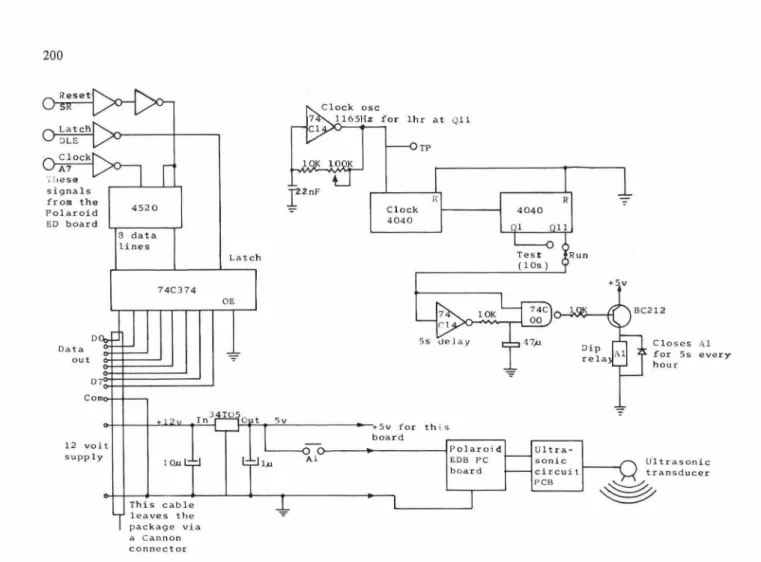
increments, we adapted a Polaroid ultrasonic rangefinder. The
modifications and design of the instrument are descibed by
Earl et al.(l985). By mounting the instrument at the top of
the tripod we could measure the distance to the snow surface.
During times of storms or blowing snow, a scatter of data was
recorded either because of reflection of the signal off
drifting snow between the sensor and the ground, or because
the wind increased the length of the signal path. 1he scatter
enabled us to determine the duration of the storm, and at the
end, a measure the new increment of snow was available. It is
possible that further information such as fluctuations in
transport rates could be obtained from the scatter of the
depth data during storms.
Windspeed was measured using a robust
anemometer which gave an electrical count.
built a wind direction vane which was mounted
Munroe cup
We designed and
on a viscous
damped oil bearing within 16 reed switches arranged to give a
step-wise resistance read-out.
A 12 volt lead acid battery with high specific gravity
acid was used as a power supply and kept charged with a solar
panel capable ot charging about 600mA at 16v. Because the
instrument shuts down between transmissions~ this power supply
has been found to be sufficient.
Ini ti·ally the information was recorded on a small data
logger (built by Solid State Equipment Ltd., NZ>, which was
left at the tripod. This was unsatisfactory for several
reasons: (a) the information was only available after the
data had been retrieved from the memory <using a magnetic tape at the site> and then processed on a computer in Christchurch. This meant the information was not readily available each day;
(bl the data records were often not continuous, and we suspect
that either static electricity (which is common during
conditions of blowing snow) erased the memory of the data
logger, or the retrieval of the data onto the tape was not
Page '::1
For the winter of 1985, a telemetry system capable ot
transmitting via the normal voice-link radio network already
installed throughout the Mount Cook Park, was designed by
Peter Squires <Department of Electrical Engineering,
University of Canterbury), and this enabled transmission of
the data to the Mount Cook village. The information at
present is recorded on hard copy and used for input for the
local avalanche forecast which is compiled daily. The
information is also relayed daily to the Meteorological
department at Christchurch airport and used by Mt. Cook
Airlines for assessing flying conditions. 'rhe station can be
programmed from the base to transmit at intervals varying from 1 to 60min but the faster rate of transmissions may be limited by the available power supply.
Further refinements to the weather station might include: (a) storage of the data on a disc at the base station to enable further processing and analysis of the data.
<b> other instrumentation such as humidity, solar
radiation, or a measure of snow drifting rates may be useful.
(c) a measure of the minute by minute fluctuations or
standard deviations associated with each measurement would be valuable.
(d) although icing and riming of the instrument is not a
bad problem at the Tasman neve location, at some locations
this could be a problem. 1~e usual way of de-icing is by
providing propane, electrical heaters or using an anti-freeze
fluid.
All of these modifications would add to the power
requirements and cost of the instrument.
2. 3 REFERENCES.
Buser, 0., Fohn, P., Good, W., Gubler,H., and Salm,
B.:<l985) "Different methods for the assessment of avalanche
danger". Cold Regions Science and 'l'echnology, Vol. 10,
pl99-218.
~Conway, H. :(1983a> "Mountain avalanche forecasting using
meteorological data from Mount Cook village". Unpublished
"'-Conway, H. and Abrahamson, J.:(l983) "A !3ummary ot
weather and snow conditions at the Tasman saddle area during
the winters of 1980-1982". Unpublished report.
"'=Earl, W.M., Grey, G.R., Conway, H. and
J.:(l985) "Remote sensing of snow accumulation".
Science and Technology, Vol.ll, pl99-202.
Abrahamson .•
Cold Regions
Fohn, P.M.B. and Meister, R.:tl983l "Distribution ot
snow drifts on ridge slopes: measurements and theoretical
approximations". Annals of GlaciolOg'".f, Vol. 4, pS2-S "J.
"'=Young, R., and Conway, H.:(l983) "Comparisons of weather
between the Tasman saddle area and Mount Cook village - winter
1983". Unpublished report.
3. MECHANICAL PROPERTIES OF SNOW.
3.1 INTRODUCTION.
For understanding avalanche release mechanisms, we are
particularly interested in those properties of snow which
might be related to snow strength and, for practical use,
those which can be easily measured in the field.
On a microscopic scale, these properties can be
characterised by snow grains tshape, dimensions, orientation
of the crystals.), the mean number of bonds per grain, and the
spatial arrangement of chains formed by ·several grains.
Measurements commonly made in the field include snow depths,
density, relative hardness, snow temperatures, grain diameter
and type, and an assessment of the degree of bonding between,
as well as with~n, layers.
LaChapelle and Ferguson tl980) gathered snowpit
information from various locations, and then asked several
different avalanche forecasters to make an interpretation of
the snow stability. Their study emphasised the subjective
nature of stability assessment, and they suggested that a
better quantitative definition of the parameters related to
snow stability would improve stability evaluation. ~ost
techniques developed recently to describe snow structure rely
on thin section analysis. For example, methods developed by
Good tl975) and Kry (1975a,l975b) provide an insight into
bonding mechanisms and snow structure but are difficult to
perform in the field. One measure which can quantify snow
structure somewhat is that of air permeability. We designed
and built an air permeability device for use in the field which is discussed later.
Sommerfeld <1973,1974,1980) and Gubler <1978a,l978b>
described snow strength using statistical models by
considering the snow bonds to consist of either <a) elements
of.force conducting material in series <Weibull theory> or <b)
elements in parallel <Daniels theory>. For snow Sommerfeld
suggested that a combination of these models would be
properties tin particular strengths/ from strength tests made
on small samples. We wanted to make strength measurements in
the field on relatively large samples of snow with minimum
sample disturbance. We also wanted to simulate as closely as
possible the stress conditions which occur in the snowpack.
Our tests are described later in this section.
3.2 POWDER MODELS AND APPLICATIONS TO SNOW.
Bonding forces acting between contacting particles cause
cohesive behaviour of solid materials. Molerus tl982)
described the simplest model for a cohesive material. If a
sample is subjected to a sliding stress S, and normal stress
a, over an area A, then for slip within the material (assuming
Coulomb friction), the limiting equation is:
~
=
tanp=
Sl<a+T0> <l>for the coefficient of friction l-1 and the angle of
friction p respectively. T
0 is the isostatic tensile force
and represents the cohesive forces acting at the contacts of
the powder when it is unconsolidated.
Combination of the slip equation <eqn.ll with the Mohr
circle representation of stress, yields the condition that
slip will occur if the largest Mohr circle touches the yield
locus.
Often the cohesive forces T0 are not constant but depend
on the previous compressive normal force. The behaviour of a
bulk powder can be described by three parameters: (althe
adhesive force T0 at the contacts in an unconsolidated powder,
(b)a constant K, which describes the increase in adhesive
forces between particles due to consolidation, and <c)the
angle of internal friction p, which describes the frictional
behaviour at inter particle contacts. A family of yield loci
can be experimentally derived at different consolidation
forces for a particular powder.
Under normal conditions, particularly for fine-grained
materials, van der Waals forces dominate bonding between
particles. However, several other factors may contribute to
the adhesive forces <Molerus, 1982>: tl) solid or liquid
Page 13
the melting point of the material, <3> electrostatic forces.
The different bonding mechanisms and the fact that the
shear may not be strictly according to the Coulomb
approximation (there also may be bulk volume changes see fig.
3.1), cause the yield locus to be non-linear for most
materials. Furthermore, it is easy to see how conditions
within a powder may change with time and the yield locus can
be thought of as time dependent. Non linearity of the yield
locus for snow was particularly evident in the ·measurements
made by Haefeli [Bader et al.,l954J. Many laboratory studies
note the change of strength of snow with time and also changes
of characteristics with test rate during the experiment (for
example, Singh and Smith,l980 and Narita,l980,1983 making
tensile tests, and McClung,l977 and de Montmollin,l982 making
shear tests). Most snow is relatively compressible and close
to its melting point so such behaviour is not unexpected.
I I Ill
----1 I I I I
111111--Pure coulomb friction without volume change.
I I I I I
I I I I I I
Homogeneous shearing throughout the
sample.
A combwation of coulomb friction rmd volume changes.
f'ig11re .r 1.
It is well known that the strength of a material of the
same chemical composition increases as the grain size
decreases. Load is transmitted through bonds between grains,
and the number of contacts between grains increases for
materials of smaller size. Perla and Martinelli <1976> also
note that snow consisting of large sized crystals fails more
easily than snow consisting of small sized crystals .
3.3 THE
AIR PERMEABILITY DEVICE.Measurements of air permeability of snow were first made
by Bader [Bader et al.,l954J. He thought because air
permeability was related to the void space and structure, it
might give an unambiguous measure of some snow properties. We
also thought it might be well correlated with tensile strength
and strain history so we designed and built two air
permeability devices. These two devices together with our
measurements are discussed fully in Conway and Abrahamson
(1982b,l984b). In these papers we concluded that air
permeability gave a useful indication of snow texture, but the
relationship with our strength measurements was less clear.
In general terms, we found that a dec~ease of air permeability
over a period of time on similar snows was a stabilizing trend
(due to formation of bonds and a tendency to equilibrium
crystal forms), and an increase of air permeability over a
period of time was indicative of decreasing stability (either
due to bond elongation and stretching from tensile strain,
and/or kinetic growth of crystals>.
3.4 SHEAR TESTS - STRAIN SOFrENING OF MATERIALS.
Schwedes <1975) noted that most shear tests made on
materials are a combination of: (a) pure Coulomb friction
with no volume change;
throughout the sample
fig.3.l).
(b) homogeneous shear which occurs
together with volumetric changes <see
Schwedes also showed using a tri-dimensional condition
diagram <derived by Roscoe) that a "critical state" line
exists which divides the states of a material into two
regions: "looser than critical" or unconsolidated, and
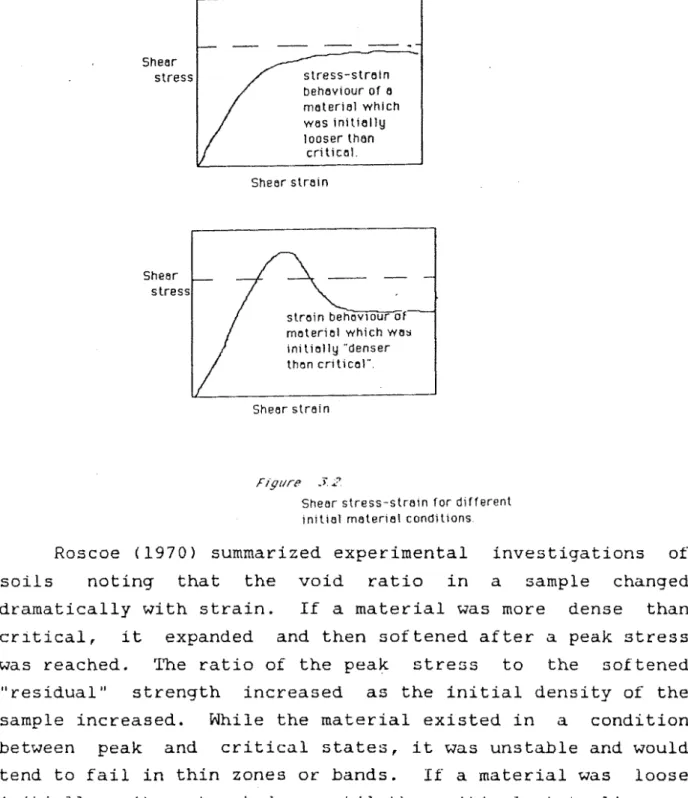
Page 15
vs shear strain graph for the conditions is shown in fig.J.2.
Shear stress
Shear stress
- - - 4
behoviour or a material which was initially looser thon
criticaL
Shear strain
moteriol which wo~
ini liolly .. denser thon criticol".
Sheor strain
Fig lire 3'.:.?.
Sheor stress-stra1n for different initial materiel conditions
Roscoe (1970) summarized experimental investigations of
soils noting that the void ratio in a sample changed
dramatically with strain. If a material was more dense than
critical, it expanded and then softened after a peak stress
was reached. The ratio of the peak stress to the softened
"residual" strength increased as the initial density of the
sample increased. While the material existed in a condition
between peak and critical states, it was unstable and would
tend to fail in thin zones or bands. If a material was loose
initially, it contracted up until the critical state line was
reached and then the sample would continue to undergo shear
distortion without further changes of density or stress.
Skempton <1985) suggested that the post peak drop in the
shear strength of some <drained> over-consolidated soils could
be thought of as occurring in two stages: <1> the drop to the.
critical state strength <with associated material dilatancy);
strength drops to a residual value.
Experiments by McClung <1977) showed that snow also could
exhibit both types of behaviour, and suggested that the
softening characteristics depended not only on whether the
sample was initially more or less dense than critical but also
on the rate of loading. We also measured such behaviour in
tests of snow shear strength, and these measurements are
recorded in Conway and Abrahamson <1984c>.
Palmer and Rice <1973> first modelled the progression of
a shear failure in a thin band by equating the gravitational
work input from the slab when extending the band, with that
required to deform the material in the slab plus the
frictional losses. McClung <1979a> applied these fracture
models to snow, and although he did not deal with the
initiation of the shear fracture, he showed how a failure
might progress at stresses less than peak values. We think
these concepts are particularly important when considering
failure progression through a snow slab <Conway and
Abrahamson,l985). Some of our strain softening measurements
as well as our simple shear tests are discussed later.
3.5 TENSILE TESTING.
The fracture face of a tensile fracture is not plane, but
rather follows the surface of the particles where the forces
of adhesion have been exceeded by the tensile stresses in the
sample. These adhesive forces have different values at
different elongations for almost every material, and for
fine-grained particles, the ratio of the maxima of the
force/elongation curves at different strains can be as much as 100:1.
Schubert <1975) outlined various models for tensile
failure of materials with inter-particle forces at contact
points. These models related tensile strength to factor~ such
as density, porosity, particle s~rface area, inter-particle
forces, particle diameter, and other form fitting parameters,
many of which were difficult to measure and quantify.
Materials which have other bonding mechanisms may require
Page 1/
Two common methods of testing tensile strengths of
powders are: <a> the adhesive method in which two end plates
are bonded to the sample and then pulled apart; <b) the split
plate or traction table method.
Of particular interest is the split-plate method of
tensile testing because this method closely resembles
conditions that might apply in a snow slab overlaying a thin
weak layer (see fig. 3. 3) .
top end of o
boso l weok l oyer.
F!gtlre .r .r Spllt-plote method of tensile testing end e snow slob overlying e week Ioyer in o snowpock.
Split-plate method or tensile testing.
snow slob under grovltotionol loading
~
Schubert (1975) measured the dependence of tensile
strength on the height of the sample. Because a powder may
deform in shear, the tensile strain would be greatest in the
vicinity of the slit in the plate and would decrease towards
the surface of the material. For large sample depths, the
tensile stress would decrease near the surface. Part of the
sample above a certain height, therefore has lower than
breaking stress values when the lower material breaks. As the
height of a sample increased, Schubert found smaller tensile
found for a particular height, the ratio of the measured to
actual value of strength depended on the elastic and plastic
behaviour of the material and the conditions of cohesion
between the material and the supporting split-plate.
Applying these arguments to snow slabs, we would expect a
deep slab to fail at lower apparent values of tensile strength
than those expected for that area. Also, since a snow slab
consists of layers of different types of snow <and varying
Young's modulii), the stresses would be concentrated in layers
which were <a> close to the basal weak layer, and <b> of high
Young's modulus.
3.6 STRESS-STRAIN RELATIONSHIPS.
Schubert (1975) used a model of spheres to describe a
stress/strain relationship in powders, and noted that for most
agglomerates the strains at failure <defined to be the
position the stress-strain curve became unstable> were usually
quite small (order of l0- 3
>.
For dry powders and agglomerateswith solid bridges, the strains may be even smaller. For all
but the slowest strain-rates, Narita <1980> found the tensile
stress of snow became unstable after strains of about 0.5-1%.
Because of the sensitivity of powders, including snow, to
small strains, we suspect minor disturbances may cause at
least local ruptures in snow slabs.
Schubert et al., <1975) found that if the fracture strain
(ie. the strain at maximum load> was small~ a powder would be
more sensitive to cracking than materials which exhibited
large fracture strains even though both may have the same
tensile strength. They suggested that knowledge of the strain
behaviour helped clarify the various bonding mechanisms within
the powder. For example, dry powders have a markedly smaller
fracture strain than moist powders <with liquid bridges> and
tend to exhibit brittle behaviour. Furthermore, under
conditions of loading and unloading, they observed hysteresis
of the tensile stress-strain curve. It followed that
deformation even at the start of stress was not purely elastic
but also had a plastic component. Brown et al.Cl973>
Page 19
torsional stresses.
Although some stress strain measurements have been made
in the laboratory, little is known about strain-rates
applicable during slab failure. In an attempt to gather more
information about such rates, we built a strain gauge similar
to that described by Sommerfeld (1975,1979>, and this is
discussed later.
3.7 SIMPLE SHEAR AND TENSILE TESTS DESIGNED FOR THE FIELD.
LaChapelle and Ferguson <1980) found that identification
of potential sliding surfaces from inspection of snowpit
stratigraphy was often based on subjective judgement. Because
most slab failure models assume a weak basal layer
<Perla,l980), a method of finding such weak layers and
assessing their strength would be a primary consideration for
stability predictions. A shear frame first used by Roch
<1966> has been used by many to study the strength ot layers,
but this technique relies on the operator either identifying
the weakest lay~r, or finding the layer by many trials. A
tilt test described by Perla and Martinelli tl976) in which a
snow sample is tilted until failure occurs somewhere within
the sample, overcomes this problem. However this cannot be
easily applied in a snow slab because of the difficulty in
placing a sample on the tilting surface without disturbance.
The "shovel test" is a popular field technique for finding
potential sliding surfaces (see Sommerfeld,l984). The "wedge
test" developed by LaChapelle and Ferguson <1980), used a
technique similar to that incorporated in the ram penetrometer
to drive a wedged-shaped block behind a column of snow to
transfer compressive stress to the block, and hence shear
stress along different layer surfaces. The wedge appeared to
quantify the shovel test somewhat.
Our shear tests were designed to simulate stress
conditions that might occur in a snow slab and are fully
described in Conway and Abrahamson<l984a,l985). The shovel,
wedge and our shear tests have advantages over other tests in
that <a> the normal loading conditions on a particular slope
snow st~atigraphy is not required, and
they exist> are easily identified.
the weak layers <if
However our test did
subject the snow to a bending moment which would not normally
occur under natural loading.
The strength of the slab overlying the weak basal layer
is often not considered in field tests of snow stability. Our
simple tensile tests were designed to attempt to simulate
conditions which might occur in a snow slab~ and are discussed
in our papers Conway and Abrahamson<l984a,l985). In these
papers we have discussed the importance of viewing these
measurements as strength indices rather than absolute values,
because of factors such as; <a> the rate of strain during an
avalanche may be quite different to the rate during the test,
and Cb} size effects of the test compared with the scale of
the avalanche as discussed by Sommerfeld<l980) or
Gub 1 e r ( 19 7 8b ) .
We also found considerable spatial variability in the
values of the measurements and this is discussed in more
detail in a later section as well as in Conway and Abrahamson
(1984,1985). Sommerfeld Cin prep.> has also recorded spatial
variability of shear strength measurements.
3. 8 TIME DEPENDENT MEASUREMENTS.
A> Strain measurements over a slab.
Sommerfeld (1979) measured strain rates in a snowpack
near an avalanche starting zone. Using a 3m strain gauge, he
measured between two positions straddling the eventual
fracture, sharply increased strain rates for almost 5 hours
preceeding an avalanche, and suggested that this could be used
as an indicator of instability. Strain rates thus measured in
the field were about 1.5 orders of magnitude lower than those
measured by Narita (1980), using samples 125mm long in the
laboratory. Because of this, Sommerfeld suggested that the
strain might be concentrated and that snow fails over
localised areas. This proposal is also supported by the
laboratory measurements made by Singh and Smith Cl980) and
Page 21
Another explanation might be that discussed earlier in
which strain in the slab would be unevenly distributed, and
most likely concentrated near the shear layer \about 0.44m
below the strain gauge used by Somrner:·feld during his
measurements>.
In order to further investigate some of these properties,
we built a strain gauge similar to that built by Sommerfeld
(1975,1979>. By measuring change in resistance of a
potentiometer with movement, we planned to estimate strains
and strain rates on a snow slab. We found that a rotary
wire-wound potentiometer was not sufficiently accurate to
measur~ the expected magnitude of strain rates in a slab of
snow <l0- 6 to 10- 4 per hour) and so we used a linear
potentiometer made from conducting plastic with a total travel
of 75mm. At no time were we able to locate the instrument on
an unstable slope during critical periods, and we were wary of
leaving the in!3trument on slopes during storms. 'I'ypically
high snow accumulation occurs with each storm period and so
the likelihood of losing the instrument was high, because
often during storms it was not possible to visit the slopes.
We also found, especially for low density snows and over long
periods of time <hours>, the pads attaching the instrument to
the snow would creep, thus masking the creep we were trying to measure.
B) Shear stress-strain measurements.
Because of the difficulties described above in obtaining
strain measurements on slopes, we decided to apply a .shear
stress to a large sample (300mm x 300mm> and measure the shear
strain. 'rhe methods are described in Conway and Abrahamson
(l984c>, together with some measurements made. We had no
control over strain rate, and the stress was applied using a
calibrated spring over a period of 5-10 seconds. Because the
spring did not unload immediately after small displacements,
we could not use the device to measure stress/strain
characteristics after peak stresses had been reached. We
could however measure the residual strength by disconnecting
the strain gauge and further stressing the sample <see Conway
test was that we could not separate the component of shear movement in the weak layer from that due to the deformation of
the slab. Slab deformation may be small in hard slabs, but
measurements of the slip at the weak layer may be masked by
deformation of the slab especially in soft slabs.
We think shear strain softening of snow (measured by
McClung,l977, and Conway and Abrahamson,l984cJ, might control
propagation of failures during avalanche events, and so we
developed a further simple field test to measure the peak and
residual shear stresses. The technique <described in Conway
and Abrahamson,l984c> was to first stress the sample to
failure using the frame, and then repeat the test <with the
same sample>. It was assumed that the first stress value
might be an indication of average normal strength and the
second, a residual strength index.
As with the
considered, but
<1984c) suggest
other tests, rates of failure were not
measurements tabled in Conway and Abrahamson
that different crystal structures exhibit
different degrees of strain softening, and probably the degree
relates to the strength of the initial bonds (ie. either over
or under consolidated). For instance some new,
. 3
unmetamorphosed, low density <50 kg/m ), snow did not strain
soften, while some graupel crystals were observed to soften to
a value of 12% of the average normal value. 'I'his
consideration plays an important role in our criteria for
propagation of failure in assessment of slope stability from
field tests and is discussed in a later section and in Conway
and Abrahamson <1985).
C> Tensile stress-strain measurements.
In 1981 we built a tensile tester theoretically capable
of straining large samples of snow <up to 300x300x600nunl. For
various reasons we have had only limited success in obtaining
measurements using the tester, and some of these reasons are
discussed by Conway and Abrahamson <1982a>. Probably the
major limitation when using the device was the lack of control over environmental conditions, especially for those tests over
Page 23
often meant that creep near the end plates contributed
significantly to our measurements of strain, and wind
frequently eroded our samples. We have described some
measurements made with the device, but we have only managed to
complete a few tests which we can regard as successful <see
Conway and Abrahamson,l982a>. We do not draw any conclusions
from these tests concerning tensile stress-strain
relationships, but further tests with this instrument would be possible if made in a colder environment or a cold laboratory.
3.9 MODELS OF SLOPE FAILURE.
Typically, failure criteria are formulated in terms of
maximum stress, strain or energy capacities of a material.
However it is well known that for most engineering materials,
the tensile stresses required to cause a fracture by crack
propagation are very much smaller than the ultimate tensile
strength of the material. In order to improve a fracture
model, materials are often considered to contain flaws at
which stress concentrations occur. A failure criterion may be
based on a comparison of the yield strength and the maximum
stress calculated at the tip of a crack, or more commonly, a
balance of energy requirements and energy released during
extension of a crack. Such models can be fairly easily
extended to materials exhibiting plastic as well as elastic
behaviour, and for complex stress fields or inclined cracks
(see for example, Jayatilaka,l979 or Liebowitz,l97l).
McClung <1979a) modeled propagation of a basal shear
crack in snow using these concepts and there is good evidence
of tensile modes of failure in snow. Narita (1980,1983)
observed cracking in laboratory tensile tests, and we have
observed tensile cracking in natural snow packs. Furthermore,
strain-rates measured by Sommerfeld (1979) in the field just
prior to an avalanche, were much lower than those required to
fracture laboratory samples which suggests strain was
concentrated over small regions. For these reasons, we think
a model which considered the extension of cracks or flaws
could be usefully applied to failure of snow slabs <a tensile
3.10 CONCLUSIONS.
The material discussed above outlines some of the
difficulties in measuring <and applying) strengths of snow in
the field. In applying these strengths to snow slope
stability, we have used methods to determine average stresses,
and then considered equilibrum conditions around a snow slice
(see Conway and Abrahamson,l985). It is clear that any model
of failure would be greatly improved by knowledge of
relationships between stress, strain and strain-rates. If
characteristics of snow properties which vary with time,
stress history and strain-rates can be determined with simple
measurements in the field, and then related to rates of
failure and stress history on slopes, the stability estimate
would be greatly improved.
3 . 11 REFERENCES .
Bader, H., Haefeli, R., Bucher, E., Neher, J., Eckel, 0.,
and Thams, Chr.:<l954) 'l'ranslation: In ''Snow and its
metamorphism", 313pp, illus. Snow, Ice and Permafrost Res.
Estab., Trans!. 14. Corps Eng., U.S. Army, Wilmette, Ill.
Brown, R.L., Lang, T.E., St. Lawrence, W.F. and
Bradley, C.C.:(l973) "A failure criterion for snow". J'ournal
of Geophysical Research, Vol.78, No.23, p4950-58.
Buser, 0., Fohn, P., Good, W., Gubler, H. and Salm,
B.:(l985) "Different methods for the assessment of avalanche
danger". Cold Regions Science and Technology, Vol. 10,
pl99-218.
Conway, H.:(l984d) "Variations of basal shear strength".
The Avalanche Review,Vol.3, No.1, p5.
Conway, H. and Abrahamson, J. :<l982a) "lnsitu tests of
large volumes of snow... Unpublished report for Mountain
Safety Council.
;A:Conway, H. and Abrahamson, J.:(l982b) "Air permeability
as a measure of snow structure". Unpublished report for
Mountain Safety Council.
,.~:conway, H. and Abrahamson, J.:<l983> "A summary of
weather and snow conditions at the Tasman saddle area during
the winters of 1980-1982". Unpublished report for Dept. of
Page 25
1<Conway, H. and Abrahamson, J.:<l984a) "Snow stability
index". Journal of Glaciology, Vol. 30, No. 106, p321-7.
1-:Conway,
H.
and Abrahamson, J.:<l984bl "Air permeabilityas a textural indicator of snow". Journal of Glaciology, Vol.
30, No. 106, p328-33.
1<Conway,
H.
and Abrahamson, J.:(l984c> "Snow andavalanche research at Tasman saddle - a p~og~ess report of the
winter 1984". Unpublished ~eport for Dept. ot' Lands and
Survey.
1-:Conway, H. and Abrahamson, J.:(l985) "Snow slope
stability a probabilistic app~oach". Submitted to Jou~nal
of Glaciology.
Fohn, P.M.B. and Meiste~, R.:<l983) ':Distribution of
snow drifts on ridge slopes: measurements 'and theo~etical
approximations". Annals of Glaciology, Vol.4, p52-57.
Good, W.:(l975) "Numerical parameters to identify snow
structure". IAHS-AISH publication No.ll4, p91-102.
Gubler, H.:(l978a) "Determination of the mean number of
bonds per snow grain and of the dependence of the tensile
strength of snow on stereological parameters". Journal of
Glaciology, Vol. 20, No. 83, p329-34l.
Gubler, H.: ( 1978b > "An alternate statistical
interpretation of the strength of snow". Journal of
Glaciology, Vol. 20, No. 83, p343-357.
Jayatilaka, A. de S.: ( 1979) In "Fracture ot- Engineering
Brittle Materials". Applied Science Publishers Ltd. London.
Kry, P.R. :(1975a) "Quantitative stereological analysis of
grain bonds in snow". Journal of Glaciology, Vol. 14, No.
72, p467-477.
Kry, P.R.: (1975b) "The relationship between the
visco-elastic and structural properties of fine-grained snow".
Journal of Glaciology, Vol. 14, No. 72, p479-500.
LaChapelle, E.R. and Ferguson, S.A.:<l980) "Snowpack
structure: stability analysed by pattern-recognition
techniques". Journal of Glaciology, Vol.29, No.94, p506-5ll.
Liebowitz, H.<editor):(l971> In "Fracture- an advanced
treatise" Vol.3, Academic Press, New York.
McClung, D.M. :<1977) "Direct simple shear tests on snow
Glaciology, Vol. 19, No. 81, plOl-109.
McClung, D.M.:(l979a> "Shear fracture precipitated by
strain softening as a mechanism of dry slab release". Journal
of Geophysical Research, Vol. 84, No. B7, p3519-3526.
McClung, D.M.:<l979b) "In-situ estimates of the tensile
strength of snow utilizing large sample sizes''. Journal of
Glaciology, Vol. 22, No. 87, p321-29.
Mellor, M.:(l975) "A review of basic snow mechanics" IAHS
AISH Publ. 114, p251-291.
Molerus, 0.:(1982) "Invited Review: Flow behaviour of
cohesive materials". Chern. Eng. Commun. Vol.lS, p257-289.
Montmollin,
V.
de:<l982> "Shear tests on snow explainedby fast metamorphism". Journal of Glaciology, Vol. 28, No.
98, pl87-198.
Narita, H.:<l980) "Mechanical behaviour and structure of
snow under uniaxial tensile stress". Journal of Glaciology,
Vol 26, No. 94, p275-282.
Narita, H.: <1983) "An experimental study on tensile
fracture of snow". Contrib. No.2625 from the Inst. of Low
Temp. Science, Series A, No.32, Hokkaido Uni., Sapporo,
Japan, pl-37.
Palmer, A.C. and Rice, J.R.:<l973> "The growth of slip
surfaces in progressive failure of ovet-consolidated clay''.
Proc. Royal Society London, Ser. A, No. 332, p527-548.
Perla, R.I.:(l980) "Avalanche release, motion and
impact". In Dynamics of Snow and ;Lee Masses, <S. Colbeck,
ed.), Chapter 7, p397-462, Academic Press, New York.
Perla, R.I., and Martinelli Jr., M. :<1976) "Avalanche
Handbook" US Department of· Agriculture Forest Service.
Agriculture Handbook No.489.
Roch, A.:<l966> "Les decenchements d'avalanches".
International Symposium of Scientific Aspects of Snow and Ice
Avalanches. International Association of Hydrological
Sciences Publication, No. 69, pl82-195.
Roscoe, K.H.:<l970> "The influence of strain in soil
mechanics". Geotechnique, Vol.20, pl29-170.
Schubert, H.:<l975) "Tensile strength of agglomerates",
Powder technology, Vol.ll, p.l07-119.
Page 27
"Deformation behaviour of agglomerates under tensile stress". Powder Technology, Vol.ll, pl21-131.
Schwedes, J.:<l975) "Shearing behaviour of slightly
compressed cohesive granular materials". Powder technology,
Vol.ll, p59-67.
Singh, H. and Smith, F.W.:ll980) "Constant strain-rate
tensile testing of natural snow tabstractl". Journal of
Glaciology, Vol.26, No.94, p519.
Skempton, A.W.:<l985> "Residual strengths of clays in
landslides, folded strata and the laboratory". Geotechnique,
Vol.35, No.1, p3-l8.
Sommerfeld, R.A.:<l973> "Statistical problems in snow
mechanics". U.S. Dept. of Agriculture, Forest Service
General Report, RM-3, p29-36.
Sommerfeld, R.A. :(1974) "A Weibull prediction of the
tensile strength-volume relationship in snow". Journal of
Geophysical Research, Vol. 79, No. 23, p3353 3356.
Sommerfeld, R.A. :(1975) "Continuous measurements of
114,
deformations on an avalanche slope",
<Snow mechanics symposium, 1974>, p293-7. Sommerfeld, R.A.:(l979> "Accelerating
an avalanche". Journal of Glaciology,
p402-404.
IAHS-AISH, No.
strain Vol.
preceeding
22, No. 87,
Sommerfeld, R.A.:<l980> "Statistical models of snow
strength". Journal of Glaciology, Vol. 26, No. 94,
p217-223.
Sommerfeld, R.A.: < 1984) "Instructions for using the
250cm2 shear frame to evaluate the strength of a buried snow
surface". USDA Rocky Mountain Forest and Range Experiment
Station, Research note RM-446, 6pps.
Sommerfeld, R.A.:<in prep.> "Spatial variation of shear
strengths of avalanche sliding surfaces".
4.1 INTRODUCTION.
When snow is transported by wind
transport i~ not fully developed>, it
(especially when
is well known that
complex patterns of drift occur behind discontinuities or
obstacles, between obstacles and below cliffs. Our
measurements over slopes exhibit spatial variability, not only
in depths of snow layers but also in strengths of layers and
between layers. We think the spatial variability is caused in
part by wind and wi~d redistribution of snow, and suspect a
relationship exists between the depositional characteristics
of snow and the patterns of fluctuation of the strength.
Identification of such a relationship would be a valuable tool
for characterising snow properties on a snow slope and for
subsequent slope stability estimates.
We can consider a potential slab avalanche to consist of
some relatively stiff snow layers separated by a weak layer.
We are particularly interested in ways in which the wind might
affect the stability of a snow pack. Some of these are
outlined below and discussed in more detail later:
1> Wind-transported particles are generally smaller and
more rounded than the original precipitating crystals, and so
tend to form dense well-bonded layers such as those expected
in a slab. As a result of uneven snow distribution, stress
concentrations develop may develop at positions where sharp
changes occur in the depth of the slab. If the downslope
component of the gravitatio~al load is sufficiently high, the
stress concentrations may be sufficient to cause slope
instability.
2) Discontinuities in the thickness of a buried weak
layer may cause variability of basal shear strength, and in
such cases the size of the weak area is important for
determining whether a local fracture can propagate and become
an avalanche (see Conway and Abrahamson, 1984,1985>. Often
shear planes we have observed consist of very thin layers of
snow or occur at boundaries between layers, and this has been
also noted by others (eg. Sommerfeld, in prep.). Such shear
Page 29
surfaces of the adjacent snows. Bridgewater <1980) for
example suggested a specific layer thickness was required for
shearing to occur in non-cohesive and non-deforming particles.
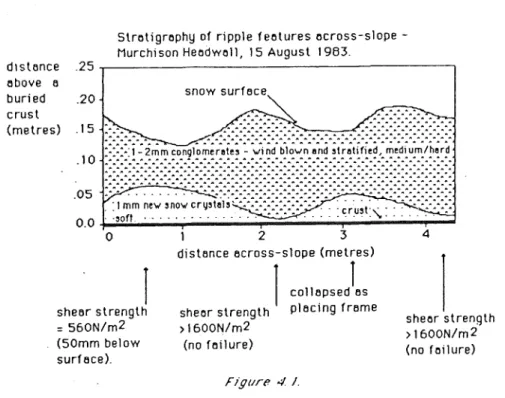
If the snow surrounding the weak layer had been rippled by
winds, the shear layer might show a pattern of large scale,
regular fluctuations of strength, corresponding to positions
where the layer thickness changed. If the shear layer was
very thin, fast random fluctuations of strength might occur
when grains from adjacent layers protrude through the weak
layer. On the other hand, if the snow surrounding the shear
plane was not protruding through the weak layer, less
variation in values of strength would be expected.
For surface snow with low cohesive strength, the
threshold wind velocity for wind transport may be very low.
This may cause redistribution of a potential weak layer such
as surface hoar before burial by subsequent snowfalls.
Furthermore, the light winds may not drastically alter the
crystal structure but sweep the weak crystals into areas which
would be determined by . the surface topography. After
snowfalls, such conditions may result in pockets of weakness
separated by stable regions (which had been eroded before the
snowfall).
3) Buried weak layers often consist of large unbroken
crystals which have fragile bonds, and a low wind-speed
appears to be a necessary condition during the time of
deposition of such crystals. We expect the variation of
strength due to the random distribution of crystal bonds to be
on a smaller scale than that which we are measuring.
4.2 AIR-FLOW STUDIES.
Airflow patterns vary considerably, especially when the
flow is not steady, and mathematical modeling of such flows is
difficult. We suspect wind could strongly affect snow
strength by causing transfer not only of snow particles, but