EFFECT OF A FLOATING ELASTIC PLATE/MEMBRANE ON THE MOTION DUE TO A
RING SOURCE IN WATER WITH POROUS BED
R. Gayen and Najnin Islam
Department of Mathematics, Indian Institute of Technology,
Kharagpur 721 302, India
e-mails: [email protected]; [email protected]
(Received 7 October 2016; after final revision 5 July 2017;
accepted 18 July 2017)
The velocity potentials due to the presence of a horizontal circular ring of wave sources of time-dependent strength in water of finite constant depth with a floating elastic plate or a floating membrane are determined. The uniform bottom is composed of non-dissipative porous medium. The problems are formulated as the initial value problems and the Laplace transform method is used to solve these. For time-harmonic source strength, the steady-state analysis of the potentials reveals the existence of outgoing progressive waves. Graphs for the surface profiles are presented for different values of the tension parameter for the membrane, flexural rigidity of ice and the porous-effect parameter.
Key words : Ring source potential; floating elastic plate; floating membrane; porous bottom.
1. INTRODUCTION
Investigation of water wave problems in which a part or whole of water surface is covered by a thin
elastic plate has gained considerable importance since the last few decades due to their applications
in two particular areas. One of these is to understand the mechanism and effects of wave propagation
through Marginal Ice Zone (MIZ) in the Antarctic (cf. Squire [32]). An MIZ is formed of broken ice
or continuous sheets of ice. The latter can be modeled as a thin elastic plate composed of elastic
ma-terial of uniform area density. Significant ice-wave interaction problems may be found in Chakrabarti
[2], Gayen and Mandal [9], Korobkin et al. [14] and Mohapatra and Sahoo [26]. Another application
(VLFS), where the large structure is modeled as a thin elastic plate using the Kirchhoff theory. In
this connection, we may mention the research works of Kashiwagi [13], Mirafzalia et al. [23] and
Watanabe [34].
For the temporary protection of coastal regions and construction sites, investigations involving
membranes floating on the surface of water are also important. Membranes are mainly made of
synthetic fiber, rubber or a polymeric material. They are easily transportable, deployable, detouchable
and somewhat inexpensive. The membrane is modeled as a thin, homogeneous and inextensible
sheet with uniform mass. Water wave scattering by horizontal membranes submerged in water was
considered by Cho and Kim [3]. Manam [19] studied the scattering of membrane coupled gravity
waves by a surface piercing plate.
All the above studies have been carried out when the fluid region has a uniform rigid bottom of
finite depth or when it is of infinite depth. In coastal engineering, porosity of the bed is also a very
important aspect due to the fact that the porous bottom is inherent in the natural events of water wave
propagation. Its presence gives rise to many interesting phenomena like wave-energy dissipation,
damping etc. Thus there exist a substantial amount of research papers which take the permeability
of the bed into account in analyzing various hydrodynamic properties, when the water surface is free
(cf. Jeng [12], Martha et al. [21], Mohapatra [27], Panda and Martha [28]). The only example of
simultaneous consideration of floating elastic plate and a porous bottom is found in Maiti and Mandal
[17], who examined water wave scattering by the edge(s) of a semi-infinite or a finite floating elastic
plate in the presence of a porous bed.
There has been a long standing interest in studying water wave generation problems by various
disturbances present either on the surface or inside the water. The velocity potentials due to a
two-dimensional wave source of time-dependent strength submerged in water with an inertial surface was
determined by Rhodes-Robinson [29] for deep water. Ghosh [10] investigated the cylindrical
wave-maker problem in presence of surface-tension in single-layered fluid. Sherief et al. [31] investigated
the vertical cylindrical porous wave maker problem in two-layered fluids. Lu and Dai [16]
inves-tigated the surface waves generated by unsteady concentrated disturbances in an initially quiescent
fluid of infinite depth with an inertial surface. Since the last few years some remarkable research
works have been published in which the wave generation problems were solved in the presence of
an ice-cover modeled as a thin elastic plate. Several problems in this direction were considered by
Banerjea et al. [1], Gayen(Chowdhury) and Mandal [5], Maiti et al. [18], Mohanty et al. [24], Savin
To the best of the authors’ knowledge there does not exist any research paper which considers
either the effect of a floating membrane or a porous medium at the bottom on the wave radiation.
Thus, the authors are motivated to consider a particular case of wave generation problem which
investigates the wave motion generated due to the presence of a ring source placed in water with a
porous bottom when the upper surface is covered either by an ice-cover or a floating membrane. There
are several usefulness of the study of ring sources. Some of them are listed below. If an obstacle is
in the form of a vertical body of revolution having a common vertical axis of symmetry with the fluid
motion, one needs to consider potential due to submerged horizontal circular rings of wave sources
since the problem can then be formulated in terms of suitable distribution of rings of wave sources
around the body [11]. An offshore structure in the high sea for the purpose of oil prospecting may
be modeled as a vertical cylinder of circular cross section. Hence consideration of velocity potentials
due to submerged circular rings of wave sources is of importance. A substantial amount of research
consists of finding suitable forms of the green’s function due to the ring sources (see Teng and Kato
[33] and the papers cited therein). Also the existence of trapped modes can be realized by placing
suitably an axisymmetric ring source in the free surface (cf. McIver and McIver [22]).
Mandal and Kundu [20] used a Laplace transform technique to obtain the velocity potential due
to a ring source of time-dependent strength submerged in finite depth water with an inertial surface
in the presence of surface tension, the inertial surface being composed of uniformly distributed
non-interacting floating material. Gayen(Chowdhury) and Mandal [4] employed a Laplace transform
tech-nique to determine the velocity potential due to a ring source of time-dependent strength submerged
for both deep water and finite depth water with an ice-cover.
In the present paper, we determine the velocity potential due to a horizontal circular ring of wave
sources of time-harmonic strength submerged in water of uniform finite depth. The bottom is
com-posed of uniform porous materials whereas the surface of water is either covered with a thin elastic
plate or a floating membrane. The problem is formulated as an initial value problem for the velocity
potential describing the motion in the fluid in Section2. In Section3, we employ Laplace transform to solve the problem. We assume the wave-source to be time-harmonic and determine the asymptotic
expressions for the potentials in the steady-state. The analyses due to a floating membrane and a
floating elastic plate are described in sections3.1and3.2respectively. The asymptotic behaviour of the potentials depends on the nature of the roots of the dispersion equations. Maiti and Mandal [17]
determined the roots of the dispersion equation when upper surface is covered by a thin ice-sheet and
the bottom is permeable. However, such analysis is not available in the literature in the context of
Appendix we establish the nature of the roots of such dispersion equation using argument principle
of complex variable theory. In Section4, the expression for the surface depression is determined and the steady state surface profiles are presented graphically. The figures reveal that how the surface
profiles are affected by the fluctuations in the flexural rigidity of ice or the tension parameter of the
membrane, or the permeability of the bottom. It is evidenced that decreasing values of the surface
parameters and the increasing porosity result in increase in the amplitude of the waves generated due
to the ring source. Finally our conclusions are summarized in Section5.
2. FORMULATION OF THEPROBLEM
To formulate the problem mathematically, it is assumed that the fluid is inviscid, incompressible
and homogeneous with densityρ. We also assume that the bottom is of uniform finite depthhand
is composed of some specific type of porous materials which constitute a non-dissipative porous
medium. Here we use a cylindrical co-ordinate system(R, θ, y)in which they-axis is taken vertically downwards passing through the center of the horizontal ring of radiusaof uniformly distributed point
sources each of strengthm(t) submerged at a depth η below the undisturbed floating ice-sheet or membrane. Since the strengthm(t)does not depend onθ,the motion of the fluid is axisymmetric. The planey= 0denotes the rest position of the floating membrane (MC) or the ice-cover (IC). Since the motion in water starts from rest, it is irrotational and can be described by a potential function φj(R, y, t)withj= 1,2. Subscripts1and2are used to denote the variables related to the membrane
and the ice-sheet respectively. Thenφj(R, y, t)satisfies the Laplace’s equation
1
R(RφjR)R+φjyy= 0 (1)
in the fluid region except at the points on the ring.
Ifζj(R, t)denotes the displacement of the upper surface below its mean position, then the lin-earized kinematic and dynamic boundary conditions on the upper surface are given by the following
equations:
φjy =ζjtony = 0, (2)
(φ1−²1φ1y)t= (−Q∇2R+ 1)gζ1ony= 0(for MC), (3)
(φ2−²2φ2y)t= (D∇4R+ 1)gζ2ony= 0(for IC). (4)
Here (Q, D) = (T,Lρg) and ²j = ρρjhj; T being the uniform tension acting on the membrane, L = Eh32
12(1−ν2) being the flexural rigidity of the ice-sheet, hj being the very small thickness of the
membrane/ice sheet,ρj being their density. Eandν are the Young’s modulus and Poisson’s ratio of
Eliminatingζ1 between (2) and (3), andζ2 between (2) and (4) we obtain the surface boundary
conditions as
(φ1−²1φ1y)tt = (−Q∇2R+ 1)gφ1yony= 0(for MC), (5)
(φ2−²2φ2y)tt = (D∇4R+ 1)gφ2yony= 0(for IC). (6)
The potential functionφj also satisfies the bottom condition
φjy−Gφj = 0ony =h. (7)
HereGis the porous-effect parameter and is related to the impedanceΓof the porous medium asG = iKΓ,K = σg2, σ is the angular frequency of the time-harmonic wave motion andg is the acceleration due to gravity. Since for a non-dissipative mediumΓis purely imaginary,Gis real and this allows the existence of progressive waves [6].
At points near the ring
φj →m(t)φ0as
p
(R−a)2+ (y−η)2 →0 (8)
where,φ0 is the potential due to a ring of wave sources of constant unit strength in an unbounded
fluid, given by [11]
φ0 = 2πa
Z ∞
0
e−k|y−η|J0(ka)J0(kR)dk. (9)
The initial conditions on the upper surface of water are
(φj−²jφjy) = 0,(φj−²jφjy)t= 0ony= 0att= 0. (10)
In the next section we describe the motion generated by a ring source of time-harmonic strength
by taking m(t) = sinσt. The derivation of the potential due to sources with impulsive strength (m(t) =δ(t))or constant strength(m(t) = 1)is straightforward [4]. We will not discuss these cases
here, because, as the sources around the ring act instantaneously att = 0, its effect will not be felt anywhere in the liquid region after a long lapse of time.
3. SOLUTION TO THEPROBLEMS
In order to solve the boundary value problem given by equations (1), (5)-(8) and (10), we employ the
Laplace transform technique. Letφj(R, y, p)denote the Laplace transform ofφj(R, y, t)defined as
φj(R, y, p) = Z ∞
0
Then,φjsatisfies the Laplace equation
1
R(RφjR)R+φjyy= 0 (12)
in the fluid region except at the points on the ring,
φj →m(p)φ0as
p
(R−a)2+ (y−η)2 →0, (13)
p2φ1−(−Q∇2R+ 1 +²1p2
g )gφ1y = 0ony= 0(for MC), (14)
p2φ2−(D∇4R+ 1 +²2p2
g )gφ2y = 0ony= 0(for IC), (15)
φjy−Gφj = 0ony=h. (16)
3.1 Ring source potential due to a floating membrane
A solution forφ1satisfying (12) and (13) can be represented as
φ1 =m(p) "
φ0−2πa
Z ∞
0
e−k(y+η)J0(ka)J0(kR)dk
+ Z ∞
0
{B1(k) coshk(h−y) +C1(k) sinhky}coshJ0(kakh)J0(kR)dk
# (17)
whereJ0(x)is the Bessel function of the first kind of order zero. Using the condition (14) on the
floating membrane and the porous bed condition (16),B1(k)andC1(k)are uniquely determined as
B1(k) = 4πa
gk(Qk2+ 1 + ²1p2
g )X(h−η) M1(k)(p2+ Ω21)
coshkh, (18)
C1(k) =−4πaM H1(k)
1(k)(p2+ Ω21)
coshkh (19)
with
Ω21 = N1(k)
M1(k), (20)
N1(k) =gk(Qk2+ 1){X(h) sinhkh+G}, (21)
M1(k) =X(h)(coshkh+²1ksinhkh) +²1kG, (22)
H1(k) =gk{Qk2+ 1 +²1p 2
g }{e
−kηG+l(k) sinhkh}+p2l(k) coshkh, (23)
SubstitutingB1(k)andC1(k)from (18), (19) into (17),φ1is finally obtained as
φ1= 2πa m(p)P1(R, y) +m(p)
Z ∞
0
Ω2 1
Ω2
1+p2
Q1(R, y, k)dk (25)
P1(R, y) =
Z ∞
0
·
e−k|y−η|−e−k(y+η)+ 2
M1(k)S1(y, k)
#
J0(ka)J0(kR)dk, (26)
S1(y, k) =²1k L(y, k)−l(k) coshkh sinhky, (27)
Q1(R, y, k) = 4πaTM1(y, k)
1(k)
J0(ka)J0(kR), (28)
T1(y, k) =
½
M1(k)
X(h) sinhkh+G−²1k ¾
L(y, k) +l(k) coshkhsinhky, (29)
L(y, k) =X(h−η) coshk(h−y)− {e−kηG+l(k) sinhkh}sinhky. (30)
Then, Laplace inversion of (25) yields a general representation of the velocity potential due to the
ring source submerged in water with membrane-cover at its top. This representation is valid for all t >0and all values ofR. Thusφ1(R, y, t)is determined as
φ1(R, y, t) = 2πa m(t)P1(R, y)
+ Z ∞
0
Ω1(k)Q1(R, y, k)
½Z t
0
sin Ω1(t−τ)m(τ)dτ
¾
dk. (31)
To analyze the motion due to a ring source of time-harmonic strength we takem(t) = sinσtand we find from (31) that
φ1(R, y, t) = 2πa sinσt P1(R, y)
+ Z ∞
0
Ω1(k)Q1(R, y, k)Ω1sinσt−σsin Ω1t Ω2
1−σ2
dk. (32)
We further modify the above form ofφ1 to obtain its asymptotic form in the steady state. Thus
we rewriteφ1as
φ1(R, y, t) = 2πa sinσt
"
P1(R, y)−2
Z ∞
0
k(Qk2+ 1)
M1(k)∆1(k)F(y, k)J0(ka)J0(kR)dk
#
(33)
−σ Z ∞
0
Ω1(k)Q1(R, y, k)
Ω1+σ
sin Ω1t
Ω1−σ
dk
where
F(y, k) =X(h)X(h−η)
coshkh coshk(h−y) +
G{l(k)−e−kηX(h)}
To obtain the form of equation (33) for large time, we now introduce a Cauchy principal value at k=µ01which is the real positive zero of∆1(k), where
∆1(k)≡K(Gtanhkh−k) + (Qk2+ 1−²1K)(k2tanhkh−Gk) = 0. (35)
The equation∆2(k)has three real roots0,±µ01, infinite number of imaginary roots±iα1n. Also,
∆1(k)has two complex roots ν1 andν1 withRe(ν1) < 0, Im(ν1) > 0(see Appendix for proof).
Hence, ast→ ∞using the Riemann Lebesgue Lemma, we obtain
φ1 ' 2πasinσt "
P1(R, y)−2 Z ∞
0
k(Qk2+ 1)
M1(k)∆1(k)
F(y, k)J0(ka)J0(kR)dk #
(36)
−2π2ag1(y, η;µ01) cosσt J0(µ01R)
where
g1(y, η;k) = 2X(h−Mη)V1(y, k)J0(ka)
1(k)U1(k) (37)
with
V1(y, k) = coshkh{sinhky+²1kcoshky} ∗
"
KGsinhkh−Gk{Qk2+ 1−²1K}coshkh #
+k(Qk2+ 1){Gsinhky−Gsinhkhcoshk(h−y)}
+k2(Qk2+ 1−²1K)(coshkh+²1ksinhkh) coshk(h−y),
(38)
U1(k) =K(Ghcoshkh−coshkh−khsinhkh)
+(3Qk2+ 1−²1K)(ksinhkh−Gcoshkh)
+k(Qk2+ 1−²1K)(sinhkh+khcoshkh−Ghsinhkh).
(39)
To further simplify the integral in (36), we employ Jordan’s lemma. For this we writeJ0(kR)
asJ0(kR) = H
(1) 0 (kR)+H
(2) 0 (kR)
2 whereH
(1)
0 (kR)andH
(2)
0 (kR)are the Hankel functions of the first
and the second kind of order zero, respectively. We then rotate the contour along the real axis with
indentations above the poles atk=−µ01,0and below the pole atk=µ01. This yields an alternative
representation for the expression in (36) as given by
φ1 '4πa sinσt
∞
X
n=1
g1(y, η;iα1n)K0(α1nR)
+2π2ia sinσt g1(y, η;ν1)H0(1)(ν1R)
−2π2a g1(y, η;µ01){sinσt Y0(µ01R) + cosσt J0(µ01R)}
whereK0(x)is the modified Bessel function of the second kind of order zero andY0(x)is the Bessel
function of the second kind of order zero.
To analyze the behaviour of the potential at a large distance from the centre of the ring we use the
following asymptotic representations of the Bessel functions: AsR→ ∞
K0(Rz)'
r π 2Rze
−Rz, H(1)
0 (Rz)'
r 2 πRze
i(Rz−π
4), (41)
J0(Rz)'
r 2
πRzcos(Rz− π
4), Y0(Rz)' r
2
πRzsin(Rz− π
4). (42)
Using the above limiting values, the potential for large time and distance is given by
φ1 ' −2π2a g1(y, η;µ01)
µ 2 πµ01R
¶1/2 cos
³
µ01R−σt−π4
´
. (43)
This shows that in the steady-state φ1 indeed represents progressive outgoing waves at a large
distance from the center of the ring.
3.2 Ring source potential due to a floating elastic plate
A solution forφ2 satisfying (12) and (13) can be represented as
φ2 =m(p) "
φ0−2πa
Z ∞
0
e−k(y+η)J0(ka)J0(kR)dk
+ Z ∞
0
{B2(k) coshk(h−y) +C2(k) sinhky}coshJ0(kakh)J0(kR)dk
# .
(44)
Using condition (15) on the floating elastic plate and the porous bed condition (16),B2(k)and
C2(k)are uniquely determined as
B2(k) = 4πa
gk(Dk4+ 1 + ²2p2
g )X(h−η) M2(k)(p2+ Ω22)
coshkh, (45)
C2(k) =−4πaM H2(k)
2(k)(p2+ Ω22)
coshkh (46)
with
Ω22 = N2(k)
M2(k), (47)
N2(k) =gk(Dk4+ 1){X(h) sinhkh+G}, (48)
H2(k) =gk{Dk4+ 1 +²2p2 g }{e
−kηG+l(k) sinhkh}+p2l(k) coshkh. (50)
SubstitutingB2(k)andC2(k)from (45), (46) into (44),φ2 is found as
φ2 = 2πa m(p)P2(R, y) +m(p) Z ∞
0
Ω2 2
Ω2
2+p2
Q2(R, y, k)dk (51)
P2(R, y) = Z ∞
0
"
e−k|y−η|−e−k(y+η)+ 2 M2(k)
S2(y, k) #
J0(ka)J0(kR)dk, (52)
S2(y, k) =²2k L(y, k)−l(k) coshkh sinhky, (53)
Q2(R, y, k) = 4πaTM2(y, k)
2(k) J0(ka)J0(kR), (54)
T2(y, k) =
½
M2(k)
X(h) sinhkh+G−²2k ¾
L(y, k) +l(k) coshkhsinhky. (55)
The Laplace inversion of (51) producesφ2 as given by
φ2(R, y, t) = 2πa m(t)P2(R, y)
+ Z ∞
0
Ω2(k)Q2(R, y, k)
½Z t
0
sin Ω2(t−τ)m(τ)dτ
¾
dk. (56)
This is the ring-source potential due to presence of a floating elastic plate at the top and the porous
bed at the bottom. If the strength of the source is prescribed bym(t) = sinσt, then the form ofφ2is
modified as
φ2(R, y, t) = 2πa sinσt P2(R, y)
+ Z ∞
0
Ω2(k)Q2(R, y, k)Ω2sinΩσt2−σsin Ω2t
2−σ2
dk. (57)
As in3.1, here also, we arrangeφ2 so as to analyze its behaviour in the steady-state. Thusφ2 is
rewritten as
φ2(R, y, t) = 2πa sinσt
"
P2(R, y)−2
Z ∞
0
k(Dk4+ 1)
M2(k)∆2(k)F(y, k)J0(ka)J0(kR)dk
#
−σ Z ∞
0
Ω2(k)Q2(R, y, k)
Ω2+σ
sin Ω2t
Ω2−σdk. (58)
Here∆2(k) is a transcendental function appearing in the dispersion relation arising due to the
presence of ice-cover at the surface and porous bed at the bottom.∆2(k)is given by
The equation∆2(k) = 0has three real roots0,±µ02, infinite number of imaginary roots±iα2n. Also,∆2(k) = 0has two pairs of complex conjugate rootsµ1,µ1 and−µ1,−µ1withRe(µ1) >0,
Im(µ1)>0. The existence of the roots are proved in Maiti and Mandal [17].
Modifying the contour of integration for the integral in second term as done in 3.1 and using Riemann Lebesgue Lemma for the integral in the third term, we obtain
φ2'4πa sinσt
∞
X
n=1
g2(y, η;iα2n)K0(α2nR)
+2π2ia sinσt n
g2(y, η;µ1)H0(1)(µ1R)−g2(y, η;µ1)H0(2)(µ1R)
o
−2π2a g2(y, η;µ02){sinσt Y0(µ02R) + cosσt J0(µ02R)}
where
g2(y, η;k) = 2X(h−Mη)V2(y, k)J0(ka)
2(k)U2(k) (60)
with
V2(y, k) = coshkh{sinhky+²2kcoshky} ∗ £
KGsinhkh−Gk{Dk4+ 1−²2K}coshkh¤
+k(Dk4+ 1){Gsinhky−Gsinhkhcoshk(h−y)}
+k2(Dk4+ 1−²2K)(coshkh+²2ksinhkh) coshk(h−y),
(61)
U2(k) =K(Ghcoshkh−coshkh−khsinhkh)
+(5Dk4+ 1−²2K)(ksinhkh−Gcoshkh)
+k(Dk4+ 1−²2K)(sinhkh+khcoshkh−Ghsinhkh).
(62)
Using the asymptotic values ofK0(Rz), H0(1),(2)(Rz), Y0(Rz),J0(Rz)asR→ ∞given in (41)
and (42), the potential for large time and distance is given by
φ2 ' −2π2a g2(y, η;µ02)
µ 2 πµ02R
¶1/2 cos
³
µ02R−σt−π4
´
. (63)
It is evident from the above expression that in the steady-state and at a large distance from the
ring,φ2represents progressive outgoing waves.
4. SURFACEPROFILES
Using the linearized kinematic condition on the upper surface, the dimensionless surface displacement ζj
h(R, t)can be written as ζj
h(R, t) = 1 hRe
½ g2
σ3
Z t
0
φjy(R,0, τ)dτ ¾
To display the effect of the membrane surface on the wave motion generated due to the presence
of a ring source, the dimensionless surface displacementζ1
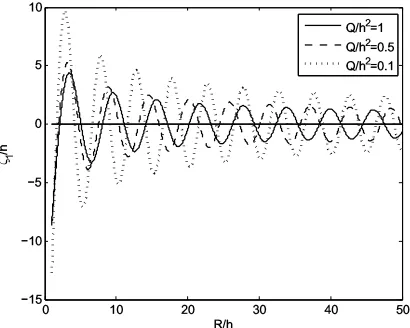
h is presented graphically againstR/h. In Figure 1 the surface displacement ζh1 is plotted versusR/hfor three different values of the
tension-parameter hQ2 = 1,0.5,0.1for the membrane withGh= 0.5, ²h1 = 0.01, ηh = 0.8, ha = 0.6,Kh= 1
andσt = 100. From Figure 1, it is observed that the wave amplitude increases with the decreasing values of hQ2. This is due to the fact that as hQ2 diminishes the upper surface tends to become free
which makes it lighter and so, the wave height increases.
The effect of the ice-cover surface on the wave motion is illustrated in Figure 2. In this figure the
surface displacement ζh2 is plotted versus R/hfor three different values of the ice-cover parameter D
h4 = 0.5,0.2,0.01 withGh = 0.5, ²h2 = 0.01, ηh = 0.8, ha = 0.6,Kh = 1andσt = 100. Here
also it is observed that when the waves pass over a heavier surface, its amplitude is reduced by a
significant amount.
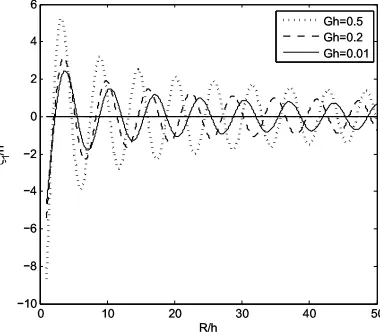
Also, to visualize the effect of the porosity on the wave motion, the dimensionless surface
dis-placement ζ1
h and ζh2 are presented graphically against R/h in Figures 3 and 4. In Figure 3 the surface displacement ζ1
h is depicted for the three different values of the porous effect parameter Gh = 0.5,0.2,0.01with tension-parameter hQ2 = 0.5and ²h1 = 0.01, ηh = 0.8, ah = 0.6,Kh = 1
andσt = 100. In Figure 4 the surface displacement ζh2 is depicted for the three different values of the porous effect parameterGh = 0.5,0.2,0.01with ice-cover parameter hD4 = 0.5and ²h2 = 0.01.
Other parametric values are same as those in Figure 3. We notice from these figures that the wave
amplitude steadily increases with the increase in the values ofGh. Thus the presence of porous bed
amplifies the wave height irrespective of the material of the upper surface.
ζ
[image:12.612.229.434.534.698.2]
!" # $%&'()* + ,-./012
Figure 1 : Surface displacement forGh= 0.5,²1
h = 0.01, η
ζ
!
[image:13.612.197.387.123.301.2]"#$%&'() *+,-./01 234567879
Figure 2 : Surface displacement forGh= 0.5,²2
h = 0.01, ηh = 0.8, ha = 0.6,Kh= 1,σt= 100.
ζ
[image:13.612.199.389.342.508.2]
!" #$% & '( )*+ , -. /0/ 1
Figure 3 : Surface displacement for ²1
h = 0.01, ηh = 0.8, ah = 0.6,Kh= 1,σt= 100, hQ2 = 0.5
!
"
#
$
% &'
ζ
(
)
*
+ ,-./0 1 23456 7 89:;: <
Figure 4 : Surface displacement for ²2
[image:13.612.200.392.547.707.2]5. CONCLUSION
The velocity potential due to the presence of a horizontal circular ring of wave sources of
time-harmonic strength in water of finite constant depth with a floating elastic plate or a floating membrane
is obtained when the bottom of the fluid region is composed of non-dissipative porous medium. The
steady-state analysis of the potentials reveals the existence of outgoing progressive waves of any
frequency under the ice or the membrane cover. If the elastic parameterDor the tension parameterQ
is put equal to zero, then the ice-covered or the membrane covered surface becomes an inertial surface.
In this case outgoing time-harmonic progressive waves exist only when the angular frequency is less
than a certain constant which depends on the surface density of the inertial surface. The dimensionless
form of the ice-covered or the membrane covered surface profile is plotted in a number of figures for
different values of the tension parameter for the membrane, flexural rigidity of ice and the
porous-effect parameter. It has been observed that the wave amplitude increases with the decreasing values
of the tension parameterhQ2 and the ice-cover parameter hD4, whereas it increases with the increasing
values of the porous-effect parameterGh. The results developed here are expected to be helpful in
the areas of coastal and marine engineering. The problem may be further extended to a two-fluid
medium (cf. Mohapatra et al. [25]) where the upper fluid is bounded above by a membrane or an ice
cover and the lower fluid has a porous bed. Also, similar analysis may be done when the ring source
is present in a fluid medium with a viscoelastic and poroelastic beds (cf. Das et al. [7] and Das and
Sahoo [8]).
ACKNOWLEDGEMENT
The authors are thankful to the reviewers for their comments and suggestions to revise the paper in
the present form.
APPENDIXA: ROOTS OF THE DISPERSION EQUATION(35)
In order to discuss the roots of the dispersion equation (35), we first rewrite the equation as
tanhkh= kG(Qk
2−²
1K+ 1) +kK
k2(Qk2−²1K+ 1) +KG. (A.1)
If we ploty = tanhkh andy = kG(Qk2−²1K+1)+kK
k2(Qk2−²1K+1)+KG againstkh, they intersect atkh = 0and
exactly once forkh >0. But these two functions are odd ink, so there are always exactly two real roots occurring as plus and minus of some positive quantity which we denote asµ01. Whenk= ip
for some realp, equation(A.1)becomes
tanph= pG(−Qp2−²1K+ 1) +pK
The above equation has infinite number of real roots which are given by ±α1n(n = 1,2, ...). Thus equation(A.1)has infinite number of purely imaginary roots±iα1n(n= 1,2, ...). To find out other possible roots, we rearrange the equation(A.1)as
γ1(k)≡e2kh−(k+G){k(Qk
2+ 1−²
1K) +K}
(k−G){k(Qk2+ 1−²1K)−K} = 0. (A.3)
In order to find the possible existence of complex roots, we consider the contour C formed by the
boundary of the square with vertices at(±(N +14)πh,±(N +14)πh)in the complexk-plane wherek is taken anti-clockwise on the square. For a large integerN, it is easy to see that the change in the
argument ofγ1(k)along C is(2N+ 1)2πand so from the argument principle, the number of zeros of
γ1(k)minus the number of poles ofγ1(k)enclosed in the square is(2N+ 1). Now, one can observe
thatγ1(k) has four poles inside the contour given by the zeros of the denominator of the fraction
appearing in the equation(A.3). Therefore, the number of zeros ofγ1(k)that lie within the square is
2N + 5. But already we have found thatγ1(k)has three real zeros and2N purely imaginary zeros
inside the square. So there must be two complex zeros inside C. Since the equation(A.1)has real coefficient it follows that these must be conjugate to each other which we denote asν1andν1.
Now we consider the change in argument of the functionγ2(p)where
γ2(p) = tanph{−p2(−Qp2−²1K+ 1) +KG} − {pG(−Qp2−²1K+ 1) +pK},
while traversing the triangular contour with vertices (0,0) and ((N + 14)πh,±(N + 14)πh). We find that the number of zeros ofγ2(p)minus the number of poles ofγ2(p)enclosed in the triangle is zero.
Since the tan function hasN real poles inside the contour, so the number of zeros ofγ2(p) that lie
within the triangle isN. But already we have found thatγ2(p)hasN real zeros inside the triangle,
so there are no zeros other than the real ones.
Similarly, if we consider the change in argument of the functionγ2(p)in traversing the triangular
contour with vertices (0, 0) and(−(N+14)πh,±(N+14)πh), we find that the number of zeros ofγ2(p)
minus the number of poles ofγ2(p)enclosed in the triangle is two. Since the tan function hasN real
poles inside the contour, so the number of zeros ofγ2(p)that lie within the triangle isN + 2. But
already we have found thatγ2(p) hasN real zeros inside the triangle, so there are two zeros other
than the real ones. Since zeros ofγ2(p)areitimes the roots of equation(A.1), we find that Im(ν1)
>Re(ν1)whereν1 =α+iβwithα < 0, β > 0. A schematic sketch of the roots are depicted in
[image:16.612.225.436.124.326.2]
Figure 5 : Zeros of membrane cover region dispersion equation.
REFERENCES
1. S. Banerjea, P. Rakshit and P. Maiti, On the waves generated due to a line source present in an ocean with an ice cover and a small bottom undulation, Fluid Dyn. Res., 43 (2011), 025506.
2. A. Chakrabarti, On the solution of the problem of scattering of surface water waves by the edge of an ice cover, Proc. Roy. Soc. London A., 456 (2000), 1087-1099.
3. I. H. Cho and M. H. Kim, Interactions of a horizontal flexible membrane with oblique incident waves, J. Fluid Mech., 367 (1998), 139-161.
4. R. G. Chowdhury and B. N. Mandal, Motion due to ring source in ice-covered water, Int. J. Eng. Sci., 42 (2004), 1645-1654.
5. R. G. Chowdhury and B. N. Mandal, Motion due to fundamental singularities in finite depth water with an elastic solid cover, Fluid Dyn. Res., 38 (2006), 224-240.
6. A. T. Chwang and A. T. Chan, Interaction between porous media and wave motion, Annu. Rev. Fluid Mech., 30 (1998), 53-84.
7. S. Das, H. Behera and T. Sahoo, Flexural gravity wave motion over poroelastic bed, Wave Motion, 63 (2016), 135-148.
8. S. Das and T. Sahoo, Hydroelastic analysis of very large floating structure over viscoelastic bed, Mec-canica, 52 (2017), 1871-1887.
10. N. K. Ghosh, A cylindrical wave-maker problem in a liquid of finite depth with an inertial surface in the presence of surface tension, ANZIAM J., 33 (1991), 111-121.
11. A. Hulme, The potential of a horizontal ring of wave sources in a fluid with a free surface, Proc. Roy. Soc. London A., 375 (1981), 95-306.
12. D. S. Jeng, Wave dispersion equation in a porous seabed, Ocean Eng., 28 (2001), 1585-1599.
13. M. Kashiwagi, Research on hydroelastic responses of VLFS: recent progress and future work, IJOPE, 10 (2000).
14. A. A. Korobkin, T. I. Khabakhpasheva and A. A. Papin, Waves propagating along a channel with ice cover, Eur. J. Mech. B Fluids, 47 (2014), 166-175.
15. D. Q. Lu, J. C. Le and S. Q. Dai, Unsteady waves due to oscillating disturbances in an ice-covered fluid, J. Hydrodyn. Ser. B, 18 (2006), 177-180.
16. D. Q. Lu and S. Q. Dai, Generation of unsteady waves by concentrated disturbances in an inviscid fluid with an inertial surface, Acta Mech. Sin., 24 (2008), 267-275.
17. P. Maiti and B. N. Mandal, Water wave scattering by an elastic plate floating in an ocean with a porous bed, Appl. Ocean Res., 47 (2014), 73-84.
18. P. Maiti, P. Rakshit and S. Banerjea, Wave motion in an ice covered ocean due to small oscillations of a submerged thin vertical plate, J. Marine Sci. Appl., 14 (2015), 355-365.
19. S. R. Manam, Scattering of membrane coupled gravity waves by partial vertical barriers, ANZIAM J., 51 (2009), 241-260.
20. B. N. Mandal and K. Kundu, Ring source potentials in a fluid with an inertial surface in the presence of surface tension, Int. J. Eng. Sci., 25 (1987), 1383-1386.
21. S. C. Martha, S. N. Bora and A. Chakrabarti, Oblique water-wave scattering by small undulation on a porous sea-bed, Appl. Ocean Res., 29 (2007), 86-90.
22. P. McIver and M. McIver, Trapped modes in an axisymmetric water-wave problem, Q. J. Mech. Appl. Math., 50 (1997), 165-178.
23. F. Mirafzali, A. Tavakoli and M. Mollazadeh, Hydroelastic analysis of fully nonlinear water waves with floating elastic plate via multiple knot B-splines, Appl. Ocean Res., 51 (2015), 171-180.
24. S. K. Mohanty, R. Mondal and T. Sahoo, Time dependent flexural gravity waves in the presence of current, J. Fluid Struct., 45 (2014), 28-49.
26. S. C. Mohapatra and T. Sahoo, Wave interaction with a floating and submerged elastic plate system, J. Eng. Math., 87 (2014), 47-71.
27. S. Mohapatra, Scattering of oblique surface waves by the edge of small deformation on a porous ocean bed, J. Marine Sci. Appl., 14 (2015), 156-162.
28. S. Panda and S. C. Martha, Oblique wave scattering by undulating porous bottom in a two-layer fluid: Fourier transform approach, Geophys. Astrophys. Fluid Dyn., 108 (2014), 587-614.
29. P. F. Rhodes-Robinson, On the generation of water waves at an inertial surface, ANZIAM J., 25 (1984), 366-383.
30. A. A. Savin and A. S. Savin, Waves generated on an ice cover by a source pulsating in fluid, Fluid Dyn., 48 (2013), 303-309.
31. H. H. Sherief, M. S. Faltas and E. I. Saad, Axisymmetric gravity waves in two-layered fluids with the upper fluid having a free surface, Wave motion., 40 (2004), 143-161.
32. V. A. Squire, Of ocean waves and sea-ice revisited, Cold Reg. Sci. Technol., 49 (2007), 110-133. 33. B. Teng and S. Kato, A method for second-order diffraction potential from an axisymmetric body, Ocean
Eng., 26 (1999), 1359-1387.