ISSN Online: 2333-9721 ISSN Print: 2333-9705
DOI: 10.4236/oalib.1104152 Dec. 22, 2017 1 Open Access Library Journal
Tracking a Moving Objects Using Foreground
Detector and Improved Morphological Filter
Diallo Mamadou Saidou
School of Telecommunication, Hangzhou Dianzi University, Hangzhou, China
Abstract
Mobile object detection is one of the most important steps in computer vision applications such as: medical analysis human-machine interface, robotics, traffic monitoring, and more. In this article, we apply the Gaussian mixing model which is established on the background subtraction. A smoothing me-thod was used for the pre-processing step and a morphological filter was ap-plied to remove unwanted pixels from the background in the other to solve the problem of background noise disturbance. We also demonstrated that fil-tering foreground segmentation twice with the same morphological structured element but with a different width was used to improve the accuracy of the result. The results show that the proposed method is effective in detecting and tracking moving vehicles, compared to filter segmentation in the foreground only once. Several methods and algorithms have been used to solve this prob-lem. All the methods used before have been effective but also have limits. Some of these methods lose the object when the number of frames is wide while others lose it when it changes direction or rolls at a high speed. In addi-tion, the algorithms proposed for the detection of colors in RGB also lose their objectives when the object changes the color. But the proposed combination in this paper maintains contact with the object without losing it even if it changes direction or speed or the number of frame increases.
Subject Areas
Applications of Communication Systems
Keywords
Tracking, Background, Foreground, Gaussian Mixture Model, Morphological Filter
1. Introduction
For many years in computer vision applications, the detection of the moving
How to cite this paper: Saidou, D.M. (2017) Tracking a Moving Objects Using Foreground Detector and Improved Mor- phological Filter. Open Access Library Journal, 4: e4152.
https://doi.org/10.4236/oalib.1104152
Received: November 13, 2017 Accepted: December 19, 2017 Published: December 22, 2017
Copyright © 2017 by author and Open Access Library Inc.
This work is licensed under the Creative Commons Attribution International License (CC BY 4.0).
http://creativecommons.org/licenses/by/4.0/
DOI: 10.4236/oalib.1104152 2 Open Access Library Journal
object is a very important step in the areas of recognition and security. Man by nature can easily detect and distinguish a moving object, but it is difficult for a computer to detect and recognize an object like humans because it does not have the ability to think, which helps detect and recognize moving objects. An object
detection system that is not complicated and adaptable is necessary [1]. Moving
objects like humans, vehicles, etc. is monitored using a video camera in a visual surveillance scene. The process of extracting the foreground object is an impor-tant step in grouping, tracking, and analyzing the activities of the subject object, which is why subtraction of the background plan has been applied in this article
[2].
Many related research can be distinguished such as the search by matching
[3], search by mean shift [4], search by optical/median flow [5] and bayesian
search [6]. Most of the work related to this problem is oriented in terms of the
color, size, shape or movement of the mobile, but size plays a very important role in the use of particles. For the extraction of points in the image and the
fol-low-up of these points the algorithm KLT [7] has been much used by many
people, it was developed by Kanade and Lucas, it is found in many tasks of tracking of objects. The extraction of points in the first image is done using the Harris detector. To estimate a global motion model in the image, many use the
RMRm algorithm developed by J-M Obodez [5]. It allows, from a robust
mul-ti-scale estimation, to define a 2D motion model with several Parameters be-tween two images.
Background subtraction has been chosen as one of the preferred methods for real-time segmentation of moving objects in the alternation of images which is
the capture of a still camera [7]. Background subtraction is a process by which
the background is cut off from the current frame, i.e. each new frame is
sub-tracted from that pattern and the resultant difference and the binary segmented image represent the exit. The threshold is chosen carefully to reduce the number
of false negatives and positives [8] [9]. A false positive is obtained when we
choose a small value for the threshold, for the case there will be a lot of foreign pixels. On the other hand, when a high value is chosen, it gives a false negative. In general, we can now summarize the subtraction of the background in: Back-ground initialization, BackBack-ground modelling, BackBack-ground maintenance, Fore-ground detection.
By other, there are many challenges to overcome that include the following: change of lighting variation, movement of background objects, initialization of shadows with moving objects and complex dynamic backgrounds such as sway-ing of trees, ripples in water.
The use of Background Subtraction Methods (BS) could find a way to deal
with these problems [10] which is why BS is adopted in this article. The sound
re-DOI: 10.4236/oalib.1104152 3 Open Access Library Journal
duces the effects of the noise of the detected object, which improves the effi-ciency of the detection process. This article has described a task that has been successful in achieving satisfactory results in detecting and tracking the mov-ing object in the video. The task is to keep an object selected by the user in the center of the image whatever its movements. This algorithm allows good ro-bustness to the very strong disturbances due to video transmission and oper-ates at a bit rate close to the video bit rate. Experimentation in real conditions shows the effectiveness of the proposed system. This document is organized in the following order. Section II presents a brief presentation of our proposed method. Section III presents the results of the simulation and Section IV presents the conclusion.
2. Proposed Method
The method is structured in five steps which are indicated in the figure below
(Figure 1).
The input video smoothes the process where the noise is reduced and the im-age is blurred. Second, the background subtraction based on the Gaussian mix-ing model is used to detect the movmix-ing object. Third, by usmix-ing thresholdmix-ing, the binary image is obtained. Fourth, morphological filtering is applied twice, which has had a considerable effect on noise reduction and merges the separate blobs associated with an object. Fifth, the connected blobs are tagged to the individual object by the bounding box. Etc.
1) Imput video (smoothing):
[image:3.595.266.481.443.704.2]The smoothing process is used to create a fuzzy image and reduce the noise of
DOI: 10.4236/oalib.1104152 4 Open Access Library Journal
an image. This is a method very commonly used in image processing; it is
main-ly used in pre-treatment for background subtraction that depends on GMM [11].
In this article, we will use 5 × 5 average box filters, because of the real-time processing. The cost of calculation is reduced, unlike others, for example the Gaussian filter [12].
2) Gaussian Mixture Model (GMM)
GMM represents a combination of n Gaussian distribution that corresponds
to the distribution of the pixel strength in the current frame. The probability of intensity in the frame at time t can be modeled as follows:
( )
1 ,(
, , , ,)
nt n n t t n t n t
p x =
∑
= w xN xµ
∑
(1)where, wn t, ,
µ
n t, and∑
n t, are respectively the weight estimation, mean, andthe covariance matrix of Gaussian th
n , the variance of the Gaussian nth matrix
is referred from standard deviation
, ,
n t =µn txt
∑
(2)The intensity of the pixel xt is evaluated with respect to each of the Gaussian
elements at the nearest distribution, the parameters, wn t, ,
µ
n t, and,∑
n t, areupdated. The set of background pixels is adaptably identified. With this, it is more preferable to use GMM to remove all potential background pixels. GMM established on the background subtraction is resistant against any change of lighting [13].
3) Morphological filtering
Background subtraction, using GMM, the output contains a lot of noise and the moving object separates, the two fundamental operations of the
morpholog-ical filtering are erosion and dilation [14]. In this article we will use the aperture
filter, which has been successfully applied to the binary image. Morphological filtering is a process that is mainly used to reduce noise in detected images. A morphological operation gives the best edges to moving vehicles and produces the best performance. Some unwanted noises are part of in the foreground seg-mentation process, which makes it not perfect. We decided to double-filter
fore-ground segmentation to remove the noise [15]. Using the blob vision analysis
object, this one found a link component of the bounding box corresponding to the moving car. Any blob of less than 150 pixels is not accepted.
3. Results of the Simulations
The video used in this work is that of an automobile in motion along a trajecto-ry, this video is in AVI format (length 60 seconds, frame width 320, frame height 240, data rate 200 kbps, total bitrate 200 kbps, frame rate 25 frame/second)
(Figure 2).
Using GMM, Background subtraction, we can notice that the output contain a
lot of noise and the detection of the moving object becomes troubled (Figure 3).
DOI: 10.4236/oalib.1104152 5 Open Access Library Journal
Figure 2. The original video.
Figure 3. Background image with Gaussian additive noise.
Morphological filtering is used to reduce noise in image detection, by applying
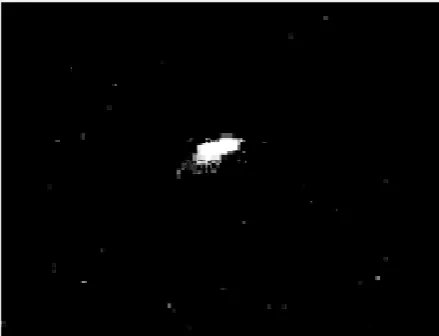
that technic, we can see on (Figure 4) that all the noises have been removed by
the morphological filter. And by that, we obtain a clean foreground. On this im-age we can see that all the noises have been removed by the morphological fil-ters. This saw us that morphological operation gives the best assets for moving vehicles and produces the best performance.
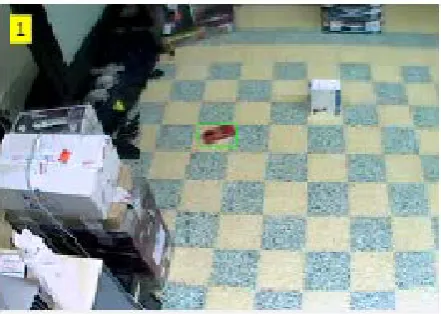
The Figure 5 shows the result of the algorithm.
4. Conclusion
[image:5.595.263.483.281.449.2]DOI: 10.4236/oalib.1104152 6 Open Access Library Journal
Figure 4. The Gaussian Noise is cleaned by the
[image:6.595.263.482.72.248.2]Morpho-logical filtering.
Figure 5. The car is detected buy the algorithm.
moving vehicles and produces a good performance due to the elimination of noise which now makes the blob analysis to produce a precise delineation to each of the vehicles. The result of the simulation shows the effectiveness of the proposed method.
5. Discussions
Despite the fact that the results obtained are satisfactory, this work can be im-proved for more performance. In the future, it will be interesting to make projects, to resume the work done and to complete it. So that it can first improve its speed of execution by simplifying it, improving its result by improving the techniques, or by facilitating its use. For this, it would be possible to study new algorithms that could improve the results of a type of video or object.
References
[image:6.595.264.485.296.453.2]DOI: 10.4236/oalib.1104152 7 Open Access Library Journal
science Engineering and Technology, 2, 1385-1387.
[2] Crane, H. and Steele, C. (1968) Translation-Tolerant Mask Matching Using Non coherent Reflective Optics. Recognition, 1, 129-136.
[3] Han, B., Joo, S.-W. and Davis, L.S. (2007) Probabilistic Fusion Tracking Using Mixture Kernel-Based Bayesian Filtering. In IEEE 11th International Conference on
Computer Vision, Rio de Janeiro, Brazil, September 2007, 14-20.
[4] Klein, J., Lecomte, C. and Miche, P. (2007) Fast Color-Texture Discrimination: Ap-plication to Car-Tracking. In IEEE ITSC, Seattle, WA, USA, 30 Sept.-3 Oct. 2007, 546-541.https://doi.org/10.1109/ITSC.2007.4357765
[5] Bouwmans, T., Baf, F. and Vachon, B. (2008) Background Modelling Using Mixture of Gaussians for Foreground Detection—A Survey. Recent Patents on Computer
Science, 1, 219-237.https://doi.org/10.2174/2213275910801030219
[6] Khurana, K. and Awasthi, R. (2013) Techniques for Object Recognition in Images and Multi-Object Detection. International Journal of Advance Research in
Com-puter Engineering and Technology, 2, 1383-1387.
[7] Dimitrijevic, M. (2006) Detecting Human Body Posture Using Spatial-Temporal Bayesian Models. International Conference on Intelligent and Advanced Systems, 10, 127-139.
[8] Vahora, S., Chauhan, N. and Prajapati, N. (2012) A Robust Method for the Detec-tion of Moving Objects Using the Modified Statistical Method. International
Jour-nal of Advanced Information Technology (IJAIT), 2, 204-209.
https://doi.org/10.5121/ijait.2012.2106
[9] Bobick, A. and Davis, J. (2001) The Recognition of Human Movements Using Temporal Models. IEEE Transactions on Model Analysis and Artificial Intelligence, 23, 257-267.
[10] Haritaoglu, I., Harwood, D. and Davis, L.S. (2000) W4: Real-Time Monitoring of the Activities of People. IEEE Transactions on Artificial Intelligence and Model Analysis, 22, 809-830.
[11] Azarbayejani, T.D. and Pentl, P. (1997) Real-time Monitoring of the People. IEEE
Transactions on Artificial Intelligence and Model Analysis, 19, 780-785.
[12] Stauffer, C. and Grimson, W. (1999) Adaptive Background Mixture Models for Real-Time Monitoring in Computer Vision and Pattern Recognition. IEEE Com-puter Society, 2, 2246-2252.
[13] Stauffer, C., Eric, W. and Grimson, L. (2000) Activity Learning Models Using Real-Time Monitoring. IEEE Transactions on Model Analysis and Artificial Intelli-gence, 22, 747-757.
[14] Bouwmans, T., Baf, F. and Vachon, B. (2008) Background Modeling Using a Gaus-sian Mix for Leading Detection—An Investigation. Recent Patents on Computer
Science, 1, 219-237. https://doi.org/10.2174/2213275910801030219
[15] Schick, A., Bauml and Stiefelhagen, R. (2012) Improvement of Foreground Seg-mentations with Random Fields of Probabilistic Markov Super Pixels. Computer
Vision and Pattern Recognition (CVPR), 2012 IEEE Computer Society Conference