warwick.ac.uk/lib-publications
A Thesis Submitted for the Degree of PhD at the University of Warwick
Permanent WRAP URL:
http://wrap.warwick.ac.uk/109868
Copyright and reuse:
This thesis is made available online and is protected by original copyright.
Please scroll down to view the document itself.
Please refer to the repository record for this item for information to help you to cite it.
Our policy information is available from the repository home page.
T H E B R I T I S H L I B R A R Y DOCUM ENT SUPPLY CENTRE
An Artificial Intelligence Fram ework
TITLE
Experim ental Design and Analysis
!* Discrete Event Simulation
A U TH O R
Richard Paul TA YLOR
IN S T IT U T IO N
and DATE
U N l V E R S l T I O F V O A R v ò t c K1 9 8 8
Attention is drawn to the fact that the copyright of
this thesis rests with its author.
This copy of the thesis has been supplied on condition
that anyone who consults it is understood to recognise
that its copyright rests with its author and that no
information derived from it may be published without
the author’s prior written consent.
T H E B R IT ISH L IB R A R Y
D O C U M E N T SU PPLY C E N T R E — n T T T 3 r T 4 1 5 1 6
c m s
Boston Spa, Wetherby W est Yorkshire
United Kingdom R E D U C T IO N X _____________
20
An Artificial Intelligence Framework
for
Experimental Design and Analysis
in
Discrete Event Simulation
by
Richard Paul TAYLOR
A Thesis submitted in partial fulfilment of the requirements for the degree of
"Doctor of Philosophy”
University of Warwick School of Industrial and Business Studies
Table of Contents
T itle ... i
Contents ... ii
Appendices... viii
Figures... ix
T ables... xi
Acknowledgements... xiii
Abstract... xiv
Chapter 1 : Some Considerations about Experimental Design and Analysis... 1
1.1 Introduction... 1
1.2 Research O bjectives... 4
1.3 Overview of Chapters ... 3
Chapter 2 : Current Practices in Simulation and Artificial Intelligence ... 8
2.1 Introduction... 8
2.2 Simulation and Operational Research... 9
2.2.1 The Simulation Approach ... 9
2.2.2 The OR Analyst and Computer Simulation--- ---— . 11
2.2.3 Phases o f a Simulation Study... ... ... 14
2.2.4 Approaches to Simulation Modelling... 23
2.2 5 Enhancements to the practice of Simulation ... ... ... 23
2.2.6 Decision-Problems within Simulation... 29
2.3 Decision-Making and Decision-Support Tools ... 32
2.3.1 Introduction... 32
2.3.2 Classification of Decisions... 32
2.3.3 Decision-Support Systems (D SS)... 34
2.3.4 Heuristics ... 36
2.3.5 Considerations about DSS and Simulation Problems... 39
2.4 Decision-Making and Artificial Intelligence (A l)... 40
2.4.1 Introduction ... 40
2.4.2 Artificial Intelligence Expert Systems ... ... 41
2.4.3 Future Al: the Fifth Generanon ... 33
2.4.4 Conclusion ... . 55
2.3 Simulation and Artificial Intelligence... 56
2.5.1 OR and Artificial Intelligence .—...---- ...--- ... 56
2.5.2 Combining Simulation and Artificial Intelligence... 57
2.5.3 Current Research... 58
2.3.4 Future Simulation ... 67
2.5.5 Towards support systems in experimental Design... 68
2.6 Objectives and Reasons for this Thesis ... 72
2.6.1 Need for Experimentation Support ... 72
2.6.2 Limitations of Current Research... 73
2.6.3 Proposed Research ... 74
2.6.4 Objectives of this Thesis... - ... 75
Chapter 3 : A n Intelligent Controller - Human Intelligence & Machine Control ... 77
3.1 Introduction... 77
3.2 Conventional Experimentation Environment ... 78
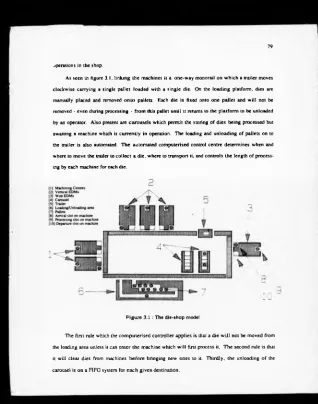
3.2.1 Example Model: the Die S h o p ... 78
3.2.2 Naive Experimentation Behaviour - Case Study ... 81
3.2.3 Expert Experimentation Behaviour ... 82
3.2.4 Postulate for Successful Experimentation ... 83
3.3 A Framework for Procedural Control o f Execution... 84
3.3.1 Objectives ... 84
3.3.2 A Frame for Experimentation ... 84
3.3.3 Automating the Experimental F ra m e ... 91
3.3.4 Uses of the Procedural Fram ew ork... 100
3.4 Enhancing Procedural Control through Remote Machine Intelligence... 102
3.4.1 Limitations of Procedural Control Framework... 102
3.4.2 Remote Intelligence ... 102
3.4.3 An Example ... 104
3.4.4 Artificially induced Intelligent Input ... 106
3.5 Towards a Framework for non-Procedural Control of Execution ... 109
3.5.1 Limitations of the Procedural Controller... 109
3.5.2 Moving the Centre of Control from Fortran to Prolog ... 110
3.5 3 Enhancing input through previous experimental results... 114
3.5.4 Self-Explaining Models ... 116
3.5.5 Assessment... 118
3.6 Conclusion ... 119
Chppter 4 : An Advisor - Machine Intelligence and Human Control... 121
4.1 Introduction... 121
4.2 Appropriateness of ES Fran ework to Simulation Experimentation ... 122
4.2.1 Simulation Tasks... 122
4.2.2 Nature Characterisation of Experimentation Problems ... 123
4.2.3 Appraisal ... 124
4.3 Development Framework for an Advisor in Experimental Design ... 125
4.3.1 Identification ... 125
4.3.2 Conceptualisation... 130
4.3.3 Formalisation ... 132
4.3.4 Implementation ... 135
4.4 Implementation of a Framework for an Advisor ... 136
4.4.1 Introduction ...- ... ... ... 136
4.4.2 Step 1. WES is introduced to MODEL... ... 138
4.4 3 Step 2: WES consults U S E R ____________________________________ 140 4.4.4 Step 3: WES and USER determine problem ... 141
4.4.5 Step 4: WES ‘thinks' about problem ... 143
4.4.6 Step 5: WES advises on Experimentation ... 145
4.4.7 Step 6: WES and USER discuss results... 148
4.4.8 Step 7: WES produces rep o rt... 150
4.4.9 Conclusion ... 151
4.5 Expert Tasks for a Prototype A dvisor... 152
4.5.1 Introduction... 152
4.5.2 Prediction ... ... ...—...--- ...--- 152
4.5.3 Evaluation ... ... ... 157
4.5.4 Comparison ... 160
4.5.6 Sensitivity Analysis ... 162
4.5.7 Functional Relations ... —...--- ...— --- 165
4.5.8 Transient Behaviour... 168
4.5.9 Optimisation... 170
Chapter 5 : Towards an Integrated Expert - Machine intelligence and Control ... 176
5.1 Introduction... 176
5.2 Parallel Linking of the Intelligent Controller to the Advisor ... 177
5.2.1 Review of the Controller and the Advisor... 177
5.2.2 Enhancing the Advisor with a model interface... 177
5.2.3 Problems and Limitations of Parallel Linking... 183
3.3 Sequential Linking of Advisor to Controller ... 185
3.3.1 Objective--- 185
5.3.2 Sequential Operations ...—... 185
5.3.3 Input and Output Communications... 189
5.3 4 Implications of the Sequential L ink... 190
5.3.5 Limitations o f Sequential L in k ... 194
5.4 Enhancing Machine Expertise ... 196
5.4.1 Objective____________________________________ ________________ 196 5.4.2 Model-Type Dependent and Independent Rules... 196
5.4.3 Mechanism to input users own expertise... ... 197
5.4.4 Additional Fram es... 204
5.4.5 Usage Experience... 204
5.5 Conclusion ... 205
Chapter 6 : A Teacher - Enhancing Understanding using Machine Knowledge... 206
6.1 Introduction... 206
6.2 Teaching through Explanation... 208
6.2.1 The MYCIN m ould... 208
6.2.2 "Single Explanation" Facility ... 210
6.2.3 Multiple Queries ... 212
6.2.4 An Information System ... 216
6.2.5 A Mixed Support Facility ... 219
6.2.6 A Rule Trace Explanation Facility ... 221
6.2.7 Conclusion ... 223
6.3 Teaching through Demonstration ... 224
6.3.1 Introduction... 224
6.3.2 A tutorial facility to operate WES ... 224
6.4 Conclusion ... 228
Chapter 7 : Results and Considerations about Use and Application ... 230
7.1 Introduction... 230
7.2 Some Retro-active Studies... 232
7.2.1 Preliminary A nalysis... 232
7.2.2 Correct Execution of Designed Experiments... 236
7.2.3 The Steady State Issues... 237
7.2.4 The closed view" analysis ... 241
7.2.5 Benefits from WES ... 241
7.3 Application o f WES to a Data-Driven Simulation Package... 242
7.3.1 WES and W ITNESS... 242
7.3.2 Linking WES to W ITNESS_____________________________________ 243 7.3.3 Automatic Model Understanding ...---... 248
7.3.4 Automatic Learning: evaluation of WITNESS models ... 250
7.3.5 Increasing WES Expertise ... 251
7.3.6 Results and Some Concluding Considerations ... 254
7.4 WES versus MBA students... ... 255
7.4.1 Problem Description and MBA Results... ... - ... 255
7.4.2 WES and the ARGON problem --- --- 258
7.4.3 Considerations about the system's limitations ... ... 261
7.5 Towards further Expertise : Dealing with Uncertainty... 263
7.5.1 Issues of Indecision... 263
7.5.2 An approach to Uncertainty ... 263
7.5.3 EXPERT and the ARGOS problem ... 267
7.5.4 Application of EXPERT ... 269
7.6 Users and WES ... 270
7.6.1 M otivation... 270
7.6.2 Experiment Description ... 270
7.6.3 Results... 275
7.6.4 Remarks from the Subjects about the experiment ... 277
7.6.5 Conclusion ... 278
7.7 Conclusion ... 279
8.1 Introduction... 281
8.2 Research Summary ... 281
8.3 Conclusions... 284
8.3.1 Enhancing Experimentation with a Controller ... 284
8.3.2 Advisory Systems on an A1 Paradigm... 284
8.3.3 Integrated Experimenter — ... 285
8.3.4 Transfer of Expertise... 285
8.4 Future Research... 286
8.4.1 Intuitive Strategies ... 286
8.4.2 Understanding of the Model Environment ... 286
Appendices
Appendix 1 Programming in Prolog
Appendix 2 Fortran-Prolog interprocessor link
Appendix 3 Modification to existing software
Appendix 4 Linking Fortran and Prolog programs
Appendix 5 WES : some rule operations
Appendix 6 Output files from the advisor
Appendix 7 Implementation of the sequential link
Appendix 8 Structure of WES
Appendix 9 Results from retro-active studies and the MBA students
Appendix 10 WITNESS : link to data-driven simulation
Appendix 11 Files of extra expertise
Appendix 12 WES and USER experiment
Appendices
Appendix 1 Programming in Prolog
Appendix 2 Fortran-Prolog interprocessor link
Appendix 3 Modification to existing software
Appendix 4 Linking Fortran and Prolog programs
Appendix 3 WES : some rule operations
Appendix 6 Output files from the advisor
Appendix 7 Implementation of the sequential link
Appendix 8 Structure of WES
Appendix 9 Results from retro-active studies and the MBA students
Appendix 10 WITNESS : link to data-driven simulation
Appendix 11 Files of extra expertise
Appendix 12 WES and USER experiment
Figures
Figure 2.1 Simulation versus Analytic approach to the Modelling
Solution 10
Figure 2.2 Table to assist with selecting the appropriate
statistical test 22
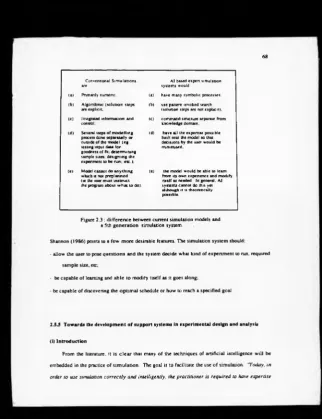
Figure 2.3 Difference between current simulation models
and a 5th generation simulation system 68
Figure 3.1 The die-shop model 79
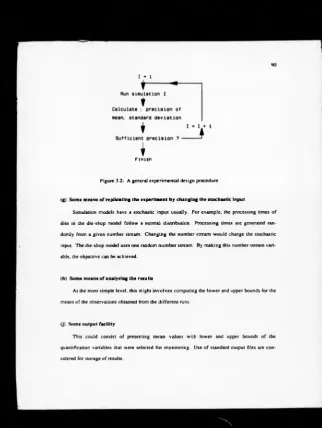
Figure 3.2 A general experimental design procedure 90
Figure 3.3 An environment to link the controller to remote
intelligence 103
Figure 3.4 Flow diagram of the EXECUTIONER module 111
Figure 4.1 A general approach to knowledge acquisition 125
Figure 4.2 Extended model of intelligent reasoning 129
Figure 4.3 Desirable concepts for simulation experimentation 131
Figure 4.4 Required rules in an advisor for experimentation 133
Figure 4.5 Formalisation of the system architecture for the advisor 134
Figure 4.6 Screen offering choice of tasks to investigate 140
Figure 4.7 Screen presenting choice for evaluation criteria 142
Figure 4.8 Pattern of search through the rule-base 144
Figure 4.9 Implementation of experimentation behaviour patterns 145
Figure 4.10 Screen informing user of experiment in progress 147
Figure 4.11 Screen offering choice for course of action 150
Figure 4.12 Screen offering choice of course of action after
report generation 151
Figure 4.13 WES report file from a prediction consultation 157
Figure 4.14 WES report file from evaluation consultation 159
Figure 4.15 WES report file from comparison consultation 162
Figure 4.18 Figure 4.19 Figure 5.1 Figure 6.1 Figure 6.2 Figure 6.3 Figure 6.4 Figure 6.5 Figure 6.6 Figure 6.7 Figure 7.1 Figure 7.2 Figure 7.3 Figure 7.4 Figure 7.5 Figure 7.6 Figure 7.7 Figure 7.8 a & b
Screen output from a transient behaviour exercise 170
WES report file from an optimisation investigation 173
Illustration o f the new CONTROLLER module 182
Exponential growth of an explanation facility 214
Converging explanations 215
De-contextualisation process of an explanation 215
Representation of an information tree 216
The information tree with different entry points 219
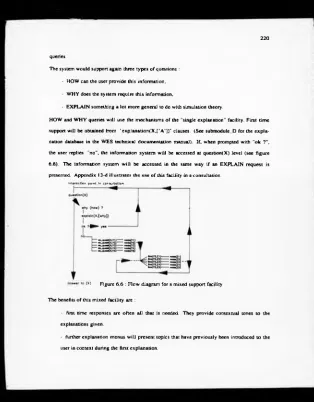
Flow diagram for a mixed support facility 220
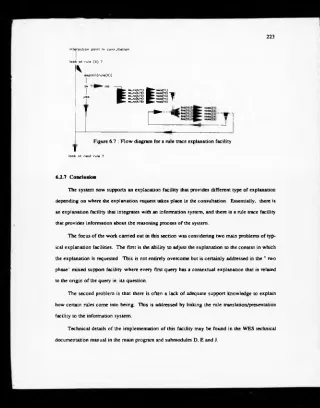
Flow diagram for a rule trace explanation facility 223
Shared data file for WES-MICROVISION communications 244
Instruction file for WES-WITNESS communications 245
Typical instruction file 245
Part of an example report file 246
Screen showing the WES discovery process of WITNESS
models 249
Screen output from evaluation of WITNESS models 250
Plot of collected samples over a long run 252
Different methods for experimental sampling
252
Tables
Table 7-a Initial classification of student projects according
to WES tasks 233
Table 7-b List of formal studies and the tasks they address 235
Table 7-c Comparison of WES and student cut-off points 240
Table 8-a Different optimal configurations 257
Table 8-b Most popular parameter values 257
Table 8-c Output from WES about the system's investigation using minimisation of the time-in-system o f entities 259
Table 8-d Output from WES about the system's investigation using maximisation of service utilisations 260
Table 8-e Output from WES about the system’s investigation using
default criteria 261
Table 9-a Example connections for EXPERT 268
Table 12-a Number of parameters changed 275
Table 12-b Most popular configurations before WES 276
Table 12-c Most popular configurations after WES 276
Table a7-l Cumulative percentage of number o f configurations
considered Appendix 9a - 4
Table a7-2 Percentage use of different criteria Appendix 9a - 4
Table a7-3 Percentage use of experimental frames Appendix 9a - 4
Table a7-4 Percentage use of formal analysis Appendix 9a - 4
Table a7-5 Percentage awareness of run-in time
considerations Appendix 9a - 5
Table a7-6 Percentage awareness of different run-in time
considerations Appendix 9a - 5
Table a7-7 Number of replications for multiple runs Appendix 9a - 5
Table a7-8 Percentage use of antithetics Appendix 9a- 5
experiments Appendix 9b - 2
Table a8-3 Distribution of sample sizes for MBA
experiments Appendix 9b - 2
Table a8-4 Form of analysis for MBA results Appendix 9b - 2
Table a8-5 Percentage usage of frames Appendix 9b - 2
Table a8-6 Percentage use of different criteria Appendix 9b - 3
Table al 2-1 Subjects and their background Appendix 12c - 1
Table al 2-2 Results from users Appendix 12c - 2
Table a l 2-3 Results of parameter value selection Appendix 12c - 3
Table al 2-4 Results from knowledge and awareness increase
by users after using WES Appendix 12c - 4
Table al2-5 Percentage number of subjects that recorded increase
in knowledge test score Appendix 12c - 5
Table a 12-6 Percentage number o f subjects that showed
Acknowledgements
The successful completion of this research would have been impossible without the contri
bution of several individuals. Although only a few can be named, I particularly wish to ack
nowledge the following. First I thank my supervisor. Dr Robert D Hurrion, for all his advice
throughout the period of this project.
This thesis benefitted significantly from the assistance of two special individuals. Dr
Andrew Flitman spent much time in the initial phases o f the research teaching me about his
"link" which is used in the early chapters. Marcia Barnes devoted many hours to assist in the
preparation o f this manuscript. I thank them both for their help and support.
I also gratefully acknowledge the award from the Senate of the University of Warwick
which helped to fund this research.
Finally. I am indebted to all the people who kindly gave up hours of their time to test for
Abstract
Simulation studies cycle through the phases of formulation, programming, verification and validation, experimental design and analysis, and implementation. The work presented has been concerned with developing methods to enhance the practice and support for the experimental design and analysis phase of a study. The investigation focussed on the introduction of Artificial Intelligence (AI) techniques to this phase, where previously there existed little support. The rea son for this approach was the realisation that the experimentation process in a simulation study can be broken down into a reasoning component and a control of execution component. In most studies, a user would perform both of these. The involvement of a reasoning process attracted the notion of artificial intelligence or at least the prospective use of its techniques.
After a study into the current state of the art. work began by considering the development of a support system for experimental design and analysis that had human intelligence and machine control of execution. This provided a semi-structured decision-making environment in the form of a controller that requested human input. The controller was made intelligent when it was linked to a non-procedural (PROLOG) program that provided remote intelligent input from either the user or default heuristics. The intelligent controller was found to enhance simulation experi mentation because it ensures that all the steps in the experimental design and analysis phase take place and receive appropriate input.
The next stage was to adopt the view that simulation experimental design and analysis may be enhanced through a system that had machine intelligence but expected human control of exe cution. This provided the framework of an advisor that adopted a consultation expert system paradigm. Users were advised on how to perform simulation experimentation. Default reasoning strategies were implemented to provide the system with advisory capabilities in the tasks of pred iction, evaluation, comparison, sensitivity analysis, transient behaviour, functional relations, optimisation.
Later the controller and the advisor were linked to provide an integrated system with both machine intelligence and machine control of execution. User involvement in the experimentation process was reduced considerably as support -¿as provided in both the reasoning and control of execution aspects. Additionally, this integrated system supports facilities for refinement purposes that aim at turning the system’s knowledge into expertise. It became theoretically possible for other simulation experts to teach the system or experiment with their own rules and knowledge.
The following stage considered making the knowledge of the system available to the user, thereby turning the system into a teacher and providing pedagogical support Teaching was intro duced through explanation and demonstration. The explanation facility used a mixed approach : it combined a first time response explanation facility to "how" and "why" questions with a menu driven information system facility for "explain" requests or further queries. The demonstration facility offers tutorials on the use of the system and how to carry out an investigation of any of the tasks that the system can address.
The final part of the research was to collect some empirical results about the performance of the system. Some experiments were performed retroactively on existing studies. The system was also linked to a data-driven simulation package 'hat permitted evaluation using some large scale industrial applications. The system’s performance was measured by its ability to perform as well as students with simulation knowledge but not necessarily expertise. The system was also found to assist the user with little or no simulation knowledge to perform as well as students with knowledge.
1
Chapter 1
Some Considerations about Experimental Design and Analysis
1.1 Introduction
The eppeal of simulation to analysts and end-users has been increased, in recent years, by
the appearance of tools which provide the facility to accelerate the passage through some of the
stages in the development cycle of a simulation model. These stages are :
- formulation
- programming
- verification
- validation
- experimental design and analysis
- implementation.
The first four stages have benefitted from most of the research. Natural Language Under
standing Systems (NLUS) assist in formulation (Balmer and Paul 1986). Program generators per
form much of the required programming (Mathewson 1985). Visual Interactive Simulation (VIS)
has made verification easier (Hurrion and Seeker 1978). Recent work by Rao and Sargent (1988)
has addressed the issue of validation with an Operational Validity Advisory System (OVAS).
Despite the fact that many languages, eg. SIMAN (Pegden, 1984), now have powerful facil
ities for collecting and presenting output, there remained until recently a distinct lack of support
for the simulation experimental design and analysis phase of a project Contrasting with the
amount of research on the earlier phases, this paucity of support has led to concern about the
effectiveness of simulation tools in the hands of non-experts. Such concern has been reflected by
Smith (1986) when he highlighted the increasing dangers in the misuse of simulation tools.
the visual interactive side of simulation at the expense of properly designed simulation experi
mentation. End-users of simulation packages, concluded Smith, are becoming if not unaware of
traditional statistical simulation problems, for example considerations of steady states or variance
reduction methods, then unable to design simulation experiments which will produce results that
are statistically significant. Also many end-users may not be giving a valid interpretation to their
simulation results. This is particularly true of interactive methods where interactions at run-time
may destroy any notion of a steady state. O'Keefe (1986a) stressed the growing need to support
the use and guard against the misuse of simulation : a task which is particularly difficult when
estimates of over 700 hours of formal tuition are needed to give someone the basic tools of simu
lation (Shannon 1986).
Some research has been started recently in the area of experimental design and analysis.
Luker (1986b) and Haddock (1987) have developed support in this area in the context o f pro
gram generators. O'Keefe (1986a, 1986b) developed a prototype to assist with transaction flow
model experimentation. In the context of knowledge-based simulations, Reddy, Fox and Hussain
(198S) have considered automating the analysis of simulations.
It is suggested that the traditional human thought-processes (generated by simulation
knowledge and experience) and activities carried out by the analyst during the phases of experi
mental design and analysis can be viewed as the combination of intelligent (non-procedural) rea
soning and formal (procedural) control of execution. The reasoning aspect appears in the form of
intelligent specification o f the experiment to be carried out. The control aspect deals with execut
ing the experiment in accordance with the specification obtained from the intelligent component
If intelligent reasoning and control (of execution) are considered as the two complementary
processes for experimental design and analysis, it is possible to consider the potential and feasi
bility of providing a support environment that assists or replaces the human nature of either (or
both) of these processes in the development of a system that gives a machine/artificial nature to
the intelligent reasoning or control (of execution) processes. Such systems would provide a sup
3
If the execution of experiments can be controlled by a (computer) system, then the risk of
error o r omission regarding the appropriate steps to be carried out is reduced or eliminated.
If the traditional thought-processes required in the experimental design and analysis phase
can be modelled using artificial intelligence (AI) techniques, then the human reasoning process
can be assisted or replaced. If a modular form (eg. production rules) is adopted to represent the
knowledge, then the incremental development of advisory systems in experimental design and
analysis is possible. Such a system could greatly increase the understanding and confidence of
users o f simulation if the captured knowledge could be made available to the user through an
explanation or teaching facility.
Further advantages of developing an AI framework for simulation experimentation may
result if the human involvement is replaced in both control and intelligent reasoning and
processes leaving an integrated system. The system could not only leant from, explain to or teach
the user, but also act as his decision-maker in the execution of simulation experiments to address
1.2 Research Objectives
This PhD thesis aims to investigate the feasibility and suitability of AI techniques to the
development and integration o f advisory systems for simulation experimentation and analysis.
These systems would assist or replace the human involvement in both the intelligent and control
aspects of experimentation.
The feasibility of replacing the human component in the control of experiments could be
achieved by considering the physical processes involved in experimentation, and by developing a
procedural system which performed the steps identified. Such a system would be a rule/human-
assisted expert which sets up, runs, controls and monitors simulation experiments, whilst seeking
intelligent input when required from human origin or rules saved in AI form. This would also
suggest the suitability of AI techniques to storing simulation experimental design and analysis
knowledge.
It is then anticipated that the appropriateness of AI techniques to simulation experimental
design and analysis could be further established by the development of a non-procedural
'consultation-based' expert system to address specific issues of simulation usage. These would
be problems of prediction, evaluation, comparison, sensitivity analysis, optimisation, transient
behaviour and functional relations. The original objective of supporting the experimentation pro
cess could be seen as achieved by observing a user with minimal simulation knowledge and
equipped with a verified model being able to address complex problems with the satisfaction of
producing results which are significant, and on which he can base decisions.
Having developed a support environment for experimental design and analysis, work is then
carried out to extend the environment with explanation and teaching facilities. This now allows a
user to ask "why?", "how?" and "explain" as well as the more normal "what-if?" questions of a
simulation project. It is seen how, by reason of the modular nature of its expertise, the system
can either learn from experienced analysts or teach users with less knowledge.
The thesis is to conclude that artificial intelligence techniques may successfully be used to
1.3 Overview of Chapters
In chapter 2, the rationale of the approach is uncovered through a literature review of the
current practices relating to Simulation. Decision Support Systems. Artificial Intelligence. Expert
Systems. Heuristics. Experimentation, and the applications of Artificial Intelligence to Simula
tion. It is seen that simulation experimentation requires expertise which previously was con
sidered to be the domain of humans. Now, the use o f heuristics within an expert system frame
work appears to provide a means of incorporating this expertise. Having considered the litera
ture. an argument is put forward to support the value o f the research undertaken in this thesis.
The third chapter covers the investigation into the suitability of AI techniques to support the
development of an intelligent Controller. This system has human intelligence but machine con
trol. It proposes a formalisation of the experimentation process by adopting a procedural frame
work. It directs the user to proceed sequentially through a number of predefined steps in design
ing his experiment, thus insuring that all relevant issues are addressed. The controller then
automatically carries out the execution of the designed experiment. A means of separating the
procedural control from the non-procedural input is presented using two machines linked via
serial RS232 interface. This framework offers the possibility o f integrating machine intelligence
into the Controller process, to help the user proceed through the different steps of the
specification procedure.
In chapter 4, the appropriateness of the expert systems framework for a simulation experi
mentation advisor is considered, leading to the development of an Advisor that has machine intel
ligence but requires human control of execution. Through questioning the user, the system gath
ers information about the simulation model under consideration. An initial experiment is devised
using production rules according to the objective o f the study. The design of any experiment
considers issues about how to achieve a steady state and how to obtain statistically significant
results. The analysis of the first experiment may prompt the advisory system to refine the experi
ment or request further experiments before it can yield a sensible conclusion. An account of the
problems that may be addressed using the system.
Chapter 5 looks at the linking of the Controller to the Advisor in order to produce a system
which has both machine intelligence and machine control of execution. The link permits the sys
tem to automatically retrieve some understanding about the components of the simulation model
under consideration. Such a system permits a user to specify through a consultation process an
experimentation goal to be achieved. This integrated system performs intelligent reasoning to
design appropriate experiments and then controls their execution.
The sixth chapter considers the necessary features to provide teaching capabilities to the
system. The objective is to enhance human understanding of the experimental design and
analysis process through the use of machine knowledge. Two complementary approaches to
teaching are considered: explanation and demonstration. The issue does not surround the
pedagogical performance of these teaching mechanisms but rather the extraction of the concentra
tion of knowledge, that has been given to the system, for the benefit of the user.
In chapter 7. some results and considerations about the úse and application of the developed
integrated system are presented. By performing a number of retro-active studies, the system is
seen to overcome a number of problems relating to bad data transcriptions, bad design, steady
state issues witnessed in the review of 59 student projects. The application of the system to a
data-driven simulation package indicates the robustness of the proposed framework to be tran
sported to other simulation environments. The ability of the system is judged to have attained stu
dent level by performing as well, in addressing an optimisation problem, as a class of students
who had simulation knowledge but not necessarily expertise. The framework was seen to support
further advanced issues such as the handling of uncertainty which increases the quality of its rea
soning process. An eighty hour long experiment involving twenty users with minimal simulation
knowledge concludes that the system significantly helped these subjects achieve simulation stu
dies comparable to the class of students considered.
Chapter 8 concludes the thesis with a summary of the research and a discussion of results,
pro-Chapter 2
Current Practices in Simulation and Artificial Intelligence
2.1 Introduction
As its title suggests, the essence of this thesis lies in the integration of artificial intelligence
techniques into the field of discrete event simulation. The literature study undertaken in this
chapter will attempt to explain how artificial intelligence techniques have come to find a place in
the evolution of discrete event simulation. The objective is twofold. Firstly, to give contextual
meaning to the problem expressed in chapter 1 : the apparent lack o f support for experimental
design and analysis in simulation experimentation. Secondly, to provide an introduction to the
tools and concepts that were mentioned in the previous chapter. Because these tools and concepts
come from different disciplines, the study will necessarily be diverse.
The role of discrete event simulation within Operational Research (OR) is considered first
(section 2.2). The phases of a simulation study are described and developments which enhanced
these different phases are mentioned. The need to eventually look outside the traditional world of
OR is explained by the type of problems which analysts encounter. These problems are described
and paralleled to those which appear in the world of decision-support systems (section 2.3). A
detailed look is given to the emerging tools o f artificial intelligence (section 2.4), and how they
might be of use to simulation analysts. Finally, a review of the current work on the integration of
A1 techniques into simulation is undertaken (section 2.3), before a conclusion is reached support
2.2 Simulation and Operational Research
2.2.1 The Simulation Approach
"Operational Research is the application o f the scientific method to assist in the solu tion o f problems which occur in the management o f an organisation. Its purpose is to provide quantitative measures on which decisions about the operation o f the organi sation and changes to its resources and structure can be based The methods used to obtain these quantitative measures are known as the techniques o f Operational Research. One. among many, o f these techniques is Simulation" (Clementson. 1980). Simulation can be broadly described as the technique of problem solving by the observation of
the performance over time o f a dynamic model of the system (Gordon. 1978).
Each of the techniques of Operational Research is based on one single central idea : a
model. A model is an abstraction of the system under study in which the essential structure has
been retained, while the extraneous detail has been omitted (Pritsker, 1984) . One essential
feature o f any model is its ability to be manipulated.
(i) Simulation Models
There are several types of simulation models (Solomon. 1983; Clementson. 1980):
a. Physical models used for training purposes : eg simulators for training car drivers, pilots or
astronauts.
b. Business games ; often called open simulations. These are models o f an organisation used to
instruct potential or trainee managers to manage their organisation.
c. Continuous simulation : these are built on digital or analogue computers which integrate dif
ferential equations. The most popular application areas for this type of technique are the
simulation of physical, chemical and atomic processes. A minor modification of this tech
nique is the use of difference (rather than differential) equations. This is the basis of
"Industrial Dynamics" and the other financial simulation techniques.
d. Discrete simulation. These models are so called because they consider time and almost all
10
(U) The Simulation Approach
(Discrete Event) Simulation differs significantly from other models and techniques. These
other techniques will permit a problem to be solved analytically, subject to a number of basic
assumptions about the problem environment. Many of the assumptions required to model prob
lems. so that they can be solved analytically, are not required in simulation: thus larger and more
complex systems can be studied. In many situations simulation is the only viable means for
analysis (Gordon, 1978).
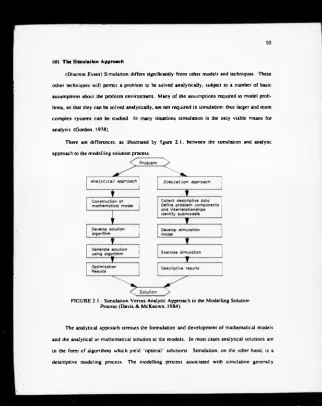
There are differences, as illustrated by figure 2.1. between the simulation and analytic
[image:28.381.43.365.31.437.2]approach to the modelling solution process.
FIGURE 2.1 : Simulation Versus Analytic Approach to the Modelling Solution Process (Davis & McKeown, 1984)
The analytical approach stresses the formulation and development of mathematical models
and the analytical or mathematical solution to the models. In most cases analytical solutions are
in the form of algorithms which yield "optimal'' solutions. Simulation, on the other hand, is a
11
involves collecting data which describe input and operational factors and defining the inter
relationship of the factors (variables), inputs, and other components of the problem being studied.
The output from a simulation model is in the form of performance descriptors. By exercising the
models, the characteristics of the problem can be explored (Davis & McKeown, 1984). It should
be noted that although simulation output is always descriptive in nature, a "search routine" can be
included in the simulation model to provide an optimal or near optimal solution. The term "near
optimal" is used because the solution may be optimal in terms of the defined model, but this does
not guarantee the solution is a global optimal. Optimality in simulation thus may be an approxi
mation of optimality which occurs in mathematical programming (Davis & McKeown. 1984).
In consequence, the models of discrete event simulation possess certain features which dis
tinguishes them from other types of models. The main features are ennumerated by Clementson
(1980) :
- Predictive (as opposed to optimising)
- Random (it represents the stochastic elements of the system) - Empirical (as opposed to analytical)
- Discrete (as opposed to continuous) - Closed (the model works without intervention) - Time-dependent (not static)
2.2.2 The OR Analyst and Computer Simulation
Modem computers allow the analysts to explore the whole range of feasible options in a
decision-problem (Solomon. 1983). Indeed, while it is possible to solve many complex problems
using hand simulation, this can be very time consuming. Also Poole & Szymankiewicz (1977)
point out that "simulation is ideally suited for computers as the rules fo r operating a model are repetitive but simple in concept". Indeed for discrete systems, where the prime interests are in the events, the equations are essentially logical, stating the conditions for an event to occur. This
thesis is concerned with computer simulation.
Because realistic computer simulation may require long computer programs which are time
12
regarded as a Iasi resort." The OR analyst resorts to simulation when it is either impossibly or not economically feasible, or just sufficiently inconvenient to experiment with and study the real
system (Conway & al. 19S9). Simulation does offer the following advantages as compared to
direct experimentation:
- cost : real experiments may be very expensive as compared to the cost of developing a
simulation model (Bobilier & al, 1976);
- time : although development of a model may take time, it allows simulation of week,
months or even years of operations in seconds o f computer time (Fishman, 1973);
- replication : the real world rarely allows precise replication of experiments in management
science. "It seems unlikely that an organisation's competitors will sit idlely by as a whole variety o f pricing policies are attempted in a bid to find the best (Pidd, 1984)." Simulations are precisely repeatable.
- safety : simulation studies permit investigation of extreme conditions where it might be
dangerous to do so in real life. "Simulated aircraft causes little damage when it runs out of fuel in the simulated sky (Pidd. 1984)”.
" Computer simulation may well be regarded as the last resort. Despite this, it is surprising how often such an approach is needed" (Pidd, 1984).
Computer simulation methods have developed since the early 1960's. The advancement
and acceptance of simulation as an OR tool has been directly tied to the developments in both
computer hardware and software.
(i) Hardware for Simulation
On the hardware side. Shannon argues (1986) that the increasing power and decreasing
costs have made computers available to organisations of all sizes. The availability of powerful
microcomputers makes the use of simulation feasible for even the smallest organisational unit.
"Personal computing allows models to be manipulated directly by the manager!decision maker. This form o f computing is far more appropriate fo r good OR work, where the objective is to persuade the manager to view his decision and explore alternatives in terms o f the model, not to provide a single correct 'answer'. Consequently, batch programs returning a single result were o f limited use to OR. whereas personal computing can embody the developed model in o form which is real to the manager."
Balmer & Paul (1986) reiterated this fact. "Microcomputers have allowed the modeller literally to take the model, rather than simply a pile o f computer output, to the user fo r verification". At Warwick university. Hurrion (1981) demonstrated the use of Visual Interactive Simulation (VIS)
on a microcomputer.
In the light of the above , it was decided that the work of this thesis should be microcom
puter based.
(ii) Software for Simulation
The development of simulation software has played an equal role in advancing the state-of-
the-art In this rapid overview (section 2.2.3 considers some points in more detail), it can be
shown as argued by Nance (1984). that the development of simulation software can be divided
into five periods:
- Pre - 1960, all simulations were written in general purpose languages such as FORTRAN.
- 1960 - 1965, the first special purpose simulation languages appeared : GPSS, SIMULA, GASP.
SIMSCRIPT. CSL.
- 1966 - 1970 saw the introduction of the second generation of these simulation languages.
GPSS U. III. 360 and V were developed as were SIMSCRIPT II, 0.5 and II-plus. SIMULA
67, Extended CSL (ECSL) and GASP II replaced earlier versions.
- 1971 -1980 witnessed the introduction of new languages such as SLAM and Q-GERT and the
addition of new features to existing languages. GASP IV added the ability to combine con
tinuous and discrete components in the same model, while SIMSCRIPT II.5 incorporated
obvious shortcomings on earlier versions of that language and introduced a greater degree
of user interaction.
Towards the end of this fourth period, attention began to shift to a concern for easier model
development and execution. Several authors began to discuss potential methods for easier pro
gramming (Mathewson. 1974; Clementson, 1980). Others began to take a more formalised
approach to the modelling process (Zeigler, 1976; Kleine, 1977).
In 1979. Oren & Zeigler produced a significant paper in which they pointed out several
weaknesses in current languages and proposed developing new languages based on two
concepts. First simulation languages should functionally separate the logically distinct
stages o f modelling, experiment design and output analysis into separate activities.
Secondly, simulation environments should be created to take advantage of current computer
capabilities for data base management, graphics and program verification.
1980 - 1988 The cunent phase is one in which the development of simulation software is in a
significant transition period. Section 2.5.3 reviews in greater detail the current research.
However, the emphasis is upon ease of use and providing an "integrated simulation environ
ment" rather than simply more powerful languages (Shannon, 1986). Henricksen (1983)
defines an integrated simulation environment to be "a collection o f software tools for designing, writing and validating models; writing and verifying simulation programs <implementing models), preparing model input data, analysing model output data; design ing and carrying out experiments with models".
2.2 J Phases o f a Simulation Study
A simulation study will go through the following phases (Mize and Cox, 1968):
1. Formulation
2. Programming
15
4. Experimental Design & Analysis
5. Implementation
(i). Formulation
a. Purpose: The first step is to clearly and completely specify the purpose for which the investi gation is being conducted. An important part of defining the purpose of a study is the
specification of criteria by which results of the investigation will be measured (Mize & Cox,
1968).
b. System description: After its purpose has been defined, the system must be described in terms which are amenable to some rather general form of model construction and ultimately to a
solution method. Mize & Cox (1968) argue that all systems can be described in terms of the following common features :
1. Components (entities which are independently identified, eg machines);
2. Variables (both external and internal)
3. Parameters (attributes which do not change during the simulation);
4. Relationships (both cause and effect among components and variables.
c. Data collection: The experimenter m ust determine and specify which data are needed for estimating (Mize & Cox, 1968; Gordon, 1978; Bobilier & al, 1976):
1. The parameters of the system (population parameters, maximum queue length, etc.);
2. The behaviour of the variables o f the system (probability distributions, etc.);
3. The nature of relationships in the system (Mize & Cox, 1968; Gordon, 1978).
According to Maisel and Gnugnoli (1972), there are three major sources to obtain this data;
- systems records (historical data), which are normally the most useful, although possibly
difficult to obtain;
- field studies (data-recording systems), which can be expensive and time-consuming and
therefore require appropriate design to ensure their validity.
d. Data processing Once the data has been collected, it will need to be processed and analysed to allow formulation of a model which realistically imitates the system being studied.
(ii). Programming
By the end of the formulation stage, a model will have been obtained which establishes the
specifications for what must be programmed. There are several methods of programming simula
tion.
- Standard package : these are available to cover simulations o f common application (eg stock
control). The problem with this method is that it offers little flexibility in the formulation of
the model: indeed, it must be acceptable to the package (Poole & Szymankiewicz, 1977).
- General Computer Language : these are traditionally BASIC, FORTRAN, ALGOL, PASCAL.
This method will involve heavy programming (Tocher, 1965).
- Simulation Languages : these have been specifically developed for simulation models. The best
known, as previously mentioned, are GPSS and SIMSCRIPT, also GASP. DYNAMO,
SIMULA, SIMON, ECSL (Solomon, 1983).
- Program Generators : these are a more recent development whereby a model is generated and a
program compiled in response to the answers to a series o f questions regarding logic, priori
ties, arithmetic, recording and initial conditions. For example : DRAFT (Mathewson, 1974),
CAPS (Clementson. 1974).
Very early on. Tocher (1965) concluded that deciding which method to adopt is most likely to be
(ill). Validation and Verification
In order to draw inferences about the real system from results obtained from the simulated
system, the simulation model must be a "reasonably" valid representation of the real system
(Pritsker, 1984). A computer simulation model is considered valid if it produces results which
are very close to the results which would be produced by the real world system, which the com
puter model is supposed to represent (Mize A Cox. 1968).
The validity of a model under all variations and all conditions cannot be verified (Maisel &
Gnugnoli, 1972). However some assurance of validity can be provided by a demonstration that
for at least one alternative version of the simulated system and one set of conditions, the simula
tor produced results which are not inconsistent with the known performance of the real system.
This kind of test is essentially a null test. A model which failed to pass would be exceedingly
suspect, but no strong statement can be made for a model which passed (Conway & al. 1959).
Verification is just another aspect associated with validating a model. Verification can be
considered equivalent to debugging a computer program and consists of checking to see if the
final computer simulation program is equivalent to the simulation model specified (Bobilier & al. 1976). There are a number of tests which can be carried out :
- trace facilities which consist of tracing the movement of all entities within the model for logical
correctness (Bulgren. 1982);
- replacing all the stochastic elements with constant values (usually the average). It is then possi
ble to calculate the result of a computer run (Bulgren. 1982);
- starting the model from extreme conditions to see if it behaves as expected;
- by using possibly a simple model, results could be compared with theoretical results
(iv). Experimental Design and Analysis
a. Introduction
Although the title of this thesis contains the words "Experimental Design and Analysis", it is not
the objective to discus and review all existing approaches to this topic. As will be argued, the
interest lies in the processes that these approaches may imply to the simulation user . Hence, the
work focuses on a framework-development to support these processes which may later, in turn,
be used to implement many of the existing approaches. The purpose of this section is thus to
present the issues relating to the design and analysis of experiments but not to present the details
as to how they are addressed. Where techniques are used, they will be discussed at implementa
tion stage. The complexity of these procedures should become apparent by the diversity of the
approaches.
Most investigation by simulation can be resolved into a comparison of alternatives when the
model is run under a variety of conditions. (Conway & al. 19S9). An important and often difficult problem in simulation concerns the very basic question of the measurement to be made:
what is to be measured and when. This is obviously critical for the analysis of results. Usually
the analyst is concerned with estimating the state probability distribution of a permanent entity’s
attribute. For example, one could simply keep track of the amount of time spent in each of the
possible system states. The probability of being in a given state is then estimated by the ratio of
the time spent in the state to the total length of the run (Conway. 1963).
How often one takes measurements is also critical to the design of experiments. This pro
cess of replication is critical in asserting the significance of results. In fact, obtaining simulation
results requires addressing a number of statistical issues such as ensuring that observations are
independent and identically distributed. "A simulation is a computer-based statistical sampling experiment (Law and Kelton. 1982)”. Fortunately. Pritsker (1984) notes that most of the statisti cal techniques are not used significantly differently in simulation studies from their use in other
b. Initial bias and starting conditions
A comparison of two alternatives should be based upon measurements obtained from the
steady-state operation of each alternative. Unfortunately, almost without exception, such condi
tions are attained only after some preliminary running time during which the transient conditions
induced by the artificiality of starting are allowed to decay (Conway & al. 1959).
Although, it is not difficult to qualitatively describe the desired equilibrium condition, actually
specifying a quantitative measure, which will indicate when it is attained, is more of a problem.
Equilibrium implies only that the long-run mean of the process be stationary, it does not deny the
existence of runs and cycles, nor does it require that the sample observations be normally distri
buted (Conway & al, 1959).
Associated with the problem o f run-in period, there is also the business of starting condi
tions. The problems of determining how to start the model, and how to obtain measurements
which are not biased by the method o f starting or stopping are among the most difficult pro
cedural questions to answer (Conway, 1963). The investigator has at least the following three
choices with respect to starting conditions (Pritsker, 1984):
- test each system starting empty and idle,
- test each system with its own "reasonable" starting conditions,
- test each system using a common set of starting conditions which is essentially a
compromise between the two different sets of reasonable starting conditions.
Another approach is to use truncation procedures: this is to decide at which point in time sam
pling should be initiated. Conway (1963), Fishman (1973), Schriber (1974), Gordon (1978) and
Gafarian & al (1977) each propose their own rules about truncation. Law and Carson (1979) pro
pose a sequential procedure for determining the length of a steady state simulation. Others pro
pose tests for detecting the presence o f initialisation bias using statistical hypotheses concerning
the mean of output processes. Schruben & al (1983) test the observed output is consistent with a null hypothesis that the mean of the process did not change throughout a run. Other tests are
And Beal (1982) borrows from the theory of convergence in distribution to develop a criterion for
convergence to a steady-state.
c. How to sample and Length of runs
Kleijnen (1977) discusses statistical techniques to address these issues. He notes the distinction
between terminating systems and non-terminating systems. In a terminating system, the simula
tion ends if a specified event occurs. Replication is the only way to increase sample size. This
also facilitates analysis as replication yields independent observations. In non-terminating sys
tems, there is no such critical event to indicate the end of a run: the system continues indefinitely.
By using a prolonged run, three approaches are possible: nearly independent subruns (batch
means), estimation of serial correlations (very theoretical) (Fishman, 1973) or independent regen
erated blocks.
d. Number of runs
A suggestion for the number of replications "n" required in order to estimate statistical parame
ters with desired levels of accuracy is provided by Mize & Cox (1968). Consider the use of a
parameter "d" denoting the precision with which the sample variance S-squared is representative
of the population variance Sigma-squared. Then the necessary sample size "n” is
2 (S)
For example, if an estimate is required of sigma-squared within 5% of its true value and with a
95% confidence, then 2
2 ( 1 .9 6 ) n = 1 + --- = 30 7 4
(0 .0 5 )
e. Variance Reduction techniques
When results are collected they need to be processed so as obtain aggregated results that represent
of its variance. Wilson (1982) indicated clearly, by considering numerical examples as above,
the limitation of simply increasing the sample sire of observations as a variance reduction tech
nique. Other techniques are commonly the use of antithetic random number streams, or the use
of common random number (Heikes & al. 1976 ; Wilson. 1982). In a more limited application
area. Adkins (1982) proposed a technique for mean flow time in open queueing network simula
tions.
f. Analysis
Much of the analysis relies on the applicauon of the Central Limit Theorems (Schruben and
Goldsman 1982). At the very least, means are computed for which confldence intervals are built.
Amer (1982) discusses how to provide statistical confldence in the evaluation of alternatives.
This can however lead to coverage errors for confldence intervals: this has been studied by Glynn
(1982). Mamrak and Amer (1980) proposed the construction of confldence intervals for propor
tion estimates instead of means as this approach does not rely on distributions. The analysis of
output is complex: data must be tested and the appropriate test is dependent on the characterisa
tion of the data. Bulgren (1982) offers a table to assist (see figure 2.2). He proposes for mul
tivariate analysis the use of techniques like Analysis Of Variance (ANOVA) and regression
analysis (see also Kleijnen 1981). However, several authors suggest that the significance level is
inappropriate as a measure for large bodies of data as are found in multiple simulation runs
because the null hypothesis is too easily rejected (Schwarz 1978. Leonard 1979). They offer
alternative tests that are based on likelihood ratios.
In the analysis of multivariate output, there is a problem of making a choice among alternatives.
Kleijnen (1975) and Dudewicz (1977) discuss the ranking and selection techniques. Gupta and
Hsu (1984) presented a package that implements some of these approaches. They also use
notions of indifference zones to group alternatives that are statistically equivalent. Friedman
(1984a) also reviewed multivariate simulation output analysis and proposed (1984b) the mul
tivariate general linear metamodel to assist in establishing functional relationships in multiple
• v N o ...
8* Conclusion
This overview o f experimental design and analysis issues suggests that this stage of a simulation
study is still unresolved and very complicated.
(v). Implementation
This phase is concerned with the implementation of results and recommendation which
derive from the analysis of the simulated runs. Although, the results from the simulation model
should have established the alternatives which can be applied to the real system, carrying out
implementation is often treated by the analyst as the management s responsibility. Though it
may be true that implementation is the responsibility of the management, preparation for imple
mentation should equally be the responsibility of those who carry out the simulation study (Mize
& Cox. 1968). Such preparation could take the form of a report carefully summarising the simu
2.2.4 Approaches to Simulation Modelling
(I) The three-phase approach
Several underlying methodologies to simulation modelling exist. The distinction between
these alternative modelling approaches lies in the "next event” selection and timing management.
(Hooper, 1986a). The three-phase approach developed back in the late fifties by Tocher (1963) is
still the most favoured in the UK (Crookes, 1982). This approach considers two types of
occurrences :
- bound activities : which are predictable and hence can be scheduled;
- conditional activities : which are dependent upon certain conditions.
The rules of the three-phase method of Tocher's approach are :
1. A-phase : time scan. Find the next time at which one or more bound activities are scheduled to
be executed and advance the clock.
2. B-phase : Execution of bound activities found necessary in the previous phase.
3. C-phase : Testing (and execution of the action part) of each conditional activity.
The executive simulation program cycles round these three-phases until termination time. Termi
nation time is given by a preset duration or when a predetermined terminating condition is
reached.
Crookes (1982), O ’Keefe and Davies (1983), Balmer & Paul (1986) and Crookes & al (1986) show examples in the current literature of the continuing use of this approach. Their cri
terion is the ease in modification of the model. This is due to the relationship between indepen
dent conditional rules and the three-phase method. This allows for modular programs to be writ
ten making the model easier to analyse, comprehend and extend.
(U). Event-Scheduling
The event-scheduling time control procedure selects, from the event list, the event notice having
the earliest occurrence, updates the simulation clock to that time, and invokes the corresponding
event routine. Any condition testing, other than on clock time must occur within event routines.
Events are chosen and processed successively until termination time. (Hooper. 1986a; Laski,
1965; Gordon,1978; Fishman. 1973).
(111). Activity-Scanning
The Activity-Scanning approach chooses the next event based on scheduled time and condi
tion testing. The basic concept is an "activity" which is (conceptually) a system state transition
requiring a period of time. An activity is usually represented as two distinct events which mark
the beginning and the end of the activity. The activity-scanning time control procedure scans
activities in priority order for time eligibility and other activation conditions, executing the
activity routine of the first component whose activation conditions are met. When an activation
occurs, the scan starts over again in priority order. This process continues until termination time.
(Hooper. 1986b; Laski. 1965; Gordon.1978; Fishman. 1973).
(iv). Process-Interaction
This approach has characteristics related to both the event-scheduling and activity-scanning
approaches. Components of a system progress through a sequence of steps (referred to as a pro
cess). Each step may consist of a condition segment and an action segment. Execution of the
condition segment determines whether execution of the action segment may occur.
The process-interaction time control procedure has two event lists : a future event list (FEL)
containing event notices for events scheduled for execution at a later check time, and a current
event list (CEL) containing event notices for events which are already eligible from the stand
point of time to be executed, but whose other conditions may not yet have been met. Each event
notice contains an indication of its components current step location in a process. When time is
CEL scan occurs. This consists of evaluating each entry's condition routine to determine whether
the corresponding components may move to the next step. If so, the step's action segment is exe
cuted. A component moves through as many successive steps as possible (ie as long as time need
not advance, and condition segments are found to be true). When a component "stops" (due to
time or other conditions), the scan resumes with the next CEL entry. When no CEL component
can move time is advanced. (Hooper. 1986a; Gordon. 1978; Fishman, 1973; Zeigler, 1976).
(v). Cellular Simulation
The methodology o f cellular simulation is described in Spinelli & Crookes (1976). The
basic idea of cellular simulation is to split the simulation into non-overiapping activity groups (or
ceils). Each cell can then be considered as a simulation in its own right.
Computational efficiency is the main advantage of this approach. Indeed, in terms of the
three-phase model, a great saving in the execution time is possible, because there will be no test
ing for a C-activity within a cell unless that cell has had a B-activity executed since the last time
the clock was stopped or an elememt has entered or left the cell. This cuts down substantially on
the checking of those activity tests which must fail.
Spinelli and Crookes (1976) also indicate the possibility of modelling large systems in
separate cells, written at different times and for different purposes and later combined.
2.2.5 Enhancements to the practice of Simulation
Computer simulation is not trivial. There are many difficulties (see Conway & al, 1959;
Conway. 1963). Realistic simulation may require long computer programs of some complexity.
Simulation verification, validation and experimentation are not easy either. (Pidd. 1984). During
the history of simulation, there have been a series of developments to enhance the practice of