T
HE
N
EED FOR
T
HIRD
-P
ARTY
H
ELP
IN
S
EPARATION
C
ONFLICTS
The influence of social support and self-efficacy on the
needs of people and a complementary comparison of
people’s need for party help and the actual
third-party involvement to meet those needs.
Bachelor Thesis, January 2014
Corinna Trindeitmar, BSc Student No.: s1006886
Faculty of Behavioral Sciences
Psychology, “Conflict, Risk and Safety” 1st supervisor: Marian van Dijk, MSc
Contents
Abstract ... ii
Samenvatting ... iii
Introduction ...1
Relevance ...1
Theoretical Background ...2
From Determinants to Needs. ...2
Meeting the Needs. ...3
Effects of Self-Efficacy on Needs ...4
Effects of Social Support on Needs ...5
Moderating Effects of Self-Efficacy & Social Support ...6
Actual Contact vs. Appropriate Contact ...6
Method ...8
Participants ...8
Procedure ...8
Measurement ...9
Results... 13
General Statistics ... 13
Hypotheses Testing ... 13
Discussion ... 18
Limitations... 20
Future Implications ... 20
Conclusion ... 21
References ... 22
Appendix ... 26
Abstract
This research investigates the need for third-party help in separation conflicts. Particularly,
the needs for emotional and/orinformational/procedural third-party help were expected to be
influenced by certain determinants: 1) the external determinant social support, which is
supposed the help one receives from his social environment (e.g. friends and family) having
emotional and informational aspects, and 2) the internal determinant self-efficacy, which
defines the degree to what people think they can succeed when conquering an obstacle. The
current study is part of a bigger study that cooperates with the Dutch Aid Desk; data from the
online questionnaire is investigated with the help of regression analyses. Most significant
results are concerned with self-efficacy: high scores on self-efficacy lead to less need for
emotional as well as informational/procedural third-party help. The determinant social support
did not indicate to have influence on the needs of people. As expected, self-efficacy
moderated the influence of social support on needs for third-party help. In the discussion I
will give advice for further research; since people seem not to involve the help form
third-party institutions that fits their needs best, future implications have to focus on how to
contribute to the appropriate third-party involvement.
Samenvatting
Dit onderzoek bestudeert de behoeftes aan derdepartij hulp in scheidingsconflicten. Vooral
wordt verwacht dat de behoeftes aan emotionele en/of informationele/procedurele derdepartij
hulp beïnvloedt worden door bepaalde determinanten: 1) de externe determinant sociale
steun, welke de steun vanuit de sociale omgeving (bijv. familie en vrienden) in emotionele en
informationele aspecten beschrijft, en 2) de interne determinant zelfredzaamheid, die bepaald
of mensen denken te kunnen slagen als ze en probleem tegen komen. Deze studie is onderdeel
van een grotere studie welke in samenwerking met het Juridisch Loket wordt uitgevoerd; de
online vragenlijst wordt met behulp van regressieanalysen onderzocht. Belangrijkste
resultaten uit deze studie hebben te maken met zelfredzaamheid: hoge scores op
zelfredzaamheid leiden tot minder behoefte aan emotionele en informationele/procedurele
derdepartij hulp. De determinant sociale steun blijkt geen invloed te hebben op de behoeften
van mensen. Zoals verwacht modereert zelfredzaamheid de invloed van sociale steun op de
behoeften voor derdepartij hulp. In de discussie geef ik aanbevelingen voor verder onderzoek;
omdat blijkt dat mensen niet de gepaste derdepartij hulp inschakelen om aan hun eigen
behoeften te voldoen, moeten toekomstige implicaties zich focussen op hoe men kan bedoelen
dat mensen de juiste vorm van derdepartij hulp betrekken.
Introduction
« When opening the newspaper we are hardly surprised that couples like Orlando Bloom and
Miranda Kerr, once admired for their perfection, announce their separation. That kind of
news seems to become daily press, and while reading we know it is only a matter of time until
the fights, carried out by their personal lawyers about money and child custody, will start.
Eventually we wonder who will win those fights. But when the two individuals try to manage a
conflict like this, can there be a winner at all? »
It seems to be quite difficult to resolve such conflicts. Bercovitch, Kremenyuk, and Zartman
even claim that instead of applying conflict resolution, working on conflicts is rather conflict management of “what cannot be fully resolved” (2009). Along with this several researchers
have investigated management strategies to find the most accurate way to handle a conflict,
thereby assessing the involvement of third-party help (Glasl, 1990; Giebels & Euwema, 2006;
Giebels & Janssen, 2005). In order to maximize the effectiveness of third-party help in
separation conflicts, this paper seeks to answer the following question: to what extent are people’s needs shaped by their personal determinants and which type of third-party help fits
which needs. Furthermore, this paper asks whether the actual third-party involvement meets
those needs (RESEARCH QUESTION). The current paper particularly investigates the need for
emotional help as well as informational/procedural help in conflicts. I expect that self-efficacy
and social support predict people’s preferences for type of third-party help. I also look into a
selected number of party institutions and examine whether party needs and
third-party involvement correspond.
Relevance
Research on conflicts already is performed on various topics, amongst them neighborhood
and workplace conflicts, investigations on conflicts with power disparity, and examinations of
cultural conflicts (Ufkes, Giebels, Otten, & Van der Zee, 2012; Shnabel & Nadler, 2008;
Tjosvold, 2008; Giebels & Janssen, 2005; Giebels & Yang, 2009). However, research on
separation conflicts1 is often scarce.
The separation conflict in particular might have its seeds in the interpersonal
relationship of the (ex-)couple, since conflicts often appear where the perceptions of two
people or parties are not compatible any more (Meline, 2009). In the first place, a separation
1
seems to be the solution to things. However, it brings up new conflicts instead, since people
want to split up literally everything they share. That is, separating couples have to make
regulations about many big issues including children (custody and visitation rights), alimony
for the (ex-)partner and/or children, housing, retirement paying, distribution of common
property or possible debts, etc. (Juridisch Loket, 2013). When negotiations about these issues
start, people see themselves often in a win or lose situation (Bercovitch et al., 2009).
Therefore these negotiations might turn into fights. Eventually each others’ violations and
ruthless behavior might become too severe causing that no one would ever take initiative to
split the differences. Giebels and Euwema (2006) consider this to be the reason for escalation.
Hence, none of the two parties can profit anymore (Deutsch, 1958; Glasl, 1990).
Not much literature is available on both social support and self-efficacy as potential
predictors of the needs in separation conflicts. Therefore I will investigate those in the current study. If we know what shapes people’s needs we can better connect to those by offering
appropriate help. However, it is not said that people detect how to satisfy their own needs.
The third parties they have contact with might not meet their needs, accordingly the contact of
little or no value. Non-successful third-party involvement might rather be highly exhausting,
psychologically and interpersonally, as well as with regard to money and time. For this
reason, I check on the involvement of third parties as well. I hope to contribute to appropriate
application of third-party help in the future.
Theoretical Background
From Determinants to Needs. The theory of planned behavior (TPB) by Ajzen and Fishbein
(1977) describes that our behavior is not entirely under our control, but that there are factors
that influence the intentions of people and therefore their behaviors. Just as intentions and
behaviors, needs might be influenced by specific factors as well. This implies that we firstly have to take a look at what determines people’s needs in order to know more about people in
a separation conflict. Secondly, different authors examined the need for third-party help with
regard to certain determinants that would influence the needs for third-party help (Schnabel &
Nadler, 2008; Rotman, 2011; Ufkes et al., 2012; Douglas, 2012; Te Brummelstroete, 2013).
Shnabel and Nadler (2008) investigated emotions in conflicts and thereby found that the
satisfaction of needs played a significant role. We need to find out how to fulfill those needs
in order to rehabilitate their well-being. At last, several studies found that preferences of
resolution individually differ (Shestowsky, 2004; Wetzer, Zeelenberg, & Pieters, 2007;
Giebels & Yang, 2009).
Meeting the Needs. There hardly can be a universal suggestion which type of third-party suits
the needs of a person in a divorce conflict best. As mentioned earlier, people seem to have a
need for structurally different types of third-party help. Shetowsky (2004) for example stated
that the socio-economic status (SES) would be related to those needs. Next to this, she
categorized two different types of procedural preferences. Firstly, she mentions evaluative
processes that imply legal assessment. The second category includes facilitative processes that “assist parties in arriving at their own resolution”. People do not only need different structures
in help but they are concerned about the content of help as well (Chen, Kim, Mjoaverian, &
Morling, 2012; Meedendorp, Giebels, & Rotman, 2011; Giebels & Yang, 2009). In the
context of interpersonal conflicts, Giebels and Yang (2009) investigated the following types
of non-substantive help within interpersonal conflicts: emotional help, relational help2, and
informational/procedural help. On behalf of the Dutch Legal Aid Desk, Meedendorp et al.
(2011) confirmed those types of third-party help and subsequently constructed a scale of
needs. Later, Chen et al. (2012) distinguished two different categories: problem-focused and
emotion-focused help.
Literature indicates that the process of separation seems to be especially emotionally
exhausting for them (Wade & Pevalin, 2004; Wu & Hart, 2002). Chen et al. made their
investigations within cultural conflicts and they found the following: the severity of negative
psychological consequences (to think of stress) could be buffered by emotional support. This
raises the importance of emotional help which is therefore in the focus of the current paper.
What Chen et al. call problem-focused help is called informational/procedural help in the
current study. Chen et al. found that emotion-focused help is more effective than
problem-focused help. However, the need for emotional help might be more effective since the need
for emotional help in separation conflicts seems to be higher in general. Still, there are people
prioritizing informational/procedural help instead. This type of help offers information on
how to frame the problem, it includes objective advice and/or help for the steps they have to
take when conquering an obstacle.
2
Effects of Self-Efficacy on Needs
Indications on determinants for needs for third-party help in the literature are conflicting:
study by Ufkes et al. (2012) indicates that conflict asymmetry has significant effects on process and outcomes of mediation. In a small study, this couldn’t be confirmed for
separation conflicts (Te Brummelstroete, 2013). These contrary findings might result from the
fact that Ufkes et al. investigated determinants for effects, Te Brummelstroete, instead,
analyzed determinants for needs. The latter seeks the current paper as well. In this context, Te
Brummelstroete indicated that other factors like social support and self-efficacy seemed to
affect the need for third-party help in divorce conflicts, and I want to trace this indication.
At first, I investigate the determinant self-efficacy. Earlier the TPB by Ajzen and Fishbein (1977) was mentioned, wherein a similar factor, “perceived behavioral control”
explains to what extent a person feels they have influence or control on his/her actions.
Through a study with college students, Heppner and Peterson (1982) supported the importance of perceived control: perceived behavioral control influences the “perceived
personal problem-solving process”. According to Deutsch, Coleman, and Marcus (2006),
self-efficacy in conflict promotes constructiveness in conflict resolution since people develop “confidence in their competencies”. Bandura earlier had a similar definition, more specified
though: self-efficacy as the degree of feeling of competence predicts “how long people will persist in the face of obstacles” (1986). High scores on self-efficacy thereby predict greater
effort on overcoming obstacles. Along with this, more recent research on self-efficacy “has
shown that the more of it you have at a particular task, the more likely you are to take on that task, try hard, persist in the face of failure, and succeed” (Kassin, 2011). McAdams (2009)
adds that the amount of self-efficacy is determining a person’s goal-directed behavior in
particular. Therefore, high scores on self-efficacy are expected to be positively related to the
need of people for informational/procedural help as people aim to approach their goal as fast
as possible (1ST HYPOTHESIS, PART I). On the other hand, people who have lower scores on
self-efficacy might be unconfident about their abilities. Along with the separation, people
have to make many arrangements with their (ex-)partner. People might be snowed under by all these tasks and become desperate. Being additionally unconfident about one’s abilities
might make people deny the tasks in order not to make it affect their emotional well-being.
People scoring low on self-efficacy are therefore expected to have less need for
informational/procedural help compared to emotional third-party help (1ST HYPOTHESIS, PART
II). Informational/procedural third-party help might lie out of their interests since they are
Effects of Social Support on Needs
The second determinant investigated is called social support and is an external determinant to
human behavior. “A conflict relationship occurs within a specific social context; it affects it, and is in turn affected by it” (Bercovitch et al., 2009). This implies the influencing value of
social support.
In 2007, most divorces had a duration3 of five to eight weeks (Sprangers & Steenbrink, 2008).
This process, as changes in general are, can be stressful to people. During this time one’s
social support plays a significant role: From the perspective of the “deliverer”, social support is the “attempt to reduce a friend’s stress” (Chen et al., 2012). In the current study the
perspective of the recipient of social support is more important. In this context, Quick, Quick,
Nelson, and Hurrel (1997) summarized social support as subjective perception whether
surrounding others are giving consolation or advice. Caplan (1974) found individuals with a
natural support system (NSS) to adapt more successfully under stress than others. The NSS
includes interpersonal relationships with “present significant others”, mostly family and
friends. However, those sources are important for the effectiveness of social support: when
received from friends instead of family, social support was found to less reduce emotional
distress (Deno, Tashiro, Miyashita, Asakage, Takahashi, Saito, Busujima, Mori, Saito, &
Ichikawa, 2012). At the same time, an unstable family background is non-supportive to
people as well (Liu & Chen, 2006).
If the different sources in the social environment offer a specific kind of support, then the
need for third-party help equal to that kind of support should be less. Along with those
different effects of social support, Chen et al. (2012) subdivided social support in two
categories. At first, there is social support that offers emotional encouragement: they state that
emotional social support would have stress-buffering effects for the person being in a
conflict. That is, people receiving emotional social support from their social environment are
expected to have a higher need for informational/procedural third-party help as they miss out
on this (2ND HYPOTHESIS, PART I). On the contrary, the social environment can offer social
support from informational origin as well. According to Chen et al. (2012), however,
informational social support can even be perceived as controlling. Therefore, friends and
family offering information and advice instead of an open ear, might not be able to disburden
the huge emotional issues that play for people in a separation. Therefore, people receiving
3
informational social support might have higher needs for emotional third-party help (2ND
HYPOTHESIS, PART II).
Moderating Effects of Self-Efficacy & Social Support
Although internal and external determinants are independent, each can moderate the others’ impact. There haven’t been many studies on the interaction of self-efficacy and social support,
yet. Those that are available hold different views. Study by Palesh et al. (2006) did not find
any significant interaction in their study with patients with breast cancer. Prior to their study
with cancer patients, Deno et al. expected self-efficacy and social support to “mediate the
relationship between social and emotional distress” (2012), implying that a lack of social
support can be compensated by high scores on self-efficacy. Their suggestions were
confirmed. Research by Amir, Roziner, Knoll, and Neufeld showed that self-efficacy together
with social support and locus of control improved the quality of life in cancer patients.
Another study suggests that satisfaction with social support amongst others is shaped by
self-efficacy (Sarason, Levine, Basham, & Sarason, 1983). Subsequently, the negative relationship
between social support and need for emotional help is expected to be moderated by
self-efficacy. That is, a lack of especially emotional social support leads to an increased need for
emotional help, but only when self-efficacy is low as well (3RD HYPOTHESIS).
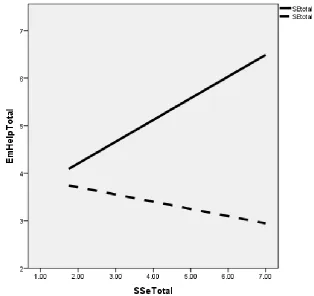
Figure 1. High self-efficacy is expected to buffer the lack of social support, which in turn
leads to less need for emotional help.
Actual Contact vs. Appropriate Contact
For the last hypothesis I handle overall expectations on how different institutions will contribute to the individuals’ needs. From this is concluded what type of third-party
involvement would be of high value to people. The content thereby should target the
emotional and informational/procedural needs of people.
Mediation holds a powerful neutral third-party role since it fulfills emotional and
informational/procedural needs at the same time. On the one hand, mediators fulfill informational/procedural needs of people by “not only [facilitating] discussions, but they
usually impose a structure and process on the discussions that is designed to move the parties
[image:12.595.77.513.452.504.2]1999). On the other hand, mediation takes interests of both parties into account so that no
solution is dictated and both parties can accept and support the result (Brenninkmeijer,
Bonenkamp, van Bruggen, & Walters, 2003; Pruitt, 1993). Thereby, the (ex-)couple works
issues out together and the emotional aspects (of their interpersonal relationship) are not
neglected. Accordingly, a positive relationship between the contact with mediators and the
need for emotional help as well as the need for informational/procedural help is expected (4TH
HYPOTHESIS,PART I).
Amongst those third parties available to people going through a separation, a number
of third parties specifically offer practical information. Since finances play a big role in
separations, I will take a look at the financial advisor. A financial advisor manages the
separation concerning housing, alimony, pension, property and debts, thereby supporting his
clients according to procedural activities. The Legal Aid Desk is an institution that is
subsidized by the Legal Aid Board and the Ministry of Security and Justice. This institution
helps people to find the appropriate way to deal with their conflict, being specialized in a
variety of conflicts.
I expect people preferring informational/procedural help to involve third-party help from
financial advisors and/or the Legal Aid Desk. Therefore they are expected to be involved when people’s need for informational/procedural help is high (4TH HYPOTHESIS,PART II).
In the Netherlands, in case of a formal separation the involvement of a lawyer is always
compulsory. However, lawyers often fight out arguments on the basis of numbers instead of
personal issues. Therefore, people having contact with lawyers – involving a lawyer by choice
or not – might have higher needs for emotional third-party help, as this aspect is often
Method
Participants
The target group of this research is people who have decided to separate from their
(ex-)partner, but still need to get things arranged. All participants are residents of the Netherlands
as the goal is to improve help and its supply in the Netherlands. It might be especially
valuable that the participants of this research are going through the separation process
themselves and the study is not conducted within imaginary settings. The total amount of
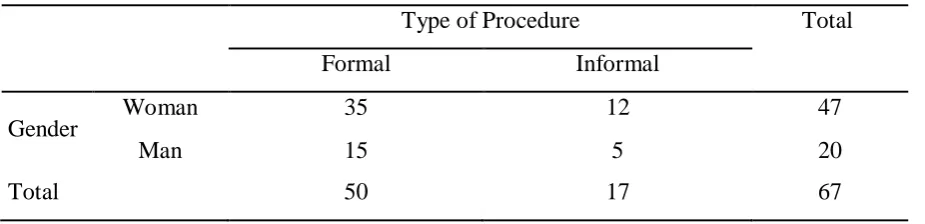
(valid) participation was 67, of which 47 were women and 20 were men. In total, 50
participants belong to the formal group (married couples, and civil unions with children), and
17 belong to the informal group (civil unions without children, and people living together).
The pre-measurement delivered a total of 115 participants. At first, the main questionnaire
which was sent out one week after the pre-measurement had a participation quote of 49%.
After sending out reminders, some additional 10% filled in the main questionnaire. Only by
[image:14.595.70.533.435.547.2]completion of that main questionnaire participants are included to the dataset.
Table 1.
Crosstable of Gender and Type of Procedure4.
Type of Procedure Total
Formal Informal
Gender Woman 35 12 47
Man 15 5 20
Total 50 17 67
Procedure
The current study is part of a major study from which the data for this study is adopted5 (Van
Dijk, 2013, manuscript in preparation). Participation was anonymous and as compensation the
4
It comes to the formal procedure in the case of marriage or civil union conflicts. Those have to involve a lawyer to make the separation of the partnership legally valid. The informal procedure affects people who are only living together and thereby used to share common goods and/or have common children. They are not bound to any legal demands and can make decisions themselves.
5
participant would receive a €10 voucher for bol.com after completion of all parts6
. The second
and third questionnaire are (going to be) sent via e-mail and, in case there is no participation
within six days after the invitation is sent, four reminders are sent again at intervals of six
days. After that the participant will no longer be contacted and removed from the main
dataset. This caused a drop-out rate of 41%.
The data was gathered within a five-month time span, with online pre-measurements
starting late July. It is obtained in cooperation with the Dutch Legal Aid Board. People with
separation issues are directed towards a particular website where they are asked to participate
in the study. Further data was obtained in various ways starting in September. There was a
distribution of hard-copy flyers on public events, spreading of online flyers on platforms for
separation issues, social networks, etc. Furthermore, divorce coaches were contacted via email
with the request to spread our questionnaire and calls were send out to professional journals.
The flyers contain both a link as well as a QR-code (quick response-code) for smart phone
users which lead people to the online questionnaire. Altogether, a broad population is reached,
and only those who are really concerned will participate.
Measurement
The questionnaire consists of around 40 questions7. On average filling in the questionnaire
takes about 15 minutes. Demographic data is retrieved from the pre-measurement. Those who
filled in the questionnaire via Rechtwijzer.nl were exposed to a second set of questions, which
serves a later diagnosis of participants and takes around 5 minutes. It reveals the kind of
shared bond the (ex-)couple has, which are later subdivided into formal and informal group.
Participants could define their stage of escalation in five different degrees, ranging from 1 = “We have not spoken about separation agreements yet” to 5 = “Talking to each
other turns into arguments and emotions run high”. The distribution of answers is shown in
table 2. It reveals that most people already experienced a bad turn in their deliberations.
6
The entire study consists of three measurements all of which are consisting of roughly the same questionnaire: Starting with a pre-measurement, which is followed by a second measurement one week later. After 5 months the last questionnaire will be sent for comparison-reasons. Due to fixed deadlines there was no possibility to wait for the data of the last questionnaire. When talking about the (main) measurement/ (main) questionnaire we mean the second questionnaire.
7
Self-efficacy (M = 4.28, SD = 1.04, α > .708) was measured in the main measurement9
by asking the participants to what extent they agreed or disagreed with specific statements.
Self-efficacy is operationalized on the basis of the Problem Solving Inventory (PSI; Heppner
& Petersen, 1982). It consists of six items which are manually adapted to divorce situations: “I adhere to my opinion when talking to my (ex-)partner”, “I keep my emotions about the
divorce under control when talking to my (ex-)partner”, etc. Answers on a 6-point Likert
scale range from 1 = “strongly disagree” to 6 = “strongly agree”.
The dataset measuring social support (M = 5.07, SD = 1.38, α > .90) is a scale
consisting of seven items which measure the availability of people in the environment of the
participant within the last two months. The items are grouped in two categories: emotional
and informational social support. Emotional social support (M = 5.37, SD = 1.41, α > .90) is assessed by four items asking to what extent people have been given comfort: “To what extent
have there been people in your close environment… • where you could be yourself?, • who
consoled you?” etc. The other three items assess informational social support (M = 4.68, SD =
1.47, α > .70) which includes support on procedural activities in the separation: “To what extent have there been people in your close environment… • who helped when some action
had to be taken?” etc. All answers again are measured on a 7-point Likert scale ranging from
1 = “not at all” to 7 = “to a very large extent”, and “not applicable” as an alternative option.
The difference between emotional and informational social support is made on the basis of
Chen et al. (2012). Different kinds of social support would be crucial to assess as they
mediate the need for help differently.
As mentioned earlier, Meedendorp et al. (2011) created a scale of needs that refers to
the preferred kind of help the participants would like to receive according to its content. The
current research is built upon the discriminative value of the scale, and worked out on the
basis of later research (Chen et al., 2012). The two types of help selected for the current study
are randomly assessed throughout the construct need for third-party help. In order to proof the
grouping of variables into two types of help, an exploratory factor analysis is carried out. The
KMO value of the factor analysis is .88, which is acceptable (Cerny & Kaiser, 1977). I found
8 Cronbach’s alpha was calculated to measure if different items of one construct would measure the same.
According to De Vellis (2003), the reliability of constructs needs to be α > .70, however, sometimes a reliability quotient of α > .60 is accepted as well, to rate a construct internally significant.
9
5 components for the analysis, which explains around 45% of the variance (table 3). All factor
loadings are above .60, so none of them is left out (table 3).
The need for emotional help (M = 4.5, SD = 1.56, α > .90; “Share my experiences with
others”, etc.) is measured by six items. According to the factor analysis, they refer to two
contents. The first component describes the desire op participant to talk about their situations
(four items). The second component shows how participants need active emotional support by
others (two items; table 3). Informational/procedural help (M = 5.32, SD = 1.28, α > .90; “Practical support when it comes to the procedure I have to go through”, etc.) consists of
nine items. Eight of those items refer to the desire of people to receive information on the
procedure today; the remaining item describes the desire to receive information on former,
similar cases (see Appendix). Answers on a 7-point Likert scale range from 1 = “strongly
disagree” to 7 = “strongly agree”.
Next, I measured if people already involved athird-party institution, with regard to the
following four institutions: mediators, financial advisors, Legal Aid Desk, and lawyers.
Dummy variables were created and possible scores are: 0 = “No third-party involvement
(yet)”, 1 = “Third-party involvement by myself or together with my (ex-)partner”. Since this is
a binary variable, a logistic regression analysis is used for all three parts of the fourth
hypothesis.
Table 2.
Stage of Escalation in Negotiations with the (Ex-)Partner.
N Percent
Valid
We have not spoken about separation agreements yet. 8 11.9
We are trying to come to an agreement together. 27 40.3
We try to discuss the agreements to be made, but it is
becoming more difficult. 12 17.9
Communication is not as good anymore. 10 14.9
Talking to each other turns into arguments and
emotions run high. 10 14.9
Table 3.
Exploratory Factor Analysis on Two Types of Third-Party Help, and the Distribution of their
Loadings of Items along 5 Components.
Item 1 2 3 4 5
Need for Informational/Procedural Help 9 .87
Need for Informational/Procedural Help 2 .85
Need for Informational/Procedural Help 5 .81
Need for Informational/Procedural Help 1 .78 .33
Need for Informational/Procedural Help 4 .72 .34
Need for Informational/Procedural Help 6 .70 .53
Need for Informational/Procedural Help 3 .62 .57
Need for Emotional Help 1 .90
Need for Emotional Help 2 .87 .36
Need for Emotional Help 3 .76
Need for Emotional Help 6 .72 .33 .46
Need for Emotional Help 5 .37 .83
Need for Informational/Procedural Help 7 .49 .75
Need for Emotional Help 4 .41 .38 .65
Need for Informational/Procedural Help 8 .37 .82
[image:18.595.71.528.550.701.2]Note. Blank space in the first row means that the cross-loadings were below .30.
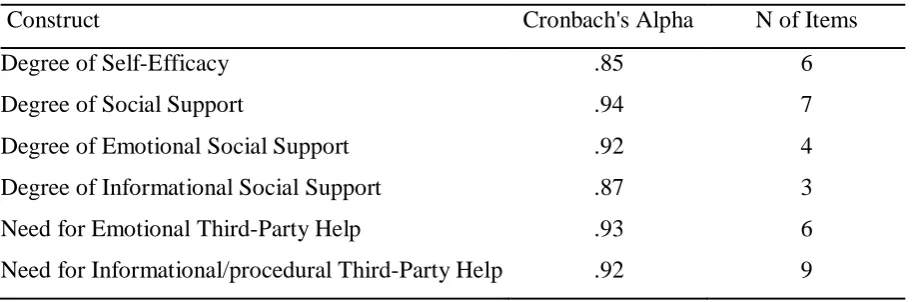
Table 4.
Cronbach’s alpha for the different constructs of the current study.
Construct Cronbach's Alpha N of Items
Degree of Self-Efficacy .85 6
Degree of Social Support .94 7
Degree of Emotional Social Support .92 4
Degree of Informational Social Support .87 3
Need for Emotional Third-Party Help .93 6
Need for Informational/procedural Third-Party Help .92 9
Results
General Statistics
The hypotheses where tested by regression analysis with α = .10. I controlled for the stage of escalation with regard to the participants’ separation. The creation of a histogram showed that
none of the constructs is normally distributed (thus non-parametric). At last, the margin of
error of this study is around .12 (margin of error = 1/√67).
Hypotheses Testing
Hypothesis 1. High scores on self-efficacy are expected to be positively related to the need of
people for informational/procedural help. People scoring low on self-efficacy might have
more need for emotional third-party help.
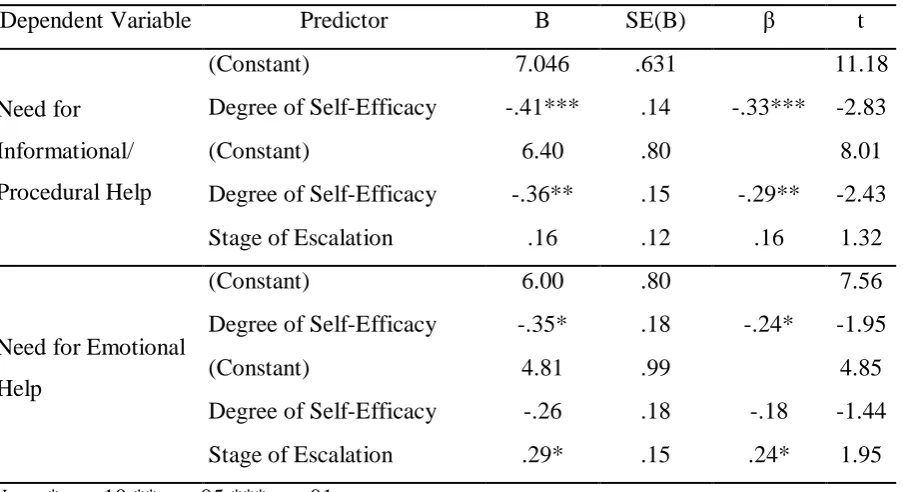
There is a significant main effect between self-efficacy and the need for
informational/procedural third-party help, with b = -.33, t(67) = 11.18, and p < .01. The
regression coefficient is negative, which was not expected. It implies that high scores on
self-efficacy also lead to less need for informational/procedural third-party help. Another main
effect is found between self-efficacy and the need for emotional third-party help, with b =
-.24, t(67) = 7.65, and p < .05. As expected, the relationship is negative, that is high scores of
[image:19.595.76.528.515.761.2]self-efficacy lead to less need for emotional third-party help. For exact values see table 5.
Table 5.
Hypothesis 1, Regression Values: Self-Efficacy as Predictor and both, Need for
Informa-tional/Procedural Help and Need for Emotional Help, as Dependent Variables (N=67)
Dependent Variable Predictor B SE(B) β t
Need for
Informational/
Procedural Help
(Constant) 7.046 .631 11.18
Degree of Self-Efficacy -.41*** .14 -.33*** -2.83
(Constant) 6.40 .80 8.01
Degree of Self-Efficacy -.36** .15 -.29** -2.43
Stage of Escalation .16 .12 .16 1.32
Need for Emotional
Help
(Constant) 6.00 .80 7.56
Degree of Self-Efficacy -.35* .18 -.24* -1.95
(Constant) 4.81 .99 4.85
Degree of Self-Efficacy -.26 .18 -.18 -1.44
Stage of Escalation .29* .15 .24* 1.95
Hypothesis 2. People receiving emotional social support from their social environment are
expected to have a higher need for informational/procedural third-party help. People
receiving informational social support might have higher needs for emotional third-party
help.
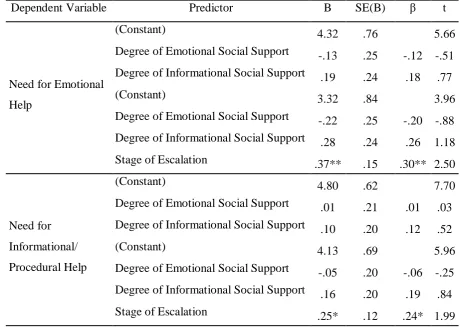
There are no main effects found between emotional social support and the need for emotional
help (b = -.12, t(67) = 5.66, ns). Therefore the first part of our hypothesis has to be rejected.
The second part describing the relationship between informational social support and need for
emotional help does not show significant main effects either: b = .18, t(67) = 5.66, ns. As I wasn’t expecting informational social support to have influence on needs for emotional
[image:20.595.65.526.383.710.2]third-party help, this part of the hypothesis in fact is supported. For exact values see table 6.
Table 6.
Hypothesis 2, Regression Values: Both Emotional Social Support and Informational Social
Support as Predictors, and Need for Emotional Help as Dependent Variable, a) when
Controlled for Stage of Escalation (N = 67)
Dependent Variable Predictor B SE(B) β t
Need for Emotional
Help
(Constant) 4.32 .76 5.66
Degree of Emotional Social Support -.13 .25 -.12 -.51
Degree of Informational Social Support .19 .24 .18 .77
(Constant) 3.32 .84 3.96
Degree of Emotional Social Support -.22 .25 -.20 -.88
Degree of Informational Social Support .28 .24 .26 1.18
Stage of Escalation .37** .15 .30** 2.50
Need for
Informational/
Procedural Help
(Constant) 4.80 .62 7.70
Degree of Emotional Social Support .01 .21 .01 .03
Degree of Informational Social Support .10 .20 .12 .52
(Constant) 4.13 .69 5.96
Degree of Emotional Social Support -.05 .20 -.06 -.25
Degree of Informational Social Support .16 .20 .19 .84
Stage of Escalation .25* .12 .24* 1.99
Hypothesis 3. A moderating effect of the two determinants is expected: A lack of especially
emotional social support leads to an increased need for emotional help, but only when
self-efficacy is low as well.
To find the moderating effect of self-efficacy on the relationship between social support and
need for emotional help, an interaction analysis is carried out. There is a significant
moderating effect with M = 3.51 and p < .05. As already indicated in hypothesis 1,
self-efficacy and need for emotional help have a significant negative relationship: b = -.29, t(67) =
-2.34, p < .05. Emotional social support is positively related to need for emotional help,
however, the variable does not have a significant value by itself (b = .16, t(67) = 1.32, ns).
The moderation of emotional social support and self-efficacy is positive: b = .28, t(67) =
2.34, p < .05 (table 7). A moderating effect is indicated, implying the following: low scores
on emotional social support cause the highest need for emotional help, when scores on
self-efficacy are low as well. Whereas low scores on emotional social support cause the lowest
need for emotional help, when scores on self-efficacy are high. In other words, high scores on
[image:21.595.88.521.487.707.2]self-efficacy buffer the need for emotional help, when social support is low.
Table 7.
Hypothesis 3, Moderation: Emotional Social Support as Predictor, Emotional Help as
Dependant Variable, and Self-Efficacy as Moderator on their Relationship, a) when
Controlled for Stage of Escalation (N = 67)
Dependent Variable Predictor B SE(B) β t
Need for Emotional
Help
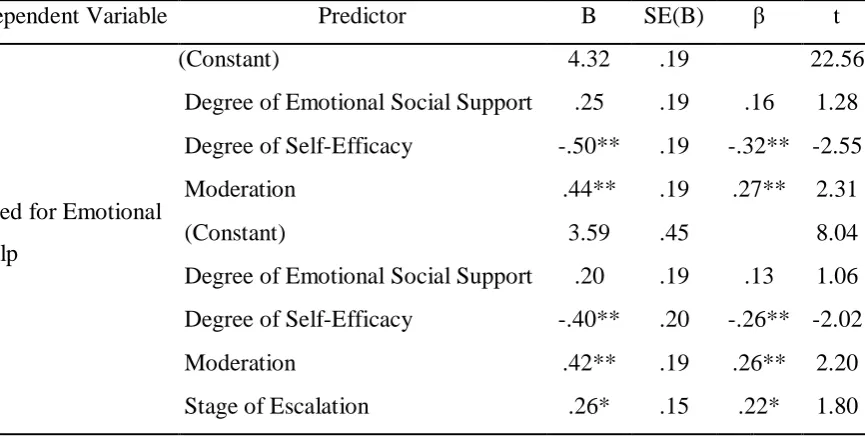
(Constant) 4.32 .19 22.56
Degree of Emotional Social Support .25 .19 .16 1.28
Degree of Self-Efficacy -.50** .19 -.32** -2.55
Moderation .44** .19 .27** 2.31
(Constant) 3.59 .45 8.04
Degree of Emotional Social Support .20 .19 .13 1.06
Degree of Self-Efficacy -.40** .20 -.26** -2.02
Moderation .42** .19 .26** 2.20
Stage of Escalation .26* .15 .22* 1.80
Figure 2. Graphic Illustration of the Moderating Effect of Self-Efficacy on the Relationship
between Emotional Social Support and Need for Emotional Third-Party Help
Hypothesis 4. A positive relationship between the contact with mediators and the need for
emotional help as well as the need for informational/procedural help is expected (part I).
Results are expressed in table 8. Regression analysis did not show significant effects for
contact with mediators and the need for emotional help (b = -.39, t(67) = 4.15, ns). It means
that people with more emotional help do not necessarily have contact with mediators. There is
a positive main effect for the contact with mediators and the need for
informational/procedural help (b = .55, t(67) = 4.15, p = .10.; table 8). It implies that people
with higher needs for informational/procedural help have more contact with mediators. Part
one of the fourth hypothesis is party confirmed.
Financial advisors and/or the Legal Aid Desk are expected to be involved when
people’s need for informational/procedural help is high (part II).
There is no significant relationship between the need for informational/procedural help and
the contact to financial advisors (b = -.03, t(67) = 3.67, ns). Neither are there main effects found people’s contact with the Legal Aid Desk and the need for informational/procedural
The more need for emotional third-party help there is, the less people are expected to
have contact with lawyers (part III).
The third part of the fourth hypothesis is not confirmed since there is no main effect found between the need for emotional help and people’s contact with a lawyer (b = -.23, t(67) =
[image:23.595.75.528.279.562.2]3.87, ns; table 8). That is, the third party of hypothesis 4 is rejected as well.
Table 8.
Hypothesis 4, Part I, II & III, Regression Values: Contact with Different Third-Party
Institutions as predictors, and the Need for Emotional Help and/or the Need for
Informational/Procedural Help as Dependent Variables (N = 67)
Dependent Variable Predictor B SE(B) Wald Exp(B)
I. Contact with
Mediator
Need for Emotional Help -.39 .30 1.67 .68
Need for
Informational/Procedural Help .55* .33 2.71 1.73
(Constant) .33 1.22 .08 1.40
II. Contact with
Financial Advisor
Need for
Informational/Procedural Help -.03 .23 .01 .97
(Constant) 1.30 1.25 1.08 3.67
II. Contact with
Legal Aid Desk
Need for
Informational/Procedural Help -.19 .24 .61 .83
(Constant) 2.10 1.36 2.39 8.13
III. Contact with
Lawyer
Need for Emotional Help -.23 .17 1.81 .80
(Constant) 1.35 .81 2.80 3.87
Note. *p < .10
Discussion
Third-party help can be important in interpersonal conflicts (Giebels & Yang, 2009).
Separations are much about the interpersonal relationship, and third-party help was indicated
to be important in separation conflicts as well (Te Brummelstroete, 2013).
The purpose of the current study is to investigate two determinants that influence the need for
third-party help. Hereby, the focus lies on divorce and separation conflicts. Those types of
conflicts are stressful in particular since they are quite complex with regard to the many
different issues that have to be regulated.
The current study is part of a bigger study which is set up in cooperation with the Dutch Legal
Aid Board. The Legal Aid Board tries to make help in conflicts available for everybody, and the studies’ overall goal is to improve the supply of appropriate help. Along with that, the
current paper not only tries to identify the needs of people, but also asks if the people are
approaching the appropriate help to fulfil their needs. If that is not the case, the Legal Aid
Board could present as much help as possible, but the people would not benefit from it in the
maximum way.
Throughout hypothesis 1 I expected people with high scores on self-efficacy to have
high needs for informational/procedural third-party help since I hypothesized that people
would be goal-oriented and seek for information on how to solve their separation conflicts.
Furthermore, people with low scores on self-efficacy were expected to have high needs for
emotional third-party help. As expected I found a negative relationship between self-efficacy
and need for emotional third-party help, implying that low scores on self-efficacy lead to a
higher need for help. Unexpectedly, a lack of self-efficacy significantly leads to higher needs
for informational/procedural help. Still, the results reflect the definition by Bandura (1986),
that self-efficacy means trusting one’s own abilities. In contrast to our assumption, people
with little self-efficacy don’t seem to be overcharged by informational/procedural help, but
seem to be happy about any kind of help instead.
In hypothesis 2 I stated that less need for either emotional or informational/procedural
third-party help is needed, when the social environment is offering either emotional or
informational social support. Due to non-significant relationships I have to reject hypothesis 2
as a whole. However, the second part of hypothesis was confirmed particularly because of the
unavailability significance. According to these findings, social support – regardless if it is
emotional or informational – is not enough to satisfy people’s needs for emotional support.
When recalling findings by Rahe (1969) that a divorce or separation is highly stressful to
reasonable. Hence, the current study is supported in the decision to lay focus on emotional
help. As mentioned earlier, Chen et al. (2012) subdivided social support in two categories,
too, and could confirm the appropriateness of this division. The current study was not able to
reproduce their findings. The study by Deno et al. (2012), however, might give an indication
why the results could not be reproduced: it describes different effects of social support in
terms of the provider. The value of social support seems to depend on the source, that is,
friends would have different influence than family. This option is not taken into account here.
Next I looked for the mediating value of self-efficacy on the relationship of emotional
social support and the need for emotional third-party help. Hypothesis 3 brought up a
significant moderating effect: A lack of emotional social support leads to an increased need
for emotional help, but only when self-efficacy is low as well. High scores of self-efficacy,
instead, buffer the lack of emotional social support and cause significantly less need for
emotional help. This goes along with hypothesis 1, where the impact of self-efficacy on need
for emotional help in form of a negative relationship was found.
In hypothesis 4, I checked whether people meet their own needs by the third-party
involvement that took place so fare. Firstly, contact with mediators was expected to predict
high needs for both, emotional and informational/procedural third-party help. Secondly,
ontact with financial advisors and the Legal Aid Desk should predict the need for
informational/procedural third-party help. At last, contact with a lawyer was expected to
negatively predict high needs for emotional help. Only the first part could be partly
confirmed: as expected, people with needs for informational/procedural help have contact
with mediators. All other parts of the hypothesis had to be rejected due to non-significance.
If results were significant, however, still three of the five hypothesized relationships are
contrary form what expected. This implies that only little people have contact with third-party
institutions which in fact meet their needs. This would indicate that people do not meet their
own needs since they have contact with the inappropriate kind of third-party help.
After all, we have to keep in mind that my predictions on the appropriate third-party
involvement miss scientific support and I, instead, made predictions on the basis of allover
assumptions on how third-party institutions contribute to needs.
Self-efficacy is said to be important for constructive conflict management (Deutsch et
come from hypotheses about self-efficacy10. The study therefore supports findings by earlier
studies about the significant impact of self-efficacy on conflicts.
Limitations
The current study was able to contribute to research on separation conflicts by the application
of determinant from other conflict research on the separation context in particular. However,
the results of the current study could eliminate some distracting factors. Due to time limits,
the expected number of participants is not a quarter as close. As mentioned in the results
section, according to the margin of error only 12% of the results found can be trusted, since a
small dataset can give a-typical results the chance to be more influential. The
pre-measurement, however, came up with around 115 participants. Reason for drop-outs could be
the length of the questionnaire is around 15 minutes, respectively 20 minutes when assessed
via Rechtwijzer.nl.
Above that, we have to expect sample bias. The gathering of participants was not randomly as
the questionnaire was spread specifically in fora and magazines for divorces, etc., which
causes that not all members of the population have an equal chance to participate.
Future Implications
Context is important when we consider the effects of social support and self-efficacy on the
needs for third-party help. This study examines these relations in the context of separation
conflicts which are both quite common and stressful. Other studies, however, took place in
different contexts (e.g. Deno et al., 2012, study with cancer patients), and although they offer
significant relationships, we cannot conclude for sure that the determinants would have the
same effects in separation conflicts. It is wise to take those findings as a leitmotif; still, it is
recommendable to investigate determinants per conflict and/or per circumstance.
For future research, I would further recommend an assessment of cultural aspects.
Prior study indicates that culture is an influential background variable for conflicts. The
current study indicated that some participants have foreign origins; therefore it would be
convenient to pursue the outcomes of other studies in the context of the current topic.
There are many more factors playing on the needs for third-party help that might be
relevant particularly in separation conflicts and could be investigated within the current study.
10
As mentioned earlier, research found that separation is a stressful life event. Others indicated
that self-efficacy seems to buffer emotional distress deriving from inadequate social support
(Deno et al., 2012). Along with that, Giebels and Janssen (2005) found that third-party help
(here: mediation) to have a significantly mitigating effect on conflict stress. Therefore there
might be interesting findings hidden behind the factor stress when it comes to separation
conflicts.
Conclusion
Many of the above evaluated hypotheses do not deliver enough significance and therefore are
rejected. Taking a closer look at their values, however, indicates that most relationships are
even contrary to what I was expecting. Assuming that the non-significance is due to lack of
participants would allow us to conclude that more than half of people indeed do not involve
the third parties that actually would fit their needs. Thereby the current study would have
found a crucial circumstance. Firstly, these findings should nourish further research in order
to find if the indication is correct. Secondly, confirming those findings would provoke the
need for new ideas about how to guide people make reasonable choices. In other words, the
help for people is only as good as it fits their needs.
Some positive feedback comes from the participants: “Practical help is desirable”,
stated one of them. After all, it is crucial to go on with research and improvements on help to
References
Ajzen, I. & Fishbein, M. (1977): Attitude & behavior relations: a theoretical analysis and
review of empirical research. Pychological Bulletin, 84, 888-918.
Amir, M., Roziner, I., Knoll, A., & Neufeld, M.Y. (1999). Self-Efficacy and Social Support as
Mediators in the Relation Between Disease Severity and Quality of Life in Patients
with Epilepsy. Epilepsia, 40(2), 216-224.
Bandura, A. . (1986). Social Foundations of Thought and Action: A Social Cognitive Theory.
Englewood Cliffs, NJ: Prentice Hall.
Bercovitch, J., Kremenyuk, V., & Zartman, I.W. (2009). The SAGE Handbook of Conflict
Resolution. London: SAGE Publications Ltd.
Brenninkmeijer, A.F.M., Bonenkamp, H.J., Bruggen, J. van, & Walters, P. (2003). Handboek
mediation. Den Haag: Sdu uitgevers.
Brummelstroete, L. te (2013). Behoefte aan hulp van een derde partij bij echtscheidingen.
Bachelorscriptie, Universiteit Twente, Enschede.
Caplan, G. (1974). Support systems and community mental health. New York: Behavioral
Publications.
Cerny, C.A., & Kaiser, H.F. (1977). A study of a measure of sampling adequacy for
factor-analytic correlation matrices. Multivariate Behavioral Research, 12(1), 43-47.
Chen, J.M., Kim, H.S., Mojaverian, T., & Morling, B. (2012). Culture and Social Support
Provision: Who Gives What and Why. Journal of Personality and Social Psychology,
38(1), 3-13
Consortium, Conflict Research. (1999). Third Party Intervention Retrieved 20 october, 2013,
from http://www.colorado.edu/conflict/peace/treatment/3ptyint.htm.
Deno, M., Tashiro, M., Miyashita, M., Asakage, T., Takahashi, K., Saito, K., Busujima, Y.,
Mori, Y., Saito, H., & Ichikawa, Y. (2012). The mediating effects of social support
and self-efficacy on the relationship between social distress and emotional distress in
head and neck cancer outpatiens with facial disfigurement. Psycho-Oncology, 21,
144-152.
Deutsch, M. (1958). Trust and suspicion. Journal of Conflict Resolution, 2, 265-279.
Deutsch, M., Coleman, P.T., Marcus, E.C. (2006). The handbook of conflict resolution:
theory and practice. (2nd ed.). San Francisco, CA: Jossey-Bass.
Dijk, M. van, medeauteurs (2013). Predictors and consequences of conflict assymetry in legal
conflicts. Manuscript in preparation.
Douglas, L.P.R. (2012). In need of a third party: The influence of conflict asymmetry, future
interaction and cultural background on the needs from third-party help. Bachelor,
Universiteit Twente, Enschede.
Ergeneli, A., Camgoz, S.M., & Karapinar, P.B. (2010). The relationship between self-efficacy
and conflict-handling styles in terms of relative authority positions of the two parties.
Social Behavior and Personality, 38(1), 13-28.
Giebels, E., & Euwema, M. (2006). Conflictmanagement: Analyse, diagnostiek en interventie
(2nd ed.). Groningen: Noordhoff Uitgevers.
Giebels, E., & Janssen, O. (2005). Conflict stress and reduced well-being at work: The
buffering effect of third-party help. European Journal of Work and Organizational
Psychology, 14(2), 137-155.
Giebels, E., & Yang, H. (2009). Preferences for Third-Party Help in Workplace Conflict: A
Cross-Cultural Comparison of Chinese and Dutch Employees. Negotiation and
Conflict Management Research, 2(4), 334-362.
Glasl, F. (1990). Konfliktment. Bern: Verlag Paul Haupt.
Heppner, P.P. & Petersen, C.H. (1982). The development and implications of a personal
problem solving inventory. Journal of Counseling Psychology, 29, 66-75.
Juridisch Loket (n.d.). Echtscheiding: hoe regel ik dat? Retrieved 20 september, 2013, from
http://www.juridischloket.nl/vraagenantwoord/familie-relatie/echtscheiding/echtscheiding-aanvragen/Pages/default.aspx.
Kassin, S., Fein, S., & Markus, H. (2011). Social Psychology (8th ed.). Belmont, CA:
Cengage Learning.
Liu, R.X., & Chen, Z.Y. (2006). The effects of marital conflict and marital disruption on
depressive affect: A comparison between women in and out of poverty. Social Science
Quarterly, 87(2), 250-271.
McAdams, D.P. (2009). The Person: An Introduction to the Science of Personality
Psychology (5th ed.). New York: Wiley.
Meedendorp, E., Giebels, E., & Rotman, L. (2011). Voorrapportage onderzoek Juridisch
Loket. Rapport wachtkameronderzoek. Enschede: Universiteit Twente.
Meline, T. (2009). A Research Primer for Communication Sciences and Disorders. (1st ed.).
Palesh, O.G., Shaffer, T., Larson, J., Edsall, S., Chen, X.H., Koopman, C., Turner-Cobb,
J.M., Kreshka, M,A,, Graddy, K., & Parsons, R. (2006). Emotional self-efficacy,
stressful life events, and satisfaction with social support in relation to mood
disturbance among women living with breast cancer in rural communities. The Breast
Journal, 12(2), 123–129.
Pruitt, D., & Carnevale, P. (1993). Negotiation in Social Conflict. Beltmont, CA: Thomson
Brooks/Cole Publishing Co.
Quick, J.C., Quick, J.D., Nelson, D.L., & Hurrell, J.J. (1997). Preventive stress management
in organizations. Washington, DC, US: American Psychological Association.
Rahe, R.H. (1969). Life crisis and health change. In P.R.A. May, & Wittenborn, J.R. (Ed.),
Psychotropic Drug Response: Advances in Prediction. Springfield, Illinois: Charles C
Thomas.
Raad voor Rechtsbijstand (n.d.). Hoe groot is de kans van slagen? Retrieved 25 september,
2013, from
http://www.rvr.org/nl/subhome_rz/faq,Mediation/Hoe-groot-is-de-slaagkans-.html
Rotman, L. (2011). Behoeften aan derde partij hulp: Welke rol speelt afhankelijkheid?
Bachelor, Universiteit Twente, Enschede.
Sarason, I.G., Levine, M.H., Basham, R.B., & Sarason, B.R. (1983). Assessing Social
Support: The Social Support Questionnaire. Journal of Personality and Social
Psychology, 44(1), 127-139.
Shestowsky, D. (2004). Procedural Preferences in Alternative Dispute Resolution: A Closer,
Modern Look at an Old Idea. Psychology, Public Policy, and Law, 10(3), 211-249.
Shnabel, N., & Nadler, A. (2008). A Needs-Based Model of Reconciliation: Satisfying the
Differential Emotional Needs of Victim and Perpetrator as a Key to Promoting
Reconciliation. Journal of Personality and Social Psychology, 94(1), 116-132.
Sprangers, A., & Steenbrink, N. (2008). Bijna 33 duizend echtscheidingszaken afgehandeld in
2007 (pp. 14-18): CBS.
Tjosvold, D. (2008). Conflict-positive organization: it depends upon us. Journal of
Organizational Behavior, 29, 19-28.
Ufkes, E.G., Giebels, E., Otten, S., & Zee, K.I. van der. (2012). The effectiveness of a
mediation program in symmetrical versus asymmetrical neighbor-to-neighbor
conflicts. International Journal of Conflict Management, 23(4), 440 - 457.
Wade, T.J. and Pevalin, D.J. (2004). Marital Transitions and Mental Health. Journal of Health
Wetzer, I.M., Zeelenberg, M., & Pieters, R. (2007). Consequences of social sharing emotions:
Testing the emotion-response congruency hypothesis. European Journal of Social
Psychology, 37, 1310-1324.
Appendix
[image:32.595.77.523.182.614.2]SPSS Output
Table 9.
Factoranalysis: Total Variance Explained.
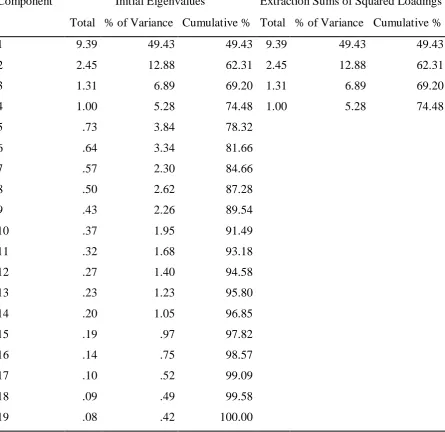
Component Initial Eigenvalues Extraction Sums of Squared Loadings
Total % of Variance Cumulative % Total % of Variance Cumulative %
1 9.39 49.43 49.43 9.39 49.43 49.43
2 2.45 12.88 62.31 2.45 12.88 62.31
3 1.31 6.89 69.20 1.31 6.89 69.20
4 1.00 5.28 74.48 1.00 5.28 74.48
5 .73 3.84 78.32
6 .64 3.34 81.66
7 .57 2.30 84.66
8 .50 2.62 87.28
9 .43 2.26 89.54
10 .37 1.95 91.49
11 .32 1.68 93.18
12 .27 1.40 94.58
13 .23 1.23 95.80
14 .20 1.05 96.85
15 .19 .97 97.82
16 .14 .75 98.57
17 .10 .52 99.09
18 .09 .49 99.58
19 .08 .42 100.00
Table 11.
Factor Analysis: Loadings and summary
Loadings - Close loadings in different factors: InfProHelp 3, 6 & EmHelp 4, 6
- Higher loadings at 1st factor: InfProHelp 1, 3, 4
- Higher loadings at 2nd factor: EmHelp 1-3
- Higher loadings at 3rd factor: EmHelp4/5, InfProHelp 7
- Higher loadings at 4th factor: InfProHelp 8
Belonging
to 1 factor
- “Information on the steps that have to be taken today“ InfProHelp 1-7, 9
- “Information about former similar cases” InfProHelp 8
- “Being able to talk about things” EmHelp 1-3, 6
- “Emotional support by others” EmHelp 4, 5
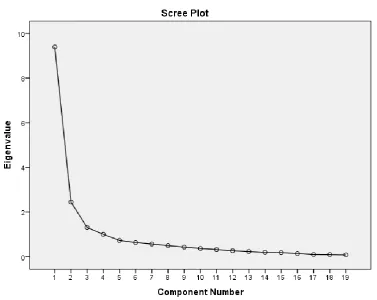
Figure 3. Scree plot: Where the graph is changing to horizontal: choose the number of
[image:33.595.77.455.364.664.2]Table 12.
Individual Comments of People (Dutch Original)
Comments pre-measurement (includes invalid measurements, i.e. drop-outs, as well)
- Mijn grootste frustratie is dat mijn partner niet voordurend bezig is om mij bewust
het bloed onder de nagels vandaan te halen door mij in alles te bevechten. Bij ons is
het zodanig geëscaleerd dat ik een uitbarsting heb gehad van fysiek geweld, IETS
WAAR IK ZELF ENORM VAN GESCHROKKEN BEN. De rechter behandeld mij
vervolgens als een stuk vuil en wijst mij binnen 5 minuten van de zitting aan als
oorzaak van alle problemen. Ik ben 80/100% arbeidsongeschikt. Mijn partner is
kostwinner en werkt 4 dagen in de week. Het werkelijke belang van de kinderen
wordt volledig genegeerd en het is voor mij duidelijk voelbaar dat de rechtbank haar
beleid volgt (50/50 regeling). De rechtbank is bijgevolg TOTAAL, maar dan ook
werkelijk TOTAAL ongevoelig voor mijn argumenten. Inmiddels ben ik zo
gefrustreerd dat ik bang ben dat ik mijn woede niet meer in de hand houdt.
Consultatiebureau, huisarts en psycholoog zeggen dat ik goed stilsta bij het belang
van de kinderen en de rechtbank veegt in één beweging ALLES van tafel. Voor een
tweede keer zijn we tijdens een zitting de gang op gestuurd om ZELF !? een
oplossing te vinden. Tijdens het uitoefenen van haar zorgtaken eist mijn partner dat
ik niet overnacht in de woning. Helaas heb ik niet altijd de mogelijkheid ergens
anders te slapen. Wat mijn partner en (letterlijk) rechter aangaat mag ik wat hun
betreft op een bankje in het park slapen. In mijn beleving wordt mijn PERSOON
GEWELD AANGEDAAN DOOR DE RECHTER/RECHTBANK HAARLEM. Er
wordt NIET GELUISTERD!!! Gewoon 50/50 regeling en de gang op.
- Betere opvang voor mensen met Verdriet.
- Ik wil er nog even aan toevoegen dat verschil/tegenstellingen in mijn antwoorden
mogelijke vragen oproepen, daarom wil ik er aantoevoegen dat de reden dat wij
willen scheiden is dat we onoverbrugbare communicatieproblemen hebben die
samenhangen met de persoonlijkheid van mijn man (hij heeft Asperger, een vorm
van autisme die vooral voorkomt bij hoger begaafden).
- Mijn man heeft een schuld van z'n vorige huwelijk na 12 jaar nog niet weggewerkt.
Ik heb er alles aan gedaan om dat wel te doen. We zijn in gemeenschap van goederen
getrouwd en ik ben nu bang dat hij me de helft van die schuld mee gaat geven. Ik zou