University of Warwick institutional repository: http://go.warwick.ac.uk/wrap A Thesis Submitted for the Degree of PhD at the University of Warwick
http://go.warwick.ac.uk/wrap/63125
This thesis is made available online and is protected by original copyright. Please scroll down to view the document itself.
A THEORETICAL AND COMPUTATIONAL STUDY OF THE
ION BEAM EXPLOSIVE INSTABILITY
MEMORANDUM
This dissertation is submitted to the University of Warwick in
support of my application for admission to the degree of Doctor of
Philosophy. It contains an account of my own work performed at the
Department of Physics at the University of Warwick during the period
October 1969 to September 1972 under the general supervision of
Dr G Rowlands. It also contains an account of work carried out using
the computing facilities at the U.K.A.E.A. Culham Laboratory under the
supervision of Mr B McNamara during the same period.
No part of this dissertation has been used previously In a degree
thesis submitted to this or any other University. The work described
in this thesis is the result of my own independent research except where
specifically acknowledged in the text.
The research for this thesis was financed by the U.K.A.E.A. Culham
Laboratory.
ACKNOWLEDGEMENTS
I would 1ike to express my thanks to Dr George Rowlands for
introducing me to the subject of plasma physics as an undergraduate, and
for his helpful advice and supervision during the course of this work.
In particular, I thank him for suggesting the problem investigated in this
thesis, and for devoting a great deal of time and interest in the progress
of the research.
I would also 1ike to thank Mr Brendan McNamara of the Culham
Laboratory for hIs help and advice on the computational aspects of the
research, and in particular for making available the NOVA program which
he developed at the Lawrence Radiation Laboratory, Livermore, California.
I thank the academic staff of the University of Warwick Physics
Department for their encouragement and friendship during this research,
and also the Culham Laboratory computer staff for their patience and the
long hours they worked to ensure that the programs were run.
Finally, I would like to thank Mrs Valerie Goodwin for typing this
ABSTRACT
This thesis contains an account of a theoretical study of the
non-linear interaction of three waves in a plasma. Kinetic equations are
derived, which describe the interaction for a plasma obeying the fluid
equations of magnetohydrodynamics, and for a plasma obeying the
Vlasov-Poisson equations. In the magnetohydrodynamic case we find that
energy is transferred back and forth between the three waves in a periodic
manner.
We study a Vlasov plasma with a diffuse ion beam propagating through
it, and find that one wave, a Landau unstable ion sound wave propagating
on the beam, behaves as though its energy were negative. The kinetic
equations predict that as it transfers energy to two other waves, it grows
in amplitude, and that all three waves reach an infinite amplitude in a
finite time. This phenomenon is known as an 'explosive instabil ity',
and the mechanisms governing the interaction are analysed in order to find
stabilisation processes.
We show that the unstable oscillations cause a heating of the beam
ions, a reduction in beam velocity and a distortion of the beam distribution
function, all of which contribute to stabilising the Interaction. We
find that the heating Is the dominant process, causing heavy Landau damping
of the unstable waves.
Two computer programs are described which were used to simulate the
beamed plasma configuration in order to test the theory. The results
show that heating is the dominant beam effect, and that wave growth saturates
as the heating becomes significant. Some of the computational techniques
developed during the implementation of the programs are described, and a
CONTENTS
MEMORANDUM
ACKNOWLEDGEMENTS
ABSTRACT
Page
( i)
(i
n
(i II)1. INTRODUCTI ON
( 1) Foreword '.1
(2) History of Work in the Field 2
(3) Scope and Plan of Thesis 6
(4)
Summary of Results8
2. THE THREE WAVE INTERACTION
( 1) Introduction
12
(2) The Multiple Timescale Approach
14
(3) Solution and Discussion of the Kinetic Equations
20
3. THREE WAVE INTERACTION IN A VLASOV PLASMA( 1) Introduction
24
(2) Negative Energy Waves
27
(3) Basic Equations 31
(4)
The Explosive Instabil ity 39(5) Discussion
44
4.
THE SATURATION OF THE INSTAB ILI TV( I ) Introduction
47
(2) Quasi-linear Effects on the Ion Beam
48
(3) Diffusion and Friction Coefficients 51
(4) Discussion 59
5. THE GALAXY ANO NOVA PROGRAMS
(5) Discussion
76
82
91
(3) An Appraisal of NOVA
(4) Results of the Simulation Experiments
6. CONCLUDING REMARKS
(1) Theory
(2) Computation
93
95
REFERENCES 99
APPENDICES
A. ENERGY CALCULATION FROM THE VLASOV EQUATION 102
B. EVALUATION OF t 107
co
CHAPTER 1
INTRODUCTION
1.1 Foreword
A difficulty in studying wave propagation in plasmas is that the
equations descrIbIng the evolutIon of a plasma are nonlinear, and in general
cannot be solved exactly. The most common simplification made, is to
assume that the plasma is close to a steady state, and hence that the
dependent plasma variables can be expressed In terms of a time independent
part and a (much smaller) time dependent part. By using such an expansion
in the plasma equations, and by neglecting products of small terms, one
gets 1 inear equations for the tIme dependent quantities, which can be
solved to yield the dispersive characteristIcs of the plasma. The study
of such equations Is known as the 'lInear plasma theory', and a central
feature of the theory Is that arbitrary (small) perturbations about a steady
state are expressible as a superposition of eigenmodes which evolve
independently of one another.
Over a period of time, much longer than the typical oscillation period
for an eigenmode however, the effects of the neglected nonl inear terms
could accumulate and modify the linear solution significantly. The waves
therefore, can no longer be considered to evolve Independently, but rather
to interact weakly with one another.
For small perturbations, the dominant nonlinear term will be that
formed from the product of two of the small time dependent quantities.
The inclusIon of such a term yields plasma equations which describe the
modification of the 'linear' wave due to the presence of two other waves in
the plasma. This phenomenon is known as a 'three wave Interaction' and
is responsible for many interesting and unusual plasma phenomena which
In this thesis, we study the interaction of three waves in an
electri-cally neutral plasma. As Kadomtsev, Mikhallovskii and Timofeev (1965)
show, it is possible for one of the waves participating in the interaction
to behave as though its energy were negative. The consequence of a
'negative energy' wave Interacting with two 'normal' waves Is that all three
wave ampl itudes can grow to infinity In a finite time. This phenomenon
is known as an 'explosive instabil ity', and clearly describes a ~esult which
is unphysical. We therefore study the mechanisms governing three wave
interactions, and also the physical properties of negative energy waves,
in order to develop a theory describing the stabilisation of the interaction.
1.2 History of Work In the Field
The phenomenon of two waves 'beating' together to drive a third Is
well known in the theory of harmonic oscillators. The mechanism behind
the phenomenon is a nonlinear Interaction between the waves, and the
condition that the coupling Is significant Is
w +w _ w,
m n R, (1.2.1)
where the w's are the frequencies of the three waves 1, m and n. If this
condition is not met, a resonance situation does not occur, and the wave 1
fails to oscillate In sympathy with the driving waves. In the case of
plasma waves, the situation is more complex. Kadomtsev (1965) shows that for plasma waves to interact, they must also satisfy the wavevector
condition
k + k "" kn•
m n '" ( 1. 2.2)
Much of the early work on the three wave Interaction was done by
Kadomtsev, and is described in his book (1965). He derives a general form for the kinetic equation describing the exchange of energy between three
(1.2.3)
where the ~IS are electrostatic potentials, and
rn
is a measure of the""mn
strength of the Interaction between the three waves t, m and n.
The usual approximation used In deriving the kinetic equation Is to
assume that dissipative effects are negligible. Malfl let (1969) however, has derived a kinetic equation which takes account of unstable or damped
waves propagating, and as such Is more difficult to analyse and solve.
The important point in Malfliet's paper Is that the effects of wave growth
and damping can be superimposed on a kinetic equation derived assuming zero
dissipation. For example, the effects of wave t having a Landau damping
rate Yt can be included by simply adding a term -Y1~t to the right hand
side of equation (1.2.3). More will be said on the subject of dissipative effects later In this Section.
The kinetic three wave Interaction equation has been solved for a
number of situations. In particular, Galeev and Oraevskli (1963) show that the Interaction can cause the decay of large amplitude Alfven waves.
Since Alfven waves represent exact solutions to the nonlinear plasma
equations, It would be expected that a large amplitude Alfven wave could
propagate indefinitely. Galeev and Oraevskll however, demonstrate how a
nonlinear coupling between the Alfven wave and a spectrum of pairs of low amplitude Ion acoustic waves results In the one way transfer of energy
from the Alfven wave to the background wave field. A similar result,
concerning the decay of high frequency plasma waves has been demonstrated
by Baka I (1970). His result applies to a plasma in which low and high frequency waves are propagating.
The first mention of the possibll ity of 'negatlve energyl waves
and Timofeev (1965). They show that for a plasma to support 'negative
energy' waves, it must be well away from thermodynamic equilibrium. They
describe some of the anomalous properties of such waves, and make the
proposition that an 'explosive Instabll ity' can occur If energy Is
trans-ferred from the negative energy wave to two other positive energy waves.
The explosive instability is examined in some detail by Coppl. Rosenbluth
and Sudan (1969) for the case of a plasma with a loss cone distribution In
a strong magnetic field. They calculate the strength of the coupling
between the three waves by balancing energy terms derived from the single
particle scattering of waves.
Fukal, Krlshan and Harris (1969) also examine the explosive Instability
for a plasma with a loss cone distribution. They calculate the coupling
strength by using a Hamiltonian formalism for the derivation of the kinetic
equation. They further show how the four wave kinetic equation describes
a stabilisation process for the Instability. The four wave equation has
solutions which predict that the waves suffer an amplitude dependent
frequency shift, and hence the frequency condition (1.2.1) for the
Inter-action would be violated. The four wave Interaction however, Is not the
unique stabilising process, and Dum and Sudan (1969) consider the
perturbations on the particle orbits caused by the large amplitude waves,
as a possible stabll Ising process. The assertion made Is that large
ampl itude oscillations can cause a significant enough change to the
distri-bution function, and hence also to the dispersion relation, for the negative
energy waves to cease to satisfy the requirements for an explosive
Instability.
As we said earlier, the problem of an explosive Instability In a region
of dissipation, is more difficult to solve. Not only Is the kinetic
equation of Malfllet (1969) more complicated due to adding effects such as
of waves appears. As Jarmen, Stenflo, Wilhelmsson and Engelmann (1969)
show, while phase changes due to either dissipation or the four wave process
of Fukai et al can stabilise explosive Instabil itles, they can also
de-stabilise situations which are otherwise stable.
The experimental evidence of the explosive Instability Is very limited.
Although the physical phenomenon of negative energy waves Is known in the
field of parametric amplifiers (cf. Sturrock, 1960), Its observation in
plasmas is speculative. Dum and Sudan (1969) comment that the bursts of
radiation and associated particle ejection observed In mirror confined
plasmas, suggest that an explosive Instability is reaching saturation point.
The suggestion is only qualitative, but Is accepted by many authors as an
explanation for the observations.
The limited experimental knowledge of the explosive Instability makes
It an ideal subject to simulate on a computer. Little or no work has
previously been done on the simulation of an explosively unstable plasma,
although numerical solutions to the kinetic equation have been found for a
large number of Initial conditions: see for example Wilhelmsson. Stenflo
and Engelmann (1970) and Stenflo. Wllhelmsson and Weiland (1970). This is
probably because simulation programs have only recently become sophisticated
enough to handle such problems.
The restrictions of speed and core size of the second generation
com-puters forced onto the computational physicist, the need to write highly
optimised programs which had to be tailored to a given class of plasma
problems. A significant Improvement was made however by the use of the
'Fast Fourier Transform' algorithm of Gentleman and Sande (1966) for solving
Poisson's equation for the electrostatic potential. This algorithm gives
an exact solution to the discrete form of Poisson's equation encountered
potential coefficients In the process. Some of the programming techniques
and high speed data dumping and restoring methods are discussed In detail
by Boris and Roberts (1969A).
With the advent of the large third generation computers and high speed
data transfer channels, It Is now possible to Implement two and three
dimensional simulation programs which are relatively free from the
restriction of being tailored to specific needs. The Increase In speed of
these machines over the previous generation opens up the possibility of
employing extremely sophisticated and accurate numerical analysis techniques,
as well as simulating a larger number of plasma particles. The larger
and cheaper memory available on present day computers also makes the task
of simulating more particles easier.
1.3 Scope and Plan of Thesis
A difficulty in studying the propagation of plasma waves Is that the
equations which describe the evolution of a plasma are nonlinear. We can
treat the equations by using a perturbation theory, and we find that it is
necessary to go to second order In the theory In order to study wave
Inter-actions, since the linear theory only describes Independent modes of
oscillation. If we attempt to do this however using a standard perturbation
theory, we find that the second order solutions contains secular terms;
that Is, terms which are unbounded in time. We can however, deal with this
problem of secularity by employing a multiple timescale perturbation theory
described by Frieman (1963), which has Its origins In the field of nonlinear
mechanics (cf. Bogoliubov and Krylov, 1947).
In Chapter 2 we demonstrate this technique for the case of a plasma
which obeys the fluid equations of magnetohydrodynamlcs (cf Montgomery and
Tidman (1964), Chapter 13). We examine a plasma configuration in which
nonlinear kinetic equations can be derived, which describe the exchange of
energy between three such waves. The kinetic equations can be solved to
give solutions describing a periodic exchange of energy back and forth
between the three waves. We further show how the multiple timescale
tech-nique can be used to derive kinetic equations describing four wave and
higher order interactions.
In Chapter 3, the same technique is applIed to the more detailed
Vlasov-Poisson plasma equations, and again kinetIc equatIons are derIved
which describe the interaction between three waves. In thIs case however,
for a certain class of waves, the equations predIct that the three waves
will all grow to an Infinite amplitude in a fInIte time. This phenomenon,
the 'explosIve Instability', was first Investigated by Kadomtsev, Mlkhailovskl
and Timofeev (1965). A necessary conditIon that three waves can Interact
In this unstable manner, Is that eIther one or two of the waves must have
what Is called 'negative energy'.
The concept of 'negative energy' waves is well known in the theory
of parametric ampl ifiers (cf Sturrock, 1960), where It Is used for studying
the amplificatIon of waves propagating in dispersive media. In Chapter 3
we also examine the physical characteristics of 'negative energy' waves
propagating in a plasma through which a diffuse ion beam Is travelling.
We show that such a beamed plasma can support three waves which satisfy the
criteria for an explosive instability. An expression Is derived for the
time taken by the waves to reach infinite amplitudes.
The Infinite solution however is unphysical and violates the
approxi-mation in the multiple timescale perturbation theory, that the waves are of
small amplitude. The examination of the physical meaning of 'negative
energy' waves however, gives us insight Into the mechanisms by which the
plasma particles when a 'negative energyl wave propagates, and in
partI-cular when it interacts with two other positive energy waves. For the
plasma configuration we study, we find three stabilisation mechanisms, the
most dominant of which is ion heating. This causes the interacting
waves to be heavily Landau damped.
In Chapter 5, we study the numerical and physical problems associated
with simulating the explosively unstable beamed plasma on a computer.
We describe the research and developments carried out on two computer
programs in an attempt to simulate the instability. We discuss methods
of avoiding numerical 'noise' caused by machine rounding errors and
approximations in the numerical analysis. A method is given for
calcu-lating initial particle co-ordinates such that the plasma has spatial
uniformity and low noise properties. We also give a condition for avoiding
spurious particle correlations which can arise In a numerical plasma of
such uniformity. The results of the computer simulations are described In
Section 5.~, and a comparison is made with the theory, specifically with
respect to the proposed saturation mechanisms. The results Indicate that
Landau damping stabilises the Instability.
l.~ Summary of Results
In Chapter 2 we derive kinetic equations for the interaction of two
circularly polarised Alfven waves with an ion acoustic wave. We use the
multiple timescale perturbation theory, and the results are the same as
given by Galeev and Sagdeev (1969) for the same case. The example is
given, not only to demonstrate the multiple timescale nature of the problem,
but also to displ,y the technique itself, and in particular we find the
frequency and wavevector conditions (1.2. land 2) appearing intrinsically
in the formal mathematics. Sagdeev and Galeev use a more phenomenological
approach to solve the problem. From the kinetic equations, an energy
theorem can be derived which has an interesting parallel in the case of
In Chapter 2 we apply the multiple timescale method to perturbations
in a neutral plasma In which the Ions are split Into two distributions.
The majority form a Maxwellian around v • 0, and the rest form a diffuse
beam. We find that a three wave interaction can occur between two Ion
sound waves propagating on the beam, and an Ion sound wave propagating In
the 'stationary' Ions. One of the beam modes has 'negative energy'.
In deriving the kinetic equations, we again find that (1.2.1 and 2) form
an intrinsic part of the formal mathematics. We solve the kinetic equations
for the three waves and find that their amplitudes grow In a similar manner
to the trigonometric tangent function. We show that the function becomes
infinite in a time which is inversely proportional to the wave amplitudes
at time t - O.
The physical characteristics of the waves and medium are analysed, and
we find that the ion beam can support a 'negative energy' wave (t) providing
and
lfoi
av
> 0,where Ub is the average beam velocity, and foi is the steady state value of
the total ion distribution function. We find that beam particle kinetic
energy is transferred to the 'negative energy' wave at Its phase velocity
in the same manner as Is found In inverse Landau damping (cf. Drummond, 1965).
The wave loses energy to the two positive energy waves and yet still gains
energy from the particles. In this way, all three waves grow, the driving
force being the beam kinetic energy.
In Chapter 4 we analyse the behaviour of the ion beam particles when
the beam modes are propagating, in order to find a process which might
beam ions, we propose three mechanisms which may cause the saturation of the
wa\e growth. The first is that the average beam velocity decreases.
The beam mode frequencies are proportional to the beam velocity, and a
reduction In beam velocity therefore causes the resonance condition (1.2.1)
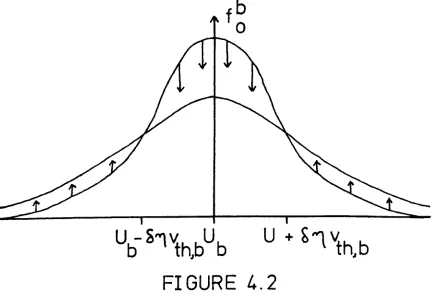
to be violated. Secondly, the large amplitude oscillations cause the beam
ions to heat up and hence cause the waves to be heavily Landau damped.
Finally, a distortion of the beam distribution function takes place. This
results in severe landau damping of the positive energy beam wave and a
reduction In the Landau growth rate of the negative energy beam wave.
The relative importance of the three processes depends on the plasma
parameters, but in the case where we use the parameter set chosen for the
simulation programs, we find that the heating of the beam ions is the
dominant effect. The heating Is enough to cause Landau damping of the
waves in one or two periods of oscillation.
In Chapter 5, we outline the work done on two plasma simulation
pro-grams, GALAXY and NOVA, and give the results of simulations of the beamed
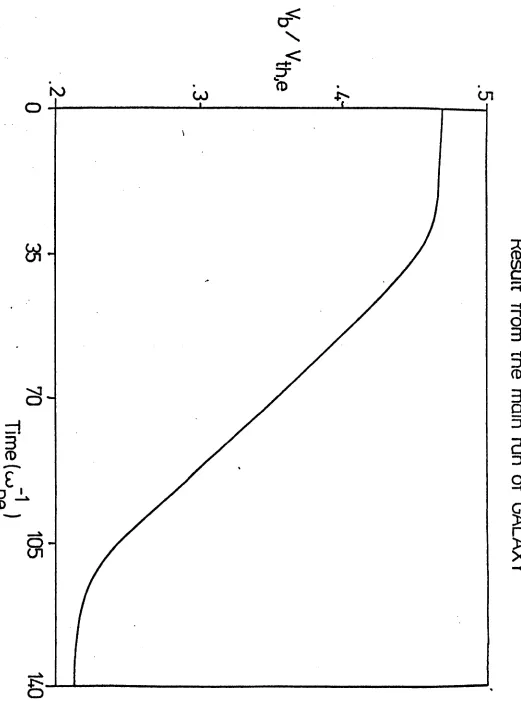
plasma configuration. We show that the Instability ~ be simulated,
even using the GALAXY program which Is prone to a high level of numerical
Inoise'. The GALAXY results predict a sharp decrease In the Ion beam
velocity as the waves grow, but disagree quantitatively with the theory In
that the deceleration is much more rapid than the theory predicts.
Unfortunately, the high noise level In GALAXY makes a detailed analysis of
the beam valueless.
We propose a method for simulating a comparatively noise free plasma
by initially placing the particles on closed orbits In a phase space which
Is spatially periodic. In this way. particles remain on pre-determined
trajectories, chosen to minimise fluctuations in space charge. When
the background spectrum of waves. The method is used in the NOVA program,
and gives a background level of wave amplitudes which are 10-6 of those found In GALAXY. We also show that this Initial choice of particle
co-ordinates causes no spurious binary correlation effects, even though
the spatial configuration is lattice like.
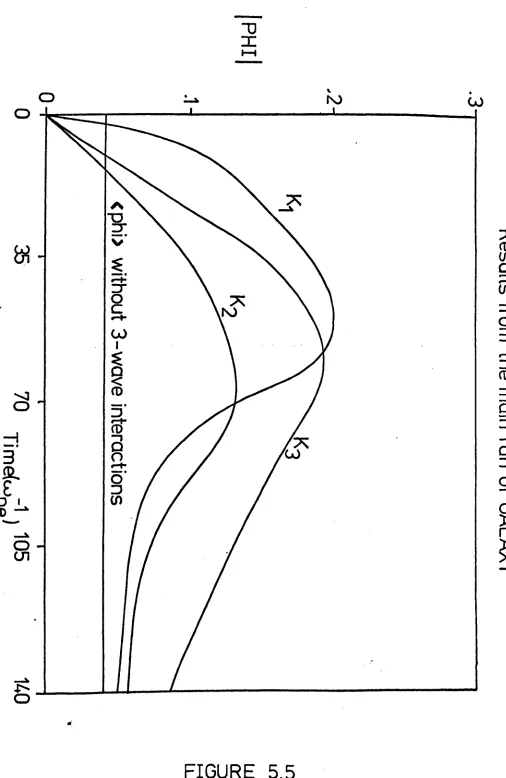
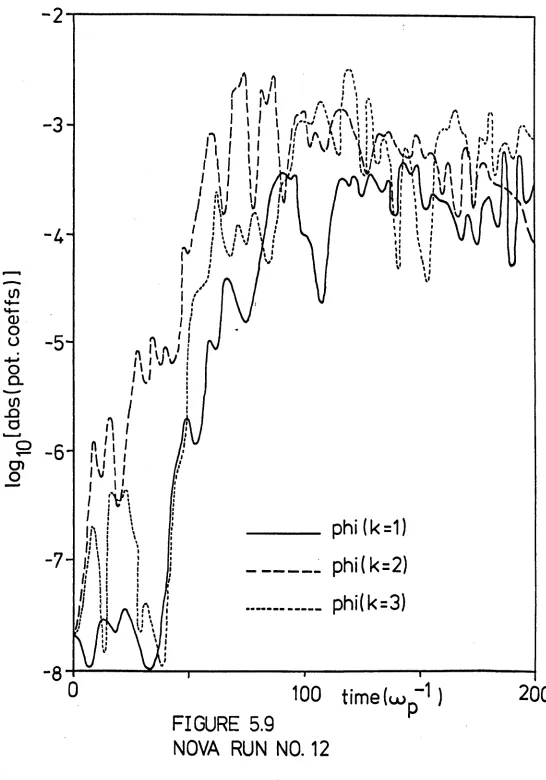
The results of the NOVA program show that although the beam Ions
decelerate slightly, they heat up significantly, as do the stationary Ions.
The results indicate that beam heating Is responsible for the saturation
CHAPTER 2
THE THREE WAVE INTERACTION
2.1 Introduction
We are going to study the behaviour of a plasma for states which are
Initially close to a steady state. As Bernstein and Trehan (1960) have
demonstrated, being close to a steady state implies the existence of some
small dimensionless parameter In terms of which one can expand the time
dependent quantities in the equations governing the plasma. The expanded
equations to lowest order In the small parameter are Just those which
govern the steady state. To next order one obtains a set of 1 inear
equations with constant coefficients, the theory of which Is known as
linear plasma theory. The literature on linear plasma theory Is extensive,
and Bernstein and Trehan's comprehensive review article (1960) makes
reference to many of the original and most useful publications. A central
feature of the theory Is that arbitrary (small) perturbations about a steady
state are expressible as a superposition of elgenmodes which evolve
Independently of one another. We can however examine the interaction
between the eigenmodes by considering the nonlinear terms which are neglected
In the 1 inear theory cf. Coppl, Rosenbluth and Sudan (1969).
Frieman (1963) demonstrates the well known result that to do this by
simply equating terms of second order In the expanded plasma equations gives
solutions whIch are secular. That Is, second order perturbed quantities
which are proportional to time, and hence diverge for large times, even for
cases where we know the result remains finite. Frieman further shows
that one may avoid the occurrence of such non-physical solutions by taking
advantage of the fact that for small perturbations, the effect of the
typical oscillation period of the eigenmodes. The multiple timescale
nature of the problem arises naturally since (if we call the dimensionless
expansion parameter
£),
the linear terms in the expanded equations areproportional to £ whereas the nonlinear terms are proportional to £2 and
higher. Consideration of the time dependence of the lowest order perturbed
quantities q (say) due to nonlinear terms (of order qn say) shows that they
n-l
will vary on a timescale of order 1/£ • This being the case, we treat
the problem using a multiple timescale perturbation theory employed by
Frieman, which has a built in formal Ism for removing secular solutions.
In this Chapter, we demonstrate the technique In the case of a plasma
which obeys the fluid equations of magnetohydrodynamics (cf. Montgomery
and Tidman (1964), Chapter 13). This particular example has been treated
previously by Galeev and Oraevskii (1963) using a different mathematical
technique. Their method involves time averaging the expanded nonlinear
equations in order to obtain kinetic equations governing the long timescale
effects of the nonlinear terms on the first order quantities. These
authors show that the resulting kinetic equations describe the transfer of
energy back and forth between three waves propagating In the plasma.
This process Is known as the 'three wave Interaction' and is a feature of
great importance to the rest of the thesis.
The multiple timescale (MTS) technique is ideally suited to the study
of the three wave Interaction, due to the linear and nonlinear phenomena
occurring on widely separated tlmescales, and it can be extended with very
little difficulty to deal with multi-wave interactions. Moreover, the
strength of the coupling between the waves appears expl icitly as the formal
mathematics evolves, whereas In methods such as the 'detailed balance of
microscopic energy' used by Coppi, Rosenbluth and Sudan (1969), and the
strength has to be calculated independently of the derivation of the
kinetic equation.
The example is given however, not only to demonstrate the perturbation
technique, but also to highlight the nature of the energy transfer. We
will see that to assume a fluid description prevents the detailed analysis
of particle effects, which is important In a certain category of three
wave interactions; namely those associated with negative energy waves.
The physical meaning of negative energy waves, and the particle nature of
their interaction with other waves Is discussed in Chapter 3.
2.2 The Multiple Timescale Approach
For a plasma close to a steady state, we write the time dependent
plasma variables as a power series in the small parameter E; namely
where qno is the steady state value of the quantity qn' and E Is a measure
of the strength of the perturbation. Now we expect different order
non-linear terms to describe different physical processes. Thus we expect
the plasma system to behave differently on the various tlmescales, unity,
l/E, 1/£2 etc., each of which corresponds to different order nonl inear
terms becoming important. The method described here exploits this, in that
we assume that solutions to the plasma equations can be found with a time
dependence of the form
The variables tl, t2 etc. are related to the real time t by the relation
dtn ... 1;
Tt
n ...1, 2, ••• etc. (2.2.1)
choice of initial conditions on the plasma equations allows us to treat
2
t, etl, e t2 etc. as Independent variables. Thus the time derivative
(a/at) can be formally expanded In powers of e as
(2.2.2)
Throughout this thesis we shall use the notation that t's subscripts are
omitted. As such, e Is used as a 'book-keeping' parameter for the
ordering of not only the time dependent plasma quantities but also the
time-scales themselves.
The magnetohydrodynamlc (MHO) equations for the velocity ~ of the
plasma 'fluid', the charge density n, and the magnetic field Hare
H
;t + (~.V)!!+ !!(!.~ - (!!.V)~ • 0, and
2
where p is the fluid pressure • nc and c Is the sound speed. The first
equation represents the conservation of momentum, the third represents the
conservation of charge, and the second derives from Maxwell '5 equations.
The steady state plasma is considered to have a uniform density no' zero
fluid velocity, and a uniform magnetic field H In the z direction. o
Following the example of Sagdeev and Galeev (1969) we examine perturbations about this steady state In the form of circularly polarised Alfven waves
propagating In the z direction, and sound waves also propagating along z.
We write an expansion in the form dictated by (2.2.1) and (2.2.2),
+ e:Hp1(z , 2 ;,
.
,) 2 2...
)H
=
H t, e:t, e: t, + e Hp2(Z, t, e:t, e: t, etc. ,~
+ e:nzl(z , 2
...
) 2 2...
)n
=
no t, e:t, e: t, + e:nz2(z, t, e:t, e: t, et c .,e:vpl(z , 2 ••• ) + 2 2
...
)v .. t, e:t, e: t, e:vp2(Z, t, e:t, e: t, etc. +
e:vzl(Z' t, e:t, e: t,2 ••• ) + e:vz2(Z' t, Et, e: t,2 2
...
) etc. ,where the subscript z refers to perturbations In the z direction, which are
associated with the sound waves, and subscript p refers to perturbations
perpendicular to the z direction, which are associated with the circularly
polarised Alfven waves.
Substituting these expansions Into the expanded MHO equations, we can
separate out the z and p components of the momentum equation, and equating
terms proportional to e: gives the four equations
a"zl + C2 anzl
..
° ,
at
n az0
anzl + n aVzl
..
0,at 0 az
(2.2.3)
(2.2.4)
H ~
0
0,
41fno az
..
~
..
O .H
0 az
(2.2.5)
(2.2.6·)
These are just the linear MHO equations for the configuration, and we assume
solutions of the form
.. L
R,
and similar summations in exp i (kR,z - wR,t) for nz1' vpl and Hpl' where the
k's are wavevectors and the w1s are frequencies. Using these solutions
and looking at the R,-th Fourier component, the system of equations (2.2.3,
4,
~ · s. •
0 (2.2.7)iii £
where
S.
is a column vector with the four components vzl' nzl' vpl and Hpl'The condition that non trivial solutions of (2.2.7) exist Is that the
determinant of M vanishes. This gives us the dispersion relation
( 2 k2 ,,2) ( 2 _ k2 c2)
wt - t A wt £ - 0, (2.2.8)
where VA is the 'Alfven velocity' given by
V2 .. H2/41Tn .
A 0 0
From the matrix equation we can also shaw that
(2.2.9)
and (2.2.10)
Equating terms in the expanded MHO equations which are proportional to E2 gives the four equations
av 2 2
_!_ +
=--at no
-
az - vzlnz1 2 anzl H 1
+_ C __ __E_!_
no
az
=;
(2.2.11)an 1
Z',
..
-_
- nzl
anz1
Vz 1 az (2.2.12)
H aHp2 av 1 nz1 aH 1
av 2 0 .. - ___E_!_
~,
~-
az aEt - 1iml azat J;;T'il 0
0
aHp2 aVp2 aH 1 aH 1
- H • _ __E_!_
-
vzl ___£!_ •at 0 az aEt az
(2.2.13)
(2.2.14)
Equations (2.2.11) and (2.2.12) represent the second order correction to
the sound wave perturbation. They are similar to equations (2.2.3) and
right hand sides. Likewise, equations (2.2.13) and (2.2.14) represent the
second order correction to the Alfven wave perturbation, and In the same
manner are similar to equations (2.2.5) and (2.2.6).
Since the nonlinear terms on the right hand sides of equations
(2.2. 11, 12, 13 and 14) are products of two plane wave forms, the second
order corrections will take on a plane wave form, having frequencies and
wavevectors which are sums and differences of those of the elgenmodes.
These second order waves are often called 'virtual' or 'beat' waves, and
have wavevectors which are members of the same set as the eigenmodes', since
the k's constitute a quasi-continuum. The set of their frequencies
however intersects but is not identical to the set of elgenmode frequencies
since a frequency wt (given by wt - wm + wn) and a wavevector kt (given by k c k + k ) are not necessarily related through the dispersion relation
1 m n
(2.2.8). So a second order wave formed from two elgenmodes beating
together is not necessarily an elgenmode Itself. The case when it Is, Is
a special case and will be treated as such.
Meanwhile, therefore, we write solutions of (2.2.11, 12, 13 and 14)
in the form
• L
1
and similarly for the other second order quantities. We substitute these
solutions Into (2.2.11, 12, 13 and 14) and look at the 1-th Fourier
com-ponent. From (2.2.II) and (2.2.12) we eliminate n~2' and from (2.2.13) and (2.2.14) we eliminate v~2' We substitute the first order quantities
v~l and n;1 from (2.2.9) and (2.2.10) respectively, thus reducing the
system of equations to two. The first is for the second order correction
(2.2.15)
- w )
t 1 i .The second is for the Alfven wave, and is
(-2
w
-1
- t(w -
'W )
te 2. 1 +
(2.2.16)
From (2.2.15) and (2.2.16) we can write the solutions for v!2 and
H~2. We notice however that but for the term In a/att on the right hand
side of (2.2.15) we have a secular solution for v12 when ~ - k2c2 Is zero
Z 1 2.
or of order E. Similarly, but for the a/att term in (2.2. 16) H~2 Is
-2 2 2
secular when (111 - ktVA Is small. The multlple timescale theory however,
provides us with a procedure for removing the secular solutions. That is,
by equating the right hand sides of (2.2.15) and (2.2.16) to zero when
('W -
w ) approaches Zero.1 1
The interesting equations however arise from the condition that
1 t
secular solutions for vz2 and Hp2 do not exist.
can be written as
For Ht this condition p2
aH1
_.£.!. -
-!
(VA2 ik~kn/Wnwn)HmplvznlaEt k +k -kn ~ ~
m n ~
-in
e (2.2.17)
Equation (2.2.17) can also take on the form
a
Hm__El ..
_!
(V2o&t km+kn-k1 A
The condition that secular solutions for v;2 do not exist can be written as
-In
e •
n
aV
zl 1*
-"-e:-t =
-I
(ik 14wn )H 1 Hmplo k +k -k n 0 p
m n 1
-in
e (2.2.19)
where the
*
denotes the complex conjugate.Equations (2.2.17, 18 and 19) are kinetic equations for the slow
variation (Et) of the first order quantities. As we have said, a condition
that they hold, Is that
n
Is close to zero. Thus we can writeand
w + w - w ~ e: or less
m n R,
k + k - k ~ e: or less
m n 1
(2.2.20)
With these conditions, the equations describe the slow variation In
ampll-tude of a wave 1 which Is being driven by pairs of waves beating together
at the original wave's frequency and wavevector. They are the kinetic
equations governing the 'three wave Interaction', and the conditions
(2.2.20) are known as the 'resonance conditions' for the three wave Interaction.
2.3 Solution and Discussion of the Kinetic Equations
Equations essentially equivalent to (2.2.17, 18 and 19) were derived by Sagdeev and Galeev (1969) by time averaging the nonlinear expanded MHD equations, and noting that the slow variation of the first order quantities
Is nonzero providing that the resonance conditions (2.2.20) are satisfied. An objection to this approach is that the three wave Interaction equation
and the expression for the second order plasma quantities are separated
ad hoc, whereas in the MTS approach they separate as a necessary condition
for avoiding secular solutions.
Sagdeev and Galeev (1969) have solved equations (2.2.17. 18 and 19)
under the condition that the summation Is replaced by a single product term.
This assumption Is valid If all other waves have negligible amplitudes or
Sagdeevand Galeev solve the equations for
n
being identically zero, Interms of symmetrised wave amplitudes Ct defined by
The equations take on the form
(2.3.1)
lac
m
-aEt
(2.3.2)
(2.3.3)
These equations permit two classes of wave Interaction Illustrated In
Figures 2.1(a) and (b). That is, energy transfer from mode t to modes m
and n, and energy transfer from modes m and n to mode 1.
As stated In Section 2.2 we now drop the E'S In (2.3.1,2 and 3), and treat the CiS as 'small'. For the case Ct -
°
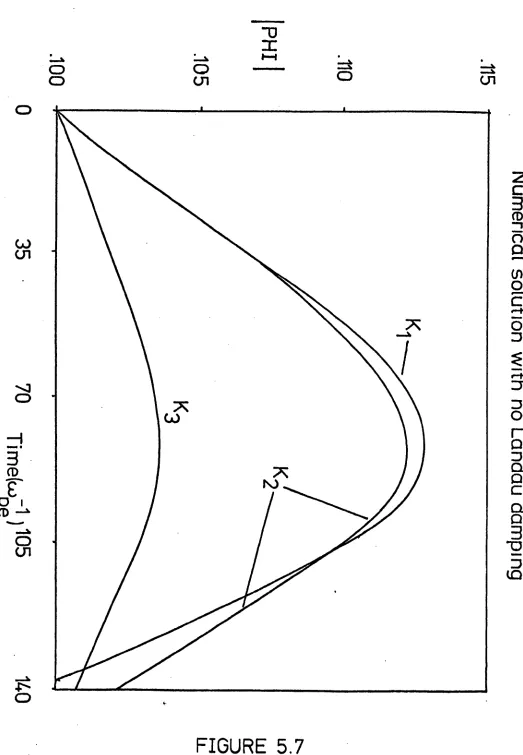
and Cm » Cn at time t - 0, the equations can be solved In terms of sines and cosines to give a resultof the form shown in Figure 2.2, displaying the energy transfer back and
forth between the three waves. Furthermore Sagdeev and Galeev (1969)
show that the
IcI2
can be interpreted as the number of 'quasi particles' or 'quanta' N in a mode, since the N's are defined bywhere the Wls are the mode energies. From (2.2.1, 2 and 3), using the N's
we can derive
-
at +aN
m
n
n
-
(/)Cm
~ C
::J
~
L-o
L-~
_o
L-0
-u
m
m
FIGURE 2.1
(0)
FIGURE 2.1 (b)
time (arbitrary
units)
aN
+ _n_
at
- 0, (2.2.5)• O. (2.2.6)
The relations (2.2.4, 5 and 6) are called the 'Manley-Rowe' relations and are well known In the theory of parametric amplifiers. They tell us
that if a 'quantum' of energy Is gained (or lost) by mode 1, then one will
be lost (or gained respectively) by both mode m and n.
The case we have treated Is for a plasma In which only three waves
propagate. In reality, there will be many pairs m and n satisfying the
resonance conditions (2.2.20) with a wave 1. As shown by Galeev and Oraevskll (1963) and Sagdeev and Galeev (1969), If the amplitude of the Alfven wave 1 is larger than the m's and n's It will decay Irreversibly providing that the number of (m,n) pairs Is large enough, and the Initial
phases of the (m,n) waves are random. Sagdeev and Galeev treat this case
by using a random phase approximation to the waves In the system. It Is then found that a large amplitude Alfven wave Is transformed Into random
oscillations of the medium rather than an ordered pair of waves capable of
Interacting back.
This example has been given not only to display the MTS technique, but
also to highlight the limitations of a fluid description of a plasma when
studying the three wave Interaction. The Important features are twofold.
Firstly, as we will see In Chapter 3 there exists a class of three wave
Interactions for which the single (m,n) product case and the case of an
arbitrarily large summation have qualitatively the same behaviour, the only
difference being the timescale of the nonlinear process. Secondly, we will
see that by using the approach of solving the Vlasov equation, we are able
to analyse the particle physics Involved In the Interactions of 'negative
CHAPTER 3
THREE WAVE INTERACTION IN A VLASOV PLASMA
3.1 Introduction
In this Chapter we derive a kinetic equation for the amplitude of a
monochromatic electrostatic wave which Is Interacting weakly with other
similar waves In a one dimensional neutral Vlasov plasma. We use the
multiple timescale (MTS) method outlined In the previous Chapter.
The equations for the slow variation of the wave amplitudes are found
to take on the general form
a~R.
--
at
.
m,n
(3.1.1)
where the ,IS are the electrostatic potentials of the waves, and the M's
describe the wave coupling strength and are often called the 'matrix
elements' of the kinetic equations. These kinetic equations are similar
in form to those derived in the previous Chapter (cf. 2.3. 1,2 and 3).
In order to make the general kinetic equations solvable, we assume
that only three waves are participating In the Interaction; that Is, that
the summation In (3.1.1) disappears. As stated In Chapter 2, this is not
the general case, but we will discuss the problems and Implications of
con-sidering the sum over many wave pairs In Section 3.5. The assumption
Is reasonable when the three waves under study have amplitudes far In excess
of the background level (while still of course remaining 'small' compared
with the electron temperature, for the perturbation expansion to hold).
simulations, since as we will see in Chapter 5, none of the three chosen waves can interact with any but one another. This is because the
simulation wavevectors are discrete, and in all other cases, the wavevector
resonance condition on the existence of the kinetic equations Is violated.
We show that a consequence of adopting the Vlasov approach Is that the
matrix elements of the kinetic equations can be written in the form
..
where Ftmn is a function symmetric In the subscripts 1, m and n, and t Is
the plasma dispersion function. We further show that If
at/awl!
Isnegative, the kinetic equations describe waves which grow to an Infinite
amplitude in a finite time. This phenomenon Is called an lexploslve
instability' and cannot be described by an MHO calculation, (cf. Chapter 2,
where the matrix elements are all the same sign).
We therefore examine those properties of the waves and the medium
which make aE/aW negative, In order to determine the physical mechanisms
driving the Instabll ity. The plasma configuration we study consists of
a Maxwellian distribution of electrons about velocity v ..0, the bulk of
the Ions also in a Maxwell Ian about v .. 0, and a diffuse Maxwell ian Ion beam
about v .. Ub. In Appendix B we show that this configuration can support
ion sound waves with phase velocities around v • 0, and also 'Doppler
shifted' Ion sound waves with phase velocities around v • Ub. We choose
to examine the interaction of one of the 'nearly stationaryl ion sound
waves, one lion beam' wave with phase velocity Just above Ub, and one Iion
beam' wave with phase velocity Just below Ub. Now for the 'slow' beam
mode we find that aE/aW Is negative, whereas for the 'fastl beam mode and
the 'ordinary' Ion mode, it Is positive.
dispersive medium when a monochromatic electrostatic wave propagates in
it, Is proportional to
IEI2
a(w£)/aw, whereE
Is the amplitude of the waveelectric field. In the case of the wave being a normal mode of the system
and hence satisfying the dispersion equation £-0, the change In energy as calculated by Stix, is proportional to
IEI2
a£law. From this, wemight conclude that the energy of the 'slow' ion beam mode is negative.
The physical meaning of 'a wave with negative energy' Is examined in
Section 3.2, and an explanation is given for how the energy of a medium can
decrease when a wave propagating in it increases In ampl itude. Many
authors e.g. Kadomtsev, Mikhailovskli and Tlmofeev (1965), and Dikasov,
Rudakov and Ryutov (1965) simply state that the energy of a monochromatic
wave can be negative, and hence when it interacts with two ordinary
'positive energy' waves (through a three wave interaction like that
dis-cussed in Chapter 2), energy Is transferred from It to them resulting in
the unbounded growth of all three wave amplitudes. This statement describes
a very useful and economical mathematical model for describing the explosive
Instabll ity. It does however pose the question of what is meant physically
by a negative energy wave.
In this Chapter, we examine the energy Wadded to a plasma when a
monochromatic electrostatic wave propagates, and find for normal modes
(£ m 0), that It Is proportional to aE(w)/aw which for some media can be
negative. However, by deriving W from the Vlasov equation (Appendix A)
it is clearly equal to the sum of the electrostatic wave energy and the
change in that part of the charged particle kinetic energy which is
associated with the coherent wave motion. We argue moreover, that this
sum can be negative in a beamed plasma in which beam particles slow down,
and some of their energy is transferred to the wave. It transpires that
the greater the amount of kinetic energy extracted from the beam (at the
if some of the beam kinetic energy is transferred to two other waves, all
three can grow in amplitude. So, rather than regarding one of the waves
as having negative energy, we use the more physical picture of treating the
beam kinetic energy as the driving force for the Instability. This
creates a better understanding of explosive Instabilities, and also gives
us a starting point for examining the saturation of the Instability in the
following Chapter.
In the course of this Chapter, the symbol £ is used both as a label
for the 'smallness parameter' In the perturbation expansion, and also to
signify the dispersion function. When any confusion may arise, the
meaning is stated explicitly.
3.2 Negative Energy Waves
Stix (1962) has shown that the change in energy of a dispersive
medium when a monochromatic electrostatic wave propagates, Is given by
a
oW
where E is the amplitude of the wave electric field, and £h Is the
Hermitian part of the dielectric function for the medium. The result
(3.2.1) is not the usual constant multiple of IEI2 which we expect for a
wave, and Stix analyses It by looking at electron plasma oscillations.
In this case, W can be Interpreted as the sum of the electrostatic energy
(IEI2) and that portion of the charged particle kinetic energy which Is
associated with the perturbation of the particle distribution function.
In Appendix A we derive (3.2.1) explicitly for a plasma using the Vlasov
equation and Poisson's equation to describe the system, except for the
factor of 1/16n In Stix's derivation which arises from his formulation of
Poynting's theorem. The Vlasov derivation automatically produces the two
separate terms, and the physical interpretation of each is obvious, since
I
v2 (f - fo)dv (averaged over the phase of the oscillation),where f is the perturbed particle distribution function and fo is the
unperturbed distribution function. This term describes the kinetic energy
associated with the perturbation on the particles. The advantage of the
Vlasov approach is that the physics Is clear In the general case (we need
not choose a specific example as Stlx does). When we add the two terms
to get the total energy associated with the wave, we get the result that
W a:
IEI2
__
3__ {w £ }3w (cf. A.IO)
Now it is well known that there exist media which for certain values of w
and k, have 3£/3w negative. Such a wave will be called a Inegatlve energy wavel• From the expression for the energy of such a wave (3.2.1)
we see that as its ampl itude increases, its energy decreases. Thus if it
loses energy to two positive energy waves for Instance, all three increase
in amplitude. The questions now arise; what sort of medium exhibits
this anomalous dispersive characteristic, and what happens to a plasma when
a negative energy wave propagates and Interacts with other waves.
Landau and Lifshitz (1960) show from entropy considerations that a
region of transparency In a medium In thermodynamic equilibrium will exhibit
normal dispersion I.e. 3(w€)/3w is positive. For media away from such an
equilibrium, the thermodynamic theory ceases to hold, and the positiveness
of a(w€)/3w can no longer be assumed. For this reason, we choose to look
at a plasma with beams in order to find negative energy dispersion
characteristIcs. Such an example Is relevant to the theme of this thesis,
and will bring out the physics of negative energy waves.
Sturrock (1960) has demonstrated that if two waves of equal ampl itude
with the (non-relativistic) velocity Ub, then the energy of the two waves
(as measured in a stationary frame) is given
by:-W (forward wave) .. +
Ub +
lu
II{ 1ui 1 }WI ,
W (backward wave) ..
-U - 1u II
{ b
lui I
}WI ,(3.2.2)
where WI is the energy of the waves measured in the moving frame. We
observe that the two waves have energies of opposite sign if
Ub >
1
uII.
(3.2.3)We might conclude from (3.2.2) and (3.2.3) that negative energy waves
are a classical relativistic phenomenon, but this would only be a half
truth since it fai1s to exp 1a In phys iea 11y why such a wave can Increase In
ampl itude as it decreases in energy.
An Important thing to note however, Is that the medium needs to be
moving faster than a given velocity (3.2.3) i.e. there needs to be a large
amount of kinetic energy In the medium Itself. Unfortunately, most of
the literature on explosive Instabilities takes the study of the waves
themselves no further than stating 'negatlve energy waves exlst', and little
work has been done on the combined physics of the medium and the wave.
Such a study Is essential since It reveals the full physics of these waves,
and also gives a deeper understanding of explosive Instabilities, and how
they saturate. The approach of analysing the medium has previously been
ignored only to yield oversimplified and often misleading results. This
point will be taken up in greater detail in Chapter 4, but at present we
will concern ourselves with an interpretation of the statement that a
negative energy wave Increases In ampl itude as it decreases in energy.
The important point bere is that lenergy' In this sense Is a sum of
a beam carries a wave, If the excitation of the wave can be achieved by
decelerating some of the beam particles (namely by a special kind of
perturbation) then the change in energy of the system due to the presence
of the wave is proportional to
IEI2
minus the change In kinetic energy of the perturbed particles. Clearly, since a plasma's kinetic energygreatly exceeds its potential energy, we need only decelerate a minute
fraction of the particles in order to excite such a wave. Moreover for
such a configuration, the larger the wave amplitude we want, the greater
the number of particles we need to perturb (decelerate).
A question arising at this point Is whether we need to decelerate
particles in order to excite a negative energy wave on a beam. Gu ided
by the relativistic argument of Sturrock (3.2.2) we examine the 'slow'
beam mode, and if we consider a Maxwell ian distribution of beam particles
we see that there are more particles travel Iing faster than the wave's
phase velocity than slower, providing Ub > lu'l (cf. 3.2.3). Hence, the net effect of adjusting local particle velocities to the waves phase
velocity Is a reduction In kinetic energy. that Is a deceleration.
This argument is not dissimilar to the quasi linear theory of the
saturation of 'Landau unstable' plasma oscillations. As shown by
Drummond (1965), the growth of plasma oscillations with wand k such that
af ltv is positive at v • w/k, occurs at the expense of a reduction in o
particle kinetic energy. It Is also true that the Landau damping factor
y is given by
y
•
Im(El
/ae:/aw , (3.2.4)namely that a negative energy wave Is Landau unstable if 1m (e:) is negative.
The full circle of equivalence Is completed by condition (3.2.3).
with phase velocity below the beam velocity Ub• Moreover, its amplitude
increases as we Increase the perturbation on the particles (as we expect)
-the perturbation however being increased by decelerating an increased
number of beam particles. This interpretation avoids making the misleading
claim that a wave in a medium can, independently of the medium, be assigned
an energy which is less than zero.
At this point we can see what is happening when a negative energy
wave interacts with two positive energy waves. The positive energy waves
have frequencies wm and wn such that wm + wn - wi (the frequency of the negat ive energy wave). Similarly the wavevectors k + k • kn' which as
m n ",.
we saw In Chapter 2 are the two Iresonance condltions' for the Interaction
of three waves. Now since the two lower frequency waves beat together to
form a wave of phase velocity wt/kt, we have a situation where particle
kinetic energy can be transferred to them (since afo/av is positive at
that velocIty). This causes the negatIve energy wave amplItude to
increase, and then we have an explosive InstabIlity (since all three waves
are driving one another's amplItude up). The details of the explosive
instabll ity will be developed In Section 3.4. 3.3 Basic Equations
To obtain the equations governing the three wave Interaction discussed
in Section 3.1 we start with the one dimensional Vlasov equation,
af.
__j_ +
at
af.
a
lfl af I •v__j_ - (e~ ~ -.JL
ax m • ax av
J
o ,
(3.3.1)where the subscript j refers to the plasma species, namely ions (i) or electrons (e). The electrostatic potential $ is given by Poisson's
equation,
00
(3.3.2)
where no is the total particle number density of one of the species, and
e is the electronic charge. Normalisation of the Ion and electron particle
distribution functions fi and fe Is such that
00
f
f.I,e dv
=
n.I,eIn.0-00
Consider the plasma to be neutral with a Maxwell ian electron velocity
distribution about v • 0, and an ion distribution made up of the bulk of
the ions in a Maxwellian at v - 0, and the rest forming a Maxwell ian beam
about v ., Ub• We write the beam density as n2 which is a small quantity.
As shown in Appendix B, this ordering gives us a configuration which supports
negative energy waves, and also makes possible the quantitative calculations
of timescales, amp! itudes, etc.
We want to find an expression for the potential ~ correct to second
order in the small parameter E • e~o/kBTe' where kB Is Boltzmann's constant,
Te is the electron temperature, and ~o is some characteristic value of the
electrical potential. We introduce the MTS expansion
fi "" (I - n2) fO01 (v, t , Et, E2t
,
••• ) + + n2 fb. (v - Ub, t, Et, E2t •.• ) +01
,
+ E f11 (x, v, t , Et, E2t, ••• ) + + E2 f2i (x, v, t, Et, E2t. •.• ) + + terms of order E3 and higher.
fe
-
foe (v, t. Et, E2t, ••• ) ++ Et1e (x , v, t, Et, E2t,
...
) ++ E2f (x , v, t, Et, E2t,
...
) + etc. 2e~ • E~l (x, t, Et, E2t, ••• ) +
For purposes of treating the total ion distribution, e.g. on the right hand
side of Poisson's equation, or the a/av term in the Vlasov equation, we call
the unperturbed ion distribution function fol where
We do however treat the 'stationary' and 'beam' ions as separate terms when
this is necessary e.g. in time derivatives, where the two terms may have
different temporal behaviours.
Making use of the expanded form of the time derivative (2.2.2) we
equate terms of order unity in the expanded Vlasov equation for ions, and
get
afO
01 -
o.
atSimilarly, equating spatially Independent terms of order € gives
Since fO. Is independent of t, Integration of the above equation with respect 01
to t gives in general, a secular contribution to f~i'
conclude that
We therefore
at
o.
-
_
..
In a similar way, if we consider the Vlasov equation for electrons, we find
that
af oe
_-ae:t
af oe
--at -
o.
Therefore, equating terms of order e: in the expanded forms of (3.3.1 and 2) gives
~ + vafU
at ax
~~1 (e)
m J ax
af .
_.E..!_ - 0
Cl)
and
a
24>1
-
41TnoeI
(fll - fIe) dv. (3.3.4)..
3)(2
-Cl)
It is well known that equations (3.3.3 and 4) should be solved as an
initial value problem In order not to lose the significance of the Landau
contour. To avoid lengthy algebra however, we will simply assume solutions
of (3.3.3 and 4) to be of the form
flj
..
r
fljR. exp(i\X -
IwR. t ) ,R.
(3.3.5)
and ~l •
r
~R. exp(iktx - Iwtt),1 1
and when the necessity arises, ensure that the appropriate velocity Integrals
are done using the Landau contour. In such a case, the w's will be
under-stood to refer to complex frequencies. For the main part however, they
are to be considered as the real part of the frequency unless specifically
stated otherwise.
Looking at the t-th Fourier component of (3.3.3) we get
(3.3.6)
Using Poisson's equation (3.3.4) to eliminate $~, we get the well known
linear dispersion relation
• - 0, (3.3.7)
c
where w . is the plasma frequency for the species
J,
and c denotes thePJ
La ndau con tou r•
not only gives us the linear solutions, but also describes systematically the
second order corrections produced by cross modulations of the first order
waves. The description given In Section 2.2 of the characteristics of the
second order waves' frequencies and wavevectors, carries over into this
example. If we follow a parallel path of analysis to that in Chapter 2, we
will again find that the case of the beat wave's frequency and wavevector
satisfying the dispersion relation (3.3.7) gives rise to an equation des-cribing the three wave interaction. Accordingly, we equate terms of order
E2 in the expanded Vlasov and Poisson equations, and get
_ (e) m •
J
a~2 af.
~
-ax
av
(e)m • J• 0, (3.3.8)
and
where the beam term in (3.3.8) will be omitted for the case of j referring to electrons. As we did In Chapter 2, we assume solutions of the form
f2j
L
R,
exp(lkR,x - i'wR,t),
=
f2jR,
and
'2
=
L
~~ exp( ikR,x - i;R,e) .R,
Before making these substitutions, we can separate the spatially dependent
parts of (3.3.8) from the spatially independent parts to give us two
equations. The spatially Independent terms form an equation describing
the quasi-linear effect of the waves on the unperturbed distribution
functions, and for the ion species can be written as
afl·
__ I }
·
0,
av
(3.3.10)where the subscript s Indicates that we only take spatially independent
products for the bracket term.
We shall return to the study of (3.3.10) in Section 4.2, but meanwhile
making the above substitutions for f2j and ¢2 into (3.3.8 and 9). and looking at the l-th Fourier component, we are left with
Iknv) fR,2· - (~)
~ J _ m.J
-I(w -w)t
1 1
e +
af I k <I>R,.:.:.2l. _
R, 2 av
(3.3.11) (e~ m • J
L
k ,k n mk +,k .. k n m R.
and
(3.3.12)
R,
Equation (3.3.11) gives us an expression for f2j. Writing this expression
firstly for j representing Ions and then for j representing electrons, we can substitute for f~1 and f~e In (3.3.12) to give
l {
1 +L
2
j
c
41Tn.e
I
dva
( R- R. -I(w'- w )
t0 { - I R-
R-c
k2 aet
f1 I - fIe) e
(;
-
kR,v)R, R.
c
-tfW'
+ W' - ;; )tm . n m R.
_ (e~
L
n af1 I ek.n<l>1 av
m I
kn,km
+ (e~ m
e
~fm -I(ID + tAl - (; ) t
o le n m R.
~ e } •
where £ is the dispersion function as It appeared In (3.3.7). So we can
formally write
• R.H.S. of (3.3.13)
c(w~t kt)
except when £ - 0, that is when the second order beat wave is a normal mode
of the system. To avoid such a secular solution for ~~, we must insist
that the right hand side of (3.3.13) is identically zero when
wR. -
Wt.t t
So doing, gives us an equation for the 'slow' variation of (fl i-fIe)' and
substituting their values from (3.3.6) we see that the first term on the
right hand side of (3.3.13) simplifies to
(3.3.14)
Now for the second two terms on the right hand side of (3.3.13) to be
nonzero, the argument In the exponentials must be zero, otherwise the 'fast'
t-timescale oscillations would average out on the et-timescale to zero.
Therefore we arrive at the conditions for a non-trivial expression for the
R.
slow variation of~l' namely that
= W + W
m n
(3.3.15)
• k + k •
m n
These are the 'resonance conditions' discussed In Chapter 2. In a similar
manner to the derivation of result (3.3.14) we can substitute for f~1 and f~e
into the second two terms on the right hand side of (3.3.13). We can
therefore write the condition that the right hand side of (3.3.13) Is
identically zero as
a~~
•
1:
r m nk +k -kt tmn ~ 1 ~ 1 ' (3.3.16)
aet n m at
where
=.!.}: 2
I
kik k af ./av dv
(e) m n OJ
r W •
imn 2 • PJ m .
(wi-k,v} (wm-kmv) (wn-knv)
J J
c
and
a,
'" k2 ae: (3.3.17)R- aw
,
Equation (3.3.16) Is the equation governing the Interaction of three waves
1 m n
'1' , 1 and '1' It is of a similar form to those derived in Chapter 2
(cf. 2.3.1,2 and 3), and the resonance conditions for such an interaction are identical to those derived using the M.H.D. approach. Moreover, the
interaction equation (3.3.16) and the matrix element (3.3.17) are structured Identically to those described by Kadomtsev (1965).
The factor of 1/2 In fn arises because the complete sum In (3.3.17)
Jl.mn
m ·n n ·m
counts all terms twice, I.e. Includes the
'1
~l term as well as the ~l ~l term.For the case wR, ~ wR,' namely when the second order beat wave Is not a
normal mode of the system, we can see from (3.3.13) that
> -+
time average
0,
due to the rapidly oscillating exponential factor. Therefore, In a similar
manner to the derivation of (3.3.16), we get tbe.solution for ~~ to be
• rR,mn (3.3.18)
kn+km-kR,
w +w ·w
n m R,
Equation (3.3.16) governs the three wave interaction in the Vlasov
representation of a plasma, and forms the starting point for the discussion
in Section 3.4. Equation (3.3.10) represents a quasi-linear effect of the
waves on the ions, which we will study in Section 4.2 in connection with the
violation of the resonance conditions (3.3.15).
3.4 The Explosive Instabi) Ity
As we stated In Section 3.2, if the plasma was In thermodynamic
equil ibrium, that is did not have the Ion beam, then a(WE)/OW would be
positive. For those W corresponding to normal modes therefore, since
E(w,k) - 0, OE/OW would be positive. That being the case, all three wave energies would be positive and the analagous equation to (3.3.16) for the
three wave interaction would have at (cf. 3.3.17) positive. Equation (3.3.16)
and the corresponding equations for O~~/OEt and a~~/o£t could then be solved
In ab identical manner to those discussed in Chapter 2. That is, the
solutions would be of the form shown In Figure 2.2, exhibiting the Manley-Rowe
behaviour of energy transfer back and forth between the three waves.
The deviation from thermodynamic equll ibrlum caused by the presence of
the ion beam however, gives rise to the possibility of having negative energy
waves, and a corresponding negative a for some waves In (3.3.16). As shown
in Appendix B, for the beam plasma system described in the previous section,
we can choose three waves ~~, ~~ and ~~ which have the following
characteristics:
Wm - (3.4.1)
W ..
n
where n2 is the ratio of the number of beam ions to the total number of ions,
02 is the electron to ion mass ratio, Ub Is the ion beam velocity, and vth,e