http://www.scirp.org/journal/jmp
ISSN Online: 2153-120X ISSN Print: 2153-1196
DOI: 10.4236/jmp.2018.92009 Jan. 19, 2018 130 Journal of Modern Physics
New Analytical Method of Interdiffusion
Problems
Hiroki Cho
1, Kazu-Masa Yamada
2, Takahisa Okino
3*1Department of Mechanical Systems Engineering, Faculty of Environment Engineering, University of Kitakyushu, Kitakyushu, Japan 2Department of Production Systems Engineering, National Institute of Technology Hakodate College, Hakodate, Japan
3Applied Mathematics Department, Faculty of Science & Engineering, Oita University, Oita, Japan
Abstract
The nonlinear diffusion equation for a binary system interdiffusion was ana-lytically solved in the previous work. The theoretical relation of Kirkendall ef-fect was also derived in the previous work. These new results have not yet been concretely applied to actual diffusion problems. In the present work, it is revealed that the previous results reproduce the experimental concentration profile by taking account of the movement of diffusion region space. It is thus actually confirmed that any problems of binary system interdiffusion can be solved by the new analytical method if even diffusivities of self-diffusion and impurity diffusion in the materials concerned are given. The method for solv-ing interdiffusion problems of many elements system, which is extremely im-portant for the development of new useful materials, is also reasonably dis-cussed. Further, it is revealed that the concept of intrinsic diffusion is unsuita-ble for the diffusion theory. The fundamental theory of diffusion discussed here will be useful for analyzing actual diffusion problems in future.
Keywords
Diffusion, Many Elements System Interdiffusion, Kirkendall Effect, Parabolic Law
1. Introduction
The diffusion problem is one of the most fundamental and important research subjects in the material science field. The diffusion research has been thus widely and actively performed in accordance with the industry requirements for the de-velopment of new useful materials [1] [2] [3] [4] [5]. However, the progress of fundamental theory of diffusion had been hardly seen until recently. A lot of How to cite this paper: Cho, H., Yamada,
K.-M. and Okino, T. (2018) New Analytical Method of Interdiffusion Problems. Journal of Modern Physics, 9, 130-144.
https://doi.org/10.4236/jmp.2018.92009
Received: December 1, 2017 Accepted: January 16, 2018 Published: January 19, 2018
Copyright © 2018 by authors and Scientific Research Publishing Inc. This work is licensed under the Creative Commons Attribution International License (CC BY 4.0).
DOI: 10.4236/jmp.2018.92009 131 Journal of Modern Physics
research papers accepting the Darken equation [6], which is mathematically wrong in the derivation process [7], have been still reported [8] [9] [10] [11] [12]. It was thus required to establish a new method for solving interdiffusion prob-lems. In that situation, the analytical method of the nonlinear diffusion equation, which is applicable to analyzing interdiffusion problems, was reported [13] [14] [15]. Nevertheless, it does not seem that the method is really applied to analyzing results of diffusion experiments. In the present study, therefore, the analytical theory of interdiffusion problems is concretely expanded and is applied to expe-rimental results.
First of all, we mention here fundamental concept of the diffusion theory in mathematics. In general, the usual experiments of interdiffusion between ele-ments I and II are performed within such a temperature region that the norma-lized concentrations I
C and II
C satisfy the relation of
I II
1
C +C = .
(1) The diffusion equations for I
C and CII in the interdiffusion field are
I I
I
C C
D
t x x
∂ = ∂ ∂
∂ ∂ ∂ for the element I (2)
and
II II
II
C C
D
t x x
∂ ∂ ∂
=
∂ ∂ ∂ for the element II, (3)
where DI and DII are diffusivities for the elements I and II. Substituting
Equ-ation (1) into EquEqu-ations ((2) and (3)) yields
I I
I
C C
D
t x x
∂ = ∂ ∂
∂ ∂ ∂ ,
II II
I
C C
D
t x x
∂ = ∂ ∂
∂ ∂ ∂ and
II II
II
C C
D
t x x
∂ = ∂ ∂
∂ ∂ ∂ ,
I I
II
C C
D
t x x
∂ ∂ ∂
= ∂ ∂ ∂ .
The above equations mean
2
2 0
j
D
D C
t x x x
∂ ∂ ∂− − ∂ = ∂ ∂ ∂ ∂
for j=I, II,
(4)
using the so-called interdiffusion coefficient of
I II
D =D =D . (5) Here, note that Equation (5) is valid only in the differential equation for I
C or
II
C [15] [16]. The relation between diffusion fluxes JI+JII= − ∂D C I ∂ −x
(
)
II I II 0
D C∂ ∂ = − ∂x D C +C ∂ =x is also valid only in the differential equation of diffusion. On the other hand, when we solve Equation (4) in accordance with the given initial and/or boundary values different from each other, the diffusivi-ties I
D and DII satisfying DI≠DII are naturally obtained. When we use solutions of Equations (4) for the diffusion flux J= − ∂ ∂D C x, JI+JII≠0 is
also valid then. There is thus no doubt that the Kirkendall effect (K effect) rele-vant to the essence of interdiffusion mechanism is caused by I II
0
DOI: 10.4236/jmp.2018.92009 132 Journal of Modern Physics
[16] [17] [18]. Nevertheless, the mathematical basics mentioned here had not been noticed in the long history of diffusion.
In order to understand the K effect, therefore, the intrinsic diffusion coeffi-cients I
INT
D and II INT
D satisfying I II INT INT
D ≠D were newly conceived in those days. Although the Darken equation based on the concept given by
I II II I INT INT
D=D C +D C (6) has been widely used for analyzing interdiffusion problems [6] [8] [9] [10] [11] [12], the equation itself is not only mathematically wrong in the derivation process but also entirely meaningless because of using the intrinsic diffusion coefficients nonexistent in the recent diffusion theory [7] [15]. In the present work, the physical meaning of K effect is reasonably discussed compared with experimental results, regardless of the Darken equation. As discussed at the con-clusion section, the Gauss divergence theory indicates that the K effect may oc-cur in the diffusion problems as universal phenomena.
Applying the analytical solutions of Equation (4) to experimental results of in-terdiffusion problems [17] [19] [20] [21], we confirmed that the concentration profiles are reasonably reproduced in the present work. Hereafter, as mentioned above, the Darken equation as well as the concept of intrinsic diffusion will dis-appear from the theory of interdiffusion problems. On the other hand, the new method discussed here will become one of the most useful methods for analyzing interdiffusion problems.
2. Mathematical Theory of Analytical Method
The diffusion Equations ((2) and (3)) in the time and space
( )
t x, is generallyrewritten as
C C
D
t x x
∂ = ∂ ∂
∂ ∂ ∂ , (7) where the suffixes I and II are removed. When the diffusivity depends on the concentration, it had been believed until recently that the mathematical solutions of the nonlinear diffusion Equation (7) are impossible. However, the mathemati-cal method for solving Equation (7) was established in the previous work [13] [14]. This means that the diffusion problems including a many elements system interdiffusion are essentially solved [18]. The matters necessary for the present study are briefly summarized in the following.
Boltzmann transformed Equation (7) into the ordinary differential equation of
d d d
2 d d d
C C
D
ζ
ζ ζ ζ − =
, (8)
using the parabolic law
ζ
=x t [22]. In the previous work [13], Equation (8) was rewritten as a formula of diffusion flux in the parabolic space yielding( )
( ) ( )
dd
C
J ζ D ζ ζ
ζ
DOI: 10.4236/jmp.2018.92009 133 Journal of Modern Physics
where
( )
0exp 0( )
d2
J J
D
ζ η
ζ η
η
= − −
∫
for 0( ) ( )
0d
d
C
J D
ζ
ζ ζ
ζ =
= .
In mathematics, the dependence of diffusivity on the concentration means d
d
C C C D
D
ζ ζ ζ
∂ ∂ ∂
= +
∂ ∂ ∂ .
(10) 1) Impurity diffusion
In case of the impurity diffusion, since the diffusivity of Equation (9) corres-ponds approximately to a constant value D=D0, its equation becomes
( )
( )1 20
0
d
exp
d 4
C C
D
ζ ζ
ζ
= −
,
(11)
where ( )1
0 d d 0
C = C ζ ζ= . The solution of Equation (11) is obtained as
( )
A B A B0
erf
2 2 2
C C C C
C
D
ζ ζ = + − −
(12) for the initial condition of C
( )
−∞ =CA and C( )
∞ =CB under the normalizedcondition of Equation (1). 2) Binary system interdiffusion
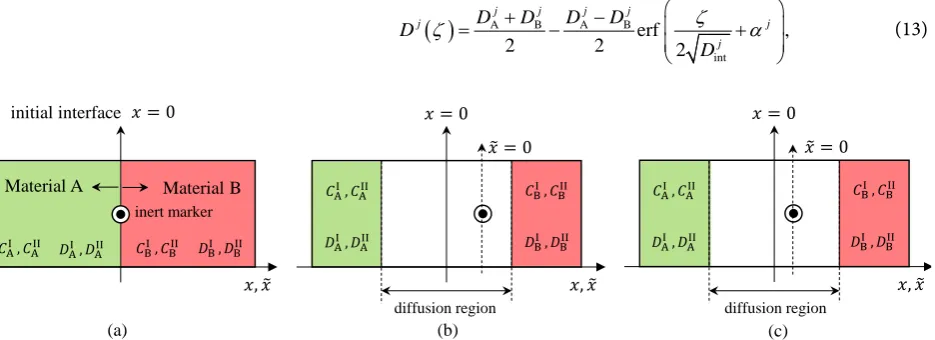
By solving simultaneously Equations ((9) and (10)), mathematical solutions of Equation ((8) or (9)) are possible (See Ref. [13]). As shown in Figure 1, under the condition of initial and/or boundary values A, A
j j
C D of a material A and
B, B
j j
C D of a material B for j=I, II in the binary system interdiffusion, the general solutions of Equation (9), j
( )
D ζ and Cj
( )
ζ , are obtained as( )
A B A Bint
erf ,
2 2 2
j j j j
j j
j
D D D D
D
D
ζ
ζ = + − − +α
[image:4.595.74.542.457.627.2] (13)
Figure 1. Schematic figure of interdiffusion phenomena. The coordinate systems of
( )
t x, and( )
t x , are set at a point of the mass center and at a point of space on the initial interface between materials A and B, respectively. The relation between their coordinate systems resulting from the movement of diffusion region space is conceived as t=t and0
t
x= +x
∫
vdt using a ve-locity v of the origin of( )
t x , against the origin of( )
t x, . The notation ● means an inert marker. The partial figures (a), (b) and (c) represent the initial state at a room temperature, a state at a high temperature during diffusion treatment and a state at a room temperature after diffusion treatment, respectively.Material A Material B initial interface
(a)
inert marker
diffusion region
(b) (c)
DOI: 10.4236/jmp.2018.92009 134 Journal of Modern Physics
( )
A B A Bint
erf ,
2 2 2
j j j j
j j
j
C C C C
C
D
ζ
ζ = + − − +β
(14) where I II
1
C +C = , int int
(
A B)
2j j j
D =D += D +D for ζ ≥0 , Dint =Dintj−=
A B
j j
D D for ζ <0 and 1 A B
A B A B
2 erf
ln ln
j j j
j j j j
D D
D D D D
α = − + −
− − ,
(
A B) (
A B)
j j j j j j
D D D D
β =α − − + .
We confirmed that Equations ((13) and (14)) agree well with results of the empirical Boltzmann Matano method [13] [22] [23].
In order to specify the general solutions, we must determine the initial and/or boundary values of diffusivities in the interdiffusion problem. The general method for determining them had not been experimentally and theoretically known until recently. However, they can be reasonably obtained by using the self-diffusion coefficient and impurity diffusion coefficient, since the analytical solutions are obtained. Here, note that Equations ((13) and (14)) yield the dependence of dif-fusivity on the concentration given by
( )
(
)
A B A Berf ,
2 2
j j j j
j D D D D j
D = + − − f C
where
( )
1 A B(
) (
)
A B A B
A B A B
2 ( )
erf
j j j
j j j j j
j j j j
C C C
f C D D D D
C C C C
ζ
− +
= − + − +
− −
.
As can be easily seen, problems of binary system interdiffusion in the material composed of an arbitrary rate between elements I and II are solved by investi-gating the interdiffusion problem between a pure material I and a pure material II. In that case, the above initial and/or boundary values for Equations ((13) and (14)) are physically accepted as I I
A self
D =D , I I
B imp
D =D , CAI =1, I B 0
C = ,
II II
A imp
D =D , DBII=DselfII , II A 0
C = and CBII=1, using the self-diffusion coefficient self
j
D of the material j itself and impurity diffusion coefficient Dimpj of the ma-terial j in the other material. The solutions of interdiffusion problem between pure materials I and II are thus obtained as
( )
selfI impI selfI impII I
I int
erf ,
2 2 2
D D D D
D
D
ζ
ζ = + − − +α
(15a)
( )
impII selfII impII selfIIII II
II int
erf
2 2 2
D D D D
D
D
ζ
ζ = + − − +α
(15b) and
( )
I I
I int
1 1 erf
2 2
C
D
ζ
ζ = − +β
, II
( )
IIII int
1 1 erf
2 2
C
D
ζ
ζ = + +β
. (15c)
DOI: 10.4236/jmp.2018.92009 135 Journal of Modern Physics
are expressed as
( )
(
)
( )
(
)
I I I I
self imp self imp
I I
II II II II
imp self imp self
II II
erf
2 2
erf
2 2
D D D D
D f C
D D D D
D f C
+ −
= −
+ −
= −
(16)
where
( )
( )
I{
1(
( )
)
(
) (
)
}
self imp self imp
1 j erf 1 2
j j j j j j
f C = − − − − C ζ + D − D D + D .
If we can experimentally obtain even diffusivities of self-diffusion and impuri-ty diffusion in a material concerned, initial and/or boundary values necessary for solving an interdiffusion problem are thus obtained from using Equation (16).
For the interdiffusion problem of an arbitrary diffusion couple between the material A composed of I II
A , A 1
C =
γ
C = −γ
and the material B composed ofI II B , B 1
C =
λ
C = −λ
, Equation (16) shows that the initial and/or boundary values of diffusivities are( )
(
)
( )
(
)
I I I I
self imp self imp
I A
I I I I
self imp self imp
I B
erf ,
2 2
erf .
2 2
D D D D
D f
D D D D
D f
γ
λ
+ −
= −
+ −
= −
(17a)
and
(
)
(
)
(
)
(
)
II II II II
imp self imp self II
A
II II II II
imp self imp self II
B
erf 1 ,
2 2
erf 1 .
2 2
D D D D
D f
D D D D
D f
γ
λ
+ −
= − −
+ −
= − −
(17b)
The initial and/or boundary values of diffusivities corresponding to each ele-ment in a material composed of an arbitrary concentration rate for eleele-ments I and II were thus obtained as Equations ((17a) and (17b)). Therefore, the diffu-sivity profile of Equation (13) is obtained by using these diffudiffu-sivity values of Eq-uations ((17a) and (17b)). At the same time, the concentration profile of Equa-tion (14) is also obtained by using these diffusivity values. As a matter of course, the diffusivity values of Equations ((17a) and (17b)) are also applied to int
j
D , αj and
β
jin Equations ((13) and (14)).
In addition, the K effect shows that the diffusion region space, which is com-posed of vacancies and/or interstices among micro particles in a material, moves through the migration of their micro particles [17]. It is also physically consi-dered that the diffusion region space interacts with the free space near the sur-face of specimen considered to be the sink and source [18]. This means that the coordinate transformation of the diffusion equation is necessary for analyzing interdiffusion problems [15] [16]. Using the solutions obtained here, the relation of K effect ∆xeff was obtained as
(
I II)
(
I I)
eff A B A B
x D D C C t
DOI: 10.4236/jmp.2018.92009 136 Journal of Modern Physics
in consistency with the empirical equation satisfying the parabolic law [15] [16] [18].
3) Determination of initial and/or boundary values of diffusivities in a ternary system interdiffusion
It is revealed that the so-called interdiffusion coefficient in a many elements system is meaningful only in the differential equation of diffusion [15] [18]. In the following, we first investigate the interdiffusion problem between the material A composed of elements I and II and the pure material B composed of an element III. Their initial concentrations are expressed as I
A
C =
γ
, CAII= −1γ
, III A 0C = ,
I B 0
C = , CBII=0, III B 1
C = under the normalized condition of I II III
1
C +C +C =
in the diffusion region.
In that case, the initial and/or boundary values of diffusivities in the ternary system, I I
A A,tny
D =D and DAII=DA, tnyII , for I and II in the material A are consi-dered to be I I
A,tny A,bny
D =D and II II
A, tny A, bny
D =D , where DI and DII of Equa-tions ((17a) and (17b)) obtained by analyzing the problems of binary system in-terdiffusion are rewritten as I I
A A, bny
D =D and II II A A, bny
D =D . The initial and/or boundary value of diffusivity III III
A A, tny
D =D for III in the ternary system inter-diffusion is acceptable as III III
A, tny A,imp
D =D using the impurity diffusion coefficient III
A,imp
D of III in the material A. In the same manner, those values DB, tnyI , DB, tnyII and III
B, tny
D in the material B are considered to be I I B, tny B,imp
D =D , II II
B, tny B,imp
D =D
and III III B, tny B,self
D =D , using impurity diffusion coefficients of elements I, II in the material B and the self-diffusion coefficient of the material B.
The present solutions of a ternary system interdiffusion problem are thus easi-ly obtained as follows [18].
( )
(
)
( )
(
)
( )
(
)
I I I I
A, bny B, imp A, bny B, imp
I I I
int
II II II II
A, bny B, imp A, bny B, imp
II II II
int III III III III
A, imp B, self A, imp B, self
III III III
int erf 2 2 2 erf 2 2 2 erf 2 2 2
D D D D
D D
D D D D
D D
D D D D
D D
ζ ζ α
ζ ζ α
ζ ζ α
+ − = − + + − = − + + − = − + (19) where I I
A, bny B, imp
I 1
I I I I
A, bny B, imp A, bny B, imp
II II
A, bny B, imp
II 1
II II II II
A, bny B, imp A, bny B, imp
III III
A, imp B, self
III 1
III III
A, imp B, self A, i
2 erf ln ln 2 erf ln ln 2 erf ln D D
D D D D
D D
D D D D
D D
D D D
α α α − − − + = − − − + = − − − + = −
− III III
mp lnDB, self
− and
(
)
(
)
(
)
I I I I
int int A, bny B,imp
II II II II
int int A, bny B,imp
III III III III
int int A,imp B,self
2
2
2
D D D D
D D D D
D D D D
+ + + = = + = = + = = +
DOI: 10.4236/jmp.2018.92009 137 Journal of Modern Physics
I I I I
int int A, bny B,imp II II II II int int A, bny B,imp
III III III III int int A,imp B,self
D D D D
D D D D
D D D D
− − − = = = = = =
for ζ <0.
The concentrations are
( )
( )
( )
I I I int II II II int III III III int 1 erf 2 2 1 1 erf 2 2 1 1 erf 2 2 C D C D C D γ ζ ζ β γ ζ ζ β ζ ζ β = − + − = − + = + + (20) where I I
A, bny B,imp
I I
I I
A, bny B,imp
D D
D D
β =α − −
+ ,
II II
A, bny B,imp
II II
II II
A, bny B,imp
D D
D D
β =α − −
+ , III III A,imp B,self III III III III A,imp B,self D D D D
β =α − −
+ .
Further, using the following relations of
( )
{
( )
}
(
) (
)
( )
{
( ) (
)
}
(
) (
)
( )
{
( )
}
(
) (
)
I 1 I I I I I
A, bny B, imp A, bny B, imp
II 1 II II II II II
A, bny B, imp A, bny B, imp
III 1 III III III III III
A, imp B, self A, imp B, self
erf 1 2
erf 1 2 1
erf 2 1
f C C D D D D
f C C D D D D
f C C D D D D
ζ γ ζ γ ζ − − − = − + − + = − − + − + = − + − + (21)
the dependences of diffusivity on the concentration are obtained as
( )
(
( )
)
( )
(
( )
)
( )
(
( )
)
I I I I
A, bny B, imp A, bny B, imp
I I
II II II II
A, bny B, imp A, bny B, imp
II II
III III IIII III A, imp B, self A, imp B, self
III III erf 2 2 erf 2 2 erf 2 2
D D D D
D f C
D D D D
D f C
D D D D
D f C
ζ ζ ζ + − = − + − = − + − = −
. (22)
4) Ternary system interdiffusion
For a ternary system interdiffusion problem between materials composed of an arbitrary concentration rate, for example, a material A composed of I I
A A
C =
µ
,II II A A
C =
µ
and CAIII=µ
AIII and a material B composed ofI I B B
C =
µ
, CBII=µ
BIIand III III B B
C =
µ
, the solutions are possible under the condition ofµ
AI +µ
AII+µ
AIII1
= and I II III
B B B 1
µ
+µ
+µ
= . In that case, we must determine the initial and/orboundary values of diffusivities for each element in the materials A and B. In Eq-uation (20), we first determine the point of ζ ζ= A satisfying a given
III III
A A
DOI: 10.4236/jmp.2018.92009 138 Journal of Modern Physics
as follows
(
)
{
}
I 1 III III
A 2 Dint erf 2 A 1
ζ = − µ − −β . (23)
By substituting ζ ζ= A into equation (20) and using a parameter
γ
for thegiven values of I A
µ
and II Aµ
, the relations ofI A I
A
I int
1 erf
2 2 D
ζ γ
µ = − +β
and II A II
A
II int
1
1 erf
2 2 D
ζ γ
µ = − − +β
(24)
are reasonably valid in the diffusion region of the interdiffusion problem men-tioned above.
The initial and/or boundary values of diffusivities in the ternary system inter-diffusion, which are applicable to the material A composed of the concentration rate I I
A A
C =
µ
, II IIA A
C =
µ
and III IIIA A
C =
µ
, are thus obtained as( )
(
)
( )
(
)
( )
(
)
I I I I
A, bny B,imp A, bny B,imp
I I
A A
II II II II
A, bny B,imp A, bny B,imp
II II
A A
III III III III A,imp B,self A,imp B,self
III III A A erf 2 2 erf 2 2 erf 2 2
D D D D
D f
D D D D
D f
D D D D
D f µ µ µ + − = − + − = − + − = − (25)
by using Equation (21).
In a similar manner, we can determine the initial and/or boundary values of diffusivities I
B
D , II
B
D and III B
D which are applicable to the ternary system in-terdiffusion in the material B composed of the concentration rate I I
B B
C =
µ
,II II B B
C =
µ
and III IIIB B
C =
µ
. Using these initial and/or boundary values, the ana-lytical solutions of the ternary system interdiffusion are reasonably obtained as( )
A B A Bint
erf
2 2 2
j j j j
j j
j
D D D D
D
D
ζ
ζ = + − − +α
for
I, II and III
j= (26)
and
( )
A B A Bint
erf
2 2 2
j j j j
j j
j C
D
µ µ µ µ ζ
ζ = + − − +β
for
I, II and III
j= (27)
In the above theory, the K effect is obtained as
(
)
III
eff A B
I
j j j j
x Dω C C t
=
∆ =
∑
− ,(24)
where
ω
→A if A Bj j
C >C and
ω
→B if A Bj j
C <C [18].
As can be seen from the above analytical method, the successive calculations yield the solutions of a
(
N+1)
elements system interdiffusion problem byDOI: 10.4236/jmp.2018.92009 139 Journal of Modern Physics
3. Analysis of Experimental Results
Kirkendall found that Zn atoms diffuse faster than Cu atoms in the Zn-Cu alloy [17] [19] [20]. The molybdenum wire set at a point on the initial interface be-tween the pure copper and the brass (Cu-70%, Zn-30%) was used as an inert marker then. The diffusion treatment was performed at the temperature 880˚C during 119 days in the experiment. In the present work, we apply the above theory to the historical experimental results first known as the K effect. The ini-tial values of concentration in Figure 1 are I Zn
A A 0
C =C = , CAII=CACu=1, I Zn
B B 0.3
C =C = and CBII=CBCu =0.7 then. In that case, however, it is difficult to
apply the analytical method resulting in Equations ((17a) and (17b)), since the pure Zn melts at a temperature of 420˚C. We cannot thus understand the self- diffusivity Zn
B,self
D in the above theory. On the other hand, the diffusivity of a metal near the temperature of melting point becomes about 12 2 1
10− m ⋅s−
re-gardless of its kind [8]. The value of Zn B,self
D is determined as follows in the present work.
The relation of K effect generalized from Equation (18) is used for determin-ing the value of Zn
B,self
D compared with the empirical relation of ∆xeff =m t.
The relation of
(
Zn Zn)
(
Zn Zn)
A B A B
2
m D D C C
µ
= − −
(27)
is thus valid in the present case [15] [18]. For the diffusion length
µ
Dt,2
µ= is used as a matter of convenience for Equation (18). Here, the impurity diffusivity of Zn in the pure Cu given by Zn 14 2 1
A,imp 8.3 10 m s
D = × − ⋅ − is adopted as a Zn
A
D value in the present study [21]. Substituting the initial values, CAZn=0, Zn
B 0.3
C = , and Zn 14 2 1
A 8.3 10 m s
D = × − ⋅ − into Equation (27), the relation of
Zn 7
B
5 m 8.3 10
3
D = × − µ (28)
is obtained. For example, the experimental data at 785˚C indicate
7 0.5
1.22 10 m s
m= × − ⋅ − . With reference to the numerical behavior of solutions,
Zn 12 2 1
B 1.25 10 m s
D = × − ⋅ − is thus adopted as a physically reasonable value in the present study. Here, the solution of basic diffusion Equation (7) for the present problem is expressed as
( )
Zn Zn
Zn int
3
1 erf ,
20 2
x
C x
D t
β
= + +
(29)
using the defined Zn int
D and
β
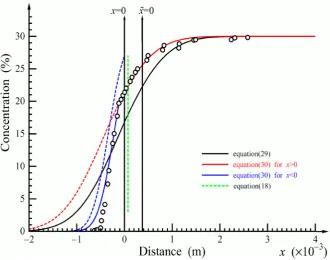
Zn.In Figure 2, the black curve denotes the concentration profile of Zn given by Equation (29) of the fixed coordinate system at the temperature 880˚C and
diffu-sion time 5
4.284 10 s
DOI: 10.4236/jmp.2018.92009 140 Journal of Modern Physics
Figure 2. Concentration profile of Zn in the diffusion region of Zn-Cu alloy. The nota-tion ○ indicates an experimental value at a given point in the diffusion region. The
black curve shows Equation (29) at the temperature 880˚C and the time 5
4.284 10 s×
regardless an effect of vacancies. The red curve shows Equation (30) for x>0 at a room
temperature after the diffusion treatment and it is taken account of an effect of vacancies. The dotted blue curve shows Equation (30) for x<0 at a room temperature after the
diffusion treatment and the blue curve is taken account of an effect of vacancies in accor-dance with a situation for x<0 then. The dotted green line indicates the so-called
Kir-kendall effect.
also the K effect shown by the dotted green line is experimentally obtained as
5
eff 7.5 10 m
x −
∆ = × then. Here, note that the unbalanced vacancies between the
regions of x>0 and x<0 at the temperature 880˚C and diffusion time
5
4.284 10 s
t= × become a distribution in the thermal equilibrium state at a room temperature.
Considering the inert characteristic of marker, the movement of an inert marker shows that the diffusion region space moves to the inverse orientation against the movement of diffusion particles. As discussed in the previous works, the coordinate transformation of the diffusion equation is thus indispensable for understanding the K effect [15] [16] [18]. In the present case, therefore, the ori-gin of fixed coordinate system
( )
t x, is set at the point of mass center on thein-itial interface and the origin of moving coordinate system
( )
t x , is set at a pointof space on the initial interface under the condition of t=t and
0 d t x= +x
∫
v t, where v is a velocity of the origin of( )
t x , against the origin of( )
t x, . Equation(27) indicates that the velocity v of the origin of
( )
t x , expressed as(
Zn)
(
Zn Zn)
0.5A B A B
1 Zn
v D D C C t
µ
−
DOI: 10.4236/jmp.2018.92009 141 Journal of Modern Physics
Introducing the effect of shift sft 0 d t
x =
∫
v t into Equation (29), the concentra-tion profile for x>0 at a room temperature is expressed as( )
Zn sft Zn
Zn int
3 1 erf
20 2
x x
C x
D t
β
+
+ ∆
= + +
(30)
using the notation of xsft xsft xeff
+
∆ = − ∆ , since the excess vacancies disappear during a temperature fall after the diffusion treatment. In other words, the x=0
axis and the inert marker on the x=xsft interface return to x= ∆xeff called
the Kirkendall interface after the diffusion treatment [15] [16].
The red curve approximately agrees with the experimental results for x>0
under the condition of 4 sft 3 10 m
x+ −
∆ = × , but the dotted red curve is over shifted
in the region of x<0 compared the experimental results. Resulting from the
diffusion behavior of Zn atoms, the material B side of diffusion couple is in a su-persaturated state of vacancies, while the material A side is in an unsaturated state of vacancies. The red curve of Equation (30) should be thus accepted only in the region for x>0. In the present case, the material A is the pure Cu and it
seems that Zn atoms on the interface near x=xA in the diffusion region of
A B
x ≤ ≤x x diffuse into the pure Cu as impurities, if we neglect the vacancy be-havior in the diffusion field. This indicates that we can thus adopt Zn Zn
int- A,imp
D =D
in Equation (30) for x<0 as a first approximation.
The dotted blue curve denotes the concentration of Zn for x<0 at a room
temperature. Further, taking account of the effect of vacancies for x<0, the
blue curve shifts to the positive direction of the x axis under the condition of
the shift 4
sft 1.2 10 m
x− x+ −
∆ = ∆ − × resulting from the unsaturated vacancies for
0
x< . The shifted blue curve agrees approximately with the experimental results for x<0 at the room temperature after the diffusion treatment. As a result, this
gives an evidence for the validity of present method for determining an initial and/or boundary value of diffusivity discussed in the section 2.
Using Equations ((29), (30)), the concentration profile of experimental results was physically reproduced as shown by the red curve for x>0 and the blue
curve for x<0 in Figure 2. However, the correlation between ∆xeff and xsft
is considerably complicated as discussed in the following. As mentioned above, the diffusion region space moves to the positive direction of x axis in the present case. The inert maker on the initial interface moves to x=xsft during diffusion
treatment in accordance with the movement of x=0 axis then. During the
temperature fall from 880˚C to a room temperature after diffusion treatment, the supersaturated vacancies for x>0 flow to the negative direction of x axis
be-cause of the unsaturated state of vacancies in the region of x<0, and at the
same time they also flow to the specimen surface considered to be the sink and source of vacancies then. The inert marker does not move to the direction of x
axis even if vacancies flow to the specimen surface perpendicular to the x axis. Therefore, the inert marker on the x=xsft interface returns to x= ∆xeff
DOI: 10.4236/jmp.2018.92009 142 Journal of Modern Physics
4. Discussion and Conclusions
Using the analytical solutions expressed by Equations ((29) and (30)), the inter-diffusion problem between the pure copper and brass alloy was reasonably solved in the present study, regardless of the Darken equation. It was concretely confirmed that the Darken equation, which has been widely used for analyzing problems of binary system interdiffusion, is not only actually unnecessary but also theoretically unsuitable for analyzing the interdiffusion problems. By apply-ing the diffusion theory obtained previously to the actual interdiffusion problem, the necessity of coordinate transformation for the diffusion equation was con-cretely confirmed in the present work. At the same time, it was also confirmed that the concept of intrinsic diffusion is nonexistent from the beginning.
The quantity of excess vacancies corresponding to
(
xsft− ∆xeff)
returns to thenegative direction of x axis after the diffusion treatment. In other words, the quantity of excess vacancies corresponding to ∆xeff flows toward the specimen
surface. The K effect thus corresponds to the quantity of vacancies absorbed by the specimen surface considered to be the sink and source of vacancies.
In the region of pure copper, it is considered that diffusion behavior is ap-proximately acceptable as an impurity diffusion mechanism if we neglect the ef-fect of vacancies for interdiffusion problems. In fact, the result based on the con-cept was reasonably obtained. This gives evidence that the analytical method for solving interdiffusion problems of many elements system is valid, since we can determine initial and/or boundary values of diffusivities as discussed in the Sec-tion 2.
For the developments of new useful materials, solving interdiffusion problems between materials is fundamentally one of the most important research subjects. The new analytical method discussed here will be widely applicable to analyzing the interdiffusion problems of many elements system. Behavior of vacancies plays extremely important role in the interdiffusion problems. In order to under-stand further detailed diffusion behavior, solving the diffusion equation of va-cancies in the diffusion region will be necessary [15] [18].
Here, the conclusions obtained from the present work are summarized as fol-lows.
1) It was confirmed that the concept of intrinsic diffusion is not only unneces-sary but also wrong from a viewpoint of mathematical physics. The Darken equ-ation should not be used for interdiffusion problems.
2) The Gauss divergence theorem indicates that the diffusion flux J t x
( )
,given by
( )
,( )
eqJ t x = − ∂ ∂ +D C x J t +J
is valid because of ∂ ∂x J t
{
( )
+Jeq}
=0 [24]. Here, the flux J t( )
means amovement of space within the diffusion region and the K effect gives evidence for its validity. The flux Jeq independent of the time and space plays an
DOI: 10.4236/jmp.2018.92009 143 Journal of Modern Physics
theoretical relation of K effect derived from J t
( )
of each element is reasonably valid.3) We found that the present analytical theory is essentially indispensable for analyzing actual interdiffusion problems.
In Appendix, we would like to report the errors of equations in Refs. [13] [14] [15] [16] [18] relevant to the present work.
References
[1] Altman, E.I. and Schwarz, U.D. (2010) Advanced Materials, 22, 2854-2869. https://doi.org/10.1002/adma.200903927
[2] Novikov, D., Fieremans, E., Jensen, J.H. and Helpern, J.A. (2011) Nature Physics, 7, 508-514.
[3] Agarwal, K., Gopalakrishnan, S., Knap, M., Müller, M. and Demler, E. (2015) Phys-ical Review Letters, 114, 160401. https://doi.org/10.1103/PhysRevLett.114.160401 [4] Zaburdaev, V., Denisov, S. and Klafter, J. (2015) Review of Modern Physics, 87, 483.
https://doi.org/10.1103/RevModPhys.87.483
[5] Lausch, T., Mayer, D., Schmidt, F., Lutz, E. and Widea, A. (2017) Nature Physics, 13, 137-141.
[6] Darken, L. S. (1948) Transactions of the Metallurgical Society of AIME, 175, 184-201.
[7] Okino, T. (2013) Journal of Modern Physics, 4, 1495-1498. https://doi.org/10.4236/jmp.2013.411180
[8] Shewmon, P. G. (1963) Diffusion in solids, McGraw-Hill.
[9] Iijima, Y., Funayama, K., Kosugi, T. and Fukumichi, K. (1996) Philosophical Maga-zine Letters, 74, 423-428.
[10] Masumura, R.A., Rath, B.B. and Pande, C.S. (2002) Acta Materialia, 50, 4535-4544. https://doi.org/10.1016/S1359-6454(02)00273-2
[11] Nathaniel, R., Scott, D.B. and Jerome, D. (2017) Physical Review E, 95, 013206. https://doi.org/10.1103/PhysRevE.95.013206
[12] Mehrer, H. (2007) Diffusion in Solid. Springer-Verlag Berlin Heidelberg. https://doi.org/10.1007/978-3-540-71488-0
[13] Okino, T. (3011) Materials Transactins, 52, 2220-2227. [14] Okino, T. (2012) Journal of Modern Physics, 3, 255-259.
https://doi.org/10.4236/jmp.2012.33034
[15] Okino, T. (2015) Journal of Modern Physics, 6, 2109-2144. https://doi.org/10.4236/jmp.2015.614217
[16] Okino, T., Cho, H. and Yamada, K. (2015) Journal of Modern Physics, 8, 903-918. https://doi.org/10.4236/jmp.2017.86056
[17] Smigelskas, A. D. and Kirkendall, E.O. (1947) Transactions of the Metallurgical So-ciety of AIME, 171, 130-142.
[18] Okino, T. (2014) Applied Physics Research, 6, 1-7. https://doi.org/10.5539/apr.v6n2p1
[19] Kirkendall, E., Thomasson, L. and Upthegrove, C. (1939) Transactions of the Me-tallurgical Society of AIME, 133, 186-203.
DOI: 10.4236/jmp.2018.92009 144 Journal of Modern Physics
104-110.
[21] Hino, J., Tomizuka, C.T. and Wert, C.A. (1957) Acta Metallurgy, 5, 41. https://doi.org/10.1016/0001-6160(57)90153-0
[22] Boltzmann, L. (1894) Annual Review of Physical Chemistry, 53, 959-964. https://doi.org/10.1002/andp.18942891315
[23] Matano, C. (1933) Japanese Journal of Physics, 8, 109-113. [24] Okino, T. (2012) Journal of Modern Physics, 3, 1388-1393.
https://doi.org/10.4236/jmp.2012.310175
Appendix
1) The equation of
(
) (
)
IN 2 A B A B A B
j j j j j j
D D D D D D
ξ = − + for j=I, II and/or no-suffix j used at the pages 2223 and 2227 in Ref. [6], at the page 258 in Ref. [7], at the page 2129 in Ref. [8], at the page 911 in Ref. [9] and at the page 5 in Ref. [11] should be revised as
(
) (
)
IN 2 int- A B A B
j j j j j
D D D D D
ξ = − + for int- A B
j j j
D = D D
2) The equation of
( )
d
d j j n j
C C
D D
ξ ξ
∂ = ∂ + ∂
∂
used as Equation (4)-(10) at the page 2124 in Ref. [8] should be revised as
d
d j j j
C C
C D
D
ξ
∂ = ∂ + ∂
∂ for C=C
( )
ξ
n .3) The equation of
1
IN A B A B
A B A B
int-2 erf
2 ln ln
2
j j j j
j
j j j j
j
C C D D
D D D D
D
ξ
β
= − + − − + − − −
used at the page 911 in Ref. [9] should be revised as
1
IN A B
A B A B
int-2 erf
ln ln 2
j j
j
j j j j
j
D D
D D D D
D
ξ
β = − + − + −
− −