Received 11 April 2016 Accepted 23 May 2016
Edited by V. Holy´, Charles University, Prague, Czech Republic
Keywords:X-ray dynamical diffraction theory; lateral structures; lateral crystals; reciprocal space maps; Bragg–Laue geometry; coherent diffraction imaging; deformations.
Bragg–Laue X-ray dynamical diffraction on perfect
and deformed lateral crystalline structures
Vasily I. Punegov,a,b* Sergey I. Kolosovaand Konstantin M. Pavlovc,d
aKomi Research Center, Ural Division, Russian Academy of Sciences, Syktyvkar, 167982, Russian Federation,bSyktyvkar
State University, Syktyvkar, 167001, Russian Federation,cSchool of Science and Technology, University of New England, NSW 2351, Australia, anddSchool of Physics and Astronomy, Monash University, VIC 3800, Australia. *Correspondence e-mail: [email protected]
The new dynamical diffraction approach to X-ray diffraction on lateral crystalline structures has been developed to investigate the angular and spatial distribution of wavefields in the case of the Bragg–Laue geometry in non-perfect lateral structures. This approach allows one to calculate reciprocal space maps for deformed lateral crystals having rectangular cross sections for both the transmitted and reflected wavefields. Numerical modelling is performed for crystals with different lateral sizes, thicknesses and deformations. The approach can be used in coherent diffraction imaging to simulate Fraunhofer diffraction patterns produced by relatively large deformed crystals.
1. Introduction
Lateral (having a finite length in the lateral direction) crys-talline structures (e.g.nanowires) are widely used in opto- and nanoelectronics. For instance, core–shell nanowires, having a high surface-to-volume ratio, are promising candidates for light emitting diodes (Yanet al., 2009), solar cells (Krogstrupet al., 2013), transistors (Colingeet al., 2010) and other devices (Liet al., 2006; Dasguptaet al., 2014). In recent years there has been a renewed interest in using X-ray diffraction as a char-acterization technique on such lateral structures (see e.g. Kaganer & Belov, 2012; Minkevichet al., 2011; Leeet al., 2006; Stankevicˇ et al., 2015, and references therein). Lateral struc-tures are also often the objects of interest (seee.g.Chaet al., 2010; Ko¨hl et al., 2013; Yang et al., 2013) in applications of coherent diffraction imaging (CDI) [see a recent review of Bragg CDI by Vartanyants & Yefanov (2015) and references therein].
Some dynamical diffraction approaches (Olekhnovich & Olekhnovich, 1978; Thorkildsen & Larsen, 1999a; Kolosov & Punegov, 2005; Yan & Li, 2014) based on Takagi’s equations (Takagi, 1962, 1969) have been employed to calculate rocking curves from ideal (i.e.non-deformed) crystals with a rectan-gular cross section. A simpler kinematical diffraction theory was used to simulate X-ray diffraction on deformed crystals having a trapezium cross-sectional shape (Punegovet al., 2006; Punegov & Kolosov, 2007) or an arbitrary cross-sectional shape (Punegovet al., 2007). However, this does not take into account dynamical diffraction effects, which become evident even for relatively small crystals (Punegovet al., 2014).
Usually, Takagi’s equations are used to simulate dynamical X-ray diffraction on lateral crystalline structures (Becker, 1977; Becker & Dunstetter, 1984; Olekhnovich & Olekhno-vich, 1980; Saldin, 1982; Chukhovskiiet al., 1998; Thorkildsen & Larsen, 1999b). However, these approaches do not allow
ISSN 1600-5767
one to simulate reciprocal space maps (RSMs). Recently, we applied (Punegovet al., 2014) Darwin’s recurrence relations to calculate the crystal rocking curves and RSMs in Bragg geometry for X-ray diffraction on non-deformed lateral crys-tals. However, a simultaneous Bragg and Laue or a mixed Laue–Bragg geometry is a more realistic variant for lateral crystals.
Lehmann & Borrmann (1967, and references therein) observed, explained and later numerically modelled inter-ference fringes appearing in Laue–Bragg geometry. The experiment and calculations were done by Lehmann & Borrmann for a point source placed at the crystal surface. The partial reflection at one of the crystal sides (which is parallel to the crystal reflection plane) produces an additional ‘virtual’ source, shifted with respect to the real one. Such a ‘virtual’ source, caused by reflection, is often used in optics, for instance as Lloyd’s mirror (Born & Wolf, 1999; Jesson et al., 2007), to produce interference fringes.
Saka and co-workers generalized the approach presented by Lehmann & Borrmann (1967) and discussed the theory of X-ray diffraction for finite polyhedral crystals in the Laue– Bragg (Sakaet al., 1972a), Laue–(Bragg)m(Sakaet al., 1972b, 1973) and Bragg–(Bragg)m(Sakaet al., 1973) cases. In parti-cular, Kato’s dynamical diffraction theory (Kato, 1961a,b) for spherical waves (represented as a superposition of plane waves) was employed. Saka et al. (1972a) also defined four special cases – Laue–Laue, Bragg–Bragg, Laue–Bragg and Bragg–Laue – for different configurations for incident and exit waves with respect to the entrance and exit surfaces of a crystal. For instance, they said (Sakaet al., 1972a, p. 103) that ‘when the Bragg reflected waves emerge from the entrance surface, we shall call this the ‘Bragg case on the entrance surface’, whereas when they all propagate through the crystal, the case is called the ‘Laue case on the entrance surface’’. It should be noted that Sakaet al.(1972a) did not consider the case of a lateral crystal which we discuss in this paper. For a lateral crystal it is possible (see x3 below) to have simulta-neously both the above-mentioned cases (namely, Laue and Bragg cases) for the entrance surface. Similarly, both Laue and Bragg cases can be observed for the exit surface in lateral crystals (seex3 below). Saka and co-workers also considered a finite polyhedral crystal (Sakaet al., 1972b, 1973), but only for the case of a spherical incident wave, having a limited wave-front at the entrance surface. This differs significantly from the configuration discussed in this paper, where we deal with deformed lateral crystals ‘bathing’ in the incident plane wave and calculate the distribution of diffracted intensity in reci-procal space.
While in their original study Lehmann and Borrmann considered the strong absorption case (t> 18), whereis the normal X-ray linear absorption coefficient and t the crystal thickness, Mai & Zhao (1989) discussed in detail Borrmann– Lehmann interference in the moderate absorption case (t= 1.6). In particular, they noted that the observed fringe spacing in the case of low or moderate absorption is not described by formulae originally obtained for the case of strong absorption. Mai & Zhao (1989) derived a general formula of the observed
fringe spacing which is valid for high, moderate and low absorption. Their computer simulation was in good agreement with the experimental topographs.
Langet al.(1986, 1990) used synchrotron radiation to study the Borrmann–Lehmann interference effect. They observed a high sensitivity of the interference fringes to lattice distortion. Such a high sensitivity can be qualitatively explained by analogy with X-ray interferometry. Their modelling (Langet al., 1990) was based on Kato’s ray-optical diffraction theory for a mildly distorted crystal (Kato, 1963, 1964a,b) with the assumption of a constant strain gradient.
Uragami (1983) numerically simulated the intensity distri-bution of the wavefield, caused by a very narrow incident wave, in an ideal rectangular-shaped crystal, using the Takagi equations (Takagi, 1962, 1969) in the Laue geometry case. The result of the numerical simulation was compared with an analytical solution (Uragami, 1971) using a Green’s function approach (Uragami, 1969, 1970; Afanas’ev & Kohn, 1971). It was demonstrated that the transmitted wave, upon hitting a side face of the rectangular-shaped crystal, is reflected back inside the crystal and then interferes with the Bragg diffracted wave already propagating in the crystal. However, the distri-bution of intensity in reciprocal space, discussed in this paper, was not investigated. Also, in addition to a different calcula-tion algorithm, we consider an incident plane wave instead of a delta function like the narrow incident wave used by Uragami (1983).
Yan & Noyan (2005) investigated an effect of dynamical diffraction for a spatially limited and slightly divergent (i.e. non-parallel) beam by a plane-parallel Si crystal in the Bragg– Laue, Bragg–Bragg–Laue and multiple Bragg–Bragg cases. In particular, they observed fictitious double spots at the spatial detector caused by back-surface diffraction. Additionally, they provided a set of equations that can be used to calculate the separation of such peak pairs. Such double peaks in Laue diffraction patterns may cause difficulties in the strain analysis, as shown in their subsequent paper (Yan & Noyan, 2006). To avoid such a problem, an additional (analyser) crystal in the diffracted beam can be used (Yan & Noyan, 2006). This analyser crystal allows one to distinguish spatial and angular shifts of the diffracted beam.
It should be noted that the method first proposed by us in 2014 (Punegovet al., 2014) and further developed in this paper might seem similar to the numerical calculations of images in X-ray topography (seee.g.Authieret al., 1968; Taupin, 1967; Bowen & Tanner, 1998; Authier, 2001; Epelboin, 1985). However, our method differs from the above in that it deals with lateral crystals ‘bathing’ in the incident plane wave and allows one to calculate the distribution of diffracted intensity in reciprocal space.
volume of the order of several micrometres (Pellegrini & Sto¨hr, 2003). If the illuminated object, having a size of several micrometres, matches the coherence volume, the dynamical diffraction effects (Authier, 2001) start to be observable. For instance, thePendello¨sungoscillations in the Laue diffraction geometry (seex3 below) cannot be simulated or reconstructed using kinematical diffraction theory. However, the current variants of dynamical diffraction on lateral crystalline struc-tures (exclusive of Punegov et al., 2014) do not allow the simulation of RSMs, which are required in CDI for the reconstruction of the electron density and deformation field in the sample. Also, the variant of dynamical diffraction theory developed by Punegovet al.(2014) did not take into account the deformation field in the lateral crystal, which is often the most important part of the information to be reconstructed by CDI. Therefore, it is timely to explore the possibilities offered by dynamical diffraction on deformed lateral crystals in application to CDI. This will make it possible to employ the new capabilities (e.g. large coherence volume) offered by modern synchrotron sources.
The purpose of the current paper is to present a new approach to dynamical diffraction theory based on Takagi’s equations in the case of Bragg–Laue geometry for deformed lateral crystals. This approach allows one to effectively calculate RSMs for deformed lateral crystals having rectan-gular cross sections for both the transmitted and reflected
wavefields along with the intensity distribution within the crystal.
2. Dynamical diffraction on lateral crystalline structures with a rectangular cross section
The current variants of X-ray dynamical diffraction theory (Authier, 2001) usually consider crystals with the shapes of plane-parallel slabs (see Fig. 1 and AppendixA for details) having finite thickness only in one direction. In this paper we consider lateral crystalline structures with a rectangular cross section (see Fig. 2) having a finite width ofLxand thickness of Lz.
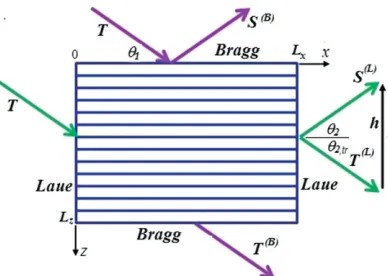
We consider simultaneously both geometries, namely the Bragg and Laue geometries (see Fig. 2). Therefore, this case can be classified as mixed Bragg–Laue diffraction, and we calculate both the transmitted and diffracted wavefields taking into account their appropriate boundary conditions at all four external surfaces of a lateral crystal. Fig. 2 demonstrates the local areas of either Bragg or Laue diffraction on such a lateral crystal.
Let us introduce a dynamical extension of the kinematical approach, previously reported by Kirste et al. (2005). We consider two-beam diffraction in the coplanar geometry, where thex0yplane is the top surface of a lateral crystal and the x0z plane is the plane of diffraction (see Fig. 2). The incident wave is assumed to be a plane monochromatic wave. A solution of Maxwell’s equations (seee.g.Afanas’ev & Kohn, 1971) within the crystal is sought in the following form:
EðrÞ ¼E0ðrÞexpðik B
0 rÞ þEhðrÞexp½iðk B
0 þhÞ r; ð1Þ
where, following Takagi (seee.g.Takagi, 1969), we assume that the amplitudes of the transmitted and diffracted wavesE0;hðrÞ
[image:3.610.94.252.412.705.2]are slowly varying functions. The vector kB0 can be chosen arbitrarily. In our case this vector is defined as always satis-fying the Bragg conditions and its magnitude is 2/, where is the X-ray wavelength in vacuum. The vector h is the appropriate vector of the reciprocal lattice (see Fig. 2).
Figure 1
A schematic of the symmetrical Bragg (a) and Laue (b) X-ray diffraction by a crystal having the same family of reflecting atomic planes (hkl), corresponding to the reciprocal lattice vectorh.
Figure 2
[image:3.610.344.538.571.709.2]Inside the crystal the X-ray wavefield is described by a system of equations of the dynamical diffraction based on Takagi’s equations (Takagi, 1969; Afanas’ev & Kohn, 1971):
@E0ðrÞ
@s0
¼i0ðrÞ
E0ðrÞ þi
hhðrÞC
EhðrÞexp½ihuðrÞ; @EhðrÞ
@sh
¼i0ðrÞ
EhðrÞ þi
hðrÞC
E0ðrÞexp½ihuðrÞ:
ð2Þ
Here0;h;hhare the Fourier components of the susceptibility,C is the polarization factor and u is the atomic displacement vector. The functions0;h;hhdepend onrowing to the variation in the chemical composition. It should be noted that in (2) we use the expressions for0;h;hh obtained for an infinitely large crystal, which is, obviously, an approximation for a lateral crystal. Thes0coordinate axis is directed along the vectork
B 0 and theshcoordinate axis is directed along the vectork
B 0 þh. Although (2) describes a general case of asymmetrical diffraction and arbitrary polarization, in this paper, for the sake of simplicity, we consider only the symmetrical coplanar diffraction of -polarized waves by a lateral crystal of rectangular shape. Such a shape belongs to the so-called convex polygons that contain all the line segments connecting any pair of its points.
The wavefieldEvðrÞjust outside the crystal volume can be represented as a combination of the incident, diffracted and transmitted waves, respectively:
EvðrÞ ¼Ev0ðrÞexpðik v 0rÞ þE
v
hðrÞexpðik v hrÞ þEvtrðrÞexpðik
v
trrÞ: ð3Þ
Here kv0 is the average wavevector of the incident wave, formed by the X-ray source and optical system before the lateral crystal, and kvh;tr are the average wavevectors of the diffracted and transmitted waves selected either spatially (e.g. by a two-dimensional detector placed at a large distance after the lateral crystal) or angularly by an analyser crystal. We consider a lateral crystal which is ‘bathing’ in the incident plane wave. Thus, the incident wave consists of two parts. The first interacts with the lateral crystal and the second does not. The latter can be excluded from the registration process, for instance, by slits, which will cut off the part of the incident wave that does not interact with the crystal. Then the wave-fields Ev0ðrÞ and E
v
trðrÞ are spatially separated. The first is located at the vertical left face and top surface of the crystal (i.e.in the space before the interaction with the lateral crystal occurs), and the second exists in the crystal ‘shadow’: at the right vertical face and the bottom surface of the crystal (i.e. after the propagated wavefield has interacted with the crystal) (see Fig. 2).
In this paper we assume that the incident wave can be approximated by a monochromatic plane wave, which is a reasonable approximation for modern synchrotron sources if monochromator crystals are used and the distance between the source and the sample is relatively large. ThenEv0ðrÞis a constant. However, this is not true for the transmitted and diffracted amplitudes. The amplitudes EvhðrÞandE
v
trðrÞ are a position-dependent function and can be calculated using
recurrence relations, which will be introduced below. Along with the traditionally used scattering vector Q¼kvhk
v 0, usually used to describe the distribution of the diffracted intensity in reciprocal space, we can also define a ‘transmis-sion’ scattering vectorQtr¼k
v trk
v
0to describe the deviation of the transmitted wavefield from the original direction,kv0, of the incident wave.
Let us assume that the experimental setup uses an analyser crystal with a very narrow (like a delta function) rocking curve to select a particular direction in reciprocal (Fourier) space, defined by either kvh (diffracted wave) or k
v
tr (transmitted wave). The wave reflected by such an analyser crystal is then integrated by a point detector. It was shown by Pavlovet al. (2001, see equation 2 therein) that the intensity registered by such a point detector is proportional to the integral over the beam cross section for the propagating wavefield just after the object. In our experimental setup this integral can be approximated by the absolute square of a sum over the crystal surface for eitherEvhðrÞorE
v
trðrÞfor the diffracted and trans-mitted waves, respectively. The same approximation can be used for a typical CDI experimental setup, which usually uses a two-dimensional position-sensitive detector placed in the far-field zone.
The information about the deviation, q (or qtr), of the scattering vector,Q(orQtr), from the vectorh(or zero for the transmitted beam) consists of the boundary conditions at the external surfaces of the lateral crystal [see (4a), (4b), (4c), (4d) below].
We assume that the crystal has a rectangular shape (see Fig. 2); then we can write four boundary conditions at the following external surfaces:
(a) At the top surface and left vertical face of the crystal (for the incoming incident wave)
Ev0ðreÞexpðik v
0reÞ ¼E0ðreÞexpðik B
0reÞ: ð4aÞ
(b) At the top surface and right vertical face of the crystal (for the leaving diffracted wave)
EvhðreÞexpðik v
hreÞ ¼EhðreÞexp½iðk B
0 þhÞ re: ð4bÞ
(c) At the bottom surface and right vertical face of the crystal (for the leaving transmitted wave)
EvtrðreÞexpðik v
trreÞ ¼E0ðreÞexpðik B
0reÞ: ð4cÞ
(d) At the left vertical face and bottom surface of the crystal (to indicate the absence of the incoming diffracted wave from this particular direction)
0¼EhðreÞexp½iðk B
0 þhÞ re: ð4dÞ
Here re is the vector defining a position at the crystal
kv0;x¼kcosð1Þ ¼kcosðBþ1Þ; kv0;z¼ksinð1Þ ¼ksinðBþ1Þ; kvh;x¼kcosð2Þ ¼kcosðBþ2Þ; kvh;z¼ ksinð2Þ ¼ ksinðBþ2Þ; kvtr;x¼kcosð2;trÞ ¼kcosðBþ2;trÞ; kvtr;z¼ksinð2;trÞ ¼ksinðBþ2;trÞ:
ð5Þ
Here1,2and2;trare small deviations from the exact Bragg angular position determined by B. Their positive/ negative directions are defined to increase/decrease the appropriate glancing angles 1,2and2;tr between the posi-tivexaxis and the wavevectorskv0,k
v handk
v
tr, respectively (see Fig. 2).
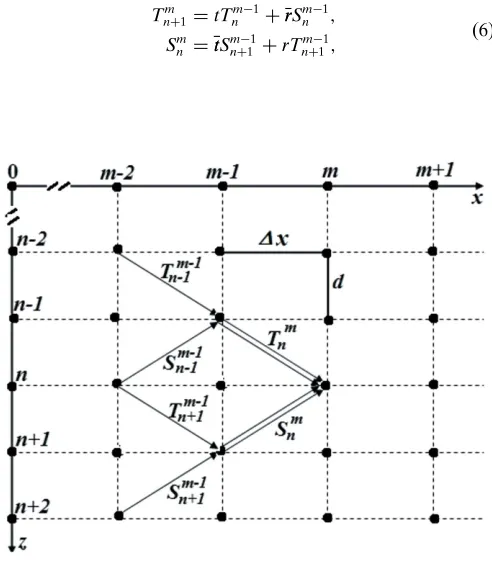
Let us describe a two-dimensional rectangular lattice as shown in Fig. 3. We assume thatdis the distance between the atomic planes (hkl), so their vertical positions arezn¼nd(nis
an integer). Then, following Punegov et al. (2014), we can choosex¼dcotBas a step size along thexaxis to indicate the positionsxm¼mx(mis an integer) where this beam [in
a finite difference form of Takagi’s equations (2)] will be partially transmitted to the next atomic plane or partially reflected. This defines a two-dimensional rectangular lattice with step sizes d and x along the z and x directions, respectively. Note that the positions of nodes (n,m) (see Fig. 3) in this lattice are fixed and do not depend on either1or2, or
2;tr. Now we can rewrite (2) in the finite difference form on the two-dimensional rectangular lattice shown in Fig. 3:
Tm nþ1¼tT
m1 n þrrS
m1 n ; Smn ¼ttS
m1 nþ1 þrT
m1 nþ1;
ð6Þ
whereTm n andS
m
n are the amplitudes of the transmitted, E0, and reflected,Eh, waves, respectively, at the (m;n) node of a
two-dimensional rectangular lattice (see Fig. 3); t¼tt¼ ð1þr0Þ, rr¼rhhexp½ihuðrÞ, r¼rhexp½ihuðrÞ, rg¼igd=ðsinBÞ(g¼0;h;hh). Equations (6) are similar to the ones we obtained previously (Punegovet al., 2014) for the Bragg geometry diffraction case using Darwin’s approach. The difference is in the absence of the phase terms, which are now included in the boundary conditions [see (4a), (4b), (4c), (4d)], and in the presence of terms exp½ihuðrÞ describing the deformation field. Now these equations can be employed in the case of the Bragg–Laue geometry, where an extended set of boundary conditions [see (4a), (4b), (4c), (4d)] will be used. In the Bragg geometry the diffracted wave S(B) and the transmitted waveT(B) are registered on the top surface and bottom surface, respectively. In the Laue geometry both waves,S(L)andT(L), are registered at the right vertical face of the crystal (see Fig. 2).
It should also be noted that a common multiplicative coefficient can be used to increase the step sizesd andx. This will speed up the simulation process. For instance, if one uses 20das the vertical step size instead ofdand 20xas the horizontal step size instead of x, the simulation time decreases by 400 times. However, such an increase should be implemented cautiously, to avoid artefacts.
The number of periods of the two-dimensional rectangular lattice, Mx and Nz, along the x and z axes, respectively, is
determined by the structure width,Lx¼Mxx, and thickness, Lz¼Nzd.
We can now rewrite the four boundary conditions given in (4a), (4b), (4c) and (4d) in a scalar form to simplify their use in recurrence relations (6):
(a) For the transmitted waves inside the crystal: at the top surface,Tm
0, and left vertical face,Tn0, of the crystal
T0m¼expði’ m
x;inÞ ¼exp½ið2=Þmxðcos1cosBÞ; Tn0¼expði’
n
z;inÞ ¼exp½ið2=Þndðsin1sinBÞ:
ð7aÞ
(b) For the diffracted waves just outside the crystal: at the top surface,Ev
hðmx;0Þ, and right vertical face,E v
hðMxx;ndÞ,
of the crystal
Evhðmx;0Þ ¼S m 0 expði’
m x;SÞ
¼Sm0 exp½ið2=ÞmxðcosBcos2Þ; EvhðMxx;ndÞ ¼S
Mx
n expði’ n z;SÞ ¼SMx
n expfið2=Þ½MxxðcosBcos2Þ ndðsinBsin2Þg:
ð7bÞ
(c) For the transmitted waves just outside the crystal: at the bottom surface, Ev
trðmx;NzdÞ, and right vertical face, Ev
[image:5.610.49.295.426.711.2]trðMxx;ndÞ, of the crystal Figure 3
Evtrðmx;NzdÞ ¼T m Nzexpði’
m x;TÞ
¼TmNzexpfið2=Þ½mxðcosBcos2;trÞ
þNzdðsinBsin2;trÞg;
EvtrðMxx;ndÞ ¼T Mx
n expði’ n z;TÞ ¼TMx
n expfið2=Þ½MxxðcosBcos2;trÞ þndðsinBsin2;trÞg:
ð7cÞ
(d) For the diffracted waves inside the crystal: at the left vertical face, S0n, and bottom surface, S
m
Nz, of the crystal (to
indicate the absence of the incoming diffracted wave from this particular direction)
S0n¼S m
Nz ¼0: ð7dÞ
The simulation procedure based on (6) is described in detail by Punegov et al. (2014). The difference is only in the requirement to use the boundary conditions at all external surfaces of the lateral crystal.
The amplitude reflection Sðqx;qzÞ and transmission Tðqtr;x;qtr;zÞ coefficients of the lateral plane-parallel
crystal-line structure are the following sums:
Sðqx;qzÞ ¼S ðBÞ
ð1; 2Þ þS ðLÞ
ð1; 2Þ; ð8Þ
Tðqtr;x;qtr;zÞ ¼T ðBÞ
ð1; 2;trÞ þT ðLÞ
ð1; 2;trÞ: ð9Þ
Here we distinguish the coefficients relating to the local Bragg geometry diffraction (see Fig. 2),
SðBÞð1; 2Þ ¼
PMx
m¼0 Sm
0 expði’mx;SÞ;
TðBÞð1; 2;trÞ ¼
PMx
m¼0 Tm
Nzexpði’
m x;TÞ;
and the coefficients relating to the local Laue geometry diffraction (see Fig. 2),
SðLÞð1; 2Þ ¼
PNz
n¼1 SMx
n expði’nz;SÞ;
TðLÞð1; 2;trÞ ¼
PNz
n¼1 TMx
n expði’nz;TÞ:
The connection between the angular parameters 1;2¼Bþ1;2 and the projections of the reciprocal space vectorsqx,qzis as follows (cf.Iida & Kohra, 1979):
qx¼ksinBð12Þ;
qz¼ kcosBð1þ2Þ: ð10Þ
The components of the newly introduced vectorqtrdepend on
1;2;tr¼Bþ1;2;tr:
qtr;x¼ksinBð12;trÞ;
[image:6.610.106.514.355.719.2]qtr;z¼kcosBð2;tr1Þ: ð11Þ
Figure 4
Figure 5
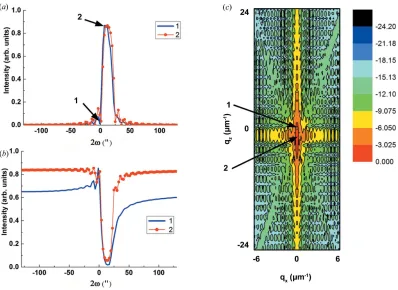
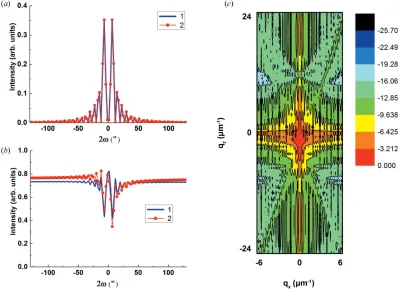
[image:7.610.108.507.416.708.2](a) The reflection rocking curve, (b) the transmission rocking curve and (c) the normalized diffracted RSM for a lateral crystal with thicknessLz= 3mm and widthLx= 37.4mm. Red lines (2) in (a) and (b) show simulations for a crystal with widthLx=1. Points 1 and 2 correspond to the minimum and maximum diffracted intensity, respectively, near the node (111) in reciprocal space. The RSM is shown in logarithmic scale.
Figure 6
In the so-called !–2!(or–2) scanning mode there is the following connection between the angular deviations for the registered diffracted beam in the Bragg geometry: 1¼
2¼!. Then qx¼0 and qz¼ kcosBð21Þ ¼ 2kcosB!. This scanning mode condition 1¼2¼! also satisfies the so-called lateral (for the top surface of the lateral crystal) diffraction condition [seee.g.ch. 4 in Pietschet al.(2004)] and corresponds to a crystal truncation rod (CTR) scan along theqzdirection.
The CTR scan in the Laue geometry is performed along the qxdirection. Then, for the registered diffracted beam1¼ 2¼!,qx¼ksinBð21Þ ¼2k!sinBandqz¼0.
To follow the direction of the transmitted wave for both the Laue and Bragg geometries, the condition 2;tr¼1¼! must be satisfied to enable the comparison with the traditional dynamical diffraction approaches (16) and (17). This makes qtr;x¼qtr;z¼0.
The above-mentioned conditions (1¼2¼!for the qz scan, 1¼ 2¼! for the qx scan and 2;tr¼
1¼! for the transmitted beam) will be used in x3 to compare the simulations done using (6), (8) and (9) and the traditional dynamical diffraction approaches (13), (14), (16) and (17).
3. Numerical modelling
The numerical modelling of RSMs and directional scans in reciprocal space for the transmitted and diffracted waves, in
the case of the lateral crystal, is performed using (6), (8) and (9). For comparison, the modelling of Bragg or Laue diffrac-tion for a crystal having an infinite extent in one direcdiffrac-tion was done using (13) and (14) or (16) and (17), respectively. In our simulations we use CuK1 radiation (the wavelength is 0.154056 nm) for the (111) reflection of an Si crystalline structure. The appropriate Bragg angle is B¼ 14.22
. The primary extinction length (Authier, 2001) for the Si(111) Bragg diffraction case is 1.506mm (Stepanov & Forrest, 2008); the Pendello¨sung distance for the Laue diffraction case is 18.67mm (Stepanov & Forrest, 2008).
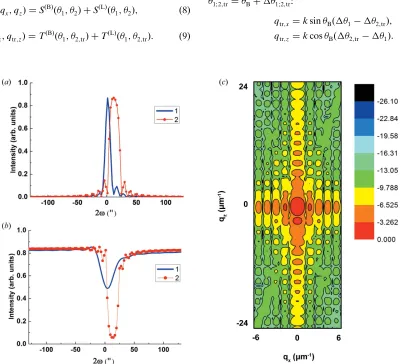
In Figs. 4–7 the rocking-curve simulations for a lateral crystal, based on (8) and (9), are labelled 1, and the Bragg [(13) and (14)] and Laue [(16) and (17)] diffraction case simulations for a crystal having an infinite extent in one direction are labelled 2. In an effort to apply proper normal-ization, all simulated reflected/transmitted-wave intensities for a lateral crystal were normalized on the maximum intensity of the rocking curves for a plane-parallel crystal [(13), (14), (16) and (17)] of the same thickness. We can say for a lateral crystal that the Bragg–Laue diffraction case applies ifLx>Lz. Then,
ifLx<Lz, the Laue–Bragg diffraction case applies. All RSMs
in Figs. 4–7 are shown in a logarithmic scale. A step size of 0.178 for intensity maps was used in Figs. 8 and 9.
3.1. Bragg–Laue diffraction
First we consider the caseLx>Lz, where the major effect is
[image:8.610.106.508.431.720.2]caused by Bragg diffraction and Laue diffraction plays a minor
Figure 7
role. For the same crystal thickness,Lz,of 3mm, which is twice
the primary extinction length, we compare the simulation results for two different crystal widths, namely a small lateral width (Lx=5mm) and a large lateral width (Lx=37.4mm)
Fig. 4 shows simulations for the reflection rocking curve (Fig. 4a, blue line 1), transmission rocking curve (Fig. 4b, blue line 1) and diffracted RSM for a crystal widthLxof 5mm. For
comparison, also shown are (red lines labelled 2) the reflection (Fig. 4a) and transmission (Fig. 4b) rocking curves for a crystal having an infinite extent in thexdirection. Despite the crystal thickness,Lz,still being the same, the simulation curves for a
lateral crystal (blue lines) and a plane-parallel crystal (red lines) are markedly distinguished. For such a ‘narrow’ lateral crystal, the dynamical interaction between the transmitted and diffracted wave cannot properly occur, and the rocking curves and RSM demonstrate the semi-dynamical character of such an interaction.
For the case of a ‘wide’ lateral crystal with width Lx =
37.4mm (see Figs. 5aand 5b) the difference between rocking curves calculated for a lateral crystal (Lx = 37.4mm) and a
plane-parallel crystal (Lx = 1) is markedly smaller. The
existing difference can be explained by the redirection of intensity in the Laue diffraction channel. Fig. 5(c) shows the diffracted intensity RSM for a ‘wide’ lateral crystal with width Lx= 37.4mm near the node (111) in reciprocal space, which
corresponds to the origin of Fig. 5(c). Points 1 and 2, shown in
Fig. 5, correspond to the minimum and maximum diffracted intensity, respectively, near the node (111) in reciprocal space.
3.2. Laue–Bragg diffraction
Now we consider the case of Laue–Bragg diffraction, where the major role is played by Laue diffraction. To analyse this case, one needs to chooseLx<Lzfor the lateral crystal. Our
simulations are done for two lateral crystals having the same width Lx = 18.7mm, which coincides with the Pendello¨sung
distance, and different thicknesses,Lz, namely 13 and 63mm.
Fig. 6 shows the simulations for the reflection rocking curve (Fig. 6a, blue line 1), transmission rocking curve (Fig. 6b, blue line 1) and diffracted RSM (Fig. 6c) for a crystal thicknessLz
of 13mm. The red line in Figs. 6(a) and 6(b) shows the simu-lations [based on (16) and (17)] for a crystal having an infinite thickness, i.e. Lz = 1. There is a substantial difference
between these simulation results. However, both demonstrate typical characteristic features of Laue diffraction. The blue dashed line in Fig. 6(a) shows the kinematical diffraction simulation [based on equation 3.9 of Authier (2001)]. This demonstrates that the kinematical theory cannot correctly describe the dynamical character of interaction between the transmitted and diffracted wave in the Laue diffraction case.
For the second crystal, having a thicknessLzof 63mm, the
[image:9.610.47.560.396.696.2]simulation results (see Fig. 7) are very similar to those [based on (16) and (17)] for a crystal with thickness Lz = 1. The
Figure 8
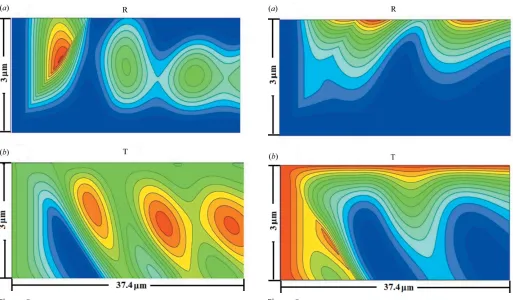
(a) The reflection and (b) the transmission X-ray intensity distribution maps (in linear scale with a step size of 0.05 for intensity) at!¼0 inside a crystal having widthLx= 37.4mm and thicknessLz=3mm. The red and blue colours correspond to 1 (maximum) and 0.05 (minimum), respectively.
Figure 9
(a) The reflection and (b) the transmission X-ray intensity distribution maps (in linear scale with a step size of 0.05 for intensity) at!¼500inside
observed small difference between the red (Lz=1) and blue
(Lz= 63mm) lines can be explained by the Bragg diffraction
channel, where a part of the intensity escapes through the top and bottom surfaces of the lateral crystal.
3.3. X-ray wavefields inside the lateral crystal
Figs. 8 and 9 show the reflection and transmission X-ray intensity distribution maps at points 1 and 2 shown in Fig. 5(a), respectively, inside a crystal having width Lx = 37.4mm and
thicknessLz= 3mm. The maps are given using a linear scale
with a step size of 0.05 for intensity. Red and blue colours correspond to 1 (maximum) and 0.05 (minimum) intensity, respectively.
The crystal width corresponds to two of the Pendello¨sung distances in the Laue geometry. The diffraction and trans-mission rocking curves as well as RSMs for this crystal are shown in Fig. 5. In particular, the angular positions!¼0 and !¼500correspond to points 1 (q
z=0) and 2 (qz=2mm 1
), respectively. It should be noted that in this particular case Bragg diffraction plays the major role.
First we consider the case when!¼0. As the Darwin curve centre is shifted owing to refraction by about 700, the Bragg
diffraction intensity (see Fig. 8a) at this angular position is small (see also Fig. 5). However, in the Laue geometry there is no such refraction shift; therefore this angular position is expected to have a high intensity for the Laue diffraction case (see Fig. 8b) in a lateral crystal having thicknessLz=3mm. At
the same time, this Laue type of diffraction is relatively weak since the left vertical face of the lateral crystal is only 3mm. Nevertheless, we observe thePendello¨sungeffects in the form of ellipses in both the diffracted (Fig. 8a) and transmitted (Fig. 8b) wavefields.
When!¼500 (orq
z=2mm 1
) (see Fig. 9), which corre-sponds to point 2 in Fig. 5, we observe the maximum intensity in the Bragg diffracted wavefield at the top surface of the lateral crystal (see Fig. 9a). One can see two areas of such strong intensity near the top surface. Such inhomogeneity is caused by the Laue diffraction effects at the left and right vertical faces of the lateral crystal.
The maximum value of transmitted intensity at the top left corner of Fig. 9(b) is caused by the boundary conditions: in particular, the X-ray wave is incident on the left vertical face and top surface of the lateral crystal. The further propagation inside the crystal diminishes the transmitted-wave intensity owing to the primary extinction effects caused by interference. Therewith its energy is transferred into the diffracted wave.
3.4. Effect of the deformation field
The approach presented in x2 allows one to simulate dynamical diffraction RSMs for a deformed lateral crystal. To illustrate this ability we use a model of the deformation field reported by Chaet al.(2010). This parabolic displacement may be associated (Cha et al., 2010) with the attachment of the lateral crystal to a substrate and can be approximated as exp½ihuðrÞ ¼exp½i’ðrÞ ¼exp½i ðxLx=2Þ
2
[image:10.610.48.562.497.706.2], where is a constant inversely proportional to the radius of curvature and ’ðrÞis the phase shift caused by the deformation field. In our simulations we have chosen the values of the coefficient to have a maximum of the phase shift, ’ðrÞ, of either or 2 radians at the edges of the lateral crystal. Such a phase shift is the so-called strong phase limit, which is extremely likely to occur in practice (Cha et al., 2010). However, the support-based phasing method, used in the iterative reconstruction procedure reported by Chaet al.(2010), was not successful for such large phase shifts.
Figure 10
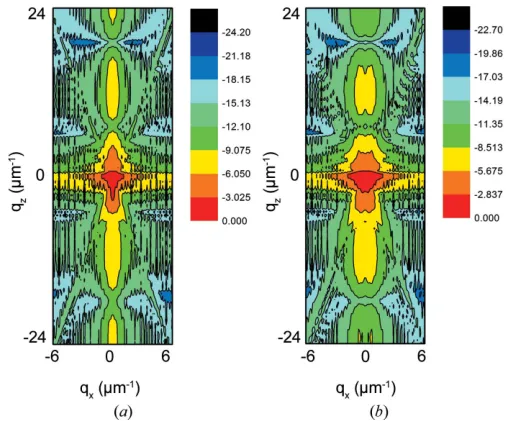
[image:10.610.313.566.498.709.2] [image:10.610.48.302.498.706.2]RSMs for a deformed lateral crystal with thicknessLz= 3mm and width Lx= 5mm. The maximum phase shift,’ðrÞ, caused by the deformation is (a)and (b) 2. The RSMs are shown in logarithmic scale.
Figure 11
We applied this deformation field to two of the lateral crystals considered in this paper, namely the lateral crystal having thickness, Lz, of 3mm and lateral width,Lx, of 5mm
(see Fig. 10 and Figs. 12a and 12b) and the lateral crystal having thickness,Lz, of 13mm and lateral width,Lx, of 18.7mm
(see Fig. 11 and Figs. 12cand 12d).
The simulated RSMs (Figs. 10 and 11) demonstrate broad-ening in the qx direction in comparison with the RSMs from
non-deformed crystals (Figs. 4c and 6c). The deformation producing the maximum phase shift,’ðrÞ, of 2radians causes splitting of the diffraction patterns (see Figs. 10band 11b).
Fig. 12 shows theqxscans (withqz = 0) for the diffracted
intensity (Figs. 12aand 12c) and the appropriate transmission rocking curves (Figs. 12b and 12d). The qz scans do not
demonstrate sensitivity to this deformation field depending on thexcoordinate only. Theseqxscans allow one to see the fine
structure of the intensity distribution shown in RSMs (Figs. 10 and 11). In Fig. 12 the maximum phase shift,’ðrÞ, caused by the deformation is either zero (blue lines 1) or(red lines 2), or 2(black lines 3).
4. Conclusions
We have demonstrated how the dynamical theory approach for lateral crystals, first implemented in the case of non-deformed crystals for Bragg geometry (Punegovet al., 2014) using Darwin’s dynamical theory, can be extended to the case of deformed crystals in mixed Bragg–Laue geometries using Takagi’s equations. This approach allows calculations of RSMs
in both the directions of the transmitted and diffracted waves for rectangular-shaped crystals of arbitrary sizes. This makes easier the solution of X-ray diffraction inverse problems based on minimization of the discrepancy between the simulated and experimental data (Pavlov et al., 1995; Punegov et al., 1996; Kirste et al., 2005; Vartanyants & Yefanov, 2015) in high-resolution X-ray diffractometry and CDI. The approach can be potentially extended to the three-dimensional case in both the Fourier space and real space.
APPENDIXA
Here we provide a short review of some classical results obtained for symmetrical Bragg and Laue X-ray diffraction on plane-parallel non-deformed crystals of a finite thickness. These results are used to simulate rocking curves in the Bragg and Laue geometries in the main part of this paper. Here we assume that the incident X-ray wave is a plane wave of unit intensity and infinite extent. Also in this paper we consider only a symmetrical coplanar diffraction case for polariza-tion.
Let us start with Takagi’s equations (Takagi, 1969) describing symmetrical Bragg diffraction by an ideal crystal having thicknessLz(see Fig. 1a). Here the angle between the
[image:11.610.107.506.70.352.2]wavevector of the incident plane wave and the top crystal surface is 1¼Bþ!, where !¼1B is the angular deviation from the Bragg angleBfor the family of reflecting atomic planes (hkl).
Figure 12
@
@zE0ðz;zÞ ¼ia ðBÞ
0 E0ðz;zÞ þia ðBÞ h
h Ehðz;zÞ @
@zEhðz;zÞ ¼i½a ðBÞ
0 þzEhðz;zÞ þia ðBÞ
h E0ðz;zÞ 8
> < > :
ð12Þ
where E0;hðz;zÞ are the amplitudes of the transmitted and
diffracted waves, respectively, að0BÞ¼0=ðjsinBjÞ, a ðBÞ h;h¼ Ch;h=ðjsinBjÞ, z¼2kcosðBÞ! is the angular para-meter used in the so-called!–2!scanning mode (theqzscan
in reciprocal space for the diffracted wave), is the X-ray wavelength in vacuum,k¼2=,Cis the polarization factor (C= 1 for the -polarization case considered in this paper), g¼ r0
2F
g=ðVcÞare the Fourier coefficients of dielectric susceptibility (polarizability) where g¼0;h;hh, Fg is the
structure factor,Vcis the volume of the elementary unit cell, r0¼e2=ðmc2Þis the classical electron radius,cis the speed of light in vacuum, andeandmare electron charge and electron mass, respectively.
As the crystal and the incident wave are of infinite extent in the x direction, the amplitudes of both the transmitted and diffracted waves depend only on thezcoordinate. We consider the case when the angular deviation!is small.
Using the following boundary conditions for the incident E0ðz;z¼0Þ ¼T ¼1 and the reflected Ehðz;z¼LzÞ ¼0
waves as well as for the amplitude reflection Sð1BÞðzÞ ¼ Ehðz;z¼0Þ and amplitude transmission T
ðBÞ 1ðzÞ ¼ E0ðz;z¼LzÞ coefficients, one can obtain (Punegov, 1991,
1993; Punegov et al., 2010), in the case of symmetrical Bragg diffraction, the amplitude reflection coefficient at the top surface and the amplitude transmission coefficient at the bottom surface, respectively:
Sð1BÞðzÞ ¼a ðBÞ h fexp½i
ðBÞ
Lz 1g=Q; ð13Þ
Tð1BÞðzÞ ¼expfi½a ðBÞ 0 þ
ðBÞ 1 Lzg½
ðBÞ=
Q; ð14Þ
where ðBÞ¼ f½2aðBÞ 0 þz
2
4aðhBÞa ðBÞ hg
1=2
, ð1B;2Þ¼ f½2að0BÞþ
z
ðBÞg=2 and Q¼ðBÞ 1 exp½i
ðBÞL
z
ðBÞ
2 . The primary extinction length (Authier, 2001)ext¼jsinBj=ðCjhjÞis one of the major characteristic parameters of dynamical diffraction in the Bragg geometry. If the crystal thickness is smaller than the primary extinction length, it is usually assumed (Authier, 2001) that kinematical diffraction will occur. This is not always correct for the lateral crystalline structures (Punegovet al., 2014).
Let us now consider the case of symmetrical Laue diffrac-tion on a plane-parallel crystal having thickness Lx (see
Fig. 1b). Note that we use the same family of reflecting planes (hkl) as in the Bragg case considered above. As the crystal and the incident wave are of infinite extent in thezdirection, the amplitudes of both the transmitted and diffracted waves depend only on thexcoordinate. Takagi’s equations (Takagi, 1969) for the transmitted and diffracted waves are as follows:
@
@xE0ðx;xÞ ¼ia ðLÞ
0 E0ðx;xÞ þia ðLÞ
hEhðx;xÞ
@
@xEhðx;xÞ ¼i½a ðLÞ
0 þxEhðx;xÞ þia ðLÞ
h E0ðx;xÞ 8
> < > :
ð15Þ
where að0LÞ¼0=ðjcosBjÞ and a ðLÞ
h;h¼Ch;h= ðjcosBjÞ. Here,x¼2ksinðBÞ!is the angular parameter describing theqx scan in reciprocal space for the diffracted
wave.
The boundary conditions in the case of symmetrical Laue diffraction areE0ðx;x¼0Þ ¼T¼1,Ehðx;x¼0Þ ¼0.
In this diffraction geometry, the amplitude reflection Sð1LÞðxÞ ¼Ehðx;x¼LxÞ and the amplitude transmission T1ðLÞðxÞ ¼E0ðx;x¼LxÞ coefficients are considered at a
distance Lx from the entrance surface (see Fig. 1b). The
analytical solutions for the amplitude reflection coefficient and the amplitude transmission coefficients, respectively, are (Punegov & Pavlov, 1992)
Sð1LÞðxÞ ¼2ia ðLÞ h expfi½a
ðLÞ
0 þx=2Lxgsin½ ðLÞ
Lx=2= ðLÞ;
ð16Þ
T1ðLÞðxÞ ¼expfi½a ðLÞ
0 þx=2Lxgfcos½ ðLÞ
Lx=2
ixsin½ ðLÞ
Lx=2= ðLÞ
g; ð17Þ
whereðLÞ¼ ½2 xþ4a
ðLÞ h a
ðLÞ h
1=2
. In the case of Laue diffraction the major characteristic parameter is the Pendello¨sung distance0¼jcosBj=ðCjhjÞ(Authier, 2001).
Acknowledgements
This study was supported in part by the Ural branch of the Russian Academy of Sciences (project No. 15-9-1-13) and the Russian Foundation for Basic Research (project No. 16-43-110350). KMP acknowledges financial support from the University of New England.
References
Afanas’ev, A. M. & Kohn, V. G. (1971).Acta Cryst.A27, 421–430. Authier, A. (2001).Dynamical Theory of X-ray Diffraction.Oxford
University Press.
Authier, A., Malgrange, C. & Tournarie, M. (1968).Acta Cryst.A24, 126–136.
Becker, P. (1977).Acta Cryst.A33, 243–249.
Becker, P. & Dunstetter, F. (1984).Acta Cryst.A40, 241–251. Born, M. & Wolf, E. (1999).Principles of Optics, 7th ed. Cambridge
University Press.
Bowen, D. K. & Tanner, B. K. (1998). High Resolution X-ray Diffractometry and Topography.London: Taylor and Francis. Cha, W., Song, S., Jeong, N. C., Harder, R., Yoon, K. B., Robinson,
I. K. & Kim, H. (2010).New J. Phys.12, 035022.
Chukhovskii, F. N., Hupe, A., Rossmanith, E. & Schmidt, H. (1998).
Acta Cryst.A54, 191–198.
Colinge, J.-P., Lee, C.-W., Afzalian, A., Akhavan, N. D., Yan, R., Ferain, I., Razavi, P., O’Neill, B., Blake, A., White, M., Kelleher, A.-M., McCarthy, B. & Murphy, R. (2010).Nat. Nanotechnol. 5, 225–229.
Dasgupta, N. P., Sun, J., Liu, C., Brittman, S., Andrews, S. C., Lim, J., Gao, H., Yan, R. & Yang, P. (2014).Adv. Mater.26, 2137–2184. Epelboin, Y. (1985).Mater. Sci. Eng.73, 1–43.
Iida, A. & Kohra, K. (1979).Phys. Status Solidi A,51, 533–542. Jesson, D. E., Pavlov, K. M., Morgan, M. J. & Usher, B. F. (2007).
Phys. Rev. Lett.99, 016103.
Kaganer, V. M. & Belov, A. Y. (2012).Phys. Rev. B,85, 125402. Kato, N. (1961a).Acta Cryst.14, 526–532.
Kirste, L., Pavlov, K. M., Mudie, S. T., Punegov, V. I. & Herres, N. (2005).J. Appl. Cryst.38, 183–192.
Ko¨hl, M., Schroth, P., Minkevich, A. A. & Baumbach, T. (2013).Opt. Express,21, 27734–27749.
Kolosov, S. I. & Punegov, V. I. (2005). Crystallogr. Rep. 50, 357– 362.
Krogstrup, P., Jørgensen, H. I., Heiss, M., Demichel, O., Holm, J. V., Aagesen, M., Nygard, J. & Fontcuberta i Morral, A. (2013).Nat. Photon.7, 306–310.
Lang, A. R., Kowalski, G. & Makepeace, A. P. W. (1990).Acta Cryst.
A46, 215–227.
Lang, A. R., Kowalski, G., Makepeace, A. P. W. & Moore, M. (1986).
Acta Cryst.A42, 501–510.
Lee, K., Yi, H., Park, W.-H., Kim, Y. K. & Baik, S. (2006).J. Appl. Phys.100, 051615.
Lehmann, K. & Borrmann, G. (1967).Z. Kristallogr.125, 234–248. Li, Y., Qian, F., Xiang, J. & Lieber, C. M. (2006).Mater. Today,9, 18–
27.
Mai, Z. & Zhao, H. (1989).Acta Cryst.A45, 602–609.
Minkevich, A. A., Fohtung, E., Slobodskyy, T., Riotte, M., Grigoriev, D., Metzger, T., Irvine, A. C., Nova´k, V., Holy´, V. & Baumbach, T. (2011).Europhys. Lett.94, 66001.
Olekhnovich, N. M. & Olekhnovich, A. I. (1978).Acta Cryst.A34, 321–326.
Olekhnovich, N. M. & Olekhnovich, A. I. (1980).Acta Cryst.A36, 22– 27.
Pavlov, K. M., Kewish, C. M., David, J. R. & Morgan, M. J. (2001).J. Phys. D Appl. Phys.34, A168–A172.
Pavlov, K. M., Punegov, V. I. & Faleev, N. N. (1995).JETP,80, 1090– 1097.
Pellegrini, C. & Sto¨hr, J. (2003).Nucl. Instrum. Methods Phys. Res. Sect. A,500, 33–40.
Pietsch, U., Holy, V. & Baumbach, T. (2004).High-Resolution X-ray Scattering. From Thin Films to Lateral Nanostructures, 2nd ed. New York: Springer-Verlag.
Punegov, V. I. (1991).Sov. Phys. Solid State,33, 136–140. Punegov, V. I. (1993).Phys. Status Solidi A,136, 9–19.
Punegov, V. I. & Kolosov, S. I. (2007).Crystallogr. Rep.52, 191–198.
Punegov, V. I., Kolosov, S. I. & Pavlov, K. M. (2006).Tech. Phys. Lett.
32, 809–812.
Punegov, V. I., Kolosov, S. I. & Pavlov, K. M. (2014).Acta Cryst.A70, 64–71.
Punegov, V. I., Maksimov, A. I., Kolosov, S. I. & Pavlov, K. M. (2007).
Tech. Phys. Lett.33, 125–127.
Punegov, V. I., Nesterets, Y. I. & Roshchupkin, D. V. (2010).J. Appl. Cryst.43, 520–530.
Punegov, V. I. & Pavlov, K. M. (1992).Sov. Tech. Phys. Lett.18, 390– 391.
Punegov, V. I., Pavlov, K. M., Podorov, S. G. & Faleev, N. N. (1996).
Phys. Solid State,38, 148–152.
Saka, T., Katagawa, T. & Kato, N. (1972a).Acta Cryst.A28, 102–113. Saka, T., Katagawa, T. & Kato, N. (1972b).Acta Cryst.A28, 113–120. Saka, T., Katagawa, T. & Kato, N. (1973).Acta Cryst.A29, 192–200. Saldin, D. K. (1982).Acta Cryst.A38, 425–432.
Stankevicˇ, T., Dzhigaev, D., Bi, Z., Rose, M., Shabalin, A., Reinhardt, J., Mikkelsen, A., Samuelson, L., Falkenberg, G., Vartanyants, I. A. & Feidenhans’l, R. (2015).Appl. Phys. Lett.107, 103101.
Stepanov, S. & Forrest, R. (2008).J. Appl. Cryst.41, 958–962. Takagi, S. (1962).Acta Cryst.15, 1311–1312.
Takagi, S. (1969).J. Phys. Soc. Jpn,26, 1239–1253. Taupin, D. (1967).Acta Cryst.23, 25–35.
Thorkildsen, G. & Larsen, H. B. (1999a).Acta Cryst.A55, 840–854. Thorkildsen, G. & Larsen, H. B. (1999b).Acta Cryst.A55, 1–13. Uragami, T. S. (1969).J. Phys. Soc. Jpn,27, 147–154.
Uragami, T. S. (1970).J. Phys. Soc. Jpn,28, 1508–1527. Uragami, T. S. (1971).J. Phys. Soc. Jpn,31, 1141–1161. Uragami, T. S. (1983).J. Phys. Soc. Jpn,52, 3073–3079.
Vartanyants, I. A. & Yefanov, O. M. (2015). X-ray Diffraction: Modern Experimental Techniques, edited by O. H. Seek & B. M. Murphy, ch. 12. Boca Raton: Pan Stanford Publishing.
Yan, R., Gargas, D. & Yang, P. (2009).Nat. Photon.3, 569–576. Yan, H. & Li, L. (2014).Phys. Rev. B,89, 014104.
Yan, H. & Noyan, I. C. (2005).J. Appl. Phys.98, 073527. Yan, H. & Noyan, I. C. (2006).J. Appl. Cryst.39, 320–325.