A Linear-Time Algorithm for the Terminal Path
Cover Problem in Block Graphs
Ruo-Wei Hung
∗†Abstract—In this paper, we study a variant of the path cover problem, namely, the terminal path cover problem. Given a graph G and a subset T of ver-tices of G, a terminal path cover of G with respect toT is a set of pairwise vertex-disjoint paths PCthat covers the vertices of G such that the vertices of T are all endpoints of the paths in PC. The terminal path cover problem is to find a terminal path cover of G of minimum cardinality; note that, if T is empty, the stated problem coincides with the classical path cover problem. We show that the terminal path cover problem can be solved in linear time on the class of block graphs. More precisely, we first establish a tree structural representation for the class of block graphs. Then, based on the tree structure, we present an al-gorithm which, for a block graphG onn vertices and m edges, computes a minimum terminal path cover of G in linear time, that is, in O(n+m) time. The proposed algorithm is simple and only requires linear space.
Keywords: graph algorithms, path cover, terminal path cover, block graphs, linear-time algorithms
1
Introduction
1.1
Framework–Motivation
A well studied problem with numerous practical appli-cations in graph theory is to find a minimum number of vertex-disjoint paths of a graphGthat covers the vertices of G. This problem, also known as the path cover prob-lem, finds application in the fields of VLSI design, code optimization [4], mapping parallel programs to parallel architectures [14, 18], making a network have a Hamilto-nian cycle [9, 21], and program testing [17]. It is evident that the path cover problem for general graphs is NP-complete since finding a path cover, consisting of a single path, corresponds directly to the Hamiltonian path prob-lem, that is, the problem of deciding whether a graph has a Hamiltonian path [8].
The Hamiltonian path problem on some special classes of graphs, including bipartite graphs [13], chordal bipartite graphs [15], undirected path graphs [3], and directed path
∗Department of Computer Science and Information
Engineer-ing, Chaoyang University of Technology, No. 168, Jifong E. Rd., Wufong Township, Taichung Country 41349, Taiwan
†Email:[email protected]
graphs [16], has been shown to be NP-complete. Hence, the path cover problem on these above classes of graphs is also NP-complete. However, the path cover problem ad-mits polynomial time algorithms to solve when the input is restricted to be in some classes of graphs, including trees [14], block graphs [22, 23], interval graphs [2, 5], circular-arc graphs [11], distance-hereditary graphs [10], and cocomparability graphs [7].
Consider an application of the path cover problem that mapping a parallel program into a parallel architecture. The parallel program is divided into some units. The relations among program units can be represented as a graph, where program units are represented as vertices, and two vertices are adjacent if their represented units are relevant. Then, the program units are mapped into the processors of the parallel architecture. The capabilities of the parallel architecture can be increased by adding some auxiliary links among the processors. The mini-mum set of edges needed to augment the parallel archi-tecture so that it can accommodate the parallel program is determined by a minimum path cover of the graph rep-resenting the parallel program. However, some program units of the parallel program may run first. Hence, some program units must be the endpoints of paths in a path cover.
Motivated by the above issue we state a variant of the path cover problem, namely, theterminal path cover prob-lem, which generalizes the path cover problem. LetGbe a graph and letT be a subset of vertices ofG. Aterminal path cover of Gwith respect to T is a path cover ofG such that the vertices ofT are all endpoints of the paths in the path cover. Aminimum terminal path cover ofG with respect toT is a terminal path cover ofGof mini-mum cardinality. Theterminal path cover problem is to find a minimum terminal path cover ofG. We denote the cardinality of a minimum terminal path cover ofGwith respect to T by π(G,T), called the minimum terminal path cover number. We callT theterminal set ofG, the vertices in T the terminals, and the other vertices free vertices. Note that the path cover problem is a special case of the terminal path cover problem withT =∅.
vertex υ in G is called a cut vertex if the removal of υ from G increases the number of connected components. A block is a maximal connected subgraph without a cut vertex. The intersection of two distinct blocks contains at most one vertex, and a vertex is a cut vertex if and only if it is the intersection of two or more blocks. Consequently, a graph with one or more cut vertices has at least two blocks. A connected graph is ablock graphif every block in it is a clique (complete graph). Note that the line graph of a tree is a block graph, but the reverse is not true, i.e., the class of block graphs is the super-class of trees.
1.2
Contribution and Related Works
In this paper, we study the the complexity status of the terminal path cover problem on the class of block graph, and show that this problem can be solved in linear time when the input is a block graph. More precisely, we es-tablish a tree structure of a block graph. Based on the structure, we traverse its nodes bottom-up and then com-pute the related minimum terminal path cover numbers. After completing the traversal, the size of a minimum terminal path cover of a block graph G with n vertices and m edges is obtained. The proposed algorithm runs in time linear in the size of the input graphG, that is, in O(n+m) time, and requires linear space. To the best of our knowledge, this is the first linear-time algorithm for solving the terminal path cover problem on the class of block graphs.
Previous related works are summarized below. Moran and Wolfstahl solved the path cover problem on trees [14]. Skikant et al. proposed a linear-time algorithm for the path cover problem on block graphs [20]. How-ever, as pointed out by Yan and Chang [23], their al-gorithm does not work for all block graphs. Then, Yan and Chang gave another linear-time algorithm to solve the path cover problem on block graphs [23]. Although Wong [22] pointed out Yan and Chang’s linear-time algo-rithm in [23] for the path cover problem on block graphs is not correct, Chang [6] corrected one typo at the algo-rithm in [23] and stated that the algoalgo-rithm in [22] is much more complicated and is not clear to be implemented in linear time. Thus the linear-time algorithm proposed in [23] is correct and is more simple. Note that the path cover problem is a special case of the terminal path cover problem. In this paper, we will expand Yan and Chang’s result to solve the terminal path cover problem on block graphs in linear time.
1.3
Road Map
The paper is organized as follows. In Section 2, we estab-lish the notation and related terminology, and we present background results. In Section 3, we present our linear-time algorithm for the terminal path cover problem on block graphs. Finally, in Section 4 we conclude the paper
v1
v2 v5
v3
v6
v4 v9
v7 v8
v1
v2
v5
v3
v6 v4
v9
v7
v8
v12
v11
v10
(a) (b)
B1
B2
B3
B4 B
5 B6
B7
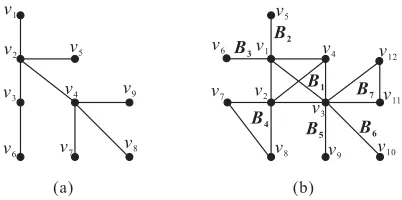
Figure 1: (a) A tree, and (b) a block graph.
and discuss possible future extensions.
2
Theoretical Framework
We consider finite undirected graphs without loops or multiple edges. LetG= (V, E) be a graph with terminal setT and letpbe a simple path inG. We denote the ver-tex set and edge set ofGbyV(G) andE(G), respectively. The set of vertices visited bypis denoted byV(p). Letv be a vertex inGandV be a subset ofV(G). We denote G−v by deletingv and edges incident to v fromGand denote byG−V the graph obtained fromGby deleting all vertices ofV and edges incident to any vertex ofV. For simplicity, we denoteT − {v} byT −v, and denote
T ∪ {v} by T +v. Let G be a subgraph of G and let
PCbe a terminal path cover ofG. We denoteT ∩V(G) byTG and denote the restriction ofPC to G by PCG. Then,PCG is a terminal path cover ofGwith respect to
TG. For two vertex-disjoint pathsp1=u1u2· · ·u|p1|and
p2=v1v2· · ·v|p2|ofGsuch thatu|p1|andv1are adjacent,
letp1→p2denote the pathu1u2· · ·u|p1|v1v2· · ·v|p2|that
is said to be theconcatenation ofp1 andp2.
2.1
The Block Tree
Let G be a block graph. Then, every block in G is a clique (complete graph) and every cut vertex is the inter-section of two or more blocks inG. IfBi andBj are two distinct blocks in G, then Bi∩Bj is empty or contains at most one vertex [1, 12, 19, 22]. For instance, Figure 1(b) depicts a block graph andv1is a cut vertex which is the intersection of blocks B1,B2, andB3. On the other hand, Figure 1(a) reveals a tree. We can find that there are many similarities between them. In fact, trees are block graphs. It follows from the above observations that we can construct a tree-like hierarchy, called block tree, from a block graph as follows.
Definition 1. LetGbe a block graph containingtblocks B1, B2,· · ·, Bt. The representation tree T∗ = (V∗, E∗)
of G is constructed as follows: Create t new nodes B1, B2,· · ·, Bt standing for these t blocks in G. Let
BT = {B1, B2,· · ·, Bt} and let V∗ = V ∪BT. The
[image:2.595.327.528.69.169.2]B1
v2 v3 v4
v5
B2 B3 B4 B5
v1
v6 v7 v8v9 v12 B6
v10 v11
: block node : cut node : end vertex
B7
(b) (a)
v1
v2 v 3
v4 v5 v6
v7 v8 v9 v10 v11
v12
B1
B2
B3
B4 B5 B6
B7
B
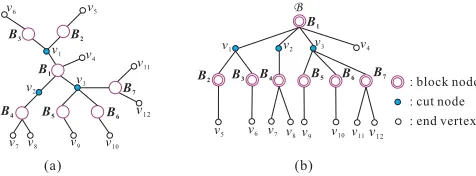
Figure 2: (a) A representation tree constructed from a block graph shown in Figure 1(b), and (b) a block tree TB with rootB=B1 for (a).
Clearly,T∗ is a tree. For instance, given a block graphG shown in Figure 1(b), the representation treeT∗ ofGis shown in Figure 2(a). While picking an arbitrary block nodeBofT∗as the root, we get a rooted tree with rootB. This rooted tree, denoted byTB= (V∗, E∗), is called the
block tree corresponding to block graph G. Figure 2(b) depicts the block tree of the block graph shown in Figure 1(b). Note that rooting a representation tree suggests a natural way to decompose the computation. On the other hand, given a block graphGthe block tree can be constructed inO(|V(G)|+|E(G)|) time by the depth first search [1].
We call an element of V∗ a node of block tree TB in general. The element of V∗ is called ablock node of TB if it is in BT; that is, it is not a vertex ofV(G). A node is called an end vertex in TB if it is in V(G) but it is not a cut vertex inG. The remains are calledcut nodes. Figure 2(b) also reveals the types of nodes in TB.
LetG be a block graph and letTB be its corresponding block tree with rootB. The subtree ofTBrooted at node ωis denoted byTω, whereωis either a cut node or a block node inTB. LetGωdenote the subgraph ofGinduced by the set of vertices ofV(G) which are nodes in the subtree Tω of TB. For instance, GB4 = ({v7, v8},{(v7, v8)}) and
Gv1 = ({v1, v5, v6},{(v1, v5),(v1, v6)}) in Figure 2.
2.2
The Background Results
In this subsection, we establish some basic lemmas that are used in proving our main results. LetGbe a graph. Since removing a terminal from a terminal path cover of Gwill decrease the number of paths by at most one, the following lemma and corollary can be easily verified.
Lemma 1. Assume that Gis a graph with terminal set
T and v ∈ T. Then, π(G−v,T −v) + 1≥π(G,T) ≥ π(G−v,T −v).
Corollary 2. Assume that G is a graph with terminal set T and v ∈ T. Then, π(G,T)> π(G−v,T −v) if and only ifπ(G,T) =π(G−v,T −v) + 1.
For a graphGwith terminal setT and a free vertexvof
G, we have the following lemma and corollary.
Lemma 3. Assume that Gis a graph with terminal set
T and v ∈ V(G)− T. Then, the following statements hold:
(1) π(G−v,T) + 1≥π(G,T +v);
(2) π(G,T +v)≥π(G,T);
(3) π(G−v,T) + 1≥π(G,T +v)≥π(G−v,T).
Proof. Since a minimum terminal path cover ofG−vwith respect to T together with the path v forms a terminal path cover ofGwith respect toT +v,π(G−v,T) + 1≥ π(G,T +v). Since a minimum terminal path cover ofG with respect to T +v is a terminal path cover ofGwith respect toT,π(G,T +v)≥π(G,T). On the other hand, suppose that PCis a minimum terminal path cover ofG with respect toT +v. Consider removing vertexv from
PC. What results is a terminal path coverPC of G−v with respect toT. Since the deletion of a terminal inPC will decrease the number of paths by at most one and v is an endpoint of a path in PC, we get that|PC| =|PC| or |PC| = |PC| −1. SincePC is a terminal path cover of G−v with respect to T, |PC| ≥ π(G−v,T). Thus,
|PC| =π(G,T +v) ≥ |PC| ≥ π(G−v,T). Combining with Statement (1), we obtain that π(G−v,T) + 1 ≥ π(G,T +v)≥π(G−v,T).
Corollary 4. Assume that G is a graph with terminal set T and v∈V(G)− T. Then, π(G,T)> π(G−v,T)
if and only if π(G,T) =π(G,T +v) =π(G−v,T) + 1.
3
The Terminal Path Cover Problem in
Block Graphs
We next present a linear-time algorithm to solve the ter-minal path cover problem on block graphs. In the rest of the paper, let Gdenote a block graph with terminal set
T and letTBrepresent its block tree with rootB. We will traverse the nodes ofTB in a bottom-up manner. Then, the traversed node may be either a block node or a cut node.
3.1
Block Nodes
Suppose that B is a block node with children v1, v2,· · · , vc in TB. By definition, v1, v2,· · ·, vc form a
clique and (Gvi−vi)’s are pairwise disjoint forc≥i≥1. By Lemma 1, ifvi∈ T then eitherπ(Gvi,TGvi) =π(Gvi− vi,TGvi−vi) + 1 orπ(Gvi,TGvi) =π(Gvi−vi,TGvi−vi). By Lemma 3, ifvi∈ T andπ(Gvi,TGvi) =π(Gvi,TGvi + vi) then either π(Gvi,TGvi) = π(Gvi −vi,TGvi) + 1 or π(Gvi,TGvi) = π(Gvi −vi,TGvi). Note that vi is a free vertex andπ(Gvi,TGvi) =π(Gvi,TGvi +vi) implies that vi is an endpoint of a path in a minimum terminal path
[image:3.595.50.288.71.159.2]I
tJ
tI
fJ
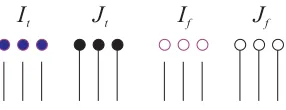
fFigure 3: The sketch map ofIt, Jt, If, Jf, where terminals are drawn by filled circle, a line represents a path, and forvi∈It∪If,vi is a path in a minimum terminal path cover ofGvi.
Definition 2. Let B is a block node with children v1, v2,· · · , vc in block treeTB. Define
It={vi∈ T |c≥i≥1, π(Gvi,TGvi) =π(Gvi−vi,TGvi − vi) + 1},
Jt={vi ∈ T |c≥i≥1, π(Gvi,TGvi) =π(Gvi−vi,TGvi− vi)},
If = {vi ∈ T |c ≥ i ≥ 1, π(Gvi,TGvi) = π(Gvi,TGvi + vi) =π(Gvi−vi,TGvi) + 1},
Jf = {vi ∈ T |c ≥ i ≥ 1, π(Gvi,TGvi) = π(Gvi,TGvi + vi) =π(Gvi−vi,TGvi)}.
By Lemma 1, It∪Jt = {vi|c ≥ i ≥ 1, vi ∈ T }. By Lemma 3,If∪Jf ={vi|c≥i≥1, vi∈ T, π(Gvi,TGvi) = π(Gvi,TGvi +vi)}. Figure 3 gives a brief illustration of It, Jt, If, Jf. We then have the following lemma for
com-puting π(GB,TGB).
Lemma 5. Assume thatB is a block node with children
v1, v2,· · · , vc in block tree TB. Then,
π(GB,TGB) =
c
i=1π(Gvi,TGvi)− |If|+ 1
, ifIf =∅ andIt∪Jf =∅;
c
i=1π(Gvi,TGvi)− |If| −
|It|+|Jf|
2 , otherwise.
Proof. For eachc≥i≥1, letPCibe a minimum terminal path cover ofGvi with respect toTGvi. Forvi∈It(resp. vi ∈Jt,vi∈If,vi∈Jf), we may assume that vi (resp.
vi → pi, vi, vi → pi) is a path in PCi with vi ∈ TGvi (resp. vi ∈ TGvi and pi =∅, vi ∈ TGvi, vi ∈ TGvi and pi=∅). For the case ofIf =∅andIt∪Jf =∅, letPC=
∪c≥i≥1PCi−∪vi∈If{vi}∪{p}, wherepis a path visiting all vi’s ofIf. Then,PCis a terminal path cover ofGB with respect to TGB. Hence, π(GB,TGB)≤
c
i=1π(Gi,TGvi)−
|If|+ 1. For the other cases, let P =∪vi∈It{vi} ∪vi∈Jf
{vi → pi} and let PC=∪c≥i≥1PCi− ∪vi∈If{vi} − P ∪
{p1, p2,· · · , p|It|+|Jf|
2 }
, where each pi except p1 is the concatenation of two paths inP andp1 is formed by the remaining one or two paths inPtogether with allvi’s for vi ∈If. Then, PC is a terminal path cover of GB with
respect to TGB. Hence,π(GB,TGB)≤ c
i=1π(Gvi,TGvi)−
|If| − |It|+2|Jf| .
On the other hand, suppose thatPCis a minimum termi-nal path cover ofGB with respect toTGB. A path inPC is calledmixedif it contains vertices in at least two differ-ent Gvi’s. We may assume thatPC is chosen to contain the fewest vertices in all mixed paths. Any mixed pathr is of the form r →r →r, wherer or r is either∅, vi inTGvi, or a nontrivial path in someGvi withvi as an endpoint, and r is either ∅ or a sequence of some vi’s. It follows that the deletion of any vertexxin ris still a path, which we denote byr−x. Let
I ={v
i|c≥i≥1, vi is the only vertex ofGvi that is in some mixed pathrandvi∈ TGvi}, and
J ={v
i|c≥i≥1, Gvi contains a nonempty r or r of a mixed pathr}.
It is easy to see that I∩J =∅. We claim thatI ⊆If
andJ⊆If∪It∪Jf.
Next, we will prove the above two claims. Suppose that vi ∈ I −If. Let vi be the only vertex of Gvi that is in some mixed path r. By definition, vi ∈ TGvi. Con-sider the terminal path cover PC = PC − PCGvi−vi −
{r} ∪ PCi∪ {r−vi} of GB. Then, we get that |PC| =
|PC| − |PCGvi−vi|+|PCi| ≤ |PC| −π(Gvi−vi,TGvi) + π(Gvi,TGvi)≤ |PC|since vi ∈If and vi ∈ TGvi implies π(Gvi,TGvi) ≤ π(Gvi −vi,TGvi) by Corollary 4. Con-sequently, PC is another minimum terminal path cover ofGB with fewer vertices in all mixed paths thanPC, a contradiction. Hence,I ⊆If.
Suppose thatvi∈J−(If∪It∪Jf). Without loss of gen-erality, assume thatGvicontains a nonemptyrifor some mixed path ri =ri →ri → ri. Consider that ri con-tainsvi ∈ TGvi only. Let PC =PC − {ri} − PCGvi−vi∪
PCi∪ {ri−vi}. Then, PC is a terminal path cover of GB with respect toTGB and|PC| =|PC| − |PCGvi−vi|+
|PCi| ≤ |PC|−π(Gvi−vi,TGvi−vi)+π(Gvi,TGvi)≤ |PC| since vi ∈It and vi ∈ TGvi implies that π(Gvi,TGvi) ≤ π(Gvi−vi,TGvi −vi) by Corollary 2. Consequently,PC is another minimum terminal path cover of GB with fewer vertices than PC in all mixed paths, a contra-diction. Now, consider that ri = ri → vi such that
ri =∅ andvi ∈ TGvi. Consider the terminal path cover
PC = PC − {ri} − PCGvi−V(ri)∪ PCi ∪ {ri → ri } of GB, where PCGvi−V(r
i) ∪ {ri} forms a terminal path cover of Gvi with respect to TGvi +vi. Then, |PC| =
|PC| − |PCGvi−V(ri)|+|PCi| ≤ |PC| −(π(Gvi,TGvi + vi)−1) +π(Gvi,TGvi) ≤ |PC| since vi ∈ If ∪Jf and vi ∈ TGvi implies that π(Gvi,TGvi +vi) > π(Gvi,TGvi) by Statement (2) of Lemma 3. Consequently, PC is an-other minimum terminal path cover ofGBwith fewer ver-tices thanPC in all mixed paths, a contradiction. Thus, J⊆I
f∪It∪Jf.
Now, suppose PChasκmixed paths. Then, π(GB,TGB) =|PC|=
vi∈I∪J
|PCi|+
vi∈I
vi∈J∩It
|PCGvi−vi|+
vi∈J∩(If∪Jf)
|PCGvi−V(ri)|+κ
≥
vi∈I∪J
π(Gvi,TGvi) +
vi∈I
π(Gvi − vi,TGvi) +
vi∈J∩It
(π(Gvi,TGvi)−1) +
vi∈J∩(If∪Jf)
(π(Gvi,TGvi)−
1) +κ=c
i=1π(Gvi,TGvi)− |I
| − |J|+κ.
For the case of If =∅ and It∪Jf =∅, I∪J ⊆If. If κ= 0, then I =J =∅, and, hence,−|I| − |J|+κ= 0≥ −|If|+ 1. Ifκ≥1, then−|I| − |J|+κ≥ −|If|+ 1.
Thus, π(GB,TGB)≥ c
i=1π(Gvi,TGvi)− |I
| − |J|+κ≥
c
i=1π(Gvi,TGvi)− |If| + 1. Consider the other cases.
Since each mixed path contains vertices in at most two Gvi’s with vi ∈ J, we get that κ≥ |J
|
2 . Since J ⊆
If∪It∪Jf, we have that|J|=|J∩If|+|J∩(It∪Jf)|,
and, hence, |J2| = |J∩If|+|J∩(It∪Jf)|
2 ≤ |J∩If|+
|J∩(It∪Jf)|
2 . Then, −|I| − |J|+κ≥ −|I| − |J
|
2 ≥
−|I| − |J ∩I
f| − |J
∩(I t∪Jf)|
2 ≥ −|If| − |It|+2|Jf| .
Thus, π(GB,TGB)≥ c
i=1π(Gvi,TGvi)− |I
| − |J|+κ≥
c
i=1π(Gvi,TGvi)− |If| −
|It|+|Jf|
2 .
3.2
Cut Nodes
We then consider the cut nodes in block treeTB. Let υ be a cut node with children block nodesB1, B2,· · ·, Bb
inTB. By Lemma 5 and Definition 2, we should calculate π(Gυ,TGυ) andπ(Gυ−υ,TGυ−υ) ifυ∈ T; and compute π(Gυ,TGυ),π(Gυ,TGυ+υ),π(Gυ−υ,TGυ) otherwise. For υ ∈ T, we compute π(Gυ,TGυ) and π(Gυ−υ,TGυ−υ) by Lemma 10 and Lemma 6, respectively. Forυ∈ T, we computeπ(Gυ,TGυ),π(Gυ,TGυ+υ), andπ(Gυ−υ,TGυ) by Lemma 11, Lemma 12, and Lemma 6, respectively. Since GB1, GB2,· · · , GBb are pairwise disjoint, the fol-lowing lemma is obvious:
Lemma 6. Assume that υ is a cut node with chil-dren B1, B2,· · · , Bb in block tree TB. If υ ∈ T, then
π(Gυ−υ,TGυ−υ) =
b
i=1π(GBi,TGBi); otherwise,π(Gυ−
υ,TGυ) =
b
i=1π(GBi,TGBi).
LetBbe a child of cut nodeυinTB, and letv1, v2,· · ·, vc be the children ofB inTB. LetGB+υbe the graph with vertex setV(GB)∪{υ}and edge setE(GB)∪{(υ, vi)|c≥ i ≥ 1}. Recall that It, Jt, If, Jf are subsets of children ofB that are defined in Definition 2. For graphGB+υ, we can construct its block tree TBυ fromTB by setting υ to be the child ofB such thatTBυ is rooted at B,B has children υ, v1, v2,· · · , vc, and υ has no child. Then, the following two lemmas can be easily verified from Lemma 5.
Lemma 7. Assume that υ is a cut node, B is a child of υ, and that v1, v2,· · · , vc are children ofB in TB. If
υ ∈ T, then π(GB +υ,TGB +υ) = c
i=1π(Gvi,TGvi)−
|If| − |It|+2|Jf|+ 1.
Lemma 8. Assume that υ is a cut node, B is a child of υ, and that v1, v2,· · · , vc are children ofB in TB. If
υ∈ T, then
π(GB+υ,TGB) = c
i=1π(Gvi,TGvi)− |If|+ 1
, if It∪Jf =∅;
c
i=1π(Gvi,TGvi)− |If| −
|It|+|Jf|
2 , otherwise.
Assume that υ ∈ T is a cut node with child B in TB. By setting υ to be a terminal, we can calculate
π(GB +υ,TGB +υ) by Lemma 7. Thus the following lemma immediately holds:
Lemma 9. Assume that υ is a cut node, B is a child of υ, and that v1, v2,· · · , vc are children ofB in TB. If
υ ∈ T, then π(GB +υ,TGB +υ) =
c
i=1π(Gvi,TGvi)−
|If| − |It|+2|Jf|+ 1.
Letυbe a cut node with child nodeBinTB. We observe that (1) if υ is a terminal then it must be an endpoint of a path in a minimum terminal path cover ofGυ with respect toTGυ, and (2) ifυ is a free vertex andπ(GB+ υ,TGB) = π(GB +υ,TGB +υ) then υ is an endpoint of a path in a minimum terminal path cover of GB+υ with respect to TGB. Using Lemmas 7– 9, we have the following two lemmas. Due to the space limitation, the proofs of these two lemmas are omitted.
Lemma 10. Assume that υ ∈ T is a cut node with children B1, B2,· · · , Bb in block tree TB. If there ex-istsBλ forb≥λ≥1 such that π(GBλ+υ,TGBλ +υ) =
π(GBλ,TGBλ), thenπ(Gυ,TGυ) =
b
i=1π(GBi,TBi);
other-wise, π(Gυ,TGυ) =b
i=1π(GBi,TBi) + 1.
Lemma 11. Assume thatυ∈ T is a cut node with chil-dren B1, B2,· · · , Bb in block tree TB. Let τ =|{Bi|b ≥ i ≥ 1, π(GBi +υ,TGBi) = π(GBi +υ,TGBi +υ) = π(GBi,TGBi)}| and let η = |{Bi|b ≥ i ≥ 1, π(GBi + υ,TGBi) =π(GBi,TGBi)}|. Then,
π(Gυ,TGυ) = b
i=1π(GBi,TGBi)−1 , if τ≥2;
b
i=1π(GBi,TGBi) , if τ≤1 andη≥1;
b
The following lemma can be easily obtained from Lemma 10 by setting a free vertexυ to become a terminal.
Lemma 12. Assume that υ ∈ T is a cut node with children B1, B2,· · · , Bb in block tree TB. If there exists
Bλ for b ≥ λ ≥ 1 such that π(GBλ +υ,TGBλ +υ) = π(GBλ,TGBλ), then π(Gυ,TGυ +υ) = b
i=1π(GBi,TGBi);
otherwise,π(Gυ,TGυ+υ) = b
i=1π(GBi,TGBi) + 1.
3.3
The Algorithm
Based on Lemma 5, Lemmas 6–9, and Lemmas 10–12, given a block tree TB with terminal set T, a linear algorithm for computing π(GB,T) is sketched as fol-lows: Initially, let π(Gv,∅) = 1, π(Gv,{v}) = 1, and π(Gv −v,∅) = 0 for each end vertex v ∈ T; and let π(Gv,{v}) = 1 andπ(Gv−v,∅) = 0 for each end vertex
v ∈ T. Our algorithm then traverses the nodes of TB in a bottom-up manner. For each block node B, it com-putesπ(GB,TGB) using Lemma 5. IfBis the root ofTB, then it outputsπ(GB,TGB); otherwise, letυbe the par-ent of B, ifυ∈ T then it computesπ(GB+υ,TGB) and π(GB+υ,TGB+υ) using Lemmas 8–9, otherwise it com-putesπ(GB+υ,TB+υ) by Lemma 7. For each cut node υ, the algorithm computesπ(Gυ,TGυ) using Lemmas 10– 11,π(Gυ−υ,TGυ−υ) using Lemma 6, andπ(Gυ,TGυ+υ) using Lemma 12 ifυ∈ T. After visiting each node ofTB once,π(GB,T) is calculated.
The correctness of the above algorithm follows from Lemma 5, Lemmas 6–9, and Lemmas 10–12. Now, we analyze its complexity. LetBbe a block node withc chil-dren and letυbe a cut node withbchildren inTB. Then, processing block node B and cut node υtakes O(c) and O(b) time, respectively. Let B1, B2,· · · , Btbe the block
nodes in TB and let δ(Bi) denote the number of
chil-dren of Bi for t ≥ i ≥ 1. Then, t
i=1δ(Bi) = |V(GB)|.
Thus, processing all block nodes requires O(|V(GB)|) time. Since the number of block nodes inTBis bounded in
O(|V(GB)|) and processing all cut nodes takesO(t) time, processing all cut nodes requiresO(|V(GB)|) time. It fol-lows immediately from the above analyses thatπ(GB,T) can be calculated inO(|V(GB)|) time.
Though we only describe the algorithm to compute π(GB,T) for a block graph GB with terminal set T, it
can be easily extended to find a minimum terminal path cover ofGB in the same time bound. Hence, we conclude the following theorem.
Theorem 13. Given a block graphG= (V, E)with ter-minal setT, the terminal path cover problem onGcan be solved inO(|V|+|E|)-linear time. Moreover, if its block tree is given, then the terminal path cover problem onG can be solved in O(|V|)time.
4
Concluding Remarks
The path cover problem on block graphs is linear solvable in [23]. However, the path cover problem is a special case of terminal path cover problem with terminal set be empty. In this paper, we first construct a block tree of a block graph. Based on the block tree, we solve the terminal path cover problem on block graphs in linear time. It is interesting to know whether the approach used in this paper can be applied to design efficient algorithms for the terminal path cover problem on the other classes of graphs, such as Ptolemaic graphs and distance-hereditary graphs that are the super-classes of block graphs.
5
Acknowledgements
This research was partly supported by the National Sci-ence Council of Taiwan under grant no. NSC96-2221-E324-024. The author would like to thank anonymous referee for many useful comments and suggestions which have improved the presentation of this paper.
References
[1] A.V. Aho, J.E. Hopcroft, and J.D. Ullman,The De-sign and Analysis of Computer Algorithms, Reading, MA, 1974.
[2] S.R. Arikati, C.P. Rangan, “Linear algorithm for op-timal path cover problem on interval graphs,” In-form. Process. Lett., vol. 35, 1990, pp. 149–153.
[3] A.A. Bertossi, M.A. Bonuccelli, “Hamiltonian cir-cuits in interval graph generalizations,”Inform. Pro-cess. Lett., vol. 23, 1986, pp. 195–200.
[4] F.T. Boesch, J.F. Gimpel, “Covering the points a digraph with point-disjoint paths and its application to code optimization,” J. ACM, vol. 24, 1977, pp. 192–198.
[5] M.S. Chang, S.L. Peng, and J.L. Liaw, “Deferred-query: an efficient approach for some problems on interval graphs,”Networks, vol. 34, 1999, pp. 1–10.
[6] G.J. Chang, “Corrigendum to: The path-partition problem in block graphs,” Inform. Process. Lett., vol. 83, 2002, pp. 293–293.
[7] P. Damaschke, J.S. Deogun, D. Kratsch, and G. Steiner, “Finding Hamiltonian paths in cocompara-bility graphs using the bump number algorithm,”
Order, vol. 8, 1992, pp. 383–391.
[8] M.R. Garey, D.S. Johnson, Computers and In-tractability: A Guide to the Theory of NP-Completeness, Freeman, San Francisco, CA, 1979.
on Graph Theory and Combinatorics,Lecture Notes in Math., Springer, Berlin, vol. 406, 1974, pp. 262– 272.
[10] R.W. Hung, M.S. Chang, “Finding a minimum path cover of a distance-hereditary graph in polynomial time,” Discrete Appl. Math., vol. 155, 2007, pp. 2242–2256.
[11] R.W. Hung, M.S. Chang, “Solving the path cover problem on circular-arc graphs by using an approx-imation algorithm,”Discrete Appl. Math., vol. 154, 2006, pp. 76–105.
[12] L.T. Quoc Hung, M.M. Syslo, M.L. Weaver, and D.B. West, “Bandwidth and density for block graphs,”Discrete Math., vol. 189, 1998, pp. 163–176.
[13] M.S. Krishnamoorthy, “An NP-hard problem in bi-partite graphs,” SIGACT News, vol. 7, 1976, pp. 26–26.
[14] S. Moran, Y. Wolfstahl, “Optimal covering of cacti by vertex disjoint paths,”Theoret. Comput. Sci., vol. 84, 1991, pp. 179–197.
[15] H. M¨uller, “Hamiltonian circuits in chordal bipartite graphs,”Discrete Math., vol. 156, 1996, pp. 291–298.
[16] G. Narasimhan, “A Note on the Hamiltonian circuit problem on directed path graphs,”Inform. Process. Lett., vol. 32, 1989 pp. 167–170.
[17] S.C. Ntafos, S. Louis Hakimi, “On path cover prob-lems in digraphs and applications to program test-ing,”IEEE Trans. Software Engrg., vol. 5, 1979, pp. 520–529.
[18] S. Pinter, Y. Wolfstahl, “On mapping processes to processors,”Internat. J. Parallel Programming, vol. 16, 1987, pp. 1–15.
[19] J.W. Robert E., “Complexity and block graphs,”
Congr. Numer., vol. 33, 1981, pp. 129–142.
[20] R. Srikant, R. Sundaram, K.S. Singh, and C.P. Ran-gan, “Optimal path cover problem on block graphs and bipartite permutation graphs,” Theoret. Com-put. Sci., vol. 115, 1993, pp. 351–357.
[21] A.S. Tanenbaum, Computer Networks, Prentice-Hall, Englewood Cliffs, 1981.
[22] P.K. Wong, “Optimal path cover problem on block graphs,”Theoret. Comput. Sci., vol. 225, 1999, pp. 163–169.