Abstract—Context Aware Mobile Computing is an emerging strategic technology for enterprises. Context is highly dynamic in mobile environments; if fully utilized, it can bring substantial improvements in the productivity of an enterprise. Context aware mobile applications are fast becoming part of the mobile workforce of organizations. Enterprises are transformed into real time enterprises through mobile applications. Formation of new software engineering techniques requires the understanding of mobile as a pervasive device for computing, new ways of working and the usage of context in daily computing specifically in mobile environments.
Developing context aware mobile applications of such nature require a rethinking of the software engineering techniques. The pervasive systems due to their properties and taxonomy require development of new requirement elicitation techniques. Since pervasive computing is a very broad subject the target of this research is to develop methods for requirements elicitation techniques for field force in various domains. This paper presents a method for using the requirement elicitation technique for the development of context aware mobile application for field force.
Index Terms— Mobile Applications, Pervasive computing,
Requirements Specifications-Elicitation methods.
I. INTRODUCTION
Mobile technology has become part of our daily life and is being used in various domains such as construction, health care, government and enterprises computing. The mobile device since its inception as a voice device has transformed into mobile computer. Use of internet and other technologies that were restricted to desktop are now commonly used in mobile devices. Mobile devices are available of different flavors such as for entertainment and media, enterprise and business and sports. Slowly the enterprise computing is gaining momentum towards the pervasive enterprise architecture [13]. There are numerous case studies showing that the mobile has become a true enterprise grade tool and has made the enterprises “Real time Enterprises” [2]. Mobile Enterprise Resource Planning solutions, Mobile Customer Recourse Management and other business software are the new strategic tools for the next generation organizations. Mobile work force at a remote location updates the data to backend enterprise and hence expedites critical decisions.
Ahmad Hassan Afridi is Masters of Science Student at the CEIT, Institute of Management Sciences, Peshawar,25000, Pakistan (corresponding author to provide phone: +92-333-9216682; e-mail: [email protected]).
Saleem Gul is Assistant Professor at the CEIT, Institute of Management Sciences, Peshawar, 25000, Pakistan (corresponding author to provide phone: +92-300-5977113; e-mail: [email protected]).
Mobile enabled field force has made an impact on the dynamics of the field work and increased the mobile workers productivity. Many case studies are present in very diverse areas such as construction, health care, sales, marketing and government, that validate the increasing the efficiency.
Latest trends have shown that technologies are providing more flexibility to the user in their tasks and less user attention. Mobile computing is dynamic in nature and hence the context continuously changes. Context awareness is the capability of a system where it can extract, interpret and use the current context [8]. Technically context is divided into categories such as user-static, user-dynamic, network connectivity and environmental status [18]. Context is the environmental characteristics such as the user location, time, identity, profile and activity to inform the computing device so that it may provide information to the user that is relevant to the current context [8]. Context awareness has been applied to various domains such as the Microsoft Easy living [21] which is an intelligent environment project by Microsoft that makes a smart home for future. Context awareness has been used to reduce perceived burden of proactive messages [5] and Siren [6], a Context aware firefighting system which estimates safe routes Application of Context awareness has also been shown in SMMART project which uses context awareness in mobile commerce [4]. Context is composed of three types. First is computing context which includes available devices, CPU, Memory, Screen size, energy and bandwidth. Second is User context which includes preference, purpose, user calendar, personal information, energy, facilities and disabilities. Third is a Physical context including location, time, destination, traffic condition, physical, weather [1].
As the importance of mobile work force increases in the enterprise computing paradigm, there is a need for enhancing the field force with the enabling technology. The main goal of the context awareness is to fully exploit the ambient data in the form of personal, computational or environmental to relevant need of the activity. For the development of new method we have discussed the mobile, field activities and basic context awareness capability uses in detail. Our basic aim is towards the development of new software engineering techniques to exploit context aware mobile capability in different scenarios and to translate them into working products [25]. We explore the usefulness of conventional requirements engineering techniques and methods for context aware mobile applications development, and devise new ways of working in new domains using the context aware mobile applications.
This paper is composed of seven sections. Section 2 discusses the requirement elicitation techniques for
Method Assisted Requirements Elicitation for
Context Aware Computing for the Field Force
pervasive, context aware systems and discusses the goals and impacts of the research done. Section 3 discusses the context awareness for field force activities. Section 4 covers a detail discussion with some scenarios for field force and context needs. Section 5 discusses framework and Section 6 testing and evaluations. Finally Section 7 concludes and suggests future research directions.
II. REQUIREMENT ELICITATION FOR CONTEXT AWARE
MOBILE SYSTEM
An elicitation technique defines how to perform the elicitation for software systems and how to describe the product. A method assisting the elicitation technique is defined as a guideline for using the elicitation technique.
As initially defined in the paper, the context aware mobile application is a new computing paradigm that requires new software engineering techniques. When eliciting requirements for the pervasive applications key properties of the systems must always be kept in mind such as non-contextual and contextual. The contextual properties include the dynamic environments, variable bandwidth, changing display and the target platforms. Various elicitation techniques exists such as traditional techniques, Group elicitation technique, Prototyping, model driven techniques, cognitive techniques and contextual techniques. These elicitation techniques are assisted by the methods for their use [23]. To understand the usage of model we analyze the context awareness in field force.
Literature survey reveals that some work has been done in this direction. According to Lyubov pervasive computing is a new paradigm and needs new design and development approach [22]. One method suggested is the requirement elicitation for the design of context aware applications [1]. This method describes the target groups for focus, estimates typical context, describe requirements, determines user activity, determines context features to adopt and finally reiterates in case of missing context aware features. For the field force these step are used in a modified manner.
When you submit your final version, after your paper has been accepted, prepare it in two-column format, including figures and tables.
III. CONTEXT AWARENESS FOR MOBILE WORKERS
There are a number of case studies that show the use of context in mobile environments, a few cases show the usage of context aware mobile computing for enterprise mobile workers (field force)[24] . When developing the context aware field force applications a key challenge lies in the evolution of the context usage and goals related to the introduction of context awareness. Most of the research conducted concentrates on individual project and a brief insight into the dynamics of context aware mobile computing in the field force is provided. Context aware mobile applications are the future of mobility. Consider these future working scenarios.
• The mobile device alerts user if there is potential of an occurrence of accident at a particular position or
location.
• In event of late arrival the field supervisor will know the traffic conditions and mobile worker activity.
• Mobile software will arrange most of the project relevant data and requires human input only for assurance for further action.
• New business opportunities by sales worker will be discovered and based upon mobile applications on their devices.
• Paramedical teams will be precise and equipped for the emergency response.
To understand context aware requirement elicitation we analyze some recent research done and practices in the projects. Context aware mobile computing in construction industry shows that the productivity of an enterprise can be improved using the context such as (time, location and profile) [19]. Further context contributes to the elimination of distraction and filtering (context relevant information) for mobile workers, profile based task allocation, instant messaging upon delivery of material to the site and real time tracking support. Andrew May et al [9] and Sven Meyer and Andry Rakotonairainy [3] describes the same attributes and deduces that context contributes towards the usability of the system. A. Spriestersbach describes text prediction as an example [7]. Julie Rennecker proposes context that can be used for the collaboration [10].
As the mobile environment is highly dynamic health and security is some key aspects that context covers. Opportunities are present in domains such as construction as location is sub context type. A key context type “date” has been used to monitor progress and workforce maintenance inspections [18].
Some possible scenarios in which the context can be used in field are to know the traffic and weather status of a particular place. Productivity remains a key factor, however Inter or intra social needs also play important role. At the managerial level the enhancement of efficiency of mobile worker, error free, minimum and human input that contribute to the enhanced or new business process are some reasons why the enterprise mobile computing should opt for context aware mobile computing. The meaningful uses of context aware technologies by humanistic research strategy showed the three classes of needs related to mobility. The first class is personal needs such as fun, games or writing some personal note. Second class is cognitive need in nature and third class as determined needs for example awareness of change of schedule to all members [14].
Case studies of various domains tell us that the context aware mobile capability is essential if:
• the productivity of our field force is influenced by distraction
• information filtering is necessary for our overloaded mobile application
• social needs in inter or intra enterprise or collaboration critical for mobile assisted operations
mobile
• monitoring field force becomes difficult without context
• there some instant information important to my current context
We must also consider the HCI issues for mobile computing in variable work environments [24]. Judy York and Prag C described issues such as human characteristics, wireless networking, hardware, input and output techniques, knowledge management solutions, development and implementation techniques [24].
IV. FIELD FORCE ACTIVITIES & CONTEXT NEEDS
In order to develop new methods we first analyze the mobile workers activities in light of Activity theory and then discuss how context awareness is useful to them.
Oulasvirta describes the design of mobile solutions for mobile workers [14]; it discusses the design approach models explaining the existing design theories such as way of thinking, way of controlling, way of working and way of modeling. We analyze some research in the area of mobile based field working that describes the way of working.
Jorg Cassens and Andres Kofod-Petersen [16] and Manasawee Kaenampornpan and Eamonn O’Neill [20] suggest the use of Activity theory to model and context aware system design. Activity theory was proposed in 1920, a psychological framework helping to understand the unity of consciousness and activity. The five guiding principles include:
• Hierarchical structure of activity
• Object-oriented
• Mediation
• Continuous development
• Distinction between internal and external activities. We analyze the field force activities on the basis of the activity theory and formulate a foundation for our strategy.
A. Hierarchical Structure of Activity
Firefly-Construction [2], a project conducted in construction domain revealed the usefulness of mobile data access and delivery in the field and benefits of mobile computing to construction industry such as fast distribution of e-data, reduction of paper work and auto-generation of reports. The project test revealed that the potential of mobile is not fully utilized and much information is needed in relation to construction activities. Currently information is manually feed or user has to use other means to get it such as telephone, contacting other institutions and choosing between the correctness and reliability of information.
Mobile workers perform various kinds of activities. Some of these are related to the job and some activities are performed to start or pre-start of an activity. For example a construction industry field worker leaves for the construction site. The worker performs the site quality assurance tests at the construction site. Along with his primary tasks the mobile worker also wants to collaborate with other field worker. While the worker is enroute, he must be aware of the traffic
positions and weather forecast, which are not directly related to the job but help for traveling to reach the site.
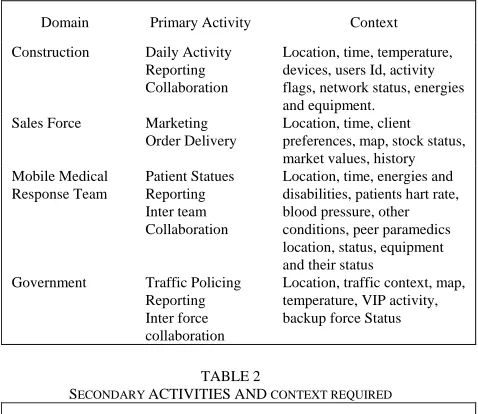
Primary activity and non-primary activity must be categorized against the types of the context requirements. In the previous example the context variables such as location, time, temperature, ambient objects identification and status, and all types that are relevant for the construction site are categorized as primary context types for primary activity. Weather, traffic and route conditions can be categorized as non-primary context types for non-primary activities. These are illustrated in Table-1 and Table-2.
According to Lyubov user activity occurs in spurts [22]. There can be context types that can be used for both primary and non-primary. The classification must be done on the basis of the domain areas for which the classification is being applied. Mobile medical response team is equipped with mobile devices. The primary activity includes the reporting of the patient’s condition back to the hospital server for preparedness, medical tem collaboration and communication and patient monitoring at the disaster site. Primary activities need context variables such as location, patient body health parameters such as heart rate, blood pressure etc and activity status of the peer paramedics.
TABLE I
PRIMARY ACTIVITIES AND CONTEXT REQUIRED
Domain Primary Activity Context
Construction Daily Activity
Reporting Collaboration
Location, time, temperature, devices, users Id, activity flags, network status, energies and equipment.
Sales Force Marketing
Order Delivery
Location, time, client preferences, map, stock status, market values, history Mobile Medical
Response Team
Patient Statues Reporting Inter team Collaboration
Location, time, energies and disabilities, patients hart rate, blood pressure, other conditions, peer paramedics location, status, equipment and their status
Government Traffic Policing
Reporting Inter force collaboration
[image:3.612.312.551.340.547.2]Location, traffic context, map, temperature, VIP activity, backup force Status
TABLE 2
SECONDARY ACTIVITIES AND CONTEXT REQUIRED
Domain Primary Activity Context
Construction Traveling Traffic conditions, law in
order status, weather,
Sales Force Traveling Map, route, traffic status,
bus schedule
Mobile Medical Response Team
Traveling Support Services ( Fire dept. Police, rescue dept)
Locations, status, equipments, energies , weather and traffic conditions
Government Traveling Location, temperature,
B. Object oriented
daily activity report in the field. Ensuring the supplies are available in the field. The activity starts with an initial goal, passes through series of sub activities and then finally ends at final stage
C. Mediation
An activity is mediated by the tools being used during the field activity the field force is mediated by the mobile devices with the mobile application support. Context aware mobile activity can be defined as composition of the physical and computational leaves under the influence of environmental states.
Activity relation to a taxonomy of Contextual Knowledge defines subject as personal context, object as task context, community as spatio-temporal, Mediating artifact as environmental, mediating rules as task and mediating division of labor as social context according to CHAT [16].
It can also be said that we can introduce or replace an activity type with another type of activity such as physical activity involved to know the bus schedule by providing computational context or values. The introduction depends upon the resources available to the user such as time, transport and computational access.
D. Continuous Development
Tools and the activity itself are continuously developing. A question arises here, is context awareness used to enable the activity or to enable the application? For example in the construction activity the context awareness is used to enable the application i.e. daily activity report by automatic text generation and activity by important message notification for health and for collaboration. Both types of facilitation moves the application towards same goal however enabling the activity is rather more direct and application an enabling component.
When new business processes are introduced there is space for the business process redefinition [17].
V. THE METHOD FOR USING ELICITATION TECHNIQUES
Analyzing the field force activity and the context variables usage we conclude that:
1. Context awareness has certain characteristic and when applied to the mobile field force area shows certain benefits. The outcome depends upon why the context awareness is used, what opportunities exist in introducing it and what future lies in making smart systems.
2. Context awareness is used mostly when the situation is so dynamic that user attention is difficult in activities. Any important information need attention and important to the user at a given time. That can in the form of discovery of some resource or information, some emergency information related to the location, message related to an activity or state change at the collaboration.
3. Main use is automating the activities through use of context for which the mobile worker may have been using other means.
4. In the field force domain the mobile worker performs activities moving from one location to other,
interacting with different people and objects, works on activities that have objective to it and performs supporting activities that are instrumental in achieving or performing the main task.
5. Enabling the main activity brings opportunity to enable the supporting activity as well.
Figure-1: Activity System for CA Mobile Applications for Field Force
Group driven elicitation technique defines elicitation technique in which the group is the elicitation is carried out in group; brainstorming sessions and the stakeholder participate to reach a consensus.
Using this technique for context aware mobile systems development leads to identify the following:
1. Core users of Context aware mobile system i.e. construction workers, health professional and sales force etc.
2. Services to deliver i.e. mobile learning, decision support and input/output generation.
Model Driven elicitation techniques define elicitation using a specific model. The Model can be goal oriented i.e. what is the aim of context aware mobile solution in the enterprise etc. The use of Scenarios such as in construction site when the workers reach the site, their context will be visible to the supervisors. Using this technique leads to the identification of the following:
1. Target service development for field force.
2. Scenarios identification and usage of context in the field operations.
Both of the above two mentioned techniques have drawbacks when used for the development of context aware mobile systems. The following problems surface:
1. An emergence of generic and time consuming enterprise model.
2. Where the context usage is more important? Is it being over used?
3. What are the constraints in which a particular activity being automated to use context awareness? The following method provides a procedure for usage of the above requirement elicitation technique for context
elicitation. The framework best illustrates the overall strategy for context awareness for mobile.
1. Enlist all the tasks during the field operations.
ARTIFACT: Mobile Device Context aware System
OBJECT: Context Detection
DIVISION OF LABOR: Mobile workers prepare report ,context aware systems provide services
of collaboration , data filtering and messaging.
COMMUNITY: Field Force
RULES: Enterprise Business Rules
2. Define the primary and secondary/tertiary activities for the domain for which the solution is being developed.
3. Develop a hierarchical structure (activity chart) to complete the field force activity life cycle.
4. Identify where to enable, the technology or activity. And enlist the key activities for which context to be used.
5. Define how context benefits the productivity and efficiency in terms of resources (time, HR, equipment, labor, physical activity, computational). 6. Establish context variables required for the context
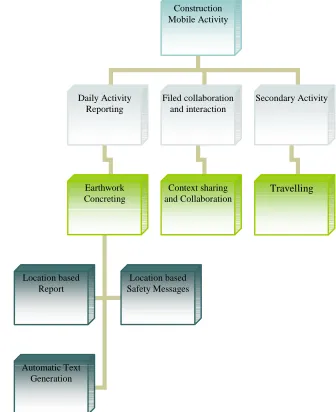
awareness i.e. time, location, bandwidth etc. As a scenario consider development of context aware mobile application for the construction industry. The Primary activity includes the daily activity reporting and on-site peer collaboration. The daily report includes reporting of earthwork and concrete quality tests reporting. Both these reports consume location based reports, incase of supply delivery messaging and health related safety messages. Also context sharing involves the sharing of current field worker status, energies and disabilities to peer in the field. As an example when a field worker visits a site from office, he needs the whether status and traffic conditions to his destination.
[image:5.612.77.245.358.564.2]
Figure 2: Activity Chart for Mobile workers in Construction VI. TESTING AN EVALUATION
The software requirement elicitation techniques such as group elicitation technique and Model driven techniques are most appropriate for the development of the context aware mobile applications for field force. For testing and evaluation of the method, both of the above mentioned techniques were used in combination to elicit the requirements for context aware mobile application for the health services field force. Then these two techniques were used assisted by proposed method in a project firefly at IM-Sciences, Center of Excellence in IT.
The group driven technique developed the understanding of the field force groups and types of common context based
operations. Using this approach we outlined the software need when there is understanding of the expected capabilities to be met. For health services the profile based task allocation and medicine availability checking can be need of only health domain and not construction.
The model driven technique helped to specify the possible scenarios during which the context is needed. The scenarios in health can be emergency, calendar or program driven or combination of both. The urban and rural trends and for context need specify the variables needed during the mobility of the worker.
The method/ context elicitation framework enlist the operation during mobility of a particular to the domain also type of support activity in the domains such as for
construction the weather and emergency the traffic. The target or desired functionality can be mapped to new domains with different scenarios but analyzing the context in hierarchy of activities and tasks or analyzing in terms of optimizing resources using context in mobile can only be visualized through this developed new method. The method was tested for health services project but it was also useful in other situations such as construction, emergency working, sales workers and enterprise mobility scenarios.
Method for Using Requirement Elicitation Technique 1.Tasks during Mobility---Driving, Sales, Monitoring 2. Categorization of Activities---Primary, Supporting 3. Activity chart generation---hierarchy of Activities 4. Context awareness for Activity---Time, LBS. 5. Evaluate context benefit / usage for Activity---Results and Resource benefits for each activity
6. Context information/ variable for each Activity----Date needed for Activity 1,7,3 etc.
Table-3: Diagrammatic presentation of method using technique.
The outlined method specifically targets the implementation of a context aware mobile field force, its impact in the general domain of context awareness needs further study. The method assumes the target mobile devices as field force grade. The field force grade means the enterprise grade mobile device such as PDAs, communicators, Palm top computers.
VII. CONCLUSIONS AND FUTURE RESEARCH DIRECTIONS
Research on context aware computing for mobile workers is still in its infancy. More case studies are required to fully analyze its complete impact.
We have presented the strategy for development of context aware mobile applications for field force. Our Strategy provides a framework for development of context aware services in initial stages by providing an analysis of research done in the area and circumstances the context is used. Secondly presenting a primary and secondary activity perspective this paper provides a method of classifying the activities and then applying various classification of context. The classification enables full exploitation of context in mobile device in achieving the efficiency in work during mobility. The future lies in the use of context awareness towards increase the productivity, efficiency and mobility of mobile worker.
Construction Mobile Activity
Daily Activity Reporting
Filed collaboration and interaction
Earthwork Concreting
Location based Report
Location based Safety Messages
Automatic Text Generation
Context sharing and Collaboration
Secondary Activity
REFERENCES
[1] Dan Hong, Dickson K.W Chiu, Vincent Y. Shen. Requirements
Elicitation for Design of Context aware applications in ubiquitous
Environment. ICEC 2005 China, August 15-17 2005
[2] Ahmad Hassan Afridi ,Mobile devices in construction industry, Journal of Computer and Information Sciences ,Volume 1 ,ISSN: 1995- 5391, August – December , 2007, page 11-13,.
[3] Sven Meyer and Andry Rakotonairainy. A Survey on Research on
Context Aware Homes. Workshop on Wearable, Invisible, Context
aware, Ambient, Pervasive and Ubiquitous Computing, Adelaide, Australia 2003
[4] Stan Kurkovsky, Vladimir Zanev, Anatoly Kurkovsky. SMMART:
Using Context Awareness in M-Commerce. MobileHCI’05, September
19-22, 2005, Salzburg, Austria
[5] Joyce Ho and Stephen S. Intille. Using Context-Aware Computing to
Reduce the Perceived Burden of Interruptions from Mobile devices.
CHI 2005, April 2-7, Portland, Oregon, USA.
[6] Xiaodong Jiang, Siren: Context-aware computing for Firefighting,
Second International conference on Pervasive Computing, April 18-23, Linz-Vienna, Austria.
[7] A. Spriestersbach, H. Vogler , F. Lehmann, T. Ziegert ,Integrating
context information into enterprise applications for the mobile
workforce - a case study, Proceedings of the 1st international workshop
on Mobile commerce, Pages: 55 - 59 ,Year of Publication: 2001 ,ISBN:1-58113-376-6
[8] M. Korkea-aho. Context Aware Applications Surveys. http://
www.hut.fi/ mkorkeaa/doc/context-aware.html, 2000.
[9] Andrew May, Val Mitchell, Sarah Bowden, Tony Thorpe,
Opportunities and challenges for location aware computing in the
construction industry, Proceedings of the 7th international conference
on Human computer interaction with mobile devices & services, Salzburg, Austria , Pages: 255 - 258 ,Year of Publication: 2005 ,ISBN:1-59593-089-2.
[10] Julie Rennecker, Promoting awareness in distributed mobile
organizations: a cultural and technological challenge, Proceedings of
the 2005 international ACM SIGGROUP conference on Supporting
group work, Pages: 442 – 443,Year of Publication: 2005,
ISBN:1-59593-223-2
[11] Yan Wang, Els van de Kar , Geleyn Meijer, Designing mobile solutions
for mobile workers: lessons learned from a case study, Proceedings of
the 7th international conference on Electronic commerce, Xian, china, Pages: 582 – 589,Year of Publication: 2005,ISBN:1-59593-112-0
[12] Eija Kaasinen, User needs for location-aware mobile services, Personal and Ubiquitous Computing, Volume 7, Issue 1 (May 2003), Pages: 70 – 79, Year of Publication: 2003, ISSN: 1617-49
[13] Puneet Gupta , Deependra Moitra, Evolving a pervasive IT
infrastructure: a technology integration approach, Personal and
Ubiquitous Computing, Volume 8 , Issue 1 (February 2004), Pages: 31 – 41,Year of Publication: 2004, ISSN:1617-4909
[14] Oulasvirta, A. (2004). Finding meaningful uses for context-aware
technologies: The humanistic research strategy. Proceedings of CHI
2004, ACM Press, New York, pp. 247-254
[15] Javier Munoz, Pedro Valderas, Vicente Pelecha, Requirements
Engineering for Pervasive Systems. A Transformational Approach,
Proceedings of the 14th IEEE International Requirements Engineering Conference (RE'06), Pages: 344 - 345 ,Year of Publication: 2006,ISBN ~ ISSN:1090-705X , 0-7695-2555-5
[16] Jorg Cassens and Andres Kofod-Petersen. Using Activity Theory to
Model Context Awareness: A Qualitative Approach., FLAIRS
Conference 2006, Proceedings of the Nineteenth International Florida Artificial, Intelligence Research Society Conference, Melbourne Beach, Florida, USA, May 11-13, 2006
[17] Rahul C Basol, Transforming Enterprise Through Mobile
Applications, A multiphase framework, Proceedings of 11th
Americas Conference on Information Systems, Omaha, NE, USA, August 11-14 2005
[18] Z. Aziz, C.J. Anumba, D. Ruikar, P.M. Carrillo & N.M. Bouchlaghem,
Context Aware Information Delivery for On-Site Construction
Operations, 22nd Conference on Information Technology in
Construction, Dresden, Germany 2005.
[19] Z. Aziz, C. Anumba, and K. Law, Using Context-Awareness and
Web-Services to Enhance Construction Collaboration, The 11th
International Conference on Computing in Civil and Building Engineering, (ICCCBE XI), Montreal, Canada, June, 2006.
[20] Manasawee Kaenampornpan and Eamonn O’Neill, Integrating history
and Activity theory in context aware systems design, ECHISE2005, 1st
International Workshop on Exploiting Context Histories in Smart Environments, 3rd International Conference on Pervasive Computing - PERVASIVE 2005.
[21] Microsoft Easy Living, http:// research.microsoft.com/easyliving/
[22] Lyubov Kolos-Mazuryk, Gert-Jan poulisse and Pascal van Eck, Requirements engineering for Pervasive Services, https://doc.telin.nl/dscgi/ds.py/Get/File-54663,last accessed on 12
December 2007.
[23] Bashar Nuseibeh and Steve Easterbrook, Requirements Engineering: International Conference on Software Engineering archive, Proceedings of the Conference on The Future of Software Engineering, Limerick, Ireland, Pages: 35 – 46 ,Year of Publication: 2000 , ISBN:1-58113-253-0, ACM Press
[24] Judy York and Prag. C. Pendharkar, Human Computer Interaction Issues in a variable work context, International Journal of Human computer Studies, Elsevier 1071-5819, page 771-791, Year of Publication: 2004