Abstract—Worldwide Interoperability for Microwave Access (WiMAX) is a technology that bridges the gap between fixed and mobile access and offer the same subscriber experience for fixed and mobile user. Demand for such type of mobile broadband services and applications are growing rapidly as it provides freedom to the subscribers to be online wherever they are at a competitive price with other significant facilities such as increasing amounts of bandwidth, using a variety of mobile and nomadic devices etc. The earliest version of WiMAX is based on IEEE 802.16 and is optimized for fixed and nomadic access, which is further extended to support portability and mobility based on IEEE 802.16e, also known as Mobile WiMAX. However, frequent topology changes caused by node mobility make routing in Mobile WiMAX networks a challenging problem. In this paper, we focus upon those routing protocols especially designed for wireless networks. Here, we study and compare the performance of four wireless routing protocols (AODV, DSR, OLSR and ZRP) for Mobile WiMAX environment under the assumption that each of the subscriber station has routing capabilities within its own network. From our simulation, we found that ZRP and AODV protocols outperform DSR and OLSR.
Keywords—AODV, DSR, Mobile WiMAX, OLSR and ZRP
I. INTRODUCTION
Today’s broadband Internet connections are restricted to wireline infrastructure using DSL, T1 or cable-modem based connection. However, these wireline infrastructures are considerably more expensive and time consuming to deploy than a wireless one. Moreover, in rural areas and developing countries, providers are unwilling to install the necessary equipment (optical fiber or copper-wire or other infrastructures) for broadband services with little profit. Broadband Wireless Access (BWA) has emerged as a promising solution for “last mile” access technology to provide high speed connections. IEEE 802.16 standard for BWA and its associated industry consortium, Worldwide Interoperability for Microwave Access (WiMAX) forum promise to offer high data rate over large areas to a large number of users where broadband is unavailable. This is the first industry wide standard that can be used for fixed wireless access with substantially higher bandwidth than most cellular
Manuscript received December 30, 2007
S. A. is with the Faculty of Engineering, 10, 50728 Kuala Lumpur, Malaysia (Phone: 60146279987; e-mail: [email protected]).
M. M. is with the Faculty of Information Communication Technology, 10, 50728 Kuala Lumpur, Malaysia (e-mail: [email protected]).
F. A. is with the Faculty of Engineering, 10, 50728 Kuala Lumpur, Malaysia (e-mail: [email protected]).
A. R. is with the Faculty of Engineering, 10, 50728 Kuala Lumpur, Malaysia (e-mail: [email protected]).
networks [1], [2]. Development of this standard facilitates low cost equipment, ensure interoperability, and reduce investment risk for operators. In the recent years, IEEE 802.16 working group has developed a number of standards for WiMAX. The first standard IEEE 802.16 was published in 2001 focused on the frequency range between 10 and 66 GHz and required line-of-sight (LOS) propagation between the sender and the receiver [3]. This reduces multipath distortion, thereby increases communication efficiency. Theoretically IEEE 802.16 can provide single channel data rates up to 75 Mbps on both the uplink and downlink. Providers could use multiple IEEE 802.16 channels for a single transmission to provide bandwidths of up to 350 Mbps [4]. However, because of LOS transmission, cost-effective deployment is not possible. Consequently, several versions came with new features and techniques. IEEE 802.16-2004, has been developed to expand the scope to licensed and license-exempt bands from 2 to 11 GHz. IEEE 802.16-2004 specifies the air interface, including the Media Access Control (MAC) of wireless access for fixed operation in metropolitan area networks. Support for portable/mobile devices is considered in IEEE 802.16e standard, which is published in December 2005. WiMAX networks consist of a central radio Base Station (BS) and a number of Subscriber Stations (SSs). In Mobile WiMAX network, BS (which is fixed) is connected to public network and can handle multiple sectors simultaneously and SSs are mobile.
A number of wireless routing protocols are already designed to provide communication in wireless environment; they are AODV, OLSR, DSDV, ZRP, LAR, LANMAR, STAR, DYMO etc. Performance comparison among some set of routing protocols are already performed by the researchers such as among PAODV, AODV, CBRP, DSR, and DSDV [6], among DSDV, DSR, AODV, and TORA [7], among SPF, EXBF, DSDV, TORA, DSR, and AODV [8], among DSR and AODV [9], among STAR, AODV and DSR [10], among AMRoute, ODMRP, AMRIS and CAMP [11], among DSR, CBT and AODV [12], among DSDV, OLSR and AODV [13] and many more. These performance comparisons are carried out for ad-hoc networks but none for Mobile WiMAX. For this reason, evaluating the performance of wireless routing protocols in Mobile WiMAX environment is still an active research area and in this paper we study and compare the performance of AODV, DSR, OLSR and ZRP routing protocols.
For performing the simulation, we assume that each of the subscriber station maintain routing table for its own network, so that it can send data directly to the destination without the help of base station. However, if one subscriber station has to
Performance Evaluation of Wireless Routing
Protocols in Mobile WiMAX Environment
send data to a station located in another network, it must send data through the base station and vice versa.
II. WIRELESS ROUTING PROTOCOLS
A. Ad-hoc On-demand Distance Vector Routing Protocol
(AODV)
Ad-hoc On-demand distance vector (AODV) [14] is another variant of classical distance vector routing algorithm. Like DSDV, AODV provides loop free routes in case of link breakage but unlike DSDV, it doesn’t require global periodic routing advertisement. AODV experiences unacceptably long waits frequently before transmitting urgent information because of its on demand fashion of route discovery [13], [14]. In AODV, each host maintains a traditional routing table, one entry per destination. Each entry records the next hop to that destination and a sequence number generated by the destination, which indicates the freshness of this information. AODV uses a broadcast route discovery mechanism where source node initiate route discovery method by broadcasting a route request (RREQ) packet to its neighbor. The RREQ packet contains a sequence number and a broadcast id. Each neighbor satisfied with the RREQ replies with the route reply packet adding one in the hop count field. Unlike DSDV, in AODV if a node cannot satisfy the RREQ, it keeps track of the necessary information in order to implement the reverse and forward path setup that will accompany the transmission of the RREP. The source sequence number is used to maintain freshness information about the reverse route to the source and the destination sequence number specifies how fresh a route to the destination must be before it can be accepted by the source The source node can begin data transmission as soon as the first RREP is received. Hence, sending the first data packet to the destination is delayed due to route discovery process.
B. Dynamic Source Routing (DSR)
The Dynamic Source Routing (DSR) protocol presented in [31] is a reactive routing protocol that is based on the concept of source routing. Mobile nodes are required to maintain route caches that contain the source routes of which the mobile is aware of. DSR allows the network to be completely self-organizing and self-configuring. It determines the complete sequence of nodes from the source (sender) to the destination (receiver) to forward the packets. DSR is composed of the two mechanisms of Route Discovery and Route Maintenance, which work together to allow nodes to discover and maintain source routes to arbitrary destinations in the network [15]. When a mobile node has a packet to send to some destination, it first checks its route cache to determine whether it already has a route to the destination. If it has an unexpired route, it will use this route to send the packet to the destination. On the other hand, if the cache does not have such a route, it initiates route discovery by broadcasting a route request packet. Each node receiving the packet checks whether it identifies a route to the destination. If it does not, it adds its own address to the route record of the packet and then forwards the packet along its outgoing links. A route reply is generated when either the route request reaches the
destination itself or when it reaches an intermediate node which knows a route to the destination [16].
There are quite a number of advantages of DSR in wireless network. DSR dynamically discovers the route to send a packet from source to destination. No periodic routing advertisement message is used to monitor the routes which are in use. When a sender wants to send a packet and there is a link failure, the sender will be notified straight away. As a result, DSR can quickly adapt to topological changes caused by node movement which may often occur in a mobile wireless network.
C. Optimized Link State Routing (OLSR)
Optimized Link State Routing protocol (OLSR) [17], [18] is based on link stare algorithm and it is proactive in nature. OLSR is an optimization over a pure link sate protocol [19] as it compact the size of information send in the messages, and reduces the number of retransmissions. It provides optimal routes in terms of number of hops. For this purpose, the protocol uses multipoint relaying technique to efficiently flood its control messages [17]. Unlike DSDV and AODV, OLSR reduces the size of control packet by declaring only a subset of links with its neighbors who are its multipoint relay selectors and only the multipoint relays of a node retransmit its broadcast messages. Hence, the protocol does not generate extra control traffic in response to link failures and additions. OLSR is particularly suitable for large and dense networks [17]. In OLSR, each node uses the most recent information to route a packet. Each node in the network selects a set of nodes in its neighborhood, which retransmits its packets. This set of selected neighbor nodes is called the multipoint relays (MPR) of that node. The neighbors not belong to MPR set, read and process the packet but do not retransmit the broadcast packet received from the node. The MPR set can change over time, which is indicated by the selectors in their HELLO messages. The smaller set of multipoint relay provides more optimal routes. The path to the destination consists of a sequence of hops through the multipoint relays from source to destination. In OLSR, a HELLO message is broadcasted to all of its neighbors containing information about its neighbors and their link status and received by the node which are one hop away but they are not relayed to further nodes. On reception of HELLO messages, each node would construct its MPR Selector table. Multipoint relays of a given node are declared in the subsequent HELLO messages transmitted by this node.
D. Zone Routing Protocol (ZRP)
node’s routing zone [15]. IERP and IARP are not specific routing protocols. Instead, IARP is a family of limited-depth, proactive link-state routing protocols. Correspondingly, IERP is a family of reactive routing protocols that offer enhanced route discovery and route maintenance services based on local connectivity monitored by IARP [21]
III. SIMULATION ENVIRONMENT
The overall goal of this simulation study is to analyze the performance of different existing wireless routing protocols in Mobile WiMAX environment. The simulations have been performed using QualNet version 4 [22], a software that provides scalable simulations of Wireless Networks and a commercial version of GloMoSim [23]. In our simulation, we consider a network of 50 nodes (one source and one destination) that are placed randomly within a 1000m X 1000m area and operating over 500 seconds. Multiple runs with different seed numbers are conducted for each scenario and collected data is averaged over those runs.
A two-ray propagation path loss model is used in our experiments with lognormal shadowing model. The parameters we used to configure PHY802.16 for Subscriber Station (SS) and Base Station (BS) are given in table I.
Variable Parameters SS BS
Antenna Gain -1 dBi 15 dBi
Transmission Power 15.0 dBm 30.0 dBm
Antenna Height 1.5 m 32 m
Common Parameters Value (both BS and SS)
System Channel Bandwidth 20 MHz
FFT Size (NFFT) 2048
Cyclic Prefix 8.0
Temperature 290.0 K
[image:3.612.65.318.328.454.2]Noise Factor 10.0
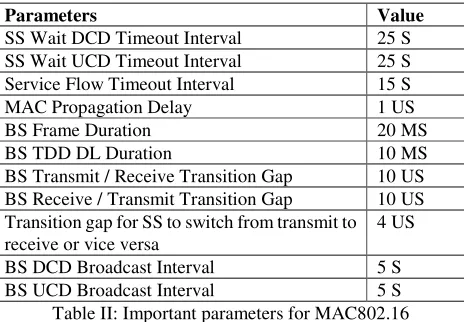
Table I: Important parameters for PHY802.16 The MAC802.16 is chosen as the medium access control protocol. The specific access scheme is CSMA/CA with acknowledgements. MAC layer parameters used in this paper is given in table II.
Parameters Value
SS Wait DCD Timeout Interval 25 S
SS Wait UCD Timeout Interval 25 S
Service Flow Timeout Interval 15 S
MAC Propagation Delay 1 US
BS Frame Duration 20 MS
BS TDD DL Duration 10 MS
BS Transmit / Receive Transition Gap 10 US BS Receive / Transmit Transition Gap 10 US Transition gap for SS to switch from transmit to receive or vice versa
4 US
BS DCD Broadcast Interval 5 S
[image:3.612.69.301.519.680.2]BS UCD Broadcast Interval 5 S
Table II: Important parameters for MAC802.16 The network layer may affect the QoS if it has fewer queues, as it will queue packets of different service types into one queue [5]. Even if the application sets a high precedence for its packets, they may be blocked by lower precedence
packets in network queues. Therefore, in order to fully guarantee the service types, we configure 8 queues at the network layer.
The node movements (except base station) in these experiments are modeled using the random waypoint mobility model [24], [25] with mobility speed ranging from 10 km/h to 100 km/h. We choose this range because WiMAX support medium mobility unlike cellular system [26]. A node randomly selects a destination and moves towards that destination at a predefined speed. Once the node arrives at the destination, it stays in its current position for a pause time between 0 and 30 seconds. After that it selects another destination and repeats the same.
A distinctive feature of 802.16e is its QoS support. It has five service classes to support real time and non-real time communications. They are Unsolicited Grant Service (UGS), Extended Real-time Polling Service (ertPS), Real-time Polling Service (rtPS), Non-real-time Polling Service (nrtPS) and Best Effort (BE) [5], [27]. In this simulation, we use UGS service to support real-time data streams consisting of fixed-size data packets issued at periodic intervals.
To evaluate the performance of routing protocols, both qualitative and quantitative metrics are needed. Most of the routing protocols ensure the qualitative metrics. For this reason, we use four different quantitative metrics to compare the performance. They are
1) Packet Delivery Ratio: The fraction of packets sent by the application that are received by the receivers [28]. 2) Routing overhead: The routing overhead describes how
many routing packets for route discovery and route maintenance need to be sent in order to propagate the data packets.
3) Average End-to-end delay: End-to-end delay indicates how long it took for a packet to travel from the source to the application layer of the destination. [29].
4) Throughput: The throughput is defined as the total amount of data a receiver R actually receives from the sender divided by the time it takes for R to get the last packet [30].
IV. SIMULATION RESULTS
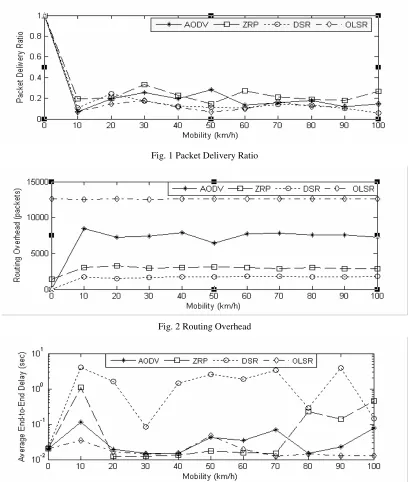
Fig. 1 shows the packet delivery ratio of AODV, DSR, OLSR and ZRP as a function of mobility speed. All these four protocols have packet delivery ratio of 100% when the nodes are stationary. However, packet delivery ratio decline when nodes begin to move. When looking at the packet delivery ratio (Fig. 1) it can easily be observed that ZRP and AODV perform much better than DSR and OLSR. Initially (10 km/h) all these protocols show poor performance. AODV demonstrate better performance when node mobility is between 20 km/h to 50 km/h. ZRP shows better performance in higher mobility than other three protocols. DSR and OLSR show nearly the same behavior. However, in highly mobile situation, DSR demonstrate poor performance than other three protocols.
overhead increases when the nodes begin to move. DSR has considerably less overhead because of its on-demand routing nature. ZRP requires sending more routing packets due to its proactive scheme, namely the frequent hello packets to update the routing table within the local zone than DSR. Though AODV uses on-demand routing scheme, it always has higher routing overhead than DSR. Due to aggressive caching, DSR will most often find a route in its cache and therefore rarely initiate a route discovery process unlike AODV. OLSR demonstrates almost constant routing overhead in different mobility scenarios (0 km/h to 100 km/h), which is higher than other three protocols.
Fig. 3 shows the average end-to-end delay from the source to the destination’s application layer. OLSR and ZRP demonstrate less delay than other two protocols due to their proactive nature. They regularly update their routing table. In case of AODV and DSR which are reactive in nature, have higher delay. Among these two reactive routing protocols, AODV demonstrate better performance. In higher mobility scenarios (80 km/h to 100 km/h), AODV has lower delay than ZRP. DSR performs very bad, because DSR often uses stale routes due to the large route cache, which leads to frequent packet retransmission and extremely high delay times.
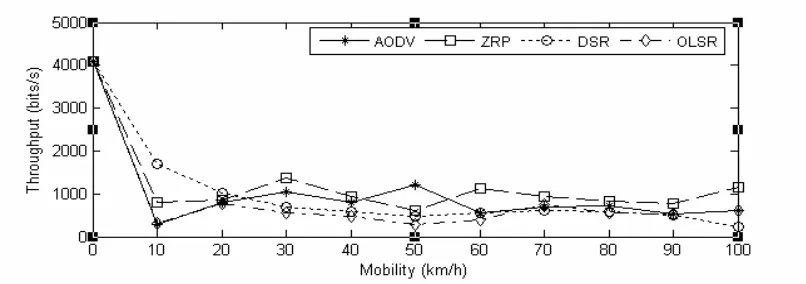
Fig. 4 shows the throughput comparison of AODV, DSR, OLSR and ZRP. We measure the “throughput” at the receiver. When the nodes are stationary, all four protocols provide almost same throughput which is around 4000 bps. Throughput decline when nodes begin to move. From the figure it can easily be observed that ZRP and AODV perform better than DSR and OLSR. Although in higher mobility scenario (60 km/h to 100 km/h) AODV, DSR and OLSR demonstrate nearly same performance. AODV demonstrate better performance when node mobility is between 20 km/h to 50 km/h. ZRP shows better performance in higher mobility than other three protocols. DSR performs better than OLSR in less mobility. However, OLSR demonstrate better performance in higher mobility.
V. CONCLUSION
In this paper, a performance comparison of four different wireless routing protocols (AODV, DSR, OLSR and ZRP) is performed using different mobility scenarios. Simulation has been conducted in Mobile WiMAX environment. From the result of our studies, it can be said that, on an average ZRP and AODV perform better than DSR and OLSR. In case of DSR, it has less routing overhead, but average end to end delay is higher. However in case of OLSR, it has higher routing overhead, but average end to end delay is less. For other metrics (packet delivery ration and throughput), DSR and OLSR demonstrate poor performance.
REFERENCES
[1] Ghosh, A., Wolter, D.R., Andrews, J.G. and Chen, R., “Broadband wireless access with WiMax/802.16: current performance benchmarks and future potential,” Communications Magazine, IEEE, Vol.43, Iss.2, February 2005, pp. 129-136.
[2] Mohammad A. Hasan, “Performance Evaluation of WiMAX/IEEE 802.16 OFDM Physical Layer,” Masters Thesis, Dept. of Electrical
and Communications Engineering, Communications Laboratory, Helsinki University of Technology, Finland, June 2007
[3] Kejie Lu and Yi Qian, “A Secure and Service-Oriented Network Control Framework for WiMAX Networks,”IEEE Communications
Magazine, May 2007, pp. 124-130.
[4] Steven J., Vaughan-Nichols,“Industry Trends - Achieving Wireless Broadband with WiMAX,” Computer Magazine, June 2004, pp. 10-13.
[5] QualNet documentation, “QualNet 4.0 Model Library: Advanced
Wireless,” Available:
http://www.scalable-networks.com/products/qualnet/download.php#d ocs
[6] A. Boukerche, “Performance Evaluation of Routing Protocols for Ad Hoc Wireless Networks,” Mobile Networks and Applications, vol. 9, Kluwer Academic Publishers, 2004, pp. 333-342.
[7] Broch, D. A. Maltz, D. B. Johnson, Y-C Hu and J. Jetcheva, “A Performance Comparison of Multihop Wireless Ad Hoc Network Routing Protocols,” In Proceedings Of MOBICOMM, October 1998. [8] S. R. Das, R. Castaneda and J. Yan, “Simulation Based Performance
Evaluation of Mobile Ad Hoc Network Routing Protocols,” In Proceedings of Seventh International Conference on Computer
Communications and Networks, 1998.
[9] S. R. Das, C. E. Perkins and E. M. Royer, “Performance Comparison of Two On-Demand Routing Protocols for Ad Hoc Networks,” In
Proceedings Of INFOCOM 2000, Tel-Aviv, Israel, March 2000.
[10] Hong Jiang, “Performance Comparison of Three Routing Protocols for Ad Hoc Networks,” Communications of the ACM, vol. 37, August 1994.
[11] J. Broch, D. A. Maltz, David B. Johnson, Y. Hu and J. Jetcheva, “ A Performance Comparison of Multi-Hop Wireless Ad Hoc Network Routing Protocols,” Proceedings of the Fourth Annual ACM/IEEE
International Conference on Mobile Computing and Networking,
MobiCom’98, October 1998, pp. 25-30.
[12] A. Boukerche, “Performance Comparison and Analysis of Ad Hoc Routing Algorithms,” In Proceedings of IPCCC 2001, USA, April 2001, pp. 171-178.
[13] S. Azad, A. Rahman and F. Anwar, “A Performance Comparison of Proactive and Reactive Routing Protocols of Mobile Ad-hoc NETwork (MANET),” Journal of Engineering and Applied Sciences 2(5), 2007, pp 891-896.
[14] C. E. Perkins and E. M. Royer, “Ad Hoc On-demand Distance Vector Routing,” In Proceedings of the 2nd IEEE Workshop on Mobile Computing Systems and Applications, New Orleans, LA, February 1999, pp. 90-100.
[15] Charles E. Perkins, Ad hoc networking, Addison-Wesley publication, 2001, Ch. 5.
[16] Elizabeth M. Royer and C-K Toh “A Review of Current Routing Protocols for Ad-Hoc Mobile Wireless Networks,” IEEE Personal
Communications, April 1999, pp. 46-55.
[17] Hong Jiang, “Performance Comparison of Three Routing Protocols for Ad Hoc Networks,” Communications of the ACM, vol. 37, August 1994.
[18] T. Clausen, P. Jacquet, A. Laouiti, P. Mulethaler, A. Qayyum and L. Viennot, “Optimized Link State Routing Protocol,” In Proceedings of
IEEE INMIC, Pakistan, 2001.
[19] P. Jacquet, P. Mahlethaler and A. Qayyum, “Optimized Link State Routing Protocol,” IETF MANET, Internet Draft “draft-ietf-MANET-olsr-02.txt,” July 2000.
[20] Spilios Giannoulis, Christos Antonopoulos, Evangelos Topalis, Stavros Koubias “ZRP versus DSR and TORA: A comprehensive survey on ZRP performance,” Emerging Technologies and Factory
Automation, 2005. ETFA 2005, vol. 1, September 2005.
[21] Abudhahir Buhari and Mohamed Othman, “Efficient Query Propagation by Adaptive Bordercast Operation in
Dense Ad Hoc Network,” IJCSNS International Journal of Computer Science and Network Security, VOL.7 No.8, August 2007, pp. 101-108.
[22] QualNet Network Simulator, Avaiable:
http://www.scalable-networks.com.
[23] GloMoSim Simulator, Available: http://pcl.cs.ucla.edu/projects/glomosim.
[24] D.B. Johnson and D.A. Maltz. ”Dynamic Source Routing in Ad Hoc Wireless Networks,” In Mobile Computing, edited by T. Imielinski and
H. Korth, Kluwer Publishing Company. 1996, Ch. 5, pp. 153-181.
Computer Science Department, University of California, Los Angeles, IEEE, 1999, Available: http://www.cs.ucla.edu/NRL/wireless. [26] “Mobile WiMAX: Personal Broadband Services for Enhancing
Lifestyles and Productivity,” White Paper, WiMAX Forum, 2006. [27] “Can WiMAX Address Your Applications?,” Prepared by Westech
Communications Inc. on behalf of the WiMAX Forum, October 24, 2005.
[28] Jorjeta G.Jetcheva and David B. Johson, “A Performance Comparison of On-Demand Multicast Routing Protocols for Ad Hoc Networks,” school of computer science, computer science department, Pittsburgh, December 15, 2004.
[29] David Oliver Jorg, “Performance Comparison of MANET Routing Protocols In Different Network Sizes”, Computer Science Project, Institute of Computer Science and Applied Mathematics, Computer Networks and Distributed Systems (RVS), University of Berne, Switzerland, 2003.
[30] Uyen Trang Nguyen and Xing Xiong, “Rate-adaptive Multicast in Mobile Ad-hoc Networks,” IEEE International Conference on Wireless and Mobile Computing, Networking and Communications
2005 (WiMob 2005), Montreal, Canada, August 2005.
[31] D. B. Johnson and D. A. Maltz, “Dynamic Source Routing in Ad-Hoc Wireless Networks," Mobile Computing, ed. T. Imielinski and H.
[image:5.612.101.512.168.650.2]Korth, Kluwer Academic Publishers, 1996, pp. 153-181.
Fig. 1 Packet Delivery Ratio
Fig. 2 Routing Overhead