Proceedings of the 2019 Conference on Empirical Methods in Natural Language Processing and the 9th International Joint Conference on Natural Language Processing, pages 229–239,
229
Improving Relation Extraction with Knowledge-attention
Pengfei Li1, Kezhi Mao1∗, Xuefeng Yang3, and Qi Li2
1School of Electrical and Electronic Engineering, Nanyang Technological University, Singapore 2Interdisciplinary Graduate School, Nanyang Technological University, Singapore
3ZhuiYi Technology, Shenzhen, China
{pli006,ekzmao,liqi0024}@ntu.edu.sg, [email protected]
Abstract
While attention mechanisms have been proven to be effective in many NLP tasks, major-ity of them are data-driven. We propose a novel knowledge-attention encoder which incorporates prior knowledge from external lexical resources into deep neural networks for relation extraction task. Furthermore, we present three effective ways of integrat-ing knowledge-attention with self-attention to maximize the utilization of both knowledge and data. The proposed relation extraction sys-tem is end-to-end and fully attention-based. Experiment results show that the proposed knowledge-attention mechanism has comple-mentary strengths with self-attention, and our integrated models outperform existing CNN, RNN, and self-attention based models. State-of-the-art performance is achieved on TA-CRED, a complex and large-scale relation ex-traction dataset.
1 Introduction
Relation extraction aims to detect the semantic relationship between two entities in a sentence.
For example, given the sentence: “James Dobson
has resigned as chairman ofFocus On The Family, which he founded thirty years ago.”, the goal is to recognize the
organization-founder relation held between“Focus
On The Family”and“James Dobson”. The various rela-tions between entities extracted from large-scale unstructured texts can be used for ontology and
knowledge base population (Chen et al., 2018a;
Fossati et al.,2018), as well as facilitating
down-stream tasks that requires relational understand-ing of texts such as question answerunderstand-ing (Yu et al.,
2017) and dialogue systems (Young et al.,2018).
Traditional feature-based and kernel-based ap-proaches require extensive feature
engineer-ing (Suchanek et al.,2006;Qian et al.,2008;Rink
∗
Corresponding author.
and Harabagiu,2010). Deep neural networks such
as Convolutional Neural Networks (CNNs) and Recurrent Neural Networks (RNNs) have the abil-ity of exploring more complex semantics and ex-tracting features automatically from raw texts for
relation extraction tasks (Xu et al.,2016;Vu et al.,
2016;Lee et al.,2017). Recently, attention
mech-anisms have been introduced to deep neural net-works to improve their performance (Zhou et al.,
2016;Wang et al.,2016;Zhang et al.,2017).
Es-pecially, the Transformer proposed by Vaswani et al. (2017) is based solely on self-attention and has demonstrated better performance than
tradi-tional RNNs (Bilan and Roth, 2018;Verga et al.,
2018). However, deep neural networks normally require sufficient labeled data to train their numer-ous model parameters. The scarcity or low qual-ity of training data will limit the model’s abilqual-ity to recognize complex relations and also cause over-fitting issue.
A recent study (Li and Mao,2019) shows that
uti-lization of both knowledge and data, and achieve optimal performance for relation extraction.
In summary, the main contributions of the paper are: (1) We propose knowledge-attention encoder, a novel attention mechanism which incorporates prior knowledge from external lexical resources to effectively capture the informative linguistic clues for relation extraction. (2) To take the advantages of both knowledge-attention and self-attention, we propose three integration strategies: multi-channel attention, softmax interpolation, and knowledge-informed self-attention. Our final models are fully attention-based and can be easily set up for end-to-end training. (3) We present detailed analysis on knowledge-attention encoder. Results show that it has complementary strengths with self-attention encoder, and the integrated models achieve start-of-the-art results for relation extraction.
2 Related Works
We focus here on deep neural networks for rela-tion extracrela-tion since they have demonstrated bet-ter performance than traditional feature-based and kernel-based approaches.
Convolutional Neural Networks (CNNs) and Recurrent Neural Networks (RNNs) are the ear-liest and commonly used approaches for relation extraction. Zeng et al. (2014) showed that CNN with position embeddings is effective for rela-tion extracrela-tion. Similarly, CNN with multiple
fil-ter sizes (Nguyen and Grishman,2015), pairwise
ranking loss function (dos Santos et al., 2015)
and auxiliary embeddings (Lee et al.,2017) were
proposed to improve performance. Zhang and
Wang (2015) proposed bi-directional RNN with max pooling to model the sequential relations. In-stead of modeling the whole sentence,
perform-ing RNN on sub-dependency trees (e.g.
short-est dependency path between two entities) has demonstrated to be effective in capturing
long-distance relation patterns (Xu et al.,2016;Miwa
and Bansal, 2016). Zhang et al. (2018)
pro-posed graph convolution over dependency trees and achieved state-of-the-art results on TACRED dataset.
Recently, attention mechanisms have been
widely applied to CNNs (Wang et al., 2016;Han
et al.,2018) and RNNs (Zhou et al.,2016;Zhang
et al.,2017;Du et al.,2018). The improved
per-formance demonstrated the effectiveness of atten-tion mechanisms in deep neural networks.
Particu-larly, Vaswani et al. (2017) proposed a solely self-attention-based model called Transformer, which is more effective than RNNs in capturing long-distance features since it is able to draw global dependencies without regard to their distances in the sequences. Bilan and Roth (2018) first ap-plied self-attention encoder to relation extraction task and achieved competitive results on TACRED
dataset. Verga et al. (2018) used self-attention
to encode long contexts spanning multiple
sen-tences for biological relation extraction.
How-ever, more attention heads and layers are required for self-attention encoder to capture complex se-mantic and syntactic information since learning is solely based on training data. Hence, more high quality training data and computational power are needed. Our work utilizes the knowledge from external lexical resources to improve deep neural network’s ability of capturing informative linguis-tic clues.
External knowledge has shown to be effective
in neural networks for many NLP tasks.
Ex-isting works focus on utilizing external knowl-edge to improve embedding representations (Chen
et al.,2015;Liu et al.,2015;Sinoara et al.,2019),
CNNs (Toutanova et al.,2015;Wang et al.,2017;
Li and Mao,2019), and RNNs (Ahn et al.,2016;
Chen et al.,2016,2018b;Shen et al.,2018). Our
work is the first to incorporate knowledge into Transformer through a novel knowledge-attention mechanism to improve its performance on relation extraction task.
3 Knowledge-attention Encoder
We present the proposed knowledge-attention en-coder in this section. Relation indicators are first generated from external lexical resources
(Sec-tion 3.1); Then the input texts are transformed
from word semantic space into relational seman-tic space by attending to the relation indicators
us-ing knowledge-attention mechanism (Section3.2);
Finally, position-aware attention is used to sum-marize the input sequence by taking both relation semantics and relative positions into consideration
(Section3.3).
3.1 Relation Indicators Generation
x1 x2 x3 x4 xn
k1
k2
k3
k4
km
h1 h2 h3 h4 hn
Relation Indicators (K & V) Texts
Input Embeddings
(Q)
Knowledge Attention
Hidden Representation
Subtraction
o1 o2 o3 o4 on
Attention Output
avg
Relation Indicators Mean
Q K V (K)
Linear Linear
Knowledge-attention h
Concat
Linear
Norm
Position-wise Feed Forward
[image:3.595.116.471.69.274.2]Add and Norm
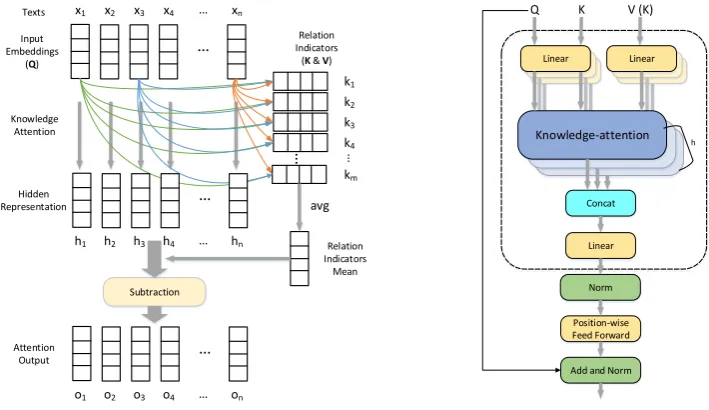
Figure 1: Knowledge-attention process (left) and multi-head structure (right) of knowledge-attention encoder.
We utilize two publicly available lexical resources
including FrameNet1 and Thesaurus.com2 to find
such lexical units.
FrameNet is a large lexical knowledge base which categorizes English words and sentences into higher level semantic frames (Ruppenhofer
et al., 2006). Each frame is a conceptual
struc-ture describing a type of event, object or relation. FrameNet contains over 1200 semantic frames, many of which represent various semantic rela-tions. For each relation type in our relation ex-traction task, we first find all the relevant seman-tic frames by searching from FrameNet (refer Ap-pendix for detailed semantic frames used). Then we extract all the lexical units involved in these frames, which are exactly the keywords or phrases
that often used to express such relation.
The-saurus.com is the largest online thesaurus which has over 3 million synonyms and antonyms. It also has the flexibility to filter search results by relevance, POS tag, word length, and complexity. To broaden the coverage of relation indicators, we utilize the synonyms in Thesaurus.com to extend the lexical units extracted from FrameNet. To re-duce noise, only the most relevant synonyms with the same POS tag are selected.
Relation indicators are generated based on the word embeddings and POS tags of lexical units. Formally, given a word in a lexical unit, we find its
word embeddingwi ∈ Rdw and POS embedding
1
https://framenet.icsi.berkeley.edu/ fndrupal
2https://www.thesaurus.com
ti ∈ Rdt by looking up the word embedding
ma-trixWwrd∈Rdw×Vwrd and POS embedding
ma-trixWpos ∈Rdt×Vpos respectively, whered
w and
dt are the dimensions of word and POS
embed-dings,Vwrd is vocabulary size3 andVpos is total
number of POS tags. The corresponding relation indicator is formed by concatenating word
embed-ding and POS embedembed-ding,ki = [wi,ti]. If a
lex-ical unit contains multiple words (i.e. phrase), the corresponding relation indicator is formed by av-eraging the embeddings of all words. Eventually, around 3000 relation indicators (including 2000
synonyms) are generated:K={k1,k2, ...,km}.
3.2 Knowledge Attention
3.2.1 Knowledge-attention process
In a typical attention mechanism, a query (q) is
compared with the keys (K) in a set of key-value
pairs and the corresponding attention weights are calculated. The attention output is weighted sum
of values (V) using the attention weights. In
our proposed knowledge-attention encoder, the queries are input texts and the key-value pairs are both relation indicators. The detailed process of
knowledge-attention is shown in Figure1(left).
Formally, given text inputx={x1, x2, ..., xn},
the input embeddings Q = {q1,q2, ...,qn} are
generated by concatenating each word’s word em-bedding and POS emem-bedding in the same way as
relation indicator generation in Section3.1. The
3Same word embedding matrix is used for relation
hidden representations H = {h1,h2, ...,hn}are obtained by attending to the knowledge indicators
K, as shown in Equation1. The final
knowledge-attention outputs are obtained by subtracting the hidden representations with the relation indicators
mean, as shown in Equation2.
H=sof tmax(QK
T
√ dk
)V (1)
knwl(Q,K,V) =H−XK/m (2)
where knwl indicates knowledge-attention
pro-cess, m is the number of relation indicators, and
dk is dimension of key/query vectors which is a
scaling factor same as in Vaswani et al. (2017). The subtraction of relation indicators mean will result in small outputs for irrelevant words. More importantly, the resulted output will be close to the related relation indicators and further apart from other relation indicators in relational
seman-tic space. Therefore, the proposed
knowledge-attention mechanism is effective in capturing the linguistic clues of relations represented by relation indicators in the relational semantic space.
3.2.2 Multi-head knowledge-attention
Inspired by the multi-head attention in
Trans-former (Vaswani et al., 2017), we also have
multi-head knowledge-attention which first
lin-early transforms Q, Kand V h times, and then
perform h knowledge-attentions simultaneously,
as shown in Figure1(right).
Different from the Transformer encoder, we use
the same linear transformation for Q and K in
each head to keep the correspondence between queries and keys.
headi=knwl(QWQi ,KW
Q
i ,VWVi ) (3)
whereWQi ,WiV ∈Rdk×(dk/h)andi∈[1,2, ...h]. Besides, only one residual connection from input embeddings to outputs of position-wise feed for-ward networks is used. We also mask the outputs of padding tokens using zero vectors.
The multi-head structure in
knowledge-attention allows the model to jointly attend inputs to different relational semantic subspaces with different contributions of relation indicators. This is beneficial in recognizing complex relations where various compositions of relation indicators are needed.
3.3 Position-aware Attention
It has been proven that the relative position infor-mation of each token with respective to the two target entities is beneficial for relation extraction
task (Zeng et al.,2014). We modify the
position-aware attention originally proposed by Zhang et al. (2017) to incorporate such relative position in-formation and find the importance of each token to the final sentence representation.
Assume the relative position of tokenxito
tar-get entity ispˆi. We apply position binning
func-tion (Equafunc-tion 4) to make it easier for the model
to distinguish long and short relative distances.
pi =
(
ˆ
pi |pˆi| ≤2
ˆ
pi
|pˆi|dlog2|pˆi|+ 1e |pˆi|>2 (4)
After getting the relative positionspsi andpoi to the
two entities of interest (subject and object respec-tively), we map them to position embeddings base
on a shared position embedding matrixWp. The
two embeddings are concatenated to form the final position embedding for tokenxi:pi= [psi,poi].
Position-aware attention is performed on the
outputs of knowledge-attentionO ∈ Rn×dk,
tak-ing the correspondtak-ing relative position
embed-dingsP∈Rn×dp into consideration:
f =OTsof tmax(tanh(OWo+PWp)c) (5)
whereWo ∈Rdk×da,W
p ∈Rdp×da,dais
atten-tion dimension, andc ∈ Rda is a context vector
learned by the neural network.
4 Integrate Knowledge-attention with Self-attention
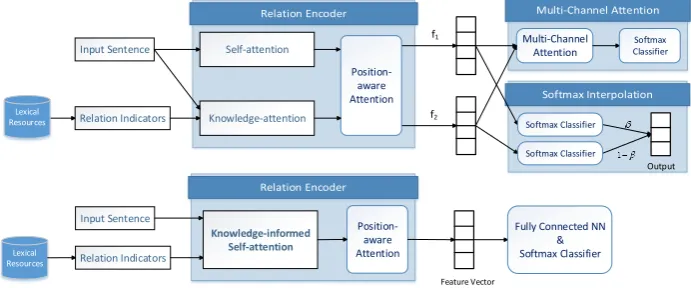
The self-attention encoder proposed by Vaswani et al. (2017) learns internal semantic features by modeling pair-wise interactions within the texts themselves, which is effective in capturing long-distance dependencies. Our proposed knowledge-attention encoder has complementary strengths of capturing the linguistic clues of relations precisely based on external knowledge. Therefore, it is ben-eficial to integrate the two models to maximize the utilization of both external knowledge and train-ing data. In this section, we propose three
inte-gration approaches as shown in Figure2, and each
Input Sentence Self-attention
Knowledge-attention
f1
f2
Output
Position-aware Attention
Softmax Classifier
Relation Indicators
Lexical Resources
Softmax Classifier Multi-Channel
Attention
Softmax Classifier
Knowledge-informed Self-attention
Feature Vector
Position-aware Attention
Fully Connected NN & Softmax Classifier
Relation Indicators
Lexical Resources
[image:5.595.126.472.65.209.2]Input Sentence
Figure 2: Three ways of integrating knowledge-attention with self-attention: multi-channel attention and softmax interpolation (top), as well as knowledge-informed self-attention (bottom).
4.1 Multi-channel Attention
In this approach, self-attention and knowledge-attention are treated as two separate channels to model sentence from different perspectives. Af-ter applying position-aware attention, two feature
vectorsf1 andf2 are obtained from self-attention
and knowledge-attention respectively. We apply another attention mechanism called multi-channel attention to integrate the feature vectors.
In multi-channel attention, feature vectors are first fed into a fully connected neural network to
get their hidden representations hi. Then
atten-tion weights are calculated using a learnable
con-text vectorc, which reflects the importance of each
feature vector to final relation classification. Fi-nally, the feature vectors are integrated based on
attention weights, as shown in Equation6.
r=X
i
sof tmax(hTi c)hi (6)
After obtaining the integrated feature vectorr, we
pass it to a softmax classifier to determine the re-lation class. The model is trained using stochastic gradient descent with momentum and learning rate decay to minimize the cross-entropy loss.
The main advantage of this approach is flexibil-ity. Since the two channels process information independently, the input components are not nec-essary to be the same. Besides, we can add more features from other sources (e.g. subject and ob-ject categories) to multi-channel attention to make final decision based on all the information sources.
4.2 Softmax Interpolation
Similar as multi-channel attention, we also use two independent channels for self-attention and
knowledge-attention in softmax interpolation. In-stead of integrating the feature vectors, we make two independent predictions using two softmax classifiers based on the feature vectors from the two channels. The loss function is defined as to-tal cross-entropy loss of the two classifiers. The final prediction is obtained using an interpolation function of the two softmax distributions:
p=β·p1+ (1−β)·p2 (7)
where p1, p2 are the softmax distributions
obtained form self-attention and
knowledge-attention respectively, andβ is the priority weight
assigned to self-attention.
Since knowledge-attention focuses on capturing the keywords and cue phrases of relations, the pre-cision will be higher than self-attention while the recall is lower. The proposed softmax interpo-lation approach is able to take the advantages of both attention mechanisms and balance the
preci-sion and recall by adjusting the priority weightβ.
4.3 Knowledge-informed Self-attention
Since knowledge-attention and self-attention
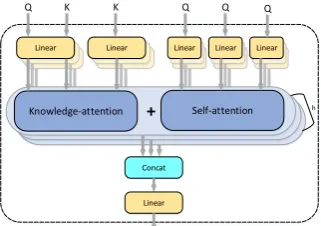
share similar structures, it is also possible to integrate them into a single channel. We propose knowledge-informed self-attention encoder which
incorporates knowledge-attention into every
self-attention head to jointly model the semantic relations based on both knowledge and data.
The structure of knowledge-informed
self-attention is shown in Figure 3. Formally, given
texts input matrixQ∈ Rn×dk and knowledge
in-dicatorsK∈Rm×dk. The output of each attention
head is calculated as follows:
headi = knwl(QWQi ,KW
Q
i ,KWVi )+
self(QWQs
i ,QW
Ks
i ,QW
Vs
i )
Q K K
Linear Linear
h
Concat
Linear
Linear Linear Linear
+
[image:6.595.100.261.68.181.2]Knowledge-attention Self-attention Q Q Q
Figure 3: Knowledge-informed self-attention structure. Q, K represent input matrix and knowledge indicators respectively, h is the number of attention heads.
where knwl and self indicate
knowledge-attention and self-knowledge-attention respectively, and all the linear transformation weight matrices have the
dimensionality ofW∈Rdk×(dk/h).
Since each self-attention head is aided with
prior knowledge in knowledge-attention, the
knowledge-informed self-attention encoder is able to capture more lexical and semantic information than single attention encoder.
5 Experiment and Analysis
5.1 Baseline Models
To study the performance of our proposed models, the following baseline models are used for com-parison:
CNN-based modelsincluding: (1) CNN: the
clas-sical convolutional neural network for sentence
classification (Kim, 2014). (2) CNN-PE: CNN
with position embeddings dedicated for relation
classification (Nguyen and Grishman, 2015). (3)
GCN: a graph convolutional network over the pruned dependency trees of the sentence (Zhang
et al.,2018).
RNN-based models including: (1) LSTM: long
short-term memory network to sequentially model the texts. Classification is based on the last hid-den output. (2) PA-LSTM: Similar position-aware attention mechanism as our work is used to
sum-marize the LSTM outputs (Zhang et al.,2017).
CNN-RNN hybrid model including
contextu-alized GCN (C-GCN) where the input vectors are obtained using bi-directional LSTM
net-work (Zhang et al.,2018).
Self-attention-based model (Self-attn) which
uses self-attention encoder to model the input sen-tence. Our implementation is based on Bilan and Roth (2018) where several modifications are made
on the original Transformer encoder, including the use of relative positional encodings instead of ab-solute sinusoidal encodings, as well as other con-figurations such as residual connection, activation function and normalization.
For our model, we evaluate both the proposed knowledge-attention encoder (Knwl-attn) as well as the integrated models with self-attention in-cluding multi-channel attention (MCA), softmax interpolation (SI) and knowledge-informed self-attention (KISA).
5.2 Experiment Settings
We conduct our main experiments on TACRED, a large-scale relation extraction dataset introduced by Zhang et al. (2017). TACRED contains over 106k sentences with hand-annotated subject and object entities as well as the relations between
them. It is a very complex relation extraction
dataset with 41 relation types and a no relation
class when no relation is hold between entities. The dataset is suited for real-word relation
extrac-tion since it is unbalanced with 79.5%no relation
samples, and multiple relations between different entity pairs can be exist in one sentence. Besides, the samples are normally long sentences with an average of 36.2 words.
Since the dataset is already partitioned into train (68124 samples), dev (22631 samples) and test (15509 samples) sets, we tune model hyper-parameters using dev set and evaluate model us-ing test set. The evaluation metrics are
micro-averaged precision, recall and F1 score. For fair
comparison, we select the model with median F1
score on dev set from 5 independent runs, same as Zhang et al. (2017). The same “entity mask” strategy is used which replaces subject (or object)
entity with specialNER-SUBJ (orNER-OBJ)
tokens to avoid overfittting on specific entities and provide entity type information.
Besides TACRED, another dataset called
SemEval2010-Task8 (Hendrickx et al., 2009)
is used to evaluate the generalization ability of our proposed model. The dataset is significantly smaller and simpler than TACRED, which has 8000 training samples and 2717 testing samples. It contains 9 directed relations and 1 other relation (19 relation classes in total). We use the official
macro-averaged F1score as evaluation metric.
since further increasing the number of layers and attention heads will degrade the performance. For
softmax interpolation, we choose β = 0.8 to
balance precision and recall. Word embeddings are fine-tuned based on pre-trained GloVe
(Pen-nington et al.,2014) with dimensionality of 300.
Dropout (Srivastava et al.,2014) is used during
tri-aning to alleviate overfitting. Other model hyper-parameters and training details are described in Appendix due to space limitations.
5.3 Results and Analysis
5.3.1 Results on TACRED dataset
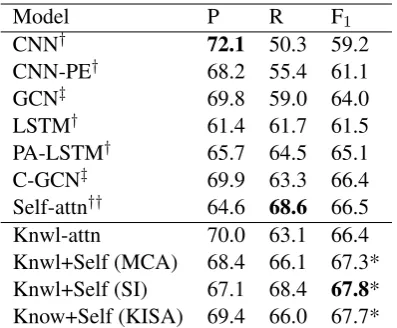
Table 1 shows the results of baseline as well as
our proposed models on TACRED dataset. It is observed that our proposed knowledge-attention encoder outperforms all CNN-based and
RNN-based models by at least 1.3 F1. Meanwhile, it
achieves comparable results with C-GCN and self-attention encoder, which are the current start-of-the-art single-model systems.
Comparing with self-attention encoder, it is ob-served that knowledge-attention encoder results in higher precision but lower recall. This is reason-able since knowledge-attention encoder focuses on capturing the significant linguistic clues of lations based on external knowledge, it will re-sult in high precision for the predicted relations similar to rule-based systems. Self-attention en-coder is able to capture more long-distance de-pendency features by learning from data, result-ing in better recall. By integratresult-ing self-attention and knowledge-attention using the proposed ap-proaches, a more balanced precision and recall can be obtained, suggesting the complementary effects of self-attention and knowledge-attention mech-anisms. The integrated models improve
perfor-mance by at least 0.9 F1 score and achieve new
state-of-the-art results among all the single end-to-end models.
Comparing the three integrated models, soft-max interpolation (SI) achieves the best perfor-mance. More interestingly, we found that the pre-cision and recall can be controlled by adjusting the
priority weightβ. Figure4shows impact ofβ on
precision, recall and F1score. Asβincreases,
pre-cision decreases and recall increases. Therefore,
we can choose a small β for relation extraction
system which requires high precision, and a large
β for the system requiring better recall. F1 score
reaches the highest value when precision and
re-Model P R F1
CNN† 72.1 50.3 59.2
CNN-PE† 68.2 55.4 61.1
GCN‡ 69.8 59.0 64.0
LSTM† 61.4 61.7 61.5
PA-LSTM† 65.7 64.5 65.1
C-GCN‡ 69.9 63.3 66.4
Self-attn†† 64.6 68.6 66.5
Knwl-attn 70.0 63.1 66.4
Knwl+Self (MCA) 68.4 66.1 67.3*
Knwl+Self (SI) 67.1 68.4 67.8*
[image:7.595.318.517.61.225.2]Know+Self (KISA) 69.4 66.0 67.7*
Table 1: Micro-averaged precision (P), recall (R) and F1 score on TACRED dataset. †, ‡and †† mark the
results reported in (Zhang et al.,2017), (Zhang et al.,
2018) and (Bilan and Roth, 2018) respectively. ∗ marks statistically significant improvements over Self-attn withp <0.01under one-tailed t-test.
Figure 4: Change of precision, recall and F1score on
dev set as the priority weightβin softmax interpolation changes.
call are balanced (β = 0.8).
Knowledge-informed self-attention (KISA) has comparable performance with softmax interpola-tion, and without the need of hyper-parameter tun-ing since knowledge-attention and self-attention
are integrated into a single channel. The
per-formance gain over self-attention encoder is 1.2
F1 with much improved precision,
demonstrat-ing the effectiveness of incorporatdemonstrat-ing knowledge-attention into self-knowledge-attention to jointly model the sentence based on both knowledge and data.
[image:7.595.307.524.326.484.2]Model P R F1
MCA 68.4 66.1 67.3
+NER 68.7 66.2 67.5
+Entity category 70.0 65.8 67.8
[image:8.595.88.274.61.131.2]+Both 70.1 66.0 67.9
Table 2: Results of adding NER embeddings and entity categorical embeddings to the multi-channel attention (MCA) integrated model.
model to further improve its performance. Table
2 shows the results of adding NER embeddings
of each token to self-attention channel, and en-tity (subject and object) categorical embeddings to multi-channel attention as additional feature
vec-tors. We use dimensionality of 30 and 60 for
NER and entity categorical embeddings respec-tively, and the two embedding matrixes are learned by the neural network. Results show that adding NER and entity categorical information to MCA
integrated model improves F1score by 0.2 and 0.5
respectively, and adding both improves precision
significantly, resulting a new best F1score.
5.3.2 Results on SemEval2010-Task8 dataset
We use SemEval2010-Task8 dataset to evaluate the generalization ability of our proposed model. Experiments are conducted in two manners: mask or keep the entities of interest. Results in Table
3 show that the “entity mask” strategy degrades
the performance, indicating that there exist strong correlations between entities of interest and rela-tion classes in SemEval2010-Task8 dataset. Al-though the results of keeping the entities are better, the model tends to remember these entities instead of focusing on learning the linguistic clues of re-lations. This will result in bad generalization for sentences with unseen entities.
Regardless of whether the entity mask is used, by incorporating knowledge-attention mechanism, our model improves the performance of self-attention by a statistically significant margin, espe-cially the softmax interpolation integrated model. The results on SemEval2010-Task8 are consistent with that of TACRED, demonstrating the effec-tiveness and robustness of our proposed method.
5.3.3 Ablation study
To study the contributions of specific components of knowledge-attention encoder, we perform abla-tion experiments on the dev set of TACRED. The results of knowledge-attention encoder with and
Model mask entity keep entity
Self-attn 76.8 83.1
Knwl-attn 76.1 82.3
Knwl+Self (MCA) 77.4* 84.0*
Knwl+Self (SI) 78.0* 84.3*
Know+Self (KISA) 77.5* 84.0*
Table 3: Macro-averaged F1 score on
SemEval2010-Task8 dataset. ∗ marks statistically significant im-provements over Self-attn withp < 0.01under one-tailed t-test.
Model Dev F1
Knwl-attn Encoder 66.5
1. −Multi-head structure 64.6
2. −Synonym relation indicators 64.7
3. −Relation indicators mean 65.0
4. −Output masking 65.8
5. −Entity masking 65.4
[image:8.595.306.530.61.146.2]6. −Relative positions 63.0
Table 4: Ablation study on knowledge-attention en-coder. Results are the median F1scores of 5
indepen-dent runs on dev set of TACRED.
without certain components are shown in Table4.
It is observed that: (1) The proposed multi-head knowledge-attention structure outperforms single-head significantly. This demonstrates the effectiveness of jointly attending texts to different relational semantic subspaces in the multi-head
structure. (2) The synonyms improve the
per-formance of knowledge-attention since they are able to broaden the coverage of relation indicators and form a robust relational semantic space. (3) The subtraction of relation indicators mean vec-tor from attention hidden representations helps to suppress the activation of irrelevant words and re-sults in a better representation for each word to capture the linguistic clues of relations. (4-5) The two masking strategies are helpful for our model: the output masking eliminates the effects of the padding tokens and the entity masking avoids en-tity overfitting while providing enen-tity type infor-mation. (6) The relative position embedding term in position-aware attention contributes a
signifi-cant amount of F1 score. This shows that
posi-tional information is particularly important for re-lation extraction task.
5.3.4 Attention visualization
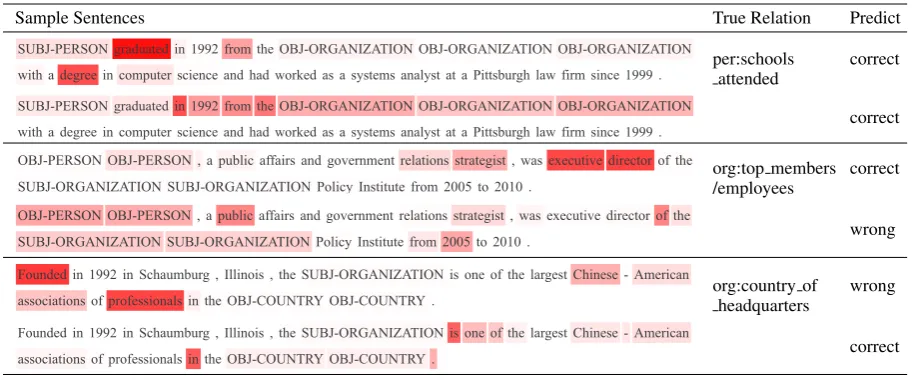
To verify the complementary effects of
[image:8.595.313.519.213.324.2]Sample Sentences True Relation Predict
SUBJ-PERSON graduated in 1992 from the OBJ-ORGANIZATION OBJ-ORGANIZATION OBJ-ORGANIZATION
with a degree in computer science and had worked as a systems analyst at a Pittsburgh law firm since 1999 . per:schoolsattended correct
SUBJ-PERSON graduated in 1992 from the OBJ-ORGANIZATION OBJ-ORGANIZATION OBJ-ORGANIZATION
with a degree in computer science and had worked as a systems analyst at a Pittsburgh law firm since 1999 . correct
OBJ-PERSON OBJ-PERSON , a public affairs and government relations strategist , was executive director of the
SUBJ-ORGANIZATION SUBJ-ORGANIZATION Policy Institute from 2005 to 2010 . org:top members/employees correct
OBJ-PERSON OBJ-PERSON , a public affairs and government relations strategist , was executive director of the
SUBJ-ORGANIZATION SUBJ-ORGANIZATION Policy Institute from 2005 to 2010 . wrong
Founded in 1992 in Schaumburg , Illinois , the SUBJ-ORGANIZATION is one of the largest Chinese - American
associations of professionals in the OBJ-COUNTRY OBJ-COUNTRY . org:country ofheadquarters wrong
Founded in 1992 in Schaumburg , Illinois , the SUBJ-ORGANIZATION is one of the largest Chinese - American
[image:9.595.71.531.61.251.2]associations of professionals in the OBJ-COUNTRY OBJ-COUNTRY . correct
Table 5: Attention visualization for knowledge-attention encoder (first) and self-attention encoder (second). Words are highlighted based on the attention weights assigned to them. Best viewed in color.
encoder, we compare the attention weights
as-signed to words from the two encoders. Table5
presents the attention visualization results on sam-ple sentences. For each samsam-ple sentence, attention weights from knowledge-attention encoder are visualized first, followed by self-attention
en-coder. It is observed that knowledge-attention
encoder focuses more on the specific keywords or cue phrases of certain relations, such as “gradu-ated”, “executive director” and “founded”; while self-attention encoder attends to a wide range of words in the sentence and pays more attention to the surrounding words of target entities especially the words indicating the syntactic structure, such
as “is”, “in” and “of”. Therefore,
knowledge-attention encoder and self-knowledge-attention encoder have complementary strengths that focus on different perspectives for relation extraction.
5.3.5 Error analysis
To investigate the limitations of our proposed model and provide insights for future research, we analyze the errors produced by the system on the test set of TACRED. For knowledge-attention en-coder, 58% errors are false negative (FN) due to the limited ability in capturing long-distance de-pendencies and some unseen linguistic clues
dur-ing traindur-ing. For our integrated model4 that takes
the benefits of both self-attention and knowledge-attention, FN is reduced by 10%. However, false positive (FP) is not improved due to overfitting that leads to wrong predictions. Many errors are
4We observed similar error behaviors of the three
pro-posed integrated models.
caused by multiple entities with different
rela-tions co-occurred in one sentence. Our model
may mistake irrelevant entities as a relation pair. We also observed that many FP errors are due to the confusions between related relations such as “city of death”and “city of residence”. More data or knowledge is needed to distinguish “death” and “residence”. Besides, some errors are caused by imperfect annotations.
6 Conclusion and Future Work
We introduce knowledge-attention encoder which effectively incorporates prior knowledge from ex-ternal lexical resources for relation extraction. The proposed knowledge-attention mechanism trans-forms texts from word space into relational se-mantic space and captures the informative linguis-tic clues of relations effectively. Furthermore, we show the complementary strengths of knowledge-attention and self-knowledge-attention, and propose three dif-ferent ways of integrating them to maximize the utilization of both knowledge and data. The pro-posed models are fully attention-based end-to-end systems and achieve state-of-the-art results on TACRED dataset, outperforming existing CNN, RNN, and self-attention based models.
In future work, besides lexical knowledge, we will incorporate conceptual knowledge from encyclopedic knowledge bases into knowledge-attention encoder to capture the high-level
seman-tics of texts. We will also apply
References
Sungjin Ahn, Heeyoul Choi, Tanel P¨arnamaa, and Yoshua Bengio. 2016. A neural knowledge lan-guage model.arXiv preprint arXiv:1608.00318.
Ivan Bilan and Benjamin Roth. 2018. Position-aware self-attention with relative positional encodings for slot filling. arXiv preprint arXiv:1807.03052.
Muhao Chen, Yingtao Tian, Xuelu Chen, Zijun Xue, and Carlo Zaniolo. 2018a. On2vec: Embedding-based relation prediction for ontology population. In Proceedings of the 2018 SIAM International Confer-ence on Data Mining, pages 315–323. SIAM.
Qian Chen, Xiaodan Zhu, Zhen-Hua Ling, Diana Inkpen, and Si Wei. 2018b. Neural natural language inference models enhanced with external knowl-edge. InProceedings of the 56th Annual Meeting of the Association for Computational Linguistics (Vol-ume 1: Long Papers), pages 2406–2417.
Yun-Nung Chen, Dilek Hakkani-Tur, Gokhan Tur, Asli Celikyilmaz, Jianfeng Gao, and Li Deng. 2016. Knowledge as a teacher: Knowledge-guided structural attention networks. arXiv preprint arXiv:1609.03286.
Zhigang Chen, Wei Lin, Qian Chen, Xiaoping Chen, Si Wei, Hui Jiang, and Xiaodan Zhu. 2015. Re-visiting word embedding for contrasting meaning. In Proceedings of the 53rd Annual Meeting of the Association for Computational Linguistics and the 7th International Joint Conference on Natural Lan-guage Processing (Volume 1: Long Papers), pages 106–115.
Jinhua Du, Jingguang Han, Andy Way, and Dadong Wan. 2018. Multi-level structured self-attentions for distantly supervised relation extraction. In Proceed-ings of the 2018 Conference on Empirical Methods in Natural Language Processing, pages 2216–2225.
Marco Fossati, Emilio Dorigatti, and Claudio Giuliano. 2018. N-ary relation extraction for simultaneous t-box and a-t-box knowledge base augmentation. Se-mantic Web, 9(4):413–439.
Xu Han, Pengfei Yu, Zhiyuan Liu, Maosong Sun, and Peng Li. 2018. Hierarchical relation extraction with coarse-to-fine grained attention. In Proceedings of the 2018 Conference on Empirical Methods in Nat-ural Language Processing, pages 2236–2245.
Iris Hendrickx, Su Nam Kim, Zornitsa Kozareva, Preslav Nakov, Diarmuid ´O S´eaghdha, Sebastian Pad´o, Marco Pennacchiotti, Lorenza Romano, and Stan Szpakowicz. 2009. Semeval-2010 task 8: Multi-way classification of semantic relations be-tween pairs of nominals. In Proceedings of the Workshop on Semantic Evaluations: Recent Achievements and Future Directions, pages 94–99. Association for Computational Linguistics.
Yoon Kim. 2014. Convolutional neural networks for sentence classification. InProceedings of the 2014 Conference on Empirical Methods in Natural Lan-guage Processing (EMNLP), pages 1746–1751.
Ji Young Lee, Franck Dernoncourt, and Peter Szolovits. 2017. Mit at semeval-2017 task 10: Rela-tion extracRela-tion with convoluRela-tional neural networks. arXiv preprint arXiv:1704.01523.
Pengfei Li and Kezhi Mao. 2019. Knowledge-oriented convolutional neural network for causal relation ex-traction from natural language texts. Expert Systems with Applications, 115:512–523.
Quan Liu, Hui Jiang, Si Wei, Zhen-Hua Ling, and Yu Hu. 2015. Learning semantic word embeddings based on ordinal knowledge constraints. In Pro-ceedings of the 53rd Annual Meeting of the Associ-ation for ComputAssoci-ational Linguistics and the 7th In-ternational Joint Conference on Natural Language Processing (Volume 1: Long Papers), pages 1501– 1511.
Makoto Miwa and Mohit Bansal. 2016. End-to-end re-lation extraction using lstms on sequences and tree structures. InProceedings of the 54th Annual Meet-ing of the Association for Computational LMeet-inguistics (Volume 1: Long Papers), volume 1, pages 1105– 1116.
Thien Huu Nguyen and Ralph Grishman. 2015. Rela-tion extracRela-tion: Perspective from convoluRela-tional neu-ral networks. InProceedings of the 1st Workshop on Vector Space Modeling for Natural Language Pro-cessing, pages 39–48.
Jeffrey Pennington, Richard Socher, and Christopher Manning. 2014. Glove: Global vectors for word representation. InProceedings of the 2014 confer-ence on empirical methods in natural language pro-cessing (EMNLP), pages 1532–1543.
Longhua Qian, Guodong Zhou, Fang Kong, Qiaoming Zhu, and Peide Qian. 2008. Exploiting constituent dependencies for tree kernel-based semantic relation extraction. InProceedings of the 22nd International Conference on Computational Linguistics-Volume 1, pages 697–704. Association for Computational Lin-guistics.
Bryan Rink and Sanda Harabagiu. 2010. Utd: Clas-sifying semantic relations by combining lexical and semantic resources. InProceedings of the 5th Inter-national Workshop on Semantic Evaluation, pages 256–259. Association for Computational Linguis-tics.
Josef Ruppenhofer, Michael Ellsworth, Myriam Schwarzer-Petruck, Christopher R Johnson, and Jan Scheffczyk. 2006. Framenet ii: Extended theory and practice.
53rd Annual Meeting of the Association for Compu-tational Linguistics and the 7th International Joint Conference on Natural Language Processing (Vol-ume 1: Long Papers), pages 626–634.
Ying Shen, Yang Deng, Min Yang, Yaliang Li, Nan Du, Wei Fan, and Kai Lei. 2018. Knowledge-aware at-tentive neural network for ranking question answer pairs. In The 41st International ACM SIGIR Con-ference on Research & Development in Information Retrieval, pages 901–904. ACM.
Roberta A Sinoara, Jose Camacho-Collados, Rafael G Rossi, Roberto Navigli, and Solange O Rezende. 2019. Knowledge-enhanced document embeddings for text classification. Knowledge-Based Systems, 163:955–971.
Nitish Srivastava, Geoffrey Hinton, Alex Krizhevsky, Ilya Sutskever, and Ruslan Salakhutdinov. 2014. Dropout: a simple way to prevent neural networks from overfitting. The Journal of Machine Learning Research, 15(1):1929–1958.
Fabian M Suchanek, Georgiana Ifrim, and Gerhard Weikum. 2006. Combining linguistic and statistical analysis to extract relations from web documents. In Proceedings of the 12th ACM SIGKDD interna-tional conference on Knowledge discovery and data mining, pages 712–717. ACM.
Kristina Toutanova, Danqi Chen, Patrick Pantel, Hoi-fung Poon, Pallavi Choudhury, and Michael Gamon. 2015. Representing text for joint embedding of text and knowledge bases. In Proceedings of the 2015 Conference on Empirical Methods in Natural Lan-guage Processing, pages 1499–1509.
Ashish Vaswani, Noam Shazeer, Niki Parmar, Jakob Uszkoreit, Llion Jones, Aidan N Gomez, Łukasz Kaiser, and Illia Polosukhin. 2017. Attention is all you need. InAdvances in neural information pro-cessing systems, pages 5998–6008.
Patrick Verga, Emma Strubell, and Andrew McCallum. 2018. Simultaneously self-attending to all mentions for full-abstract biological relation extraction. In Proceedings of the 2018 Conference of the North American Chapter of the Association for Computa-tional Linguistics: Human Language Technologies, Volume 1 (Long Papers), pages 872–884.
Ngoc Thang Vu, Heike Adel, Pankaj Gupta, et al. 2016. Combining recurrent and convolutional neural net-works for relation classification. InProceedings of NAACL-HLT, pages 534–539.
Jin Wang, Zhongyuan Wang, Dawei Zhang, and Jun Yan. 2017. Combining knowledge with deep convo-lutional neural networks for short text classification. InIJCAI, pages 2915–2921.
Linlin Wang, Zhu Cao, Gerard De Melo, and Zhiyuan Liu. 2016. Relation classification via multi-level at-tention cnns.
Yan Xu, Ran Jia, Lili Mou, Ge Li, Yunchuan Chen, Yangyang Lu, and Zhi Jin. 2016. Improved rela-tion classificarela-tion by deep recurrent neural networks with data augmentation. InProceedings of COLING 2016, the 26th International Conference on Compu-tational Linguistics: Technical Papers, pages 1461– 1470.
Tom Young, Erik Cambria, Iti Chaturvedi, Hao Zhou, Subham Biswas, and Minlie Huang. 2018. Aug-menting end-to-end dialogue systems with common-sense knowledge. In Thirty-Second AAAI Confer-ence on Artificial IntelligConfer-ence.
Mo Yu, Wenpeng Yin, Kazi Saidul Hasan, Ci-cero dos Santos, Bing Xiang, and Bowen Zhou. 2017. Improved neural relation detection for knowl-edge base question answering. arXiv preprint arXiv:1704.06194.
Daojian Zeng, Kang Liu, Siwei Lai, Guangyou Zhou, Jun Zhao, et al. 2014. Relation classification via convolutional deep neural network.
Dongxu Zhang and Dong Wang. 2015. Relation classi-fication via recurrent neural network.arXiv preprint arXiv:1508.01006.
Yuhao Zhang, Peng Qi, and Christopher D Manning. 2018. Graph convolution over pruned dependency trees improves relation extraction. InProceedings of the 2018 Conference on Empirical Methods in Nat-ural Language Processing, pages 2205–2215.
Yuhao Zhang, Victor Zhong, Danqi Chen, Gabor An-geli, and Christopher D Manning. 2017. Position-aware attention and supervised data improve slot fill-ing. InProceedings of the 2017 Conference on Em-pirical Methods in Natural Language Processing, pages 35–45.