
Proceedings of the 2019 Conference on Empirical Methods in Natural Language Processing 326
Uncover the Ground-Truth Relations in Distant Supervision: A Neural
Expectation-Maximization Framework
Junfan Chen BDBC and SKLSDE Beihang University, China
Richong Zhang∗ BDBC and SKLSDE Beihang University, China
Yongyi Mao School of EECS University of Ottawa, Canada
Hongyu Guo
Digital Technologies Research Center National Research Council Canada, Canada
Jie Xu
School of Computing
University of Leeds, United Kingdom
Abstract
Distant supervision for relation extraction en-ables one to effectively acquire structured re-lations out of very large text corpora with less human efforts. Nevertheless, most of the prior-art models for such tasks assume that the given text can be noisy, but their corresponding la-bels are clean. Such unrealistic assumption is contradictory with the fact that the given la-bels are often noisy as well, thus leading to significant performance degradation of those models on real-world data. To cope with this challenge, we propose a novel label-denoising framework that combines neural network with probabilistic modelling, which naturally takes into account the noisy labels during learning. We empirically demonstrate that our approach significantly improves the current art in uncov-ering the ground-truth relation labels.
1 Introduction
Relation extraction aims at automatically extract-ing semantic relationships from a piece of text. Consider the sentence “Larry Page, the chief ex-ecutive officer of Alphabet, Google’s parent com-pany, was born in East Lansing, Michigan.”. The knowledge triple (Larry Page, employed by,
Google) can be extracted. Despite various ef-forts in building relation extraction models ( Ze-lenko et al., 2002; Zhou et al., 2005; Bunescu and Mooney,2005;Zeng et al.,2014;dos Santos et al.,2015;Yang et al.,2016;Liu et al.,2015;Xu et al.,2015;Miwa and Bansal,2016;G´abor et al.,
2018), the difficulty of obtaining abundant training data with labelled relations remains a challenge, and thus motivates the development ofDistant Su-pervision relation extraction (Mintz et al., 2009;
Riedel et al., 2010;Zeng et al., 2015;Lin et al.,
2016;Ji et al.,2017;Zeng et al.,2018;Feng et al.,
∗
Corresponding author
2018;Wang et al.,2018b,a;Hoffmann et al.,2011;
Surdeanu et al.,2012;Jiang et al.,2016;Ye et al.,
2017;Su et al.,2018;Qu et al.,2018). Distant su-pervision (DS) relation extract methods collect a large dataset with “distant” supervision signal and learn a relation predictor from such data. In detail, each example in the dataset contains a collection, or bag, of sentences all involving the same pair of entities extracted from some corpus (e.g., news reports). Although such a dataset is expected to be very noisy, one hopes that when the dataset is large enough, useful correspondence between the semantics of a sentence and the relation label it implies still reinforces and manifests itself. De-spite their capability of learning from large scale data, we show in this paper that these DS relation extraction strategies fail to adequately model the characteristic of the noise in the data. Specifically, most of the works fail to recognize that the labels can be noisy in a bag and directly use bag labels as training targets.
This aforementioned observation has inspired us to study a more realistic setting for DS rela-tion extracrela-tion. That is, we treat the bag labels as the noisy observations of the ground-truth labels. To that end, we develop a novel framework that jointly models the semantics representation of the bag, the latent ground truth labels, and the noisy observed labels. The framework, probabilistic in nature, allows any neural network, that encodes the bag semantics, to nest within. We show that the well-known Expectation-Maximization (EM) algorithm can be applied to the end-to-end learn-ing of the models built with this framework. As such, we term the frameworkNeural Expectation-Maximization, or thenEM.
la-(a) CSCL (b) NSCL
[image:2.595.79.283.59.246.2](c) CSNL (d) NSNL
Figure 1: Assumptions on the cleanness of DS dataset. In each matrix, rows correspond to the sentences in a bag, and columns correspond to the labels assigned to the bag. A check mark on(Si, Lj)indicates that the
labelLjis supported by sentenceSi.
bels are required for evaluating our model. To that end, we manually re-annotate a fraction of the testing bags in a standard DS dataset with their real ground-truth labels. We then perform extensive experiments and demonstrate that the proposed nEM framework improves the current state-of-the-art models in uncovering the ground truth relations. To the best of our knowledge, this work is the first that combines a neural network model with EM training under the “noisy-sentence noisy-label” assumption. The re-annotated testing dataset 1, containing the ground-truth relation la-bels, would also benefit the research community.
2 Problem Statement
Let set R contain all relation labels of interest. Specifically, each label r in R corresponds to a candidate relation in which any considered pair
(e, e0) of entities may participate. Since R can-not contain all relations that are implied in a cor-pus, we include inRan additional relation label “NA”, which refers to any relation that cannot be regarded as the other relations inR.
Any subset of R will be written as a {0,1} -valued vector of length|R|, for example,z, where each element of the vectorzcorresponds to a label
r ∈ R. Specifically, if and only if labelr is con-tained in the subset, its corresponding elementz[r]
ofzequals1. If two entitieseande0participate in a relationr, we say that the triple(e, r, e0)is
fac-1Will be released upon the acceptance of the paper
tual. LetBbe a finite set, in which eachb∈ Bis a pair(e, e0)of entities. Eachb= (e, e0)∈ Bserves as the index for abagxb of sentences.
The objective of DS is to use a large but noisy training set to learn a predictor that predicts the re-lations involving two arbitrary (possibly unseen) entities; the predictor takes as input a bag of sen-tences each containing the two entities of inter-est, and hopefully outputs the set of all relations in which the two entities participate.
3 Prior Art and Related Works
Relation extraction is an important task in natural language processing. Many approaches with su-pervised methods have been proposed to complete this task. These works, such as (Zelenko et al.,
2002; Zhou et al., 2005; Bunescu and Mooney,
2005), although achieving good performance, rely on carefully selected features and well labelled dataset. Recently, neural network models, have been used in (Zeng et al.,2014;dos Santos et al.,
2015;Yang et al.,2016;Liu et al.,2015;Xu et al.,
2015;Miwa and Bansal,2016) for supervised re-lation extraction. These models avoid feature en-gineering and are shown to improve upon previous models. But having a large number of parameters to estimate, these models rely heavily on costly human-labeled data.
Distant supervision was proposed in (Mintz et al.,2009) to automatically generate large dataset through aligning the given knowledge base to text corpus. However, such dataset can be quite noisy. To articulate the nature of noise in DS dataset, a sentence is said to benoisyif it supports no rela-tion labels of the bag, and a label of the bag is said to benoisyif it is not supported by any sentence in the bag. A sentence or label that is not noisy will be calledclean. The cleanness of a training exam-ple may obey the following four assumptions, for each of which an example is given In Figure1.
• Clean-Sentence Clean-Label (CSCL): All sentences and all labels are clean (Figure1(a)).
• Noisy-Sentence Clean-Label (NSCL): Some sentences may be noisy but all labels are clean (Figure1(b)). Note that CSCL is a special case of NSCL.
• Noisy-Sentence Noisy-Label (NSNL): Some sentences may be noisy and some labels may also be noisy (Figure1(d)).
Obviously, CSCL, NSCL, CSNL are all special cases of NSNL. Thus NSNL is the most general among all these assumptions.
The author of (Mintz et al., 2009) creates a model under the CSCL assumption, which is how-ever pointed out a too strong assumption (Riedel et al., 2010). To alleviate this issue, many stud-ies adopt NSCL assumption. Some of them, in-cluding (Riedel et al., 2010; Zeng et al., 2015;
Lin et al.,2016;Ji et al.,2017;Zeng et al.,2018;
Feng et al., 2018; Wang et al., 2018b,a), formu-late the task as a multi-instance learning prob-lem where only one label is allowed for each bag. These works take sentence denoising through selecting the max-scored sentence (Riedel et al.,
2010;Zeng et al.,2015,2018), applying sentence selection with soft attention (Lin et al., 2016;Ji et al.,2017), performing sentence level prediction as well as filtering noisy bags (Feng et al.,2018) and redistributing the noisy sentences into nega-tive bags (Wang et al., 2018b,a). Other studies complete this task with multi-instance multi-label learning (Hoffmann et al., 2011;Surdeanu et al.,
2012;Jiang et al.,2016;Ye et al.,2017;Su et al.,
2018), which allow overlapping relations in a bag. Despite the demonstrated successes, these mod-els ignore the fact that relation labmod-els can be noisy and “noisy” sentences that indeed point to factual relations may also be ignored. Two recent ap-proaches (Liu et al.,2017;Luo et al.,2017) using the NSNL assumption have also been introduced, but these methods are evaluated based on the as-sumption that the evaluation labels are clean.
We note that this paper is not the first work that combines neural networks with EM train-ing. Very recently, a model also known as Neural Expectation-Maximization or NEM (Greff et al.,
2017) has been presented to learn latent represen-tations for clusters of objects (e.g., images) un-der a complete unsupervised setting. The NEM model is not directly applicable to our problem setting which deals with noisy supervision sig-nals from categorical relation labels. Nonethe-less, given the existence of the acronym NEM, we choose to abbreviate our Neural Expecation-Maximization model as the nEM model.
4 The nEM Framework
We first introduce the nEM architecture and its learning strategy, and then present approaches to encode a bag of sentences (i.e., the Bag Encoding Models) needed by the framework.
4.1 The nEM Architecture
Let random variableX denote a random bag and random variableZdenote the label set assigned to
X. Under the NSNL assumption,Z, or some la-bels within, may not be clean forX. We introduce another latent random variableY, taking values as a subset ofR, indicating the set of ground-truth (namely, clean) labels for X. We will write Y
again as an|R|-dimensional{0,1}-valued vector. From here on, we will adopt the convention that a random variable will be written using a capitalized letter, and the value it takes will be written using the corresponding lower-cased letter.
A key modelling assumption in nEM is that ran-dom variablesX,Y andZ form a Markov chain
X → Y → Z. Specifically, the dependency of noisy labelsZon the bagXis modelled as
pZ|X(z|x) :=
X
y∈{0,1}|R|
pY|X(y|x)pZ|Y(z|y) (1)
The conditional distributionpZ|Y is modelled as
pZ|Y(z|y) :=
Y
r∈R
pZ[r]|Y[r](z[r]|y[r]) (2)
That is, for each ground-truth labelr ∈ R, Z[r]
depends only on Y[r]. Furthermore, we assume that for each r, there are two parametersφ0r and
φ1rgoverning the dependency ofZ[r]onY[r]via
pZ[r]|Y[r](z[r]|y[r]):=
φ0r y[r]= 0,z[r]= 1 1−φ0r y[r]= 0,z[r]= 0 φ1r y[r]= 1,z[r]= 0 1−φ1r y[r]= 1,z[r]= 1
(3)
We will denote by{φ0r, φ1r : r ∈ R} collectively byφ. .
On the other hand, we modelpY|X by
pY|X(y|x) :=
Y
r∈R
pY[r]|X(y[r]|x) (4)
section (namely Section4.3), we here specify the form ofpY[r]|X(y[r]|x)for eachr:
pY[r]|X(1|x) =σ rTx+br
(5)
where σ(·) is the sigmoid function, r is a |R| -dimensional vector andbris bias. That is,pY[r]|X
is essentially a logistic regression (binary) classi-fier based on the encoding x of bag x. We will denote byθthe set of all parameters{r :r ∈ R}
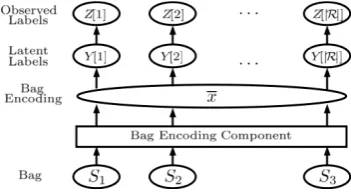
and the parameters for generating encodingx. At this end, we have defined the overall struc-ture of the nEM framework (summarized in Figure
[image:4.595.93.269.247.344.2]2). Next, we will discuss the learning of it.
Figure 2: The probabilistic framework of nEM
4.2 Learning with the EM Algorithm
Let`(z|x;φ, θ)be the log-likelihood of observing the label setzgiven the bagx, that is,
`(z|x;φ, θ) := logpZ|X(z|x). (6)
The structure of the framework readily enables a principled learning algorithm based on the EM al-gorithm (Dempster et al.,1977).
Let`total(φ, θ)be the log-likelihood defined as
`total(φ, θ) :=
X
b∈B
`(zb|xb;φ, θ). (7)
The learning problem can then be formulated as maximizing this objective function over its param-eters(φ, θ), or solving
(φ,b θ) := arg maxb
φ,θ `total(φ, θ). (8)
LetQ be an arbitrary distribution over {0,1}|R|.
Then it is possible to show
`(z|x;φ, θ)
= log X
y∈{0,1}|R|
Q(y)
Q
r∈R
pY[r]|X(y[r]|x)pZ[r]|Y[r](z[r]|y[r])
Q(y)
> X
y∈{0,1}|R|
Q(y) log
Q
r∈R
pY[r]|X(y[r]|x)pZ[r]|Y[r](z[r]|y[r])
Q(y)
=L(z|x;φ, θ, Q)
(9)
where the lower bound L(z|x;φ, θ, Q), often re-ferred to as the variational lower bound. Now we defineLtotalas
Ltotal(φ,θ,{Qb:b∈ B}):=
X
b∈B
L(zb|xb;φ,θ,Qb)(10)
where we have introduced aQbfor eachb∈ B.
In-stead of solving the original optimization problem (8), we can turn to solving a different optimization problem by maximizingLtotal
(φ,b θ,b{Qbb}) := arg max
φ,θ,{Qb}
Ltotal(φ, θ,{Qb}) (11)
The EM algorithm for solving the optimization problem (11) is essentially the coordinate ascent algorithm on objective functionLtotal, where we
iterate over two steps, the E-Step and the M-Step. In the E-Step, we maximizesLtotalover{Qb}for
the current setting of(φ, θ)and in the M-Step, we maximize Ltotal (φ, θ) for the current setting of
{Qb}. We now describe the two steps in detail,
where we will use superscripttto denote the iter-ation number.
E-step: In this step, we hold (φ, θ)fixed and up-date{Qb : b ∈ B}to maximize the lower bound
Ltotal(φ, θ,{Qb}). This boils down to update each
factorQb,rofQb according to:
Qtb,r+1(y[r]) : =pY[r]|X,Z(yb[r]|xb, zb[r];θt, φtr)
=pZ|Y(zb[r]|yb[r];φ t
r)pY|X(yb[r]|xb;θt)
pZ|X(zb[r]|xb;θt, φtr)
= pZ|Y(zb[r]|yb[r];φ
t
r)pY|X(yb[r]|xb;θt)
P
y[r]∈{0,1}
pZ|Y(zb[r]|y[r];φrt)pY|X(y[r]|xb;θt)
(12)
M-step: In this step, we hold {Qb} fixed and
update (φ, θ), to maximize the lower bound
Ltotal(φ, θ,{Qb}). Let
M = Y
r∈R
pY[r]|X(yb[r]|xb)pZ[r]|Y[r](zb[r]|yb[r]), (13)
then(φ, θ)is updated according to:
(θt+1, φt+1) := argmax
θ,φ Ltotal(θ, φ,{Q t+1
b })
= argmax θ,φ
X
b∈B X
yb∈{0,1}|R|
Qtb+1(y)log
M
Qtb+1(y)
= argmax θ,φ
X
b∈B X
yb∈{0,1}|R|
Qbt+1(y)logM−
X
b∈B X
yb∈{0,1}|R|
Qtb(y)logQ
t+1
b (y)
= argmax θ,φ
X
b∈B X
r∈R
X
yb[r]∈{0,1}
Qb,rt+1(y[r]) logpZ|Y(zb[r]|yb[r];φr)
+ logpY|X(yb[r]|xb;θ)
Overall the EM algorithm starts with initializing
(φ, θ,{Qb}), and then iterates over the two steps
until convergence or after some prescribed number of iterations is reached. There are however several caveats on which caution is needed. First, the opti-mization problem in the M-Step cannot be solved in closed form. As such we take a stochastic gra-dient descent (SGD) approach2.
In each M-Step, we perform ∆updates, where
∆ is a hyper-parameter. Such an approach is sometimes referred to as “Generalized EM” (Wu,
1983; Jojic and Frey, 2001; Greff et al., 2017). Note that since the parameters θ are parameters for the neural network performing bag encoding, the objective functionLtotal is highly non-convex
with respect toθ. This makes it desirable to choose an appropriate ∆. Too small ∆ results in little change in θ and hence provides insufficient sig-nal to update {Qb}; too large ∆, particularly at
the early iterations when {Qb} has not been
suf-ficiently optimized, tends to make the optimiza-tion stuck in undesired local optimum. In practice, one can try several values of∆by inspecting their achieved value of Ltotal and select the∆ giving
rise to the highestLtotal. Note that such a tuning of∆ requires no access of the testing data. The second issue is that the EM algorithm is known to be sensitive to initialization. In our implementa-tion, in order to provide a good initial parameter setting, we set eachQ0
b tozb. Despite the fact that
[image:5.595.92.271.525.595.2]zcontains noise, this is a much better approxima-tion of the posterior of true labels than any random initialization.
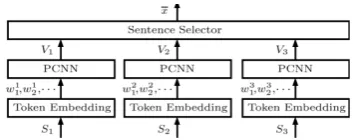
Figure 3: The structure of Bag Encoding component.
The nEM framework needs the encoding of a bag of x as discussed in Equation 4. Any suit-able neural network can be deployed to achieve this goal. Next, we present the widely used meth-ods for DS relation extraction strategies: the Bag Encoding Models.
2In fact, the approach should be called “stochastic
gradi-ent ascgradi-ent”, since we are maximizing the objective function not minimizing it.
4.3 Bag Encoding Models
As illustrated in Figure3, the Bag Encoding Mod-els include three components: Word-Position Em-bedding, Sentence Encoding, and Sentence Selec-tors.
4.3.1 Word-Position Embedding
For thejthword in a sentence, Word-Position Em-bedding generates a vector representation wj as
concatenated three components
h
ww j,w
p1
j ,w p2
j
i
. Specifically, wwj is the word embedding of the word andwpj1 andwjp2 are two position embed-dings. Herewpj1 (resp. wpj2) are the embedding of the relative location of the word with respect to the first (resp. second) entity in the sentence. The dimensions of word and position embeddings are denoted bydwanddp respectively.
4.3.2 Sentence Encoding
Sentence encoding uses Piecewise Convolutional Neural Networks (PCNN) (Zeng et al., 2015;
Lin et al., 2016; Ye et al., 2017; Ji et al.,
2017), which consists of convolution followed by Piecewise Max-pooling. The convolution op-eration uses a list of matrix kernels such as
{K1,K2,· · · ,Klker} to extract n-gram features
through sliding windows of length lwin. Here
Ki ∈ Rlwin×de and l
ker is the number of
ker-nels. Letwj−lwin+1:j ∈R
lwin×de be the
concate-nated vector of token embeddings in thejth win-dow. The output of convolution operation is a ma-trixU ∈Rlker×(m+lwin−1) where each element is
computed by
Uij =Kiwj−lwin+1:j+bi (15)
where denotes inner product. In Piecewise Max-Pooling, Ui is segmented to three parts
U1i,U2i,U3i depending on whether an element inUi is on the left or right of the two entities, or
between the two entities. Then max-pooling is ap-plied to each segment, giving rise to
gip= max(Upi),16i6lker,16p63 (16)
Let g = g1,g2,g3. Then sentence encoding outputs
v= ReLU(g)◦h, (17)
4.3.3 Sentence Selectors
Let n be the number of sentences in a bag. We denote a matrix V ∈ Rn×(lker×3)consisting of
each sentence vectorvT. Vk:andV:j are used to
index the kth row vector and jth column vector of V respectively. Three kinds of sentence-selectors are used to construct the bag encoding. Mean-selector (Lin et al.,2016;Ye et al.,2017): The bag encoding is computed as
x= 1 n
n
X
k=1
Vk: (18)
Max-selector (Jiang et al.,2016): Thejthelement of bag encodingxis computed as
xj = max(V:j) (19)
Attention-selector Attention mechanism is exten-sively used for sentence selection in relation ex-traction by weighted summing of the sentence vec-tors, such as in (Lin et al.,2016;Ye et al.,2017;Su et al.,2018). However, all these works assume that the labels arecorrectand only use the golden label embeddings to select sentences at training stage. We instead selecting sentences using all label em-beddingsrand construct a bag encoding for each labelr ∈ R. The output is then a list of vectors
{xr}, in which therthvector is calculated through
attention mechanism as
el=VTl:Ar, αk=
exp(ek)
Pn
l=1exp(el)
, xr=
n
X
k=1
αkVk: (20)
whereA∈Rdr×dr is a diagonal matrix andd
ris
the dimension of relation embedding.
5 Experimental Study
We first conduct experiments on the widely used benchmark data set Riedel (Riedel et al., 2010), and then on the TARCED (Zhang et al.,2017) data set. The latter allows us to control the noise level in the labels to observe the behavior and working mechanism of our proposed method. The code for our model is found on the Github page3.
5.1 Evaluation on the Riedel Dataset
The Riedel dataset2is a widely used DS dataset for relation extraction. It was developed in (Riedel et al., 2010) through aligning entity pairs from
3
https://github.com/AlbertChen1991/nEM
2http://iesl.cs.umass.edu/riedel/ecml/
Freebase with the New York Times (NYT) cor-pus. There are 53 relations in the Riedel dataset, including “NA”. The bags collected from the 2005-2006 corpus are used as the training set, and the bags from the 2007 corpus are used as the test set. The training data contains 281,270 entity pairs and522,611sentences; the testing data contains
96,678entity pairs and172,448sentences.
5.1.1 Ground-Truth Annotation
The Riedel dataset contains no ground-truth la-bels. The held-out evaluation (Mintz et al.,2009) is highly unreliable in measuring a model’s perfor-mance against the ground truth. Since this study is concerned with discovering the ground-truth la-bels, the conventional held-out evaluation is no longer appropriate. For this reason, we annotate a subset of the original test data for evaluation pur-pose. Specifically, we annotate a bagxb by its all
correct labels, and if no such labels exist, we label the bag NA.
In total 3762 bags are annotated, which in-clude all bags originally labelled as non-NA (”Part 1”) and 2000 bags (”Part 2”) selected from the bags originally labelled as NA but have rela-tively low score for NA label under a pre-trained PCNN+ATT (Lin et al.,2016) model. The ratio-nale here is that we are interested in inspecting the model’s performance in detecting the labels of known relations rather than NA relation.
Table 1: The statistics of ground-truth annotation. ori-gindenotes the total number of originally assigned la-bels of these bags. correctandwrongdenote the total number of correctly assigned and wrongly assigned la-bels. addeddenote the number of missing labels we added into these bags.
bags origin correct wrong added
Part 1 1762 1953 1245 708 804
Part 2 2000 2000 938 1062 1211
The statistics of annotation is shown in Table
1. Through the annotation, we notice that, about 36% of the original labels in original non-NA bags and 53% of labels in original NA bags are wrongly assigned. Similar statistics has been reported in previous works (Riedel et al., 2010;Feng et al.,
2018).
5.1.2 Evaluation Metrics and Baselines
curve is reported to compare performance of mod-els. Three baselines are considered:
• PCNN+MEAN (Lin et al., 2016; Ye et al.,
2017): A model using PCNN to encode stences and a mean-selector to generate bag en-coding.
• PCNN+MAX (Jiang et al., 2016): A model using PCNN to encode sentences and a max-selector to generate bag encoding.
• PCNN+ATT (Lin et al., 2016;Ye et al., 2017;
Su et al., 2018): A model using PCNN to en-code sentences and an attention-selector to gen-erate bag encoding.
We compare the three baselines with their nEM versions (namely using them as the Bag Encod-ing component in nEM), which are denoted with a “+nEM” suffix.
5.1.3 Implementation Detail
Following previous work, we tune our models us-ing three-fold validation on the trainus-ing set. As the best configurations, we setdw = 50, dp = 5
and dr = 230. For PCNN, we set lwin = 3,
lker = 230and set the probability of dropout to
0.5. We use Adadelta (Zeiler, 2012) with default setting (ρ= 0.95, ε= 1e−6) to optimize the mod-els and the initial learning rate is set as 1. The batch size is fixed to160and the max length of a sentence is set as120.
For the noise model pZ|Y, we set φ0N A =
0.3, φ1
N A = 0for the NA label andφ0r = 0, φ1r =
0.9for other labelsr 6=N A. In addition, the num-ber∆of SGD updates in M-step is set to2000.
5.1.4 Predictive performance
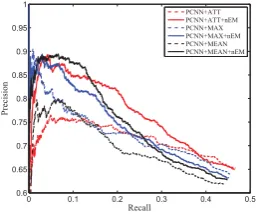
The evaluation results on manually labeled test set are shown in Figure 4. From which, we observe that the PR-curves of the nEM models are above their corresponding baselines by significant mar-gins, especially in the low-recall regime. This observation demonstrates the effectiveness of the nEM model on improving the extracting perfor-mance upon the baseline models. We also observe that models with attention-selector achieve better performance than models with mean-selector and max-selector, demonstrating the superiority of the attention mechanism on sentence selection.
We then analyze the predicting probability of PCNN+ATT and PCNN+ATT+nEM on the ground-truth labels in the test set. We divide the predicting probability values into 5 bins and
0 0.1 0.2 0.3 0.4 0.5
0.6 0.65 0.7 0.75 0.8 0.85 0.9 0.95 1
Recall
Precision
[image:7.595.339.468.70.177.2]PCNN+ATT PCNN+ATT+nEM PCNN+MAX PCNN+MAX+nEM PCNN+MEAN PCNN+MEAN+nEM
Figure 4: PR curves on DS test set.
count the number of label within each bin. The result is shown in Figure 5(a). We observe that the count for PCNN+ATT in bins 0.0−0.2,
0.2−0.4,0.4−0.6and0.6−0.8are all greater than PCNN+ATT+nEM. But in bin0.8−1.0, the count for PCNN+ATT+nEM is about 55% larger than PCNN+ATT. This observation indicates that nEM can promote the overall predicting scores of ground-truth labels.
Figure 5(b) compares PCNN+ATT and PCNN+ATT+nEM in their predictive probabilities on the frequent relations. The result shows that PCNN+ATT+nEM achieves higher average pre-dicting probability on all these relations, except for the NA relation, on which PCNN+ATT+nEM nearly levels with PCNN+ATT. This phenomenon demonstrates that nEM tends to be more confident in predicting the correct labels. In this case, rais-ing the predictive probability on the correct label does increase the models ability to make the cor-rect decision, thereby improving performance.
0−0.2 0.2−0.4 0.4−0.6 0.6−0.8 0.8−1.0 0
200 400 600 800 1000 1200 1400 1600 1800
Score Range
Counts
PCNN+ATT PCNN+ATT+nEM
NA Con Nat Com PoL PoD PoB 0
0.1 0.2 0.3 0.4 0.5 0.6 0.7 0.8 0.9
Relation
Average Score
PCNN+ATT PCNN+ATT+nEM
(a) Score distribution (b) Scores on main relations
Figure 5: Predictive probabilities on the test set. CON, Nat, Com, PoL, PoD and PoB represent ’contains’, ’na-tionality’, ’company’, ’place lived’, ’place of death’ and ’place of birth’ relations respectively.
5.2 Evaluation on the TACRED Dataset
2009−2012, year 2013and year 2014 are used as training, validation and testing sets respectively. In all annotated sentences, 68,124 are used for training, 22,631 for validation and 15,509 for testing. There are in total 42,394distinct entity pairs, where33,079of these entity pairs appear in exactly one sentence. Since these 33,079entity pairs dominate the training set, we simply treat each sentence as a bag for training and testing. Another advantage of constructing single-sentence bags is that it allows us to pinpoint the correspon-dence between the correct label and its supporting sentence. The number of relations in TACRED dataset is42, including a special relation “no re-lation”, which is treated as NA in this study.
5.2.1 Constructing Semi-synthetic Dataset
To obtain insight into the working of nEM, we cre-ate a simulcre-ated DS dataset by inserting noisy la-bels into the training set of a supervised dataset, TACRED. Since the training set of TACRED was manually annotated, the labels therein may be re-garded as the ground-truth labels. Training using this semi-synthetic dataset allows us to easily ob-serve models’ behaviour with respect to the noisy labels and the true labels.
We inject artificial noise into the TACRED training data through the following precedure. For each bagxbin the training set, we generate a noisy
label vectorz˜bfrom the observed ground-truth
la-bel vectoryb. Specifically,z˜bis generated by
flip-ping each element yb[r] from 0 to 1 or 1 to 0
with a probabilitypf. This precedure simulates a
DS dataset through introducing wrong labels into training bags, thus corrupts the training dataset.
5.2.2 Experimental Settings
Following (Zhang et al.,2017), the common rela-tion classificarela-tion metrics Precision, Recall and F1 are used for evaluation. The PCNN model is used to generate the bag encoding since sentence selec-tion is not needed in this setting. The same hyper-parameter settings as in Section 5.1.3are used in this experiment. For the noise modelpZ[r]|Y[r]of
PCNN +nEM, we setφ0r = 0.1, φ1r = 0.1for each labelr ∈ R. The number∆of SGD updates in each M-step is set to1600.
5.2.3 Test Results
From Table 2, we see that PCNN+nEM achieves better recall and F1 score than the PCNN model under various noise levels. Additionally, the recall
and F1 margins between PCNN and PCNN+nEM increase with noise levels. This suggests that nEM keeps better performance than the corre-sponding baseline model under various level of training noise. We also observe that the precision of nEM is consistently lower than that of PCNN when noise is injected to TACRED. This is a nec-essary trade-off present in nEM. The training of nEM regards the training labels with less confi-dence based on noisy-label assumption. This ef-fectively lowers the probability of seen training la-bels and considers the unseen lala-bels also having some probability to occur. When trained this way, nEM, at the prediction time, tends to predict more labels than its baseline (PCNN) does. Note that in TACRED, each instance contains only a single ground truth label. Thus the tendency of nEM to predict more labels leads to the reduced precision. However, despite this tendency, nEM, comparing with PCNN, has a stronger capability in detecting the correct label and gives the better recall of nEM. The gain in recall dominates the loss in precision.
Table 2: Test performance on the TACRED dataset.
pf PCNN PCNN+nEM
P R F1 P R F1
0.02 65.2 30.0 41.1 61.8 34.8 44.5 0.04 63.5 28.9 39.7 60.2 33.8 43.3 0.06 70.5 25.2 37.1 59.9 31.1 41.0 0.08 63.5 23.6 34.4 58.8 29.8 39.6 0.10 66.1 22.7 33.9 56.5 28.9 38.3
5.2.4 Training Label Probabilities
0.62 0.64 0.66
Original label average score
0.02 0.03 0.04 0.05 0.06 0.07 0.08 0.09 0.10 0.1 0.2
Noisy label average score
pf PCNN Original PCNN+nEM Original PCNN Noisy PCNN+nEM Noisy
0 2 4 6 8 10
0.03 0.035 0.04 0.045 0.05 0.055 0.06 0.065 0.07 0.075
EM Iterations
Average of Q
b,r
[image:9.595.74.287.63.148.2](y[r])
Figure 6: Average probabilities for noisy and original labels (left) and averageQb,r(y[r])over EM iterations (right)
5.2.5 Effectiveness of EM Iterations
For each training bag xb and each artificial noisy
label r, we track the probability Qb,r(y[r]) = 1
over EM iterations. This probability, measuring the likelihood of the noise labelrbeing correct, is then averaged overr and over all bagsxb. It can
be seen in Figure 6(right) that the average value ofQb,r(y[r])decreases as the training progresses,
leading the model to gradually ignore noisy labels. This demonstrates the effectiveness of EM itera-tions and validates the proposed EM-based frame-work.
6 Concluding Remarks
We proposed a nEM framework to deal with the noisy-label problem in distance supervision rela-tion extracrela-tion. We empirically demonstrated the effectiveness of the nEM framework, and provided insights on its working and behaviours through data with controllable noise levels. Our frame-work is a combination of latent variable models in probabilistic modelling with contemporary deep neural networks. Consequently, it naturally sup-ports a training algorithm which elegantly nests the SGD training of any appropriate neural net-work inside an EM algorithm. We hope that our approach and the annotated clean testing data would inspire further research along this direc-tion.
Acknowledgment
This work is supported partly by China 973 pro-gram (No. 2015CB358700), by the National Nat-ural Science Foundation of China (No. 61772059, 61421003), by the Beijing Advanced Innova-tion Center for Big Data and Brain Computing (BDBC), by State Key Laboratory of Software De-velopment Environment (No. SKLSDE-2018ZX-17) and by the Fundamental Research Funds for the Central Universities.
References
Razvan C. Bunescu and Raymond J. Mooney. 2005. Subsequence kernels for relation extraction. In Advances in Neural Information Processing Sys-tems 18 [Neural Information Processing SysSys-tems, NIPS 2005, December 5-8, 2005, Vancouver, British Columbia, Canada], pages 171–178.
Arthur P Dempster, Nan M Laird, and Donald B Rubin. 1977. Maximum likelihood from incomplete data via the em algorithm. Journal of the royal statistical society. Series B (methodological), pages 1–38.
Jun Feng, Minlie Huang, Li Zhao, Yang Yang, and Xi-aoyan Zhu. 2018. Reinforcement learning for re-lation classification from noisy data. In Proceed-ings of the Thirty-Second AAAI Conference on Ar-tificial Intelligence, (AAAI-18), the 30th innovative Applications of Artificial Intelligence (IAAI-18), and the 8th AAAI Symposium on Educational Advances in Artificial Intelligence (EAAI-18), New Orleans, Louisiana, USA, February 2-7, 2018, pages 5779– 5786.
Kata G´abor, Davide Buscaldi, Anne-Kathrin Schu-mann, Behrang QasemiZadeh, Ha¨ıfa Zargayouna, and Thierry Charnois. 2018. Semeval-2018 task 7: Semantic relation extraction and classification in scientific papers. InSemEval@NAACL-HLT, pages 679–688. Association for Computational Linguis-tics.
Klaus Greff, Sjoerd van Steenkiste, and J¨urgen Schmidhuber. 2017. Neural expectation maximiza-tion. InAdvances in Neural Information Processing Systems 30: Annual Conference on Neural Informa-tion Processing Systems 2017, 4-9 December 2017, Long Beach, CA, USA, pages 6694–6704.
Raphael Hoffmann, Congle Zhang, Xiao Ling, Luke S. Zettlemoyer, and Daniel S. Weld. 2011. Knowledge-based weak supervision for information extraction of overlapping relations. InThe 49th An-nual Meeting of the Association for Computational Linguistics: Human Language Technologies, Pro-ceedings of the Conference, 19-24 June, 2011, Port-land, Oregon, USA, pages 541–550.
Guoliang Ji, Kang Liu, Shizhu He, and Jun Zhao. 2017. Distant supervision for relation extraction with sentence-level attention and entity descriptions. InProceedings of the Thirty-First AAAI Conference on Artificial Intelligence, February 4-9, 2017, San Francisco, California, USA., pages 3060–3066.
Nebojsa Jojic and Brendan J. Frey. 2001. Learning flexible sprites in video layers. In2001 IEEE Com-puter Society Conference on ComCom-puter Vision and Pattern Recognition (CVPR 2001), with CD-ROM, 8-14 December 2001, Kauai, HI, USA, pages 199– 206.
Yankai Lin, Shiqi Shen, Zhiyuan Liu, Huanbo Luan, and Maosong Sun. 2016. Neural relation extraction with selective attention over instances. In Proceed-ings of the 54th Annual Meeting of the Association for Computational Linguistics, ACL 2016, August 7-12, 2016, Berlin, Germany, Volume 1: Long Papers.
Tianyu Liu, Kexiang Wang, Baobao Chang, and Zhi-fang Sui. 2017. A soft-label method for noise-tolerant distantly supervised relation extraction. In Proceedings of the 2017 Conference on Empirical Methods in Natural Language Processing, EMNLP 2017, Copenhagen, Denmark, September 9-11, 2017, pages 1790–1795.
Yang Liu, Furu Wei, Sujian Li, Heng Ji, Ming Zhou, and Houfeng Wang. 2015. A dependency-based neural network for relation classification. In Pro-ceedings of the 53rd Annual Meeting of the Associ-ation for ComputAssoci-ational Linguistics and the 7th In-ternational Joint Conference on Natural Language Processing of the Asian Federation of Natural Lan-guage Processing, ACL 2015, July 26-31, 2015, Bei-jing, China, Volume 2: Short Papers, pages 285– 290.
Bingfeng Luo, Yansong Feng, Zheng Wang, Zhanxing Zhu, Songfang Huang, Rui Yan, and Dongyan Zhao. 2017. Learning with noise: Enhance distantly su-pervised relation extraction with dynamic transition matrix. In Proceedings of the 55th Annual Meet-ing of the Association for Computational LMeet-inguis- Linguis-tics, ACL 2017, Vancouver, Canada, July 30 - August 4, Volume 1: Long Papers, pages 430–439.
Mike Mintz, Steven Bills, Rion Snow, and Daniel Ju-rafsky. 2009. Distant supervision for relation extrac-tion without labeled data. InACL 2009, Proceedings of the 47th Annual Meeting of the Association for Computational Linguistics and the 4th International Joint Conference on Natural Language Processing of the AFNLP, 2-7 August 2009, Singapore, pages 1003–1011.
Makoto Miwa and Mohit Bansal. 2016. End-to-end re-lation extraction using lstms on sequences and tree structures. InProceedings of the 54th Annual Meet-ing of the Association for Computational LMeet-inguis- Linguis-tics, ACL 2016, August 7-12, 2016, Berlin, Ger-many, Volume 1: Long Papers.
Meng Qu, Xiang Ren, Yu Zhang, and Jiawei Han. 2018. Weakly-supervised relation extraction by pattern-enhanced embedding learning. In Proceed-ings of the 2018 World Wide Web Conference on World Wide Web, WWW 2018, Lyon, France, April 23-27, 2018, pages 1257–1266.
Sebastian Riedel, Limin Yao, and Andrew McCal-lum. 2010. Modeling relations and their men-tions without labeled text. In Machine Learning and Knowledge Discovery in Databases, European Conference, ECML PKDD 2010, Barcelona, Spain, September 20-24, 2010, Proceedings, Part III, pages 148–163.
C´ıcero Nogueira dos Santos, Bing Xiang, and Bowen Zhou. 2015. Classifying relations by ranking with convolutional neural networks. In Proceedings of the 53rd Annual Meeting of the Association for Computational Linguistics and the 7th International Joint Conference on Natural Language Process-ing of the Asian Federation of Natural Language Processing, ACL 2015, July 26-31, 2015, Beijing, China, Volume 1: Long Papers, pages 626–634.
Sen Su, Ningning Jia, Xiang Cheng, Shuguang Zhu, and Ruiping Li. 2018. Exploring encoder-decoder model for distant supervised relation extraction. InProceedings of the Twenty-Seventh International Joint Conference on Artificial Intelligence, IJCAI 2018, July 13-19, 2018, Stockholm, Sweden., pages 4389–4395.
Mihai Surdeanu, Julie Tibshirani, Ramesh Nallapati, and Christopher D. Manning. 2012. Multi-instance multi-label learning for relation extraction. In Pro-ceedings of the 2012 Joint Conference on Empirical Methods in Natural Language Processing and Com-putational Natural Language Learning, EMNLP-CoNLL 2012, July 12-14, 2012, Jeju Island, Korea, pages 455–465.
William Yang Wang, Weiran Xu, and Pengda Qin. 2018a. DSGAN: generative adversarial training for distant supervision relation extraction. In Proceed-ings of the 56th Annual Meeting of the Associa-tion for ComputaAssocia-tional Linguistics, ACL 2018, Mel-bourne, Australia, July 15-20, 2018, Volume 1: Long Papers, pages 496–505.
William Yang Wang, Weiran Xu, and Pengda Qin. 2018b. Robust distant supervision relation extrac-tion via deep reinforcement learning. In Proceed-ings of the 56th Annual Meeting of the Associa-tion for ComputaAssocia-tional Linguistics, ACL 2018, Mel-bourne, Australia, July 15-20, 2018, Volume 1: Long Papers, pages 2137–2147.
CF Jeff Wu. 1983. On the convergence properties of the em algorithm. The Annals of statistics, pages 95–103.
Yan Xu, Lili Mou, Ge Li, Yunchuan Chen, Hao Peng, and Zhi Jin. 2015. Classifying relations via long short term memory networks along shortest depen-dency paths. InProceedings of the 2015 Conference on Empirical Methods in Natural Language Pro-cessing, EMNLP 2015, Lisbon, Portugal, September 17-21, 2015, pages 1785–1794.
neural network based on dependency tree for re-lation classification. In Proceedings of the 2016 Conference on Empirical Methods in Natural Lan-guage Processing, EMNLP 2016, Austin, Texas, USA, November 1-4, 2016, pages 65–74.
Hai Ye, Wenhan Chao, Zhunchen Luo, and Zhoujun Li. 2017. Jointly extracting relations with class ties via effective deep ranking. In Proceedings of the 55th Annual Meeting of the Association for Compu-tational Linguistics, ACL 2017, Vancouver, Canada, July 30 - August 4, Volume 1: Long Papers, pages 1810–1820.
Matthew D. Zeiler. 2012. ADADELTA: an adaptive learning rate method.CoRR, abs/1212.5701.
Dmitry Zelenko, Chinatsu Aone, and Anthony Richardella. 2002. Kernel methods for relation ex-traction. InProceedings of the 2002 Conference on Empirical Methods in Natural Language Process-ing, EMNLP 2002, Philadelphia, PA, USA, July 6-7, 2002.
Daojian Zeng, Kang Liu, Yubo Chen, and Jun Zhao. 2015. Distant supervision for relation extraction via piecewise convolutional neural networks. In Pro-ceedings of the 2015 Conference on Empirical Meth-ods in Natural Language Processing, EMNLP 2015, Lisbon, Portugal, September 17-21, 2015, pages 1753–1762.
Daojian Zeng, Kang Liu, Siwei Lai, Guangyou Zhou, and Jun Zhao. 2014. Relation classification via convolutional deep neural network. In COLING 2014, 25th International Conference on Computa-tional Linguistics, Proceedings of the Conference: Technical Papers, August 23-29, 2014, Dublin, Ire-land, pages 2335–2344.
Xiangrong Zeng, Shizhu He, Kang Liu, and Jun Zhao. 2018. Large scaled relation extraction with rein-forcement learning. In Proceedings of the Thirty-Second AAAI Conference on Artificial Intelligence, (AAAI-18), the 30th innovative Applications of Arti-ficial Intelligence (IAAI-18), and the 8th AAAI Sym-posium on Educational Advances in Artificial Intel-ligence (EAAI-18), New Orleans, Louisiana, USA, February 2-7, 2018, pages 5658–5665.
Yuhao Zhang, Victor Zhong, Danqi Chen, Gabor An-geli, and Christopher D. Manning. 2017. Position-aware attention and supervised data improve slot fill-ing. InProceedings of the 2017 Conference on Em-pirical Methods in Natural Language Processing, EMNLP 2017, Copenhagen, Denmark, September 9-11, 2017, pages 35–45.

![Figure 6: Average probabilities for noisy and originallabels (left) and average Qb,r(y[r]) over EM iterations(right)](https://thumb-us.123doks.com/thumbv2/123dok_us/1336454.664955/9.595.74.287.63.148/figure-average-probabilities-noisy-originallabels-average-iterations-right.webp)