How to cite: Du Plessis, H. 2019. Facilitation of construction project management through building contracts: A South African perspective on the locally developed suites of contracts. Acta Structilia, 26(1), pp. 120-147. © Creative Commons With Attribution (CC-BY)
Published by the UFS
http://journals.ufs.ac.za/index.php/as
Hendri du Plessis
Mr Hendri du Plessis, Lecturer, Department of Quantity Surveying and Construction Management, University of the Free State, Bloemfontein 9301, South Africa. Phone: +27 (0) 51 401 3322 or +27 (0) 73 177 8953, email: <duplessishb@ufs. ac.za> ORCID: https://orcid. org/0000-0002-6342-0702
DOI: http://dx.doi.
org/10.18820/24150487/as26i1.5 ISSN: 1023-0564
e-ISSN: 2415-0487
Acta Structilia 2019 26(1): 120-147
Facilitation of
construction project
management through
building contracts: A
South African perspective
on the locally developed
suites of contracts
Peer reviewed and revised April 2019 Published June 2019
*The author declared no conflict of interest for the article or title
Abstract
Construction Work 2015 and the Joint Building Contracts Committee’s (JBCC) Principal Building Agreement Edition 6.2) provide the employer’s agent (EA) the necessary authority to manage the project for its intended purpose. It became apparent that the contracts may allow certain project management functions to be implemented by placing different emphases on different aspects of the contract. Due to the complexity and uniqueness of each project, the number of standard contract conditions governing a contract are limited. A strong project management function must take place during the planning phases. The contract used influences the way in which the project management functions are applied during the project life cycle (PLC). Thus, the project manager must have an intimate knowledge of the content of the contract in order to implement the desired construction project management functions, as required during each of the PLC stages.
Keywords: General Conditions of Contract for Construction Work (GCC), Joint Building Contracts Committee (JBCC), Principal Building Agreement (PBA), project life cycle; construction project management.
Abstrak
Hierdie artikel ondersoek die diepte waarop die Suid-Afrikaanse bou-kontrakte die effektiewe implementering van konstruksieprojekbestuurspraktyke kan fasiliteer. Die hipotese verklaar dat die standaard Suid-Afrikaanse kontrakte vir bouwerk so ontwikkel het om beheer deur konstruksieprojekbestuursprosesse te bevorder. Die Suid-Afrikaanse bou-kontrakte word vergelyk met die projekbestuurskantoor se hoof fokusareas vir beste praktyke. Dit streef daarna om die bevorderlikheid van goeie projekbestuursfunksies op bouprojekte te evalueer. Die hoofklousules van elke kontrak word vergelyk met die konstruksieprojekbestuur kennis areas. Twee kontrakte word aanskou met die doel om vas te stel of beide kontrakte (General Conditions of Contract for
Construction Work2015 and the Joint Building Contracts Committee’s (JBCC)
Principal Building Agreement Edition 6.2) die werkgewer se agent die nodige magtiging verleen om die projek te bestuur vir sy beoogde doel. Dit het duidelik geword dat die kontrakte kan toelaat dat sekere projekbestuursfunksies
geïmplementeer word deur die klem op verskillende aspekte van die kontrak te plaas. As gevolg van die kompleksiteit en uniekheid van elke projek, is die aantal standaardkontrakvoorwaardes wat ’n kontrak beheer, beperk. ’n Sterk projekbestuursfunksie moet tydens die beplanningsfases plaasvind. Die gebruik van die kontrak beïnvloed die manier waarop die projekbestuurfunksies toegepas word gedurende die projek lewensiklus. Die projekbestuurder moet dus ’n intieme kennis hê van die inhoud van die kontrak om die verlangde konstruksieprojekbestuursfunksies te implementeer, soos benodig tydens elk van die projeklewensiklus stadiums.
Sleutelwoorde: General Conditions of Contract for Construction Work (GCC), Joint Building Contracts Committee (JBCC), Principal Building Agreement
(PBA), projeklewensiklus; konstruksieprojekbestuur.
1.
Introduction
projects, namely the General Conditions of Contract for Construction Work Third Edition of 2015 (GCC) and the Joint Building Contracts Committee’s (JBCC) Principal Building Agreement Edition 6.2 (PBA) of 2018.
Because of the number of possible contract suites available, the traditional lump-sum building contracts are used to evaluate the benefits of the contract in managing the construction process (Du Plessis & Oosthuizen, 2018: 152-181).
Building contracts are reciprocal because a contractor undertakes to supply the necessary labour and materials to produce a building in all aspects. In return, the employers agree to pay the agreed contract price. Lump-sum contracts may consist of bills of quantities or provisional bills of quantities, which will influence the tendering procedure and the stakeholders involved (Finsen & Segal, 2018: 18-40; Adriaanse, 2016: 7). A large portion of building contracts are covered by the state of law although not directly referenced in the contract document. A good example is the Construction Regulations 2014, which bestow more responsibility on the employer towards Health and Safety (H&S) requirements. This, in turn, makes it obligatory for the appointment of the H&S consultant on most of the construction projects (Finsen & Segal, 2018: 39-40). It is thus not possible to compile standard contract conditions applicable to each situation.
The objective of this article is to establish the depth to which the two main South African suites of contracts can facilitate the effective implementation of CPM practices. The hypothesis states that the standard South African forms of contract for building work evolved in order to promote control through CPM processes.
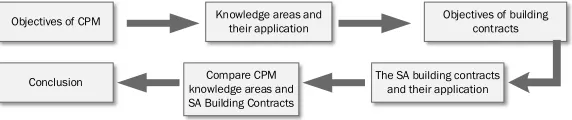
This article first defines the objectives of CPM, before highlighting the CPM knowledge areas and their application in construction projects. The objectives of building contracts and the structure of the South African building contracts are subsequently defined, before comparing the South African building contracts to the CPM objectives and CPM knowledge areas. The logical flow is shown in Figure 1:
Objectives of CPM Knowledge areas and their application
The SA building contracts and their application
Objectives of building contracts
Compare CPM knowledge areas and SA Building Contracts Conclusion
[image:3.421.60.346.456.516.2]1 : I nc ept io n 2 : C on cept and lit
y 3: D
es ig n opm ent 4 : D oc um ent at ion oc ur em ent 5 : C on st ruc tion 6 : C lo se -o ut Co nt ra ct in p la ce (e xc lud ing L at ent D ef ec ts p er io d) Pro cu re - m ent pr oc es s Co nt ra ct be in g dr af te d Co nt ra ct li fe cyc le truc tio n ec t L ife Cyc le
}
In itia tio n pr oc es s gr oup – Int egr at ion a nd st ak ehol de r m anag em ent}
Pl anni ng p ro ce ss gr oup – A ll 12 kn ow ledge a rea s}
Exe cu tin g p ro ce ss gr oup}
M oni to ring a nd c on trol ling pr oc es s gr oup – A ll 12 kn ow ledge a rea s • Int egr at ion -• Q ual ity -• Re sou rc es -• Com mu ni ca tio n-• Pro cu re m en t-• St ak eh ol de r-• H& S, Se cur ity a nd Env iro nm ent -Cl os ing p ro ce ss gr oup – • Int egr at ion -• Re sou rc e-• Pro cu re m en t-O ffer and ac cep tan ce St ar t End End Im pl em en t – ce rt ifi ca te o f co m ple tio n Co nc ep t - Pr oj ec t Pr op os al ec t L ife Cyc le D es ig n – Ba se lin e p la n Com mi ss ion - C lo se -o ut re po rt Bas el in e pl anIntegration between projec
t phases (own diagram)
Adapted from CBE, 2011: 3
-6; Cooke & Williams, 2009: 81, 132; PM
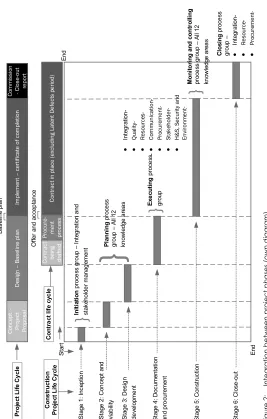
[image:4.421.80.347.116.535.2]Traditionally, the contract comes into effect at the end of stage 4 and the beginning of stage 5 of the construction project life cycle (PLC), as depicted below in Figure 2 (Du Plessis & Oosthuizen, 2018: 165-166). These stages are based on the South African Council for the Built Environment’s (CBE) standardisation of PLC stages (CBE, 2011: 3-6). Figure 2 highlights and compares the ‘traditional’ contract life cycle, the PLC (as per a traditional project management perspective), the Construction PLC (as per CBE/SACPCMP) (SACPCMP is the abbreviation for the South African Council for the Project and Construction Management Professions) and the twelve1 CPM knowledge areas, in an endeavour to highlight the project management functions that take place before and during construction contract implementation (referenced below).
From Figure 2 and the Process Groups and Knowledge Areas Mapping (PGKAM) (PMI, 2016: 20), it is established that the CPM knowledge areas are emphasised differently during the PLC. It is also clear that a large portion of the PGKAM’s emphasis on planning is placed or located outside the contract. The fundamental objectives of the CPM and the PLC are discussed below before comparing the specific contract conditions to the knowledge areas.
2.
CPM objectives
The objectives of a construction project must be condensed into a logical document on which an offer can be based. Project manage-ment remains a combination of art and science that complemanage-ment each other (Msengana, 2012: iii). Many commentators refer to the golden triangle, which mainly highlights the relationship between cost, time, and quality management (Knipe, Van der Waldt, Van Niekerk, Burger & Nel: 2002: 18; Burke, 2010: 35; Dobre, 2007: 327; Nicholas & Steyn, 2012: 421). These correlate with one of the contributors to project failures, namely ambiguous requirements by the managing team (Dalal, 2012: 160; Moustafaev, 2015: 10).
Henri Fayol states that management comprises four main functions, namely planning coordination (organising), commanding (leading), and controlling. His interpretation of control is that managers should receive feedback on the process in order to make amendments as
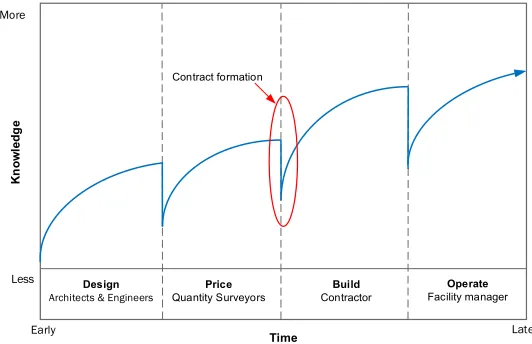
and when required. If there are no effective systems in place, people may easily deviate from the plan (cited in Msengana, 2012: 93). Control depends on proper planning. Successful projects cannot happen in a vacuum (Cooke & Williams, 2009: 3). A large amount of information is transferred from one stage of the project to another, and from one profession to another. Figure 3 depicts a simplification of this information transfer and relates to the adoption of other industries striving to simplify the process of communication across different phases (Bernstein, 2015: video). Figure 3 indicates that the transfer of information happens (should happen) in such a manner that the party using that information takes ownership thereof and builds on the available information with the objective of sharing it after completion of their tenure.
Price Quantity Surveyors
Kn
ow
le
dg
e
Build
Contractor Facility managerOperate Design
Architects & Engineers Less
Early More
Late Time
Contract formation
Figure 3: The traditional method of information flow from one process to the other (Modified: Bernstein, 2015: video).
[image:6.421.84.350.214.386.2]Successful project managers filter the noise of information and transfer the correct amount and quality of information to those involved in the project (Dalal, 2012: 213). With the position of the contract formation established and considering Figure 3, it is concluded that a substantial percentage of the information can be transferred through the contract documentation.
Construction projects not only fulfil stakeholders’ requirements, but also take the geography, site conditions, communities, physical environments, and existing infrastructure into consideration. A unique product is produced, coupled with a high degree of risk, and integrating different disciplines. Many services have become speciality services, thereby increasing the challenge to impose control over the CPM knowledge areas. This subset includes technically advanced disciplines of planning and scheduling, cost management, risk management, document controls, and forensic analyses. These items, together with regulations and jurisdictional requirements, can create an even more complex construction environment, not to mention new materials, equipment, and social political environments that influence all stakeholders. It is important to remember that the inherent complexity of a project is not always apparent at the start of the project. The development team should carefully analyse the project to determine the complexities before confirming commitments for scope, time, quality, safety, and cost. Risk-management procedures should be integrated in this process to minimize any adverse impact on the project. Research shows that decisions made at the front end (e.g., the occupation and functionality of building influences major items such as the size, location and the facilities needed, and so on) of the project are major culprits for construction project failures, which, in many cases, are not considered (PMI, 2016: 1-5; AECOM, 2018: 31-44).
Timely, balanced, and appropriate types of available data are critical to a project manager’s success. Dynamic data management is essential to stakeholders at different stages of a project (Dalal, 2012: 410-434).
of the rules that are key. Proper project management is a blend of theory and skills (Van der Waldt & Fox, 2015: 195).
The project management office (PMO) should focus on enforcing best practices through some common practices, namely (PMI, 2016: 6):
• good historical data regarding costs;
• good H&S, security, and environmental practices; • quality control;
• contract administration;
• subcontractor supplier management, and • change and claims management.
The main functions of a good project manager, however, include strong planning, pre-contract preparation, good communication and teamwork skills, as well as good administrative skills in terms of contracts. The importance of the urgency and transparency of information demanded by owners are often undervalued (PMI, 2016: 6).
It is concluded that, due to the complexity of construction projects, a certain amount of skills and experience are needed to compile an inclusive contract. The link of good project management practices has, over the years, necessitated contracts to allow for certain basic requirements, as highlighted below. However, the supplementary requirements (transferring information) of the one of a kind product, managed by ad hoc teams in fluctuating circumstances, necessitate the objectives within each building project to be clear. Simplified, the objectives of any project are neatly summarised through the golden triangle.
3.
Knowledge areas and their application
According to Kerzner (2013: 225), control is a threefold process, namely: • Measuring – determining the progress through formal and
informal reports;
• Evaluating – determining the cause of the deviation and how to act on it, and
• Correcting – taking control to correct an unfavourable trend. Steyn et al. (2016: 160) summarises project control as follows:
Project control involves anticipating the quality of deliverables, measuring progress and expenditure and identifying undesirable results. During project execution, actual and anticipated outcomes are compared to the project plan and (if needed) actions taken to bring the project in line with the plan. The project manager reports variances and corrective actions to the relevant stakeholders. Project control could include changing the plan in collaboration with stakeholders.
Control in a project involves systems and not people. It is a common challenge that project managers want to control people and not the circumstances within a project. There is a thin line between being in control and micro-management (Msengana, 2012: 94-95). Change management involves the compromise between time, cost, and performance, with alterations to specifications and compromises on quality in order to meet cost and time constraints (Nicholas & Steyn, 2012: 421).
Due to the amount of information contained in all the CPM knowledge areas, this article uses Project Management Process Groups and Knowledge Areas Mapping (PMI, 2017: 25) together with the CPM Process Groups and Knowledge Areas Mapping (PMI, 2016: 20) to evaluate the forms of contracts. Twelve knowledge areas in total are used to evaluate the conduciveness of the suite of contracts, taking into account the PLC or process groups.
Considering the management of a site, it is in the contractor’s best interest to keep good site records to enable him/her to:
• establish the basis of a claim; • defend a counterclaim;
• substantiate applications for extensions of time;
• claim payment for extra work not included in the contract, and • report at progress meetings (Cooke & Williams, 2009: 341). The aim is thus to evaluate the objectives of contracts against the measuring, evaluating, and correcting measures, as referred to earlier. This assists in evaluating the contracts’ conduciveness to management processes. With the control measures established, the objectives of the South African contracts can be established before evaluating the contracts’ control measures against the CPM knowledge areas.
4.
Objectives of building contracts
Simplified, a contract is an agreement between two parties, the contractor and the employer (Finsen & Segal, 2018: 1). Lord Diplock (cited in Adriaanse, 2016: 1) describes a standard form of contract as
… an entire contract for sale of goods and work and labour for a lump sum price payable by instalments as the goods are delivered and the work done. Decisions have to be made from time to time about such essential matters as the making of variation orders, the expenditure of provisional and prime cost sums and extension of time for the carrying out of the work under the contract.
4.1 Risks and administration
Risk allocation is a major part of any contract and one of the objectives of a contract is to mitigate or allocate the risk. Risks are varied and can be categorised as the:
• unforeseen, such as unexpected ground conditions;
• length of the contract and the changes that may occur during this period;
• number of participants and parties on a project, and
• relationship in which conflict is possible (Adriaanse, 2016: 5-6). Planning is fundamental for control and involves following steps setting the standards, determining the actual facts, comparing the facts with the anticipated plans (establish variances), taking action, and revising the plan (Cooke & Williams, 2009: 329; Steyn, et al., 2016: 161). The relationship between the contractor and planning is more extensive than many might realise. Cooke and Williams (2009: 12) state that formal contracts establish administrative arrangements such as notices, payments, delays, compensation, disputes, the type of programme that will be used, how the information will be displayed, and so on.
From the above discussion, it can be concluded that the major objective of the contract is allocating risk and assigning responsibility, with a strong emphasis on communication. Returning to the basic requirements of quality, time, and cost the next section discusses the risk these factors may pose to these objectives.
4.2 Quality, time, and costs
Control over quality, scheduling, cost, and other critical risk factors should be balanced, in order to result in effective control. An experienced project manager will be able to use contingency reserves and work breakdown structures (WBS) in his/her planning and monitoring processes to set certain targets. Through approaches such as Earned Value (EV), Critical Chain and Critical Path reporting, the project manager can identify the necessary key risk factors (Steyn et al., 2016: 162-170; Nagata, Manginelli, Lowe & Trauner, 2018: 10-12).
The primary objective of a project schedule is to communicate the planned progress so that the project participants can make timely decisions (Nagata et al., 2018: 2). The relationship between the contractor and planning is more extensive than many might realise. Cooke and Williams (2009: 12) state that formal contracts establish administrative arrangements such as notices, payments, delays, compensation, disputes, the type of programme that will be used, how the information will be displayed, and so on.
When a project has challenges or is failing, few stakeholders will take responsibility. People often rather defend themselves than acknowledge their contribution to the problem and thus how to contribute to a situation. Most of the people in business organisation are in favour of collaboration – it is only when things start coming undone that silos are formed. Disengagement occurs over time. The solution to this is not reductionism (reducing complex phenomena into simpler and more understandable pieces), it is a lack of system thinking (Msengana, 2012: 110-112).
From the above, the basic responsibilities stipulated within a building contract may best be summarised as the objectives of teamwork.
4.3 Conclusion
analysis that focuses on the way in which systems function over time within larger systems (Rouse, 2005: online). It is derived that, because of the amount of information contained within a contract, a large portion of its content is assumed by the parties. Thus, a standard form of contract may influence the particular party’s assumptions towards his/her expectations. The two main South African forms of building contracts are reviewed next.
5.
South African forms of building contracts
The two main South African Conditions of Contract are the JBCC Principal Building Agreement Edition 6.2 (JBCC PBA), as published by the Joint Building Contracts Committee in 2018, and the General Conditions of Contract for Construction Works Third Edition (GCC 2015), as published by the South African Institution of Civil Engineering in 2015 (CIDB, 2015: 3-4) (CIDB is the abbreviation for the Construction Industry Development Board). The JBCC PBA has developed from a strong architectural or building background, while the GCC 2015 has a strong engineering background.
5.1 JBCC PBA contract
The Joint Building Contracts Committee (JBCC), established in 1984, published the first JBCC PBA in 1991. It has since published various versions of the contract with the objective of being neutral to all parties and incorporating as many of the requirements of the stakeholders involved as possible. The documents also evolved over the years to accommodate government, mainly the Central Government Department of Public Works’ requirements, as well as the international standards as imposed by the CIDB (Finsen & Segal, 2018: 43).
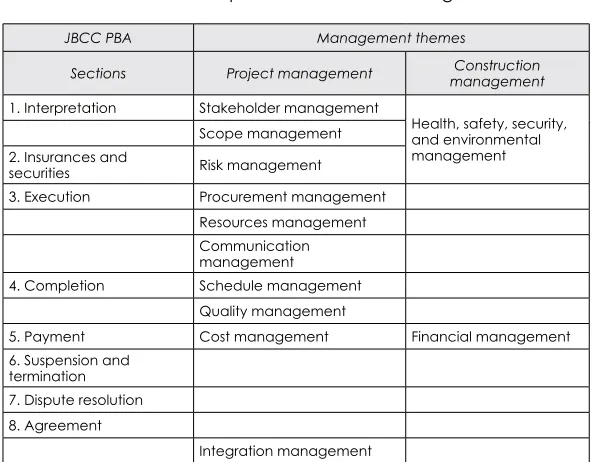
Table 1 summarises and assists in the comparison between the main sections of the JBCC PBA and the CPM knowledge areas. Many CPM knowledge areas are spread throughout the different sections and clauses of the contract and prove difficult to summarise in a single table. This is due to the sequential structure of the contract.
Table 1: JBCC PBA comparison to CPM knowledge areas
JBCC PBA Management themes
Sections Project management managementConstruction
1. Interpretation Stakeholder management
Health, safety, security, and environmental management Scope management
2. Insurances and
securities Risk management 3. Execution Procurement management
Resources management Communication management
4. Completion Schedule management Quality management
5. Payment Cost management Financial management 6. Suspension and
termination 7. Dispute resolution 8. Agreement
Integration management
Source: JBCC, 2018a; PMI, 2016: 20
At first glance, the contract is structured more in line with the procedure of execution (sequential) than the project knowledge areas. This may lead to a different method of interpretation when project management procedures are applied. The JBCC PBA, excluding the other sections of the tender document, mainly comprises three documents, namely:
• The JBCC PBA;
• The Contract Data, and
[image:14.421.70.366.131.362.2]As mentioned earlier, this excludes documentation such as drawings, specifications, tender conditions, and so on, which form part of the contract (Verster, 2006: 7). This confirms that the compilation of a building contract is not an endeavour meant for the novice.
5.2 GCC 2015
As with the JBCC PBA, the GCC 2015 starts with a general clause, followed by the basis of contract, on which the contract is structured. The obligations of the parties follow, before the specific contractual clauses (SAICE, 2015: iv-xiii). At the back of the document, the contract price adjustment schedule (CPAP) and the adjudication board rules are included with five pro-formas given as appendixes (SAICE, 2015: 86-116).
• Appendix 1: Form of offer and acceptance; • Appendix 2: Contract data;
• Appendix 3: Performance statement; • Appendix 4: Disclosure statement, and
• Appendix 5: Adjudication board member agreement. The GCC 2004 replaced the GCC 1990 and COLTO 1998, satisfying the CIDB’s requirements for a standard form of contract, and is suitable to use in procurement documents. The GCC, Second Edition, 2010 (known as GCC 2010) replaced the 2004 version by clearing up responsibilities and providing for a wider range of construction works (SAICE, 2010: iii).
The document is set out in 10 chapters, in which various clauses dealing with similar matters are arranged. The major enhancements from the 2004 version that have been incorporated in the 2010 edition are construction regulations on health and safety. Greater emphasis is placed on programming of the works, a new performance guarantee, clarification of acceleration of the works, and updating dispute resolution to reflect the current way of thinking (Claassen, 2010: 15).
Table 2: GCC 2015 comparison to CPM knowledge areas
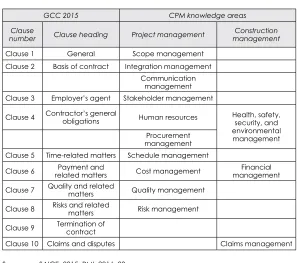
GCC 2015 CPM knowledge areas
Clause
number Clause heading Project management managementConstruction
Clause 1 General Scope management Clause 2 Basis of contract Integration management
Communication management Clause 3 Employer’s agent Stakeholder management
Clause 4 Contractor’s general obligations Human resources Health, safety, security, and environmental management Procurement
management Clause 5 Time-related matters Schedule management
Clause 6 related mattersPayment and Cost management managementFinancial
Clause 7 Quality and related matters Quality management
Clause 8 Risks and related matters Risk management
Clause 9 Termination of contract
Clause 10 Claims and disputes Claims management
Source: SAICE, 2015; PMI, 2016: 20
6.
Comparison to CPM knowledge areas
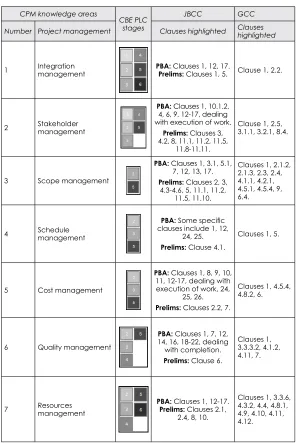
As mentioned earlier, it is concluded that the GCC 2015 is more closely aligned to the CPM areas, while the JBCC PBA has a more sequential (or a PLC) layout. It is further concluded that the JBCC PBA gives more authority to the bills of quantities, especially regarding the preliminaries and the corresponding Bill No. 1, in contrast to the GCC 2015, which emphasises the conditions of contract.
[image:16.421.69.366.69.332.2]Table 3: CPM knowledge area comparison to contract clauses
CPM knowledge areas
CBE PLC stages
JBCC GCC
Number Project management Clauses highlighted Clauses highlighted
1 Integration management PBA:Prelims: Clauses 1, 12, 17. Clauses 1, 5. Clause 1, 2.2.
2 Stakeholder management
PBA: Clauses 1, 10.1.2,
4, 6, 9, 12-17, dealing with execution of work.
Prelims: Clauses 3,
4.2, 8, 11.1, 11.2, 11.5, 11.8-11.11.
Clause 1, 2.5, 3.1.1, 3.2.1, 8.4.
3 Scope management
PBA: Clauses 1, 3.1, 5.1, 7, 12, 13, 17.
Prelims: Clauses 2, 3,
4.3-4.6, 5, 11.1, 11.2, 11.5, 11.10.
Clauses 1, 2.1.2, 2.1.3, 2.3, 2.4, 4.1.1, 4.2.1, 4.5.1, 4.5.4, 9, 6.4.
4 Schedule management
PBA: Some specific clauses include 1, 12,
24, 25.
Prelims: Clause 4.1.
Clauses 1, 5.
5 Cost management
PBA: Clauses 1, 8, 9, 10,
11, 12-17, dealing with execution of work, 24,
25, 26.
Prelims: Clauses 2.2, 7.
Clauses 1, 4.5.4, 4.8.2, 6.
6 Quality management
PBA: Clauses 1, 7, 12,
14, 16, 18-22, dealing with completion.
Prelims: Clause 6.
Clauses 1, 3.3.3.2, 4.1.2, 4.11, 7.
7 Resources management PBA:Prelims: Clauses 1, 12-17. Clauses 2.1, 2.4, 8, 10.
[image:17.421.56.353.70.513.2]CPM knowledge areas
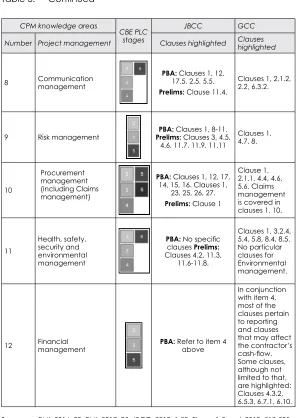
CBE PLC stages
JBCC GCC
Number Project management Clauses highlighted Clauses highlighted
8 Communication management PBA:17.5, 2.5, 5.5. Clauses 1, 12,
Prelims: Clause 11.4.
Clauses 1, 2.1.2, 2.2, 6.3.2.
9 Risk management Prelims:PBA: Clauses 1, 8-11. Clauses 3, 4.5, 4.6, 11.7, 11.9, 11.11
Clauses 1, 4.7, 8.
10
Procurement management (including Claims management)
PBA: Clauses 1, 12, 17, 14, 15, 16. Clauses 1,
23, 25, 26, 27.
Prelims: Clause 1
Clause 1, 2.1.1, 4.4, 4.6, 5.6. Claims management is covered in clauses 1, 10.
11
Health, safety, security and environmental management
PBA: No specific clauses Prelims:
Clauses 4.2, 11.3, 11.6-11.8.
Clauses 1, 3.2.4, 5.4, 5.8, 8.4, 8.5. No particular clauses for Environmental management.
12 Financial management PBA: Refer to item 4 above
In conjunction with item 4, most of the clauses pertain to reporting and clauses that may affect the contractor’s cash-flow. Some clauses, although not limited to that, are highlighted: Clauses 4.3.2, 6.5.3, 6.7.1, 6.10.
Sources: PMI, 2016: 20; PMI, 2017: 25; JBCC, 2018: 1-30; Finsen & Segal, 2018: 512-525; SAICE, 2015: 1-116
[image:18.421.70.366.62.480.2]With the amount of data contained within each clause highlighted above, the reader may find value in referring to the forms of contract for more information. The main outcomes from the above table are highlighted below.
6.1 Integration management
JBCC PBA: Throughout the contract, such obligations are given to the principal agent who shall, on behalf of the employer and other agents, ensure that the contractor is provided with the required information timeously. The preliminaries also equip the principal agent through clauses 1 and 5 to arrange progress meetings and technical meetings, whereby a large portion of the stakeholder management functions can be managed (Finsen & Segal, 2018: 2, 4).
GCC 2015: Throughout the contract, integration management promoting clauses are found. General items are defined as items stipulated in the pricing data relating to general obligations, site services, facilities, and/or items that cover elements of the cost of work, which are not considered as proportional to the cost of the permanent works (SAICE, 2015: 3). Interestingly, the default governing law is specified as the South African law, except if otherwise specified (SAICE, 2015: 7).
6.2 Stakeholder management
JBCC PBA: No specific clause deals explicitly with stakeholder management. However, it is dealt with throughout the JBCC PBA with some specific clauses in the preliminaries.
GCC 2015: In the contract, certain definitions can be attributed to certain stakeholders in the contract. Arrangements between the contracting parties are given at the beginning of the document. The extent of their authorisation shall be by means of a written notice specifying limits and identifying the person or office holder (Clause 1.2.3) (SAICE, 2015: 5).
6.3 Scope management
JBCC PBA: Although clause 12 stipulates specific obligations towards the parties, supplementary documentation such as specifications is needed to assist management processes (JBCC, 2018a: 10-11). The preliminaries also provide for additional items to be added in its Section C (Finsen & Segal, 2018: 512-513).
GCC 2015: The scope of works is defined as the document that specifies and describes the works that are to be provided, and any other requirements and constraints relating to the manner in which the work is to be carried out (SAICE, 2015: 2-5).
6.4 Schedule management
JBCC PBA: On the second page of the JBCC PBA, a guide to actions is listed against specific time periods and linked to the applicable clauses in the contract (JBCC, 2018a: 2). Obligations towards the schedule are also available in clause 12 (JBCC, 2018a: 10-11). The JBCC PBA does not, however, give specific guidelines on the schedule’s design like some of the other forms of contracts. The preliminaries are also parched on this subject, with most of the obligations set out in the JBCC PBA.
GCC 2015: The contract devotes an entire clause to time and related matters. The clause starts by mentioning how time calculations will be done, considering the starting date of such calculation and special non-working days (Clause 5.1). Clauses 5.2 to 5.4 are concerned with the commencement date, which is subject to the instruction by the EA, the submission of the required documentation by the contractor, and the necessary access to the site being given (SAICE, 2015: 21-23). The contract also stipulates the minimum requirements for such a programme and the reporting thereof (SAICE, 2015: 23-24).
6.5 Cost management
JBCC PBA: Many clauses throughout the document pertain to cost management, with clauses 24-26 being more specific towards payments, and so on. The preliminaries also have two clauses pertaining to cost management, although they are more inclined towards financial management (Finsen & Segal, 2018: 2, 5).
6.6 Quality management
JBCC PBA: Quality is interwoven in many of the clauses contained in the contract and goes hand in hand with scope management. The JBCC PBA mainly allows the bills of quantities together with the specifications, drawings, and other supplementary documentation to specify the required quality (Maritz & Siglé, 2016: 16). The preliminaries do, however, have a specific clause pertaining to quality (Finsen & Segal, 2018: 4-5).
GCC 2015: An entire clause is dedicated to quality, supplemented by the remainder of the document. All the quality specifications and inspections on the contracts amount to the final approval certificate issued by the EA stating the date on which the works were completed and all defects corrected in accordance with the contract. This is precluded by the defects liability period, which is defined as the period stated in the contract data, commencing from the issue of the certificate of completion, or certificates of completion in the event of more than one certificate having been issued for different parts of the works, during which the contractor has both the right and the obligation to make good defects in the materials, plant, and workmanship covered by the contract (SAICE, 2015: 2-3).
Please see sections 5.3.6 and 5.3.9, which directly relate to quality management.
6.7 Resources management
6.8 Communication management
JBCC PBA: Communication arrangements are summarised on page two of the JBCC PBA document (JBCC, 2018a: 2). Communication is further stipulated throughout the contract and only some of the applicable clauses have been highlighted in Table 1.
GCC 2015: Throughout the contract, communication is highlighted, with no specific clause dedicated to it. As with the JBCC PBA, specific definitions of communication are given (SAICE, 2015: 5-6). Clause 6.3.2, for instance, highlights the fact that any order for variations should be in writing (SAICE, 2015: 37). The methods and time related to notices and other communications are also given within the specific clauses.
6.9 Risk management
JBCC PBA: An entire section of the document is dedicated to insurances and securities, with other risks supplemented with other clauses throughout (JBCC, 2018a: 7-9).
GCC 2015: An entire clause is devoted to risk management, with other clauses acting as supplementary clauses. Minimum insurances and allowance are made for any additional insurances that may be required (SAICE, 2015: 60-67).
6.10 Procurement management (including claims management)
JBCC PBA: The most powerful procurement management tool available to the employer is the procurement and appointment of a competent contractor. Procedures are given, with an impartial agent appointed. Prevention of disputes is possible, but not explicitly put on paper. The execution sections mainly deal with procurement arrangements, after the contractor has been appointed. Clauses 14 to 16 deal with subcontractors and direct contractors and require the main contractor to forward proof if entered into a nominated or a selected subcontractor agreement (JBCC, 2018a: 13-15).
entire clause to claims and disputes in Clause 10. The contractor may claim for both extension of time and compensation (SAICE, 2015: 80). A large portion of procurement and prevention of claims is contained in the specifications and/or preambles. This mainly relates to the quality of the goods that must be procured and constructed. Well-written specifications (Maritz & Siglé, 2016: 29)
• are compatible with the form of contract; • state the clear-cut responsibility for design;
• have internal consistency, both technically and contractually; • have the capacity to support the preparation of a balanced
tender for the work to be performed, and
• state clear integration and co-ordination of structural elements with installation of services.
6.11 Health, safety, security and environmental management
JBCC PBA: The contract does not explicitly address health, safety, security, and environmental management. It does, however, address it through the preliminaries and allows specifications and additional requirements to be incorporated in the contract conditions (Finsen & Segal, 2018: 3-7).
GCC 2015: Some reference is made to particular H&S matters, but supplementary documentation is needed. No specific clauses for H&S are mentioned and legislation applies. The same applies to environmental issues and a very similar stance as per the JBCC PBA is taken. The possession of site is set out in Clause 5.4 with the access to site specified in the contract data (SAICE, 2015: 22).
6.12 Financial management
JBCC PBA: The principal agent has limited control over the contractor’s financial management. Clause 12, however, does allow the principal agent to scrutinise the projected cash-flow against the actual cash-flow and to request mitigation plans if required. Other items that may assist the contractor are shorter valuation intervals, payment for materials on and off site as per Clauses 25.4 and 25.5, and shorter payment periods.
payment certificates, but it can be specified in the contract data (SAICE, 2015: 36-51).
7.
Conclusion
The objective of this article was to review the conduciveness to which the South African suites of contracts facilitate CPM practices. The hypothesis states that the standard South African forms of contract for building work promote control through construction project management processes.
Considering the PMO main focus areas, the conduciveness of the contract is evaluated based on the above evidence (PMI, 2016: 6):
• Good historical data towards costs: Both contracts relay the accuracy of the Bills of Quantities and the processes outside the contract conditions. They do, however, allow the employer’s agents to enforce the measure, as stipulated in the contract data. A large portion of the success of this area relates to planning beforehand.
• Good health and safety, security and environmental practices: The contract does allow for enforcement of the area, as highlighted in section 5.3.11. The success of this area depends on adequate planning.
• Quality control: As noted earlier, quality is clearly emphasised in the conditions of the contracts, albeit emphasised differently between the JBCC PBA and the GCC 2015. Proper planning is needed to understand the relationship between the contract conditions, the specifications, and the Bills of Quantities. • Contract administration: The basic contract administration is
very clearly stipulated in the contract conditions and can be supplemented in the allowables of the contracts. This includes items such as minutes, and progress and cash-flow reports, which are stipulated in the contract conditions.
• Subcontractor supplier management: Both contracts allow for subcontracting and a certain amount of control is given to the employer. The JBCC PBA has specific guidelines for the nominated and selected subcontractors, with prescribed forms of contracts, although it is relatively silent on direct contractors. The GCC 2015, on the other hand, requires the employer to approve all subcontractors.
on the obligations of the parties and give specific guidelines for reaction to instruction and notices. Although claims avoidance is key, both contracts have specific and clear procedures if and when claims occur.
The JBCC PBA may seem to be the shortest form of contract, if only the contract conditions are considered. However, it addresses most of the management knowledge areas and allows the incorporation of supporting documentation. An experienced principal agent (project manager) will be able to use the contract effectively in the management of the construction project. When compared to the other contracts, it appears to correspond to the least specific project management requirements. For instance, it has less specific requirements in terms of the programme than the GCC 2015 and allows the preliminaries to fill the gaps with regard to legislation, while allowing the contract to be kept standard.
It is noticeable that the GCC 2015 is written for South Africa, when it refers to the Health and Safety Act and the fact that South African law will be deemed to be the governing law if no other is specified. It addresses most of the management knowledge areas comprehensively. For instance, the GCC 2015 makes provision for the EA to instruct the contractor to remove any incompetent person from the works (SAICE, 2015: 20). The GCC 2015 is also specific about the programme and gives the employer’s agent the authority to accept or reject the programme.
From the above analysis, it may be concluded that both contracts give the employer’s agent ample power to manage the project to its intended purpose. The hypothesis is subsequently proven. Through the review, it has, however, become apparent that the contracts may allow certain project management functions to be implemented, by placing different emphases on different aspects of the contract. A very strong project management function must still take place during the PLC. The construction project manager must have an in-depth knowledge of the forms of contract to enable him/ her to implement his/her style of management.
References
AECOM, 2018. African property and construction cost guide. 29th edition. [Online]. Available at: <https://www.aecom.com/
za/wp-content/uploads/2018/07> [Accessed: 25 May 2019]. ISBN number: 978-0-620-79321-6.
Adriaanse, J. 2016. Construction contract law. 4th edition. London:
Palgrave. https://doi.org/10.1057/978-1-137-00959-3
Bernstein, P. 2015. TEDx Talks. The future of making buildings. [Online]. Available at: <https://www.youtube.com/watch?v=Kg0gbG1DAkk> [Accessed: 17 January 2019].
Claassen, W. 2010. GCC 2010: The SAICE documents for the future.
Civil Engineering, 18(6), pp. 15-18.
Burke, R. 2007. Introduction to project management, one small step
for the project manager. Ringwood, CA: Burke Publishing.
Burke, R. 2010. Fundamentals of project management. Ringwood, CA: Burke Publishing.
CIDB (Construction Industry Development Board). 2015. Standard
for uniformity in construction procurement. South Africa. Pretoria.
July. [Online]. Available at: <http://www.cidb.org.za/publications/ Documents> [Accessed: 2 December 2018].
Cooke, B. & Williams, P. 2009. Construction planning programming and control. 3rd edition. Oxford: Wiley-Blackwell.
CBE (Council for the Built Environment). 2011. Board notice no.
4, May 2011. South Africa. [Online]. Available at: <http://www.cbe.org.
za/content/images/ SACPCMP_Notice.pdf> [Accessed: 18 April 2017]. Dalal, A. 2012. The 12 pillars of project excellence: A lean approach to improving project results. Boca Raton, CA: CRC Press. https://doi. org/10.1201/b11735
Dobre, E. 2007. Control of projects: A cybernetic control. Journal of
Applied Quantitative Methods, 2(2), pp. 327-333.
Du Plessis, H.B. & Oosthuizen, P. 2018. Construction project management through building contracts: A South African perspective. Acta Structilia, 25(1), pp. 152-181. DOI: https://doi. org/10.18820/24150487/as25i1.6.
Finsen, E. & Segal, S. 2018. Finsen’s the building contract. 3rd edition.
Claremont: Juta and Company.
Froise, T. 2014. Building information modelling as a catalyst for an
integrated construction project delivery culture in South Africa.
Ph.D. thesis. Nelson Mandela Metropolitan University Port Elizabeth, South Africa.
Jaafar, M. & Aziz, A. 2013 New management approaches in construction. Pulau Pinang: Penerbit.
JBCC (Joint Building Contracts Committee). 2018a. The JBCC Principal Building Agreement, Edition 6.2. Johannesburg: JBCC, May. JBCC (Joint Building Contracts Committee). 2018b. The JBCC Principal Building Agreement, Edition 6.2 - Contract data. Johannesburg: JBCC, May.
Kerzner, H. 2013. Project management: A systems approach to
planning, scheduling, and controlling. 11th edition. Hoboken, NJ:
John Wiley & Sons Inc.
Knipe, A., Van Der Waldt, G., Van Niekerk, D., Burger, D. & Nell, K. 2002. Project management for success. Sandown: Heinemann. Maritz, M.J. & Siglé H.M. 2016. Quantity surveying in South Africa. Pretoria: Construction Economics Associates (Pty) Ltd.
Moustafaev, J. 2015. Project scope management. Boca Raton, CA: CRC Press. https://doi.org/10.1201/b17797
Msengana, L. 2012. The missing link in projects. Randburg: Knowres Pub. Nagata, M.F., Manginelli, W.A., Lowe, S. & Trauner, T.J. 2018.
Construction delays. 3rd edition. Cambridge, MA:
Butterworth-Heinemann. https://doi.org/10.1016/B978-0-12-811244-1.00004-5 Nicholas, J. & Steyn, H. 2012. Project management for engineering,
business, and technology. 4th edition. Abingdon, Oxon: Routledge.
PMI (Project Management Institute). 2016. Construction extension
to the project management body of knowledge guide. Newton
Square, PA: Project Management Institute.
PMI (Project Management Institute). 2017. A guide to the project
management body of knowledge (PMBOK guide). 6th edition.
Rouse, M. 2005. How will AI impact IT infrastructure? [Online]. Available at: <https://searchcio.techtarget.com/definition/systems-thinking> [Accessed: 31 January 2019].
SAICE (South African Institution of Civil Engineering). 2010. General
conditions of contract for construction works. Midrand: SAICE (Print
3.1).
SAICE (South African Institution of Civil Engineering). 2015. General
conditions of contract for construction works. Midrand: SAICE.
Steyn, H., Curruthers, M., Dekker, A., Du Plessis, Y., Kruger, D., Kuschke, B., Sparrius, A., Van Eck, S. & Visser, K. 2016. Project management: A
multi-disciplinary approach. 4th edition. Pretoria: FPM Publishing.
Van der Waldt, G. & Fox, W. 2015. A guide to project management. 2nd edition. Cape Town: Juta.
Verster, J.J.P. 2006. Managing cost, contracts, communication and claims: A quantity surveying perspective on future opportunities. In: Semolic, B., Kerin, A. & Stare, A. (Eds.). Proceedings of the 1st ICEC & IPMA Global Congress on Project Management, 5th World Congress
on Cost Engineering, Project Management and Quantity Surveying,
Ljubljana, 23-26 April 2006. Slovenia: ZMP.