Proceedings of the 2019 Conference on Empirical Methods in Natural Language Processing
2642
DIVINE: A Generative Adversarial Imitation Learning Framework for
Knowledge Graph Reasoning
Ruiping Li and Xiang Cheng∗
State Key Laboratory of Networking and Switching Technology Beijing University of Posts and Telecommunications, Beijing 100876, China
{liruiping,chengxiang}@bupt.edu.cn
Abstract
Knowledge graphs (KGs) often suffer from sparseness and incompleteness. Knowledge graph reasoning provides a feasible way to ad-dress such problems. Recent studies on knowl-edge graph reasoning have shown that rein-forcement learning (RL) based methods can provide state-of-the-art performance. Howev-er, existing RL-based methods require numer-ous trials for path-finding and rely heavily on meticulous reward engineering to fit specific dataset, which is inefficient and laborious to apply to fast-evolving KGs. In this paper, we present DIVINE, a novel plug-and-play frame-work based on generative adversarial imita-tion learning for enhancing existing RL-based methods. DIVINE guides the path-finding process, and learns reasoning policies and re-ward functions self-adaptively through imitat-ing the demonstrations automatically sampled from KGs. Experimental results on two bench-mark datasets show that our framework im-proves the performance of existing RL-based methods without extra reward engineering.
1 Introduction
Knowledge graphs (Suchanek et al., 2007; Auer et al.,2007;Bollacker et al.,2008;Carlson et al., 2010; Vrandeˇci´c and Kr¨otzsch, 2014), typically composed of massive relational triples, are useful resources for many downstream natural language processing applications such as information ex-traction and question answering. Although exist-ing KGs have an extraordinarily large scale, they are still highly incomplete (Min et al.,2013), lead-ing extensive research efforts on automated infer-ence of missing information from observed evi-dence. In this paper, we focus on the problem of multi-hop reasoning in KGs, which learns explicit inference formulas from existing triples to com-plete missing ones.
∗Corresponding author
To tackle multi-hop reasoning, various path-based methods (Lao et al., 2011; Gardner et al., 2013,2014;Guu et al., 2015;Neelakantan et al., 2015; Toutanova et al., 2016; Das et al., 2017) have been proposed, which leverage the elaborate-ly selected relational paths in KGs as the reason-ing evidence. However, such evidential paths are obtained by random walks, which inevitably intro-duces inferior or even noisy paths. To address this problem, the RL-based methods, such as Deep-Path (Xiong et al., 2017) and MINERVA (Das et al., 2018), strive for more reliable evidential paths by policy-conditioned walking and achieve state-of-the-art performance. They formulate the path-finding problem as a Markov decision pro-cess where their policy-based agents continuously choose the most promising relation for state transi-tion based on the current state and reasoning pol-icy. Once a relational path found, the reasoning policy is updated by a reward function according to the path quality. Finally, through such a trial-and-error process, the well-trained policy-based a-gent can be used to find evidential paths for pre-dictions.
Therefore, for different datasets, the reward func-tions in the RL-based methods need manual ad-justments to achieve a good performance, which will not only be inefficient and laborious but also difficult to adapt to the rapid evolutions of real-world KGs (Shi and Weninger,2018).
In this paper, we present a novel plug-and-play framework based on generative adversarial imita-tion learning (GAIL) (Ho and Ermon, 2016) for enhancing existing RL-based methods, which is referred to as DIVINE for “Deep Inference via Imitating Non-human Experts”. DIVINE trains a reasoner, consisting of a generator and a discrim-inator, from demonstrations by employing gener-ative adversarial training, where the generator can be any of the policy-based agents in existing RL-based methods and the discriminator can be con-sidered as a self-adaptive reward function. In this way, for different datasets, the reward function-s can be automatically tuned to approximate the optimal performance, eliminating extra reward en-gineering and manual interventions. In particular, to enable the policy-based agent to find more di-verse evidential paths for predictions, we propose a path-based GAIL method, which can learn the reasoning policy by imitating the path-level se-mantic features of the demonstrations. In addi-tion, to acquire demonstrations without extra man-ual labor, we design an automated sampler for our framework to dynamically sample relational paths from KGs as the demonstrations according to the specific environment of each entity.
In summary, our contributions are threefold:
• We present a plug-and-play framework based on GAIL to enhance existing RL-based rea-soning in KGs by learning rearea-soning poli-cies and reward functions through imitating demonstrations. To the best of our knowl-edge, we are the first to introduce GAIL into the field of knowledge graph reasoning.
• We propose a path-based GAIL method to encourage the diversity of evidential path-s and depath-sign an automated path-sampler for our framework to sample demonstrations without extra manual labor.
• We conduct extensive experiments on two benchmark datasets. The experimental re-sults illustrate that our framework improves the performance of the current state-of-the-art RL-based methods while eliminating ex-tra reward engineering.
2 Related Work
Automated reasoning on KGs has been a long-standing task for natural language processing. In recent years, various embedding-based method-s umethod-sing tenmethod-sor factorization (Nickel et al., 2011; Bordes et al.,2013;Riedel et al.,2013;Yang et al., 2014; Trouillon et al., 2017) or neural network models (Socher et al.,2013) have been develope-d, where they learn a projection which maps the triples into a continuous vector space for further tensor operations. Despite the impressive results they achieved, most of them lack the ability to cap-ture chains of multi-hop reasoning patterns con-tained in paths.
To address the limitation of the embedding-based methods, a series of path-embedding-based method-s have been propomethod-sed, which conmethod-sider the method- select-ed relational paths as reasoning evidence. Lao et al.(2011) propose the Path-Ranking Algorithm (PRA) which uses random walks for path-finding. Gardner et al.(2013,2014) propose a variation on PRA which computes feature similarity in the vec-tor space. To combine the embedding-based meth-ods, several neural multi-hop models ( Neelakan-tan et al.,2015;Guu et al.,2015;Toutanova et al., 2015,2016;Das et al.,2017) are proposed which perform a hybrid reasoning. Nevertheless, the ev-idential paths they used are gathered by random walks, which might be inferior and noisy.
3 Preliminaries
3.1 Knowledge Graph Reasoning
Given an incomplete knowledge graph G = {(h, r, t)|h∈ E, t∈ E, r∈ R}, where E and R denote the entity set and relation set, respective-ly. There are two main tasks in knowledge graph reasoning, namely link prediction and fact predic-tion. Link prediction involves inferring the tail entity t given the head entity h and the query relation rq, while fact prediction seeks to pre-dict whether an unknown fact (h, rq, t) holds or not. Recently, RL-based reasoning has become a popular approach for knowledge graph reason-ing, which achieves state-of-the-art performance. In general, RL-based reasoning methods strive to find relational paths to tune their reasoning poli-cies for predictions and formulate the path-finding problem as a Markov decision process (MDP). In such a process, the policy-based agent decides to take an action a ∈ A from the current state (i.e., the current entity and its context information)
s∈ Sto reach the next one according to its reason-ing policyπ, where the action space is defined as all the relations inG. In particular, each relational chain in the relational paths can be considered as a reasoning chain.
3.2 Imitation Learning
Imitation learning focuses on learning policies from demonstrations, which has achieved great success in solving reward engineering. The classi-cal approach is to find the optimal reward function by inverse reinforcement learning (IRL) ( Russel-l,1998;Ng et al.,2000) to explain expert behav-iors. However, IRL requires solving RL inside a learning loop, which can be expensive to run in large environments. Therefore, generative adver-sarial imitation learning (GAIL) (Ho and Ermon, 2016) has recently been proposed, which learns the expert policy with generative adversarial net-work (GAN) (Goodfellow et al., 2014), eliminat-ing any intermediate IRL steps.
In GAIL, a generator Gθ is trained to gener-ate trajectories matching the distribution of ex-pert trajectories (i.e., demonstrations). Each tra-jectoryτ is represented as a state-action sequence
[(st, at)]∞t=0(st ∈ S, at ∈ A). In addition, a dis-criminator Dω is learned to distinguish between the generated policyπθ and expert policyπE. For each training epoch, the discriminator is updated
first with the gradient as:
Eτ[∇ωlog(D(s,a))]+EτE[∇ωlog(1−D(s,a))], (1)
whereτEdenotes the expert trajectories generated byπEand the trajectory expectation can be calcu-lated in theγ-discounted infinite horizon as:
Eτ[D(s, a)] =
∞ ∑
t=0
E[γtD(st, at)], (2)
where the discriminator here can be interpreted as a local reward function to provide feedback for the policy learning process. Then, the generator is up-dated with the cost functionlog(D(s, a))using the trust region policy optimization (TRPO) ( Schul-man et al., 2015). After sufficient adversarial training, the optimal policy ˆπ can be found by GAIL to rationalize the expert policyπE.
4 Methodology
4.1 Framework Overview
As shown in Figure 1, our framework DIVINE consists of two modules, namely a generative ad-versarial reasoner and a demonstration sampler. In particular, the reasoner is composed of a genera-tor and a discriminagenera-tor. The generagenera-tor can be any of the policy-based agents in existing RL-based methods and the discriminator can be interpreted as a self-adaptive reward function. For each query relation, the sampler and the generator are adopted respectively to automatically extract demonstra-tions and generate relational paths from the giv-en KG. The discriminator is thgiv-en used to evalu-ate the semantic similarity between the generevalu-ated paths and demonstrations to update the generator.
After sufficient adversarial training between the generator and the discriminator alternatively, the well-trained policy-based agent (i.e., generator) can be used to find evidential paths matching the distribution of the demonstrations and make pre-dictions by synthesizing these evidential paths.
4.2 Generative Adversarial Reasoner
*HQHUDWRU ([LVWLQJ$JHQW
'LVFULPLQDWRU ݔොݔොଵଶ ݔොே
GHPRQVWUDWLRQV JHQHUDWHGSDWKV
ݔே
ݔଵ
ݔଶ
5HDVRQHU
.QRZOHGJH*UDSK
UHZDUG
7RSRORJ\ )LOWHULQJ
6HPDQWLF 0DWFKLQJ VWDWH
DFWLRQ
6DPSOHU
Figure 1: Overview of our framework DIVINE, where the generator can be any of the existing policy-based agent for knowledge graph reasoning and the discriminator can be considered as a self-adaptive reward function.
poor performance. The main reason lies in that the agent will tend to choose the same actions as in the expert trajectories under certain states, while ignoring many valuable evidential paths which are semantically similar to the expert trajectories but contain different reasoning chains.
Therefore, to encourage the agent to find more diverse evidential paths, it is desirable to train the agent by imitating each trajectory instead of each of its state-action pairs. In addition, in the scenari-o scenari-of knscenari-owledge graph reasscenari-oning, since the reasscenari-on- reason-ing chains consist of only relations, the demon-strations do not necessarily contain the state infor-mation. In other words, the demonstrations can be composed of only relational paths.
Based on the above analysis, we propose a path-based GAIL method, where the reasoning policy is learned by imitating the path-level semantic fea-tures of the demonstrations which are composed of only relational paths.
In what follows, we first describe the two com-ponents of the reasoner, i.e., the generator and the discriminator. Then, we show how to extract the path-level semantic features.
Generator
The generator can be any of the policy-based agent in existing RL-based methods. We strive to enable the generator to find more diverse evidential paths matching the distribution of the demonstrations in the semantic space.
Discriminator
To better semantically distinguish between gener-ated paths and demonstrations, we choose the con-volutional neural networks (CNNs) to construct
our discriminator D, as CNNs have shown high performance in semantic feature extraction from natural languages (Kim,2014).
Semantic Feature Extraction
For each positive entity pair, we respectively pack the current generated paths and corresponding demonstrations in the same package form. For each packageP ={x1, x2, ..., xN}containingN relational paths, we encode the package to a real-valued matrix as:
p=x1⊕x2⊕...⊕xN, (3)
wherexn∈Rkis thek-dimensional path embed-ding and⊕denotes the concatenation operator for the package representationp ∈ RN×k. In partic-ular, given a relational pathx={r1, r2, ...rt, ...}, the path embeddingxis encoded as:
x=∑
rt∈x
rt, (4)
where each relationrtis mapped into a real-valued embeddingrt ∈ Rkpre-trained by TransE ( Bor-des et al.,2013).
After packing, we feed the package representa-tionpinto our discriminatorDto parameterize its semantic features D(p). Specifically, a convolu-tional layer activated by ReLU nonlinearity is first used to extract local features by sliding a kernel
ω∈Rh×lfor a new feature map:
c=ReLU(Conv(p,ω) +bc), (5)
where bc denotes the bias term. Then, a fully-connected hidden layer and an output layer are used for further semantic feature extraction:
where the corresponding biases are not shown above for brevity and the output layer is normal-ized by a sigmoid function while other layers are activated by ReLU nonlinearity.
4.3 Demonstration Sampler
For imitation learning, the first prerequisite is to have high-quality demonstrations. However, due to the large scale and complexity of KGs, man-ually constructing a large number of reasoning demonstrations requires considerable time and ex-pert efforts. Therefore, we design an automat-ed sampler to sample reliable reasoning demon-strations from KGs without supervision and extra manual labor.
Static Demo Sampling
For each query relation, we use all positive enti-ty pairs to sample demonstration candidates from the given KG. Specifically, for each positive entity pair, we use bi-directional breadth-first search to explore the shortest path between two entities. In particular, since the shorter paths incline to char-acterize more direct correlations between two enti-ties, we prefer to use them for initialization to en-sure the quality of demonstration candidates. As for the longer paths, despite their potential utility values, they are more likely to contain worthless or even noisy inference steps, thus we learn them only in the training phase. In doing so, we can get a demonstration setΩE which contains all the candidates we sampled. Finally, to accommodate the fixed input dimension of the discriminatorD, we can simply select a subset Pe ⊆ ΩE with the topNoccurrence frequency, whereN is normally much smaller than|ΩE|.
Dynamic Demo Sampling
Despite the simplicity of the static demo sam-pling method, the obtained demonstrations by this method are fixed and ignore the specific environ-ment of each entity in the given KG. Therefore, we propose an improving method to dynamically sample demonstrations by taking the topological correlations of entities into consideration.
Given a positive entity pair⟨ehead, etail⟩, we in-troduce a relational setRhwhich contains all rela-tions directly connected toehead. For each reason-ing attempt, Rh can be considered as the region of interest (ROI) of the agent to start reasoning, where the ROI related paths tend to be more rele-vant to the current entity pair. Thus, we refine the
demonstration set by filtering out the demonstra-tions which begin fromRh:
Ω′E={x|r1(x)∈ Rh, x∈ΩE} (Rh̸=∅), (7)
where ΩE is generated by the static demo sam-pling method andr1(x) denotes the first relation in relational pathx={r1, r2, ...rt, ...}.
In most cases, we can obtain enough demonstra-tions inΩ′Eto select a subsetPe⊆Ω′Ein the same way as the static demo sampling method. How-ever, due to the sparsity of data in KG, we may get insufficient demonstrations on long-tail enti-ties. To solve this problem, we perform semantic matching to explore more demonstrations from the remaining candidatesCE = ΩE \Ω′E. Since the reasoning policy is updated based on the seman-tic similarities between the generated paths and demonstrations, candidates which are semantical-ly similar to the current demonstrations are also instructive for the imitation process.
Inspired by the neighborhood attention for one-shot imitation learning (Duan et al.,2017), we use each demonstration in Ω′E to query other candi-dates in correlation to itself. We adopt the dot product to measure the semantic matching simi-larity between two path embeddings:
αi= ∑
xj∈Ω′E ¯
xi·xj i= 1,2, ...,|CE|, (8)
where αi represents the sum of matching scores between the current candidate x¯i and existing demonstrations in Ω′E. Finally, we iteratively s-elect the candidate with the highest α to pad the refined demonstration setΩ′E until accommodat-ing the required input dimensionN.
4.4 Training
For each package pair⟨Pg,Pe⟩, we train the dis-criminatorDby minimizing its loss and expect it to be expert in distinguishing betweenPeandPg. In addition, to make the adversarial training pro-cess more stable and effective, we adopt the loss function proposed in WGAN-GP (Gulrajani et al., 2017) to update the discriminator:
LC =E[D(pg)]−E[D(pe)];
LP =λE[(∥ ∇p˜D( ˜p)∥2 −1)2];
LD =LC+LP,
(9)
whereLC ,LP andLDrespectively denote the o-riginal critic loss, gradient penalty and the loss of discriminator,λis the gradient penalty coefficien-t and p˜is sampled uniformly along straight lines betweenpgandpe. According to the feedback of the discriminator, we calculate the rewardRGas:
RG =δgmax{E[D(pg)]−E[D(pn)],0}, (10)
δg = {
1, Pg ⊆Ω+G
0, otherwise , (11)
where pn denotes a noise embedding composed of random noise with continuous uniform distri-bution,δg is a characteristic function which char-acterizes the validity of package Pg, Ω+G is the collection of all valid generated paths. We only give positive rewards for partial valid paths that at least have higher expectations than noise em-beddingpn, which filters out the paths of inferi-or quality to improve the convergence efficiency of the training process. Once the reward obtained, we updated the generatorGby maximizing the ex-pected cumulative reward with Monte-Carlo Poli-cy Gradient (i.e., REINFORCE) (Williams,1992). We use mini-batch stochastic gradient descent (SGD) to optimize the loss function of discrimina-tor, while the generator is updated with the Adam algorithm (Kingma and Ba,2014).
5 Experiments
5.1 Datasets and Evaluation Metrics
Dataset # Ent. # Rel. # Facts # Tasks NELL-995 75,492 200 154,213 12 FB15K-237 14,505 237 310,116 20
Table 1: Statistics of the datasets. # Ent. denotes the number of unique entities and # Rel. denotes the num-ber of relations.
The experiments are conducted on two bench-mark datasets: NELL-995 (Xiong et al.,2017) and FB15K-237 (Toutanova et al.,2015). The details of the two datasets are described in Table1. In par-ticular, NELL-995, which is known to be a simple dataset for reasoning tasks, is generated from the 995th iteration of the NELL system (Carlson et al., 2010) by selecting the triples with Top-200 fre-quently occurring relations. Compared to NELL-995, FB15K-237 is more challenging and closer to real-world scenarios, where its facts are creat-ed from FB15K (Bordes et al.,2013) with redun-dant relations removed. For each triple (h, r, t), both datasets contain the inverse triple(h, r−1, t)
such that the agent can step backward in KGs, which makes it possible to recover from a poten-tially wrong decision that has been taken before. For each reasoning task with a query relationrq, all the triples withrqorrq−1are removed from the KG and split into train and test samples.
Similar to recent works (Das et al., 2018; X-iong et al.,2017), we use mean average precision (MAP), mean reciprocal rank (MRR) and Hits@k to evaluate the reasoning performance, where Hit-s@k is the fraction of positive instances ranked in the topkpositions.
5.2 Baselines and Implementation Details
In our experiments, we consider two state-of-the-art RL-based methods as baselines: DeepPath ( X-iong et al., 2017) and MINERVA (Das et al., 2018). Deep path feeds the gathered evidential paths to PRA (Lao et al.,2011) for both link pre-diction and fact prepre-diction tasks, while MINERVA directly applies the well-trained agent to the link prediction task for question answering. For Deep-Path, we use the code released by Xiong et al. (2017). For MINERVA, we use the code released by Das et al.(2018). The experiment settings for the baselines are set according to the suggestions in the original papers.
In the implementation of our framework, we set the path numberN to 5 for each path packageP, while the path dimensionkis set to 200 which is the same as the relation dimension in baselines. For the discriminator, we set the convolution ker-nel size to3×5, the hidden layer size to 1024, and the output layer size to the path dimensionk, while the gradient penalty coefficientλis set to 5 and L2 regularization is also used to avoid over-fitting.
Link Prediction Fact Prediction
Data Metric DeepPath Div(DeepPath) MINERVA Div(MINERVA) DeepPath Div(DeepPath)
NELL-995
Hits@1 0.718 0.749 0.799/0.663† 0.840/0.668† 0.687 0.701 Hits@3 0.847 0.878 0.936/0.773† 0.936/0.778† 0.839 0.841 MRR 0.784 0.811 0.852/0.725† 0.874/0.731† 0.764 0.774 MAP 0.796 0.821 0.885 0.893 0.774/0.493‡ 0.785/0.494‡
FB15K-237
Hits@1 0.417 0.520 0.427/0.217† 0.444/0.223† 0.394 0.421 Hits@3 0.646 0.740 0.582/0.329† 0.590/0.331† 0.565 0.599 MRR 0.560 0.639 0.546/0.293† 0.556/0.296† 0.522 0.545 MAP 0.572 0.658 0.553 0.568 0.536/0.311‡ 0.558/0.339‡
Table 2: Overall results on NELL-995 and FB15K-237. “†” denotes the results with settings for question answering and “‡” denotes the results of directly ranking all the positive and negative triples given a query relation.
against the negative triples used in DeepPath and MINERVA. In particular, there are approximately 10 corresponding negative triples for each positive ones. Each negative triple is generated by replac-ing the answer entitytwith a faked onet′given a positive triple(h, r, t).
5.3 Results
The main results on the two datasets are shown in Table2. We use “Div(*)” to denote the RL-based method “*” which adopts our framework DIVINE. For a fair comparison, we follow MINERVA to re-port the Hits@k and MRR scores (denoted with “†”) to evaluate the link prediction performance for question answering, which ranks entities ac-cording to the probability that the agent can reach the entity along evidential paths. Moreover, we al-so follow DeepPath to report the MAP scores (de-noted with “‡”) on the fact prediction task, which directly ranks all the positive and negative triples for a given query relation.
From the results shown in Table2, we can ob-serve that our framework produces consistent im-provements for the two RL-based methods under varying degrees on both link prediction and fac-t predicfac-tion fac-tasks. On fac-the one hand, for exisfac-ting RL-based methods, their results on FB15K-237 are generally lower than those on NELL-995 s-ince FB15K-237 is more complex and arguably more difficult to design proper reward function-s manually. However, our framework relieffunction-s thifunction-s problem to some extent by dynamically learning superior reward functions, thus we make greater improvements on challenging FB15K-237. On the other hand, for different datasets, the improve-ments our framework makes for DeepPath vary a lot while MINERVA not. This is because MIN-ERVA manually adjusts its hyper-parameters ac-cordingly when calculating cumulative discounted
reward, while DeepPath keeps the same. Obvious-ly, it validates the necessity for existing RL-based methods to adjust their reward functions accord-ingly to fit different datasets. Enhanced by our framework, these RL-based methods no longer re-quire additional manual adjustments for different datasets, which reveals great robustness.
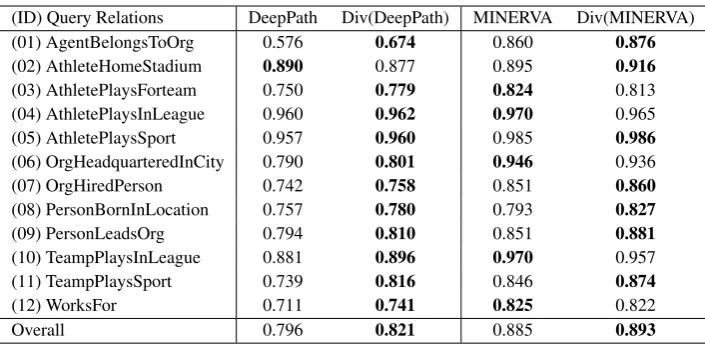
Similar to existing RL-based methods, we also report the decomposed results of link prediction and use MAP to evaluate the performance for each query relation on NELL-995 in Table3. From the results, we can observe that the results on differen-t reladifferen-tions are of high variance and differen-the enhanced RL-based methods achieve better or comparable performance for all query relations.
5.4 Effectiveness of the Path-Based GAIL Method
1 2 3 4 5 6 7 8 9 10 11 12 TXHU\UHODWLRQ,'
0 20 40 60
QXP
EH
URI
SD
WK
V 3DWK%DVHG*$,/
[image:7.595.309.519.454.581.2]2ULJLQDO*$,/
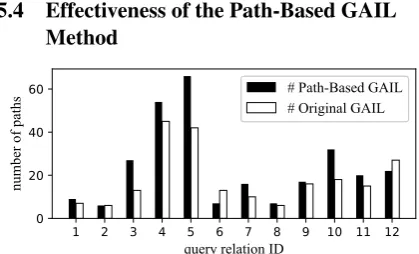
Figure 2: Statistics of path-finding on NELL-995.
MAP Path Avg. # Link # Fact # Path-Based GAIL 24 0.821 0.494 # Original GAIL 18 0.814 0.468
Table 4: Results of different imitation learning settings.
a-(ID) Query Relations DeepPath Div(DeepPath) MINERVA Div(MINERVA) (01) AgentBelongsToOrg 0.576 0.674 0.860 0.876
(02) AthleteHomeStadium 0.890 0.877 0.895 0.916
(03) AthletePlaysForteam 0.750 0.779 0.824 0.813 (04) AthletePlaysInLeague 0.960 0.962 0.970 0.965 (05) AthletePlaysSport 0.957 0.960 0.985 0.986
(06) OrgHeadquarteredInCity 0.790 0.801 0.946 0.936 (07) OrgHiredPerson 0.742 0.758 0.851 0.860
(08) PersonBornInLocation 0.757 0.780 0.793 0.827
(09) PersonLeadsOrg 0.794 0.810 0.851 0.881
(10) TeampPlaysInLeague 0.881 0.896 0.970 0.957 (11) TeampPlaysSport 0.739 0.816 0.846 0.874
(12) WorksFor 0.711 0.741 0.825 0.822
Overall 0.796 0.821 0.885 0.893
Table 3: Results of link prediction decomposed over different query relations on NELL-995.
gent by the original GAIL method, the demonstra-tions are composed of state-action trajectories. For each state-action pair(st, at), the state representa-tion st is calculated by(et,etail −et), where et andetaildenote the embeddings of the current en-tity and the tail enen-tity, respectively. In Figure2, we show the statistics of the evidential path setPnew which are found by the agent and different from the demonstrations. In Table 4, we compare the average path number of Pnew and the reasoning performance on the two prediction tasks.
As shown in Figure 2and Table4, we can ob-serve that our path-based GAIL method obtains more evidential paths for most query relations and achieves better performance on both link and fac-t predicfac-tions, which validafac-tes fac-the effecfac-tiveness of our path-based GAIL method and the rationality of encouraging the agent to find more diverse evi-dential paths.
5.5 Ablation Studies
We conduct ablation studies by embedding Deep-Path into our framework to quantify the role of components. Specifically, we re-train our frame-work by ablating certain components:
• W/O Semantic Matching, where no seman-tic matching is performed on long-tail enti-ties. Instead, we directly extract some paths from the remaining demonstration candidates
CE according to their occurrence frequency.
• W/O Dynamic Sampling, where no dynamic demo sampling is performed to incorporate the local environment of entities. In other words, we only adopt the static demo sam-pling method to obtain demonstrations.
• W/O Demo Sampling, where no demonstra-tion is used for imitademonstra-tion learning, which de-generates to DeepPath.
MAP
Configuration NELL-995 FB15K-237
Div(DeepPath) 0.821 0.658
W/O Semantic Matching 0.818 0.651
W/O Dynamic Sampling 0.806 0.640
[image:8.595.122.475.60.232.2]W/O Demo Sampling 0.796 0.572
Table 5: Ablation on different components.
We use MAP to evaluate the link prediction performance on both NELL-995 and FB15K-237 in Table 5. From the results, we can observe that: (1) Based on imitation learning, our frame-work can effectively improve the reasoning per-formance, even if we use the static demo sampling method to obtain demonstrations; (2) High-quality demonstrations are crucial for imitation learning, which indicates both topology filtering and seman-tic matching play important roles in the demon-stration sampler of our framework.
6 Conclusion
Acknowledgments
This work was supported by National Natural Sci-ence Foundation of China under Grant 61872045. We acknowledge anonymous reviewers for their valuable comments.
References
S¨oren Auer, Christian Bizer, Georgi Kobilarov, Jen-s Lehmann, Richard Cyganiak, and Zachary IveJen-s. 2007. Dbpedia: A nucleus for a web of open da-ta. InThe semantic web, pages 722–735. Springer.
Kurt Bollacker, Colin Evans, Praveen Paritosh, Tim S-turge, and Jamie Taylor. 2008. Freebase: a collab-oratively created graph database for structuring hu-man knowledge. In Proceedings of the 2008 ACM SIGMOD international conference on Management of data, pages 1247–1250.
Antoine Bordes, Nicolas Usunier, Alberto Garcia-Duran, Jason Weston, and Oksana Yakhnenko. 2013. Translating embeddings for modeling multi-relational data. InAdvances in Neural Information Processing Systems 26, pages 2787–2795.
Andrew Carlson, Justin Betteridge, Bryan Kisiel, Bur-r Settles, Estevam R HBur-ruschka JBur-r, and Tom M Mitchell. 2010. Toward an architecture for never-ending language learning. In Proceedings of the Twenty-Fourth AAAI Conference on Artificial Intel-ligence, pages 1306–1313.
Rajarshi Das, Shehzaad Dhuliawala, Manzil Zaheer, Luke Vilnis, Ishan Durugkar, Akshay Krishna-murthy, Alex Smola, and Andrew McCallum. 2018. Go for a walk and arrive at the answer: Reasoning over paths in knowledge bases using reinforcement learning. In International Conference on Learning Representations.
Rajarshi Das, Arvind Neelakantan, David Belanger, and Andrew McCallum. 2017. Chains of reasoning over entities, relations, and text using recurrent neu-ral networks. pages 132–141.
Yan Duan, Marcin Andrychowicz, Bradly Stadie, Ope-nAI Jonathan Ho, Jonas Schneider, Ilya Sutskever, Pieter Abbeel, and Wojciech Zaremba. 2017. One-shot imitation learning. In Advances in Neural In-formation Processing Systems 30, pages 1087–1098.
Matt Gardner, Partha Talukdar, Jayant Krishnamurthy, and Tom Mitchell. 2014. Incorporating vector space similarity in random walk inference over knowledge bases. In Proceedings of the 2014 Conference on Empirical Methods in Natural Language Process-ing, pages 397–406.
Matt Gardner, Partha Pratim Talukdar, Bryan Kisiel, and Tom Mitchell. 2013. Improving learning and in-ference in a large knowledge-base using latent syn-tactic cues. InProceedings of the 2013 Conference
on Empirical Methods in Natural Language Pro-cessing, pages 833–838.
Ian Goodfellow, Jean Pouget-Abadie, Mehdi Mirza, Bing Xu, David Warde-Farley, Sherjil Ozair, Aaron Courville, and Yoshua Bengio. 2014. Generative ad-versarial nets. InAdvances in Neural Information Processing Systems 27, pages 2672–2680.
Ishaan Gulrajani, Faruk Ahmed, Martin Arjovsky, Vin-cent Dumoulin, and Aaron C Courville. 2017. Im-proved training of wasserstein gans. InProceedings of the 31st International Conference on Neural In-formation Processing Systems, pages 5767–5777.
Kelvin Guu, John Miller, and Percy Liang. 2015. Traversing knowledge graphs in vector space. In Proceedings of the 2015 Conference on Empirical Methods in Natural Language Processing, pages 318–327.
Jonathan Ho and Stefano Ermon. 2016. Generative ad-versarial imitation learning. In Advances in Neu-ral Information Processing Systems 29, pages 4565– 4573.
Yoon Kim. 2014. Convolutional neural networks for sentence classification. InProceedings of the 2014 Conference on Empirical Methods in Natural Lan-guage Processing, pages 1746–1751.
Diederik P Kingma and Jimmy Ba. 2014. Adam: A method for stochastic optimization. arXiv preprint arXiv:1412.6980.
Ni Lao, Tom Mitchell, and William W Cohen. 2011. Random walk inference and learning in a large s-cale knowledge base. In Proceedings of the Con-ference on Empirical Methods in Natural Language Processing, pages 529–539.
Bonan Min, Ralph Grishman, Li Wan, Chang Wang, and David Gondek. 2013. Distant supervision for relation extraction with an incomplete knowledge base. In Proceedings of the 2013 Conference of the North American Chapter of the Association for Computational Linguistics: Human Language Tech-nologies, pages 777–782.
Arvind Neelakantan, Benjamin Roth, and Andrew Mc-Callum. 2015. Compositional vector space models for knowledge base inference. In2015 aaai spring symposium series.
Andrew Y Ng, Stuart J Russell, et al. 2000. Algorithms for inverse reinforcement learning. InProceedings of the Seventeenth International Conference on Ma-chine Learning, pages 663–670.
Sebastian Riedel, Limin Yao, Andrew McCallum, and Benjamin M Marlin. 2013. Relation extraction with matrix factorization and universal schemas. In Pro-ceedings of the 2013 Conference of the North Amer-ican Chapter of the Association for Computational Linguistics: Human Language Technologies, pages 74–84.
Stuart Russell. 1998. Learning agents for uncertain en-vironments. InProceedings of the eleventh annual conference on Computational learning theory, pages 101–103.
John Schulman, Sergey Levine, Pieter Abbeel, Michael Jordan, and Philipp Moritz. 2015. Trust region pol-icy optimization. In International Conference on Machine Learning, pages 1889–1897.
Baoxu Shi and Tim Weninger. 2018. Open-world knowledge graph completion. In Thirty-Second AAAI Conference on Artificial Intelligence.
Richard Socher, Danqi Chen, Christopher D Manning, and Andrew Ng. 2013. Reasoning with neural ten-sor networks for knowledge base completion. In Advances in Neural Information Processing Systems 26, pages 926–934.
Fabian M Suchanek, Gjergji Kasneci, and Gerhard Weikum. 2007. Yago: a core of semantic knowl-edge. InProceedings of the 16th international con-ference on World Wide Web, pages 697–706.
Kristina Toutanova, Danqi Chen, Patrick Pantel, Hoi-fung Poon, Pallavi Choudhury, and Michael Gamon. 2015. Representing text for joint embedding of text and knowledge bases. In Proceedings of the 2015 Conference on Empirical Methods in Natural Lan-guage Processing, pages 1499–1509.
Kristina Toutanova, Victoria Lin, Wen-tau Yih, Hoi-fung Poon, and Chris Quirk. 2016. Compositional learning of embeddings for relation paths in knowl-edge base and text. InProceedings of the 54th An-nual Meeting of the Association for Computational Linguistics, pages 1434–1444.
Th´eo Trouillon, Christopher R Dance, ´Eric Gaussier, Johannes Welbl, Sebastian Riedel, and Guillaume Bouchard. 2017. Knowledge graph completion vi-a complex tensor fvi-actorizvi-ation. The Journal of Ma-chine Learning Research, 18(1):4735–4772.
Denny Vrandeˇci´c and Markus Kr¨otzsch. 2014. Wiki-data: a free collaborative knowledgebase. Commu-nications of the ACM, 57(10):78–85.
Ronald J Williams. 1992. Simple statistical gradient-following algorithms for connectionist reinforce-ment learning. Machine learning, 8(3-4):229–256.
Wenhan Xiong, Thien Hoang, and William Yang Wang. 2017. Deeppath: A reinforcement learning method for knowledge graph reasoning. In Proceed-ings of the 2017 Conference on Empirical Methods in Natural Language Processing, pages 564–573.