Proceedings of the 2019 Conference on Empirical Methods in Natural Language Processing and the 9th International Joint Conference on Natural Language Processing, pages 4611–4621,
4611
Leveraging Just a Few Keywords for Fine-Grained Aspect Detection
Through Weakly Supervised Co-Training
Giannis Karamanolakis, Daniel Hsu, Luis Gravano
Columbia University, New York, NY 10027, USA {gkaraman, djhsu, gravano}@cs.columbia.edu
Abstract
User-generated reviews can be decomposed into fine-grained segments (e.g., sentences, clauses), each evaluating a different aspect of the principal entity (e.g., price, quality, appear-ance). Automatically detecting these aspects can be useful for both users and downstream opinion mining applications. Current super-vised approaches for learning aspect classifiers require many fine-grained aspect labels, which are labor-intensive to obtain. And, unfortu-nately, unsupervised topic models often fail to capture the aspects of interest. In this work, we consider weakly supervised approaches for training aspect classifiers that only require the user to provide a small set of seed words (i.e., weakly positive indicators) for the as-pects of interest. First, we show that current weakly supervised approaches do not effec-tively leverage the predictive power of seed
words for aspect detection. Next, we
pro-pose a student-teacher approach that effec-tively leverages seed words in a bag-of-words classifier (teacher); in turn, we use the teacher to train a second model (student) that is po-tentially more powerful (e.g., a neural network that uses pre-trained word embeddings). Fi-nally, we show that iterative co-training can be used to cope with noisy seed words, leading to both improved teacher and student models. Our proposed approach consistently outper-forms previous weakly supervised approaches (by 14.1 absolute F1 points on average) in six different domains of product reviews and six multilingual datasets of restaurant reviews.
1 Introduction
A typical review of an entity on platforms such as Yelp and Amazon discusses multiple aspects of the entity (e.g., price, quality) in individual re-view segments (e.g., sentences, clauses). Consider for example the Amazon product review in Fig-ure 1. The text discusses various aspects of the
Great price for an excellent LED TV
Great Tv for the price. Easy to setup.
The audio is ok for the tiny speakers.
The picture is just as good as my panasonic viera 42" plasma tv. Much better than the 20" tube tv.
Price Ease of Use
Image Sound Quality
General Aspect Sentence
Figure 1: Example of product review with aspect an-notations: each individual sentence of the review dis-cusses a different aspect (e.g., price) of the TV.
TV such as price, ease of use, and sound quality. Given the vast number of online reviews, both sell-ers and customsell-ers would benefit from automatic methods for detecting fine-grained segments that discuss particular aspects of interest. Fine-grained aspect detection is also a key task in downstream applications such as aspect-based sentiment anal-ysis and multi-document summarization (Hu and Liu,2004;Liu, 2012;Pontiki et al.,2016; Ange-lidis and Lapata,2018).
In this work, we consider the problem of clas-sifying individual segments of reviews to pre-defined aspect classes when ground truth aspect labels are not available. Indeed, reviews are of-ten entered as unstructured, free-form text and do not come with aspect labels. Also, it is infeasi-ble to manually obtain segment annotations for re-tail stores like Amazon with millions of different products. Unfortunately, fully supervised neural networks cannot be applied without aspect labels. Moreover, the topics learned by unsupervised neu-ral topic models are not perfectly aligned with the users’ aspects of interest, so substantial human ef-fort is required for interpreting and mapping the learned topics to meaningful aspects.
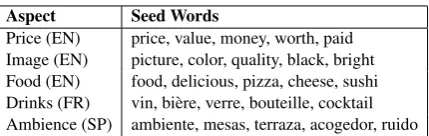
Aspect Seed Words
[image:2.595.76.291.60.128.2]Price (EN) price, value, money, worth, paid Image (EN) picture, color, quality, black, bright Food (EN) food, delicious, pizza, cheese, sushi Drinks (FR) vin, bière, verre, bouteille, cocktail Ambience (SP) ambiente, mesas, terraza, acogedor, ruido
Table 1: Examples of aspects and five of their corre-sponding seed words in various domains (electronic products, restaurants) and languages (“EN” for En-glish, “FR” for French, “SP” for Spanish).
aspect class. Table 1 shows examples of aspects and five of their corresponding seed words from our experimental datasets (described later in more detail). In contrast to a classification label, which is only relevant for a single segment, a seed word can implicitly provide aspect supervision to poten-tially many segments. We assume that the seed words have already been collected either manually or automatically. Indeed, collecting a small1set of seed words per aspect is typically easier than man-ually annotating thousands of segments for train-ing neural networks. As we will see, even noisy seed words that are only weakly predictive of the aspect will be useful for aspect detection.
Training neural networks for segment-level as-pect detection using just a few seed words is a challenging task. Indeed, as a contribution of this paper, we observe that current weakly supervised networks do not effectively leverage the predic-tive power of the available seed words. To address the shortcomings of previous seed word-based ap-proaches, we propose a novel weakly supervised
approach, which uses the available seed words in a more effective way. In particular, we con-sider a student-teacher framework, according to which a bag-of-seed-words classifier (teacher) is applied on unlabeled segments to supervise a sec-ond model (student), which can be any supervised model, including neural networks.
Our approach introduces several important con-tributions. First, our teacher model considers each individual seed word as a (noisy) aspect indicator, which as we will show, is more effective than pre-viously proposed weakly supervised approaches. Second, by using only the teacher’s aspect prob-abilities, our student generalizes better than the teacher and, as a result, the student outperforms both the teacher and previously proposed weakly
1In our experiments, we only consider around 30 seed
words per aspect. For comparison, the vocabulary of the datasets has more than 10,000 terms.
supervised models. Finally, we show how iterative co-training can be used to cope with noisy seed words: the teacher effectively estimates the pre-dictive quality of the noisy seed words in an unsu-pervised manner using the associated predictions by the student. Iterative co-training then leads to both improved teacher and student models. Over-all, our approach consistently outperforms exist-ing weakly supervised approaches, as we show with an experimental evaluation over six domains of product reviews and six multilingual datasets of restaurant reviews.
The rest of this paper is organized as follows. In Section2 we review relevant work. In Section3 we describe our proposed weakly supervised ap-proach. In Section4 we present our experimen-tal setup and findings. Finally, in Section 5 we conclude and suggest future work. A preliminary version of this work was presented at the Sec-ond Learning from Limited Labeled Data Work-shop (Karamanolakis et al.,2019).
2 Related Work and Problem Definition
We now review relevant work on aspect detec-tion (Secdetec-tion 2.1), co-training (Section2.2), and knowledge distillation (Section2.3). We also de-fine our problem of focus (Section2.4).
2.1 Segment-Level Aspect Detection
The goal of segment-level aspect detection is to classify a segmentstoKaspects of interest.
Supervised Approaches. Rule-based or tradi-tional learning models for aspect detection have been outperformed by supervised neural net-works (Liu et al.,2015;Poria et al.,2016;Zhang et al., 2018). Supervised neural networks first use an embedding function2 (EMB) to compute a low dimensional segment representation h = EMB(s) ∈ Rd and then feed h to a classifica-tion layer3 (CLF) to predict probabilities for the
K aspect classes of interest:p =hp1, . . . , pKi = CLF(h). For simplicity, we write p = f(s). The parameters of the embedding function and the classification layer are learned using ground truth,
2Examples of segment embedding functions are the
aver-age of word embeddings (Wieting et al.,2015;Arora et al.,
2017), Recurrent Neural Networks (RNNs) (Yang et al.,
2016;Wieting and Gimpel,2017), Convolutional Neural Net-works (CNNs) (Kim, 2014), self-attention blocks (Devlin et al.,2019;Radford et al.,2018), etc.
3The classification layer is usually a hidden layer
segment-level aspect labels. However, aspect la-bels are not available in our setting, which hinders the application of supervised learning approaches.
Unsupervised Approaches. Topic models have been used to train aspect detection with unan-notated documents. Recently, neural topic mod-els (Iyyer et al.,2016;Srivastava and Sutton,2071; He et al.,2017) have been shown to produce more coherent topics than earlier models such as La-tent Dirichlet Allocation (LDA) (Blei et al.,2003). In their Aspect Based Autoencoder (ABAE), He et al.(2017) first use segmentsto predict aspect probabilities p = f(s) and then use p to recon-struct an embeddingh0forsas a convex combina-tion ofK aspect embeddings: h0 = PK
k=1pkAk, whereAk ∈ Rdis the embedding of thek-th as-pect. The aspect embeddings Ak are initialized by clustering the vocabulary embeddings using k-means withK clusters. ABAE is trained by mini-mizing the segment reconstruction error.4
Unfortunately, unsupervised topic models are not effective when used directly for aspect detec-tion. In particular, in ABAE, theKtopics learned to reconstruct the segments are not necessarily aligned with the K aspects of interest. A possi-ble fix is to first learn K0 >> K topics and do aK0-to-K mapping as a post-hoc step. However, this mapping requires either aspect labels or sub-stantial human effort for interpreting topics and as-sociating them with aspects. This mapping is nev-ertheless not possible if the learned topics are not aligned with the aspects.
Weakly Supervised Approaches. Weakly su-pervised approaches use minimal domain knowl-edge (instead of ground truth labels) to model meaningful aspects. In our setting, domain knowl-edge is given as a set of seed words for each as-pect of interest (Lu et al.,2011;Lund et al.,2017; Angelidis and Lapata, 2018). Lu et al. (2011) use seed words as asymmetric priors in proba-bilistic topic models (including LDA).Lund et al. (2017) use LDA with fixed topic-word distribu-tions, which are learned using seed words as “an-chors” for topic inference (Arora et al., 2013). Neither of these two approaches can be directly applied into more recent neural networks for as-pect detection. Angelidis and Lapata (2018) re-cently proposed a weakly supervised extension
4The reconstruction error can be efficiently estimated
us-ing contrastive max-margin objectives (Weston et al.,2011;
Pennington et al.,2014).
of the unsupervised ABAE. Their model, named Multi-seed Aspect Extractor, or MATE, initializes the aspect embedding Ak using the weighted av-erage of the corresponding seed word embeddings (instead of the k-means centroids). To guarantee that the aspect embeddings will still be aligned with theKaspects of interest after training, Ange-lidis and Lapata(2018) keep the aspect and word embeddings fixed throughout training. In this work, we will show that the predictive power of seed words can be leveraged more effectively by considering each individual seed word as a more direct source of supervision during training.
2.2 Co-training
Co-training (Blum and Mitchell,1998) is a classic multi-view learning method for semi-supervised learning. In co-training, classifiers over different feature spaces are encouraged to agree in their pre-dictions on a large pool of unlabeled examples. Blum and Mitchell(1998) justify co-training in a setting where the different views are conditionally independent given the label. Several subsequent works have relaxed this assumption and shown co-training to be effective in much more general settings (Balcan et al., 2005; Chen et al., 2011; Collins and Singer,1999;Clark et al.,2018). Co-training is also related to self-Co-training (or boot-strapping) (Yarowsky,1995), which trains a clas-sifier using its own predictions and has been suc-cessfully applied for various NLP tasks (Collins and Singer,1999;McClosky et al.,2006).
Variable Description
s Segment (e.g., sentence) of a text review
K Number of aspects of interest
D Total number of seed words
Gi (i= 1, . . . , K) Set of seed words for thei-th aspect
h∈Rd Segment embedding (student) c∈ND Bag-of-seed-words representation ofs p=hp1, . . . , pKi Student’s aspect predictions
[image:4.595.71.293.60.158.2]q=hq1, . . . , qKi Teacher’s aspect predictions
Table 2: Notation.
2.3 Knowledge Distillation
Our approach is also related to the “knowledge distillation” framework (Buciluˇa et al., 2006;Ba and Caruana,2014;Hinton et al.,2015), which has received considerable attention recently ( Lopez-Paz et al.,2016;Kim and Rush,2016;Furlanello et al.,2018;Wang,2019). Traditional knowledge distillation aims at compressing a cumbersome model (teacher) to a simpler model (student) by training the student using both ground truth labels and the soft predictions of the teacher in a distilla-tion objective. Our work also considers a student-teacher architecture and the distillation objective but under a considerably different, weakly super-vised setting: (1) we do not use any labels for training and (2) we create conditions that allow the student to outperform the teacher; in turn, (3) we can use the student’s predictions to learn a better teacher under co-training.
2.4 Problem Definition
Consider a corpus of text reviews from an en-tity domain (e.g., televisions, restaurants). Each review is split into segments (e.g., sentences, clauses). We also consider K pre-defined as-pects of interest(1, . . . , K), including the “Gen-eral” aspect, which we assume is theK-th aspect for simplicity. Different segments of the same review may be associated with different aspects but ground-truth aspect labels arenotavailable for training. Instead, a small number of seed words
Gk are provided for each aspect k ∈ [K]. Our goal is to use the corpus of training reviews and the available seed wordsG = (G1, . . . , GK) to train a classifier, which, given an unseen test segments, predictsKaspect probabilitiesp=hp1, . . . , pKi.
3 Our Student-Teacher Approach
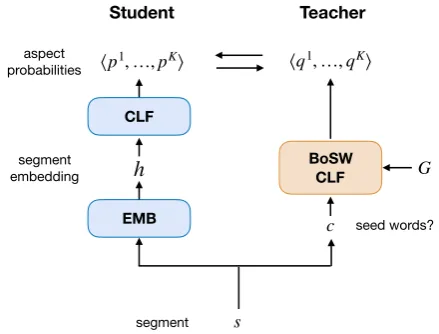
We now describe our weakly supervised frame-work for aspect detection. We consider a student-teacher architecture (Figure2), where the teacher
EMB
BoSW CLF h
CLF ⟨p1, …,pK⟩
c seed words?
s
⟨q1, …,qK⟩
Student Teacher
segment embedding
aspect probabilities
segment
G
Figure 2: Our student-teacher approach for segment-level aspect detection using seed words.
is a bag-of-words classifier based solely on the provided seed words (i.e., a “bag-of-seed-words” classifier), and the student is an embedding-based neural network trained on data “softly” labeled by the teacher (as in the distillation objective). In the rest of this section, we describe the individ-ual components of our student-teacher architec-ture and our proposed algorithm for performing updates.
3.1 Teacher: A Bag-of-Seed-Words Classifier
Our teacher model leverages the available seed wordsGthat are predictive of theK aspects. Let
Ddenote the total number of seed words inG. We can represent a segment si using a bag-of-seed-words representationci ∈ ND, wherecji encodes the number of times thej-th seed word occurs in
si. (Note thatciignores the non-seed words.) The teacher’s prediction for thek-th aspect is:
qki = exp(
PD
j=11{j ∈Gk} ·cji)
P
k0exp(
PD
j=11{j ∈Gk0} ·cj
i)
. (1)
If no seed word appears ins, then the teacher pre-dicts the “General” aspect by settingqKi = 1. Un-der this configuration the teacher uses seed words in a direct and intuitive way: it predicts aspect probabilities for thek-th aspect, which are propor-tional to the counts of the seed words under Gk, while if no seed word occurs ins, it predicts the “General” aspect. The classifier receivesci as in-put and predictsqi=hqi1, . . . , qKi i.
[image:4.595.306.526.73.240.2]non-seed words to carry predictive power. Next, we describe the student network that learns to as-sociate non-seed words with aspects.
3.2 Student: An Embedding-Based Network
Our student model is an embedding-based neu-ral network: a segment is first embedded (hi =
EMB(si) ∈ Rd) and then classified to theK as-pects (pi = CLF(hi)) (see Section2.1). The stu-dent does not use ground-truth aspect labels for training. Instead, it is trained by optimizing the distillation objective, i.e., the cross entropy be-tween the teacher’s (soft) predictions and the stu-dent’s predictions:
H(qi, pi) =−
X
k
qiklogpki (2)
While the teacher only uses the seed words in si to form its prediction qi, the student uses all the words in si. Thus, using the distillation loss for training, the student learns to use both seed words and non-seed words to predict aspects. As a re-sult, the student is able to generalize better than the teacher andpredict aspects even in segments that do not contain any seed words. To regularize the student model, we apply L2 regularization to the classifier’s weights and dropout regularization to the word embeddings (Srivastava et al.,2014). As we will show in Section 4, our student with this configuration outperforms the teacher in as-pect prediction.
3.3 Iterative Co-Training
In this section, we describe our iterative co-training algorithm to cope with noisy seed words. The teacher in Section 3.1 considers each seed word equally, which can be problematic because not all seed words are equally good for predict-ing an aspect. In this work, we propose to esti-mate the predictive quality of each seed word in an unsupervised way. Our approach is inspired in the Model Bootstrapped Expectation Maximiza-tion (MBEM) algorithm of Khetan et al. (2018). MBEM is guaranteed to converge (under mild conditions) when the number of training data is sufficiently large and the worker quality is suffi-ciently high. Here, we treat seed words as “noisy annotators” and adopt an iterative estimation pro-cedure similar to MBEM, as we describe next.
We model the predictive quality of thej-th seed word as a weight vectorzj =hzj1, . . . , zjKi, where
Algorithm 1Iterative Seed Word Distillation Input: {si}i∈[N], D seed words grouped into
Kdisjoint setsG= (G1, . . . , GK)
Output: fˆ: predictor function for segment-level aspect detection
Predict{qi}i∈[N](Eq. (1)) .Apply teacher Repeat until convergence criterion
Learnfˆ(Eq. (2)) .Train student
Predict{pi= ˆf(si)}i∈[N] .Apply student Update{zj}j∈[D](Eq. (4)) .Update teacher Predict{qi}i∈[N](Eq. (3)) .Apply teacher
zkj measures the strength of the association with thek-th aspect. We thus change the teacher to con-sider seed word quality. In particular, we replace Equation (1) by:
qki = exp
PD
j=11{j∈Gk} ·zˆkj ·c j i
P
k0exp
PD
j=11{j∈Gk0} ·zˆk
0
j ·c j i
, (3)
where zˆj is the current estimate of zj. As no ground-truth labels are available, we fol-lowKhetan et al.(2018) and estimatezj via Max-imum Likelihood Estimation using the student’s predictions as the current estimate of the ground truth labels. In particular, we assume that the pre-diction of the student for a training segmentsi is
ti = argmaxkpki. Then, for each seed word we compute the quality estimate for the k-th aspect using the student’s predictions forN segments:
ˆ
zjk=
PN
i=11{c j
i >0}1{ti =k}
P
k0
PN i=11{c
j
i >0}1{ti =k0}
. (4)
According to Equation (4), the quality of thej-th seed word is estimated according to the student-teacher agreement on segments where the seed word appears.
Building upon the previous ideas, we present our Iterative Seed Word Distillation (ISWD) al-gorithm for effectively leveraging the seed words for fine-grained aspect detection. Each round of ISWD consists of the following steps (Algorithm 1): (1) we apply the teacher on unlabeled training segments to get predictionsqi (without consider-ing seed word qualities); (2) we train the student using the teacher’s predictions in the distillation objective of Equation (2);5 (3) we apply the stu-dent in the training data to get predictionspi; and
(4) we update the seed word quality parameters us-ing the student’s predictions in Equation (4).
In contrast to MATE, which uses the validation set (with aspect labels) to estimate seed weights in an initialization step, our proposed method is an unsupervised approach to modeling and adapt-ing the seed word quality duradapt-ing trainadapt-ing. We stop this iterative procedure after the disagreement be-tween the student’s and teacher’s hard predictions in the training data stops decreasing. We empiri-cally observe that 2-3 rounds are sufficient to sat-isfy this criterion. This observation also agrees with Khetan et al.(2018), who only run their al-gorithm for two rounds.
4 Experiments
We evaluate our approach to aspect detection on several datasets of product and restaurant reviews.
4.1 Experimental Settings
Datasets. We train and evaluate our models on Amazon product reviews for six domains (Lap-top Bags, Keyboards, Boots, Bluetooth Head-sets, Televisions, and Vacuums) from the OPO-SUM dataset (Angelidis and Lapata, 2018), and on restaurant reviews in six languages (English, Spanish, French, Russian, Dutch, Turkish) from the SemEval-2016 Aspect-based Sentiment Anal-ysis task (Pontiki et al.,2016). Aspect labels (9-class for product reviews and 12-(9-class for restau-rant reviews) are available for each segment6 of the validation and test sets. The restaurant reviews also come with training aspect labels, which we only use for training the fully supervised mod-els. For a fair comparison, we use exactly the same 30 seed words (per aspect and domain) used in Angelidis and Lapata (2018) for the product reviews and use the same extraction method de-scribed inAngelidis and Lapata(2018) to extract 30 seed words for the restaurant reviews. See the supplementary material for more dataset details.
Experimental Procedure. For a fair compari-son, we use exactly the same pre-processing (to-kenization, stemming, and word embedding) and evaluation procedure as in Angelidis and Lapata
inKhetan et al.(2018), which is an alternative form of noise-aware loss functions (Natarajan et al.,2013), is equivalent to our distillation loss: using the log loss asl(.)in Equation (4) ofKhetan et al.(2018) yields the cross entropy loss.
6In product reviews, elementary discourse units (EDUs)
are used as segments. In restaurant reviews, sentences are used as segments.
(2018). For each domain, we train our model on the training set without using any aspect labels, and only use the seed words G via the teacher. For each model, we report the average test per-formance over 5 different runs with the parameter configuration that achieves best validation perfor-mance. As evaluation metric, we use the micro-averaged F1.
Model Configuration. For the student net-work, we experiment with various modeling choices for segment representations: bag-of-words (BOW) classifiers, the unweighted average of word2vec embeddings (W2V), the weighted av-erage of word2vec embeddings using bilinear at-tention (Luong et al., 2015) (same setting as He et al. (2017); Angelidis and Lapata (2018)), and the average of contextualized word representations obtained from the second-to-last layer of the pre-trained (self-attention based) BERT model (Devlin et al., 2019), which uses multiple self-attention layers (Vaswani et al.,2017) and has been shown to achieve state-of-the-art performance in many downstream NLP applications. For the English product reviews, we use the base uncased BERT model. For the multilingual restaurant reviews, we use the multilingual cased BERT model.7
In iterative co-training, we train the student net-work to convergence in each iteration (which may require more than one epoch over the training data). Moreover, we observed that the iterative process is more stable when we interpolate be-tween weights of the previous iteration and the estimated updates instead of directly applying the estimated seed weight updates (according to Equa-tion (3)).
Model Comparison. For a robust evaluation of our approach, we compare the following models and baselines:
• LDA-Anchors: The topic model of Lund et al.(2017) using seed words as “anchors.”
• ABAE:The unsupervised autoencoder ofHe et al. (2017), where the learned topics were manually mapped to aspects.
• MATE-*: The MATE model of Angelidis and Lapata (2018) with various configura-tions: initialization of the aspect embeddings
7Both models can be found in
Product Review Domain
Method Bags Keyboards Boots Headsets TVs Vacuums AVG
LDA-Anchors (Lund et al.,2017) 33.5 34.7 31.7 38.4 29.8 30.1 33.0
ABAE (He et al.,2017) 38.1 38.6 35.2 37.6 39.5 38.1 37.9
MATE (Angelidis and Lapata,2018) 46.2 43.5 45.6 52.2 48.8 42.3 46.4
MATE-unweighted 41.6 41.3 41.2 48.5 45.7 40.6 43.2
MATE-MT (best performing) 48.6 45.3 46.4 54.5 51.8 47.7 49.1
Teacher 55.1 52.0 44.5 50.1 56.8 54.5 52.2
Student-BoW 57.3 56.2 48.8 59.8 59.6 55.8 56.3
Student-W2V 59.3 57.0 48.3 66.8 64.0 57.0 58.7
Student-W2V-RSW 51.3 57.2 46.6 63.0 62.1 57.1 56.2
Student-ATT 60.1 55.6 49.9 66.6 63.4 58.2 58.9
[image:7.595.81.519.60.226.2]Student-BERT 61.4 57.5 52.0 66.5 63.0 60.4 60.2
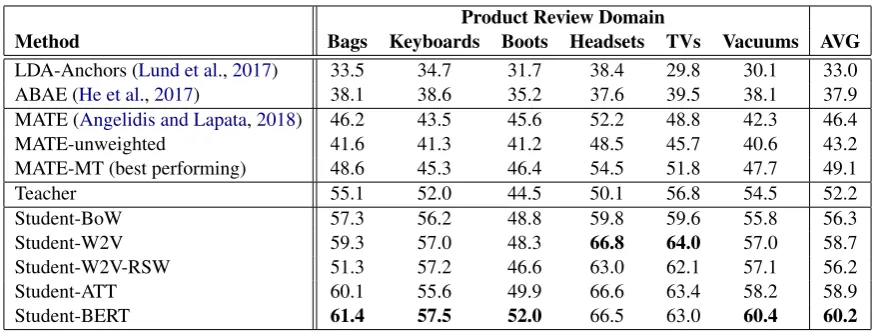
Table 3: Micro-averaged F1 reported for 9-class EDU-level aspect detection in product reviews.
Restaurant Review Language
Method En Sp Fr Ru Du Tur AVG
W2V-Gold 58.8 50.4 50.4 69.3 51.4 55.7 56.0
BERT-Gold 63.1 51.6 50.5 64.6 53.5 55.3 56.4
MATE 41.0 24.9 17.8 18.4 36.1 39.0 29.5
MATE-unweighted 40.3 18.3 19.2 21.8 31.5 25.2 26.1
Teacher 44.9 41.8 34.1 54.4 40.7 30.2 41.0
Student-W2V 47.2 40.9 32.4 59.0 42.1 42.3 44.0
Student-ATT 47.8 41.7 32.9 57.3 44.1 45.5 44.9
Student-BERT 51.8 42.0 39.2 58.0 43.0 45.0 46.5
Table 4: Micro-averaged F1 reported for 12-class sentence-level aspect detection in restaurant reviews. The fully supervised *-Gold models are not directly comparable with the weakly supervised models.
Ak using the unweighted/weighted average of seed word embeddings and an extra multi-task training objective (MT).8
• Teacher:Our bag-of-seed-words teacher.
• Student-*:Our student network trained with various configurations for the EMB function.
• *-Gold: Supervised models trained using ground truth aspect labels, which are only available for restaurant reviews. These mod-els are not directly comparable with the other models and baselines.
4.2 Experimental Results
Tables 3and4 show the results for aspect detec-tion on product and restaurant reviews, respec-tively. The rightmost column of each table re-ports the average performance across the 6 do-mains/languages.
8The multi-task training objective in MATE requires
datasets from different domains but same language, thus it cannot be applied in our datasets of restaurant reviews.
MATE-* models outperform ABAE. Using the seed words to initialize aspect embeddings leads to more accurate aspect predictions than mapping the learned (unsupervised) topics to as-pects.
LDA-Anchors performs worse than MATE-* models. Although averages of seed words were used as “anchors” in the “Tandem Anchoring” al-gorithm, we observed that the learned topics did not correspond to our aspects of interest.
The teacher effectively leverages seed words. By leveraging the seed words in a more direct way, Teacher is able to outperform the MATE-* models. Thus, we can use Teacher’s predictions as supervi-sion for the student, as we describe next.
dis-EMB
BoSW CLF
h
CLF
⟨p1, …,pK⟩
c
s
⟨q1, …,qK⟩
Student Teacher
segment
embedding aspect
probabilities
G
[image:8.595.105.264.60.209.2]snon−seed sseed
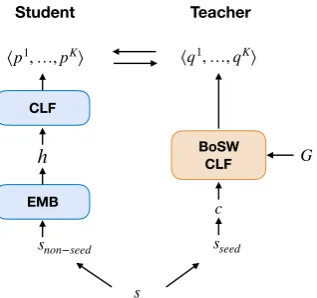
Figure 3: Our weakly supervised co-training approach when seed words are removed from the student’s input (RSW baseline). Segmentsnon−seedis an edited
ver-sion ofs, where we replace each seed word insby an “UNK” special token (like out-of-vocabulary words).
tillation approach are highlighted using neural net-works with word embeddings. Student-W2V out-performs both Teacher and Student-BoW, showing that obtaining segment representations as the av-erage of word embeddings is more effective than using bag-of-words representations for this task.
The student outperforms previous weakly su-pervised models even in one co-training round. Student-ATT outperforms MATE-unweighted (by 36.3% in product reviews and by 52.2% in restau-rant reviews) even in a single co-training round: although the two models use exactly the same seed words (without weights), pre-trained word embeddings, EMB function, and CLF function, our student-teacher approach leverages the avail-able seed words more effectively as noisy super-vision than just for initialization. Also, using our approach, we can explore more powerful methods for segment embedding without the constraint of a fixed word embedding space. Indeed, using con-textualized word representations in Student-BERT leads to the best performance over all models.
As expected, our weakly supervised approach does not outperform the fully supervised (*-Gold) models. However, our approach substantially re-duces the performance gap between weakly super-vised approaches and fully supersuper-vised approaches by 62%. The benefits of our student-teacher ap-proach are consistent across all datasets, highlight-ing the predictive power of seed words across dif-ferent domains and languages.
The student leverages non-seed words. To bet-ter understand the extent to which non-seed words
Method Initial Iterative
Product Reviews (AVG)
MATE 46.4
-Teacher / Student-W2V 52.2 / 58.7 58.5/59.7
Teacher / Student-BERT 52.2 / 60.2 58.6/60.8
Restaurant Reviews (En)
MATE 29.5
-Teacher / Student-W2V 44.9 / 47.2 45.8/49.0
[image:8.595.307.526.61.180.2]Teacher / Student-BERT 44.9 / 51.8 49.8/53.4
Table 5: Micro-averaged F1 scores during the first round (middle column) and after iterative co-training (right column) in product reviews (top) and restaurant reviews (bottom).
can predict the aspects of interest, we experiment with completely removing the seed words from Student-W2V’s input during training (Student-W2V-RSW method; see Figure3). Thus, in this setting, Student-W2V-RSW is forced to only use non-seed words to detect aspects. Note that the co-training assumption of conditionally independent views (Blum and Mitchell,1998) is satisfied in this setting, where Teacher is only using seed words and Student-W2V is only using non-seed words. Student-W2V-RSW effectively learns to use non-seed words to predict aspects and performs better than Teacher (but worse than Student-W2V, which considers both seed and non-seed words). For ad-ditional ablation experiments, see the supplemen-tary material.
Iterative co-training copes with noisy words. Further performance improvement in Teacher and Student-* can be observed with the iterative co-training procedure of Section 3.3. Table 5 re-ports the performance of Teacher and Student-* after co-training for both product reviews (top) and English restaurant reviews (bottom). (For more detailed, per-domain results, see the supplemen-tary material.) Compared to the initial version of Teacher that does not model the quality of the seed words, iterative co-training leads to estimates of seed word quality that improve Teacher’s per-formance up to 12.3% (in product reviews using Student-BERT).
Figure 4: Co-training performance for each round re-ported for product reviews (left) and restaurant reviews (right). T<i>and S<i>correspond to the teacher’s and student’s performance, respectively, at thei-th round.
student-teacher disagreement, which substantially improves performance. Across the 12 datasets, Student-BERT leads to an average absolute in-crease of 14.1 F1 points.
Figure 4 plots Teacher’s and Student-BERT’s performance after each round of co-training. Most of the improvement for both Teacher and Student-BERT is gained in the first two rounds of co-training: “T0” (in Figure 4) is the initial teacher, while “T1” is the teacher with estimates of seed word qualities, which leads to more accurate pre-dictions, e.g., in segments with multiple seed words from different aspects.
5 Conclusions and Future Work
We presented a weakly supervised approach for leveraging a small number of seed words (in-stead of ground truth aspect labels) for segment-level aspect detection. Our student-teacher ap-proach leverages seed words more directly and effectively than previous weakly supervised ap-proaches. The teacher model provides weak su-pervision to a student model, which generalizes better than the teacher by also considering non-seed words and by using pre-trained word embed-dings. We further show that iterative co-training lets us estimate the quality of the (possibly noisy) seed words. This leads to a better teacher and, in turn, a better student. Our proposed method con-sistently outperforms previous weakly supervised methods in 12 datasets, allowing for seed words from various domains and languages to be lever-aged for aspect detection. Our student-teacher ap-proach could be applied for any classification task for which a small set of seed words describe each class. In future work, we plan to extend our
frame-work to multi-task settings, and to incorporate in-teraction to learn better seed words.
Acknowledgments
We thank the anonymous reviewers for their con-structive feedback. This material is based upon work supported by the National Science Founda-tion under Grant No. IIS-15-63785.
References
Stefanos Angelidis and Mirella Lapata. 2018. Summa-rizing opinions: Aspect extraction meets sentiment prediction and they are both weakly supervised. In
Proceedings of the 2018 Conference on Empirical Methods in Natural Language Processing.
Sanjeev Arora, Rong Ge, Yoni Halpern, David Mimno, Ankur Moitra, David Sontag, Yichen Wu, and Michael Zhu. 2013. A practical algorithm for topic
modeling with provable guarantees. In
Proceed-ings of the International Conference on Interna-tional Conference on Machine Learning.
Sanjeev Arora, Yingyu Liang, and Tengyu Ma. 2017. A simple but tough-to-beat baseline for sentence em-beddings. InProceedings of the International Con-ference on Learning Representations.
Jimmy Ba and Rich Caruana. 2014. Do deep nets really need to be deep? InAdvances in Neural Information Processing Systems.
Maria-Florina Balcan, Avrim Blum, and Ke Yang. 2005. Co-training and expansion: Towards bridging theory and practice. InAdvances in Neural Informa-tion Processing Systems.
David M Blei, Andrew Y Ng, and Michael I Jordan.
2003. Latent dirichlet allocation. Journal of
Ma-chine Learning Research, 3(Jan):993–1022.
Avrim Blum and Tom Mitchell. 1998. Combining la-beled and unlala-beled data with co-training. In Pro-ceedings of the Annual Conference on Computa-tional Learning Theory.
Cristian Buciluˇa, Rich Caruana, and Alexandru
Niculescu-Mizil. 2006. Model compression. In
Proceedings of the ACM SIGKDD International Conference on Knowledge Discovery and Data Min-ing.
Minmin Chen, Kilian Q Weinberger, and John Blitzer.
2011. Co-training for domain adaptation. In
Ad-vances in Neural Information Processing Systems.
Kevin Clark, Minh-Thang Luong, Christopher D
Man-ning, and Quoc Le. 2018. Semi-supervised
se-quence modeling with cross-view training. In
Michael Collins and Yoram Singer. 1999.
Unsuper-vised models for named entity classification. In
1999 Joint SIGDAT Conference on Empirical Meth-ods in Natural Language Processing and Very Large Corpora.
Andrew M Dai and Quoc V Le. 2015. Semi-supervised
sequence learning. InAdvances in Neural
Informa-tion Processing Systems.
Jacob Devlin, Ming-Wei Chang, Kenton Lee, and
Kristina Toutanova. 2019. Bert: Pre-training of
deep bidirectional transformers for language under-standing. InProceedings of the 2019 Conference of the North American Chapter of the Association for Computational Linguistics: Human Language Tech-nologies.
Tommaso Furlanello, Zachary Lipton, Michael
Tschannen, Laurent Itti, and Anima Anandkumar. 2018. Born-again neural networks. InInternational Conference on Machine Learning.
Ruidan He, Wee Sun Lee, Hwee Tou Ng, and Daniel
Dahlmeier. 2017. An unsupervised neural
atten-tion model for aspect extracatten-tion. InProceedings of the Annual Meeting of the Association for Computa-tional Linguistics.
Geoffrey Hinton, Oriol Vinyals, and Jeff Dean. 2015. Distilling the knowledge in a neural network. arXiv preprint arXiv:1503.02531.
Jeremy Howard and Sebastian Ruder. 2018. Universal language model fine-tuning for text classification. In
Proceedings of the Annual Meeting of the Associa-tion for ComputaAssocia-tional Linguistics.
Minqing Hu and Bing Liu. 2004. Mining and
sum-marizing customer reviews. In Proceedings of the
ACM SIGKDD International Conference on Knowl-edge Discovery and Data Mining.
Mohit Iyyer, Anupam Guha, Snigdha Chaturvedi, Jor-dan Boyd-Graber, and Hal Daumé III. 2016. Feud-ing families and former friends: Unsupervised learn-ing for dynamic fictional relationships. In Proceed-ings of the 2016 Conference of the North American Chapter of the Association for Computational Lin-guistics: Human Language Technologies.
Giannis Karamanolakis, Daniel Hsu, and Luis Gra-vano. 2019. Training neural networks for aspect
ex-traction using descriptive keywords only. In
Pro-ceedings of the Second Learning from Limited La-beled Data Workshop.
Ashish Khetan, Zachary C Lipton, and Anima Anand-kumar. 2018. Learning from noisy singly-labeled
data. In Proceedings of the International
Confer-ence on Learning Representations.
Yoon Kim. 2014. Convolutional neural networks for sentence classification. InProceedings of the 2014 Conference on Empirical Methods in Natural Lan-guage Processing.
Yoon Kim and Alexander M Rush. 2016. Sequence-level knowledge distillation. InProceedings of the 2016 Conference on Empirical Methods in Natural Language Processing.
Bing Liu. 2012. Sentiment analysis and opinion min-ing. Synthesis lectures on human language tech-nologies, 5(1):1–167.
Pengfei Liu, Shafiq Joty, and Helen Meng. 2015. Fine-grained opinion mining with recurrent neural
net-works and word embeddings. InProceedings of the
2015 Conference on Empirical Methods in Natural Language Processing.
David Lopez-Paz, Léon Bottou, Bernhard Schölkopf, and Vladimir Vapnik. 2016. Unifying distillation
and privileged information. InProceedings of the
International Conference on Learning Representa-tions.
Bin Lu, Myle Ott, Claire Cardie, and Benjamin K Tsou.
2011. Multi-aspect sentiment analysis with topic
models. In2011 IEEE International Conference on
Data Mining Workshops. IEEE.
Jeffrey Lund, Connor Cook, Kevin Seppi, and Jordan Boyd-Graber. 2017. Tandem anchoring: A multi-word anchor approach for interactive topic
model-ing. In Proceedings of the Annual Meeting of the
Association for Computational Linguistics.
Thang Luong, Hieu Pham, and Christopher D Man-ning. 2015. Effective approaches to attention-based
neural machine translation. In Proceedings of the
2015 Conference on Empirical Methods in Natural Language Processing.
David McClosky, Eugene Charniak, and Mark John-son. 2006. Effective self-training for parsing. In
Proceedings of the 2006 Conference of the North American Chapter of the Association of Compu-tational Linguistics. Association for Computational Linguistics.
Nagarajan Natarajan, Inderjit S Dhillon, Pradeep K Ravikumar, and Ambuj Tewari. 2013. Learning with
noisy labels. In Advances in Neural Information
Processing Systems.
Jeffrey Pennington, Richard Socher, and Christopher
Manning. 2014. Glove: Global vectors for word
representation. In Proceedings of the 2014
Con-ference on Empirical Methods in Natural Language Processing.
Soujanya Poria, Erik Cambria, and Alexander
Gel-bukh. 2016. Aspect extraction for opinion
min-ing with a deep convolutional neural network.
Knowledge-Based Systems, 108:42–49.
Alec Radford, Karthik Narasimhan, Tim Salimans,
and Ilya Sutskever. 2018. Improving
lan-guage understanding by generative pre-training.
https://blog.openai.com/language-unsupervised.
Sebastian Ruder and Barbara Plank. 2018. Strong
baselines for neural semi-supervised learning under domain shift. InProceedings of the Annual Meeting of the Association for Computational Linguistics.
Akash Srivastava and Charles Sutton. 2071.
Au-toencoding variational inference for topic models. In Proceedings of the International Conference on Learning Representations.
Nitish Srivastava, Geoffrey Hinton, Alex Krizhevsky, Ilya Sutskever, and Ruslan Salakhutdinov. 2014. Dropout: a simple way to prevent neural networks
from overfitting. The Journal of Machine Learning
Research, 15(1):1929–1958.
Ashish Vaswani, Noam Shazeer, Niki Parmar, Jakob Uszkoreit, Llion Jones, Aidan N Gomez, Łukasz Kaiser, and Illia Polosukhin. 2017. Attention is all
you need. InAdvances in Neural Information
Pro-cessing Systems.
Weiran Wang. 2019. Everything old is new again: A multi-view learning approach to learning using priv-ileged information and distillation. arXiv preprint arXiv:1903.03694.
Jason Weston, Samy Bengio, and Nicolas Usunier. 2011. Wsabie: Scaling up to large vocabulary image
annotation. In Twenty-Second International Joint
Conference on Artificial Intelligence.
John Wieting, Mohit Bansal, Kevin Gimpel, and Karen Livescu. 2015. Towards universal paraphrastic
sen-tence embeddings. In Proceedings of the
Interna-tional Conference on Learning Representations.
John Wieting and Kevin Gimpel. 2017. Revisiting re-current networks for paraphrastic sentence embed-dings. InProceedings of the Annual Meeting of the Association for Computational Linguistics.
Zichao Yang, Diyi Yang, Chris Dyer, Xiaodong He, Alex Smola, and Eduard Hovy. 2016. Hierarchi-cal attention networks for document classification. InProceedings of the 2016 Conference of the North American Chapter of the Association for Computa-tional Linguistics: Human Language Technologies.
David Yarowsky. 1995. Unsupervised word sense
dis-ambiguation rivaling supervised methods. In
An-nual Meeting of the Association for Computational Linguistics.
Lei Zhang, Shuai Wang, and Bing Liu. 2018. Deep learning for sentiment analysis: A survey. Wiley In-terdisciplinary Reviews: Data Mining and Knowl-edge Discovery, page e1253.