Proceedings of the 2019 Conference on Empirical Methods in Natural Language Processing 3183
Enhancing AMR-to-Text Generation with Dual Graph Representations
Leonardo F. R. Ribeiro†, Claire Gardent‡and Iryna Gurevych†
†Research Training Group AIPHES and UKP Lab, Technische Universit¨at Darmstadt
www.ukp.tu-darmstadt.de
‡CNRS/LORIA, Nancy, France [email protected]
Abstract
Generating text from graph-based data, such as Abstract Meaning Representation (AMR), is a challenging task due to the inherent difficulty in how to properly encode the structure of a graph with labeled edges. To address this dif-ficulty, we propose a novel graph-to-sequence model that encodes different but complemen-tary perspectives of the structural information contained in the AMR graph. The model learns parallel top-down and bottom-up rep-resentations of nodes capturing contrasting views of the graph. We also investigate the use of different node message passing strategies, employing different state-of-the-art graph en-coders to compute node representations based on incoming and outgoing perspectives. In our experiments, we demonstrate that the dual graph representation leads to improvements in AMR-to-text generation, achieving state-of-the-art results on two AMR datasets1.
1 Introduction
Abstract Meaning Representation (AMR; Ba-narescu et al.(2013)) is a linguistically-grounded semantic formalism that represents the meaning of a sentence as a rooted directed graph, where nodes are concepts and edges are semantic relations. As AMR abstracts away from surface word strings and syntactic structure producing a language neu-tral representation of meaning, its usage is benefi-cial in many semantic related NLP tasks, includ-ing text summarization (Liao et al.,2018) and ma-chine translation (Song et al.,2019).
The purpose of AMR-to-text generation is to produce a text which verbalises the meaning en-coded by an input AMR graph. This is a chal-lenging task as capturing the complex structural information stored in graph-based data is not triv-ial, as these are non-Euclidean structures, which
1Code is available at
https://github.com/UKPLab/emnlp2019-dualgraph
implies that properties such as global parametriza-tion, vector space structure, or shift-invariance do not hold (Bronstein et al., 2017). Recently, Graph Neural Networks (GNNs) have emerged as a powerful class of methods for learning effec-tive graph latent representations (Xu et al.,2019) and graph-to-sequence models have been applied to the task of AMR-to-text generation (Song et al.,
2018; Beck et al., 2018; Damonte and Cohen,
2019;Guo et al.,2019).
In this paper, we propose a novel graph-to-sequence approach to AMR-to-text generation, which is inspired by pre-neural generation algo-rithms. These approaches explored alternative (top-down, bottom-up and mixed) traversals of the input graph and showed that a hybrid traver-sal combining both top-down (TD) and bottom-up (BU) information was best as this permits integrat-ing both global constraints top-down from the in-put and local constraints bottom-up from the se-mantic heads (Shieber et al., 1990;Narayan and Gardent,2012).
Similarly, we present an approach where the input graph is represented by two separate struc-tures, each representing a different view of the graph. The nodes of these two structures are en-coded using separate graph encoders so that each concept and relation in the input graph is assigned both a TD and a BU representation.
Our approach markedly differs from existing graph-to-sequence models for MR-to-Text gener-ation (Marcheggiani and Perez Beltrachini,2018;
elimi-nates the need for additional positional informa-tion (Beck et al., 2018) which is required when the same graph is used to encode both TD and BU information, thereby making the edges undirected.
Our main contributions are the following:
• We present a novel architecture for
AMR-to-text generation which explic-itly encodes two separate TD and BU views of the input graph.
• We show that our approach outperforms
re-cent AMR-to-text generation models on two datasets, including a model that leverages additional syntactic information (Cao and Clark,2019).
• We compare the performance of three graph encoders, which have not been studied so far for AMR-to-text generation.
2 Related Work
Early works on AMR-to-text generation employ statistical methods (Flanigan et al., 2016b; Pour-damghani et al.,2016;Castro Ferreira et al.,2017) and apply linearization of the graph by means of a depth-first traversal.
Recent neural approaches have exhibited suc-cess by linearising the input graph and using a sequence-to-sequence architecture. Konstas et al.
(2017) achieve promising results on this task. However, they strongly rely on named entities anonymisation. Anonymisation requires an ad hoc procedure for each new corpus. The matching pro-cedure needs to match a rare input item correctly (e.g., “United States of America”) with the cor-responding part in the output text (e.g., “USA”) which may be challenging and may result in in-correct or incomplete delexicalisations. In con-trast, our approach omits anonymisation. Instead, we use a copy mechanism (See et al., 2017), a generic technique which is easy to integrate in the encoder-decoder framework and can be used in-dependently of the particular domain and applica-tion. Our approach further differs from Konstas et al.(2017) in that we build a dual TD/BU graph representation and use graph encoders to represent nodes.
Cao and Clark(2019) factor the generation pro-cess leveraging syntactic information to improve the performance. However, they linearize both AMR and constituency graphs, which implies that
important parts of the graphs cannot well be rep-resented (e.g., coreference).
Several graph-to-sequence models have been proposed. Marcheggiani and Perez Beltrachini
(2018) show that explicitly encoding the structure of the graph is beneficial with respect to sequential encoding. They evaluate their model on two tasks, WebNLG (Gardent et al., 2017) and SR11Deep (Belz et al., 2011), but do not apply it to AMR benchmarks. Song et al. (2018) and Beck et al.
(2018) apply recurrent neural networks to directly encode AMR graphs. Song et al. (2018) use a graph LSTM as the graph encoder, whereasBeck et al. (2018) develop a model based on GRUs. We go a step further in that direction by develop-ing parallel encoddevelop-ings of graphs which are able to highlight different graph properties.
In a related task, Koncel-Kedziorski et al.
(2019) propose an attention-based graph model that generates sentences from knowledge graphs.
Schlichtkrull et al. (2018) use Graph Convolu-tional Networks (GCNs) to tackle the tasks of link prediction and entity classification on knowledge graphs.
Damonte and Cohen (2019) show that off-the-shelf GCNs cannot achieve good performance for AMR-to-text generation. To tackle this issue,Guo et al.(2019) introduce dense connectivity to GNNs in order to integrate both local and global features, achieving good results on the task. Our work is related to Damonte and Cohen (2019), that use stacking of GCN and LSTM layers to improve the model capacity and employ anonymization. How-ever, our model is substantially different: (i) we learn dual representations capturing top-down and bottom-up adjuvant views of the graph, (ii) we em-ploy more effective graph encoders (with different neighborhood aggregations) than GCNs and (iii) we employ copy and coverage mechanisms and do not resort to entity anonymization.
3 Graph-to-Sequence Model
In this section, we describe (i) the representations of the graph adopted as inputs, (ii) the model ar-chitecture, including the Dual Graph Encoder and (iii) the GNNs employed as graph encoders.
3.1 Graph Preparation
LetG = (V, E, R) denote a rooted and directed
AMR graph with nodesvi 2V and labeled edges
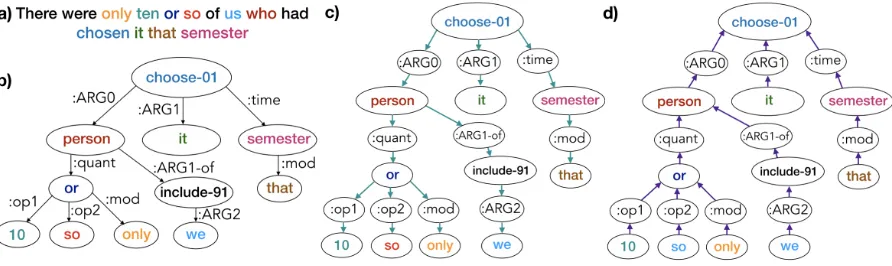
Figure 1: (a) an example sentence, (b) its original AMR graph (G) and different graph perspectives: (c) top-down (Gt) and (d) bottom-up (Gb).
Letn =|V|andm =|E|denote the numbers of
nodes and edges, respectively.
We convert each AMR graph into an unlabeled and connected bipartite graph Gt = (Vt, Et), transforming each labeled edge (vi, r, vj) 2 E into two unlabeled edges(vi, r),(r, vj)2Et, with
|Vt| = n+m and |Et| = 2m. This process, called Levi Transformation (Beck et al., 2018), turns original edges into nodes creating an un-labeled graph. For instance, the edge between
semester and that with label :mod in Fig-ure1(b) is replaced by two edges and one node in
1(c): an edge between semester, and the new node :mod and another one between :mod and
that. The new graph allows us to directly rep-resent the relationships between nodes using em-beddings. This enables us to encode label edge in-formation using distinct message passing schemes employing different GNNs.
Gt captures a TD view of the graph. We also create a BU view of the graph Gb = (Vt, Eb), where each directed edgeek = (vi, vj) 2 Et be-comesek = (vj, vi) 2 Eb, that is, we reverse the direction of original edges. An example of a sen-tence, its AMR graph and the two new graphsGt andGbis shown in Figure1.
3.2 Dual Graph Encoder
We represent each nodevi 2 Vtwith a node em-beddingei 2 Rd, generated from the node label. In order to explicitly encode structural informa-tion, our encoder starts with two graph encoders, denoted byGEtandGEb, that compute represen-tations for nodes inGtandGb, respectively.
EachGE learns node representations based on
the specific view of its particular graph,GtorGb. Since Gt andGb capture distinct perspectives of the graph structure, the information flow is
prop-agated throughout TD and BU directions, respec-tively. In particular, for each nodevi, theGE re-ceives the node embeddings of vi and its neigh-bors, and computes its node representation:
hti =GEt({ei,ej :j2Nt(i)}),
hbi =GEb({ei,ej :j2Nb(i)}),
whereNt(i) andNb(i)are the immediate incom-ing neighborhoods of vi in Gt and Gb, respec-tively.
Each node vi is represented by two different hidden states,ht
i andhbi. Note that we learn two representations per relation and node of the orig-inal AMR graph. The hidden states hti and hbi,
and embedding ei contain different information regardingvi. We concatenate them building a final node representation:
ri=⇥htikhbikei⇤.
This approach is similar to bidirectional RNNs (Schuster and Paliwal,1997). Bidirectional RNNs benefit from left-to-right and right-to-left propa-gation. They learn the hidden representations sep-arately and concatenate them at the end. We per-form a similar encoding: first we learn TD and BU representations independently, and lastly, we con-catenate them.
The final representationri is employed in a se-quence input of a bidirectional LSTM. For each AMR graph, we generate a node sequence by depth-first traversal order. In particular, given a representation sequence fromr1 torn, the hidden forward and backward states ofriare defined as:
!
hi =LSTMf(ri,!hi 1),
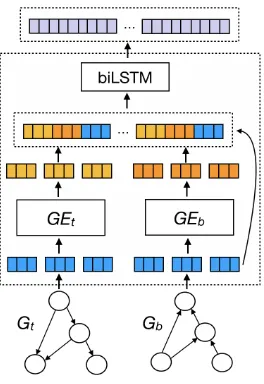
[image:3.595.77.523.63.196.2]Figure 2: Dual Graph Encoder. The encoder receives the two graph views and generates structural node rep-resentations that are used by the decoder. Represen-tations in blue, yellow and orange areei,ht
i andhbi, respectively.
where LSTMf is a forward LSTM and LSTMb is a backward LSTM. Note that, for the backward LSTM, we feed the reversed input as the order fromrntor1. Lastly, we obtain the final hidden state by concatenating them as:
hi = [!hik hi].
The resulting hidden statehiencodes the informa-tion of both preceding and following nodes.
Stacking layers was demonstrated to be effec-tive in graph-to-sequence approaches ( Marcheg-giani and Perez Beltrachini, 2018; Koncel-Kedziorski et al., 2019; Damonte and Cohen,
2019) and allows us to test for their contributions to the system performance more easily. We em-ploy different GNNs for both graph encoders (Sec-tion 3.3). Figure 2 shows the proposed encoder architecture.
3.3 Graph Neural Networks
TheGEs incorporate, in each node representation,
structural information based on both views of the graph. We explore distinct strategies for neighbor-hood aggregation, adopting three GNNs: Gated Graph Neural Networks (GGNN,Li et al.(2016)), Graph Attention Networks (GAT,Veliˇckovi´c et al.
(2018)) and Graph Isomorphic Networks (GIN,
Xu et al. (2019)). Each GNN employs a specific message passing scheme which allows capturing different nuances of structural information.
Gated Graph Neural Networks GGNNs em-ploy gated recurrent units to encode node repre-sentations, reducing the recurrence to a fixed num-ber of steps. In particular, the l-th layer of a GGNN is calculated as:
h(il)=GRU⇣h(il 1), X
j2N(i)
W1h(jl 1) ⌘
,
whereN(i)is the immediate neighborhood ofvi,
W1 is a parameter and GRU is a gated recur-rent unit (Cho et al.,2014). Different from other GNNs, GGNNs use back-propagation through time (BPTT) to learn the parameters. GGNNs also do not require to constrain parameters to ensure convergence.
Graph Attention Networks GATs apply atten-tive mechanisms to improve the exploitation of non-trivial graph structure. They encode node rep-resentations by attending over their neighbors, fol-lowing a self-attention strategy:
h(il)=↵i,iW2h(il 1)+ X
j2N(i)
↵i,jW2h(jl 1),
where attention coefficients↵i,jare computed as:
↵i,j=softmax
⇣ ⇣
a>[W2hi(l 1)kW2h(lj 1)]
⌘⌘ ,
where is the activation function and kdenotes
concatenation. W2 anda are model parameters. The virtue of the attention mechanism is its ability to focus on the most important parts of the node neighborhood. In order to learn attention weights in different perspectives, GATs can employ multi-head attentions.
Graph Isomorphic Networks GIN is a GNN as powerful as the Weisfeiler-Lehman (WL) graph isomorphism test (Weisfeiler and Lehman,1968) in representing isomorphic and non-isomorphic graphs with discrete attributes. Itsl-th layer is de-fined as:
h(il)=hW ⇣
h(il 1)+ X
j2N(i)
h(jl 1)⌘,
where hW is a multi-layer perceptron (MLP). In contrast to other GNNs, which combine node feature with its aggregated neighborhood feature, GINs do not apply the combination step and sim-ply aggregate the node along with its neighbors.
LDC2015E86 LDC2017T10
training, dev and test instances 16,833 1,368 1,371 36,521 1,368 1,371
min, average and max graph diameter 0 6.9 20 0 6.7 20
min, average and max node degree 0 2.1 18 0 2.1 20
min, average and max number of nodes 1 17.7 151 1 16.8 151
min, average and max number of edges 0 18.6 172 0 17.7 172
number of DAG and non-DAG graphs 18,679 893 37,284 1,976
[image:5.595.75.524.62.173.2]min, average and max length sentences 1 21.3 225 1 20.4 225
Table 1: Data statistics of LDC2015E86 and LDC2017T10 datasets. The values are calculated for all splits (train, development and test sets). DAG stands for directed acyclic graph.
3.4 Decoder
An attention-based unidirectional LSTM decoder is used to generate sentences, attending to the hid-den representations of edges and nodes. In each stept, the decoder receives the word embedding of
the previous word (during training, this is the pre-vious word of the reference sentence; at test time it is the previously generated word), and has the decoder statest. The attention distribution at is calculated as inSee et al.(2017):
eti =v·tanh(Whhi+Wsst+wcsc+b),
at=softmax(et),
wheresc is the coverage vector andv, Wh,Ws,
wcandbare learnable parameters. The coverage vector is the accumulation of all attention distribu-tions so far.
Copy and Coverage Mechanisms Previous works (Damonte and Cohen,2019;Cao and Clark,
2019) use anonymization to handle names and rare words, alleviating the data sparsity. In contrast, we employ copy and coverage mechanisms to address out-of-vocabulary issues for rare target words and to avoid repetition (See et al.,2017).
The model is trained to optimize the negative log-likelihood:
L= |Y|
X
t=1
logp(yt|y1:t 1, X;✓),
whereY = y1, . . . , y|Y|is the sentence, X is the
AMR graph and✓ represents the model
parame-ters.
4 Data
We use two AMR corpora, LDC2015E86 and LDC2017T102. In these datasets, each instance
2The datasets can be found at
https://amr.isi.edu/download.html
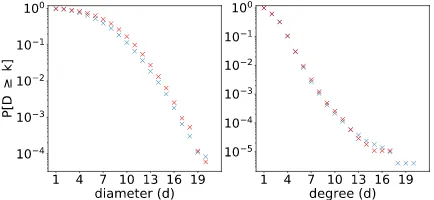
Figure 3: Distribution of the AMR graph diameter (left) and node degree (right) in the training set for LDC2015E86 (red) and LDC2017T10 (blue) datasets.
contains an AMR graph and a sentence. Table1
shows the statistics for both datasets. Figure 3
shows the distribution of the AMR graph diame-ters and node degrees for both datasets. The AMR graph structures are similar for most examples. Note that 90% of AMR graphs in both datasets have the diameter less than or equal to 11 and 90% of nodes have the degree of 4 or less. Very struc-turally similar graphs pose difficulty for the graph encoder by making it harder to learn the differ-ences between their similar structures. Therefore, the word embeddings used as additional input play an important role in helping the model to deal with language information. That is one of the reasons why we concatenate this information in the node representationri.
5 Experiments and Discussion
[image:5.595.308.525.231.331.2]regu-Model BLEU METEOR
LDC2015E86 Konstas et al. (2017) 22.00
-Song et al. (2018) 23.28 30.10
Cao et al. (2019) 23.50
-Damonte et al.(2019) 24.40 23.60
Guo et al. (2019) 25.70
-S2S 22.55±0.17 29.90±0.31
G2S-GIN 22.93±0.20 29.72±0.09
G2S-GAT 23.42±0.16 29.87±0.14
G2S-GGNN 24.32±0.16 30.53±0.30 LDC2017T10
Back et al. (2018) 23.30
-Song et al. (2018) 24.86 31.56
Damonte et al.(2019) 24.54 24.07
Cao et al. (2019) 26.80
-Guo et al. (2019) 27.60
-S2S 22.73±0.18 30.15±0.14
G2S-GIN 26.90±0.19 32.62±0.04
G2S-GAT 26.72±0.20 32.52±0.02
[image:6.595.306.525.62.133.2]G2S-GGNN 27.87±0.15 33.21±0.15
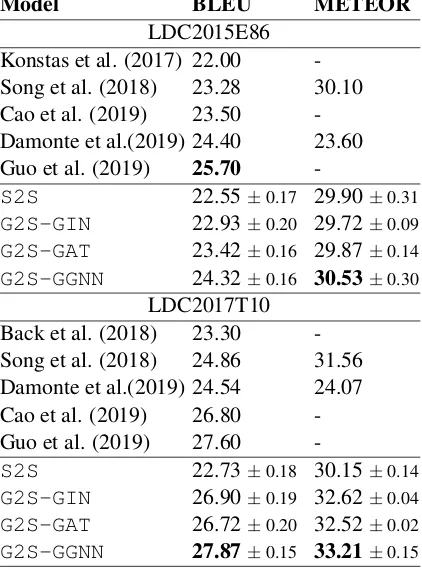
Table 2: BLEU and METEOR scores on the test set of LDC2015E86 and LDC2017T10 datasets.
larize the model, during training we apply dropout (Srivastava et al.,2014) to the graph layers with a rate of 0.3. The graph encoder hidden vector sizes are set to 300 and hidden vector sizes for LSTMs are set to 900.
The models are trained for 30 epochs with early stopping based on the development BLEU score. For our models and the baseline, we used a two-layer LSTM decoder. We use Adam optimization (Kingma and Ba, 2015) as the optimizer with an initial learning rate of 0.001 and 20 as the batch size. Beam search with the beam size of 5 is used for decoding.
Results We call the models G2S-GIN (iso-morphic encoder),G2S-GAT(graph-attention en-coder), and G2S-GGNN (gated-graph encoder), according to the graph encoder utilized. As a base-line (S2S), we train an attention-based encoder-decoder model with copy and coverage mecha-nisms, and use a linearized version of the graph generated by depth-first traversal order as input. We compare our models against several state-of-the-art results reported on the two datasets ( Kon-stas et al., 2017; Song et al., 2018; Beck et al.,
2018;Damonte and Cohen,2019;Cao and Clark,
2019;Guo et al.,2019).
Model External BLEU
Konstas et al. (2017) 200K 27.40
Song et al. (2018) 200K 28.20
Guo et al. (2019) 200K 31.60
G2S-GGNN 200K 32.23
Table 3: Results on LDC2015E86 test set when models are trained with additional Gigaword data.
We use both BLEU (Papineni et al., 2002) and METEOR (Denkowski and Lavie,2014) as evalu-ation metrics3. In order to mitigate the effects of random seeds, we report the averages for 4 train-ing runs of each model along with their standard deviation. Table2shows the comparison between the proposed models, the baseline and other neural models on the test set of the two datasets.
For both datasets, our approach substantially outperforms the baselines. In LDC2015E86,
G2S-GGNN achieves a BLEU score of 24.32, 4.46% higher thanSong et al.(2018), who also use the copy mechanism. This indicates that our archi-tecture can learn to generate better signals for text generation. On the same dataset, we have compet-itive results toDamonte and Cohen(2019). How-ever, we do not rely on preprocessing anonymisa-tion not to lose semantic signals. In LDC2017T10,
G2S-GGNN achieves a BLEU score of 27.87, which is 3.33 points higher thanDamonte and Co-hen(2019), a state-of-the-art model that does not employ external information. We also have com-petitive results toGuo et al.(2019), a very recent state-of-the-art model.
We also outperform Cao and Clark(2019) im-proving BLEU scores by 3.48% and 4.00%, in LDC2015E86 and LDC2017T10, respectively. In contrast to their work, we do not rely on (i) leveraging supplementary syntactic information and (ii) we do not require an anonymization pre-processing step. G2S-GINand G2S-GAT have comparable performance on both datasets. In-terestingly, G2S-GGNN has better performance among our models. This suggests that graph en-coders based on gating mechanisms are very ef-fective in text generation models. We hypothesize that the gating mechanism can better capture long-distance dependencies between nodes far apart in the graph.
[image:6.595.73.284.67.352.2]Model BLEU METEOR Size biLSTM 22.50 30.42 57.6M
GEt+biLSTM 26.33 32.62 59.6M
GEb+biLSTM 26.12 32.49 59.6M
[image:7.595.308.526.62.318.2]GEt+GEb+biLSTM 27.37 33.30 61.7M
Table 4: Results of the ablation study on the LDC2017T10 development set.
Additional Training Data Following previous works (Konstas et al.,2017;Song et al.,2018;Guo et al.,2019), we also evaluate our models employ-ing additional data from English Gigaword corpus (Napoles et al.,2012). We sample 200K Gigaword sentences and use JAMR4(Flanigan et al.,2016a) to parse them. We follow the method ofKonstas et al. (2017), which is fine-tuning the model on the LDC2015E86 training set after every epoch of pretraining on the Gigaword data. G2S-GGNN
outperforms others with the same amount of Giga-word sentences (200K), achieving a 32.23 BLEU score, as shown in Table 3. The results demon-strate that pretraining on automatically generated AMR graphs enhances the performance of our model.
Ablation Study In Table4, we report the results of an ablation study on the impact of each com-ponent of our model on the development set of LDC2017T10 dataset by removing the graph en-coders. We also report the number of parame-ters (including embeddings) used in each model. The first thing we notice is the huge increase in metric scores (17% in BLEU) when applying the graph encoder layer, as the neural model receives signals regarding the graph structure of the input. The dual representation helps the model with a different view of the graph, increasing BLEU and METEOR scores by 1.04 and 0.68 points, respec-tively. The complete model has slightly more pa-rameters than the model without graph encoders (57.6M vs 61.7M).
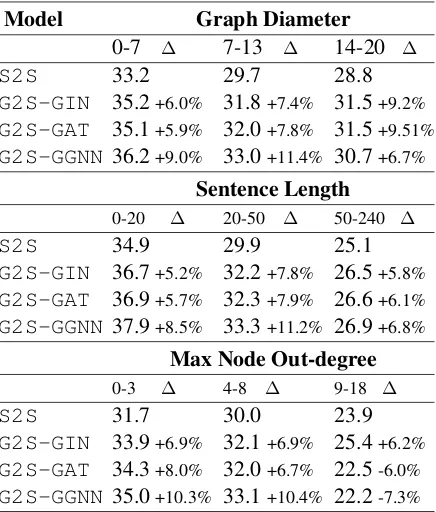
Impact of Graph Size, Arity and Sentence Length The good overall performance on the datasets shows the superiority of using graph en-coders and dual representations over the sequential encoder. However, we are also interested in esti-mating the performance of the models concerning different data properties. In order to evaluate how the models handle graph and sentence features, we
4https://github.com/jflanigan/jamr
Model Graph Diameter
0-7 7-13 14-20
S2S 33.2 29.7 28.8
G2S-GIN 35.2+6.0% 31.8+7.4% 31.5+9.2%
G2S-GAT 35.1+5.9% 32.0+7.8% 31.5+9.51%
G2S-GGNN 36.2+9.0% 33.0+11.4% 30.7+6.7%
Sentence Length
0-20 20-50 50-240
S2S 34.9 29.9 25.1
G2S-GIN 36.7+5.2% 32.2+7.8% 26.5+5.8%
G2S-GAT 36.9+5.7% 32.3+7.9% 26.6+6.1%
G2S-GGNN 37.9+8.5% 33.3+11.2% 26.9+6.8%
Max Node Out-degree
0-3 4-8 9-18
S2S 31.7 30.0 23.9
G2S-GIN 33.9+6.9% 32.1+6.9% 25.4+6.2%
G2S-GAT 34.3+8.0% 32.0+6.7% 22.5-6.0%
[image:7.595.73.293.63.133.2]G2S-GGNN 35.0+10.3% 33.1+10.4% 22.2-7.3%
Table 5: METEOR scores and differences to theS2S, in the LDC2017T10 test set, with respect to the graph diameter, sentence length and max node out-degree.
perform an inspection based on different sizes of graph diameter, sentence length, and max node out-degree. Table 5shows METEOR5 scores for the LDC2017T10 dataset.
The performances of all models decrease as the diameters of the graphs increase. G2S-GGNNhas a 17.9% higher METEOR score in graphs with a diameter of at most 7 compared to graphs with di-ameters higher than 13. This is expected as encod-ing a bigger graph (containencod-ing more information) is harder than encoding smaller graphs. Moreover, 71% of the graphs in the training set have a diam-eter less than or equal to 7 and only 2% have a diameter bigger than 13 (see Figure3). Since the models have fewer examples of bigger graphs to learn from, this also leads to worse performance when handling graphs with higher diameters. We also investigate the performance with respect to the sentence length. The models have better re-sults when handling sentences with 20 or fewer to-kens. Longer sentences pose additional challenges to the models.
G2S-GIN has a better performance in han-dling graphs with node out-degrees higher than 9. This indicates that GINs can be employed in tasks where the distribution of node degrees has a long
REF)GEN
Model ENT CON NEU
S2S 38.45 11.17 50.38
G2S-GIN 49.78 9.80 40.42
G2S-GAT 49.48 8.09 42.43
G2S-GGNN 51.32 8.82 39.86
GEN)REF
Model ENT CON NEU
S2S 73.79 12.75 13.46
G2S-GIN 76.27 10.65 13.08
G2S-GAT 77.54 8.54 13.92
G2S-GGNN 77.64 9.64 12.72
Table 6: Entailment (ENT), contradiction (CON) and neutral (NEU) average percentages for the LDC2017T10 test set. (Top)The premise and the hy-pothesis are the generated (GEN) and reference (REF) sentences, respectively. (Bottom)The hypothesis and the premise are the generated (GEN) and reference (REF) sentences, respectively.
tail. Surprisingly, S2S has a better performance than G2S-GGNN and G2S-GAT when handling graphs that contain high degree nodes.
Semantic Equivalence We perform an entail-ment experientail-ment using BERT (Devlin et al.,2019) fine-tuned on the MultiNLI dataset (Williams et al.,2018) as a NLI model. We are interested in exploring whether a generated sentence (hypothe-sis) is semanticallyentailedby the reference sen-tence (premise). In a related text generation task,
Falke et al.(2019) employ NLI models to rerank alternative predicted abstractive summaries.
Nevertheless, uniquely verifying whether the reference (REF) entails the generated sentence (GEN) or vice-versa (GEN entails REF) is not suf-ficient. For example, suppose that “Today Jon
walks” is the REF and“Jon walks” is the GEN.
Even though REF entails GEN, GEN does not entail REF, that is, GEN is too general (miss-ing information). Furthermore, suppose that“Jon
walks” is the REF and“Today Jon walks”is the
GEN, GEN entails REF but REF does not entail GEN, that is, GEN is too specific (added informa-tion). Therefore, in addition to verify whether the reference entails the generated sentence, we also verify whether the generated sentence entails the reference.
[image:8.595.315.517.61.213.2]Table6shows the average probabilities for en-tailment, contradiction and neutral classes on the LDC2017T10 test set. All G2S models have
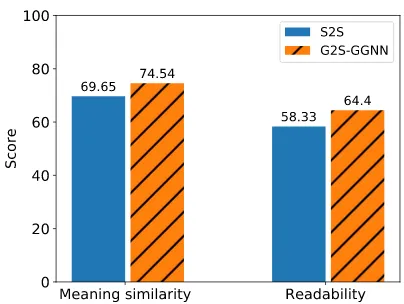
Figure 4: Human evaluation of the sentences generated byS2SandG2S-GGNNmodels. Results are statisti-cally significant withp <0.05, using Wilcoxon rank-sum test.
higher entailment compared to S2S. G2S-GGNN
has 33.5% and 5.2% better entailment perfor-mances than S2S, when REF entails GEN and GEN entails REF, respectively. G2S models also generate sentences that contradict the reference sentences less. This suggests that our models are capable of capturing better semantic information from the graph generating outputs semantically re-lated to the reference sentences.
Human Evaluation To further assess the qual-ity of the generated sentences, we conduct a hu-man evaluation. We employ theDirect Assessment (DA) method (Graham et al., 2017) via Amazon Mechanical Turk. Using the DA method inspired byMille et al.(2018), we assess two quality crite-ria: (i)meaning similarity: how close in meaning the generated text is to the gold sentence; and (ii) readability: how well the generated sentence reads (Is it good fluent English?).
We randomly select 100 sentences generated by
S2SandG2S-GGNNand randomly assign them to HITs (following Mechanical Turk terminology). Human workers rate the sentences according to meaning similarity and readability on a 0-100 rat-ing scale. The tasks are executed separately and workers were first given brief instructions. For each sentence, we collect scores from 5 workers and average them. Models are ranked according to the mean of sentence-level scores. We apply a quality control step filtering workers who do not score some faked and known sentences properly.
Figure 4 shows the results. In both metrics,
[image:8.595.73.292.62.232.2](a / agree :ARG0 (a2 / and :op1 (c / country :wiki China :name (n / name :op1 China)) :op2 (c2 / country :wiki Kyrgyzstan :name (n2 / name :op1 Kyrgyzs-tan))) :ARG1 (t / threaten-01 :ARG0 (a3 / and :op1 (t2 / terrorism) :op2 (s / separatism) :op3 (e / extremism)) :ARG2 (a4 / and :op1 (s3 / security :mod (r / region)) :op2 (s4 / stability :mod r)) :time (s2 / still) :ARG1-of (m / major-02)) :medium (c3 / communique :mod (j / joint)))
GOLD China and Kyrgyzstan agreed in a joint communique that terrorism, separatism and extremism still pose major threats to regional security and stability.
S2S In the joint communique, China and Kyrgyzstan still agreed to threaten terrorism, separatism, extremism and regional stability.
Song et. al (2018) In a joint communique, China and Kyrgyzstan have agreed to still be a major threat to regional security, and regional stability.
[image:9.595.75.518.63.206.2]G2S-GGNN At a joint communique, China and Kyrgyzstan agreed that terrorism, separatism and extremism are still a major threat to region security and stability.
Table 7: An example of an AMR graph and generated sentences. GOLD refers to the reference sentence.
Model ADDED MISS
S2S 47.34 37.14
G2S-GIN 48.67 33.64
G2S-GAT 48.24 33.73
G2S-GGNN 48.66 34.06
GOLD 50.77 28.35
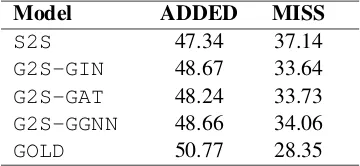
Table 8: Fraction of elements in the output that are not present in the input (ADDED) and the fraction of ele-ments in the input graph that are missing in the gener-ated sentence (MISS), for the test set of LDC2017T10. The token lemmas are used in the comparison. GOLD
refers to the reference sentences.
quality of the generated sentences regardingS2S. The Pearson correlations between meaning sim-ilarity and readability scores, and METEOR6 scores are 0.50 and 0.22, respectively.
Semantic Adequacy We also evaluate the se-mantic adequacy of our model (how well does the generated output match the input?) by compar-ing the number of added and misscompar-ing tokens that occur in the generated versus reference sentences (GOLD). An added token is one that appears in the generated sentence but not in the input graph. Conversely, a missing token is one that occurs in the input but not in the output. InGOLD, added kens are mostly function words while missing to-kens are typically input concepts that differ from the output lemma. For instance, in Figure1,there andof are added tokens whilepersonis a missing token. As shown in Table8,G2Sapproaches out-perform theS2Sbaseline.G2S-GINis closest to
GOLDwith respect to both metrics suggesting that this model is better able to generate novel words to construct the sentence and captures a larger range of concepts from the input AMR graph, covering 6METEOR score is used as it is a sentence-level metric.
more information.
Manual Inspection Table 7 shows sentences generated byS2S,Song et al.(2018),G2S-GAT, and the reference sentence. The example shows that our approach correctly verbalises the subject of the embedded clause “China and ... agreed
that terrorism, separatism and extremismSU BJ ...
pose major threats to ...”, while S2S and Song
et al.(2018) are fooled by the fact thatagree fre-quently takes an infinitival argument which shares its subject (“China ...SU BJ agreed to threaten / have agreed to be a major threat”). While this is a single example, it suggests that dual encoding en-hances the model ability to take into account the dependencies and the graph structure information, rather than the frequency of n-grams.
6 Conclusion
We have studied the problem of generating text from AMR graphs. We introduced a novel archi-tecture that explicitly encodes two parallel and ad-juvant representations of the graph (top-down and bottom-up). We showed that our approach out-performs state-of-the-art results in AMR-to-text generation. We provided an extensive evalua-tion of our models and demonstrated that they are able to achieve the best performance. In the fu-ture, we will consider integrating deep generative graph models to express probabilistic dependen-cies among AMR nodes and edges.
Acknowledgments
[image:9.595.91.271.245.328.2]References
Laura Banarescu, Claire Bonial, Shu Cai, Madalina Georgescu, Kira Griffitt, Ulf Hermjakob, Kevin Knight, Philipp Koehn, Martha Palmer, and Nathan Schneider. 2013. Abstract meaning representation for sembanking. InProceedings of the 7th Linguis-tic Annotation Workshop and Interoperability with Discourse, pages 178–186, Sofia, Bulgaria. Associ-ation for ComputAssoci-ational Linguistics.
Daniel Beck, Gholamreza Haffari, and Trevor Cohn. 2018. Graph-to-sequence learning using gated graph neural networks. In Proceedings of the 56th Annual Meeting of the Association for Com-putational Linguistics (Volume 1: Long Papers), pages 273–283, Melbourne, Australia. Association for Computational Linguistics.
Anja Belz, Mike White, Dominic Espinosa, Eric Kow, Deirdre Hogan, and Amanda Stent. 2011. The first surface realisation shared task: Overview and eval-uation results. In Proceedings of the Generation Challenges Session at the 13th European Workshop on Natural Language Generation, pages 217–226, Nancy, France. Association for Computational Lin-guistics.
Michael M. Bronstein, Joan Bruna, Yann LeCun, Arthur Szlam, and Pierre Vandergheynst. 2017. Ge-ometric deep learning: Going beyond euclidean data. IEEE Signal Processing Magazine, 34(4):18– 42.
Kris Cao and Stephen Clark. 2019. Factorising AMR generation through syntax. In Proceedings of the 2019 Conference of the North American Chapter of the Association for Computational Linguistics: Hu-man Language Technologies, Volume 1 (Long and Short Papers), pages 2157–2163, Minneapolis, Min-nesota. Association for Computational Linguistics.
Thiago Castro Ferreira, Iacer Calixto, Sander Wubben, and Emiel Krahmer. 2017. Linguistic realisation as machine translation: Comparing different MT mod-els for AMR-to-text generation. InProceedings of the 10th International Conference on Natural Lan-guage Generation, pages 1–10, Santiago de Com-postela, Spain. Association for Computational Lin-guistics.
Kyunghyun Cho, Bart van Merrienboer, Caglar Gul-cehre, Dzmitry Bahdanau, Fethi Bougares, Holger Schwenk, and Yoshua Bengio. 2014. Learning phrase representations using RNN encoder–decoder for statistical machine translation. InProceedings of the 2014 Conference on Empirical Methods in Nat-ural Language Processing (EMNLP), pages 1724– 1734, Doha, Qatar. Association for Computational Linguistics.
Marco Damonte and Shay B. Cohen. 2019. Struc-tural neural encoders for AMR-to-text generation. InProceedings of the 2019 Conference of the North
American Chapter of the Association for Compu-tational Linguistics: Human Language Technolo-gies, Volume 1 (Long and Short Papers), pages 3649–3658, Minneapolis, Minnesota. Association for Computational Linguistics.
Michael Denkowski and Alon Lavie. 2014. Meteor universal: Language specific translation evaluation for any target language. InProceedings of the Ninth Workshop on Statistical Machine Translation, pages 376–380, Baltimore, Maryland, USA. Association for Computational Linguistics.
Jacob Devlin, Ming-Wei Chang, Kenton Lee, and Kristina Toutanova. 2019. BERT: Pre-training of deep bidirectional transformers for language under-standing. InProceedings of the 2019 Conference of the North American Chapter of the Association for Computational Linguistics: Human Language Technologies, Volume 1 (Long and Short Papers), pages 4171–4186, Minneapolis, Minnesota. Associ-ation for ComputAssoci-ational Linguistics.
Tobias Falke, Leonardo F. R. Ribeiro, Prasetya Ajie Utama, Ido Dagan, and Iryna Gurevych. 2019.
Ranking generated summaries by correctness: An interesting but challenging application for natural language inference. InProceedings of the 57th An-nual Meeting of the Association for Computational Linguistics, pages 2214–2220, Florence, Italy. Asso-ciation for Computational Linguistics.
Jeffrey Flanigan, Chris Dyer, Noah A. Smith, and Jaime Carbonell. 2016a. CMU at SemEval-2016 task 8: Graph-based AMR parsing with infinite ramp loss. InProceedings of the 10th International Workshop on Semantic Evaluation (SemEval-2016), pages 1202–1206, San Diego, California. Associa-tion for ComputaAssocia-tional Linguistics.
Jeffrey Flanigan, Chris Dyer, Noah A. Smith, and Jaime Carbonell. 2016b. Generation from abstract meaning representation using tree transducers. In
Proceedings of the 2016 Conference of the North American Chapter of the Association for Computa-tional Linguistics: Human Language Technologies, pages 731–739, San Diego, California. Association for Computational Linguistics.
Claire Gardent, Anastasia Shimorina, Shashi Narayan, and Laura Perez-Beltrachini. 2017. The WebNLG challenge: Generating text from RDF data. In Pro-ceedings of the 10th International Conference on Natural Language Generation, pages 124–133, San-tiago de Compostela, Spain. Association for Com-putational Linguistics.
Yvette Graham, Timohy Baldwin, Alistair Moffat, and Justin Zobel. 2017. Can machine translation sys-tems be evaluated by the crowd alone.Natural Lan-guage Engineering, 23(1):3–30.
of the Association for Computational Linguistics, 7:297–312.
Diederick P Kingma and Jimmy Ba. 2015. Adam: A method for stochastic optimization. In Inter-national Conference on Learning Representations (ICLR), San Diego, CA, USA.
Philipp Koehn, Hieu Hoang, Alexandra Birch, Chris Callison-Burch, Marcello Federico, Nicola Bertoldi, Brooke Cowan, Wade Shen, Christine Moran, Richard Zens, Chris Dyer, Ondˇrej Bojar, Alexandra Constantin, and Evan Herbst. 2007. Moses: Open source toolkit for statistical machine translation. In
Proceedings of the 45th Annual Meeting of the ACL on Interactive Poster and Demonstration Sessions, ACL ’07, pages 177–180, Stroudsburg, PA, USA. Association for Computational Linguistics.
Rik Koncel-Kedziorski, Dhanush Bekal, Yi Luan, Mirella Lapata, and Hannaneh Hajishirzi. 2019.
Text Generation from Knowledge Graphs with Graph Transformers. In Proceedings of the 2019 Conference of the North American Chapter of the Association for Computational Linguistics: Hu-man Language Technologies, Volume 1 (Long and Short Papers), pages 2284–2293, Minneapolis, Min-nesota. Association for Computational Linguistics. Ioannis Konstas, Srinivasan Iyer, Mark Yatskar, Yejin
Choi, and Luke Zettlemoyer. 2017. Neural amr: Sequence-to-sequence models for parsing and gen-eration. In Proceedings of the 55th Annual Meet-ing of the Association for Computational LMeet-inguis- Linguis-tics (Volume 1: Long Papers), pages 146–157, Van-couver, Canada. Association for Computational Lin-guistics.
Yujia Li, Richard Zemel, Marc Brockschmidt, and Daniel Tarlow. 2016. Gated graph sequence neural networks. InProceedings of the International Con-ference on Learning Representations (ICLR), San Juan, Puerto Rico.
Kexin Liao, Logan Lebanoff, and Fei Liu. 2018. Ab-stract meaning representation for multi-document summarization. In Proceedings of the 27th Inter-national Conference on Computational Linguistics, pages 1178–1190, Santa Fe, New Mexico, USA. As-sociation for Computational Linguistics.
Diego Marcheggiani and Laura Perez Beltrachini. 2018. Deep graph convolutional encoders for struc-tured data to text generation. In Proceedings of the 11th International Conference on Natural Lan-guage Generation, pages 1–9, Tilburg University, The Netherlands. Association for Computational Linguistics.
Simon Mille, Anja Belz, Bernd Bohnet, Yvette Gra-ham, Emily Pitler, and Leo Wanner. 2018. The first multilingual surface realisation shared task (SR’18): Overview and evaluation results. InProceedings of the First Workshop on Multilingual Surface Realisa-tion, pages 1–12, Melbourne, Australia. Association for Computational Linguistics.
Courtney Napoles, Matthew Gormley, and Benjamin Van Durme. 2012. Annotated gigaword. In Pro-ceedings of the Joint Workshop on Automatic Knowl-edge Base Construction and Web-scale KnowlKnowl-edge Extraction, AKBC-WEKEX ’12, pages 95–100, Stroudsburg, PA, USA. Association for Computa-tional Linguistics.
Shashi Narayan and Claire Gardent. 2012. Structure-driven lexicalist generation. InProceedings of COL-ING 2012, pages 2027–2042, Mumbai, India. The COLING 2012 Organizing Committee.
Kishore Papineni, Salim Roukos, Todd Ward, and Wei-Jing Zhu. 2002. Bleu: A method for automatic eval-uation of machine translation. In Proceedings of the 40th Annual Meeting on Association for Com-putational Linguistics, ACL ’02, pages 311–318, Stroudsburg, PA, USA. Association for Computa-tional Linguistics.
Jeffrey Pennington, Richard Socher, and Christopher Manning. 2014. Glove: Global vectors for word representation. In Proceedings of the 2014 Con-ference on Empirical Methods in Natural Language Processing (EMNLP), pages 1532–1543, Doha, Qatar. Association for Computational Linguistics.
Nima Pourdamghani, Kevin Knight, and Ulf Herm-jakob. 2016. Generating English from abstract meaning representations. InProceedings of the 9th International Natural Language Generation confer-ence, pages 21–25, Edinburgh, UK. Association for Computational Linguistics.
Michael Sejr Schlichtkrull, Thomas N. Kipf, Peter Bloem, Rianne van den Berg, Ivan Titov, and Max Welling. 2018. Modeling relational data with graph convolutional networks. InThe Semantic Web - 15th International Conference, ESWC 2018, Heraklion, Crete, Greece, June 3-7, 2018, Proceedings, pages 593–607.
Mike Schuster and Kuldip K. Paliwal. 1997. Bidirec-tional recurrent neural networks.IEEE Transactions on Signal Processing, 45(11):2673–2681.
Abigail See, Peter J. Liu, and Christopher D. Manning. 2017.Get to the point: Summarization with pointer-generator networks. InProceedings of the 55th An-nual Meeting of the Association for Computational Linguistics (Volume 1: Long Papers), pages 1073– 1083, Vancouver, Canada. Association for Compu-tational Linguistics.
Stuart M. Shieber, Gertjan van Noord, Fernando C. N. Pereira, and Robert C. Moore. 1990. Semantic-head-driven generation. Computational Linguistics, 16(1):30–42.
Linfeng Song, Yue Zhang, Zhiguo Wang, and Daniel Gildea. 2018. A graph-to-sequence model for AMR-to-text generation. InProceedings of the 56th Annual Meeting of the Association for Computa-tional Linguistics (Volume 1: Long Papers), pages 1616–1626, Melbourne, Australia. Association for Computational Linguistics.
Nitish Srivastava, Geoffrey Hinton, Alex Krizhevsky, Ilya Sutskever, and Ruslan Salakhutdinov. 2014.
Dropout: A simple way to prevent neural networks from overfitting. Journal of Machine Learning Re-search, 15(1):1929–1958.
Petar Veliˇckovi´c, Guillem Cucurull, Arantxa Casanova, Adriana Romero, Pietro Li`o, and Yoshua Bengio. 2018. Graph Attention Networks. In International Conference on Learning Representations, Vancou-ver, Canada.
Boris Weisfeiler and A.A. Lehman. 1968. A reduction of a graph to a canonical form and an algebra aris-ing duraris-ing this reduction. Nauchno-Technicheskaya Informatsia, pages 12–16.
Adina Williams, Nikita Nangia, and Samuel Bowman. 2018. A broad-coverage challenge corpus for sen-tence understanding through inference. In Proceed-ings of the 2018 Conference of the North American Chapter of the Association for Computational Lin-guistics: Human Language Technologies, Volume 1 (Long Papers), pages 1112–1122, New Orleans, Louisiana. Association for Computational Linguis-tics.