Proceedings of the 2019 Conference on Empirical Methods in Natural Language Processing
3585
Improved Differentiable Architecture Search for
Language Modeling and Named Entity Recognition
Yufan Jiang1, Chi Hu1, Tong Xiao12∗, Chunliang Zhang12, Jingbo Zhu12
1NLP Lab, Northeastern University, Shenyang, China
2NiuTrans Research, Shenyang, China
[email protected], [email protected]
{xiaotong, zhangchunliang, zhujingbo}@mail.neu.edu.cn
Abstract
In this paper, we study differentiable neural architecture search (NAS) methods for natu-ral language processing. In particular, we im-prove differentiable architecture search by re-moving the softmax-local constraint. Also, we apply differentiable NAS to named entity recognition (NER). It is the first time that dif-ferentiable NAS methods are adopted in NLP tasks other than language modeling. On both the PTB language modeling and CoNLL-2003 English NER data, our method outperforms strong baselines. It achieves a new state-of-the-art on the NER task.
1 Introduction
Neural architecture search (NAS) has become popular recently in machine learning for their abil-ity to find new models and to free researchers from the hard work of designing network architectures. The earliest of these approaches use reinforcemen-t learning (RL) reinforcemen-to learn promising archireinforcemen-tecreinforcemen-tures in a discrete space (Zoph and Le, 2016), where-as others have successfully modeled the problem in a continuous manner (Liu et al., 2019; Xie et al., 2019b; Huang and Xiang, 2019). As an instance of the latter, differentiable architecture search (DARTS) employs continuous relaxation to architecture representation and makes gradient de-scent straightforwardly applicable to search. This leads to an efficient search process that is orders of magnitude faster than the RL-based counterparts.
Like recent methods in NAS (Xie and Yuille,
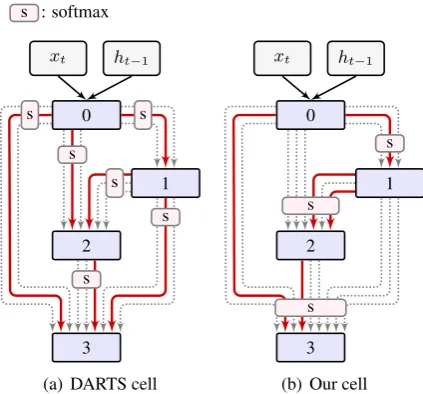
2017; Zoph and Le, 2016; Baker et al., 2016), DARTS represents networks as a directed acyclic graph for a given computation cell (see Figure
1(a)). An edge between nodes performs a pre-defined operation to transform the input (i.e., tail)
∗
Corresponding author.
xt ht−1
0
1
2
3 s
s s
s
s
s s : softmax
(a) DARTS cell
xt ht−1
0
1
2
3
s
s
s
[image:1.595.310.522.222.419.2](b) Our cell
Figure 1: An overview of DARTS cell and our cell
to the output (i.e., head). For a continuous net-work space, DARTS uses the softmax trick to re-lax the categorical choice of edges to soft deci-sions. Then, one can optimize over the graph us-ing standard gradient descent methods. The opti-mized network is inferred by choosing the edges with maximum weights in softmax.
However, DARTS is a “local” model because the softmax-based relaxation is imposed on each bundle of edges between two nodes. This leads to a biased model in that edges coming from different nodes are not comparable. Such a constraint limit-s the inference limit-space to limit-sub-graphlimit-s with one edge between each pair of nodes. Also, the learned net-work might be redundant because every node has to receive edges from all predecessors no matter they are necessary or not. This problem is simi-lar to the bias problem in other graph-based mod-els where local decisions make the model non-optimal (Lafferty et al.,2001;Daphne Koller and Nir Friedman,2009).
called I-DARTS, that further relaxes the softmax-local constraint. The idea is simple - we consider all incoming edges to a given node in a single soft-max. This offers a broader choice of edges and en-larges the space we infer the network from. For ex-ample, one can simultaneously select multiple im-portant edges between two nodes and leave some node pairs unlinked (see Figure1(b)).
I-DARTS outperforms strong baselines on the PTB language modeling and CoNLL named entity recognition (NER) tasks. This gives a new state-of-the-art on the NER dataset. To our knowledge, it is the first time to apply differentiable architec-ture search methods to NLP tasks other than lan-guage modeling. More interestingly, we observe that our method is 1.4X faster than DARTS for convergence of architecture search. Also, we pro-vide the architectures learned by I-DARTS, which can be referred for related tasks.
2 The Method
Although we will restrict ourselves to language modeling and NER for experiments, in the sec-tion, we discuss the more general case. We choose recurrent neural networks (RNNs) to model the sequence generation and tagging problems. Giv-en a sequGiv-ence of input vectors {x1, ..., xL}, we
repeat applying RNN cells to generate the out-put {h1, ..., hL}. The RNN cell is defined as:
ht = g(xt, ht−1), where t is the time step and
g(·,·)is the function of the cell. In NAS, the ob-jective is to search for a goodg(·,·)in an automat-ic fashion.
2.1 Architecture Search Space
We follow the assumption that g(·,·) is a DAG consisting ofNnodes and edges among them (Liu et al.,2019;Xie et al.,2019b;Pham et al.,2018). An edgeoi,j(·)between node pair (i,j) indicates an activation function from nodej to nodei. For nodei, it simply sums over vectors from all pre-decessor nodes (j < i), followed by a linear trans-formation with a parameter matrixWi. More
for-mally, letsibe the state of nodei. We definesi to
be:
si = X
j<i
oi,j(sj·Wj) (1)
See Figure 1 for an example network (red lines). Note that this model can encode an exponential number of graphs by choosing different sub-sets
of edges (i.e., choosingoi,j(·)for each (i,j)). The output of search is the optimal edge selection and the corresponding network.
2.2 Improved DARTS
Given a set of edges{oi,jk }, one can try eachoi,jk
to induce a network, and then train and evaluate it. The optimal choice is the edge with highest accuracy on the validation set. In I-DARTS, we instead do this in a soft way. We re-definesias:
si= X
j<i X
k
αi,jk ·oi,jk (sj ·Wj) (2)
whereαi,jk is the weight indicating the importance ofoi,jk (·). It is computed by the softmax normal-ization over edges between nodesiandj, like this
αi,jk = exp(w
i,j k ) P
k0exp(wi,jk0)
(3)
where wi,jk is the model parameter. This model reduces the architecture search problem to learn continuous variables{αi,jk }, which can be imple-mented using efficient gradient descent methods. After training, the final architecture is encoded by the edges with largest weights.
Eq. (3) imposes a constraint that weights{αi,jk }
are normalized for eachj. Such a model in gen-eral faces the local decision and bias problem-s aproblem-s pointed out in graph-baproblem-sed methodproblem-s ( Laffer-ty et al.,2001;Daphne Koller and Nir Friedman,
2009). Moreover, the inference has to be per-formed in a smaller space because we have to infer exactly one edge between each node pair and ex-clude networks violating this constraint.
Here we remove the constraint and system bias. To this end, we compute the softmax normaliza-tion over all incoming edges for nodei:
αi,jk = exp(w
i,j k ) P
j<i P
k0exp(wi,jk0)
(4)
It provides us a way to compare all incoming edges in the same manner, rather than making a local decision via a bundle of edges from nodej. As another bonus, this method can search for works that are not covered by DARTS, e.g., net-works that contain two edges between the same node pair.
differ-ence lies in that we select top-nedges with respect toαi,jk . Herenis a hyper-parameter that control-s the dencontrol-sity of the network. E.g., n = 1means a sparse net, andn = ∞means a very dense net involving all those edges.
3 Experiments
We test our method on language modeling and named entity recognition tasks. Our experiments consist of two parts: recurrent neural architecture search and architecture evaluation. In architecture search, we search for good RNN cell architectures. Then, we train and evaluate the learned architec-ture.
3.1 Architecture Search
For language modeling, we run neural search on the PTB corpus. We use the standard pre-processed version of the dataset (Pham et al.,
2018). To make it comparable with previous work, we copy the setup used in (Pham et al.,2018;Liu et al.,2019). The recurrent cell consist of 8 nodes. The candidate operation set of every edge contain 5 activation functions, including zeroize, tanh, re-lu, sigmoid, and identity. To learn architectures, we run the search system for 40 training epochs with a batch size of 256. We optimize models pa-rameters{Wi}using SGD with a learning rate of
20 and a weight decay rate of 5e-7, and optimized softmax relaxation parameters {wi,jk } by Adam with a learning rate of 3e-3 and a weight decay rate of 1e-3. For RNN models, we use a single-layer recurrent network with embedding and hid-den sizes = 300. It takes us 4 hours to learn the architecture on a single GPU of NVIDIA 1080Ti.
For named entity recognition, we choose the CONLL-2003 English dataset. We follow the same setup as in language modeling but with a d-ifferent learning rate (0.1) and a dd-ifferent hidden layer size (256). It takes us 4 hours to learn the architecture on the same GPU.
3.2 Architecture Evaluation
Firstly, the discovered architecture is evaluated on the language modeling task. Before that, we train it on the same data used in architecture search. The size of hidden layers is set to 850. We use av-eraged SGD to train the model for 3,000 epochs, with a learning rate of 20 and a weight decay rate of 8e-7. For a fair comparison, we do not fine-tune the model at the end of the training.
Architecture Perplexity Search Cost val test (GPU days)
V-RHN 67.9 65.4
-LSTM 60.7 58.8
-LSTM + SC 60.9 58.3 -LSTM + SE 58.1 56.0
-ENAS 60.8 58.6 0.50
DARTS 58.3 56.1 0.25
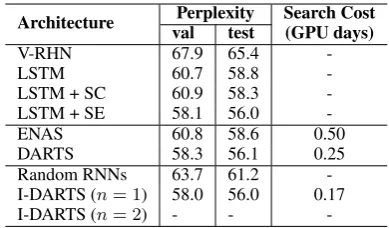
Random RNNs 63.7 61.2 -I-DARTS (n= 1) 58.0 56.0 0.17 I-DARTS (n= 2) - -
-Table 1: Perplexities on PTB (lower is better). V-RHN (Zilly et al.,2016) indicates Variational RHN. LSTM + SC (Yang et al.,2018) indicates LSTM with skip con-nection. LSTM + SE (Merity et al., 2018) indicates LSTM with mixture of softmax. Random RNNs indi-cates that the network generated by random initialized.
Table 1 shows the perplexities of different RN-N models on PTB. We also report the results of previous systems. The model discovered by I-DARTS achieves a validation perplexity of 58.0 and a test perplexity of 56.0 when n = 1. It is on par with the state-of-the-art models that are de-signed either manually or automatically. Howev-er, we find that the model failed to optimize when
n = 2. It might result from the complex interac-tion between operainterac-tions. We leave this issue for future study.
Since architecture search is initialization-sensitive (Pham et al.,2018;Liu et al.,2019), we search the architectures for 4 times with different random seeds. We evaluate the architecture every 10 search epochs by retraining it on PTB for 500 epochs. We compare DARTS with our I-DARTS method with the same random seed. See Figure
2(b) for averaged validation perplexities over 4 d-ifferent runs at dd-ifferent search epochs. We see that I-DARTS is easier to converge than DARTS (4 hours). It is 1.4X faster than that of DARTS. An-other interesting finding is that I-DARTS achieves a lower validation perplexity than DARTS during architecture search. This may indicate better ar-chitectures found by I-DARTS because the search model is optimized with respect to validation per-plexity.
[image:3.595.318.513.61.175.2]model because it achieved state-of-the-art results on several sequence labeling tasks (Lample et al.,
2016;Ma and Hovy, 2016). We use GloVe 100-dimensional word embeddings (Pennington et al.,
2014) and pooled contextual embeddings (Akbik et al.,2019) as pre-trained word embeddings. We replace the standard bidirectional LSTMs with the discovered recurrent neural cells. Also, we set the hidden layer size to 512 and apply variational dropout to the input and output of the RNN layer. We train the network using SGD with a learning rate of 0.1 and a gradient clipping threshold of 5.0. We reduce the learning rate by a factor of 0.25 if the test error does not decrease for 2 epochs.
Table2 shows a comparison of different meth-ods. Our baseline uses RNN cells generated from random initialized whose F1-score varies greatly and is lower than that of the standard LSTMs. I-DARTS significantly outperforms Random RNNs and DARTS. The best score is achieved whenn= 1. It indicates that the task prefers a sparse net-work. Also, we see that our model works with the advanced pre-trained language models in that we replace the LSTM cell to our cell. The I-DARTS architecture yields a new RNN-based state-of-the-art on this task (93.47 F1-score). In Table2, We find it interesting that Random RNNs are good for NER task. This may result from the design of search space that fit for such tasks substantially. Search space is also a key factor in neural architec-ture search that new efforts should focus on (Xie et al.,2019a).
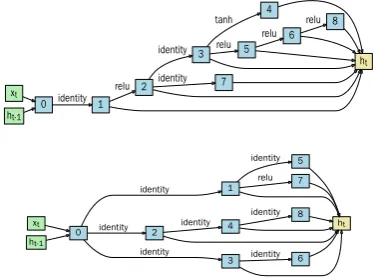
We visualize the discovered cells in Figure 3. Each cell is a directed acyclic graph consisting of an ordered sequence of 8 nodes with an activation function applied on each edge. These automati-cally discovered cells are complex and hard to be designed manually. An interesting phenomenon comes up that the best architecture on language modeling is different from that on name entity recognition. This might result from the fact that different tasks have different inductive bias. Al-so, this suggests the possibility of architecture se-lection from the top-ksearch results on the target task.
4 Related Work
Neural architecture search has been proposed to automatically search for better architectures, showing competitive results on several tasks, e.g., image recognition and language modeling. A
s-0 10 20 30 40
62 64 66 68 70
number of search epochs
V
alid
Perple
xity I-DARTS
[image:4.595.311.501.67.139.2]DARTS
Figure 2: Perplexity vs. search epoch number.
Model F1
best published
BiLSTM-CRF (Lample et al.,2016) 90.94 BiLSTM-CRF+ELMo (Peters et al.,2018) 92.22 BERT Base (Devlin et al.,2018) 92.40 BERT Large (Devlin et al.,2018) 92.80 BiLSTM-CRF+PCE (Akbik et al.,2019) 93.18 Random RNNs w/o pre-trained LM 90.64 DARTS w/o pre-trained LM 91.05 I-DARTS (n= 2) w/o pre-trained LM 90.96 I-DARTS (n= 1) w/o pre-trained LM 91.23
Random RNNs 92.89
DARTS 93.13
[image:4.595.317.517.184.336.2]I-DARTS (n= 2) 93.14 I-DARTS (n= 1) 93.47
Table 2: F1 scores on the CoNLL-2003 English NER test set.
trand of NAS research focuses on reinforcemen-t learning (Zoph and Le, 2016) and evolutionary algorithm-based (Xie and Yuille, 2017) method-s. They are powerful but inefficient. Recent ap-proaches speed up the search process by weight sharing (Pham et al.,2018) and differentiable ar-chitecture search (Liu et al.,2019). But there is no discussion on the softmax-local problem in previ-ous work. Moreover, previprevi-ous methods are often tested on language modeling. It is rare to see stud-ies on these methods for other NLP tasks.
xt
0
ht-1 1
identity relu 2
ht
3 identity
7 identity
4 tanh
5 relu relu 6
8 relu
xt 0 ht-1
1 identity
2 identity
3 identity
5 identity
7 relu
ht 4
identity
6 identity
[image:4.595.322.509.585.724.2]8 identity
5 Conclusions
We improved the DARTS to address the bias prob-lem by removing the softmax-local constraint. Our method is search efficient and discovers sev-eral better architectures for PTB language model-ing and CoNLL named entity recognition (NER) tasks. We plan to consider the network density problem in search and apply I-DARTS to more tasks in our future study.
6 Acknowledgments
This work was supported in part by the Nation-al Science Foundation of China (Nos. 61876035, 61732005 and 61432013), the National Key R&D Program of China (No. 2019QY1801) and the Opening Project of Beijing Key Laboratory of Internet Culture and Digital Dissemination Re-search. We also thank the reviewers for their in-sightful comments.
References
Alan Akbik, Tanja Bergmann, and Roland Vollgraf. 2019. Pooled contextualized embeddings for named entity recognition. InNAACL.
Alan Akbik, Duncan Blythe, and Roland Vollgraf. 2018. Contextual string embeddings for sequence labeling. InCOLING.
Bowen Baker, Otkrist Gupta, Nikhil Naik, and Ramesh Raskar. 2016. Designing neural network architec-tures using reinforcement learning. arXiv preprint arXiv:1611.02167.
Daphne Koller and Nir Friedman. 2009. Probabilis-tic Graphical Models - Principles and Techniques. MIT press.
Jacob Devlin, Ming-Wei Chang, Kenton Lee, and Kristina Toutanova. 2018. Bert: Pre-training of deep bidirectional transformers for language understand-ing. arXiv preprint arXiv:1810.04805.
Zhiheng Huang and Bing Xiang. 2019. Wenet: Weighted networks for recurrent network architec-ture search. arXiv preprint arXiv:1904.03819.
John Lafferty, Andrew McCallum, and Fernando CN Pereira. 2001. Conditional random fields: Prob-abilistic models for segmenting and labeling se-quence data.
Guillaume Lample, Miguel Ballesteros, Sandeep Sub-ramanian, Kazuya Kawakami, and Chris Dyer. 2016. Neural architectures for named entity recognition. InProceedings of the 2016 Conference of the North American Chapter of the Association for Computa-tional Linguistics: Human Language Technologies,
pages 260–270, San Diego, California. Association for Computational Linguistics.
Hanxiao Liu, Karen Simonyan, and Yiming Yang. 2019. DARTS: Differentiable architecture search. InInternational Conference on Learning Represen-tations.
Xuezhe Ma and Eduard Hovy. 2016. End-to-end sequence labeling via bi-directional LSTM-CNNs-CRF. InProceedings of the 54th Annual Meeting of the Association for Computational Linguistics (Vol-ume 1: Long Papers), pages 1064–1074, Berlin, Germany. Association for Computational Linguis-tics.
Stephen Merity, Nitish Shirish Keskar, and Richard Socher. 2018. Regularizing and optimizing LSTM language models. In International Conference on Learning Representations.
Jeffrey Pennington, Richard Socher, and Christo-pher D. Manning. 2014. Glove: Global vectors for word representation. InEMNLP.
Matthew Peters, Waleed Ammar, Chandra Bhagavatu-la, and Russell Power. 2017. Semi-supervised se-quence tagging with bidirectional language models. InProceedings of the 55th Annual Meeting of the As-sociation for Computational Linguistics (Volume 1: Long Papers), pages 1756–1765, Vancouver, Cana-da. Association for Computational Linguistics.
Matthew Peters, Mark Neumann, Mohit Iyyer, Mat-t Gardner, ChrisMat-topher Clark, KenMat-ton Lee, and Luke Zettlemoyer. 2018. Deep contextualized word rep-resentations. In Proceedings of the 2018 Confer-ence of the North American Chapter of the Associ-ation for ComputAssoci-ational Linguistics: Human Lan-guage Technologies, Volume 1 (Long Papers), pages 2227–2237, New Orleans, Louisiana. Association for Computational Linguistics.
Hieu Pham, Melody Y Guan, Barret Zoph, Quoc V Le, and Jeff Dean. 2018. Efficient neural architecture search via parameter sharing. arXiv preprint arX-iv:1802.03268.
Erik Tjong Kim Sang and Fien De Meulder. 2003. In-troduction to the conll-2003 shared task: Language-independent named entity recognition. InCoNLL.
Lingxi Xie and Alan Yuille. 2017. Genetic cnn. In
Proceedings of the IEEE International Conference on Computer Vision, pages 1379–1388.
Saining Xie, Alexander Kirillov, Ross Girshick, and Kaiming He. 2019a. Exploring randomly wired neural networks for image recognition. arXiv preprint arXiv:1904.01569.
Zhilin Yang, Zihang Dai, Ruslan Salakhutdinov, and William W. Cohen. 2018. Breaking the softmax bot-tleneck: A high-rank RNN language model. In In-ternational Conference on Learning Representation-s.
Julian G. Zilly, Rupesh Kumar Srivastava, Jan Koutn´ık, and J¨urgen Schmidhuber. 2016. Recurrent highway networks. InICML.