Proceedings of the 2019 Conference on Empirical Methods in Natural Language Processing 4313
Identifying and Explaining Discriminative Attributes
Armins Stepanjans and Andr´e Freitas
Department of Computer Science University of Manchester
[email protected] [email protected]
Abstract
Identifying what is at the center of the mean-ing of a word and what discriminates it from other words is a fundamental natural lan-guage inference task. This paper describes an explicit word vector representation model (WVM) to support the identification of dis-criminative attributes. A core contribution of the paper is a quantitative and qualitative comparative analysis of different types of data sources and Knowledge Bases in the construc-tion of explainable and explicit WVMs: (i)
knowledge graphs built from dictionary defini-tions, (ii)entity-attribute-relationships graphs
derived from images and (iii) commonsense
knowledge graphs. Using a detailed quantita-tive and qualitaquantita-tive analysis, we demonstrate that these data sources have complementary semantic aspects, supporting the creation of explicit semantic vector spaces. The explicit vector spaces are evaluated using the task of discriminative attribute identification, show-ing comparable performance to the state-of-the-art systems in the task (F1-score = 0.69), while delivering full model transparency and explainability.
1 Introduction
Word-vector/embedding models (WVM) have emerged as first-class representations in contem-porary Natural Language Processing (NLP) tasks due to their ability to capture semantic similar-ity and relatedness in an unsupervised and
com-prehensive manner (Turney and Pantel, 2010),
(Freitas, 2015). Additionally, the simplicity en-tailed by the vector space abstraction makes it an engineering-friendly representation, also ex-plaining its widespread adoption and use (Freitas, 2015). However, the latent features (dense vec-tors) at the center of most of the best-performing models have limited their application to two main uses: (i) computing semantic similarity and
relat-edness measures and (ii) performing vocabulary generalization as an input layer on Machine Learn-ing (ML) models.
The identification of discriminative attributes (IDA), recently introduced byKrebs et al.(2018), can motivate the development of word vector mod-els which can support types of operations with finer semantics, going beyond the computation of semantic similarity and relatedness scores, with potential applications in fine-grained semantic in-ference tasks.
Concretely, using the example provided by (Krebs et al., 2018), given a pair of target terms
appleandbanana, the IDA task seeks to answer if the termredis a discriminative attribute for apple in comparison to banana. According to Krebs et al.
semantic difference is a ternary relation between two concepts (apple,banana) and a discriminative feature (red) that characterizes the former concept but not the latter.
This paper focuses on proposing an explicit (sparse) WVM for detecting and explaining
dis-criminative attributes. The proposed explicit
WVM provides a dimension of explainability
while keeping the simplicity of the vector space
representation model. This addition allows the
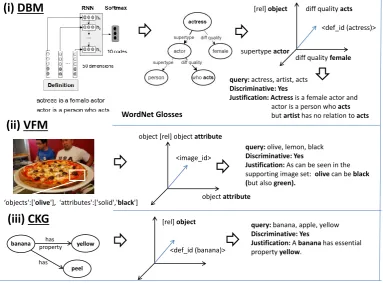
model to provide a justificationwhile addressing tasks such as the computation of discriminative attributes (Figure 1). The explicit nature of the model and its ability to compute the difference between the term pairs is the core proposed con-tribution (instead of the improvement of the F1-score for the task). Models with the ability to com-pute discriminative attributes can provide a repre-sentation paradigm which can support more fine-grained semantic inference tasks.
construction of explainable and explicit WVMs. The IDA task requires a granular representation of the necessary and sufficient conditions associ-ated with the definition of a target concept, many of these transcending lexicographic and ency-clopaedic representations. In order to address this problem, we analyse three types of data sources: (i)knowledge graphs built from dictionary defini-tions, (ii) entity-attribute-relationship graphs de-rived from images and (iii)commonsense knowl-edge graphs. The goal behind using these mod-els is twofold: (i) to provide an explainable, fine-grained word-vector model and (ii) to support the capture of lexical-semantic relations not captured in a representative fashion in regular corpora used in existing distributional models (which in most cases combine news, encyclopedic and literary discourse).
In summary, this paper focuses on the follow-ing contributions: (i) The creation of a novel in-terpretable word vector model based on the com-bination of structured definitions and visual fea-tures for the IDA task and (ii) a detailed com-parative, quantitative and qualitative evaluation of the semantic contribution of different types of data sources for explicit semantics.
2 Related Work
In this section we group related work into two major categories: (i) approaches for the identifi-cation of discriminative attributes (IDA) and (ii) definition-based word vector space models.
Existing approaches have explored combina-tions of linguistic and data resources (WordNet, ConceptNet, Wikipedia), linguistic features (syn-tactic dependencies), sparse word vector models (JoBimText), dense word-vector (DWV) models (W2V, GloVe) and supervised/ unsupervised ma-chine learning approaches (SVM, MLP, Ensemble Methods).
With regard to interpretability and explainabil-ity we can classify IDA approaches into three
categories. Frequency-based models over
text-based features, heavily relying on textual features
and frequency-based methods (Gamallo, 2018;
Gonz´alez et al.,2018) ; ML over Textual features
(Dumitru et al., 2018; Sommerauer et al., 2018; King et al.,2018;Mao et al.,2018) andML over dense vectors and textual features(Brychc´ın et al., 2018; Attia et al., 2018; Wu et al., 2018; Du-mitru et al.,2018;Arroyo-Fern´andez et al.,2018;
Speer and Lowry-Duda,2018;Santus et al.,2018; Grishin, 2018;Zhou et al., 2018;Vinayan et al., 2018;Kulmizev et al.,2018;Zhang and Carpuat, 2018;Shiue et al.,2018). While the first category concentrates on models with higher interpretabil-ity, none of these models provide explanations.
Comparatively, this work focuses on the cre-ation of an explicit word vector space model (EWVM), with an associated explanation, evalu-ating the performance of different types of lexico-semantic resources in the context of the task of identification of discriminative attributes (IDA).
3 Identifying and Explaining
Discriminative Attributes
3.1 Problem Definition
This paper provides an explainable word vector space model (EWVM) for detecting whether a given term is a discriminative attribute or not with regard to a pair of reference terms as defined by Krebs et al.(2018). Given a triple< tp, tc, tf >,
tf (feature) is considered discriminative if it is
re-lated to the first termtp (pivot) to a significantly
higher extent than it is related to the second termtc
(comparison), i.e. tf ∈p(tp)∧tf ∈/ p(tc), where
the functionp(t)returns a set of properties associ-ated with termt.
Additionally, beyond the identification of the discriminative attribute (i.e. assigning a value of true or false to the target term triple), this paper explores different notions of an explanatione as-signed to the inference, which can be both human and machine interpretable.
3.2 Types of Discriminative Attributes
The nature of the semantic relationships expressed in the task of identifying discriminative attributes can guide the selection of the supporting target corpora. In this section, we propose a classifica-tion ofterm-discriminative attribute relationships
into three dual categories: Essential vs. Inciden-tal,Sensory vs. LogicalandRelative vs. Abso-lute.
Essential vs. Incidental: pis anessential prop-erty of an objectojust in case it is necessary that
o has p, whereas p is an incidental property of an object ojust in caseo hasp but it is possible
thatolacksp. Example:(cognac, whiskey,
french) is essential and (nose, throat,
Necessary and Sufficient Conditions, but rooted in the philosophical notion of essential and acciden-tal properties, particularly, as defined by Robert-son and Atkins(2018).
Sensory vs. Logical: pis asensoryproperty of an objecto, in casepcan be identified as a prop-erty ofoexclusively through sensory information,
whereas p is a logical property of an object o
otherwise. Example: (cheek, brow, red)
is sensory and (grapes, wine, fruit) is
logical. The Sensory vs. Logical dual category is inspired by Hayes’ Second Na¨ıve Physics Mani-festo, particularly, the distinction of ‘three ways in which tokens can be attached to their denotations’, where our notion of Sensory attribute corresponds to the second way (‘some of the tokens can be at-tached to sensory and motor systems’), whereas our notion of Logical attribute corresponds to the remaining two (‘tokens could be attached to the world through language’ and ‘token is a metathe-ory of some internal part of the themetathe-ory’) (Hayes, 1995).
Relative vs. Absolute: p is arelative property of an objectoa in relation toob just in case there
exists an objectocwith the propertyp wherepis
not an attribute ofoain relation tooc. Whereaspis
anabsoluteproperty of an objectoain case there
does not exist an object ob with the property p
wherepis not an attribute ofoawhen compared to
ob. Example: (giraffe, ostrich, tall)
is relative and (bat, butterfly, fur) is
absolute. The Relative vs. Absolute dual category follows Hayes’ idea of ‘intrinsic qualities (abso-lute) versus the distance between such qualities (relative)’ (Hayes,1995).
The classification scheme will guide the cre-ation of the discriminative word vector model de-scribed in the next section.
4 Building Explicit Word Vector Space
Models (EWVM)
Based on the dual categories identified in the pre-vious section, a composition of three word vector space models is used to defineexplicit word vec-tor spaces(EWVM), using three different types of corpora:
Definition-Based Model (DBM): Consists of a dictionary-style definition corpus. In the context
of this work, WordNet and Wiktionary natural
language definitionsare used as data sources.
Visual Feature Model (VFM):Built using lexi-cal graph descriptors for images, containing enti-ties, attributes and relations, grounded on image bounding boxes.
Commonsense Knowledge Graph (CKG): Con-sists on the use of lexico-semantic knowledge graphs such as ConceptNet.
The following sections describe the construction of the EWVM.
4.1 Definition-Based Models (DBMs)
DBMs are built out of natural language term definitions (glosses) found either in dictionaries or filtered out of larger corpora (for example, Wikipedia contains many definitional sentences which can be isolated using lexico-syntactic pat-terns). The intuition behind the use of natural lan-guage definitions is twofold: first they are succinct descriptions of the necessary attributes associated to a concept and secondly they are abundant across domains and languages as dictionaries or defini-tions embedded within discourse. The latter point makes DBMs potentially transportable across lan-guages and domains.
4.1.1 Model Construction
The representation behind the definition-based model is built by segmenting and categorizing nat-ural language definitions into a set of semantic roles, a model which was introduced by (2016), (2018b), (2017). These roles aim to transform nat-ural definitions into definition knowledge graphs, in order to facilitate natural language inference tasks (Silva et al., 2018b), (Silva et al., 2018a). The set of semantic roles includes:supertype, dif-ferentia quality, difdif-ferentia event, event location, purpose, accessory determiner, origin location. Figure1(DBM) depicts an example of a classified definition.
Ad-ditionally, for each target term, we take into ac-count its upward taxonomic chain, i.e. it inher-its the definition attributes from the parent terms linked by the detected supertypes at the definition. An inverted index is used to materialize the vec-tor space. A workflow of the proposed model is depicted in Figure1.
Algorithm 1 EDAM: Identifying discriminative attributes
D: Set of definitions d, containing predicates
pDand termst
I: Set of images i, containing features with predicatesp[O,R,A]and termst
Query:< tp, tc, ta>
Output: discriminative, explanation
if(ta, tp)∈D∧(ta, tc)∈/ Dthen
discriminative←true
explanation←template(tp, tc, ta, d) return
end if
if(ta, tp)∈I∧(ta, tc)∈/ I then
discriminative←true
explanation←template(tp, tc, ta, i) return
end if
discriminative←false
4.2 Visual Feature Model
Natural language definition corpora by design fo-cus onessential,logicalandabsolute discrimina-tive attribute types. However, discriminadiscrimina-tive at-tributes can also occur as incidental, sensorialor
relative instances. Most distributional semantic models available today are built over journalis-tic, encyclopedic or narrative types of discourse. While incidental attributes can be captured as a second-order distributional phenomena, these cor-pora do not reflect explicit commonsense knowl-edge, in particular with regard to extra-linguistic phenomena.
Recent datasets introduced for the purpose of supporting image classification tasks, such as Vi-sualGenome (Krishna et al.,2017) have provided multi-modal resources connecting sub-symbolic visual data types to symbolic-level categories. These datasets explore both modalities of visual and textual data.
VisualGenome is a dataset consisting of scenes (108,077 images) segmented into bounding boxes (5.4M) and annotated with a set of objects (3.8M),
attributes (2.8M) and relationships (2.3M). Each image has an associated lexical-semantic model
represented as a labeled graph. VisualGenome
concentrates on the description of a large spectrum of commonsense scenes (not focusing on specific
named entities). Common terms are:man, person,
tree, window, grass, table(objects), white, black, blueish, metallic, round(attributes) andalong, in-side, almost, above, ride (relationships). Essen-tially, VisualGenome expresses facts about objects in commonsense scenes.
The commonsense nature of VisualGenome scenes and theobject-attributerelations provide a foundation for covering visual attribute sets, po-tentially covering part of thesensorial attributes. Additionally, VisualGenome can be used to cover
incidental attributes. VisualGenome can provide some level of support for identifying relative dis-criminative attributes, by focusing on features which are mediated by visual interpretation such as size (e.g. large, small). However, this work does not focus on a representation which can sup-port the identification of relative attributes medi-ated by visual features.
4.2.1 Model Construction
The Visual Feature Model (VFM) also uses a sparse explicit semantic vector space representa-tion as its basis. The representarepresenta-tion targets the identification of sensorial and incidental discrim-inative attributes, with a supporting explanatory model.
The model is based on the construction of two vector spaces: one for indexing objects and at-tributes, object-attribute (OA) space associated with bounding boxes and the other for indexing relationships, i.e. the scene-object-relationship
(SOR) space. The OA space supports the identi-fication of the set of attributes directly associated with objects while the SOR space supports the capture of association relations between objects (objectAcan inherit an attribute fromobjectB).
4.3 Commonsense Knowledge Graph
ex-(i) DBM
(ii) VFM
‘objects':['olive'], 'attributes':['solid','black']
query: olive, lemon, black Discriminative: Yes
Justification: As can be seen in the supporting image set: olive can be black (but also green).
<def_id (actress)>
diff quality female supertype actor
[rel] object diff quality acts
<image_id>
object attribute object [rel] object attribute
WordNet Glosses
query: actress, artist, acts Discriminative: Yes
Justification: Actress is a female actor and actor is a person who acts but artist has no relation to acts
(iii) CKG
query: banana, apple, yellowDiscriminative: Yes
Justification: A banana has essential property yellow.
<def_id (banana)> [rel] object
banana yellow
has has property
[image:5.595.109.493.70.353.2]peel
Figure 1: Sparse vector space representation and explanation of each model component.
ample Visual Genome contains 5.4 million region descriptions, whereas ConceptNet 5 contains 28 million relationships, captured using 39 relation-ship types.
4.3.1 Model Construction
The Commonsense Knowledge Graph is mapped into a sparse explicit semantic vector space. The model targets essential and logical attributes. The model is constructed by indexing each relation-ship using an idf weighting scheme, while ignor-ing negation (prefixed by Not).
4.4 Combined Model: Explainable
Discriminative Attribute Model (EDAM)
The goal of the EDAM model is twofold: to max-imize the quality of the discriminative attribute identification (IDA) and to maximize the under-lying interpretability of the model. The EDAM model combines all three models by composing them into an interpretability hierarchy.
Each component of the EDAM model provides a different type of explanation, described below:
DBM/CKG: Consists of an attribute path between the natural language definitions, using the struc-ture defined by the graphs. It provides an explana-tory model at the intensional level.
VFM: Consists of the description of the attribute-pairs incidence and the supporting ground image-set. It provides an explanatory model at an exten-sional level.
The explanations are generated using a
template-based approach as described in Algo-rithm1. Details on the construction of the models and on the formalization of the explanations can be found online1.
5 Evaluation
The proposed EDAM model was evaluated using the Semeval2018 Task 10 gold-standard on identi-fying discriminative attributes (Krebs et al.,2018). The dataset consists of 2340 triples (pivot, com-parison and attribute) terms, classified as either discriminative (if the attribute is a discriminative feature of pivot) or not (otherwise). The evalua-tion aimed at answering the following quesevalua-tions:
Q1: Can the combination of the Definition-Based
Model (DBM), the Visual Feature Model (VFM), and the Commonsense Knowledge Graphs (CKG) support the task of discriminative attribute identi-fication?
Q2: What is the contribution of each component
for each type of attribute category?
In the experiment, DBM was instantiated using WordNet 3.0 (only glosses structured into its se-mantic roles), VFM used VisualGenome 1.4 and
CKG used ConceptNet 5. Table2depicts the
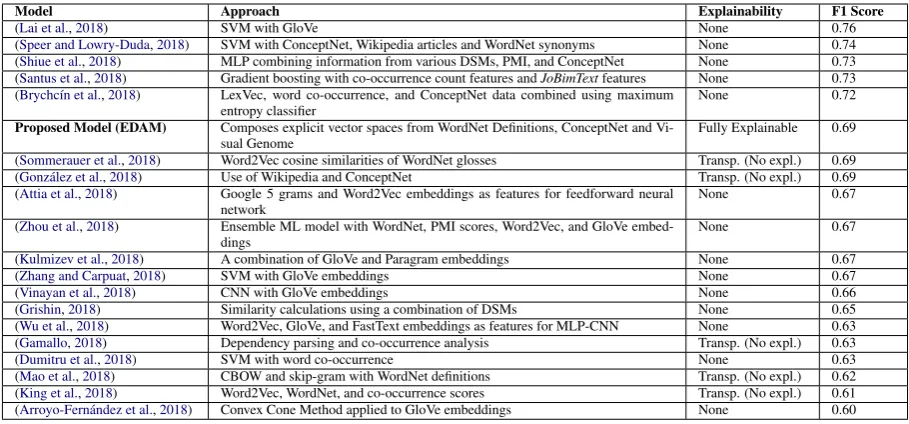
out-come of the evaluation of the combined model. In order to answer Q1, we compared our model to a set of reference systems in the task of dis-criminative attribute identification (see table 1. While EDAM performs lower than the state-of-the-art (F1-Score 0.76 vs 0.69), from existing ap-proaches EDAM provides the only explainable
model. Compared to EDAM, all the top
per-forming models used distributional methods de-rived from large-scale corpora, while EDAM uses the combination of definition, visual features and commonsense structured KBs.
In order to answer Q2, we evaluated the perfor-mance of each component of the model for the six dual-categories. The goal is to provide a quanti-tative basis to understand the contribution of each component in addressing the task.
In order to perform the evaluation, we selected a stratified random subset of 230 triples and manu-ally classified each triple with the dual categories. A triple can contain one or more categories as-sociated with it. The annotation was performed by two independent annotators, which reached an inter-annotator agreement of 81%. For the final annotated dataset, triples which were not consen-sual were eliminated (i.e. the final dataset has a 100% inter-annotator agreement). The F1-score of the combined EDAM model and of each com-ponent for each category are shown in Table2.
The list below summarizes the best component performance for each category:
• Sensory:DBM significantly outperforms the CKG and VFM model (75% over the second best).
• Logical: CKG significantly outperforms the other components (outperforms the second best component by 52%).
• Relative:DBM significantly outperforms the other components (100% over the second best).
• Absolute:CKG outperforms the second best component by 7%.
• Essential: CKG significantly outperforms DBM and VFM (100% over the second best).
• Incidental: DBM outperforms VFM by 154% and CKG by 48%.
The analysis shows the complementary nature
of the models, where DBM contributes more for
the identification of the sensory and incidental cat-egories, whileCKGcontributes to the logical and essential categories. Additionally, VFMprovides contributions across all categories and has smaller overlaps with other models. It is important to em-phasize that the models are complementary at each dimension: the combined model (EDAM) signif-icantly outperforms the best individual models at each dimension (as it can be observed at the gain row on Table2).
In order to observe the proportion on which each model contributes (and conversely, the amount of redundancy for each model), we ana-lyze for each individual model, the pairwise over-lap, in terms of true positives and false positives
(Table 3). The average redundancy between the
individual models is low (average 11%), showing that all models contribute significantly to the per-formance of the combined model.
Table 4 further breaks down the true positives for each dimension, where we can analyse the pairwise contribution of each model for each at-tribute category.The analysis shows that the over-all redundancy between the three models is low for all categories. Excluding the relative category (in which all models perform poorly), there is lit-tle variance in the overlap between the pairwise models (where the intersection between DBM and VFM is the largest for each category).
The quantitative analysis shows that the main limitation of the model is in the
identifica-tion of relative attributes. While DBMs are
able to correctly identify a small set of triples
with relative features such as (skyscraper,
apartment, tall) as discriminative, inter-pretation of relative relations requires two types of features which are not targeted by the models, namely:(i)the extraction of precise numerical ref-erence points at scale (dealing with variations of dimensional units) and (ii) the ability to extrap-olate the relations for unobserved lexemes by an explicit mechanism of comparative/transitive rea-soning. As a consequence, the current model is able to identify “skyscraper” as being taller than an “apartment”, but fails to identify neither as taller than a “giraffe”.
contribu-Model Approach Explainability F1 Score
(Lai et al.,2018) SVM with GloVe None 0.76
(Speer and Lowry-Duda,2018) SVM with ConceptNet, Wikipedia articles and WordNet synonyms None 0.74
(Shiue et al.,2018) MLP combining information from various DSMs, PMI, and ConceptNet None 0.73
(Santus et al.,2018) Gradient boosting with co-occurrence count features andJoBimTextfeatures None 0.73 (Brychc´ın et al.,2018) LexVec, word co-occurrence, and ConceptNet data combined using maximum
entropy classifier
None 0.72
Proposed Model (EDAM) Composes explicit vector spaces from WordNet Definitions, ConceptNet and Vi-sual Genome
Fully Explainable 0.69
(Sommerauer et al.,2018) Word2Vec cosine similarities of WordNet glosses Transp. (No expl.) 0.69
(Gonz´alez et al.,2018) Use of Wikipedia and ConceptNet Transp. (No expl.) 0.69
(Attia et al.,2018) Google 5 grams and Word2Vec embeddings as features for feedforward neural network
None 0.67
(Zhou et al.,2018) Ensemble ML model with WordNet, PMI scores, Word2Vec, and GloVe embed-dings
None 0.67
(Kulmizev et al.,2018) A combination of GloVe and Paragram embeddings None 0.67
(Zhang and Carpuat,2018) SVM with GloVe embeddings None 0.67
(Vinayan et al.,2018) CNN with GloVe embeddings None 0.66
(Grishin,2018) Similarity calculations using a combination of DSMs None 0.65
(Wu et al.,2018) Word2Vec, GloVe, and FastText embeddings as features for MLP-CNN None 0.63
(Gamallo,2018) Dependency parsing and co-occurrence analysis Transp. (No expl.) 0.63
(Dumitru et al.,2018) SVM with word co-occurrence None 0.63
(Mao et al.,2018) CBOW and skip-gram with WordNet definitions Transp. (No expl.) 0.62
(King et al.,2018) Word2Vec, WordNet, and co-occurrence scores Transp. (No expl.) 0.61
[image:7.595.71.526.61.273.2](Arroyo-Fern´andez et al.,2018) Convex Cone Method applied to GloVe embeddings None 0.60
Table 1: Performance of EDAM in contrast to baselines for discriminative attribute identification. Transp.means transparent covering different dimensions of interpretability (Silva et al.,2019) (but without an explanation).
Model Sensory Logical Relative Absolute Essential Incidental
DBM 0.49 0.33 0.40 0.41 0.29 0.46
CKG 0.28 0.50 0.20 0.44 0.58 0.31
VFM 0.13 0.11 0.05 0.14 0.10 0.13
EDAM(DBM+CKG+VFM) 0.62 0.63 0.50 0.65 0.68 0.60
EDAM gain 27% 26% 25% 48% 17% 30%
Table 2: Performance comparison (recall) against a random sample of categorized triples. The last row shows the relative gain of the combined model over the best performing individual model.
Positives DBM∧CKG DBM∧VFM CKG∧VFM DBM∧CKG∧VFM Avg.
True 0.23 0.07 0.08 0.06 0.11
False 0.05 0.01 0.02 0.01 0.02
Table 3: Overlap between the components relative to the combined model.
Category DBM∧CKG DBM∧VFM CKG∧VFM DBM∧CKG∧VFM Average
Sensory 0.31 0.10 0.14 0.10 0.16
Logical 0.35 0.09 0.15 0.09 0.17
Relative 0.20 0.10 0.10 0.10 0.13
Absolute 0.36 0.09 0.15 0.09 0.15
Essential 0.33 0.05 0.10 0.05 0.13
Incidental 0.33 0.12 0.17 0.12 0.19
Avg. 0.31 0.09 0.14 0.09
Table 4: Categorical model overlap breakdown, relative to all true positives identified by the combined model.
tion tosensoryattribute detection. CKG provides a significant (58%) contribution toessential. Ad-ditionally, CKG provides a significant (50%) con-tribution tologicalattribute detection.
5.1 Error Analysis
Definition Based Models: False negatives comprise the majority (83%) of all model errors. The cause is that the pivot’s definition does
[image:7.595.75.530.533.647.2]negatives most commonly occurs with
inciden-tal features (e.g. (potatoes, butter,
mashed) - true:false and (nose,
throat, perfume) - true:false).
False positives occur when the attribute applies to both pivot and comparison, however the comparison’s definition does not include the
feature. This is most prevalent with incidental
attributes (e.g. (banana,onions,peel)
-false:trueand(torah, bible, read)
- false:true).
Common Sense Knowledge Graphs: False neg-atives comprise the majority (80%) of the model’s errors and are mainly caused by incidental
at-tributes (e.g. (trays,employee,wooden)
- true:false) and relative attributes (e.g. (stool,tray,tall) - true:false).
Visual Feature Models: Similarly as with DBMs and CKGs, false negatives comprise the
ma-jority (94%) of all false classifications. Most
of the errors occur either with logical
at-tributes (e.g. (wife, lady, married)
-true:false, since these attributes are not likely to be expressed in a visual corpus or relative
at-tributes (e.g. (torah, bible, short)
-true:false. False positives occur due to do-main incompleteness. This can be caused by a lack of domain coverage of the Visual Genome
dataset (e.g. in(cat, lion, whiskers)
-false:true;(meal, supper, food)
-false:true).
Combined EDAM: The decrease in the pro-portion of false negatives as compared to the individual models, illustrates the advantages of the model composition. False negatives
com-prise 47% of model’s total errors. False
pos-itives, on the contrary, illustrate the limitations of the model, since they occur when at least one of the model components incorrectly
classi-fies a triple as discriminative: e.g. (banana,
onions, peel) - false:truefalse
posi-tive of DBM and(cat, lion, whiskers)
- false:truefalse positive of VFM.
5.2 Qualitative Analysis
In addition to correctly labeling common
dis-criminative triples such as (soup, meal,
liquid) and (walnut, spinach,
brown) the technical specificity of definitions present at dictionaries supports the identification
of discriminative triples such as (brandy,
whiskey, wine). Other noteworthy examples of discriminative attribute detection include
la-beling triples(stomach, bladder, food)
and (nightclub, bar, dancing) as
discriminative.
For the DBM, the structure induced by the
extractor (e.g. the hypernym hierarchy) can
support the transference of discriminative at-tributes across the taxonomic hierarchy. For the
triple (planet, moon, body) using
imme-diate definitions of pivot and comparison
incor-rectly suggests that the triple(planet, moon,
body) is discriminative. However, after ex-panding using super-type definitions, the model
correctly identifies body as a property of both
planetandmoon.
6 Conclusion
This paper described an explicit word vector model targeting the identification of discrimina-tive attributes using the composition of defini-tions, visual features and commonsense
knowl-edge graphs. The proposed model, which is
built from structured representations from differ-ent types of data sources is able to achieve a state-of-the-art level F1-score (0.69) while producing, human interpretable explanations. The paper also provided an in-depth comparative quantitative and qualitative analysis on the contributions of differ-ent types of data sources for the generation of ex-plicit semantic vector spaces (WordNet glosses, ConceptNet and Visual Genome), demonstrating the complementarity aspect of these resources. Future work will concentrate on extending the model to cope with relative attributes, the inclu-sion of additional data sources to increase model coverage, such as large-scale definition sets.
Acknowledgments
The authors would like to thank Viktor Schlegel for the initial supporting machine learning base-lines (not included here) and related work discus-sions in the beginning of the project.
References
Workshop on Semantic Evaluation, pages 977–984. Association for Computational Linguistics.
Mohammed Attia, Younes Samih, Manaal Faruqui, and Wolfgang Maier. 2018. Ghh at semeval-2018 task 10: Discovering discriminative attributes in distribu-tional semantics. InProceedings of The 12th
Inter-national Workshop on Semantic Evaluation, pages
947–952. Association for Computational Linguis-tics.
Tom´aˇs Brychc´ın, Tom´aˇs Hercig, Josef Steinberger, and Michal Konkol. 2018. Uwb at semeval-2018 task 10: Capturing discriminative attributes from word distributions. In Proceedings of The 12th
Inter-national Workshop on Semantic Evaluation, pages
935–939. Association for Computational Linguis-tics.
Bogdan Dumitru, Alina Maria Ciobanu, and Liviu P. Dinu. 2018. Alb at semeval-2018 task 10: A sys-tem for capturing discriminative attributes. In Pro-ceedings of The 12th International Workshop on Se-mantic Evaluation, pages 963–967. Association for Computational Linguistics.
Andre Freitas. 2015. Schema-agnositc queries over large-schema databases: a distributional semantics approach. Ph.D. thesis.
Pablo Gamallo. 2018. Citiusnlp at semeval-2018 task 10: The use of transparent distributional models and salient contexts to discriminate word attributes. In
Proceedings of The 12th International Workshop on
Semantic Evaluation, pages 953–957. Association
for Computational Linguistics.
Jos´e- ´Angel Gonz´alez, Llu´ıs-F. Hurtado, Encarna Segarra, and Ferran Pla. 2018. Elirf-upv at semeval-2018 task 10: Capturing discriminative attributes with knowledge graphs and wikipedia. In Pro-ceedings of The 12th International Workshop on Se-mantic Evaluation, pages 968–971. Association for Computational Linguistics.
Maxim Grishin. 2018. Igevorse at semeval-2018 task 10: Exploring an impact of word embeddings con-catenation for capturing discriminative attributes. In
Proceedings of The 12th International Workshop on
Semantic Evaluation, pages 995–998. Association
for Computational Linguistics.
Patrick J. Hayes. 1995. The second naive physics man-ifesto.Computation and Intelligence.
Milton King, Ali Hakimi Parizi, and Paul Cook. 2018.
Unbnlp at semeval-2018 task 10: Evaluating unsu-pervised approaches to capturing discriminative at-tributes. InProceedings of The 12th International
Workshop on Semantic Evaluation, pages 1013–
1016. Association for Computational Linguistics.
Alicia Krebs, Allesandro Lenci, and Denis Paperno. 2018. Semeval 2018 task 10: Capturing discrim-inative attributes. InProceedings of the 12th inter-national workshop on semantic evaluation (SemEval 2018).
Ranjay Krishna, Yuke Zhu, Oliver Groth, Justin John-son, Kenji Hata, Joshua Kravitz, Stephanie Chen, Yannis Kalantidis, Li-Jia Li, David A Shamma, et al. 2017. Visual genome: Connecting language and vision using crowdsourced dense image anno-tations. International Journal of Computer Vision, 123(1):32–73.
Artur Kulmizev, Mostafa Abdou, Vinit Ravishankar, and Malvina Nissim. 2018. Discriminator at semeval-2018 task 10: Minimally supervised dis-crimination. In Proceedings of The 12th
Inter-national Workshop on Semantic Evaluation, pages
1008–1012. Association for Computational Linguis-tics.
Sunny Lai, Kwong Sak Leung, and Yee Leung. 2018.
Sunnynlp at semeval-2018 task 10: A support-vector-machine-based method for detecting seman-tic difference using taxonomy and word embedding features. InProceedings of The 12th International
Workshop on Semantic Evaluation, pages 741–746.
Association for Computational Linguistics.
Rui Mao, Guanyi Chen, Ruizhe Li, and Chenghua Lin. 2018. Abdn at semeval-2018 task 10: Recognising discriminative attributes using context embeddings and wordnet. In Proceedings of The 12th
Inter-national Workshop on Semantic Evaluation, pages
1017–1021. Association for Computational Linguis-tics.
Teresa Robertson and Philip Atkins. 2018. Essential vs. accidental properties. In Edward N. Zalta, editor,
The Stanford Encyclopedia of Philosophy, spring
2018 edition. Metaphysics Research Lab, Stanford University.
Enrico Santus, Chris Biemann, and Emmanuele Cher-soni. 2018. Bomji at semeval-2018 task 10: Com-bining vector-, pattern- and graph-based informa-tion to identify discriminative attributes. In Pro-ceedings of The 12th International Workshop on Se-mantic Evaluation, pages 990–994. Association for Computational Linguistics.
Yow-Ting Shiue, Hen-Hsen Huang, and Hsin-Hsi Chen. 2018. Ntu nlp lab system at semeval-2018 task 10: Verifying semantic differences by integrat-ing distributional information and expert knowledge.
InProceedings of The 12th International Workshop
on Semantic Evaluation, pages 1027–1033.
Associ-ation for ComputAssoci-ational Linguistics.
Vivian S. Silva, Andre Freitas, and Siegfried Hand-schuh. 2017. Building a knowledge graph from nat-ural language definitions for interpretable text entail-ment recognition. In11th Language Resources and Evaluation Conference.
Vivian S. Silva, Andr´e Freitas, and Siegfried Hand-schuh. 2019. On the semantic interpretability of artificial intelligence models. ArXiV (Preprint), abs/1907.04105.
Vivian S. Silva, Siegfried Handschuh, and Andr´e Fre-itas. 2016. Categorization of semantic roles for dic-tionary definitions. InProceedings of the 5th Work-shop on Cognitive Aspects of the Lexicon (CogALex - V), pages 176–184.
Vivian S. Silva, Siegfried Handschuh, and Andre Fre-itas. 2018b. Recognizing and justifying text entail-ment through distributional navigation on definition graphs. InThirty-Second AAAI Conference on Arti-ficial Intelligence, United States. AAAI Press.
Pia Sommerauer, Antske Fokkens, and Piek Vossen. 2018. Meaning space at semeval-2018 task 10: Combining explicitly encoded knowledge with in-formation extracted from word embeddings. In Pro-ceedings of The 12th International Workshop on Se-mantic Evaluation, pages 940–946. Association for Computational Linguistics.
Robert Speer and Joanna Lowry-Duda. 2018. Lumi-noso at semeval-2018 task 10: Distinguishing at-tributes using text corpora and relational knowledge.
InProceedings of The 12th International Workshop
on Semantic Evaluation, pages 985–989.
Associa-tion for ComputaAssocia-tional Linguistics.
Peter D Turney and Patrick Pantel. 2010. From fre-quency to meaning: Vector space models of se-mantics. Journal of artificial intelligence research, 37:141–188.
Vivek Vinayan, Anand Kumar M, and Soman K P. 2018. Amritanlp at semeval-2018 task 10: Captur-ing discriminative attributes usCaptur-ing convolution neu-ral network over global vector representation. In
Proceedings of The 12th International Workshop on
Semantic Evaluation, pages 1003–1007.
Associa-tion for ComputaAssocia-tional Linguistics.
Chuhan Wu, Fangzhao Wu, Sixing Wu, Zhigang Yuan, and Yongfeng Huang. 2018. Thu ngn at semeval-2018 task 10: Capturing discriminative attributes with mlp-cnn model. InProceedings of The 12th
International Workshop on Semantic Evaluation,
pages 958–962. Association for Computational Lin-guistics.
Alexander Zhang and Marine Carpuat. 2018. Umd at semeval-2018 task 10: Can word embeddings cap-ture discriminative attributes? In Proceedings of The 12th International Workshop on Semantic Eval-uation, pages 1022–1026. Association for Computa-tional Linguistics.
Yunxiao Zhou, Man Lan, and Yuanbin Wu. 2018. Ecnu at semeval-2018 task 10: Evaluating simple but ef-fective features on machine learning methods for semantic difference detection. In Proceedings of
The 12th International Workshop on Semantic
Eval-uation, pages 999–1002. Association for