Proceedings of the 2019 Conference on Empirical Methods in Natural Language Processing
3774
Learning Semantic Parsers from Denotations with Latent
Structured Alignments and Abstract Programs
Bailin Wang, Ivan Titov and Mirella Lapata Institute for Language, Cognition and Computation
School of Informatics, University of Edinburgh
[email protected], {ititov,mlap}@inf.ed.ac.uk
Abstract
Semantic parsing aims to map natural lan-guage utterances onto machine interpretable meaning representations, aka programs whose execution against a real-world environment produces a denotation. Weakly-supervised semantic parsers are trained on utterance-denotation pairs treating programs as latent. The task is challenging due to the large search space and spuriousness of programs which may execute to the correct answer but do not generalize to unseen examples. Our goal is to instill an inductive bias in the parser to help it distinguish between spurious and cor-rect programs. We capitalize on the intu-ition that correct programs would likely re-spect certain structural constraints were they to be aligned to the question (e.g., program fragments are unlikely to align to overlapping text spans) and propose to model alignments as structured latent variables. In order to make the latent-alignment framework tractable, we decompose the parsing task into (1) predicting a partial “abstract program” and (2) refining it while modeling structured alignments with differential dynamic programming. We ob-tain state-of-the-art performance on the WIK
-ITABLEQUESTIONS and WIKISQL datasets. When compared to a standard attention base-line, we observe that the proposed structured-alignment mechanism is highly beneficial.
1 Introduction
Semantic parsing is the task of translating natural language to machine interpretable meaning repre-sentations. Typically, it requires mapping a natural language utterance onto a program, which is exe-cuted against a knowledge base to obtain an an-swer or a denotation. Most previous work ( Zettle-moyer and Collins, 2005; Wong and Mooney,
2007; Lu et al., 2008; Jia and Liang, 2016) has focused on the supervised setting where a model is learned from question-program pairs. Weakly
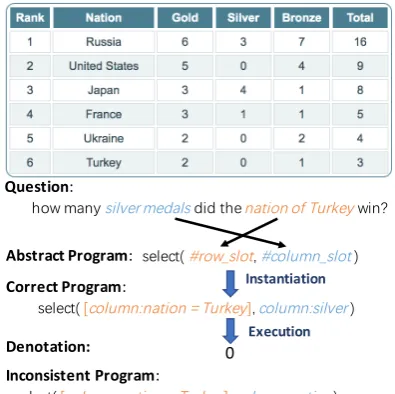
Question:
Abstract Program:
Correct Program: Instantiation
Execution
Denotation: 0
Spurious Programs:
[image:1.595.312.510.214.411.2]Inconsistent Program:
Figure 1: After generating an abstract program for a question, our parser finds alignments between slots (with prefix #) and question spans. Based on the align-ment, it instantiates each slot and a complete program is executed against a table to obtain a denotation.
supervised semantic parsing (Berant et al., 2013;
Liang et al., 2011) reduces the burden of anno-tating programs by learning from questions paired with their answers (or denotations).
Two major challenges arise when learning from denotations: 1) training of the semantic parser re-quires exploring a large search space of possible programs to find those which areconsistent, and execute to correct denotations; 2) the parser should be robust to spurious programs which acciden-tally execute to correct denotations, but do not re-flect the semantics of the question. In this paper, we propose a weakly-supervised neural semantic parser that features structured latent alignments to bias learning towardscorrectprograms which are consistent but not spurious.
re-spect certain constraints were they to be aligned to the question text, while spurious and inconsistent programs do not. For instance, in Figure 1, the answer to the question (“0”) can be obtained by executing the correct program which selects the number of Turkey’s silver medals. However, the same answer can be also obtained by the spurious programs shown in the figure.1 The spurious pro-grams differ from the correct one in that they re-peatedly use the column “silver”. Whereas, in the question, the word “silver” only refers to the tar-get column containing the answer; it also mistak-enly triggers the appearance of the column “silver” in the row selection condition. This constraint, i.e., that a text span within a question cannot trig-ger two semantically distinct operations (e.g., se-lecting target rows and target columns) can pro-vide a useful inductive bias. We propose to cap-ture structural constraints by modeling the align-ments between programs and questions explicitly
as structured latent variables.
Considering the large search space of possible programs, an alignment model that takes into ac-count the full range of correspondences between program operations and question spans would be very expensive. To make the process tractable, we introduce a two-stage approach that features ab-stract programs. Specifically, we decompose se-mantic parsing into two steps: 1) a natural lan-guage utterance is first mapped to an abstract pro-gram which is a composition of high-level opera-tions; and 2) the abstract program is then instanti-ated with low-level operations that usually involve relations and entities specific to the knowledge base at hand. This decomposition is motivated by the observation that only a small number of sensi-ble abstract programs can be instantiated into con-sistent programs. Similar ideas of using abstract meaning representations have been explored with fully-supervised semantic parsers (Dong and La-pata,2018;Catherine Finegan-Dollak and Radev,
2018) and in other related tasks (Goldman et al.,
2018;Herzig and Berant,2018;Nye et al.,2019). For a knowledge base in tabular format, we ab-stract two basic operations of row selection and column selection from programs: these are han-dled in the second (instantiation) stage. As shown in Figure1, the question is first mapped to the ab-stract program “select (#row slot, #column slot)”
1
The first program can be paraphrased as: find the row with the largest number of silver medals and then select the number of silver medals from the previous row.
whose two slots are subsequently instantiated with filter conditions (row slot) and a column name (column slot). During the instantiation of abstract programs, each slot should refer to the question to obtain its specific semantics. In Figure1,row slot
should attend to “nation of Turkey” while col-umn slotneeds to attend to “silver medals”. The structural constraint discussed above now corre-sponds to assuming that each span in a question can be aligned to a unique row or column slot. Under this assumption, the instantiation of spuri-ous programs will be discouraged. The uniqueness constraint would be violated by both spurious pro-grams in Figure1, since “column:silver” appears in the program twice but can be only aligned to the span “silver medals” once.
The first stage (i.e., mapping a question onto an abstract program) is handled with a sequence-to-sequence model. The second stage (i.e., program instantation) is approached with local classifiers: one per slot in the abstract program. The classi-fiers are conditionally independent given the ab-stract program and a latent alignment. Instead of marginalizing out alignments, which would be in-tractable, we use structured attention (Kim et al.,
2017), i.e., we compute the marginal probabili-ties for individual span-slot alignment edges and use them to weight the input to the classifiers. As we discuss below, the marginals in our constrained model are computed with dynamic programming. We perform experiments on two open-domain question answering datasets in the setting of learn-ing from denotations. Our model achieves an ex-ecution accuracy of 44.5% in WIKITABLEQUES-TIONS and 79.3% in WIKISQL, which both sur-pass previous state-of-the-art methods in the same weakly-supervised setting. In WIKISQL, our parser is better than recent supervised parsers that are trained on question-program pairs. Our contri-butions can be summarized as follows:
• we introduce an alignment model as a means of differentiating between correct and spuri-ous programs;
• we propose a neural semantic parser that per-forms tractable alignments by first mapping questions to abstract programs;
• we achieve state-of-the-art performance on two semantic parsing benchmarks.2
2Our code is available at https://github.com/
Although we use structured alignments to mostly enforce the uniqueness constraint de-scribed above, other types of inductive biases can be useful and could be encoded in our two-stage framework. For example, we could replace the uniqueness constraint with modeling the number of slots aligned to a span, or favor sparse align-ment distributions. Crucially, the two-stage frame-work makes it easier to inject prior knowledge about datasets and formalisms while maintaining efficiency.
2 Background
Given knowledge baset, our task is to map a nat-ural utterancex to programz, which is then exe-cuted against a knowledge base to obtain denota-tion[[z]]t=d. We train our parser only based ond
without access to correct programsz∗. Our exper-iments focus on two benchmarks, namely WIK-ITABLEQUESTIONS (Pasupat and Liang, 2015) and WIKISQL (Zhong et al., 2017) where each question is paired with a Wikipedia table and a denotation. Figure 1shows a simplified example taken from WIKITABLEQUESTIONS.
2.1 Grammars
Executable programs z that can query tables are defined according to a language. Specifically, the search space of programs is constrained by gram-mar rules so that it can be explored efficiently. We adopt the variable-free language of Liang et al.
(2018) and define anabstractgrammar and an in-stantiationgrammar which decompose the gener-ation of a program in two stages.3
The first stage involves the generation of an abstract version of a program which, in the sec-ond stage, gets instantiated. Abstract programs only consider compositions of high-level func-tions, such as superlatives and aggregation, while low-level functions and arguments, such as filter conditions and entities, are taken into account in the next step. In our table-based datasets, abstract programs do not include two basic operations of querying tables: row selection and column selec-tion. These operations are handled at the instan-tiation stage. In Figure 1 the abstract program has two slots for row and column selection, which are filled with the conditions “column:nation = Turkey” and “column:silver” at the instantiation
3
We also extend their grammar to additionally support op-erations of conjunction and disjunction. More details are pro-vided in the Appendix.
STRING select (ROW, COLUMN)
COLUMN #column_slot
ROW first (LIST[ROW])
LIST[ROW] #rows_slot
Abstract Program:
select (first (#rows_slot) #column_slot)
Derivation Tree:
Figure 2: An abstract program and its derivation tree. Capitalized words indicate types of function arguments and their return value.
stage. The two stages can be easily merged into one step when conducting symbolic combinatorial search. The motivation for the decomposition is to facilitate the learning of our neural semantic parser and the handling of structured alignments.
Abstract Grammar Our abstract grammar has five basic types: ROW, COLUMN, STRING, NUM-BER, and DATE; COLUMN is further sub-typed into STRING COLUMN, NUMBER COLUMN, and DATE COLUMN; other basic types are augmented with LIST to represent a list of elements like LIST[ROW]. Arguments and return values of functions are typed using these basic types.
Function composition can be defined recur-sively based on a set of production rules, each cor-responding to a function type. For instance, func-tion ROW→first(LIST[ROW]) selects the first row from a list of rows and corresponds to produc-tion rule “ROW→first”.
The abstract grammar has two additional types for slots (aka terminal rules) which correspond to row and column selection:
LIST[ROW]→#row slot
COLUMN→#column slot
An example of an abstract program and its derivation tree is shown in Figure 2. We lin-earize the derivation by traversing it in a left-to-right depth-first manner. We represent the tree in Figure 2 as a sequence of production rules: “ROOT → STRING, STRING → select, ROW →
first”,LIST[ROW]→#row slot,COLUMN→ #col-umn slot”. The first action is always to select the return type for the root node.
Given a specific table t, the abstract gram-marHtwill depend on its column types. For ex-ample, if the table does not have number cells, “max/min” operations will not be executable.
slot is filled with one or multiple conditions (COND) which are joined together with conjunc-tion (OR) and disjuncconjunc-tion (AND) operators:
COND→COLUMN OPERATOR VALUE
#row slot→COND(AND COND)*
#row slot→COND(OR COND)*
where OPERATOR∈[>, <,=,≥,≤]andVALUE is a string, a number, or a date. A special condition
#row slot→all rows is defined to signify that a program queries all rows.
2.2 Search for Consistent Programs
A problematic aspect of learning from denotations is that, since annotated programs are not available (e.g., for WIKITABLEQUESTIONS), we have no means to directly evaluate a proposed grammar. As an evaluation proxy, we measure the coverage of our grammar in terms of consistent programs. Specifically, we exhaustively search for all consis-tent programs for each question in the training set. While the space of programs is exponential, we observed that abstract programs which are instan-tiated into correct programs are not very complex in terms of the number of production rules used to generate them. As a result, we impose restrictions on the number of production rules which can ab-stract programs, and in this way the search process becomes tractable.4
We find that 83.6% of questions in WIK-ITABLEQUESTIONS are covered by at least one consistent program. However, each question even-tually has 200 consistent programs on average and most of them are spurious. Treating them as ground truth poses a great challenge for learning a semantic parser. The coverage for WIKISQL is 96.6% and each question generates 84 consistent programs.
Another important observation is that there is only a limited number of abstract programs that can be instantiated into consistent programs. The number of such abstract programs is 23 for WIK-ITABLEQUESTIONS and 6 for WIKISQL, sug-gesting that there are a few patterns underlying several utterances. This motivates us to design a semantic parser that first maps utterances to ab-stract programs. For the sake of generality, we do not restrict our parser to abstract programs in the training set. We elaborate on this below.
4Details are provided in the Appendix.
3 Model
After obtaining consistent programs z for each question via offline search, we next show how to learn a parser that can generalize to unseen ques-tions and tables.
3.1 Training and Inference
Our learning objectiveJ is to maximize the log-likelihood of the marginal probability of all con-sistent programs, which are generated by mapping an utterancexto an interim abstract programh:
J = log{X
h∈Ht
p(h|x, t) X
[[z]]=d
p(z|x, t, h)}. (1)
During training, our model only needs to focus on abstract programs that have successful instanti-ations of consistent programs and it does not have to explore the whole space of possible programs.
At test time, the parser chooses the program zˆ with the highest probability:
ˆ
h,zˆ= arg max h∈Ht, z
p(h|x, t)p(z|x, t, h). (2)
For efficiency, we only choose the top-kabstract programs to instantiate through beam search. zˆis then executed to obtain its denotation as the final prediction.
Next, we will explain the basic components of our neural parser. Basically, our model first en-codes a question and a table with an input encoder; it then generates abstract programs with a seq2seq model; and finally, these abstract programs are in-stantiated based on a structured alignment model.
3.2 Input Encoder
Each word in an utterance is mapped to a dis-tributed representation through an embedding layer. Following previous work (Neelakantan et al., 2017;Liang et al., 2018), we also add an indicator feature specifying whether the word ap-pears in the table. This feature is mapped to a learnable vector. Additionally, in WIKITABLE-QUESTIONS, we use POS tags from the CoreNLP annotations released with the dataset and map them to vector representations. The final represen-tation for a word is the concatenation of the vec-tors above. A bidirectional LSTM (Hochreiter and Schmidhuber,1997) is then used to obtain a con-textual representationlifor theithword.
of words under its column name. We also have a column type feature (i.e., number, date, or string) and an indicator feature signaling whether at least one entity in the column appears in the utterance.
3.3 Generating Abstract Programs
Instead of extracting abstract programs as tem-plates, similarly toXu et al.(2017) andCatherine Finegan-Dollak and Radev (2018), we generate them with a seq2seq model. Although template-based approaches would be more efficient in prac-tice, a seq2seq model is more general since it could generate unseen abstract programs which fixed templates could not otherwise handle.
Our goal here is to generate a sequence of production rules that lead to abstract programs. During decoding, the hidden state gj of the j -th timestep is computed based on -the previous production rule, which is mapped to an embed-dingaj−1. We also incorporate an attention
mech-anism (Luong et al., 2015) to compute a contex-tual vector bj. Finally, a score vectorsj is com-puted by feeding the concatenation of the hidden state and context vector to a multilayer perceptron (MLP):
gj = LSTM(gj−1,aj−1) bj = Attention(gj,l)
sj = MLP1([gj;bj])
p(aj|x, t, a<j) = softmaxaj(sj)
(3)
where the probability of production rule aj is computed by the softmax function. According to our abstract grammar, only a subset of production rules will be valid at the j-th time step. For in-stance, in Figure 2, production rule “STRING →
select” will only expand to rules whose left-hand side is ROW, which is the type of the first argu-ment of select. In this case, the next production rule is “ROW → first”. We thus restrict the nor-malization of softmax to only focus on these valid production rules. The probability of generating an abstract programp(h|x, t)is simply the product of the probability of predicting each production rule
Q
jp(aj|x, t, a<j).
After an abstract program is generated, we need to instantiate slots in abstract programs. Our model first encodes the abstract program using a bi-directional LSTM. As a result, the representa-tion of a slot is contextually aware of the entire abstract program (Dong and Lapata,2018).
3.4 Instantiating Abstract Programs
To instantiate an abstract program, each slot must obtain its specific semantics from the question. We model this process by an alignment model which learns the correspondence between slots and ques-tion spans. Formally, we use a binary alignment matrix A with size m×n×n, where m is the number of slots and n is the number of tokens. In Figure 1, the alignment matrix will only have A0,6,8 = 1 andA1,2,3 = 1which indicates that
the first slot is aligned with “nation of Turkey”, and the second slot is aligned with “silver medals”. The second and third dimension of the matrix rep-resent the start and end position of a span.
We model alignments as discrete latent vari-ables and condition the instantiation process on the alignments as follows:
P
[z]=d
p(z|x, t, h) =
P
A
p(A|x, t, h) P
[z]=d
p(z|x, t, h,A). (4)
We will first discuss the instantiation model
p(z|x, t, h,A)and then elaborate on how to avoid
marginalization in the next section. Each slot in an abstract program can be instantiated by a set of candidates following the instantiation grammar. For efficiency, we use local classifiers to model the instantiation of each slot independently:
p(z|x, t, h,A) =Y
s∈S
p(s→c|x, t, h,A), (5)
whereSis the set of slots andcis a candidate fol-lowing our instantiation grammar. “s→ c” repre-sents the instantiation of slotsinto candidatec.
For each slot, the probability of generating a candidate is computed with softmax normalization on a score function:
p(s→c|x, t, h,A)∝exp{MLP([s;c])}, (6)
wheresis the representation of the span that slots
is aligned with, andcis the representation of can-didatec. The representationssandcare concate-nated and fed to a MLP. We use the same MLP ar-chitecture but different parameters for column and row slots.
3.5 Structured Attention
We first formally define a few structural con-straints over alignments and then explain how to incorporate them efficiently into our parser.
The intuition behind our alignment model is that row and column selection operations represent dis-tinct semantics, and should therefore be expressed by distinct natural language expressions. Hence, we propose the following constraints:
Unique Span In most cases, the semantics of a row selection or a column selection is expressed uniquely with a single contiguous span:
∀k∈[1,|S|], X i,j
Ak,i,j = 1, (7)
where|S|is the number of slots.
No Overlap Spans aligned to different slots should not overlap. Formally, at most one span that contains wordican be aligned to a slot:
∀i∈[1, n], X k,j
Ak,i,j ≤1. (8)
As an example, the alignments in Figure1 fol-low the above constraints. Intuitively, the one-to-one mapping constraint aims to assign distinct and non-overlapping spans to slots of abstract pro-grams. To further bias the alignments and improve efficiency, we impose additional restrictions: (1) a row slot must be aligned to a span that contains an entity since conditions that instantiate the slot would require entities for filtering; (2) a column slot must be aligned to a span with length 1 since most column names only have one word.
Marginalizing out allA in Equation (4) would be very expensive considering the exponential number of possible alignments. We approximate
the marginalization by moving the outside expec-tation directly inside overA. As a result, we in-stead optimize the following objective:
J ≈log X
h∈Ht
p(h|x, t) X
[[z]]=d
p(z|x, t, h,E[A]) , (9)
whereE[A]are the marginals ofAwith respect to
p(A|x, t, h).
The idea of using differentiable surrogates for discrete latent variables has been used in many other works like differentiable data structures (Grefenstette et al.,2015;Graves et al.,2014) and attention-based networks (Bahdanau et al., 2015;
Kim et al., 2017). Using marginals E[A] can be viewed as structured attentionbetween slots and question spans.
The marginal probability of the alignment ma-trixAcan be computed efficiently using dynamic programming (see T¨ackstr¨om et al. 2015 for de-tails). An alignment is encoded into a path in a weighted lattice where each vertex has 2|S| states to keep track of the set of covered slots. The marginal probability of edges in this lattice can be computed by the forward-backward al-gorithm (Wainwright et al., 2008). The lattice weights, represented by a scoring matrix M ∈ Rm×n×nfor all possible slot-span pairs, are com-puted using the following scoring function:
Mk,i,j = MLP2([r(k);span[i:j]]), (10)
wherer(k)represents thekthslot andspan[i:j] represents the span from worditoj. Recall that we obtain r(k)by encoding a generated abstract program. A span is represented by averaging the representations of the words therein. These two representations are concatenated and fed to aMLP to obtain a score. SinceE[A]is not discrete any-more, the aligned representation of slotsin Equa-tion (6) becomes the weighted average of repre-sentations of all spans in the set.
4 Experiments
to examine whether structured attention is better at instantiating abstract programs.
4.1 Experimental Setup
Datasets WIKITABLEQUESTIONS contains 2,018 tables and 18,496 utterance-denotation pairs. The dataset is challenging as 1) the tables cover a wide range of domains and unseen tables appear at test time; and 2) the questions involve a variety of operations such as superlatives, com-parisons, and aggregation (Pasupat and Liang,
2015). WIKISQL has 24,241 tables and 80,654 utterance-denotation pairs. The questions are logically simpler and only involve aggregation, column selection, and conditions. The original dataset is annotated with SQL queries, but we only use the execution result for training. In both datasets, tables are extracted from Wikipedia and cover a wide range of domains.
Entity extraction is important during parsing since entities are used as values in filter condi-tions during instantiation. String entities are ex-tracted by string matching utterance spans and ta-ble cells. In WIKITABLEQUESTIONS, numbers and dates are extracted from the CoreNLP anno-tations released with the dataset. WIKISQL does not have entities for dates, and we use string-based normalization to deal with numbers.
Implementation We obtained word embed-dings by a linear projection of GloVe pre-trained embeddings (Pennington et al.,2014) which were fixed during training. Attention scores were com-puted based on the dot product between two vec-tors. EachMLPis a one-hidden-layer perceptron with ReLU as the activation function. Dropout (Srivastava et al., 2014) was applied to prevent overfitting. All models were trained with Adam (Kingma and Ba,2015). Implementations of ab-stract and instantiation grammars were based on AllenNLP (Gardner et al.,2017).5
4.2 Baselines
Aside from comparing our model against previ-ously published approaches, we also implemented the following baselines:
Typed Seq2Seq Programs were generated us-ing a sequence-to-sequence model with attention (Dong and Lapata, 2016). Similarly to Krishna-murthy et al. (2017), we constrained the
decod-5Please refer to the Appendix for the full list of
hyperpa-rameters used in our experiments.
Supervised by Denotations Dev. Test
Pasupat and Liang(2015) 37.0 37.1
Neelakantan et al.(2017) 34.1 34.2
Haug et al.(2018) — 34.8
Zhang et al.(2017) 40.4 43.7
Liang et al.(2018) 42.3 43.1
Dasigi et al.(2019) 42.1 43.9
Agarwal et al.(2019) 43.2 44.1
Typed Seq2Seq 37.3 38.3
Abstract Programs
f.w.standard attention 39.4 41.4
f.w.structured attention 43.7 44.5
Table 1: Results on WIKITABLEQUESTIONS.
f.w.stands for slots filled with.
ing process so that only well-formed programs are predicted. This baseline can be viewed as merging the two stages of our model into one stage where generation of abstract programs and their instanti-ations are performed with a shared decoder.
Standard Attention The aligned representation of slotsin Equation (6) is computed by a standard attention mechanism: s = Attention(r(s),l) where r(s) is the representation of slot s from abstract programs. Each slot is aligned indepen-dently with attention, and there are no global struc-tural constraints on alignments.
4.3 Main Results
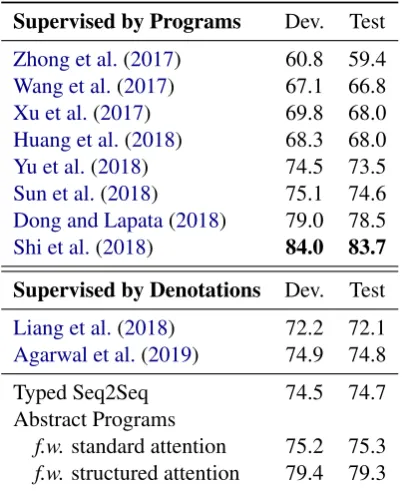
For all experiments, we report the mean accuracy of 5 runs. Results on WIKITABLEQUESTIONSare shown in Table1. The structured-attention model achieves the best performance, compared against the two baselines and previous approaches. The standard attention baseline with abstract programs is superior to the typed Seq2Seq model, demon-strating the effectiveness of decomposing seman-tic parsing into two stages. Results on WIKISQL are shown in Table 2. The structured-attention model is again superior to our two baseline mod-els. Interestingly, its performance surpasses previ-ously reported weakly-supervised models (Liang et al., 2018;Agarwal et al., 2019) and is on par even with fully supervised ones (Dong and Lap-ata,2018).
WIK-Supervised by Programs Dev. Test
Zhong et al.(2017) 60.8 59.4
Wang et al.(2017) 67.1 66.8
Xu et al.(2017) 69.8 68.0
Huang et al.(2018) 68.3 68.0
Yu et al.(2018) 74.5 73.5
Sun et al.(2018) 75.1 74.6
Dong and Lapata(2018) 79.0 78.5
Shi et al.(2018) 84.0 83.7
Supervised by Denotations Dev. Test
Liang et al.(2018) 72.2 72.1
Agarwal et al.(2019) 74.9 74.8
Typed Seq2Seq 74.5 74.7
Abstract Programs
f.w.standard attention 75.2 75.3
[image:8.595.81.284.62.308.2]f.w.structured attention 79.4 79.3
Table 2: Results on WIKISQL.f.w.: slots filled with.
ISQL only has 6 abstract programs that can be successfully instantiated. For this reason, our de-composition alone may not be very beneficial if coupled with standard attention. In contrast, our structured-attention model consistently performs much better than both baselines.
We report scores of ensemble systems in Ta-ble 3. We use the best model which relies on abstract programs and structured attention as a base model in our ensemble. Our ensemble sys-tem achieves better performance thanLiang et al.
(2018) andAgarwal et al.(2019), while using the same ensemble size.
4.4 Analysis of Spuriousness
To understand how well structured attention can help a parser differentiate between correct and spurious programs, we analyzed the posterior dis-tribution of consistent programs given a denota-tion:p(z|x, t, d)where[[z]] =d.
WIKISQL includes gold-standard SQL anno-tations, which we do not use in our experiments but exploit here for analysis. Specifically, we con-verted the annotations released with WIKISQL to programs licensed by our grammar. We then com-puted the log-probability of these programs ac-cording to the posterior distribution as a measure of how well a parser can identify them amongst all consistent programs logP
z∗p(z∗|x, t, d), where
z∗ denotes correct programs. The average
log-Models WTQ WIKISQL
Liang et al.(2018) 46.3 (10) 74.2 (5)
Agarwal et al.(2019) 46.9 (10) 76.9 (5)
[image:8.595.312.526.64.128.2]Our model 47.3(10) 81.7(5)
Table 3: Results of ensembled models on the test set; ensemble sizes are shown within parentheses.
Error Types standard structured
Abstraction Error 19.2 20.0
Instantiation Error 41.5 36.2
Coverage Error 39.2 43.8
Table 4: Proportion of errors on the development set in WIKITABLEQUESTIONS.
probability assigned to correct programs by struc-tured and standard attention is -0.37 and -0.85, re-spectively. This gap confirms that structured atten-tion can bias our parser towards correct programs during learning.
4.5 Error Analysis
We further manually inspected the output of our structured-attention model and the standard atten-tion baseline in WIKITABLEQUESTIONS. Specif-ically, we randomly sampled 130 error cases in-dependently from both models and classified them into three categories.
Abstraction Errors If a parser fails to generate an abstract program, then it is impossible for it to instantiate a consistent complete program.
Instantiation Errors These errors arise when abstract programs are correctly generated, but are mistakenly instantiated either by incorrect column names or filter conditions.
Coverage Errors These errors arise from im-plicit assumptions made by our parser: a) there is a long tail of unsupported operations that are not covered by our abstract programs; b) if enti-ties are not correctly identified and linked, abstract programs cannot be correctly instantiated.
5 Related Work
Neural Semantic Parsing We follow the line of work that applies sequence-to-sequence models (Sutskever et al., 2014) to semantic parsing (Jia and Liang, 2016; Dong and Lapata, 2016). Our work also relates to models which enforce type constraints (Yin and Neubig, 2017; Rabinovich et al., 2017; Krishnamurthy et al., 2017) so as to restrict the vast search space of potential pro-grams. We use both methods as baselines to show that the structured bias introduced by our model can help our parser handle spurious programs in the setting of learning from denotations. Note that our alignment model can also be applied in the su-pervised case in order to help the parser rule out incorrect programs.
Earlier work has used lexicon mappings ( Zettle-moyer and Collins, 2007; Wong and Mooney,
2007;Lu et al., 2008;Kwiatkowski et al., 2010) to model correspondences between programs and natural language. However, these methods cannot generalize to unseen tables where new relations and entities appear. To address this issue,Pasupat and Liang(2015) propose a floating parser which allows partial programs to be generated without being anchored to question tokens. In the same spirit, we use a sequence-to-sequence model to generate abstract programs while relying on ex-plicit alignments to instantiate them. Besides se-mantic parsing, treating alignments as discrete la-tent variables has proved effective in other tasks like sequence transduction (Yu et al., 2016) and AMR parsing (Lyu and Titov,2018).
Learning from Denotations To improve the efficiency of searching for consistent programs,
Zhang et al.(2017) use a macro grammar induced from cached consistent programs. Unlike Zhang et al. (2017) who abstract entities and relations from logical forms, we take a step further and abstract the computation of row and column se-lection. Our work also differs from Pasupat and Liang (2016) who resort to manual annotations to alleviate spuriousness. Instead, we equip our parser with an inductive bias to rule out spuri-ous programs during training. Recently, reinforce-ment learning based methods address the com-putational challenge by using a memory buffer (Liang et al., 2018) which stores consistent pro-grams and an auxiliary reward function (Agarwal et al.,2019) which provides feedback to deal with spurious programs.Guu et al.(2017) employ
vari-ous strategies to encourage even distributions over consistent programs in cases where the parser has been misled by spurious programs. Dasigi et al.
(2019) use coverage of lexicon-like rules to guide the search of consistent programs.
6 Conclusions
In this paper, we proposed a neural semantic parser that learns from denotations using abstract programs and latent structured alignments. Our parser achieves state-of-the-art performance on two benchmarks, WIKITABLEQUESTIONS and WIKISQL. Empirical analysis shows that the in-ductive bias introduced by the alignment model helps our parser differentiate between correct and spurious programs. Alignments can exhibit dif-ferent properties (e.g., monotonicity or bijectiv-ity), depending on the meaning representation lan-guage (e.g., logical forms or SQL), the definition of abstract programs, and the domain at hand. We believe that these properties can be often captured within a probabilistic alignment model and hence provide a useful inductive bias to the parser.
Acknowledgements
We would like to thank the anonymous reviewers for their valuable comments. We gratefully ac-knowledge the support of the European Research Council (Titov: ERC StG BroadSem 678254; La-pata: ERC CoG TransModal 681760) and the Dutch National Science Foundation (NWO VIDI 639.022.518).
References
Rishabh Agarwal, Chen Liang, Dale Schuurmans, and Mohammad Norouzi. 2019. Learning to generalize from sparse and underspecified rewards. InProc. of ICML.
Dzmitry Bahdanau, Kyunghyun Cho, and Yoshua Ben-gio. 2015. Neural machine translation by jointly learning to align and translate. InProc. of ICLR.
Jonathan Berant, Andrew Chou, Roy Frostig, and Percy Liang. 2013. Semantic parsing on freebase from question-answer pairs. InProc. of EMNLP.
Li Zhang Karthik Ramanathan Sesh Sadasivam Rui Zhang Catherine Finegan-Dollak, Jonathan K. Kummerfeld and Dragomir Radev. 2018. Im-proving text-to-sql evaluation methodology. In
Proc. of ACL.
search for weakly supervised semantic parsing. In
Proc. of NAACL.
Li Dong and Mirella Lapata. 2016. Language to logical form with neural attention. InProc. of ACL.
Li Dong and Mirella Lapata. 2018. Coarse-to-fine de-coding for neural semantic parsing. InProc. of ACL.
Matt Gardner, Joel Grus, Mark Neumann, Oyvind Tafjord, Pradeep Dasigi, Nelson F. Liu, Matthew Peters, Michael Schmitz, and Luke S. Zettlemoyer. 2017. Allennlp: A deep semantic natural language processing platform.
Omer Goldman, Veronica Latcinnik, Ehud Nave, Amir Globerson, and Jonathan Berant. 2018. Weakly su-pervised semantic parsing with abstract examples. InProc. of ACL.
Alex Graves, Greg Wayne, and Ivo Danihelka. 2014. Neural turing machines. arXiv preprint arXiv:1410.5401.
Edward Grefenstette, Karl Moritz Hermann, Mustafa Suleyman, and Phil Blunsom. 2015. Learning to transduce with unbounded memory. In Proc. of NeurIPS, pages 1828–1836.
Kelvin Guu, Panupong Pasupat, Evan Zheran Liu, and Percy Liang. 2017. From language to pro-grams: Bridging reinforcement learning and maxi-mum marginal likelihood. InProc. of ACL.
Till Haug, Octavian-Eugen Ganea, and Paulina Grnarova. 2018. Neural multi-step reasoning for question answering on semi-structured tables.
ECIR.
Jonathan Herzig and Jonathan Berant. 2018. Decou-pling structure and lexicon for zero-shot semantic parsing. InProc. of EMNLP.
Sepp Hochreiter and J¨urgen Schmidhuber. 1997. Long short-term memory. Neural computation, 9(8):1735–1780.
Po-Sen Huang, Chenglong Wang, Rishabh Singh, Wen tau Yih, and Xiaodong He. 2018. Natural language to structured query generation via meta-learning. In
Proc. of NAACL.
Robin Jia and Percy Liang. 2016. Data recombination for neural semantic parsing. InProc. of ACL.
Yoon Kim, Carl Denton, Luong Hoang, and Alexan-der M Rush. 2017. Structured attention networks. InProc. of ICLR.
Diederik P Kingma and Jimmy Ba. 2015. Adam: A method for stochastic optimization. In Proc. of ICLR.
Jayant Krishnamurthy, Pradeep Dasigi, and Matt Gard-ner. 2017. Neural semantic parsing with type con-straints for semi-structured tables. In Proc. of EMNLP.
Tom Kwiatkowski, Luke Zettlemoyer, Sharon Gold-water, and Mark Steedman. 2010. Inducing proba-bilistic ccg grammars from logical form with higher-order unification. InProc. of EMNLP.
Chen Liang, Mohammad Norouzi, Jonathan Berant, Quoc V Le, and Ni Lao. 2018. Memory augmented policy optimization for program synthesis and se-mantic parsing. InProc. of NeurIPS.
P. Liang, M. I. Jordan, and D. Klein. 2011. Learn-ing dependency-based compositional semantics. In
Proc. of ACL.
Wei Lu, Hwee Tou Ng, Wee Sun Lee, and Luke S Zettlemoyer. 2008. A generative model for pars-ing natural language to meanpars-ing representations. In
Proc. of EMNLP.
Minh-Thang Luong, Hieu Pham, and Christopher D Manning. 2015. Effective approaches to attention-based neural machine translation. In Proc. of EMNLP.
Chunchuan Lyu and Ivan Titov. 2018. Amr parsing as graph prediction with latent alignment. InProc. of ACL.
Arvind Neelakantan, Quoc V Le, Martin Abadi, An-drew McCallum, and Dario Amodei. 2017. Learn-ing a natural language interface with neural pro-grammer. InProc. of ICLR.
Maxwell Nye, Luke Hewitt, Joshua Tenenbaum, and Armando Solar-Lezama. 2019. Learning to infer program sketches.Proc. of ICML.
P. Pasupat and P. Liang. 2015. Compositional semantic parsing on semi-structured tables. InProc. of ACL.
Panupong Pasupat and Percy Liang. 2016. Inferring logical forms from denotations. InProc. of ACL.
Jeffrey Pennington, Richard Socher, and Christopher Manning. 2014. Glove: Global vectors for word representation. InProc. of EMNLP.
Maxim Rabinovich, Mitchell Stern, and Dan Klein. 2017. Abstract syntax networks for code generation and semantic parsing. InProc. of ACL.
Tianze Shi, Kedar Tatwawadi, Kaushik Chakrabarti, Yi Mao, Oleksandr Polozov, and Weizhu Chen. 2018. Incsql: Training incremental text-to-sql parsers with non-deterministic oracles. arXiv preprint arXiv:1809.05054.
Nitish Srivastava, Geoffrey Hinton, Alex Krizhevsky, Ilya Sutskever, and Ruslan Salakhutdinov. 2014. Dropout: a simple way to prevent neural networks from overfitting. JMLR, 15(1):1929–1958.
Ilya Sutskever, Oriol Vinyals, and Quoc V Le. 2014. Sequence to sequence learning with neural net-works. InProc. of NeurIPS.
Oscar T¨ackstr¨om, Kuzman Ganchev, and Dipanjan Das. 2015. Efficient inference and structured learn-ing for semantic role labellearn-ing.TACL.
Martin J Wainwright, Michael I Jordan, et al. 2008. Graphical models, exponential families, and varia-tional inference. Foundations and TrendsR in Ma-chine Learning, 1(1–2):1–305.
Chenglong Wang, Marc Brockschmidt, and Rishabh Singh. 2017. Pointing out SQL queries from text. Technical report, MSR.
Yuk Wah Wong and Raymond Mooney. 2007. Learn-ing synchronous grammars for semantic parsLearn-ing with lambda calculus. InProc. of ACL.
Xiaojun Xu, Chang Liu, and Dawn Song. 2017. Sqlnet: Generating structured queries from natural language without reinforcement learning. arXiv preprint arXiv:1711.04436.
Pengcheng Yin and Graham Neubig. 2017. A syntactic neural model for general-purpose code generation. InProc. of ACL.
Lei Yu, Jan Buys, and Phil Blunsom. 2016. Online segment to segment neural transduction. InProc. of EMNLP.
Tao Yu, Zifan Li, Zilin Zhang, Rui Zhang, and Dragomir Radev. 2018. Typesql: Knowledge-based type-aware neural text-to-sql generation. InProc. of NAACL.
Luke Zettlemoyer and Michael Collins. 2007. Online learning of relaxed ccg grammars for parsing to log-ical form. InProc. of EMNLP/CoNLL.
Luke S Zettlemoyer and Michael Collins. 2005. Learn-ing to map sentences to logical form: structured classification with probabilistic categorial gram-mars. InProc. of UAI.
Yuchen Zhang, Panupong Pasupat, and Percy Liang. 2017. Macro grammars and holistic triggering for efficient semantic parsing. InProc. of EMNLP.
Victor Zhong, Caiming Xiong, and Richard Socher. 2017. Seq2sql: Generating structured queries from natural language using reinforcement learning.
CoRR, abs/1709.00103.
A Grammars
We created our grammars following Zhang et al.
(2017) and Liang et al. (2018). Compared with
Liang et al. (2018), we additionally support dis-junction(OR) and conjunction(AND). Some func-tions are pruned based on their effect on coverage, which is the proportion of questions that obtain at
least one consistent program. “same as” function (Liang et al.,2018) is excluded since it introduces too many spurious programs while contributing little to the coverage. For the same reason, con-junction(AND) is not used in WIKITABLEQUES-TIONS and disjunction(OR) is not used in WIK-ISQL.
We also include non-terminals of function types in production rules (Krishnamurthy et al., 2017). For instance, function “ROW→first(LIST[ROW])” selects the first row from a list of rows and will lead to the production rule “ROW→first”. In the paper, we eliminate the function type for simplic-ity. Practically, we use two production rules to represent the function:ROW→<ROW: LIST[ROW]>and <ROW:LIST[ROW]>→first, where<ROW: LIST[ROW]>is an abstract function type.
B Search for Consistent Programs
We enumerate all possible programs in two stages using the abstract and instantiation grammars. To constrain the space and make the search process tractable, we restrict the maximal number of pro-duction rules for generating abstract programs dur-ing the first stage. It is based on the observation that the abstract programs which can be success-fully instantiated into correct programs are usu-ally not very complex. In other words, the con-sistentprograms that are instantiated by long ab-stract programs are very likely to be spurious. For instance, programs like “select( previous( next( previ-ous(argmax [all rows], column:silver) column:bronze)” are unlikely to have a corresponding question. Specif-ically, we set the maximal number of production rules for generating abstract programs to 6 and 9, which leads to search time of around 7 and 10 hours for WIKISQL and WIKITABLEQUES-TIONSrespectively, using a single CPU. Note that this needs to be done only once.
C Hyperparameters
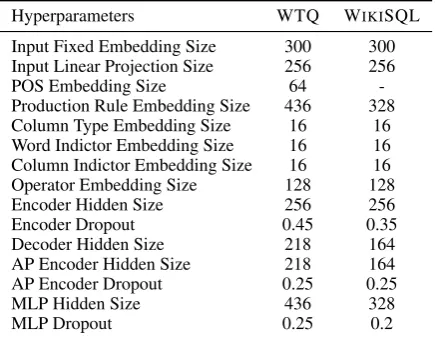
Hyperparameters WTQ WIKISQL
Input Fixed Embedding Size 300 300 Input Linear Projection Size 256 256 POS Embedding Size 64 -Production Rule Embedding Size 436 328 Column Type Embedding Size 16 16 Word Indictor Embedding Size 16 16 Column Indictor Embedding Size 16 16 Operator Embedding Size 128 128 Encoder Hidden Size 256 256 Encoder Dropout 0.45 0.35 Decoder Hidden Size 218 164 AP Encoder Hidden Size 218 164 AP Encoder Dropout 0.25 0.25 MLP Hidden Size 436 328
[image:12.595.73.291.63.232.2]MLP Dropout 0.25 0.2
Table 5: Hyperparameters for WTQ (WIKITABLE -QUESTIONS) and WIKISQL. AP Encoder is the en-coder representing the abstract programs we generate.
.
same hidden size and dropout rate. During decod-ing, we choose the top-6 abstract programs to in-stantiate via beam search.
D Alignments
If a row slot is instantiated with the special con-dition ‘all rows’, then it is possible that the se-mantics of this slot is implicit. For instance, the question “which driver completed the least num-ber of laps? ” should first be mapped to the ab-stract program “select (argmin (#row slot, #column slot), #column slot)” which is then instantiated to the cor-rect program “select (argmin (all rows, column:laps) col-umn:driver)”. The row slot in the abstract program is instantiated with ‘all rows’, but this is not ex-plicitly expressed in the question.