Proceedings of the 2019 Conference on Empirical Methods in Natural Language Processing
5689
Understanding Data Augmentation in Neural Machine Translation:
Two Perspectives towards Generalization
Guanlin Li✏⇤, Lemao Liu , Guoping Huang , Conghui Zhu✏, Tiejun Zhao✏, Shuming Shi ✏Harbin Institute of Technology, Tencent AI Lab
{epsilonlee.green}@gmail.com,{chzhu, tjzhao}@hit.edu.cn, {redmondliu, donkeyhuang, shumingshi}@tencent.com
Abstract
Many Data Augmentation (DA) methods have been proposed for neural machine translation. Existing works measure the superiority of DA methods in terms of their performance on a specific test set, but we find that some DA methods do not exhibit consistent improve-ments across translation tasks. Based on the observation, this paper makes an initial at-tempt to answer a fundamental question: what benefits, which are consistent across different methods and tasks, does DA in general obtain? Inspired by recent theoretic advances in deep learning, the paper understands DA from two perspectives towards the generalization ability of a model: input sensitivity and prediction margin, which are defined independent of spe-cific test set thereby may lead to findings with relatively low variance. Extensive experiments show that relatively consistent benefits across five DA methods and four translation tasks are achieved regarding both perspectives.
1 Introduction
Data Augmentation (DA) is a training paradigm that has been proved to be very effective in many modalities (Park et al., 2019; Perez and Wang, 2017;Sennrich et al.,2016a), especially for classi-fication (Perez and Wang,2017). In structured do-main, Neural Machine Translation (NMT) is the frontier of DA research (Sennrich et al., 2016a; Norouzi et al., 2016; Zhang and Zong, 2016; Fadaee et al., 2017; Wang et al., 2018; Zhang et al., 2019; Edunov et al., 2018; Fadaee and Monz, 2018). However, by investigating a vari-ety of DA methods, we find that their test per-formance across different translation tasks does not exhibit consistent improvement, and this phe-nomenon can be initially observed in (Wang et al., 2018) as well. The reason might be the evaluation
⇤Work done at Tencent AI Lab.
metric on a specific test set when compared to the whole data population, which generates all possi-ble data, has large variance so that leads to the in-consistency. This evaluation dilemma is also rec-ognized and explored byRecht et al.(2018,2019); Werpachowski et al.(2019), and is especially no-torious for language generation tasks (Chaganty et al., 2018; Hashimoto et al., 2019) where the evaluation metrics, e.g. BLEU (Papineni et al., 2001), are extrinsic and heavily relies on the ref-erence provided. Therefore, we ask a fundamental question: what benefits, which are more consistent across different DA methods and translation tasks, can DA in general obtain?
allevi-ate input sensitivity or promote prediction margin. By and large, our main contributions are:
• We make an initial attempt to understand the essence of DA in NMT by investigating its benefits which are relatively consistent across five DA methods and four translation tasks.
• We highlight two perspectives towards gen-eralization to measure the benefits of DA in NMT and study them with carefully designed fair experiments.
2 DA Methods in NMT
2.1 Training Objective Decomposition
Given the train set T the baseline NMT model
p✓(y|x)without using DA is trained under the em-pirical data distributionpˆ(X, Y|T)through
maxi-mum likelihood estimation:
JMLE =Ex,y⇠pˆ(X,Y|T)[logp✓(y|x)], (1)
wherepˆis a mixture of Dirac distribution
concen-trated around each training instance with uniform mixture coefficients (1/|T |). Then we define the
augmentation (AUG) model as a conditional dis-tribution over the train set, q(X, Y|T). 1 Under
the AUG model, the training objective becomes:
JAUG=Ex,y⇠q(X,Y|T)[logp✓(y|x)]. (2)
More realistically, for any DA method in any train-ing run, we can collect the augmented instances to form a set A distinguishing T, when consid-ering the curriculum of mixing Awith the origi-nal trainT. Since we would like to derive a con-ceptual framework that reflects this form of im-portance weighting, we further decompose AUG model into a linear interpolation (↵) ofpˆ(X, Y|T)
and an augmentation distributionqAUG(X, Y|T):
↵·pˆ(X, Y|T) + (1 ↵)·qAUG(X, Y|T), (3)
where↵controls the mixture ratio within a batch during SGD training. The ratio has been founded as an important factor influencing final perfor-mance (Sennrich et al.,2016a;Fadaee et al.,2017; Edunov et al.,2018;Fadaee and Monz,2018).
1In the paper, we do not consider using monolingual data
for DA thus conditioning only on bilingual data since this will further bring monolingual data selection discussed inFadaee and Monz(2018) as a factor to influence the performance of different DA methods; we leave this factor for future study.
Method Fr)En En)Fr Zh)En En)De
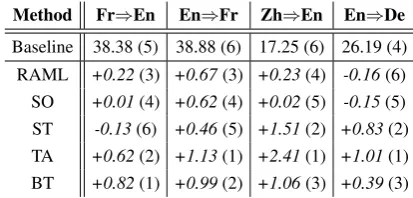
[image:2.595.311.518.62.161.2]Baseline 38.38 (5) 38.88 (6) 17.25 (6) 26.19 (4) RAML +0.22(3) +0.67(3) +0.23(4) -0.16(6) SO +0.01(4) +0.62(4) +0.02(5) -0.15(5) ST -0.13(6) +0.46(5) +1.51(2) +0.83(2) TA +0.62(2) +1.13(1) +2.41(1) +1.01(1) BT +0.82(1) +0.99(2) +1.06(3) +0.39(3)
Table 1: Main BLEU results (CTC=0.62).
Key factors Through Eq.3, we can identify two key factors for conducting fair experiments: a) the number of SGD updates on every original training instance means how much the model learns from T; b) the mixture ratio means how much the model learns fromAonline, with which together balance the learning of the translation knowledge.
2.2 Settings and Main Performance
Settings By carefully controlling the above two factors, we conduct fair and extensive experiments with Transformer (Vaswani et al., 2017) on four translation tasks for five DA methods. Fairseq (Ott et al.,2019) is used as our codebase. We use stan-dard benchmarks IWSLT17 En-Fr, WMT19 Zh-En, WMT19 En-De, where we train both transla-tion directransla-tions on the IWSLT corpus. The five DA methods are briefly summarized as follows:
• RAML: reward-augmented maximum likeli-hood training, which augment the target-side with a sampling distribution P(Y|Y⇤)
con-centrated aroundY⇤ (Norouzi et al.,2016).
• Switchout (SO): similar to RAML, but also adds the some kind of augmentation to the source-side (Wang et al.,2018).
• Self-training (ST): fix the source-side, uses an forward NMT model to generate the target-side (Zhang and Zong,2016).
• Target-agree (TA): similar to ST, but uses a forward NMT model with right-to-left de-coder (Zhang et al.,2019).
• Back-translation (BT): fix the target-side, uses an backward NMT model to generate the source-side (Sennrich et al.,2016a).
The implementation of RAML and SO are bor-rowed from the Appx. ofWang et al.(2018).2
2We categorize and analyze how we choose or train DA
Method Fr)En En)Fr Zh)En En)De
Baseline 0.565 (6) 0.623 (4) 0.422 (6) 0.682 (5) RAML -0.056(2) +0.003(5) -0.008(4) -0.003(4)
[image:3.595.71.292.64.159.2]SO -0.082(1) -0.099(1) -0.053(2) -0.143(1) ST -0.034(3) -0.009(3) -0.054(1) -0.116(2) TA -0.023(5) -0.010(2) -0.043(3) -0.013(3) BT -0.026(4) +0.035(6) -0.007(5) +0.232(6)
Table 2: Sensitivity measure (CTC=0.72).
CTCTable1shows the main BLEU results of dif-ferent methods on the test set. However, we cannot identify the best DA method because their rank-ings across the four translation tasks vary a bit. To measure the degree of consistency, we use a correlation measure called Kendall’s coefficient of concordance (Kendall and Smith,1939;Mazurek, 2011) to evaluate the correlation of the rankings produced on the four translation tasks (appx. C). The value shows strong consistency (correlation) of different rankings when it is close to 1. We call the correlation value Cross-Task Consistency measure or CTC. The CTC for the BLEU measure is 0.62, which is of weak consistency. This phe-nomenon might be a result of the intrinsic nature of using a single specific test as a substitute of the whole data population for evaluation. In the next section, we introduce two measures that are more consistent (with close-to-1 CTC value). They in some extent reflect the model generalization and are easy-to-compute as well.
3 Two Measures Towards Generalization
We attempt to understand the benefits that DA can obtain through the quantification of input sensi-tivity and prediction margin. The two measures are adapted fromNovak et al.(2018) andBartlett et al.(2017);Neyshabur et al.(2017);Jiang et al. (2019). They have been proved through massive experiments to be correlated with model general-ization. Our main purpose here is to utilize them to unveil the consistency property (measured by CTC) of DA across different methods and transla-tion tasks. The next two subsectransla-tions define the two measures and report their statistics on subsamples of the train set respectively.
3.1 Input Sensitivity
Input sensitivity is the sensitivity of the loss com-puted from the model towards a minor change of input representation. Given a point of interest x,
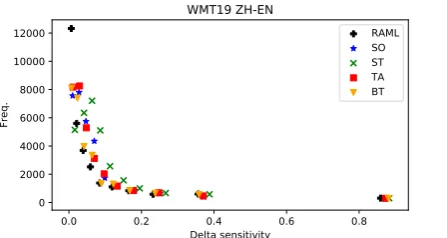
Figure 1: sensitivity binned avg. token freq. statis-tics. Each point represents a bin from which we com-pute the token level average sensitivity between that DA method and the baseline and the token level aver-age frequency as its x and y coordinate value.
the original form inNovak et al.(2018) is defined as the expected Jacobian norm of the loss vector
logp✓(·|x)andp✓is a softmax classifier:
Ex||J(x)||F, (4)
whereJ(x) = @logp✓(·|x)/@xT, and|| · ||F the
Frobenius or L2 norm of the matrix. The paper also suggests a more predictive quantity of the generalization ability. That is to take advantage of the labelyof x and only compute the L2 norm of
a slice of the Jacobian matrix indexed by the label. We adopt the later measure which is the gradient norm of the loss scalar indexed by y to x:
Ex||J(x)y||F. (5)
If x 2 Rd lies in a space with differential
struc-ture, we can apply Eq. 5 directly. But in NMT the naive representation of an instance (x,y) is
the token index given by the vocabulary, so we cannot compute the gradient of the loss with re-spect to x. We followSundararajan et al. (2017) and use the result of x after embedding lookup as its learned representation, denoted as Emb(x) 2
RLx⇥d where Lx is the length of the input and d the size of the embedding. By regarding the
translation model p✓(y|x) as a function that de-composes at each step of y given Emb(x) as
in-put to get a scalar average log likelihood, denoted asLx,y = L1y Ptlogp✓(yt|y<t,x). Moreover,
ini-tial experiments on just using the single original xi to evaluate the gradient will still result in
[image:3.595.310.534.68.187.2]evaluate the sensitivity of xiby averaging gradient
norms over itsknearest neighbor xi(j) 2kNN[xi]
through cosine similarity between word embed-dings. We set k to 5 in our experiment to guar-antee words in theknearest neighbor has similar
semantic meaning. Formally, we define the input sensitivity of an NMT model as:
E(x,y)L1 x
X
i 1 k
X
xi(j)2kNN[xi]
@Lx,y
@Emb(x)i(j) F,
(6) where the Emb(x)iis the embedding lookup of the ithtoken index, so we compute the average
token-wise gradient of each instance.
We use subsamples of the train set to approxi-mately compute the expectation in Eq.6 and the overall statistics are shown in Table 2. Similar to Table1, the DA methods are shown in their value respect to the baseline. A first thing to no-tice is that the ranking is more steady across tasks (CTC=0.72). It also shows that for input x, DA in general can reduce the gradient norm of the pre-diction loss on Emb(x)i, which shows that DA can
obtain more stable model towards data corruption. To further understand what effect DA in gen-eral has on each input token type, we compute the sensitivity between the baseline and one DA method on the same token type and sort them ac-cording to the with positive value (which means DA reduces the sensitivity of that token type). We then divide the sorted types into ten bins and com-pute the average token type frequency of that bin. As shown in Figure1, DA in general, improves the sensitivity of token types with relatively low fre-quency more than those with high frefre-quency, thus may somehow improve the translation quality of low frequency token types.
3.2 Prediction Margin
Margin is a classic concept in support vector ma-chine (Vapnik,2013), which is defined as the ge-ometric distance between the support vectors and the decision boundary. Larger margin implies bet-ter generalization. In nonlinear case, it reflects the distance of a correctly classified input represen-tation with class ito move towards the decision
boundary between iand any other class j (Jiang
et al.,2019). However, since the decision bound-ary does not have analytical form due to non-linearity, computing the geometric distance is in-tractable. In our setting we regard NMT model as doing step-wise classification with z= (x,y<t)as
Method Fr)En En)Fr Zh)En En)De
Baseline 0.797 (4) 0.592 (4) 0.756 (4) 0.679 (4) RAML -0.028(6) -0.063(6) -0.024(6) -0.006(5) SO -0.027(5) -0.060(5) -0.022(5) -0.009(6) ST +0.046(1) +0.036(1) +0.035(1) +0.044(1) TA +0.037(2) +0.019(2) +0.025(2) +0.043(2) BT +0.017(3) +0.015(3) +0.004(3) +0.016(3)
Table 3: Margin measure (CTC=0.98).
input feature and yt as the label. InBartlett et al. (2017), the original definition of the margin of cor-rectly predicted input is:
p✓(yt|z) maxv06=ytp✓(v0|z)
R · ||x||2/N
, (7)
where ytis the ground-truth label,v0another class
type,Rthe spectral complexity of the model and
N the number of training instance in the train sub-samples for computing their margins. We simplify Eq.7to only consider the numerator. The reasons are: a) under the same model architecture,Rs are very close across different DA methods; b) we can omit||x||2/N since it remains unchanged as well.
In this way, we can map every z,yt to a margin
with label type yt=v, wherev2Vtgt:
mvz,y
t :=p✓(yt|z) maxv06=ytp✓(v
0|z). (8)
So for every target token typev we can collect a
set of margins{mv
z,yt}, and the margin sets of all
token types are combined as the total margin set
[v{mvz,yt}. FollowingNeyshabur et al.(2017), we
do not compute the minimum margin of the total set which can be highly sensitive to outliers. In-stead, if the total set has cardinality N0, we
ob-tain the ✏N0-th smallest margin from the set as
the overall prediction margin, with a tolerant co-efficient ✏ 2 [0,0.1] (✏ is set to 0.001). 3 We
can also obtain token-wise prediction margin from {mv
z,yt}, which is the prediction margin of a
spe-cific token typev.
The overall prediction margins are listed in Ta-ble3. The relative rank is highly consistent across the four translation tasks (CTC=0.98). Although RAML and SO seem to be inferior to the baseline, other DA methods improve the margin in general. We give a possible explanation for this in the next subsection. Similar to the previous subsection, we
3Note that, we have tried different tolerant coefficents and
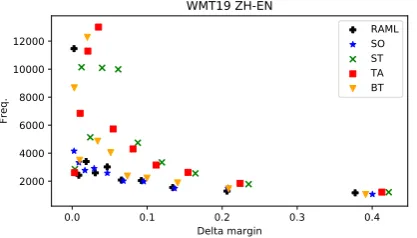
Figure 2: margin binned avg. token freq. statistics.
also report the average token type frequency of each margin binned token groups in Figure2and find that DA, in general, brings larger margin im-provement over low frequency tokens.
3.3 Discussion
Why use these two measures? We have con-ducted a relatively complete survey of the recent measures towards measuring generalization ability proposed by the deep learning community, such as model complexity (Zhang et al.,2016;Neyshabur et al., 2017), flatness (Dinh et al., 2017), stiff-ness (Fort et al., 2019) and second order Hes-sian of the input or the number of linear regions in hiddens (Novak et al., 2018; Montufar et al., 2014). Some of those measures have complex def-inition such as linear regions, others are very ex-pensive to compute for models as large as Trans-former such as Hessian and stiffness. However, we compute weight norm with different forms pro-posed inNeyshabur et al.(2017) and find no reg-ularity which suggests that the complexity mea-sure through norms for networks architectures like Transformer or convolutional/recurrent neural net-works might be very different from simple feed-forward ones which might be still an open prob-lem in theoretic deep learning community. As a matter of fact, due to computational easiness and large-scale empirical evidence, we choose sensi-tivity and margin the measures.
Why no absolute consistency between the two measures? In Section3.1 and3.2, the two mea-sures do not show well consistency between them: under the margin based measure, RAML and SO do not exhibit superiority over the baseline like they do under the sensitivity measure. One rea-son might be: despite the measures are empir-ically proved to reflect generalization, they are only one view towards generalization respectively.
Specifically, in recent generalization theory (No-vak et al.,2018;Bartlett et al.,2017), the measures are evaluated between models with extremely evi-dent difference in generalization ability (measured by test performance difference), for example, be-tween models trained with random labels and true labels. Instead, our comparison is among models with similar capacity and are well-trained, which rises challenge for us to get very consistent statis-tics through a single view. This may inspire us to combine multiple views of model training to de-sign better measures with stronger correlation.
4 Conclusion and Future Work
This paper aims at delivering relatively consistent benefit measures of DA due to the phenomenon of inconsistant BLEU improvement across trans-lation tasks. To our expect, the proposed two mea-sures exhibit relative consistency (especially pre-diction margin) on five DA methods across four translation tasks, which demonstrate that DA can benefit model with improved sensitivity or predic-tion margin especially for low frequency words.
However, the problem of intrinsic evaluation or better understanding of the unreasonable effec-tive of DA should just be a start. DA is a trade-off between noise vs. knowledge injection, so it could be a nice theoretic direction to think about DA under statistical query model (Kearns, 1998) with translation between formal languages (ws-, 2019). This could inspire another essential ques-tion: what is the intrinsic properties of the aug-mented data (Branchaud-Charron et al.,2019) that matter in discrete domain. Applications like active data selection (Coleman et al.,2019) guided with margin or sensitivity can be derived. In general, understanding NMT model’s behavior (not only with DAs) beyond BLEU (Neubig et al., 2019) should be taken seriously, e.g. to design a bevavior suite like Osband et al.(2019) is most valuable.
Acknowledgements
References
2019. Proceedings of the Workshop on Deep Learning and Formal Languages: Building Bridges. Associa-tion for ComputaAssocia-tional Linguistics, Florence.
Peter L. Bartlett, Dylan J. Foster, and Matus Telgar-sky. 2017. Spectrally-normalized margin bounds for neural networks. InNIPS.
Frederic Branchaud-Charron, Andrew Achkar, and Pierre-Marc Jodoin. 2019. Spectral metric for dataset complexity assessment. In Proceedings of the IEEE Conference on Computer Vision and Pat-tern Recognition, pages 3215–3224.
A. Chaganty, S. Mussmann, and P. Liang. 2018. The price of debiasing automatic metrics in natural lan-guage evaluation. InAssociation for Computational Linguistics (ACL).
Yong Cheng, Wei Xu, Zhongjun He, Wei He, Hua Wu, Maosong Sun, and Yang Liu. 2016. Semi-supervised learning for neural machine translation. CoRR, abs/1606.04596.
Cody Coleman, Christopher Yeh, Stephen Mussmann, Baharan Mirzasoleiman, Peter Bailis, Percy Liang, Jure Leskovec, and Matei Zaharia. 2019. Selection via proxy: Efficient data selection for deep learning. ArXiv, abs/1906.11829.
Laurent Dinh, Razvan Pascanu, Samy Bengio, and Yoshua Bengio. 2017. Sharp minima can generalize for deep nets. InProceedings of the 34th Interna-tional Conference on Machine Learning-Volume 70, pages 1019–1028. JMLR. org.
Gintare Karolina Dziugaite and Daniel M. Roy. 2017. Computing nonvacuous generalization bounds for deep (stochastic) neural networks with many more parameters than training data. CoRR, abs/1703.11008.
Sergey Edunov, Myle Ott, Michael Auli, and David Grangier. 2018. Understanding back-translation at scale. InEMNLP.
Marzieh Fadaee, Arianna Bisazza, and Christof Monz. 2017. Data augmentation for low-resource neural machine translation. InACL.
Marzieh Fadaee and Christof Monz. 2018. Back-translation sampling by targeting difficult words in neural machine translation. InEMNLP.
Stanislav Fort, Paweł Krzysztof Nowak, and Srini Narayanan. 2019. Stiffness: A new perspective on generalization in neural networks. arXiv preprint arXiv:1901.09491.
Tommaso Furlanello, Zachary Chase Lipton, Michael Tschannen, Laurent Itti, and Anima Anandkumar. 2018. Born again neural networks. InICML.
T. Hashimoto, H. Zhang, and P. Liang. 2019. Unify-ing human and statistical evaluation for natural lan-guage generation. InNorth American Association for Computational Linguistics (NAACL).
Geoffrey E. Hinton, Oriol Vinyals, and Jeffrey Dean. 2015. Distilling the knowledge in a neural network. CoRR, abs/1503.02531.
Yiding Jiang, Dilip Krishnan, Hossein Mobahi, and Samy Bengio. 2019. Predicting the generaliza-tion gap in deep networks with margin distribugeneraliza-tions. CoRR, abs/1810.00113.
Kenji Kawaguchi, Leslie Pack Kaelbling, and Yoshua Bengio. 2018. Generalization in deep learning. CoRR, abs/1710.05468.
Michael Kearns. 1998. Efficient noise-tolerant learn-ing from statistical queries. J. ACM, 45(6):983– 1006.
Maurice G Kendall and B Babington Smith. 1939. The problem of m rankings. Annals of mathematical statistics.
Yoon Kim and Alexander M. Rush. 2016. Sequence-level knowledge distillation. InEMNLP.
Jiˇr´ı Mazurek. 2011. Evaluation of ranking similar-ity in ordinal ranking problems. Acta academica karviniensia, 2:119–128.
Guido F Montufar, Razvan Pascanu, Kyunghyun Cho, and Yoshua Bengio. 2014. On the number of lin-ear regions of deep neural networks. InAdvances in neural information processing systems, pages 2924– 2932.
Graham Neubig, Zi-Yi Dou, Junjie Hu, Paul Michel, Danish Pruthi, and Xinyi Wang. 2019. compare-mt: A tool for holistic comparison of language gener-ation systems. In Meeting of the North American Chapter of the Association for Computational Lin-guistics (NAACL) Demo Track, Minneapolis, USA. Behnam Neyshabur, Srinadh Bhojanapalli, David A.
McAllester, and Nathan Srebro. 2017. Exploring generalization in deep learning. InNIPS.
Mohammad Norouzi, Samy Bengio, Zhifeng Chen, Navdeep Jaitly, Mike Schuster, Yonghui Wu, and Dale Schuurmans. 2016. Reward augmented max-imum likelihood for neural structured prediction. In NIPS.
Roman Novak, Yasaman Bahri, Daniel A. Abo-lafia, Jeffrey Pennington, and Jascha Sohl-Dickstein. 2018. Sensitivity and generalization in neural net-works: an empirical study. CoRR, abs/1802.08760. Ian Osband, Yotam Doron, Matteo Hessel, John
Myle Ott, Sergey Edunov, Alexei Baevski, Angela Fan, Sam Gross, Nathan Ng, David Grangier, and Michael Auli. 2019. fairseq: A fast, extensible toolkit for sequence modeling. In Proceedings of NAACL-HLT 2019: Demonstrations.
Kishore Papineni, Salim Roukos, Todd Ward, and Wei-Jing Zhu. 2001. Bleu: a method for automatic eval-uation of machine translation. InACL.
Daniel S Park, William Chan, Yu Zhang, Chung-Cheng Chiu, Barret Zoph, Ekin D Cubuk, and Quoc V Le. 2019. Specaugment: A simple data augmentation method for automatic speech recognition. arXiv preprint arXiv:1904.08779.
Luis Perez and Jason Wang. 2017. The effectiveness of data augmentation in image classification using deep learning.CoRR, abs/1712.04621.
Benjamin Recht, Rebecca Roelofs, Ludwig Schmidt, and Vaishaal Shankar. 2018. Do cifar-10 classifiers generalize to cifar-10? CoRR, abs/1806.00451. Benjamin Recht, Rebecca Roelofs, Ludwig Schmidt,
and Vaishaal Shankar. 2019. Do imagenet classifiers generalize to imagenet? CoRR, abs/1902.10811. Rico Sennrich, Barry Haddow, and Alexandra Birch.
2016a. Improving neural machine translation mod-els with monolingual data.CoRR, abs/1511.06709. Rico Sennrich, Barry Haddow, and Alexandra Birch.
2016b. Neural machine translation of rare words with subword units. CoRR, abs/1508.07909. Nitish Srivastava, Geoffrey E. Hinton, Alex
Krizhevsky, Ilya Sutskever, and Ruslan R. Salakhut-dinov. 2014. Dropout: a simple way to prevent neural networks from overfitting. Journal of Machine Learning Research, 15:1929–1958. Mukund Sundararajan, Ankur Taly, and Qiqi Yan.
2017. Axiomatic attribution for deep networks. In ICML.
Vladimir Vapnik. 2013.The nature of statistical learn-ing theory. Sprlearn-inger science & business media. Ashish Vaswani, Noam Shazeer, Niki Parmar, Jakob
Uszkoreit, Llion Jones, Aidan N. Gomez, Lukasz Kaiser, and Illia Polosukhin. 2017. Attention is all you need. InNIPS.
Stefan Wager, Sida I. Wang, and Percy S. Liang. 2013. Dropout training as adaptive regularization. InNIPS.
Sida I. Wang, Mengqiu Wang, Stefan Wager, Percy S. Liang, and Christopher D. Manning. 2013. Fea-ture noising for log-linear strucFea-tured prediction. In EMNLP.
Xinyi Wang, Hieu Quang Pham, Zihang Dai, and Gra-ham Neubig. 2018. Switchout: an efficient data aug-mentation algorithm for neural machine translation.
InEMNLP.
Roman Werpachowski, Andr´as Gy¨orgy, and Csaba Szepesv´ari. 2019. Detecting overfitting via adver-sarial examples. CoRR, abs/1903.02380.
Yingce Xia, Di He, Tao Qin, Liwei Wang, Nenghai Yu, Tie-Yan Liu, and Wei-Ying Ma. 2016. Dual learning for machine translation. InNIPS.
Ziang Xie, Sida I. Wang, Jiwei Li, Daniel L´evy, Aim-ing Nie, Daniel Jurafsky, and Andrew Y. Ng. 2017. Data noising as smoothing in neural network lan-guage models. CoRR, abs/1703.02573.
Chiyuan Zhang, Samy Bengio, Moritz Hardt, Ben-jamin Recht, and Oriol Vinyals. 2016. Understand-ing deep learnUnderstand-ing requires rethinkUnderstand-ing generalization. ArXiv, abs/1611.03530.
Jiajun Zhang and Chengqing Zong. 2016. Exploit-ing source-side monolExploit-ingual data in neural machine translation. InEMNLP.
Zhirui Zhang, Shujie Liu, Mu Li, Ming Zhou, and En-hong Chen. 2018. Joint training for neural machine translation models with monolingual data. InAAAI.
Zhirui Zhang, Shuangzhi Wu, Shujie Liu, Mu Li, Ming Zhou, and Enhong Chen. 2019. Regularizing neu-ral machine translation by target-bidirectional agree-ment.CoRR, abs/1808.04064.