153
Exploring Multilingual Syntactic Sentence Representations
Chen Liu, Anderson de Andrade, Muhammad Osama
Wattpad Toronto, ON, Canada
cecilia, anderson, [email protected]
Abstract
We study methods for learning sentence em-beddings with syntactic structure. We focus on methods of learning syntactic sentence-embeddings by using a multilingual parallel-corpus augmented by Universal Parts-of-Speech tags. We evaluate the quality of the learned embeddings by examining sentence-level nearest neighbours and functional dis-similarity in the embedding space. We also evaluate the ability of the method to learn syn-tactic sentence-embeddings for low-resource languages and demonstrate strong evidence for transfer learning. Our results show that syntac-tic sentence-embeddings can be learned while using less training data, fewer model parame-ters, and resulting in better evaluation metrics than state-of-the-art language models.
1 Introduction
Recent success in language modelling and repre-sentation learning have largely focused on learn-ing the semantic structures of language (Devlin et al.,2018). Syntactic information, such as part-of-speech (POS) sequences, is an essential part of language and can be important for tasks such as authorship identification, writing-style analysis, translation, etc. Methods that learn syntactic rep-resentations have received relatively less attention, with focus mostly on evaluating the semantic in-formation contained in representations produced by language models.
Multilingual embeddings have been shown to achieve top performance in many downstream tasks (Conneau et al.,2017;Artetxe and Schwenk, 2018). By training over large corpora, these mod-els have shown to generalize to similar but unseen contexts. However, words contain multiple types of information: semantic, syntactic, and morpho-logic. Therefore, it is possible that syntactically different passages have similar embeddings due
to their semantic properties. On tasks like the ones mentioned above, discriminating using pat-terns that include semantic information may result in poor generalization, specially when datasets are not sufficiently representative.
In this work, we study methods that learn sentence-level embeddings that explicitly capture syntactic information. We focus on variations of sequence-to-sequence models (Sutskever et al., 2014), trained using a multilingual corpus with universal part-of-speech (UPOS) tags for the tar-get languages only. By using target-language UPOS tags in the training process, we are able to learn sentence-level embeddings for source lan-guages that lack UPOS tagging data. This prop-erty can be leveraged to learn syntactic embed-dings for low-resource languages.
Our main contributions are: to study whether sentence-level syntactic embeddings can be learned efficiently, to evaluate the structure of the learned embedding space, and to explore the potential of learning syntactic embeddings for low-resource languages.
We evaluate the syntactic structure of sentence-level embeddings by performing nearest-neighbour (NN) search in the embedding space. We show that these embeddings exhibit properties that correlate with similarities between UPOS sequences of the original sentences. We also evaluate the embeddings produced by language models such as BERT (Devlin et al., 2018) and show that they contain some syntactic information.
We further explore our method in the few-shot setting for low-resource source languages without large, high quality treebank datasets. We show its transfer-learning capabilities on artificial and real low-resource languages.
syntactic embeddings. This is similar to exist-ing results for models trained (or pre-trained) on multiple languages (Schwenk,2018;Artetxe and Schwenk, 2018) for downstream tasks (Lample and Conneau,2019).
2 Related Work
Training semantic embeddings based on multilin-gual data was studied by MUSE (Conneau et al., 2017) and LASER (Artetxe and Schwenk,2018) at the word and sentence levels respectively. Multi-task training for disentangling semantic and syn-tactic information was studied in (Chen et al., 2019). This work also used a nearest neigh-bour method to evaluate the syntactic properties of models, though their focus was on disentangle-ment rather than embedding quality.
The syntactic content of language models was studied by examining syntax trees (Hewitt and Manning,2019), subject-object agreement ( Gold-berg, 2019), and evaluation on syntactically al-tered datasets (Linzen et al., 2016; Marvin and Linzen,2018). These works did not examine mul-tilingual models.
Distant supervision (Fang and Cohn, 2016; Plank and Agic,2018) has been used to learn POS taggers for low-resource languages using cross-lingual corpora. The goal of these works is to learn word-level POS tags, rather than sentence-level syntactic embeddings. Furthermore, our method does not require explicit POS sequences for the low-resource language, which results in a simpler training process than distant supervision.
3 Method
3.1 Architecture
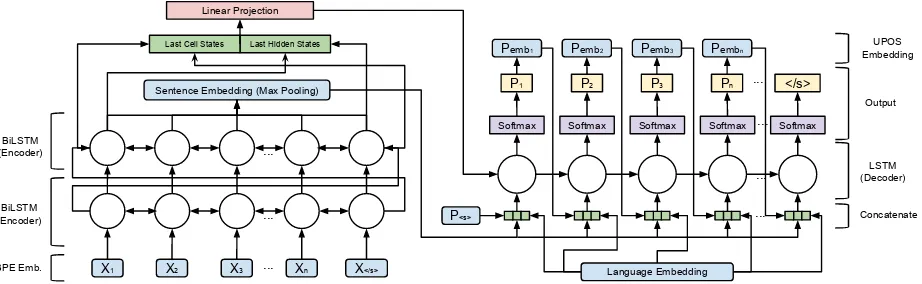
We iterated upon the model architecture pro-posed in LASER (Artetxe and Schwenk, 2018). The model consists of a two-layer Bi-directional LSTM (BiLSTM) encoder and a single-layer LSTM decoder. The encoder is language agnos-tic as no language context is provided as input. In contrast to LASER, we use the concatenation of last hidden and cell states of the encoder to initial-ize the decoder through a linear projection.
[image:2.595.328.502.75.263.2]At each time-step, the decoder takes an embed-ding of the previous POS target concatenated with an embedding representing the language context, as well as a max-pooling over encoder outputs. Figure 1 shows the architecture of the proposed model.
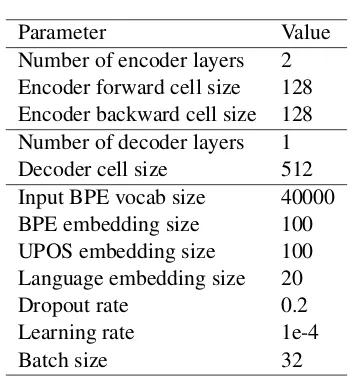
Table 1: Hyperparameters
Parameter Value
Number of encoder layers 2 Encoder forward cell size 128 Encoder backward cell size 128 Number of decoder layers 1
Decoder cell size 512
Input BPE vocab size 40000
BPE embedding size 100
UPOS embedding size 100 Language embedding size 20
Dropout rate 0.2
Learning rate 1e-4
Batch size 32
The input embeddings for the encoder were cre-ated using a jointly learned Byte-Pair-Encoding (BPE) vocabulary (Sennrich et al., 2016) for all languages by using sentencepiece1.
3.2 Training
Training was performed using an aligned paral-lel corpus. Given a source-target aligned sentence pair (as in machine translation), we:
1. Convert the sentence in the source language into BPE
2. Look up embeddings for BPE as the input to the encoder
3. Convert the sentence in a target language into UPOS tags, in the tagset of the target lan-guage.
4. Use the UPOS tags in step 3 as the targets for a cross-entropy loss.
Hence, the task is to predict the UPOS sequence computed from the translated input sentence.
The UPOS targets were obtained using Stand-fordNLP (Qi et al.,2018)2. Dropout with a drop probability of 0.2 was applied to the encoder. The Adam optimizer (Kingma and Ba,2015) was used with a constant learning rate of 0.0001. Table 1 shows a full list of the hyperparameters used in the training procedure.
3.3 Dataset
To create our training dataset, we followed an ap-proach similar to LASER. The dataset contains 6
1
https://github.com/google/sentencepiece
X1 X2 X3 Xn X</s>
Sentence Embedding (Max Pooling)
BiLSTM (Encoder)
BiLSTM (Encoder)
BPE Emb.
Linear Projection
P<s>
Language Embedding
Softmax Softmax Softmax Softmax Softmax
Pemb1
P1 P2 P3 Pn </s>
Pemb2 Pemb3 Pembn
LSTM (Decoder)
Output UPOS Embedding
Last Hidden States Last Cell States
Concatenate
...
... ... ...
...
[image:3.595.72.533.57.199.2]... ...
Figure 1: Proposed architecture.
languages: English, Spanish, German, Dutch, Ko-rean and Chinese Mandarin. These languages use 3 different scripts, 2 different language orderings, and belong to 4 language families.
English, Spanish, German, and Dutch use a Latin-based script. However, Spanish is a Roman-tic language while the others are Germanic lan-guages. Chinese Mandarin and Korean are in-cluded because they use non-latin based scripts and originate from language families distinct from the other languages. Although the grammatical rules vary between the selected languages, they share a number of key characteristics such as the Subject-Verb-Object ordering, except Korean (which mainly follows theSubject-Object-Verb or-der). We hope to extend our work to other lan-guages with different scripts and sentence struc-tures, such as Arabic, Japanese, Hindi, etc. in the future.
The dataset was created by using translations provided by Tatoeba3 and OpenSubtitles4 (Lison and Tiedemann,2016). They were chosen for their high availability in multiple languages.
Statistics of the final training dataset are shown in Table 2. Rows and columns correspond to source and target languages respectively.
3.3.1 Tatoeba
Tatoeba is a freely available crowd-annotated dataset for language learning. We selected all sen-tences in English, Spanish, German, Dutch, and Korean. We pruned the dataset to contain only sentences with at least one translation to any of the other languages. The final training set contains 1.36M translation sentence pairs from this source.
3
https://tatoeba.org/eng/
4http://opus.nlpl.eu/OpenSubtitles-v2018.php
3.3.2 OpenSubtitles
We augmented our training data by using the 2018 OpenSubtitles dataset. OpenSubtitles is a publicly available dataset based on movie subtitles (Lison and Tiedemann, 2016). We created our training dataset from selected aligned subtitles by taking the unique translations among the first million sen-tences, for each aligned parallel corpus. We fur-ther processed the data by pruning to remove sam-ples with less than 3 words, multiple sentences, or incomplete sentences. The resulting dataset contains 1.9M translation sentence pairs from this source.
4 Experiments
We aim to address the following questions:
1. Can syntactic structures be embedded? For multiple languages?
2. Can parallel corpora be used to learn syntac-tic structure for low-resource languages? 3. Does multilingual pre-training improve
syn-tactic embeddings?
We address question 1 in Secs. 4.1 and4.2 by evaluating the quality of syntactic and semantic embeddings in several ways. Questions 2 and 3 are addressed in Sec.4.3by studying the transfer-learning performance of syntactic embeddings.
4.1 Quality of Syntactic Embeddings
We studied the quality of the learned syntactic embeddings by using a nearest-neighbour (NN) method.
Table 2: Training Dataset Statistics
English German Spanish Chinese Korean Dutch
English - 521.87k 194.51k 41.33k 31.81k 190.86k
German 520.64k - 217.96k 5.67k 0.21k 12.20k
Spanish 193.01k 217.46k - 159.67k 28.68k 144.82k
Chinese 40.79k 5.62k 159.73k - 0.05k 0.32k
Korean 31.05k 1.37k 28.89k 0.07k - 56.93k
Dutch 215.18k 25.75k 155.35k 0.66k 56.92k
-UPOS sequence.
For all languages except Korean, a held-out test set was created by randomly sampling groups that contained at least 6 sentences. For Korean, all groups containing at least 6 sentences were kept as the test set since the dataset is small.
During evaluation, we applied max-pooling to the outputs of the encoder to obtain the syntactic embeddings of the held-out sentences5.
For each syntactic embedding, we find its top nearest neighbour (1-NN) and top-5 nearest neigh-bours (5-NN) in the embedding space for the held-out sentences, based on their UPOS group.
Given n sentences S = {s0, . . . , sn−1} and
their embeddings E = {e0, . . . , en−1}, for each
si there is a set of k gold nearest neighbours
G(i, k) = {g0, . . . , gk−1},G(i, k) ⊆S such that
d(si, g) ≤ d(si, s)for allg ∈ G(i, k)ands ∈
S\G(i, k), whered(·,·)is the cosine distance. Given embedding ei, we calculate cosine
dis-tances {d(ei, ej)forej ∈ E, ej 6= ei} and sort
them into non-decreasing orderdj0 ≤dj1 ≤ · · · ≤
djn−2. We consider the ordering to be unique as
the probability of embedding cosine distances be-ing equal is very small.
The set of embeddedk-nearest neighbours ofsi
is defined as
N(i, k) ={sjforj ∈ {j0, . . . , jk−1}}.
Finally, thek-nearest neighbours accuracy for si
is given by
|N(i, k)∩G(i, k)|
k .
A good embedding model should cluster the embeddings for similar inputs in the embedding space. Hence, the 5-NN test can be seen as an in-dicator of how cohesive the embedding space is.
5Evaluation data will be hosted at
https://github.com/ccliu2/syn-emb
Table 3: Syntactic Nearest-Neighbour Accuracy (%)
ISO 1-NN/5-NN Total/Groups English en 97.27/93.36 2784/160 German de 93.45/86.77 1282/91 Spanish es 93.81/86.24 1503/81 Chinese zh 71.26/61.44 167/22 Korean ko 28.27/18.40 527/40 Dutch nl 74.17/51.71 3171/452
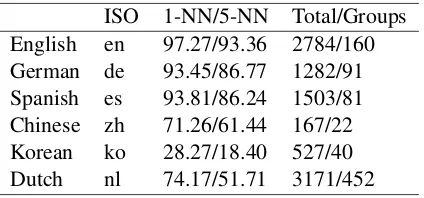
The results are shown in Table 3. The differ-ences in the number of groups in each language are due to different availabilities of sentences and sentence-types in the Tatoeba dataset.
The high nearest neighbours accuracy indicates that syntax information was successfully captured by the embeddings. Table 3 also shows that the syntactic information of multiple languages was captured by a single embedding model.
4.1.1 Language Model
A number of recent works (Hewitt and Man-ning, 2019; Goldberg, 2019) have probed lan-guage models to determine if they contain syn-tactic information. We applied the same nearest neighbours experiment (with the same test sets) on a number of existing language models: Uni-versal Sentence Encoder (USE) (Cer et al.,2018), LASER, and BERT. For USE we used models available from TensorHub6. For LASER we used models and created embeddings from the official repository7.
For BERT, we report the results using max (BERTmax) and average-pooling (BERTavg),
ob-tained from the BERT embedding toolkit8 with the multilingual cased model (104 languages, 12-layers, 768-hidden units, 12-heads), and ‘pooled-output’ (BERToutput) from the TensorHub version
6
https://www.tensorflow.org/hub
7
https://github.com/facebookresearch/LASER
of the model with the same parameters.
We computed the nearest neighbours experi-ment for all languages in the training data for the above models. The results are shown in Ta-ble 4. The results show that general purpose language models do capture syntax information, which varies greatly across languages and models. The nearest neighbours accuracy of our syn-tactic embeddings in Table3significantly outper-forms the general purpose language models. Ar-guably these language models were trained using different training data. However, this is a reason-able comparison because many real-world appli-cations rely on released pre-trained language mod-els for syntactically related information. Hence, we want to show that we can use much smaller models trained with direct supervision, to obtain syntactic embeddings with similar or better qual-ity. Nonetheless, the training method used in this work can certainly be extended to architectures similar to BERT or USE.
4.2 Functional Dissimilarity
The experiments in the previous section showed that the proposed syntactic embeddings formed cohesive clusters in the embedding space, based on UPOS sequence similarities. We further stud-ied the spatial relationships within the embed-dings.
Word2Vec(Mikolov et al.,2013) examined spa-tial relationships between embeddings and com-pared them to the semantic relationships between words. Operations on vectors in the embedding space such asKing−M an+W oman=Queen created vectors that also correlated with similar operations in semantics. Such semantic compar-isons do not directly translate to syntactic embed-dings. However, syntax information shifts with edits on POS sequences. Hence, we examined the spatial relationships between syntactic embed-dings by comparing their cosine similarities with the edit distances between UPOS sequence pairs.
GivennUPOS sequencesU ={u0, ..., un−1},
we compute the matrix L ∈ Rn×n, wherelij =
l(ui, uj), the complement of the normalized
Lev-enshtein distance betweenuianduj.
Given the set of embedding vectors
{e0, ..., en−1} where ei is the embedding for
sentence si, we also compute D ∈ Rn×n, where
dij = d(ei, ej). We further normalize dij to be
within[0,1] by min-max normalization to obtain
ˆ
D= minMax(D).
Following (Yin and Shen,2018), we define the functional dissimilarity scoreby
kL−DˆkF
n .
Intuitively, UPOS sequences that are similar (smaller edit distance) should be embedded close to each other in the embedding space, and embed-dings that are further away should have dissimilar UPOS sequences. Hence, the functional dissimi-larity score is low if the relative changes in UPOS sequences are reflected in the embedding space. The score is high if such changes are not reflected. The functional dissimilarity score was com-puted using sentences from the test set in CoNLL 2017 Universal Dependencies task (Nivre et al., 2017) for the relevant languages with the provided UPOS sequences. Furthermore, none of the evalu-ated models, including the proposed method, were trained with CoNLL2017 data.
We compared the functional dissimilarity scores of our syntactic representations against embed-dings obtained from BERT and LASER, to further demonstrate that simple network structures with explicit supervision may be sufficient to capture syntactic structure. All the results are shown in Table 5. We only show the best (lowest) results from BERT.
4.3 Transfer Performance of Syntactic Embeddings
Many NLP tasks utilize POS as features, but hu-man annotated POS sequences are difficult and ex-pensive to obtain. Thus, it is important to know if we can learn sentences-level syntactic embeddings for low-sources languages without treebanks.
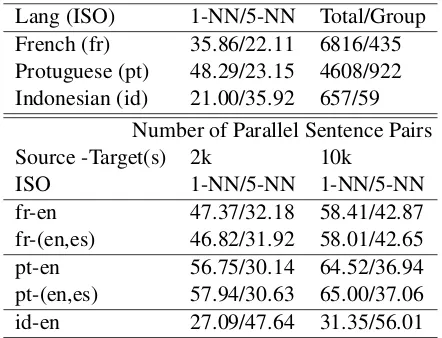
We performed zero-shot transfer of the syntac-tic embeddings for French, Portuguese and In-donesian. French and Portuguese are simulated low-resource languages, while Indonesian is a true low-resource language. We reported the 1-NN and 5-NN accuracies for all languages using the same evaluation setting as described in the previous sec-tion. The results are shown in Table6(top).
Table 4: Syntactic Nearest-Neighbour for Language Models (%)
English German Spanish Chinese Korean Dutch
Model 1-NN/5-NN 1-NN/5-NN 1-NN/5-NN 1-NN/5-NN 1-NN/5-NN 1-NN/5-NN
USE 71.83/55.68 59.87/44.26 53.05/38.06 39.23/30.18 21.22/12.43 28.66/12.77 BERTmax 90.19/86.36 83.66/77.63 83.89/79.92 67.96/68.40 20.30/11.92 37.67/19.51
BERTavg 89.06/84.70 79.54/74.82 78.24/75.61 65.75/67.07 20.30/11.47 37.04/19.46
BERToutput 77.75/63.44 66.20/51.89 65.21/50.41 52.49/46.34 16.39/10.98 24.27/10.67
[image:6.595.126.476.214.270.2]LASER 86.33/76.66 76.56/62.88 72.49/59.72 56.89/45.15 26.63/15.90 50.75/31.00
Table 5: Functional Dissimilarity Scores (Lower is Better)
Model English German Spanish Chinese Korean Dutch
BERTavg 0.3463 0.3131 0.2955 0.2935 0.3001 0.3131
LASER 0.1602 0.1654 0.2074 0.3099 0.2829 0.1654
Proposed Work 0.1527 0.1588 0.1588 0.2267 0.2533 0.1588
tag information was provided to the model for the ‘source’ languages, where supervising infor-mation comes solely from parallel sentences and UPOS tags in high-resource languages.
The results show that for a new language (French and Portuguese) that is similar to the fam-ily of pre-training languages, there are two ways to achieve higher 1-NN accuracy. If the num-ber of unique sentences in the new language is small, accuracy can be improved by increasing the size of the parallel corpora used to fine-tune. If only one parallel corpus is available, accuracy can be improved by increasing the number of unique sentence-pairs used to fine-tune.
For a new language that is dissimilar to the fam-ily of pre-training languages, e.g. Indonesian in Table6, the above methods only improved nearest neighbours accuracy slightly. This may be caused by differing data distribution or by tagger inaccu-racies. The results for Indonesian do indicate that some syntactic structure can be learned by using our method, even for a dissimilar language.
A future direction is to conduct a rigorous anal-ysis of transfer learning between languages from the same versus different language families.
5 Conclusion
We examined the possibility of creating syntactic embeddings by using a multilingual method based on sequence-to-sequence models. In contrast to prior work, our method only requires parallel cor-pora and UPOS tags in the target language.
We studied the quality of learned embeddings by examining nearest neighbours in the
embed-Table 6: Syntactic Nearest-Neighbour on New lan-guages (%)
Lang (ISO) 1-NN/5-NN Total/Group French (fr) 35.86/22.11 6816/435 Protuguese (pt) 48.29/23.15 4608/922 Indonesian (id) 21.00/35.92 657/59
Number of Parallel Sentence Pairs
Source -Target(s) 2k 10k
ISO 1-NN/5-NN 1-NN/5-NN
fr-en 47.37/32.18 58.41/42.87
fr-(en,es) 46.82/31.92 58.01/42.65
pt-en 56.75/30.14 64.52/36.94
pt-(en,es) 57.94/30.63 65.00/37.06
id-en 27.09/47.64 31.35/56.01
ding space and investigating their functional dis-similarity. These results were compared against recent state-of-the-art language models. We also showed that pre-training with a parallel corpus allowed the syntactic embeddings to be trans-ferred to low-resource languages via few-shot fine-tuning.
[image:6.595.306.527.322.491.2]References
Mikel Artetxe and Holger Schwenk. 2018. Mas-sively multilingual sentence embeddings for zero-shot cross-lingual transfer and beyond. arXiv preprint arXiv:1812.10464.
Daniel Cer, Yinfei Yang, Sheng yi Kong, Nan Hua, Nicole Limtiaco, Rhomni St. John, Noah Con-stant, Mario Guajardo-Cespedes, Steve Yuan, Chris Tar, Yun-Hsuan Sung, Brian Strope, and Ray Kurzweil. 2018. Universal sentence encoder. CoRR, abs/1803.11175.
Mingda Chen, Qingming Tang, Sam Wiseman, and Kevin Gimpel. 2019. A multi-task approach for dis-entangling syntax and semantics in sentence repre-sentations. InNAACL2019.
Alexis Conneau, Guillaume Lample, Marc’Aurelio Ranzato, Ludovic Denoyer, and Herv´e J´egou. 2017. Word translation without parallel data. arXiv preprint arXiv:1710.04087.
Jacob Devlin, Ming-Wei Chang, Kenton Lee, and Kristina Toutanova. 2018. Bert: Pre-training of deep bidirectional transformers for language understand-ing. arXiv preprint arXiv:1810.04805.
Meng Fang and Trevor Cohn. 2016. Learning when to trust distant supervision: An application to low-resource POS tagging using cross-lingual projection. In Proceedings of the 20th SIGNLL Conference on Computational Natural Language Learning.
Yoav Goldberg. 2019. Assessing bert’s syntactic abili-ties. arXiv preprint arXiv:1901.05287.
John Hewitt and Christopher D. Manning. 2019. A structural probe for finding syntax in word represen-tations. InNAACL2019.
Diederik P. Kingma and Jimmy Ba. 2015. Adam: A method for stochastic optimization. CoRR, abs/1412.6980.
Guillaume Lample and Alexis Conneau. 2019. Cross-lingual language model pretraining. CoRR, abs/1901.07291.
Tal Linzen, Emmanuel Dupoux, and Yoav Goldberg. 2016. Assessing the ability of lstms to learn syntax-sensitive dependencies. Transactions of the Associ-ation for ComputAssoci-ational Linguistics.
Pierre Lison and J¨org Tiedemann. 2016. Opensub-titles2016: Extracting large parallel corpora from movie and tv subtitles.
Rebecca Marvin and Tal Linzen. 2018. Targeted syntactic evaluation of language models. In
EMNLP2018.
Tomas Mikolov, Ilya Sutskever, Kai Chen, Gregory S. Corrado, and James A. Dean. 2013. Distributed rep-resentations of words and phrases and their compo-sitionality. InNIPS.
Joakim Nivre, ˇZeljko Agi´c, Lars Ahrenberg, et al. 2017. Universal dependencies 2.0. lindat/clarin dig-ital library at the institute of formal and applied lin-guistics, charles university, prague.
Barbara Plank and Zeljko Agic. 2018. Distant super-vision from disparate sources for low-resource part-of-speech tagging. InEMNLP2018.
Peng Qi, Timothy Dozat, Yuhao Zhang, and Christo-pher D. Manning. 2018. Universal dependency pars-ing from scratch. InProceedings of the CoNLL 2018 Shared Task: Multilingual Parsing from Raw Text to Universal Dependencies, pages 160–170, Brus-sels, Belgium. Association for Computational Lin-guistics.
Holger Schwenk. 2018. Filtering and mining parallel data in a joint multilingual space. InACL.
Rico Sennrich, Barry Haddow, and Alexandra Birch. 2016. Neural machine translation of rare words with subword units. InProceedings of the 54th An-nual Meeting of the Association for Computational Linguistics (Volume 1: Long Papers), pages 1715– 1725, Berlin, Germany. Association for Computa-tional Linguistics.
Ilya Sutskever, Oriol Vinyals, and Quoc V. Le. 2014. Sequence to sequence learning with neural net-works. InNIPS.