104
Commonsense inference in human-robot communication
Aliaksandr Huminski
Institute of High Performance Computing, Singapore
Ng Yan Bin A*STAR AI, Singapore
Singapore
ng yan [email protected]
Kenneth Kwok
Institute of High Performance Computing, Singapore
Francis Bond
Nanyang Technological University, Singapore
Abstract
Natural language communication between ma-chines and humans are still constrained. The article addresses a gap in natural language un-derstanding about actions, specifically that of understanding commands. We propose a new method for commonsense inference (ground-ing) of high-level natural language commands into specific action commands for further ex-ecution by a robotic system. The method al-lows to build a knowledge base that consists of a large set of commonsense inferences. The preliminary results have been presented. 1 Introduction
There is a significant progress in movement from early natural language understanding computer programs like SHRDLU (Winograd, 1972) with its deterministic actions in the virtual world to modern cognitive robots operating in the physical world and mapping language to actions. Artificial agents enter our lives and the end users of such systems are not technical experts. The only way for them to communicate with AI is to use natural language. For example, humans can give a natural language command expecting a follow-up action by the agent.
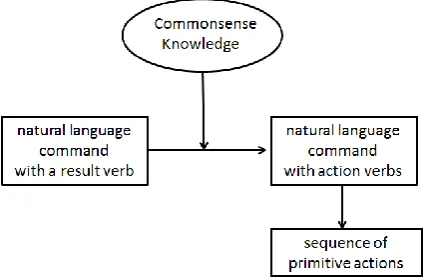
Nowadays in robotics, in order to execute a nat-ural language command which is considered as a high-level instruction, an agent needs to trans-form it to a sequence of lower-level primitive ac-tions (Figure 1.). For example, the industrial arm SCHUNK has three primitives:open-gripper, close-gripper,move-toand for this agent any high-level command should be transformed into a se-quence of these 3 actions to be performed (Kress-Gazit et al.,2008). For smarter agents with more primitives, complicated commands likefill up the cup with water can be executed by transforma-tion into a long sequence of the lower-level ac-tions: pick up the cup, move to your left, put the
Figure 1: Transformation of high-level command for an agent.
cup under the faucet, turn on the faucet, turn off the faucet, etc. In other words, natural language command decomposition is a necessary step for an agent to be capable of executing.
To make such transformations possible, pre-vious works (Misra et al., 2015; She and Chai, 2016) explicitly model verbs with predicates de-scribing the resulting states of actions. Their em-pirical evaluations have demonstrated how incor-porating result states into verb representations can link language with underlying planning modules for robotic systems (Gao et al.,2016). Recent in-vestigations use reinforcement learning to trans-form language commands into primitive actions (Misra et al., 2017) or representation of actions (Arumugam et al.,2017).
The current studies in human-robot communi-cation (She and Chai, 2017; Chai et al., 2018) show that natural language understanding of com-mands is difficult for machines because comcom-mands in human-human communications are usually ex-pressed through a desired change of state.
2 Problem Statement
As Rappaport Hovav and Levin (2010) pointed out, any action can be expressed in two different ways. Firstly, there are manner verbs that describe how actions are carried out – i.e. manners of do-ing: hit, stab, scrub, sweep, wipe, yell, etc. Sec-ondly, there are verbs that describe results of an action or a change of state: break, clean, crush, destroy, shatter, etc.
synonym for a manner verb and a term “result verb” as a synonym for a verb that describes a re-sult of an action or a change of state.
For commands in human-human communica-tion, people mostly use result verbs. We sayopen the door, not push the door; clean the table, not wipe the table.
It should be underlined that result verbs don’t express any concrete action. For instance, the command open the door represents a particular kind of change of state in an entity but it is silent about how this change comes about. The verb clean doesn’t indicate whether it was done by sweeping, wiping, washing or sucking; the same way the verbkill does not indicate how a killing was done1.
On the contrary, the action verbs in the com-mandspull the door, push the door, kick the door, etc. represent different kinds of action necessary to implement the change of stateopen the door.
The obvious question arises: if a command is expressed through a desired change of state, how humans know what actions to do? The point is that humans derive the information about the concrete actions related to the desired change from shared background knowledge about the world. There is no need to explicitly represent it in human com-munication. It is commonsense knowledge that enables us to understand each other (Clark,1996; Tomasello, 2008) and to know how to open the door or how to clean the table (see Figure 2.).
AI systems, even new generations of cognitive agents, have significantly less knowledge about the world and are not able to ground result-verb commands into action-verb commands. A com-mand with a result verb does not give AI any in-formation onwhat actionsshould be performed to achieve the disable change of state. As a result of that, commands to robots are directly linked to primitive actions implemented by a robot without the intermediate step of identifying them with ac-tion verbs (see Figure 1.).
The straightforward approach “command →
primitive actions” fails to achieve two significant
1The separation of verbs on action verbs and result verbs
[image:2.595.310.523.66.206.2]got further elaboration in cognitive science where an event representation is considered to be based on 2-vector struc-ture model: a force vector representing the cause of a change and a result vector representing a change in object properties (Gardenfors,2017;Gardenfors and Warglien,2012;Warglien et al.,2012). It is argued that this framework gives a cognitive explanation for manner verbs as force vectors and for result verbs as result vectors.
Figure 2: Transformation of high-level command for a human.
points.
First, a result verb being applied to the same ob-ject can be executed by different action-verb com-mands. For instance, the command with the result verb fill up (the cup with water)can be executed by the action verbpour (water into the cup)or by the action verbscoop (water from the bucket).
Second, a result verb being applied to differ-ent objects assumes differdiffer-ent action verbs. For instance, the following commands with the same result verb openrequire different action verbs to be executed: open the door; open the book; open the refrigerator; open the can; open the envelope, etc. Even for the similar commandsopen the door andopen the refrigeratorthere is a difference that must be noted: the last command cannot be imple-mented by pushing.
The general problem of overcoming the gap in human-robot natural language understanding being applied to the high-level natural language commands can be formulated the following way. How can AI systems transform high-level natural language commands with result verbs into com-mands with action verbs2?
3 Related Work
Although commonsense inference between ac-tion verbs and result verbs has been described in linguistic studies (Rappaport Hovav and Levin, 2010), there is still a lack of detailed account of potential causality that could be denoted by an ac-tion verb (Gao et al.,2016).
From the AI domain, there were investigations
2In the article we do not consider the follow-up step in
devoted to learning the physics of the world from videos (Fire and Zhu,2016) and simulations (Wu et al.,2017). However, except for a few works that explored the physical properties of verbs (Forbes and Choi, 2017; Zellers and Choi, 2017), how verbs and their corresponding actions affect the state of the physical world is still largely under-explored.
Well-known knowledge bases like Freebase, YAGO or DBPedia, even being automatically pop-ulated by modern NLP methods, do not contain commonsense inferences we are going to create.
Crowd-sourcing resources such as ConceptNet have an incomplete coverage, which is its main drawback. A human knowledge engineer may not list all possible events related to a particular action verb or a result verb. For example, the inference scrub →clean might be listed while others such
asmop→clean,suck →clean, orsweep→clean might be missed.
Existing linguistic resources such as Propbank, FrameNet or VerbNet provide important informa-tion about verb classificainforma-tion, its arguments and semantic roles, but they do not distinguish action verbs and result verbs. For instance, in the largest domain-independent computational verb lexicon VerbNet (Kipper Schuler,2005), that provides se-mantic role representation for 6394 verbs (version 3.2b), the action verbhitand the result verbbreak have the same structure: [Agent, Instrument, Pa-tient, Result]. Even if the semantic representation for a verb may indicate that a change of state is in-volved, it does not provide the specifics associated with the verb’s meaning (e.g., to what attribute of its patient the changes might occur) (Gao et al., 2016).
WordNet, manually created by professional lin-guists, to the best of our knowledge, is the only linguistic resource that partly provides informa-tion about causal links between acinforma-tion verbs and result verbs. As we will indicate below, these links overlap with the hypernym-hyponym relations in WordNet.
Finally, the broad-coverage resource VerbO-cean (Chklovski and Patel, 2004) set a seman-tic relation “enablement” between verbs using the following 4 patterns: “Xed * by Ying the”; “Xed * by Ying or”; “to X * by Ying the” and “to X * by Ying or”, where “X” and “Y” are verbs; (*) matches any single word. The patterns are similar to the one we are going to use. The only
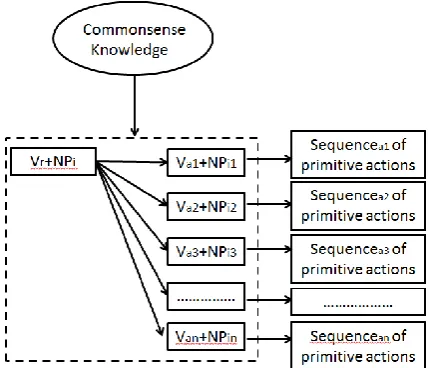
signifi-Figure 3: Transformation of high-level command.
cant difference is that all of them do not include a noun after a verb “X”. As it was mentioned in the section 3 (2nd point), a result verb being applied to different objects assumes different action verbs.
4 Proposed Approach
We consider the transformation formulated in sec-tion 3 as a process of grounding where a high-level command representing a desired change of state is grounded to an action(s) command.
The following two assumptions will be made to formalize the process of grounding.
1) The commands in human-robot interactions can occur in various forms and patterns. Some of them can be rather complicated. Our work ad-dresses the simplest case where a command is rep-resented by the structure V+NP, where V is a verb, NP is a noun phrase.
2) The grounding of a result-verb command into an action-verb command is represented as: Vr+NP1+by+Va+NP2, where Vr is a result verb; Vais an action verb3.
Since a result verb being applied to the same ob-ject can be executed by different action-verb com-mands, the schema on the Figure 2. will be un-folded as one-to-multi relations between a result-verb command and an action-result-verb command (see Figure 3.).
The key point here is how to extract one-to-multi relations. In reality, these relations are com-monsense inferences that allow humans easily to
3NP
[image:3.595.308.523.65.249.2]transform result-verb commands into action-verb commands. These commonsense inferences are so obvious and so well-known to everybody that are very rarely expressed anywhere in a written form. It makes it hard to find and extract from any source of information. As a consequence of that, we cannot apply deep learning techniques for extraction of above-mentioned one-to-multi rela-tions. Deep learning has proved incredibly pow-erful and effective for many practical tasks from perceptual classification to self-driving cars. But we have to acknowledge the data-hungry nature of systems based on deep learning. The side-effect of that is a long tail of low-frequency data that cannot be treated the same way. Our research deals with such data.
The method suggested for one-to-multi rela-tions extraction is based on 3 non-related ap-proaches and includes three steps accordingly.
1. Getting 2 sets of verbs: a set of result verbs {Vr}and a set of action verbs{Va};
2. Getting a set of the most frequent pairs {Vr+NP};
3. Getting a set of commonsense inferences {Vr+NP1+by+Va+NP2}.
In the first step, result verbs (Vr) and ac-tion verbs (Va) are separated. The separation is based on analysis of Wordnet; this is a domain-independent step that aims to cover generally re-sult and action verbs representing the physical world. In the second step, the set of the most frequent pairs {Vr+NP} are extracted using the N-gram approach to form result-verb commands: clean thefloor, cool the beer, etc. In the third step, we use a search engine to check all around the web if there is a commonsense inference between an action-verb command and a result-verb command (open the door by pressing the button). If a com-monsense inference exists in the web it is consid-ered as being validated and added to the set.
4.1 Step #1: Getting Two Sets of Verbs
The output of the step #1 is two sets of verbs: a set of action verbs{Va} and a set of result verbs
{Vr}. The separation is based on the analysis of the entire set of verbs through Princeton Word-Net (WN) (Fellbaum,1998) which is widely used in a variety of tasks related to extraction of se-mantic relations. The verb part of WN contains
11529 unique verbs (version WN 3.0)4. They are organized in verb synsets ordered mainly by troponym-hypernym hierarchical relations (Fell-baum and Miller, 1990). According to the def-initions, a hypernym is a verb with a more gen-eralized meaning, while a troponym replaces the hypernym by indicating a manner of doing some-thing. The closer a verb is to the bottom of a verb tree, the more specific the manners that are expressed by troponyms: communicate-talk-whisper5.
Meanwhile, action verbs are hidden in the WN verb structure since troponyms are not always ac-tion verbs. In some troponym-hypernym relaac-tions the verbs are in fact action verbs like in {kill} -{drown}. However, there are no explicit ways to extract them yet.
The idea is that action verbs can be extracted from WN if at least one of four conditions, applied to a verb is valid6:
1. A verb in WN is an action verb if its gloss contains the following template: “V + by [...]ing”, where V=hypernym. Example: {sweep}(clean by sweeping);
2. A verb in WN is an action verb if its gloss contains the following template: “V + with + [concrete object]”, where V=hypernym. Example: {brush} (clean with a brush). Restriction on the concrete object is made to avoid cases like with success (pleasure, preparation, etc).
3. A verb in WN is an action verb if it repre-sents movement in any direction: lift, turn, descend, etc.
4. A verb in WN is an action verb if its hyper-nym is an action verb. In other words, once a verb is an action verb, all branches located below consist of action verbs as well, regard-less of their glosses.
The procedure of using conditions 1-4 goes from all top verbs to the bottom verbs. For
ex-4 https://wordnet.princeton.edu/documentation/wnstats
7wn. The following paper (McCrae et al.,2019) outlines a roadmap for adding new entries to WordNet, so the number of verbs is notfixed, but increasing over time.
5Note that these are defined on verb-senses, not verbs.
For example, the verbsee“perceive: I see the picture” will behave differently from the verbsee“understand: I see the problem”.
6These 4 conditions elaborate the approach developed in
ample, we start from the top synset{change, alter, modify}(gloss: cause to change; make different; cause a transformation). It doesn’t satisfy the 1st or the 2nd condition, so we go down on 1 level and examine one of its troponyms: {clean, make clean}(make clean by removing dirt,filth, or un-wanted substances from). It is still not an action verb synset: in the pattern from the 1st condition – “V + by [...]ing” – the verb make cleanis not a hypernym. On the next level there are synsets with glosses that satisfy either the 1st or the 2nd condition:
• {sweep}(clean by sweeping);
• {brush}(clean with a brush);
• {steam, steam clean} (clean by means of steaming).
So, the verbssweep, brush, steam, steam cleanare action verbs. Applying the 3rd condition on them, one can state that all synsets located below these 3 synsets (if any) are action verb synsets. The frame-work is the basis of the procedure for action ex-traction.
We implemented the procedure following the conditions 1.-4. and got the following results:
1. 191 verb synsets have been extracted by matching the template “V + by [...]ing”;
2. 329 verb synsets have been extracted by matching the template “V + with + (a/an)? + ...” ;
3. 1408 verb synsets have been extracted from the motion lexicographerfile;
4. a total of 3063 verb synsets have been ex-tracted as a total number of action verbs in-cluding all the verb synsets that are located under the hypernyms as action verbs; 3063 extracted verb synsets contain 3294 unique action verbs.
All other verbs are potentially result verbs. Also some restrictions need to be applied to consider only the result and action verbs that are repre-sented in the physical world and necessary for robot actions.
We will evaluate the results intrinsically (a lin-guist will judge the validity), and extrinsically, i.e. for English verbs also found in Levin’s En-glish Word Classes and Alternations (1992) we
will compare our results to her classes. For exam-ple, class 10.3 “clear” verbs (clean, clear, drain, empty) are result verbs while 10.4.1 “wipe” verbs (bail, buff, dab, distill, dust, erase, expunge,flush, leach, lick ..) are action verbs.
4.2 Step #2: Getting Set of Pairs{Vr+NP} The output of the step #2 is a set of the most fre-quent (commonly used) pairs{Vr+NP}. The pur-pose of this step is based on the observation that a result verb being applied to different objects as-sumes different action-verb commands.
To generate the set {Vr+NP} we use N-grams (which are a contiguous sequence of n items from a given text) extracted from the largest publicly-available, genre-balanced corpus of English: the Corpus of Contemporary American English7with about 430 million words in size. With this N-grams data (2, 3, 4, 5-word sequences, with their frequency), the subset of N-grams are extracted where the 1st word is a result verb in any grammat-ical form. A threshold was set for the frequency. For example, for the result verbopenwe extracted all 3-grams that look like the following (with fre-quency at the beginning):
3459 opened the door 2611 open the door ...
201 open the window 169 opened the window ...
130 opened the box 89 open the box etc.
If the data from N-grams is insufficient we use larger, noisier corpora such as the common crawl8.
4.3 Step #3: Getting a Set of Commonsense Inferences
The output of thefinal step #3 is a set of common-sense inferences between an action-verb command and a result-verb command validated by a search engine from the web. The search engine is used to check (validate) if a commonsense inference ex-ists in the web. Each commonsense inference for the checking has a structure Vr+NP1+by+Va+NP2 (open the door by pressing the button).
The procedure is the following:
1. make a cartesian multiplication of pairs {Vr+NP}and action verbs{Va}:{(Vr+NP), Va};
2. create a sequence for each element from 1.: Vr+NP+by+Va(fill the cup by pouring);
3. run the sequence from 2. on the search engine looking for the sequence Vr+NP1+by+Va+NP2(concrete object) in the web. Estimate the frequency (or getting no result).
4. If we do notfind sufficient action-verb tem-plates Va+NP2(concrete object), we will use the learned combinations to learn new tem-plates, extending the approach (Snow et al., 2006) to learning wordnet relations.
All validated commonsense inferences will be added to the set with frequencies and stored.
5 Implementation and Preliminary Results
Theflowchart (Fig. 4) shows the general approach of causal relations extraction from text. Three modules on the bottom in grey color represent three steps from section 5. The details of the ap-proach are given below.
Raw data.WordNet is used as raw data.
Algorithm of separation. For getting prelimi-nary results, commonly used result verbs and ac-tion verbs were taken from the linguistic literature. We extracted 12 result verbs and 50 action verbs.
Result verbs: break, clean, clear, close, raise, cut,fill, heat, kill, lift, open, remove.
Action verbs: blow, brush, chip, chop, clip, comb, compress, drown,flap, grab, grasp, grind, grip, hack, hammer, hit, kick, knead, lever, mow, pound, pour, press, pull, push, rinse, rub, saw, scoop, scrape, scratch, scribble, scrub, shake, shave, shoot, shovel, slap, slash, smear, soap, splash, sponge, squeeze, stab, steam, sweep, touch, wash, wipe.
N-gram approach. For each of 12 result verbs, we extracted five 3-grams Vr+NP. Each 3-gram contains the most frequent noun phrase with the corresponding verb. Totally 60 3-grams were ex-tracted (see Table 1 for details).
Web-search. Cartesian multiplication of 60 3-grams and 50 action verbs produces 3000 combi-nations “Vr+NP by Va”. We use search engine Bing for running the template “Vr+NP by Va...”.
Accordingly, 3000 searches were made. The re-sults were taken and analyzed from the first 10 web pages that appeared. We were looking for the results corresponding the template “Vr+NP by Va+NP/Pronoun”.
Results. As a result we got 497 causal relations. Sample of 20 extracted causal relations is given in Table 2.
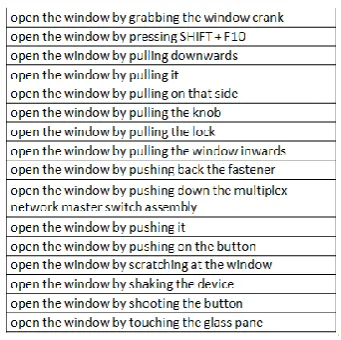
Examples of causal relations for the 3-gram “open the window” is given in Table 3.
6 Evaluation
The evaluation was based on a sample of 100 causal relations randomly taken from extracted 497 ones.
Due to the restrictions applied on event and causal relation between events we can not evalu-ate the recall of the extraction.
The precision (validity) of extracted causal rela-tions were evaluated by five human judges. They were given instructions to rate the causal relations by marking each relation with a number from 1 (very bad) to 5 (very good). Examples of invalid (break the ice by seeing it) and valid (opened the box by pulling on the handle) causal extractions were provided.
6.1 Simple Average
After 5 judges put their marks, the simple average was calculated by dividing the sum of all marks by 500. We got 3.1.
6.2 Extraction of valid causal relations
We calculated the average between judges for each causal relation and extracted 62 causal relations (among 100 randomly taken) with average score more or equal 3.
6.3 Analysis of invalid causal relations
38 causal relations with the average score lower than 3 were preliminarily analyzed for detecting the reasons. We found the following:
a) bad parsing or bad POS tagging (kill the bac-teria by pouring a half cup; fill the hole by push-ing thousands; open the window by grabbpush-ing the opening);
b) unusual causal relations that require a con-text: heat the oil by pressing the palms; cut the engine by pulling both paddles.
Figure 4: Flowchart of causal relations extraction from text
Table 1: Most frequent 3-grams for extracted result verbs
Table 2: Samples of extracted causal relations
7 Conclusion and Further Work
Commonsense inferences allow us to equip and empower cognitive robots with an ability to under-stand high-level natural language commands (or instructions). We present a method for
acquir-Table 3: Examples of causal relations for the 3-gram “open the window”
ing the knowledge needed to transform high-level result-verb commands into action-verb commands for further implementation into primitive actions.
In the future, to improve the results and increase the quality of retrieved actions we are planning to:
[image:7.595.330.501.432.602.2] [image:7.595.88.275.432.638.2]• use better NLP tools for POS tagging and parsing;
• develop more elaborated procedure for com-monsense inferences, for example, to exclude search results with negation (“don’t open the window by throwing the stone”) that produce wrong commonsense inferences;
• use metrics for calculation of consistency (re-liability) of the results (for example, Krippen-dorff’s alpha coefficient);
• enlarge the set of verbs used for com-monsense inferences using resource such as WordNets.
• build multilingual commonsense inferences (starting with Chinese and Indonesian) based on (Bond and Foster, 2013; Bond et al., 2014), (Wang and Bond,2013).
References
Dilip Arumugam, Siddharth Karamcheti, Nakul Gopalan, Lawson L.S. Wong, and Stefanie Tellex. 2017. Accurately and efficiently interpreting human-robot instructions of varying granularities. InProceedings of the Conference on Robotics: Sci-ence and Systems.
Francis Bond and Ryan Foster. 2013. Linking and ex-tending an open multilingual wordnet. In 51st An-nual Meeting of the Association for Computational Linguistics: ACL-2013, pages 1352–1362.
Francis Bond, Lian Tze Lim, Enya Kong Tang, and Hammam Riza. 2014. The combined wordnet ba-hasa. In NUSA: Linguistic studies of languages in and around Indonesia 57, pages 83–100.
Joyce Y. Chai, Qiaozi Gao, Lanbo She, Shaohua Yang, Sari Saba-Sadiya, and Guangyue Xu. 2018. Lan-guage to action: Towards interactive task learning with physical agents. InProceedings of the Twenty-Seventh International Joint Conference on Artificial Intelligence (IJCAI-18).
Timothy Chklovski and Patrick Patel. 2004. Verbo-cean: Mining the web forfine-grained semantic verb relations. InProceedings of the Conference on Em-pirical Methods in Natural Language Processing (EMNLP), Barcelona, Spain.
Herbert H. Clark. 1996. Using language. Cambridge University Press, Cambridge, UK.
Christiane Fellbaum. 1998. WordNet: An Electronic Lexical Database. MIT Press, Cambridge, MA, USA.
Christiane Fellbaum and George A. Miller. 1990. Folk psychology or semantic entailment? a reply to rips and conrad. The Psychological Review, 97:565– 570.
Amy Fire and Song-Chun Zhu. 2016. Learning per-ceptual causality from video. ACM Transactions on Intelligent Systems and Technology (TIST), 7(2):23. Maxwell Forbes and Yejin Choi. 2017. Verb physics:
Relative physical knowledge of actions and objects. InProceedings of the 55th Annual Meeting of the As-sociation for Computational Linguistics: ACL-2017 (Volume 1: Long Papers), pages 266–276.
Qiaozi Gao, Malcolm Doering, Shaohua Yang, and Joyce Y. Chai. 2016. Physical causality of action verbs in grounded language understanding. In Pro-ceedings of the 54th Annual Meeting of the Asso-ciation for Computational Linguistics: ACL-2016, pages 1814–1824, Berlin, Germany.
Peter Gardenfors. 2017. The Geometry of Meaning: Semantics Based on Conceptual Spaces. MIT Press, Cambridge, MA, USA.
Peter Gardenfors and Massimo Warglien. 2012. Us-ing conceptual spaces to model actions and events.
Journal of Semantics, 29(4):487–519.
Aliaksandr Huminski and Hao Zhang. 2018a. Action hierarchy extraction and its application. In Proceed-ings of the Eleventh International Conference on Language Resources and Evaluation (LREC-2018). Workshop “Annotation, Recognition & Evaluation of Actions (AREA)”, Miyazaki, Japan.
Aliaksandr Huminski and Hao Zhang. 2018b. Word-net troponymy and extraction of “manner-result” re-lations. InProceedings of the 9th Global WordNet Conference (GWC 2018), Singapore.
Karin Kipper Schuler. 2005. VerbNet: A broad-coverage, comprehensive verb lexicon. Ph.D. thesis. Computer and Information Science Dept. University of Pennsylvania. Philadelphia. PA.
Hadas Kress-Gazit, Georgios E. Fainekos, and George J. Pappas. 2008. Translating structured english to robot controllers. Advanced Robotics, 22(12):1343–1359.
Beth Levin. 1992. English Verb Classes And Alterna-tions. University of Chicago Press, Chicago, IL. John P. McCrae, Alexandre Rademaker, Francis Bond,
Ewa Rudnicka, and Christiane Fellbaum. 2019. En-glish wordnet 2019 – an opsource wordnet for en-glish. InProceedings of the 10th Global WordNet Conference GWC-2019, Wroclaw, Poland.
Processing: ACL-2015 (Volume 1: Long Papers), pages 992–1002, Beijing, China.
Dipendra Kumar Misra, John Langford, and Yoav Artzi. 2017. Mapping instructions and visual obser-vations to actions with reinforcement learning. In
Proceedings of the Conference on Empirical Meth-ods in Natural Language Processing (EMNLP).
Malka Rappaport Hovav and Beth Levin. 2010. Reflec-tions on manner/result complementarity. InSyntax, Lexical Semantics, and Event Structure, pages 21– 38, Oxford University Press, Oxford, UK.
Lanbo She and Joyce Y. Chai. 2016. Incremental ac-quisition of verb hypothesis space towards physical world interaction. In Proceedings of the 54th An-nual Meeting of the Association for Computational Linguistics: ACL-2016 (Volume 1: Long Papers), pages 108–117, Berlin, Germany.
Lanbo She and Joyce Y. Chai. 2017. Interactive learn-ing of grounded verb semantics towards human-robot communication. In Proceedings of the 55th Annual Meeting of the Association for Computa-tional Linguistics: ACL-2017 (Volume 1: Long Pa-pers), pages 1634–1644.
Rion Snow, Daniel Jurafsky, and Andrew Y Ng. 2006. Semantic taxonomy induction from heterogenous evidence. InProceedings of the 21st International Conference on Computational Linguistics and the 44th Annual meeting of the Association for Compu-tational Linguistics: ACL-2006, pages 801–808.
Michael Tomasello. 2008. The Origins of Human Communication. MIT Press, Cambridge, MA, USA. Shan Wang and Francis Bond. 2013. Building the chinese open wordnet (cow): Starting from core synsets. In Proceedings of the 11th Workshop on Asian Language Resources: ALR-2013, pages 10– 18.
Massimo Warglien, Peter Gardenfors, and Matthijs Westera. 2012. Event structure, conceptual spaces and the semantics of verbs. Theoretical Linguistics, 38(3-4):159–193.
Terry Winograd. 1972. Understanding natural lan-guage. Academic Press, Oxford, England.
Jiajun Wu, Erika Lu, Pushmeet Kohli, William T. Free-man, and Josh Tenenbaum. 2017. Learning to see physics via visual deanimation. InProceedings of the 31th Annual Conference on Neural Information Processing Systems (NIPS).