Machine Reading Tea Leaves: Automatically Evaluating Topic Coherence
and Topic Model Quality
Jey Han Lau
Dept of Philosophy King’s College London
David Newman
Timothy Baldwin
Dept of Computing and Information Systems The University of Melbourne
Abstract
Topic models based on latent Dirichlet al-location and related methods are used in a range of user-focused tasks including doc-ument navigation and trend analysis, but evaluation of the intrinsic quality of the topic model and topics remains an open research area. In this work, we explore the two tasks of automatic evaluation of single topics and automatic evaluation of whole topic models, and provide recom-mendations on the best strategy for per-forming the two tasks, in addition to pro-viding an open-source toolkit for topic and topic model evaluation.
1 Introduction
Topic modelling based on Latent Dirichlet Alloca-tion (LDA: Blei et al. (2003)) and related methods is increasingly being used in user-focused tasks, in contexts such as the evaluation of scientific impact (McCallum et al., 2006; Hall et al., 2008), trend analysis (Bolelli et al., 2009; Lau et al., 2012a) and document search (Wang et al., 2007). The LDA model is based on the assumption that doc-ument collections have latent topics, in the form of a multinomial distribution of words, which is typically presented to users via its top-N highest-probability words. In NLP, topic models are gener-ally used as a means of preprocessing a document collection, and the topics and per-document topic allocations are fed into downstream applications such as document summarisation (Haghighi and Vanderwende, 2009), novel word sense detection methods (Lau et al., 2012b) and machine transla-tion (Zhao and Xing, 2007). In fields such as the digital humanities, on the other hand, human users interact directly with the output of topic models. It is this context of topic modelling for direct human consumption that we target in this paper.
The topics produced by topic models have a varying degree of human-interpretability. To il-lustrate this, we present two topics automatically learnt from a collection of news articles:
1. hfarmers, farm, food, rice, agriculturei
2. hstories, undated, receive, scheduled, clientsi
The first topic is clearly related to agriculture. The subject of the second topic, however, is less clear, and may confuse users if presented to them as part of a larger topic model. Measuring the human-interpretability of topics and the overall topic model is the core topic of this paper.
Various methodologies have been proposed for measuring the semantic interpretability of topics. In Chang et al. (2009), the authors proposed an indirect approach based on word intrusion, where “intruder words” are randomly injected into topics and human users are asked to identify the intruder words. The word intrusion task builds on the as-sumption that the intruder words are more iden-tifiable in coherent topics than in incoherent top-ics, and thus the interpretability of a topic can be estimated by measuring how readily the intruder words can be manually identified by annotators.
Since its inception, the method of Chang et al. (2009) has been used variously as a means of assessing topic models (Paul and Girju, 2010; Reisinger et al., 2010; Hall et al., 2012). Despite its wide acceptance, the method relies on manual annotation and has never been automated. This is one of the primary contributions of this work: the demonstration that we can automate the method of Chang et al. (2009) at near-human levels of accu-racy, as a result of which we can perform auto-matic evaluation of the human-interpretability of topics, as well as topic models.
There has been prior work to directly estimate the human-interpretability of topics through au-tomatic means. For example, Newman et al.
(2010) introduced the notion of topic “coher-ence”, and proposed an automatic method for es-timating topic coherence based on pairwise point-wise mutual information (PMI) between the topic words. Mimno et al. (2011) similarly introduced a methodology for computing coherence, replac-ing PMI with log conditional probability. Musat et al. (2011) incorporated the WordNet hierarchy to capture the relevance of topics, and in Aletras and Stevenson (2013a), the authors proposed the use of distributional similarity for computing the pairwise association of the topic words. One ap-plication of these methods has been to remove in-coherent topics before generating labels for topics (Lau et al., 2011; Aletras and Stevenson, 2013b).
Ultimately, all these methodologies, and also the word intrusion approach, attempt to assess the same quality: the human-interpretability of top-ics. The relationship between these methodolo-gies, however, is poorly understood, and there is no consensus on what is the best approach for computing the semantic interpretability of topic models. This is a second contribution of this pa-per: we perform a systematic empirical compar-ison of the different methods and find apprecia-ble differences between them. We further go on to propose an improved formulation of Newman et al. (2010) based on normalised PMI. Finally, we release a toolkit which implements the topic inter-pretability measures described in this paper.
2 Related Work
Chang et al. (2009) challenged the conventional wisdom that held-out likelihood — often com-puted as the perplexity of test data or unseen doc-uments — is the only way to evaluate topic mod-els. To measure the human-interpretability of top-ics, the authors proposed a word intrusion task and conducted experiments using three topic mod-els: Latent Dirichlet Allocation (LDA: Blei et al. (2003)), Probabilistic Latent Semantic Indexing (PLSI: Hofmann (1999)) and the Correlated Topic Model (CTM: Blei and Lafferty (2005)). Contrary to expectation, they found that perplexity corre-lates negatively with topic interpretability.
In the word intrusion task, each topic is pre-sented as a list of six words — the five most proba-ble topic words and a randomly-selected “intruder word”, which has low probability in the topic of interest, but high probability in other topics — and human users are asked to identify the intruder
word that does not belong to the topic in question. Newman et al. (2010) capture topic inter-pretability using a more direct approach, by asking human users to rate topics (represented by their top-10 topic words) on a 3-point scale based on how coherent the topic words are (i.e. their ob-served coherence). They proposed several ways of automating the estimation of the observed coher-ence, and ultimately found that a simple method based on PMI term co-occurrence within a sliding context window over English Wikipedia produces the consistently best result, nearing levels of inter-annotator agreement over topics learnt from two distinct document collections.
Mimno et al. (2011) proposed a closely-related method for evaluating semantic coherence, replac-ing PMI with log conditional probability. Rather than using Wikipedia for sampling the word co-occurrence counts, Mimno et al. (2011) used the topic-modelled documents, and found that their measure correlates well with human judgements of observed coherence (where topics were rated in the same manner as Newman et al. (2010), based on a 3-point ordinal scale). To incorpo-rate the evaluation of semantic coherence into the topic model, the authors proposed to record words that co-occur together frequently, and update the counts of all associated words before and after the sampling of a new topic assignment in the Gibbs sampler. This variant of topic model was shown to produce more coherent topics than LDA based on the log conditional probability coherence measure. Aletras and Stevenson (2013a) introduced dis-tributional semantic similarity methods for com-puting coherence, calculating the distributional similarity between semantic vectors for the top-N topic words using a range of distributional similar-ity measures such as cosine similarsimilar-ity and the Dice coefficient. To construct the semantic vector space for the topic words, they used English Wikipedia as the reference corpus, and collected words that co-occur in a window of±5 words. They showed that their method correlates well with the observed coherence rated by human judges.
3 Dataset
domains and topic model types. In the dataset, two text collections were used: (1) 10,000 articles from English Wikipedia (WIKI); and (2) 8,447
arti-cles from the New York Times dating from 1987 to 2007 (NEWS). For each document collection,
top-ics were generated by three topic modelling meth-ods: LDA, PLSI and CTM (see Section 2). For each topic model, three settings of T (the num-ber of topics) were used: T = 50, T = 100
andT = 150. In total, there were 9 topic mod-els (3 modmod-els×3T) and 900 topics (3 models×
(50 + 100 + 150)) for each dataset.1
For some of topic interpretability estimation methods, we require a reference corpus to sam-ple lexical probabilities. We use two reference corpora: (1)NEWS-FULL, which contains 1.2
mil-lion New York Times articles from 1994 to 2004 (from the English Gigaword); and (2)WIKI-FULL,
which contains 3.3 million English Wikipedia ar-ticles (retrieved November 28th 2009).2 The ratio-nale for choosing the New York Times and English Wikipedia as the reference corpora is to ensure do-main consistency with the word intrusion dataset; the full collections are used to more robustly esti-mate lexical probabilities.
4 Human-Interpretability at the Model Level
In this section, we evaluate measures for estimat-ing human-interpretability at themodellevel. That is, for a measure — human-judged or automated — we first aggregate its coherence/interpretability scores for all topics from a given topic model to obtain the topic model’s average coherence score. We then calculate the Pearson correlation coeffi-cients between the two measures using the topic models’ average coherence scores. In summary, the correlation is computed over nine sets of top-ics (3 topic modellers×3 settings ofT) for each ofWIKIandNEWS.
4.1 Indirect Approach: Word Intrusion
The word intrusion task measures topic inter-pretability indirectly, by computing the fraction of annotators who successfully identify the in-truder word. A limitation of the word intrusion
1In the WIKItopics there were corrupted symbols in the
topic words for 24 topics. We removed these topics, reducing the total number of topics to 876.
2For both corpora we perform tokenisation and POS
tag-ging using OpenNLP and lemmatisation using Morpha (Min-nen et al., 2001).
task is that it requires human annotations, there-fore preventing large-scale evaluation. We begin by proposing a methodology to fully automate the word intrusion task.
Lau et al. (2010) proposed a methodology that learns themost representativeorbest topic word that summarises the semantics of the topic. Ob-serving that the word intrusion task — the task of detecting the least representative word — is the converse of the best topic word selection task, we adapt their methodology to automatically iden-tify the intruder word for the word intrusion task, based on the knowledge that there is a unique in-truder word per topic.
The methodology works as follows: given a set of topics (including intruder words), we compute the word association features for each of the top-N topic words of a topic,3 and combine the fea-tures in a ranking support vector regression model (SVMrank: Joachims (2006)) to learn the intruder words. Following Lau et al. (2010), we use three word association measures:
PMI(wi) = NX−1
j
logPP(w(wi, wj)
i)P(wj)
CP1(wi) = NX−1
j
P(wi, wj) P(wj)
CP2(wi) = NX−1
j
P(wi, wj) P(wi)
We additionally experiment with normalised pointwise mutual information (NPMI: Bouma (2009)):
NPMI(wi) = NX−1
j
log P(wi,wj)
P(wi)P(wj)
−logP(wi, wj)
In the dataset of Chang et al. (2009) (see Sec-tion 3), each topic was presented to 8 annota-tors, with small variations in the displayed topic words (including the intruder word) for each an-notator. That is, each topic has essentially 8 subtly different representations. To measure topic inter-pretability, the authors defined “model precision”: the relative success of human annotators at identi-fying the intruder word, across all representations of the different topics. The model precision scores produced by human judges are henceforth referred to as WI-Human, and the scores produced by our
3Nis the number of topic words displayed to the human
Topic Ref. Pearson’srwith WI-Human
Domain Corpus WI-Auto-PMI WI-Auto-NPMI
WIKI NWIKI-FULL 0.947 0.936
EWS-FULL 0.801 0.835
[image:4.595.182.419.62.124.2]NEWS NWEWSIKI-F-FULLULL 0.9130.811 0.8310.750
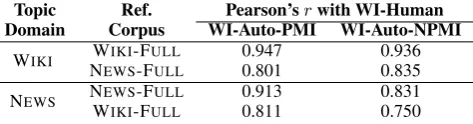
Table 1: Pearson correlation of WI-Human and WI-Auto-PMI/WI-Auto-NPMI at the model level.
automated method for the PMI and NPMI vari-ants as WI-Auto-PMI and WI-Auto-NPMI respec-tively.4
The Pearson correlation coefficients between WI-Human and WI-Auto-PMI/WI-Auto-NPMI at the model level are presented in Table 1. Note that our two reference corpora are used to inde-pendently sample the lexical probabilities for the word association features.
We see very strong correlation for in-domain pairings (i.e.WIKI+WIKI-FULL andNEWS+NEWS -FULL), achieving r > 0.9 in most cases for both
WI-Auto-PMI or WI-Auto-NPMI, demonstrating the effectiveness of our methodology at automat-ing the word intrusion task for estimatautomat-ing human-interpretability at the model level. Overall, WI-Auto-PMI outperforms WI-Auto-NPMI.
Note that although our proposed methodology is supervised, as intruder words are synthetically generated and no annotation is needed for the su-pervised learning, the whole process of computing topic coherence via word intrusion is fully auto-matic, without the need for hand-labelled training data.
4.2 Direct Approach: Observed Coherence
Newman et al. (2010) defined topic interpretabil-ity based on a more direct approach, by asking hu-man judges to rate topics based on the observed coherence of the top-N topic words, and various methodologies have since been proposed to auto-mate the computation of the observed coherence. In this section, we present all these methods and compare them.
The word intrusion dataset is not annotated with human ratings of observed coherence. To cre-ate gold-standard coherence judgements, we used Amazon Mechanical Turk:5 we presented the top-ics (with intruder words removed) to the Turkers and asked them to rate the topics using on a 3-point
4Note that both variants use CP1 and CP2 features, i.e.
WI-Auto-PMI uses PMI+CP1+C2 while WI-Auto-NPMI uses NPMI+CP1+C2 features.
5https://www.mturk.com/mturk/
ordinal scale, following Newman et al. (2010). In total, we collected six to fourteen annotations per topic (an average of 8.4 annotations per topic). The observed coherence of a topic is computed as the arithmetic mean of the annotators’ ratings, once again following Newman et al. (2010). The human-judged observed topic coherence is hence-forth referred to as OC-Human.
For the automated methods, we experimented with the following methods for estimating the human-interpretability of a topict:
1. OC-Auto-PMI: Pairwise PMI of top-N topic words (Newman et al., 2010):
OC-Auto-PMI(t) =
N X
j=2 j−1 X
i=1
logPP(w(wj, wi)
i)P(wj)
2. OC-Auto-NPMI: NPMI variant of OC-Auto-PMI:
OC-Auto-NPMI(t) =XN
j=2 j−1 X
i=1
log P(wj,wi)
P(wi)P(wj)
−logP(wi, wj)
3. OC-Auto-LCP: Pairwise log conditional probability of top-N topic words (Mimno et al., 2011):6
OC-Auto-LCP(t) =XN
j=2 j−1 X
i=1
logP(Pw(jw, wi)
i)
4. OC-Auto-DS: Pairwise distributional simi-larity of the top-N topic words, as described in Aletras and Stevenson (2013a).
For Auto-PMI, Auto-NPMI and OC-Auto-LCP, all topics are lemmatised and intruder words are removed before coherence is com-puted.7 In-domain and cross-domain pairings of
6Although the original method uses the topic-modelled
document collection and document co-occurrence for sam-pling word counts, for a fairer comparison we use log condi-tional probability only as a replacement to the PMI compo-nent of the coherence computation (i.e. words are still sam-pled using a reference corpus and a sliding window). For ad-ditional evidence that the original method performs at a sub-par level, see Lau et al. (2013) and Aletras and Stevenson (2013a).
7We once again use Morpha to do the lemmatisation, and
Topic Ref. Pearson’srwith OC-Human
Domain Corpus OC-Auto-PMI OC-Auto-NPMI OC-Auto-LCP OC-Auto-DS
[image:5.595.114.488.62.124.2]WIKI NWEWSIKI-F-FULLULL 0.6960.490 0.9030.844 0.9590.913 0.859 NEWS NWEWSIKI-F-FULLULL 0.9310.965 0.9790.964 0.8870.872 0.941
Table 2: Pearson correlation of OC-Human and the automated methods — PMI, OC-Auto-NPMI, OC-Auto-LCP and OC-Auto-DS — at the model level.
the topic domain and reference corpus are experi-mented with for these measures.
For OC-Auto-DS, all topics are lemmatised, in-truder words are removed and English Wikipedia is used to generate the vector space for the topic words. The size of the context window is set to ±5 word (i.e. 5 words to either side of the tar-get word). We use PMI to weight the vectors, cosine similarity for measuring the distributional similarity between the top-N topic words, and the “Topic Word Space” approach to reduce the di-mensionality of the vector space. A complete de-scription of the parameters can be found in Aletras and Stevenson (2013a). Note that cross-domain pairings of the topic domain and reference corpus are not tested: in line with the original paper, we use only English Wikipedia to generate the vector space before distributional similarity.
We present the Pearson correlation coefficient of OC-Human and the four automated methods at the model level in Table 2. For OC-Auto-NPMI, OC-Auto-LCP and OC-Auto-DS, we see that they correlate strongly with the human-judged coher-ence. Overall, OC-Auto-NPMI has the best per-formance among the methods, and in-domain pair-ings generally produce the best results for OC-Auto-NPMI and OC-Auto-LCP. The results are comparable to those for the automated intruder word detection method in Section 4.1.
The non-normalised variant OC-Auto-PMI cor-relates well forNEWSbut performs poorly forWIKI,
producing a correlation of only 0.490 for the in-domain pairing. We revisit this in Section 6, and provide a qualitative analysis to explain the dis-crepancy in results between OC-Auto-PMI and OC-Auto-NPMI.
4.3 Word Intrusion vs. Observed Coherence
In the previous sections, we showed for both the direct and indirect approaches that the automated methods correlate strongly with the manually-annotated human-interpretability of topics at the model level (with the exception of OC-Auto-PMI).
One question that remains unanswered, however, is whether word intrusion measures topic inter-pretability differently to observed coherence. This is the focus of this section.
From the results in Table 3 for the intruder word model vs. observed coherence, we see a strong correlation between WI-Human and OC-Human. This observation is insightful: it shows that the topic interpretability estimated by the two approaches is almost identical at the model level.
Between WI-Human and the observed coher-ence methods automated methods, overall we see a strong correlation for the Auto-NPMI, LCP and DS methods. OC-Auto-PMI once again performs poorly over WIKI, but
this is unsurprising given its previous results (i.e. its poor correlation with OC-Human). In-domain pairings tend to perform better, and the per-formance of OC-Auto-NPMI, OC-Auto-LCP and OC-Auto-DS is comparable, with no one clearly best method.
5 Human-Interpretability at the Topic Level
In this section, we evaluate the various methods at the topic level. We group together all topics for each dataset (without distinguishing the topic models that produce them) and calculate the cor-relation of one measure against another. That is, the correlation coefficient is computed for 900 top-ics/data points in the case of each of WIKI and NEWS.
5.1 Indirect Approach: Word Intrusion
In Section 4.1, we proposed a novel methodol-ogy to automate the word intrusion task (WI-Auto-PMI and WI-Auto-N(WI-Auto-PMI). We now evaluate its performance at the topic level, and present its correlation with the human gold standard (WI-Human) in Table 4.
Topic Ref. Pearson’srwith WI-Human
Domain Corpus OC-Human OC-Auto-PMI OC-Auto-NPMI OC-Auto-LCP OC-Auto-DS
[image:6.595.85.513.67.126.2]WIKI NWEWSIKI-F-FULLULL 0.900 0.6140.638 0.9270.757 0.9110.821 0.907 NEWS NWEWSIKI-F-FULLULL 0.915 0.8380.865 0.8660.874 0.8670.893 0.925
Table 3: Word intrusion vs. observed coherence: Pearson correlation coefficient at the model level.
Topic Ref. Pearson’srwith WI-Human Human
Domain Corpus WI-Auto-PMI WI-Auto-NPMI Agreement
WIKI NWEWSIKI-F-FULLULL 0.5540.622 0.5730.592 0.735 NEWS NWEWSIKI-F-FULLULL 0.6020.638 0.6120.648 0.770
Table 4: Pearson correlation coefficient of WI-Human and WI-Auto-PMI/WI-Auto-NPMI at the topic level.
level (Table 1). The performance between WI-Auto-PMI and WI-Auto-NPMI is not very differ-ent, and the cross-domain pairing slightly outper-forms the in-domain pairing.
To better understand the difficulty of the task, we compute the agreement between human anno-tators by calculating the Pearson correlation co-efficient of model precisions produced by ran-domised sub-group pairs in the topics.8 That is, for each topic, we randomly split the annotations into two sub-groups, and compute the Pearson correla-tion coefficient of the model precisions produced by the first group and that of the second sub-group.
The original dataset has 8 annotations per topic. Splitting the annotations into two sub-groups re-duces the number of annotations to 4 per group, which is not ideal for computing model precision. We thus chose to expand the number of annota-tions by sampling 300 random topics from each domain (for a total of 600 topics) and following the same process as Chang et al. (2009) to get in-truder word annotations using Amazon Mechani-cal Turk. On average, we obtained 11.7additional annotations per topic for these 600 topics. The hu-man agreement scores (i.e. the Pearson correlation coefficient of randomised sub-group pairs) for the sampled 600 topics are presented in the last col-umn of Table 4.
The sub-group correlation is around r = 0.75
for the topics from both datasets. As such, esti-mating topic interpretability at the topic level is a much harder task than model-level evaluation. Our automated methods perform at a highly credible
8To counter for the fact that annotators labelled varying
numbers of topics.
r = 0.6, but there is certainly room for improve-ment. Note that the correlation values reported in Newman et al. (2010) are markedly higher than ours, as they evaluated based on Spearman rank correlation, which isn’t attuned to the relative dif-ferences in coherence values and returns higher values for the task.
5.2 Direct Approach: Observed Coherence
We repeat the experiments of observed coherence in Section 4.2, and evaluate the correlation of the automated methods (PMI, OC-Auto-NPMI, OC-Auto-LCP and OC-Auto-DS) on the human gold standard (OC-Human) at the topic level. Results are summarised in Table 5.
OC-Auto-PMI performs poorly at the topic level in the WIKI domain, similar to what was
seen at the model level in Section 4.2. Over-all, both OC-Auto-NPMI and OC-Auto-DS are the most consistent methods. OC-Auto-LCP performs markedly worse than these two methods.
Topic Ref. Pearson’srwith OC-Human Human
Domain Corpus OC-Auto-PMI OC-Auto-NPMI OC-Auto-LCP OC-Auto-DS Agreement
[image:7.595.85.515.63.123.2]WIKI NWEWSIKI-F-FULLULL 0.5330.582 0.6380.667 0.4960.579 0.682 0.624 NEWS NWEWSIKI-F-FULLULL 0.7190.671 0.7410.722 0.4520.471 0.682 0.634
Table 5: Pearson correlation of OC-Human and the automated methods at the topic level.
Topic Ref. Pearson’srwith WI-Human
Domain Corpus OC-Human OC-Auto-PMI OC-Auto-NPMI OC-Auto-LCP OC-Auto-DS
WIKI NWEWSIKI-F-FULLULL 0.665 0.5040.472 0.5570.571 0.5470.455 0.639 NEWS NWEWSIKI-F-FULLULL 0.641 0.6040.629 0.6340.633 0.4070.390 0.649
Table 6: Word intrusion vs. observed coherence: pearson correlation results at the topic level.
5.3 Word Intrusion vs. Observed Coherence
In this section, we bring together the indirect ap-proach of word intrusion and the direct apap-proach of observed coherence, and evaluate them against each other at the topic level. Results are sum-marised in Table 6.
We see that the correlation between the human ratings of intruder words and observed coherence is only modest, implying that there are topic-level differences in the output of the two approaches. In Section 6, we provide a qualitative analysis and explanation as to what constitutes the differences between the approaches.
For the automated methods, OC-Auto-DS has the best performance, with OC-Auto-NPMI per-forming relatively well (in particularly in theNEWS
domain).
6 Discussion
Normalised PMI (NPMI) was first introduced by Bouma (2009) as a means of reducing the bias for PMI towards words of lower frequency, in addition to providing a standardised range of[−1,1]for the calculated values.
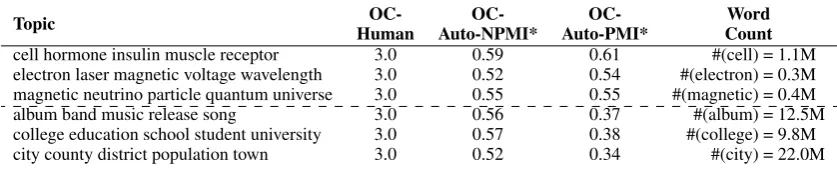
We introduced NPMI to the automated meth-ods of word intrusion (WI-Auto-NPMI) and ob-served coherence (OC-Auto-NPMI) to explore its suitability for the task. For the latter, we saw that NPMI achieves markedly higher correlation than OC-Human (in particular, at the model level). To better understand the impact of normalisation, we inspected a list of WIKI topics that have
simi-lar scores for OC-Human and OC-Auto-NPMI but very different OC-Auto-PMI scores. A sample of these topics is presented in Table 7. WIKI-FULL
is used as the reference corpus for computing the
scores. Note that the presented OC-Auto-NPMI* and OC-Auto-PMI* scores are post-normalised to the range[0,1]for ease of interpretation. To give a sense of how readily these topic words occur in the reference corpus, we additionally display the frequency of the first topic word in the reference corpus (last column).
All topics presented have an OC-Human score of 3.0 (i.e. these topics are rated as being very co-herent by human judges) and similar OC-Auto-NPMI values. Their OC-Auto-PMI scores, how-ever, are very different between the top-3 and bottom-3 topics. The bias of PMI towards lower frequency words is clear: topic words that occur frequently in the corpus receive a lower OC-Auto-PMI score compared to those that occur less fre-quently, even though the human-judged observed coherence is the same. OC-Auto-NPMI on the other hand, correctly estimates the coherence.
We observed, however, that the impact of nor-malising PMI is less in the word intrusion task. One possible explanation is that for the automated methods WI-Auto-PMI and WI-Auto-NPMI, the PMI/NPMI scores are used indirectly as a feature to a machine learning framework, and the bias could be reduced/compensated by other features.
WI-Topic HumanOC- Auto-NPMI*OC- Auto-PMI*OC- CountWord
cell hormone insulin muscle receptor 3.0 0.59 0.61 #(cell) = 1.1M electron laser magnetic voltage wavelength 3.0 0.52 0.54 #(electron) = 0.3M magnetic neutrino particle quantum universe 3.0 0.55 0.55 #(magnetic) = 0.4M
album band music release song 3.0 0.56 0.37 #(album) = 12.5M
college education school student university 3.0 0.57 0.38 #(college) = 9.8M city county district population town 3.0 0.52 0.34 #(city) = 22.0M
Table 7: A list ofWIKItopics to illustrate the impact of NPMI.
Topic # Topic OC-Human* WI-Human*
1 business company corporationcluster loch shareholder 0.94 0.25
2 songactor clown play role theatre 1.00 0.50
3 census ethnic female male populationvillage 0.92 0.25
4 composersingerjazz music opera piano 1.00 0.63
5 choice count give i.e. simply unionist 0.14 1.00
[image:8.595.89.508.60.145.2]6 digital clown friend love mother wife 0.17 1.00
Table 8: A list ofWIKItopics to illustrate the difference between observed coherence and word intrusion.
Boxes denote human chosen intruder words, and boldface denotes true intruder words.
Human* scores in the table are post-normalised to the range[0,1]for ease of comparison.
In general, there are two reasons for topics to have high OC-Human and low WI-Human scores. First, if a topic has an outlier word that is mildly related to the topic, users tend to choose this word as the intruder word in the word intrusion task, yielding a low WI-Human score. If they are asked to rate the observed coherence, however, the single outlier word often does not affect its overall coher-ence, resulting in a high OC-Human score. This is observed in topics 1 and 2 in Table 8, whereloch andclownare chosen by annotators in the word in-trusion task, as they detract from the semantics of the topic. This results in low WI-Human scores, but high observed coherence scores (OC-Human). The second reason is the random selection of intruder words related to the original topic. We see this in topics 3 and 4, where related intruder words (villageandsinger) were selected.
For topics with low OC-Human and high WI-Human scores, the true intruder words are often very different to the domain/focus of other topic words. As such, annotators are consistently able to single them out to yield high WI-Human scores, even though the topic as a whole is not coherent. Topics 5 and 6 in Table 8 exhibit this.
All topic evaluation measures described in this paper are implemented in an open-source toolkit.9
9https://github.com/jhlau/topic_ interpretability
7 Conclusion
In this paper, we examined various methodologies that estimate the semantic interpretability of top-ics, at two levels: the model level and the topic level. We looked first at the word intrusion task proposed by Chang et al. (2009), and proposed a method that fully automates the task. Next we turned to observed coherence, a more direct ap-proach to estimate topic interpretability. At the model level, results were very positive for both the word intrusion and observed coherence methods. At the topic level, however, the results were more mixed. For observed coherence, our best methods (OC-Auto-NPMI and OC-Auto-DS) were able to emulate human performance. For word intrusion, the automated methods were slightly below human performance, with some room for improvement. We finally observed that there are systematic dif-ferences in the topic-level scores derived from the two task formulations.
Acknowledgements
References
N. Aletras and M. Stevenson. 2013a. Evaluating topic coherence using distributional semantics. In
Proceedings of the Tenth International Workshop on Computational Semantics (IWCS-10), pages 13–22, Potsdam, Germany.
N. Aletras and M. Stevenson. 2013b. Representing topics using images. In Proceedings of the 2013 Conference of the North American Chapter of the Association for Computational Linguistics: Human Language Technologies (NAACL HLT 2013), pages 158–167, Atlanta, USA.
D. Blei and J. Lafferty. 2005. Correlated topic mod-els. InAdvances in Neural Information Processing Systems 17 (NIPS-05), pages 147–154, Vancouver, Canada.
D.M. Blei, A.Y. Ng, and M.I. Jordan. 2003. Latent Dirichlet allocation. Journal of Machine Learning Research, 3:993–1022.
L. Bolelli, S¸. Ertekin, and C.L. Giles. 2009. Topic and trend detection in text collections using Latent Dirichlet Allocation. InProceedings of ECIR 2009, pages 776–780, Toulouse, France.
G. Bouma. 2009. Normalized (pointwise) mutual information in collocation extraction. In Proceed-ings of the Biennial GSCL Conference, pages 31–40, Potsdam, Germany.
J. Chang, J. Boyd-Graber, S. Gerrish, C. Wang, and D. Blei. 2009. Reading tea leaves: How humans interpret topic models. InAdvances in Neural In-formation Processing Systems 21 (NIPS-09), pages 288–296, Vancouver, Canada.
A. Haghighi and L. Vanderwende. 2009. Exploring content models for multi-document summarization. InProceedings of the North American Chapter of the Association for Computational Linguistics – Human Language Technologies 2009 (NAACL HLT 2009), pages 362–370.
D. Hall, D. Jurafsky, and C.D. Manning. 2008. Study-ing the history of ideas usStudy-ing topic models. In
Proceedings of the 2008 Conference on Empirical Methods in Natural Language Processing (EMNLP 2008), pages 363–371, Honolulu, USA.
M. Hall, P. Clough, and M. Stevenson. 2012. Evalu-ating the use of clustering for automatically organ-ising digital library collections. InProceedings of the Second International Conference on Theory and Practice of Digital Libraries, pages 323–334, Pa-phos, Cyprus.
T. Hofmann. 1999. Probabilistic latent semantic in-dexing. InProceedings of 22nd International ACM-SIGIR Conference on Research and Development in Information Retrieval (SIGIR’99), pages 50–57, Berkeley, USA.
T. Joachims. 2006. Training linear SVMs in linear time. In Proceedings of the 12th ACM SIGKDD International Conference on Knowledge Discovery and Data Mining (KDD 2006), Philadelphia, USA. J.H. Lau, D. Newman, S. Karimi, and T. Baldwin.
2010. Best topic word selection for topic labelling. In Proceedings of the 23rd International Confer-ence on Computational Linguistics (COLING 2010), Posters Volume, pages 605–613, Beijing, China. J.H. Lau, K. Grieser, D. Newman, and T. Baldwin.
2011. Automatic labelling of topic models. In Pro-ceedings of the 49th Annual Meeting of the Associ-ation for ComputAssoci-ational Linguistics: Human Lan-guage Technologies (ACL HLT 2011), pages 1536– 1545, Portland, USA.
J.H. Lau, N. Collier, and T. Baldwin. 2012a. On-line trend analysis with topic models: #twitter trends detection topic model online. InProceedings of the 24th International Conference on Compu-tational Linguistics (COLING 2012), pages 1519– 1534, Mumbai, India.
J.H. Lau, P. Cook, D. McCarthy, D. Newman, and T. Baldwin. 2012b. Word sense induction for novel sense detection. In Proceedings of the 13th Con-ference of the EACL (EACL 2012), pages 591–601, Avignon, France.
J.H. Lau, T. Baldwin, and D. Newman. 2013. On collocations and topic models. ACM Transactions on Speech and Language Processing, 10(3):10:1– 10:14.
A McCallum, G.S. Mann, and D Mimno. 2006. Bib-liometric impact measures leveraging topic analysis. InProceedings of the 6th ACM/IEEE-CS Joint Con-ference on Digital Libraries 2006 (JCDL’06), pages 65–74, Chapel Hill, USA.
D. Mimno, H. Wallach, E. Talley, M. Leenders, and A. McCallum. 2011. Optimizing semantic coher-ence in topic models. In Proceedings of the 2011 Conference on Empirical Methods in Natural Lan-guage Processing (EMNLP 2011), pages 262–272, Edinburgh, UK.
G. Minnen, J. Carroll, and D. Pearce. 2001. Applied morphological processing of English. Natural Lan-guage Engineering, 7(3):207–223.
C. Musat, J. Velcin, S. Trausan-Matu, and M.A. Rizoiu. 2011. Improving topic evaluation using concep-tual knowledge. In Proceedings of the 22nd Inter-national Joint Conference on Artificial Intelligence (IJCAI-2011), pages 1866–1871, Barcelona, Spain. D. Newman, J.H. Lau, K. Grieser, and T. Baldwin.
M. Paul and R. Girju. 2010. A two-dimensional topic-aspect model for discovering multi-faceted topics. In Proceedings of the 24th Annual Conference on Artificial Intelligence (AAAI-10), Atlanta, USA. J. Reisinger, A. Waters, B. Silverthorn, and R.J.
Mooney. 2010. Spherical topic models. In Proceed-ings of the 27th International Conference on Ma-chine Learning (ICML 2010), pages 903–910, Haifa, Israel.
X. Wang, A. McCallum, and X. Wei. 2007. Topical n-grams: Phrase and topic discovery, with an ap-plication to information retrieval. In Proceedings of the Seventh IEEE International Conference on Data Mining (ICDM 2007), pages 697–702, Omaha, USA.