Multi-Domain Sentiment Relevance Classification with Automatic
Representation Learning
Christian Scheible
Institut f¨ur Maschinelle Sprachverarbeitung University of Stuttgart
Hinrich Sch¨utze Center for Information and Language Processing
University of Munich
Abstract
Sentiment relevance (SR) aims at identify-ing content that does not contribute to sen-timent analysis. Previously, automatic SR classification has been studied in a limited scope, using a single domain and feature augmentation techniques that require large hand-crafted databases. In this paper, we present experiments on SR classification with automatically learned feature repre-sentations on multiple domains. We show that a combination of transfer learning and in-task supervision using features learned unsupervisedly by the stacked denoising autoencoder significantly outperforms a bag-of-words baseline for in-domain and cross-domain classification.
1 Introduction
Many approaches to sentiment analysis rely on term-based clues to detect the polarity of sentences or documents, using the bag-of-words (BoW) model (Wang and Manning, 2012). One drawback of this approach is that the polarity of a clue is often treated as fixed, which can be problematic when content is not intended to contribute to the polarity of the entity but contains a term with a known lexical non-neutral polarity.
For example, movie reviews often have plot summaries which contain subjective descriptions, e.g., “April loves her new home and friends.”, con-taining “loves”, commonly a subjective positive term. Other domains contain different types of nonrelevant content: Music reviews may contain track listings, product reviews on retail platforms contain complaints that do not concern the prod-uct, e.g., about shipping and handling. Filtering such nonrelevant content can help to improve sen-timent analysis (Pang and Lee, 2004). Sentiment relevance (Scheible and Sch¨utze, 2013; Taboada
et al., 2009; T¨ackstr¨om and McDonald, 2011) for-malizes this distinction: Content that contributes to the overall sentiment of a document is said to besentiment relevant (SR), other content is senti-ment nonrelevant(SNR).
The main bottleneck in automatic SR classifi-cation is the lack of annotated data. On the sen-tence level, it has been attempted for the movie review domain (Scheible and Sch¨utze, 2013) on a manually annotated dataset that covers around 3,500 sentences. The sentiment analysis data by T¨ackstr¨om and McDonald (2011) contains SR an-notations for five product review domains, four of which have fewer than 1,000 annotated examples. As the amount of labeled data is low, we adopt
transfer learning(TL, (Thrun, 1995)), which has been used before for SR classification. In this setup, we train a classifier on a different task, using subjectivity-labeled data – for which a large num-ber of annotated examples is available – and ap-ply it for SR classification. To enable knowledge transfer between the tasks, feature space augmen-tation has been proposed. For this purpose, we em-ploy automatic representation learning, using the stacked denoising autoencoder (SDA, (Vincent et al., 2010)) which has been applied successfully to other domain adaptation problems such as cross-domain sentiment analysis (Glorot et al., 2011).
In this paper, we present experiments on both multi-domain and cross-domain SR classification. We show that compared to the in-domain base-line, TL with SDA features increasesF1 by 6.8% on average. We find that domain adaptation using TL with the SDA compensates for strong domain shifts, reducing the average classification transfer loss by 12.7%.
2 Stacked Denoising Autoencoders The stacked denoising autoencoder (SDA, (Vin-cent et al., 2010)) is a neural network (NN) model for unsupervised feature representation learning.
An autoencodertakes an input vectorx, uses an NN layer with a (possibly) nonlinear activation function to generate a hidden feature representa-tion h. A second NN layer reconstructs xat the output, minimizing the error.
Denoising autoencoders reconstruct x from a corrupted version of the input, ˜x. As the model learns to be robust to noise, the representations are expected to generalize better. For discrete data, masking noise is a natural choice, where each in-put unit is randomly set to 0 with probabilityp.
Autoencoders can be stacked by using the hi
produced by the ith autoencoder as the input to
the(i+1)th one, yielding the representationhi+1.
Thehof the topmost autoencoder is the final rep-resentation output by the SDA. We letk-SDA de-note a stack ofkdenoising autoencoders.
Chen et al. (2012) introduced a marginalized closed-form version, the mSDA. We opt for this version as it is faster to train and allows us to use the full feature space which would be inefficient with iterative backpropagation training.
3 Task and Experimental Setup
The task in this paper is multi- and cross-domain SR classification. Two aspects motivate our work: First, we need to address the sparse data situa-tion. Second, we are interested in how cross-domain effects influence SR classification. We classify SR in three different setups: in-domain (ID), in which we take the training and test data from the same domain; domain adaptation (DA), where training and test data are from different do-mains; and transfer learning (TL), where we use a much larger amount of data from a different but re-lated task. To improve the generalization capabili-ties of the models, we use representations learned by the SDA. We will next describe our classifica-tion setup in more detail.
Data We use the following datasets for our ex-periments. Table 1 shows statistics on the datasets. CINEMA: The movie SR data (CINEMA) by Scheible and Sch¨utze (2013) contains SR-annotated sentences for the movie review domain. Ambiguous sentences are marked asunknown; we exclude them.
PRODUCTS: The multi-domain product data (PRODUCTS) by T¨ackstr¨om and McDonald (2011) contains labeled sentences from five Amazon.com product review domains: BOOKS,DVDS, electron-ics (EL), MUSIC, and video games (VG). This
Dataset #doc #sent #SR #SNR
CINEMA 125 3,487 2,759 728 PRODUCTS 294 3,836 2,689 1,147
–BOOKS 59 739 424 315
–DVDS 59 799 524 275
–ELECTRONICS 57 628 491 137
–MUSIC 59 638 448 190
–VIDEOGAMES 60 1032 802 230 P&L – 10,000 5,000 5,000
UNLAB 7,500 68,927 – –
Table 1: Dataset statistics
dataset differs fromCINEMAfirstly in the product domains (except obviously for DVDS which also covers movies). Secondly, the data was collected from a retail site, which introduces further facets of sentiment nonrelevance, as discussed above. Thirdly, the annotation style has nounknown cat-egory: ambiguous examples are marked as SR.
P&L: The subjectivity data (P&L) by Pang and Lee (2004) serves as our cross-task training data for transfer learning. The dataset was heuristically created for subjectivity detection on the movie do-main by sampling snippets from Rotten Tomatoes as subjective and sentences from IMDb plot sum-maries as objective examples.
UNLAB: To improve generalization on PROD -UCTS, we use additional unlabeled sentences (UNLAB) for SDA training. We extract the sen-tences of 1,500 randomly selected documents for each of the five domains from the Amazon.com review data by Jindal and Liu (2008).
SDA setup We train the SDA with 10,000 hid-den units and tanh nonlinearity on the BoW fea-tures of all available data as the input. We opti-mize the noise levelpwith 2-fold cross-validation on the in-domain training folds.
Classification setup We perform SR classifica-tion with a linear support vector machine (SVM) using LIBLINEAR (Chang and Lin, 2011). We perform 2-fold cross-validation for all training data but P&L. We report overall macro-averaged F1 over both folds. The feature representation for the SVM is either bag of words (BoW) or thek -SDA output. Unlike Chen et al. (2012), we do not use concatenations of BoW and SDA vectors as we found them to perform worse.
Features Setup CINEMA BOOKS DVDS EL MUSIC VG ∅
1 Majority BL – 39.6 28.9 32.6 39.2 35.1 39.0 35.7
2 BoW ID 74.0 57.5 49.8 55.1 55.5 55.0 58.4
3 1-SDA ID 73.6 55.3 48.4 43.8 41.8 44.1 52.6
4 2-SDA ID 76.0 54.5 52.5 43.9 41.2 46.7 53.6
5 BoW TL 71.5 60.7 60.2 50.3 55.1 53.2 59.6
6 1-SDA TL 73.3 62.9 60.6 59.0 59.9 57.0 63.1
7 2-SDA TL 76.2 62.9 65.8 59.7 59.9 60.5 64.9
8 BoW ID+TL 76.6 63.5 61.7 52.4 56.7 57.0 62.3
9 1-SDA ID+TL 79.0 62.7 62.1 57.7 57.8 57.4 63.9
10 2-SDA ID+TL 80.4 62.7 65.2 59.0 58.7 58.9 65.2
Table 2: Macro-averagedF1(%) evaluating on each test domain on both folds. ∅ =row mean. Bold: best result in each column and results in that column not significantly different from it.
respect to the in-domain baseline BL: L(s, t) = F1(BL)(t, t)−F1(CL)(s, t).Lis negative if the clas-sifier surpasses the baseline. As a statistical sig-nificance test (indicated by † in the text), we use approximate randomization (Noreen, 1989) with 10,000 iterations atp <0.05.
4 Experiments
In-Domain Classification (ID) Table 2 shows macro-averagedF1 for different SR models. We first turn to fully supervised SR classification with bag-of-words (BoW) features using ID training (line 2). While the results for CINEMA are high, on par with the reported results in related work, they are low for thePRODUCTSdata. This is not surprising as the SVM is trained with fewer than 600 examples on each domain. Also, nounknown
category exists in the latter dataset. While am-biguous examples onCINEMAare annotated as un-known, they receive an SR label on PRODUCTS. Thus, many examples are ambiguous and thus dif-ficult to classify. SDA features worsen results significantly† (lines 3–4) on all domains except
CINEMAandDVDSdue to data sparsity. They are the two most homogeneous domains where plot descriptions make up a large part of the SNR con-tent. On many domains, there is no single proto-typical type of SNR which could be learned from a small amount of training data.
Transfer Learning (TL) TL with training on P&Land evaluation on CINEMA/PRODUCTSwith BoW features (line 5) performs slightly worse than ID classification, except on BOOKS and DVDS where we see strong improvements. This result is easy to explain: BothBOOKSandDVDScontain SNR descriptions of narratives, which are covered well in P&L. This distinction is less helpful on
domains like EL where SNR content is different, so we achieve worse results even with the much largerP&Ldata.
We find that 1-SDA (line 6) already performs significantly†better than the ID baseline on all
do-mains except CINEMA which has a much larger amount of ID training data available than the other domains (approx. 1700 sentences vs. fewer than 600). Using stacking, 2-SDA (line 7) improves the results on three domains significantly,† and
performs on par with the ID classifier on CIN -EMA. We found that stack depths of k > 2 do not significantly†increase performance.
Finally, we try a combination of ID and TL (ID+TL), training on bothP&Land the respective ID training fold of CINEMA/PRODUCTS. The re-sults for this experiment are shown in lines 8–10 in Table 2. Comparing BoW models, we beat both ID and TL across all domains (lines 2 and 5). With SDA features, we are able to beat ID forCINEMA. The results on the other domains are comparable to plain TL. This is a promising result, showing that with SDA features, ID+TL performs as well as or better than plain TL. This property could be exploited for domains where labeled data is not available. We will show below that SDA features become important when we apply ID+TL to do-main adaptation.
We also conducted experiments using only the 5,000 most frequent features but found that the SDA does not generalize well from this input rep-resentation, particularly on EL and MUSIC. This confirms that in SR, rare features make an im-portant contribution (such as named entities in the movie domain).
CC BC DC EC MC VC CB BB DB EB MB VB CD BD DD ED MD VD CE BE DE EE ME VE CM BM DM EM MM VM CV BV DV EV MV VV
BoW ID 2−SDA ID BOW ID+TL 2−SDA ID+TL
T
ransf
er Loss (%)
[image:4.595.76.520.61.210.2]−15 −10 −5 0 5 10 15 20 25
Figure 1: Transfer losses (%) for DA. Training-test pairs grouped by target domain and abbreviated by first letter (e.g.,CD: training onCINEMA, evaluating onDVDS). In-domain results shown for comparison to Table 2.
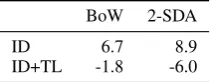
setups with BoW and 2-SDA features. We mea-sure the transfer losses we suffer from training on one domain and evaluating on another (Figure 1). The overall picture is the same as above: ID+TL 2-SDA models perform best. In the baseline BoW ID setup, domain shifts have a strong influence on the results. The combination of out-of-domain and out-of-task data in ID+TL keeps losses uniformly low. 2-SDA features lower almost all losses fur-ther. On average, 2-SDA ID+TL reduces trans-fer loss by 12.7 points compared to the baseline (Table 3). As expected, pairings of thematically strongly related domains (e.g.,BOOKSandDVDS) have lower losses in all setups.
The biggest challenge is the strong domain shift between the CINEMA and PRODUCTS domains (concerning mainly the retail aspects). With BoW ID, losses onCINEMAreach up to 25 points, and using CINEMAfor training causes high losses for PRODUCTS in most cases. Our key result is that the ID+TL 2-SDA setup successfully compensates for these problems, reducing the losses below 0.
Losses across the PRODUCTSdomains are less pronounced. TheDVDSbaseline classifier has the lowestF1 (cf. Table 2) and shows the highest im-provements in domain adaptation: BoW models of other domains perform better than the in-domain classifier. Analyzing theDVDSmodel shows over-fitting to specific movie terms which occur fre-quently across each review in the training data. SNR content in movies is mostly concerned with named entity types which cannot easily be learned from BoW representations. Out-of-domain mod-els are less specialized and perform better than
in-BoW 2-SDA
ID 6.7 8.9
ID+TL -1.8 -6.0
Table 3: Mean transfer losses (%) for the different training data and feature representation setups. In-domain results not included.
domain models. TL and SDA increase the cover-age of movie terms and provide better generaliza-tion, which improves performance further.
BOOKSis the most challenging domain in all se-tups. It is particularly heterogeneous, containing both fiction and non-fiction reviews which feature different SNR aspects. Both results illustrate that domain effects depend on how diverse SNR con-tent is within the domain.
Overall, the results show that ID+TL leads to a successful compensation of cross-domain effects. SDA features improve the results significantly†for
ID+TL. In particular, we find that the SDA suc-cessfully compensates for the strong domain shift betweenCINEMAandPRODUCTS.
5 Conclusion
[image:4.595.364.470.301.342.2]References
Chih-Chung Chang and Chih-Jen Lin. 2011. LIB-SVM: A library for support vector machines. ACM Transactions on Intelligent Systems and Technology (ACM TIST), 2(3):1–27.
Minmin Chen, Zhixiang Xu, Kilian Weinberger, and Fei Sha. 2012. Marginalized denoising autoen-coders for domain adaptation. InProceedings of the 29th International Conference on Machine Learning (ICML).
Xavier Glorot, Antoine Bordes, and Yoshua Bengio. 2011. Domain adaptation for large-scale sentiment classification: A deep learning approach. In Pro-ceedings of the 28th International Conference on Machine Learning (ICML), pages 513–520. Nitin Jindal and Bing Liu. 2008. Opinion spam
and analysis. In Proceedings of the International Conference on Web Search and Web Data Mining (WSDM), pages 219–230.
Eric W. Noreen. 1989. Computer Intensive Methods for Hypothesis Testing: An Introduction. Wiley. Bo Pang and Lillian Lee. 2004. A sentimental
educa-tion: Sentiment analysis using subjectivity summa-rization based on minimum cuts. InProceedings of the 42nd Meeting of the Association for Computa-tional Linguistics (ACL), pages 271–278.
Christian Scheible and Hinrich Sch¨utze. 2013. Senti-ment relevance. InProceedings of the 51st Annual Meeting of the Association for Computational Lin-guistics (ACL), pages 954–963.
Maite Taboada, Julian Brooke, and Manfred Stede. 2009. Genre-based paragraph classification for sen-timent analysis. In Proceedings of the SIGDIAL 2009 Conference, pages 62–70.
Oscar T¨ackstr¨om and Ryan McDonald. 2011. Semi-supervised latent variable models for sentence-level sentiment analysis. InProceedings of the 49th An-nual Meeting of the Association for Computational Linguistics (ACL), pages 569–574.
Sebastian Thrun. 1995. Is learning the n-th thing any easier than learning the first? InProceedings of Ad-vances in Neural Information Processing Systems 8 (NIPS), pages 640–646.
Pascal Vincent, Hugo Larochelle, Isabelle Lajoie, Yoshua Bengio, and Pierre-Antoine Manzagol. 2010. Stacked denoising autoencoders: Learning useful representations in a deep network with a local denoising criterion. The Journal of Machine Learn-ing Research (JMLR), 11:3371–3408.