DeSRL: A Linear-Time Semantic Role Labeling System
Massimiliano Ciaramita†∗ [email protected]
Felice Dell’Orletta‡ [email protected]
†: Yahoo! Research Barcelona, Ocata 1, 08003, Barcelona, Catalunya, Spain
‡: Dipartimento di Informatica, Universit`a di Pisa, L. B. Pontecorvo 3, I-56127, Pisa, Italy ¦: Barcelona Media Innovation Center, Ocata 1, 08003, Barcelona, Catalunya, Spain
Giuseppe Attardi‡ [email protected]
Mihai Surdeanu†,¦
Abstract
This paper describes the DeSRL sys-tem, a joined effort of Yahoo! Research Barcelona and Universit`a di Pisa for the CoNLL-2008 Shared Task (Surdeanu et al., 2008). The system is characterized by an efficient pipeline of linear complexity components, each carrying out a different sub-task. Classifier errors and ambigui-ties are addressed with several strategies: revision models, voting, and reranking. The system participated in the closed chal-lenge ranking third in the complete prob-lem evaluation with the following scores: 82.06 labeled macro F1 for the overall task, 86.6 labeled attachment for syntactic de-pendencies, and 77.5 labeled F1 for se-mantic dependencies.
1 System description
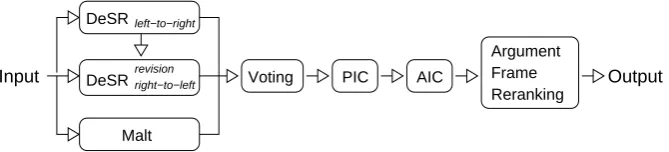
DeSRL is implemented as a sequence of compo-nents of linear complexity relative to the sentence length. We decompose the problem into three sub-tasks: parsing, predicate identification and clas-sification (PIC), and argument identification and classification (AIC). We address each of these sub-tasks with separate components without backward feedback between sub-tasks. However, the use of multiple parsers at the beginning of the process, and re-ranking at the end, contribute beneficial stochastic aspects to the system. Figure 1 summa-rizes the system architecture. We detail the parsing
∗All authors contributed equally to this work.
∗°c 2008. Licensed under the Creative Commons Attribution-Noncommercial-Share Alike 3.0 Unported li-cense (http://creativecommons.org/licenses/by-nc-sa/3.0/). Some rights reserved.
sub-task in Section 2 and the semantic sub-tasks (PIC and AIC) in Section 3.
2 Parsing
In the parsing sub-task we use a combination strat-egy on top of three individual parsing models, two developed in-house –DeSRleft−to−right and
DeSRrevision
right−to−left– and a third using an
off-the-shelf parser, Malt 1.0.01.
2.1 DeSRleft−to−right
This model is a version of DeSR (Attardi, 2006), a deterministic classifier-based Shift/Reduce
parser. The parser processes input tokens advanc-ing on the input from left to right withShift ac-tions and accumulates processed tokens on a stack withReduceactions. The parser has been adapted for this year’s shared task and extended with addi-tional classifiers, e.g., Multi Layer Perceptron and multiple SVMs.2
The parser uses the following features:
1. SPLIT LEMMA: from tokens −1, 0, 1, prev(0), leftChild(0),rightChild(0)
2. PPOSS: from−2,−1,0,1,2,3,prev(0),next(−1), leftChild(−1), leftChild(0), rightChild(−1), rightChild(0)
3. DEPREL: from leftChild(−1), leftChild(0), rightChild(−1)
4. HDIST: from−1,0
In the above list negative numbers refer to tokens on the stack, positive numbers to tokens in the in-put queue. We use the following path operators:
leftChild(x)refers to the leftmost child of token
x, rightChild(x)to the rightmost child of token
x, prev(x)andnext(x) respectively to the token preceding or followingxin the sentence.
1http://w3.msi.vxu.se/∼nivre/research/
MaltParser.html
2This parser is available for download at: http://
sourceforge.net/projects/desr/.
Voting PIC AIC
Reranking Argument Frame DeSRleft−to−right
Malt DeSRright−to−left
revision
[image:2.595.131.466.72.148.2]Output Input
Figure 1: DeSRL system architecture. The first three types of features are directly
ex-tracted from the attributes of tokens present in the training corpus. The fourth feature represents the distance of the token to the head of the noun phrase to which it belongs, or “O” if it does not belong to a noun phrase. This distance is computed with a simple heuristic, based on a pattern of POS tags. Attardi and Dell’Orletta (2008) have shown that this feature improves the accuracy of a shift/reduce dependency parser by providing approximate in-formation about NP chunks in the sentence. In fact no token besides the head of a noun phrase can have a head referring to a token outside the noun phrase. Hence the parser can learn to avoid creat-ing such links. The addition of this feature yields an increase of 0.80% in Labeled Accuracy on the development set.
2.2 Revision Parser: DeSRrevision right−to−left
Our second individual parsing model implements an alternative to the method of revising parse trees of Attardi and Ciaramita (2007) (see also (Hall & Novak, 2005)). The original approach consisted in training a classifier to revise the errors of a base-line parser. The approach assumed that only lo-cal revisions to the parse tree would be needed, since the dependency parser mostly gets individual phrases correctly. The experiments showed that in-deed most of the corrections can be expressed by a small set of (about 20) complex movement rules. Furthermore, there was evidence that one could get higher improvements from the tree revision classi-fier if this was trained on the output of a lower ac-curacy parser. The reason for this is that the num-ber of errors is higher and this provides a larger amount of training data.
For the CoNLL 2008 shared task, we refined this idea, but instead of using an independent classi-fier for the revision, we use the parser itself. The second parser is trained on the original corpus ex-tended with dependency information predicted by a lower accuracy parser. To obtain the base parser we use DeSR trained on half the training corpus using a Maximum Entropy (ME) classifier. The
ME classifier is considerably faster to train but has a lower accuracy: this model achieved an LAS of 76.49% on the development set. Using the out-put of the ME-based parser we extend the original corpus with four additional columns: the lemma of the predicted head (PHLEMMA), the PPOSS of the predicted head (PHPPOSS), the dependency of the predicted head (PHDEPREL), and the indica-tion of whether a token appears before or after its predicted head. A second parser is trained on this corpus, scanning sentences from right to left and using the following additional features:
1. PHPPOSS: from−1,0 2. PHLEMMA: from−1,0 3. PHDEPREL: from−1,0 4. PHHDIST: from0
Performing parsing in reverse order helps reduce several of the errors that a deterministic parser makes when dependency links span a long distance in the input sequence. Experiments on the CoNLL 2007 corpora (Dell’Orletta, 2008) have shown that this indeed occurs, especially for distances in the range from 6 to 23. In particular, the most signifi-cant improvements are for dependencies with label COORD(+ 6%) andP(+ 8%).
The revision parser achieves an LAS of 85.81% on the development set. Note that the extra fea-tures from the forward parser are indeed use-ful, since a simple backward parser only achieves 82.56% LAS on the development set.
2.3 Parser Combination
The final step consists in combining the out-puts of the three individual models a simple voting scheme: for each token we use major-ity voting to select its head and dependency la-bel. In case of ties, we chose the dependency predicted by our overall best individual model (DeSRrevision
right−to−left).3
Note that typical approaches to parser combination combine the outputs of inde-pendent parsers, while in our case one base model (DeSRrevision
right−to−left) is trained with
3We tried several voting strategies but none performed
information predicted by another individual model(DeSRleft−to−right). To the best of our
knowledge, combining individual parsing models that are inter-dependent is novel.
3 Semantic Role Labeling
We implement the Semantic Role Labeling (SRL) problem using three components: PIC, AIC, and reranking of predicted argument frames.
3.1 Predicate Identification and Classification The PIC component carries out the identification of predicates, as well as their partial disambigua-tion, and it is implemented as a multiclass average Perceptron classifier (Crammer & Singer, 2003). For each tokeniwe extract the following features (h,istands for token combination):
1. SPLIT LEMMA: fromhi−1, ii, i−1, i, i+1,hi, i+1i 2. SPLIT FORM: fromi−2, i−1, i, i+ 1.i+ 2 3. PPOSS: fromhi−2, i−1i,hi−1, ii, i−1, i, i+1,hi, i+
1i,hi+ 1, i+ 2i
4. WORD SHAPE: e.g., “Xx*” for “Brazil”, fromhi−2, i− 1, ii,hi−1, ii, i−1, i, i+ 1,hi, i+ 1i,hi, i+ 1, i+ 2i 5. Number of children of nodei
6. For each children j of i: split lemmaj, ppossj,
depreli,j, hsplit lemmai, split lemmaji, hppossi,
ppossji
7. Difference of positions:j−i, for each childjofi.
The PIC component uses one single classifier map-ping tokens to one of 8 classes corresponding to the rolesets suffixes 1 to 6, the 6 most frequent types, plus a class grouping all other rolesets, and a class for non predicates; i.e.,Y ={0,1,2, ..,7}. Each token classified asy7is mapped by default to
the first sensey1. This approach is capable of
dis-tinguishing between different predicates based on features 1 and 2, but it can also exploit information that is shared between predicates due to similar frame structures. The latter property is intuitively useful especially for low-frequency predicates.
The classifier has an accuracy in the multiclass problem, considering also the mistakes due to the non-predicted classes, of 96.2%, and an F-score of 92.7% with respect to the binary predicate iden-tification problem. To extract features from trees (5-7) we use our parser’s output on training, devel-opment and evaluation data.
3.2 Argument Identification and Classification
Algorithm 1 describes our AIC framework. The al-gorithm receives as input a sentenceSwhere pred-icates have been identified and classified using the
Algorithm 1: AIC
input : sentenceS; inference strategyI; modelw
foreachpredicatepinSdo set frameFin={}
foreachtokeniinSdo ifvalidCandidate(i)then
ˆ
y= arg maxy∈Yscore(Φ(p, i),w, y)
ifyˆ6= nilthen
add argument (i,yˆ) toFin
Fout=inference(Fin,I)
output: set of all framesFout
PIC component, an inference strategy I is used to guarantee that the generated best frames satisfy the domain constraints, plus an AIC classification modelw. We learnwusing a multiclass Percep-tron, using as output label setYall argument labels that appear more than 10 times in training plus anil
label assigned to all other tokens.
During both training and evaluation we se-lect only the candidate tokens that pass the
validCandidatefilter. This function requires that the length of the dependency path between pred-icate and candidate argument be less than 6, the length of the dependency path between argument and the first common ancestor be less than 3, and the length of the dependency path between the predicate and the first common ancestor be less than 5. This heuristic covers over 98% of the ar-guments in training.
In the worst case, Algorithm 1 has quadratic complexity in the sentence size. But, on average, the algorithm has linear time complexity because the number of predicates per sentence is small (av-eraging less than five for sentences of 25 words).
The functionΦgenerates the feature vector for a given predicate-argument tuple. Φ extracts the following features from a given tuple of a predicate
pand argumenta:
1. token(a)4, token(modifier of a) if a is the
head of a prepositional phrase, andtoken(p).
2. Patterns of PPOSS tags and DEPREL labels for: (a) the predicate children, (b) the children of the predicate ancestor across VC and IM dependencies, and (c) the siblings of the same ancestor. In all paths we mark the position of
p,aand any of their ancestors.
3. The dependency path between p anda. We add three versions of this feature: just the 4tokenextracts the split lemma, split form, and PPOSS
path, and the path prefixed with p and a’s PPOSS tags or split lemmas.
4. Length of the dependency path. 5. Distance in tokens betweenpanda. 6. Position ofarelative top: before or after.
We implemented two inference strategies:
greedy and reranking. The greedy strategy sorts all arguments in a frame Fin in descending order of their scores and iteratively adds each argument to the output frameFoutonly if it respects the do-main constraints with the other arguments already selected. The only domain constraint we use is that core arguments cannot repeat.
3.3 Reranking of Argument Frames
The reranking inference strategy adapts the ap-proach of Toutanova et al. (2005) to the depen-dency representation with notable changes in can-didate selection, feature set, and learning model. For candidate selection we modify Algorithm 1: instead of storing onlyyˆfor each argument inFin we store the topkbest labels. Then, from the ar-guments inFin, we generate the topkframes with the highest score, where the score of a frame is the product of all its argument probabilities, computed as thesoftmaxfunction on the output of the Per-ceptron. In this set of candidate frames we mark the frame with the highest F1score as the positive
example and all others as negative examples. From each frame we extract these features: 1. Position of the frame in the set ordered by
frame scores. Hence, smaller positions in-dicate candidate frames that the local model considered better (Marquez et al., 2007). 2. The complete sequence of arguments and
predicate for this frame (Toutanova, 2005). We add four variants of this feature: just the sequence and sequence expanded with: (a) predicate voice, (b) predicate split lemma, and (c) combination of voice and split lemma. 3. The complete sequence of arguments and predicate for this frame combined with their PPOSS tags. Same as above, we add four variants of this feature.
4. Overlap with the PropBank or NomBank frame for the same predicate lemma and sense. We add the precision, recall, and F1
score of the overlap as features (Marquez et al., 2007).
5. For each frame argument, we add the features from the local AIC model prefixed with the
WSJ + Brown WSJ Brown Labeled macro F1 82.69 83.83 73.51
LAS 87.37 88.21 80.60
[image:4.595.310.521.72.115.2]Labeled F1 78.00 79.43 66.41
Table 1: DeSRL results in the closed challenge, for the overall task, syntactic dependencies, and semantic dependencies.
Devel WSJ Brown DeSRleft−to−right 85.61 86.54 79.74
DeSRrevision
right−to−left 85.81 86.19 78.91
MaltParser 84.10 85.50 77.06
[image:4.595.318.511.166.218.2]Voting 87.37 88.21 80.60
Table 2: LAS of individual and combined parsers.
corresponding argument label in the current frame (Toutanova, 2005).
The reranking classifier is implemented as multi-layer perceptron with one hidden multi-layer of 5 units, trained to solve a regression problem with a least square criterion function. Previously we experi-mented, unsuccessfully, with a multiclass Percep-tron and a ranking PercepPercep-tron. The limited number of hidden units guarantees a small computational overhead with respect to a linear model.
4 Results and Analysis
Table 1 shows the overall results of our system in the closed challenge. Note that these scores are higher than those of our submitted run mainly due to improved parsing models (discussed be-low) whose training ended after the deadline. The score of the submitted system is the third best for the complete task. The system throughput in our best configuration is 28 words/second, or 30 words/second without reranking. In exploratory experiments on feature selection for the re-ranking model we found that several features classes do not contribute anything and could be filtered out speeding up significantly this last SRL step. Note however that currently over 90% of the runtime is occupied by the syntactic parsers’ SVM classifiers. We estimate that we can increase throughput one order of magnitude simply by switching to a faster, multiclass classifier in parsing.
4.1 Analysis of Parsing
Labeled F1 Unlabeled F1
Syntax PIC Inference Devel WSJ Brown Devel WSJ Brown
gold gold greedy 88.95 90.21 84.95 93.71 94.34 93.29
[image:5.595.124.469.72.133.2]predicted gold greedy 85.96 86.70 78.68 90.60 90.98 88.02 predicted predicted greedy 79.88 79.27 66.41 86.07 85.33 80.14 predicted predicted reranking 80.13 79.43 66.41 86.33 85.62 80.41
Table 3: Scores of the SRL component under various configurations.
Devel WSJ Brown Unlabeled F1 92.69 90.88 86.96
Labeled F1(PIC) 87.29 84.87 71.99
[image:5.595.83.277.168.209.2]Labeled F1(Sense 1) 79.62 78.94 70.11
Table 4: Scores of the PIC component.
mentioned earlier. These results show that vot-ing helps significantly (+1.56% over the best svot-ingle parser) even though inter-dependent models were used. However, our simple voting scheme does not guarantee that a well-formed tree is generated, leaving room for further improvements; e.g., as in (Sagae & Lavie, 2006).
4.2 Analysis of SRL
Table 3 shows the labeled and unlabeled F1scores
of our SRL component as we move from gold to predicted information for syntax and PIC. For the shared task setting –predicted syntax and predicted PIC– we show results for the two inference strate-gies implemented: greedy and reranking. The first line in the table indicates that the performance of the SRL component when using gold syntax and gold PIC is good: the labeled F1is 90 points for the
in-domain corpus and approximately 85 points for the out-of-domain corpus. Argument classification suffers the most on out-of-domain input: there is a difference of 5 points between the labeled scores on WSJ and Brown, even though the correspond-ing unlabeled scores are comparable.
The second line in the table replicates the setup of the 2005 CoNLL shared task: predicted syntax but gold PIC. This yields a moderate drop of 3 la-beled F1points on in-domain data and a larger drop
of 6 points for out-of-domain data.
We see larger drops when switching to predicted PIC (line 3): 5-6 labeled F1 points in domain and
12 points out of domain. This drop is caused by the PIC component, e.g., if a predicate is missed the whole frame is lost. Table 4 lists the scores of our PIC component, which we compare with a base-line system that assigns sense 1 to all identified predicates. The table indicates that, even though our disambiguation component improves signifi-cantly over the baseline, it performs poorly,
espe-cially on out-of-domain data. Same as SRL, the classification sub-task suffers the most out of do-main (there is a difference of 15 points between unlabeled and labeled F1scores on Brown).
Finally, the reranking inference strategy yields only modest improvements (last line in Table 3). We attribute these results to the fact that, unlike Toutanova et al. (2005), we use only one tree to generate frame candidates, hence the variation in the candidate frames is small. Considering that the processing overhead of reranking is already large (it quadruples the runtime of our AIC component), we do not consider reranking a practical extension to a SRL system when processing speed is a dom-inant requirement.
References
G. Attardi. 2006. Experiments with a Multilan-guage Non-Projective Dependency Parser. InProc. of CoNNL-X 2006.
G. Attardi and M. Ciaramita. 2007. Tree Revi-sion Learning for Dependency Parsing. InProc. of NAACL/HLTC 2007.
G. Attardi, F. Dell’Orletta. 2008. Chunking and De-pendency Parsing. InProc. of Workshop on Partial Parsing.
K. Crammer and Y. Singer. 2003. Ultraconservative Online Algorithms for Multiclass Problems. Journal of Machine Learning Research 3: pp.951-991. F. Dell’Orletta. 2008. Improving the Accuracy of
De-pendency Parsing. PhD Thesis. Dipartimento di In-formatica, Universit`a di Pisa, forthcoming.
K. Hall and V. Novak. 2005. Corrective Modeling for Non-Projective Dependency Parsing. InProc. of IWPT.
L. Marquez, L. Padro, M. Surdeanu, and L. Villarejo. 2007. UPC: Experiments with Joint Learning within SemEval Task 9. InProc. of SemEval 2007.
K. Sagae and A. Lavie. 2006. Parser Combination by reparsing. InProc. of HLT/NAACL.
M. Surdeanu, R. Johansson, A. Meyers, L. M`arquez and J. Nivre. 2008. The CoNLL-2008 Shared Task on Joint Parsing of Syntactic and Semantic Depen-dencies. InProc. of CoNLL-2008.
K. Toutanova, A. Haghighi, and C. Manning. 2005. Joint Learning Improves Semantic Role Labeling. In