Abstract— Portfolio optimization is one of the most
important problems in organizations. In this regard mangers face to many decision making problems. In governmental dimensions they often engage with multiphase projects in which three major problems arise: selecting the best projects, selecting qualified contractors, budgeting and scheduling the projects according to the constraints. In this paper we propose a method for selecting multiphase projects, assigning the most qualified contractor to each phase, determining financial strategies and scheduling the selected projects to maximize net present value (NPV).
In this proposed method firstly contractors that have not minimal qualifications are eliminated from consideration, then closeness coefficient of contractors to each phase of projects will be computed by Fuzzy TOPSIS method and finally these coefficients as a successful indicators of each contractor will be fed in to a linear programming model to select most profitable projects, related contractors, budgeting and scheduling the projects with respect to the constraints.
Index Terms— Project selection, contractor selection, Fuzzy
TOPSIS, mixed integer linear programming.
I. INTRODUCTION
Selecting most profitable projects is an important and prevalent activity in many organizations. Project selection is a process of selecting one or more promising project within some limitations while corporate goals or objectives are satisfied. Project selection, generally is limited by available resources such as capital research talent, laboratory space, lack of equipments, etc. Often in governmental dimensions we face with multiphase projects in which each phase requires especial knowledge and abilities such as feasibility study, construction, etc.
In the past decades, a variety of decision models have been developed to support the project selection. Recently, decision support systems (DSS) have been developed and used for project selection [6,13,15,16,23].
An integrated DSS has been proposed for R&D project selection [10]. It uses scoring method for project screening, AHP for criterion weight, Delphi for collecting information on requirements, ILP with heuristics for resource allocation, and NPV for analysis of benefit interactions. A DSS [6] has been developed that uses linear goal programming (LGP) and AHP methods to integrate multiple objectives into a single a
Trade Promotion Organization of Iran, Tehran, Iran. (Phone: +98-2121912903; email: [email protected]).
b Department of Industrial engineering, Shahed University, Tehran, Iran
(email:[email protected])
c
Trade Promotion Organization of Iran, Tehran, Iran.
(Phone: +98-2121912700; email: [email protected])
objective, and Integer LP to maximize the overall objective of the portfolio.
Nowadays most of project owners especially in the public sector tend to outsource their projects. Thus contractors play a major role in such projects. The selection process should embrace investigation of contractors’ potential to deliver a service of acceptable standard, on time, and within determined budget. Some methods are used for selecting contractors in order to award public projects are based on the principle of acceptance of the lowest bid price [20,17]. An integrated hierarchical method has been developed for construction contractor selection [25]. In this paper it takes in to consider many criteria such as organizational expertise, ability to timely complete projects, financial status and workloads to rank contractors in construction context. In many papers, contractor selection has been considered independent on project selection process [25,24,9].
From outsourcing view, some criteria should be considered in project and contractor selection. For example we will screen out projects that we haven't any related contractor for them or contractors requested to do have a high risk rate to complete that project. Also from this viewpoint some limitations may be added to decision process. For example work load of projects selected in especial field shouldn't be more than capacities of selected contractors. Thus it seems that it is essential to provide a method for solving project and contractor selection simultaneously. From a practical view point we cannot select projects and related contractors neglecting the available resources in any time. Thus it seems essential to consider budgeting and scheduling of the projects during the selection process.
II. PROPOSED METHOD
In this paper a method is proposed which utilizes both qualitative and quantitative data to select multiphase projects, related contractors and scheduling the selected projects. Contractor dependent criteria such as contractor experiences in that field, having related experts and necessary equipments, success rate of contractor in similar projects, finishing similar projects timely, and innovation are used in fuzzy TOPSIS method to calculate closeness coefficient of each contractor to each phase under each criterion. Also contractor independent criteria in project selection such as NPV are used in a linear programming model to select most profitable projects with respect to the constraints. This linear model besides assigning each phase to the most qualified contractor will determine the scheduling of each project according to some constraints such as available budget and equipment and work load of each selected contractors.
Selection of Multiphase Governmental
Projects, Related Contractors and Master
Planning under Fuzzy Environment
In this paper firstly those of contractors that have not minimal qualifications are screened out. For example appliers that haven't any related experiences or appliers whose cash credit is less than expected amount are eliminated from consideration. As a result, a list of promised projects and qualified contractors would be available. To assess each contractor's abilities in each phase of project fuzzy TOPSIS method is used. The inputs of this stage are the importance of the criteria and the rating of the contractors in each phase of project under each criterion. These two categories of data are evaluated by decision makers in terms of linguistic variables. Then the fuzzy TOPSIS steps are followed to find the closeness coefficient (CC) of each contractor-phase of project. These closeness coefficients can be considered as indicators to show the probability of contractor's success in each phase of project. Finally these coefficients will be fed in to a linear programming to select most profitable projects and related contractors with respect to the constraints. In this step some economic characteristics of each project, closeness coefficient of each contractor-projects and some constraints such as budget available and strategic limitations are taken into consideration.
The proposed method tries to select projects and related contractors in three phases:
Phase 1: prequalification
Step1: Make a list of promised projects and split projects to phases.
Step2: Make an appraisal about the duration of each phase. Step3: Make a list of applier contractors. These contractors
can apply for one or more phases in one or more projects.
Step4: Contractors prequalification. Eliminate some contractors that haven't minimal qualifications.
Phase 2: Compute the closeness coefficient (CC) of each contractor-phase of project
Step1: Determine decision maker committee for each category.
Step3: Determine project and contractor selection criteria. Step4: Determine fuzzy positive-ideal solution (FPIS) and
fuzzy negative-ideal solution (FNIS) for each criterion.
Step5: Choose the appropriate linguistic variables for the importance weight of the criteria and the linguistic ratings for alternatives with respect to criteria. Step6: Assess the importance
w
~
jof criterion Cj bydecision-makers, using linguistic variables.
Step7: Evaluate the rating of each contractor in each phase of project under each criterion by decision-makers, using the linguistic variables.
Step8: Convert the linguistic evaluation into triangular fuzzy numbers to construct the fuzzy decision matrix with fuzzy weight of each criterion.
Step9: Pool the decision makers' opinions to get the aggregated fuzzy weight of criterion Cj and to get the aggregated fuzzy rating of contractor Ai under criterion Cj in phase Pmn. Then the importance of the criteria and the rating of alternatives with respect to each criterion can be calculated as
1
… (1)
Where is the importance weight of the kth decision maker.
Also the aggregated rating of each contractor-project under criterion Cj can be calculated as
1
… (2)
Where is the rating of the kth decision maker. Step10: Construct the normalized fuzzy decision matrix. If
we describe the linguistic variables by triangular
fuzzy numbers, , , and
, , then we can obtain the normalized fuzzy decision matrix denoted by , and
̃ . B and C are the set of benefit criteria and cost criteria, respectively, and
; ), , , ( ~ * *
* c j B
c c b c a r j ij j ij j ij
ij = ∈ 3) (
; ), , , (
~ j C
c a b a a a r ij j ij j ij j
ij = ∈
− − −
(4)
;
* C j B
c ij
i
j=Max ∈ (5)
; C j a a ij i
j=Min ∈
−
(6) Step11: Construct the weighted normalized fuzzy decision
matrix. We can construct the weighted normalized fuzzy decision matrix as
, i=1,2,…,m, j=1,2,…,n
Where ̃ . .
Step12: Calculate the distance of each contractor-phase of project from FPIS and FNIS, in each criterion. We can define the fuzzy positive-ideal solution (FPIS, ) as , , … , and fuzzy negative-ideal solution (FPIS, ) as , , … , , Where 1,1,1 and 0,0,0 , j=1,2,…,n The distance of each alternative from and can be currently calculated as
), ~ , ~ ( 1 * *
∑
= = n j j iji d v v
d i=1,2,..., m (7)
), ~ , ~ ( 1
∑
= − −= nj
j ij
i d v v
d i=1,2,..., m (8)
Where d(.,.) is the distance measurement between two fuzzy numbers.
Step13: Calculate the closeness coefficient (CC) of each contractor- phase of project in each criterion. The closeness coefficient of each alternative is calculated as m i d d d CC i i i
i , 1,2,...,
*
= +
= − +
(9)
Phase 3: Selecting the best projects and related contractors
Step1: Determine the selection limitations.
Step2: Determine quantitative criteria for project selection. Step3: Model of the problem as a mathematical
Mathematical Model: Sets
i index for project, for all i=1,2,…,p j index for phase, for all j=1,2,…,Ni t index for time period, for all t=1,2,…,Nper k index for contractor, for all k=1,2,…,Nc l index for loan type, for all l=1,2,…,L Objective function
z Net present value to be maximized Parameters
Negative cash flow of phase j of project i (cost). Positive cash flow of phase j of project i (profit) Mij Minimal expected cash credit for phase j of project i Dij Duration of phase j of project i
Ck Cash credit of contractor k
ccijk Closeness coefficient of contractor k to phase j of project i compijk 1 if contractor k can be assigned to phase j of project i, otherwise 0.
αt Constant for maximum value of loaning in period t. B Total available budget
Np Number of projects Nper Number of periods
Nc Number of contractors
nl Number of period for paying back of loan type l. r Interest rate
rl Interest Rate of loan type l.
rs Interest Rate of alternate investment Variables
Xijkt
Binary variable, 1 if contractor k is assigned to phase j of project i during time period t, otherwise 0.
wijkt Binary variable, 1 if contractor k starts phase j of project i during time period t, otherwise 0. Zi Binary variable, 1 if project i is selected,
otherwise 0.
zllt Binary variable, 1 if loan type l is selected in period t, otherwise 0.
cmij Completion time of phase j of project i It Investment for period t
lolt amount of loan with type of l in period t. PBt amount of Loan Pay Backs in period t.
PF ,R%,T CC
1 CC , %,
(10)
1 … ; 1 … ;
1 … ; 1 … (11)
M x ; 1 … ;
1 …
(12)
w x x 1 … ; 1 … ;
1 … ; 1 … (13)
w x (14)
w 3 x 2x (15)
1 1 … ; 1 … (16)
x 1 … ;
1 …
(17)
x 1 … , 1 … (18)
1 1 … ;
1 …
(19)
1 1 … ; 1 … ; (20)
, %,
1 …
(21)
1 … ; 1 … (22)
1; 1 … ; 1 … (23)
, %, ́
1 …
(24)
, %, (25)
, , , , , 1 (26)
, , , 0; (27)
Equation (10) denotes the objective function that is the NPV to be maximized. Closeness coefficients of contractor-phase have been used in objective function to take contractors capabilities into consideration. It should be noted that cash flows of phases of projects have been calculated according to present circumstances, thus they should be converted to future value with inflation rate consideration. Also it is supposed that cash flows of each phase are related to the first period of starting the phase.
Constraint (11) denotes that only a qualified contractor can be assigned to a phase. This parameter will be determined at the prequalification step of the proposed approach. Constraint (12) ensures that projects will not be assigned to a contractor whose cash credit is less than the total minimal expected cash credit for these projects. Constraints (13), (14) and (15) are related to determination of phases’ start time.
kind of loan. Constraint (25) is to limit investments to total available budget. Constraint (26) and (27) provide the decision variable definition.
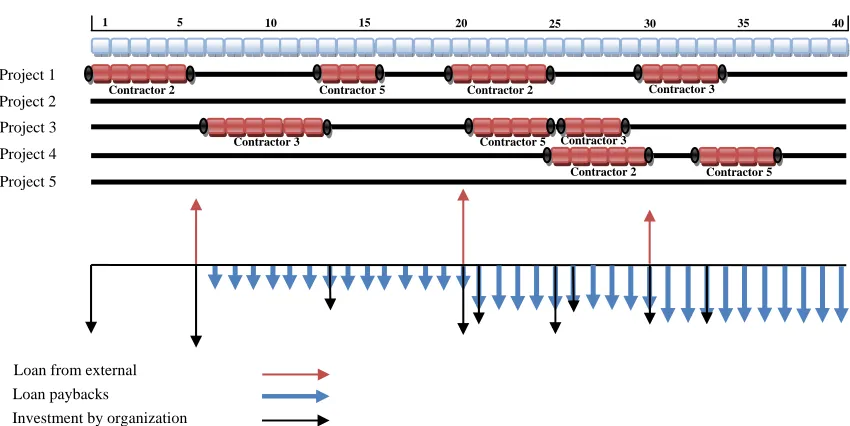
[image:4.595.57.281.254.333.2]The proposed model is a single objective mixed integer linear model whose parameters are deterministic. By the use of this model managers would be able to select the most profitable projects, assign the most qualified contractors to each selected project, make decision on financial strategies and budgeting and schedule projects according to organizational goals and constraints. Fig.1 illustrates outputs of a numerical case. In this case there are 5 promising projects which should be completed in time horizon with 40 periods. Also there are 13 applier contractors; five of them remained for further evaluations after prequalification phase. Table I shows number of phases in each promising project and related duration.
Table I. Duration of phases in each project Phase 1 Phase 2 Phase 3 Phase 4
Project 1 5 3 5 4
Project 2 6 3 5 5
Project 3 6 4 6 -
Project 4 5 4 - -
Project 5 4 5 4 3
It can be observed that three projects are selected by the proposed approach, project 1, project 3 and project 4. Also a contractor is assigned to each phase of project and there is no assignment to contractors 1 and 4. All selected projects will be completed at the end of 36th period.
Cash flows of projects have been illustrated in this figure as well. It can be observed that first and second phase of the project 1 are fully funded by the organization, while in two last phases only a part of budget is funded by organization and loans from external institutions are taken to complete needed investment. Other financial decisions can be seen in
this figure.
Some advantages of the proposed approach could be as follows:
1. Selecting projects with respect to contractors' capabilities and equipments.
2. This method considers both qualitative and quantitative criteria.
3. This method considers closeness coefficients of each contractor- phase as an index to reducing failure risk rate of each project.
4. The proposed method considers budgeting and scheduling of projects during selection process. 5. Integrated decision making is one of the most
important features of the proposed approach. III. CONCLUSION
In this paper we proposed a method for project and contractor selection, budgeting and scheduling the selected projects for multi phase projects. This method tries to select most profitable projects as well as their related contractors with respect to budgetary and strategic constraints. The proposed method uses fuzzy TOPSIS to find closeness coefficient (CC) of each contractor for each project phase in specified criteria. Afterward CC’s are used in a mixed integer linear model to minimize the failure risk rate of each project. The proposed method adopts an integrated approach for project and contractor selection. This method uses both qualitative and quantitative data in decision making process and can be simply implemented in organizations involved in any kind of projects.
REFERENCES
[1] Andre´s L. Medaglia, Samuel B. Graves, Jeffrey L. Ringuest. A multiobjective evolutionary approach for linearly constrained project selection under uncertainty. European Journal of Operational Research 2007;179: 869–894.
Loan from external Loan paybacks
Investment by organization Project 5
Project 1 Project 2 Project 3
Project 4 Contractor 5
Contractor 3
Contractor 2
Contractor 2 Contractor Contractor 5 2 Contractor 3
Contractor 3
Contractor 5
[image:4.595.85.510.441.654.2]1 5 10 15 20 25 30 35 40
[2] Anna Kadefors, Emma Björlingson, Andreas Karlsson. Procuring service innovations: Contractor selection for partnering projects. International Journal of Project Management 2007;25: 375–385.
[3] Chen-Tung Chen. Extensions of the TOPSIS for group decision-making under fuzzy environment. Fuzzy Sets and Systems 2000; 114: 1-9.
[4] C.P. Lawson, P.J. Longhurst, P.C. Ivey. The application of a new research and development project selection model in SMEs. Technovation 2006;26: 242–250.
[5] Ekambaram Palaneeswaran, Mohan Kumaraswamy. Recent advances and proposed improvements in contractor prequali®cation methodologies. Building and Environment 2001;36: 73-87.
[6] Ghasemzadeh, F., & Archer, N. P. Project portfolio selection through decision support. Decision Support Systems 2000; 29:73–88.
[7] Hatush Z, Skitmore M. Criteria for contractor selection. Construc Manage Econ 1997;15(1):19–38.
[8] Henriksen, A. D., & Traynor, A. J. A practical R&D projectselection scoring tool. IEEE Transactions on Engineering Management 1999; 46(2):158–170.
[9] Holt GD, Olomolaiye PO, Harris FC. A review of contractor selection practice in the UK construction industry. Building and Environment 1995;30(4):553–61.
[10] Iyigun, M. G. (1993). A decision support system for R&D project selection and resource allocation under uncertainty. Project Management Journal, 24(4), 5–13.
[11] J.J. Buckley, Fuzzy hierarchical analysis, Fuzzy Sets and Systems1985;17:233-247.
[12] Khorramshahgol, R; Gousty, Y. Delphic Goal Programming (DGP) - A multi-objective cost/benefit approach to R&D portfolio analysis. IEEE Transactions on Engineering Management 1986. Vol. EM-33, pp. 172-175.
[13] Kocaoglu, D. F., & Iyigun, M. G (1994). Strategic R&D project selection and resource allocation with a decision support system application. Proceedings of the IEEE International Engineering Management Conference1994 (pp. 225–232). [14] L.A. Zadeh, The concept of a linguistic variable and its
application to approximate reasoning, Inform. Sci 1975;8:199-249(I), 301-357(II).
[15] Liberatore, M. J. A decision support system linking research and development project selection with business strategy. Project Management Journal(1988a); 19(5): 14–21.
[16] Liberatore, M. J. An expert system for R&D project selection. Mathematical Computational Modeling (1988b);11:260–265. [17] Nguyen VU. Tender evaluation by fuzzy sets. Journal of
Construction Engineering and Management 1985;111(3):231–43.
[18] Ng ST, Skitmore RM. Project owner and consultant perspectives of prequalification criteria. Building and Environment 1999;34:607–21.
[19] Qijia Tian, Jian Ma, Ou Liu. A hybrid knowledge and model system for R&D project selection. Expert Systems with Applications 2002.
[20] Russell JS, Skibniewski MJ. Decision criteria in contractor prequalification. Journal of Management in Engineering 1988;4(2):148–64.
[21] S.B. Graves, J.L. Ringuest, Models & Methods for Project Selection: Concepts from Management Science, Finance and Information Technology, Kluwer Academic Publishers, 2003. [22] Simon Coldrick, Philip Longhurst, Paul Ivey, John Hannis. An
R&D options selection model for investment decisions. Technovation 2005; 25:185–193.
[23] Stewart, T. J. A multi-criteria decision support system for R&D project selection. Journal of Operation Research Society 1991;42(1):17–26.
[24] W.H. Ip, K.L. Yung, Dingwei Wang, A branch and bound algorithm for sub-contractor selection in agile manufacturing environment. Int. J. Production Economics 2004;87:195–205.