Fast Algorithm in ECC for Wireless Sensor
Network
Xu Huang, Pritam Shah, and Dharmendra Sharma
Abstract—Elliptic curve cryptography (ECC) has been attractive to the people who are working in the field of the network security due to its good potential for wireless sensor network security due to its smaller key size and its high strength of security. But there is a room to reduce the key calculation time to meet the potential applications, in particular for wireless sensor networks (WSN). It is well known that scalar multiplication is the operation in elliptical curve cryptography which takes 80% of key calculation time on wireless sensor network motes. In this paper, the research proposes algorithm based on 1’s complement subtraction to represent scalar in scalar multiplication which offer less Hamming weight and will remarkably improve the computational efficiency of scalar multiplication.
Index Terms—Elliptic curve cryptography, Scalar multiplication, Non-adjacent form, Hamming weight, one’s complement subtraction, ROM, wireless sensor networks
I. INTRODUCTION
Rapid growth in the very large scale integrated (VLSI) technology, embedded systems and micro electro mechanical systems (MEMS) has enabled production of less expensive sensor nodes which can communicate information shorter distances with efficient use of power [1]. Sensor node detects information, processes it with the help of an in-built microcontroller and communicates results to the ‘sink or base station’. The base station is a more powerful node linked with central station via satellite or internet communication. Wireless sensor networks can be deployed in various applications namely environmental monitoring e.g. volcano detection [2,3], distributed control system [4] , detection of radioactive sources [5], agricultural and farm management [6, 17], and computing platform for tomorrows’ internet[7] .
II CHALLENGESINDEVELOPINGSECURED PROTOCOLSFORWIRELESSSENSORNETWORKS Compared to traditional networks, a wireless sensor network has many resource constraints [4]. The MICA2 mote consists of an 8 bit ATMega 128L microcontroller working on 7.3 MHz. As a result nodes of WSN have limited computational power. Normally, radio transceiver of MICA motes can achieve maximum data rate of 250 Kbits/sec which puts a limitation on the communication resources. The flash memory which is available on the MICA mote is only 512 Kbyte. Apart from these the battery which is available on the board is of 3.3.V with 2A-Hr capacity. Due to the above boundaries the current state of art protocols and algorithms are expensive for sensor networks due to their high communication overheads.
III ELLIPTIC CURVE CRYPTOGRAPHY PRELIMINARIES
Elliptic Curve Cryptography was introduced by Victor Miller [9] and Neal Koblitz [10] independently in the early eighties. The advantage of ECC over other public key cryptography techniques such as RSA, Diffie-Hellman is that the best known algorithm for solving ECDLP the underlying hard mathematical problem in ECC takes the fully exponential time. On the other hand the best algorithm for solving RSA and Diffie-Hellman takes sub exponential time [11]. To sum up the problem of ECC can be solved only in exponential time and so far there is a lack of sub exponential attack on ECC.
An elliptic curve E over GF(p) can be defined by
where a, b∈GF(p) and b
ax x y2 = 3+ +
in the GF(p) (1)
0 27 4a3+ b2 ≠
The point (x, y) on the curve satisfies above equation and
the point at infinity denoted by ∞ is said to be on the curve. Let’s have examples:
5
2
32
=
+
+
x
x
y
(2)
y
2=
x
3−
2
x
+
1
(3) [image:1.595.316.533.424.765.2]
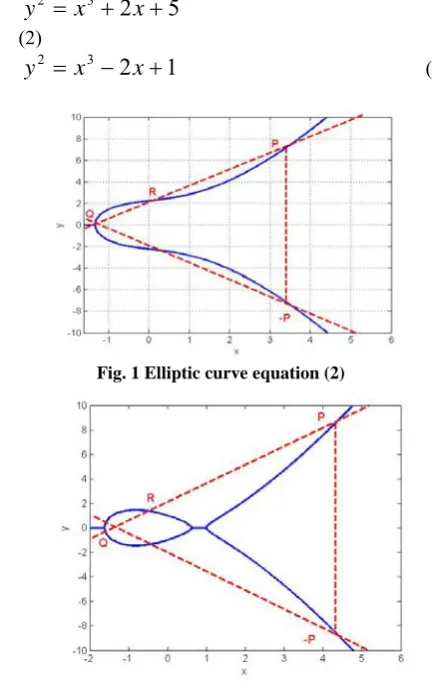
Fig. 1 Elliptic curve equation (2)
It is noted that they are in different “shapes’, Figure 1 is only part as the whole elliptic curve but Figure 2 has two part as the whole elliptic curve.
If there are two points on curve namely, P (x1, y1), Q (x2, y2) and their sum given by point R(x3, y3) the algebraic
formulas for point addition and point doubling are given by following equations:
2 1 2
3 x x
x =λ − −
1 3 1
3 (x x ) y
y =λ − −
Q P x
x y y
≠ −
−
= , if
1 2
1 2 λ
Q P y
a x
= +
= , if
2 3
1 2 λ
where the addition, subtraction, multiplication and the inverse are the arithmetic operations over GF(p), which can
be shown in Fig. 1 and Fig 2.
IV ELLIPTIC CURVE DIFFIE-HELLMAN SCHEME (ECDH) PROPOSED FOR WSN
As per [13] the original Diffie-Hellman algorithm with RSA requires a key of 1024 bits to achieve sufficient security but Diffie-Hellman based on ECC can achieve the same
security level with only 160 bit key size.
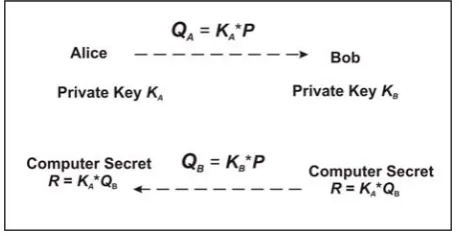
[image:2.595.45.275.399.517.2]The classical Elliptic Curve Diffie-Hellman scheme works as shown in the Fig. 3
Fig. 3 Diffie-Hellman protocol based on ECC
Initially Alice and Bob agree on a particular curve with base point P. They generate their public keys by multiplying
with their private keys namely and . After sharing public keys, they generate a shared secret key by multiplying public keys by their private keys. The secret key
is . With the known values of
, and
P
A
Q
A
K
K
BA B B
A
Q
K
Q
K
R
=
*
=
*
B
Q
P
it is computationally intractable for an eavesdropper to calculateK
A and B which are theprivate keys of Alice and Bob. As a result, adversaries cannot figure out
K
R
which is the shared secret key.V CHALLENGES INVOLVED IN THE SCALAR MULTIPLICATION
In ECC two heavily used operations are involved namely, scalar multiplication and modular reduction. The Gura et al [14] showed that 85% of execution time is spent on
scalar multiplication operation. Scalar Multiplication is the operation
Of multiplying point P on an elliptic curve E defined over a
field GF(p) with positive integer k which involves point
addition and point doubling. Operational efficiency of kP is
affected by the type of coordinate system used for point P on
the elliptic curve and the algorithm used for recoding of integer k in scalar multiplication.
This research paper proposes innovative algorithm based on one’s complement for representation of integer k which
accelerates the computation of scalar multiplication in wireless sensor networks.
VI RECODING OF INTEGER k IN SCALAR
MULTIPLICATION
The number of point doubling and point additions in scalar multiplication depends on the recoding of integer k.
Expressing integer k in binary format highlight this
dependency.
The number of zeros and number of ones in the binary form, their places and the total number of bit affects computational cost of scalar multiplications. The Hamming weight i.e. the number of non-zero elements, determines the number of point additions and bit length of integer K
determines the number of point doublings operations in scalar multiplication.
One point addition when P ≠ Q requires one field
inversion and three field multiplications [13,16,18]. Squaring is counted as regular multiplications. This cost is denoted by 1I + 3M, where the I denotes the cost of inversion and M
denotes the cost of multiplication.
One point doubling when P = Q requires 1I + 4M as we
can neglect the cost of field additions as well as the cost of multiplications by small constant 2 and 3 in the above formulae. Also for the various standards can be found in “Cryptographic Toolkit” [15].
VII THE EXISTING METHODS OF SCALAR MULTIPLICATION
1. BINARY METHOD
Scalar multiplication is the computation of the form Q = kP,
where P and Q are the elliptic curve points and k is positive
integer. This is achieved by repeated elliptic curve point addition and doubling operations. In binary method the integer k is represented in binary form:
}
1
,
0
{
,
2
1
0
∈
=
∑
−=
j l
j
j j
K
K
k
The Binary method scans the bits of either from left-to-right or right-to-left. The binary method for the computation of kP is given in the following Algorithm 1, as
Algorithm 1:Left to right binary method for point multiplication
Input: A point P∈E (Fq), an
l bits integer 2 , {0,1}
1
∈
=
∑
−=
j l
o j
j
j K
K k
Output: Q = kP 1. Q←∞
2. For j = l 1 to 0 do:
2.1 Q← 2 Q,
2.2 if kj = 1 the Q←Q + P.
3. Return Q.
The cost of multiplication in binary method depends on the number of non zero elements and length of the binary representation of k. If the representation has kl-1 ≠ 0 then
binary method require (l 1 ) point doublings and (W-1)
where l is the length of the binary expansion of k and W is the
Hamming weight of the k that is the number of non-zero
elements in expansion of k.
For example if k = 629 = (1001110101)2, it will require
(W-1) = 6 1 = 5 point additions and l 1 = 10 1 = 9 point
doublings operations.
2. SIGNED DIGIT REPRESENTATION METHOD The subtraction has virtually same cost as addition in the elliptic curve group. The negative of point (x, y) is (x, y) in
odd characteristics. This leads to scalar multiplication methods based on addition –subtraction chains, which help to reduce the number of curve operations. When integer k is
represented with the following form, it is called as binary signed digit representations.
} 1 , 0 , 1 { , 2
0
− ∈
=
∑
=
j l
j j
j S
S k
When signed digit representation has no adjacent non zero digits, i.e. Sj Sj+1 = 0 for all j≥ 0 it is called non-adjacent from
(NAF) .
The following Algorithm 2 computes the NAF of a positive integer given in binary representation.
Algorithm 2: Conversion from Binary to NAF
Input: An integer 2 , {0,1}
1
0
∈
=
∑
−=
j l
j j
j K
K k
Output: NAF 2 , {1,0, 1}
0
− ∈
=
∑
=
j l
j j
j S
S k
1. C0← 0
2. For j = 0 to l do:
3. Cj+1 ← [(Kj + Kj+1 + Cj)/2]
4. Sj←Kj + Cj 2Cj+1
5. Return (Sl … S0)
NAF has usually fewer non zero digits than binary representations. The average hamming weight for NAF form is (n 1)/3.0. So generally it requires (n 1) point doublings
and (n-1) /3.0 point additions. The binary method can be
revised accordingly and is given another algorithm for NAF form, and this modified method is called as Addition Subtraction method.
VIII PROPOSED ALGORITHM BASED ON ONE’S COMPLEMENT FOR RECODING OF SCALAR K A subtraction by utilization of the 1’s complement is most common in binary arithmetic. The 1’s complement of any binary number may be found by the following equation [19]:
(I)
N C1=(2a −1)−
where C1 = 1’s complement of the binary number
a = number of bits in N in terms of binary form
N = binary number
A close observation of the equation (I) reveals the fact that any positive integer can be represented by using minimal non zero bits in its 1’s complement form provided that it is having minimum of 50% Hamming weight. The minimal non zero bits in positive integer scalar are very important to reduce number of intermediate operations of multiplication, squaring and inverse in elliptical curve cryptography as we have seen in the previous sections.
The equation (I)can be modified as per below-
) 1 2
( − 1−
= C
N a
(II) For example, let us take N =1788
where, N= (11011111100)2 in its binary form
C1= 1’s Complement of the numberof N= (00100000011)2 a it is in binary form so we have a = 11
After putting all the above values in the equation IIwe will get,
1788 = 00100000011 , this can be reduced to,
1788 = 100000000000 00100000011 1 (III)
1788= 2048 256 2 1 1
As evident from equation IIIthe Hamming weight of scalar N
has reduced from 8 to 5 which will save 3 elliptic curve addition operations. One addition operation requires 2 Squaring, 2 Multiplication and 1 inverse operation. In this case total 6 Squaring, 6 Multiplication and 3 Inverse operations will be saved.
Algorithm for sliding window scalar multiplication on elliptic curves.
[image:4.595.50.289.78.232.2] [image:4.595.325.556.375.490.2] [image:4.595.302.555.540.691.2]
(
)
Q s i P u P u Q Q k s i n n n n u Q Q s i h s s n while k i s i i Q Q n i l and P Q s s return 11. 1 10. d] precompute is ] [ that so odd is [u ] [ 9. ] 1 -and 1 [ ) ... ( 8. [2] do 1 to 1 for 7. 1 do 0 . 6 1,0 -max 5. else 4. 1 -and [2] then 0 if 3. do 0 while 2. 1 -i . 1 i 2 i s i ← ⊕ ← ≤ + = = ← ← + = + ← = + ← ← ← = ≥ ← ← ∞Let us compute [763] P (in other words k = 763) with
sliding window algorithm with K recoded in Binary form
with different window sizes ranging from 2 to 10. It is observed that as the window size increases the number of pre computations also increases geometrically. At the same time number of additions and doubling operations decreases.
Now we present the details for the different window size to find out the optimal window size via this example:
Window Size w = 2
763 = (1011111011)2
No of precomputations = 2w – 1 = 22 – 1 = [3]
P
763 = 10 11 11 10 11
The intermediate values of Q are
P, 2P 4P, 8P, 11P, 22P, 44P, 47P, 94P, 95P, 190P, 380P, 760P, 763P Computational cost = 9 doublings, 4 additions, and 1 precomputation.
Window Size w = 3
No of precomputations = 2w – 1 = 23 – 1 = [7]
P
The intermediate values of Q are
5P, 10P, 20P, 40P, 47P, 94P, 188P, 376P, 381P, 762P, 763P Computational cost = 7 doublings, 3 additions, and 3 precomputation.
Window Size w = 4
No of precomputations = 24 – 1 = [15]
P
The intermediate values of Q are
11P, 22P, 44P, 88P, 95P, 190P, 380P, 760P, 763P
Computational cost = 6 doublings, 2 additions, and 7 precomputation.
Window Size w = 5
No of precomputations = 25 – 1 = [31]
P
The intermediate values of Q are
23P, 46P, 92P, 184P, 368P, 736P, 763P
Computational cost = 5 doublings, 1 additions, and 15 precomputation.
Window Size w = 6
The intermediate values of Q are
47P, 94P, 188P, 376P, 752P, 763P
Computational cost = 4 doublings, 1 additions, and 31 precomputation.
Window Size w = 7
The intermediate values of Q are
95P, 190P, 380P, 760P, 763P
Computational cost = 3 doublings, 1 additions, and 61 precomputation.
Window Size w = 8
The intermediate values of Q are
95P, 190P, 380P, 760P, 763P
Computational cost = 3 doublings, 1 additions, and 127 precomputation.
Window Size w = 9
763 = 101111101 1 The intermediate values of Q are 381P, 762P, 763P
Computational cost = 1 doublings, 1 additions, and 251 precomputation.
Window Size w = 10 763 = 1011111011 The intermediate values of Q are
763P
Computational cost = 0 doublings, 0 additions, and 510 precomputation.
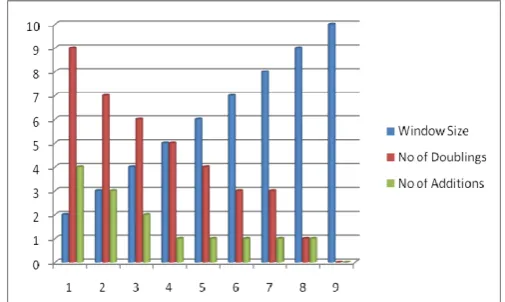
The trade-off between the computational cost and the window size are shown in Table 1.
Table 1: Window Size Vs No of doublings, additions and Pre computations
In Figure. 4 shows the trade off between window size and the computational costs
Fig. 4 Trade off between window size and computational
Figure 5 shows the trade off between window size and number of per-computations.
Window Size No of Doublings No of Additions
No of Pre computations
REFERENCES
[1]. I. F. Akyildiz, W. Su, Y. Sankarasubramaniam, and E. Cayirci, "Wireless sensor networks: a survey," Computer Networks, vol. 38, pp. 393-422, 2002.
[2]. C. Chung-Kuo, J. M. Overhage, and J. Huang, "An application of sensor networks for syndromic surveillance," 2005, pp. 191-196. [3]. G. Werner-Allen, K. Lorincz, M. Ruiz, O. Marcillo, J. Johnson, J. Lees, and M. Welsh, "Deploying a wireless sensor network on an active volcano," IEEE Internet Computing, vol. 10, pp. 18-25, 2006.
[4]. B. Sinopoli, C. Sharp, L. Schenato, S. Schaffert, and S. S. Sastry, "Distributed control applications within sensor networks,"
Proceedings of the IEEE, vol. 91, pp. 1235-1246, 2003.
[5]. D. L. Stephens, Jr. and A. J. Peurrung, "Detection of moving radioactive sources using sensor networks," Nuclear Science, IEEE Transactions on, vol. 51, pp. 2273-2278, 2004.
[6]. P. Sikka, P. Corke, P. Valencia, C. Crossman, D. Swain, and G. Bishop-Hurley, "Wireless ad hoc sensor and actuator networks on the farm," 2006, pp. 492-499.
[7]. Z. Feng, "Wireless sensor networks: a new computing platform for tomorrow's Internet," 2004, pp. I-27 Vol.1.
Fig.5: Trade off between window size and [8]. I. F. Akyildiz, Weilian Su, Yogesh Sankarasubramaniam, and E.
Cayirci, "A Survey on Sensor Networks” in IEEE Communication Magazine. vol. 40, August 2002, pp. 102-116.
number of pre computations
Now let us apply the proposed algorithm to the same number 763 to show the effectiveness of algorithm with window size of 3.
[9]. V. S. Miller, "Use of Elliptic Curves in Cryptography," in
Advances in Cryptology - CRYPTO '85: Proceedings. vol. 218: Springer-Verlag, 1986, pp. 417-426.
[10].N.Koblitz, "Elliptic Curve Cryptosystems," Mathematics of Computation, vol. 48, pp. 203-209, 1987.
As we know that [11].J. Lopez and R. Dahab., " An overview of elliptic curve cryptography," Technical report ,Institute of Computing, Sate University of Campinas, Sao Paulo, Brazil, May 2000.
763 = (10111111011)2
Let’s have record 763 with equation II in one’s complement
subtraction form and we have: [12].K. Lauter, "The advantages of elliptic curve cryptography for wireless security," Wireless Communications, IEEE [see also IEEE Personal Communications], vol. 11, pp. 62-67, 2004. 763 = 10000000000 – 0100000100-1
[13].H. Wang, B. Sheng, and Q. Li, "Elliptic curve cryptography-based access control in sensor networks," Int. J. Security and Networks,, vol. 1, pp. 127-137, 2006.
=10100000101
With window w size of 3, we obtained:
763 = 101 000000 101 [14].N. Gura, A. Patel, and A. Wander, "Comparing elliptic curve cryptography and RSA on 8-bit CPUs," in Proceedings of the 2004 Workshop on Cryptographic Hardware and Embedded Systems (CHES) August 2004.
Here “1” means “-1” We have:
The intermediate values of Q are: [15].Cryptographic
Toolkit: http://csrc.nist.gov/groups/ST/toolkit/index.html
3P, 6P, 12P, 24P, 48P, 96P, 192P, 384P, 768P, 763P
[16].D. J. Malan, M. Welsh, and M. D. Smith, "A public-key infrastructure for key distribution in TinyOS based on elliptic curve cryptography," in 2nd IEEE International Conference on Sensor and Ad Hoc Communications and Networks (SECON 2004)2nd IEEE International Conference on Sensor and Ad Hoc Communications and Networks (SECON 2004), 2004, pp. 71-80. Hence we the Computational Cost = 8 doublings, 1
addition and 3 pre computations.
With the equation II the computational cost has been reduced from 3 additions as in binary method to only 1 addition in one’s complement subtraction form. The number of pre computations remained same. This can be proved for different window sizes.
[17].I. Blake, G. Seroussi, and N. Smart, Elliptic Curves in Cryptography vol. 265, 1999.
[18].D. Hankerson, J. L. Hernandez, and A. Menezes, "Software Implementation of Elliptic Curve Cryptography over Binary Fields, CHES," 2000.
[19].Angelo C Gillie, “Binary Arithmetic and Boolean algebra,” McGRAW-HILL Book Company, 1965. pp53.
IX CONCLUSION
The positive integer in point multiplication may be recoded with one’ complement subtraction to reduce the