596
Learning Outside the Box:
Discourse-level Features Improve Metaphor Identification
Jesse Mu1,3, Helen Yannakoudakis2, Ekaterina Shutova4
1Computer Science Department, Stanford University, USA
2The ALTA Institute,3Dept. of CS & Technology, University of Cambridge, UK
4ILLC, University of Amsterdam, The Netherlands
[email protected], [email protected], [email protected]
Abstract
Most current approaches to metaphor identi-fication use restricted linguistic contexts, e.g. by considering only a verb’s arguments or the sentence containing a phrase. Inspired by pragmatic accounts of metaphor, we argue that broader discourse features are crucial for bet-ter metaphor identification. We train simple gradient boosting classifiers on representations of an utterance and its surrounding discourse learned with a variety of document embedding methods, obtaining near state-of-the-art results on the 2018 VU Amsterdam metaphor iden-tification task without the complex metaphor-specific features or deep neural architectures employed by other systems. A qualitative analysis further confirms the need for broader context in metaphor processing.
1 Introduction
From bottled up anger to the world is your oys-ter, metaphor is a defining component of lan-guage, adding poetry and humor to communica-tion (Glucksberg and McGlone, 2001) and serv-ing as a tool for reasonserv-ing about relations between concepts (Lakoff and Johnson,1980). Designing metaphor processing systems has thus seen signif-icant interest in the NLP community, with appli-cations from information retrieval (Korkontzelos et al.,2013) to machine translation (Saygin,2001). An important first step in any metaphor process-ing pipeline is metaphor identification. To date, most approaches to its identification operate in re-stricted contexts, for instance, by only considering isolated verb–argument pairs (e.g. deflate econ-omy) (Rei et al.,2017) or the sentence containing an utterance (Gao et al., 2018). However, wider context is crucial for understanding metaphor: for instance, the phrasedrowning studentscan be in-terpreted as literal (in the context of water) or metaphorical (in the context of homework).
Of-“You can’t steal their ideas.”“No, idiot—not so I canstealthem.”
Britain still can’t decide when toplaythe mandarinate game of of silence [. . . ]interests and concern of the Chinese government.
Table 1: Metaphorical examples from the VUA dataset in context. Verb is bolded, arguments underlined. Im-mediate sentence in black, with further context in gray.
ten the context required extends beyond the im-mediate sentence; in Table1, coreferences (them) must be resolved to understand the arguments of a verb, and a game is metaphorical in a political context. Indeed, a rich linguistic tradition (Grice, 1975;Searle,1979;Sperber and Wilson,1986) plains metaphor as arising from violations of ex-pectations in a conversational context.
Following these theories, in this paper we argue that metaphor processing models should expand beyond restricted contexts to use representations of wider discourse. We support this claim with two contributions: (1) we develop metaphor identifica-tion models which take as input an utterance, its immediate lexico–syntactic context, and broader discourse representations, and demonstrate that incorporating discourse features improves perfor-mance; (2) we perform a qualitative analysis and show that broader context is often required to cor-rectly interpret metaphors. To the best of our knowledge, this is the first work to investigate the effects of broader discourse on metaphor identifi-cation.1
2 Related work
Metaphor identification is typically framed as a bi-nary classification task, either with (1) word
tu-1Code and data available athttps://github.com/
ples such as SVO triples (car drinks gasoline) or (2) whole sentences as input, where the goal is to predict the metaphoricity of a token in the sentence. Recent work has used a variety of features extracted from these two types of con-texts, including selectional preferences (Shutova, 2013;Beigman Klebanov et al., 2016), concrete-ness/imageability (Turney et al., 2011; Tsvetkov et al.,2014), multi-modal (Tekiroglu et al.,2015; Shutova et al.,2016) and neural features (Do Dinh and Gurevych,2016;Rei et al.,2017).
At the recent VU Amsterdam (VUA) metaphor identification shared task (Leong et al., 2018), neural approaches dominated, with most teams using LSTMs trained on word embeddings and additional linguistic features, such as semantic classes and part of speech tags (Wu et al., 2018; Stemle and Onysko, 2018; Mykowiecka et al., 2018;Swarnkar and Singh,2018). Most recently, Gao et al. (2018) revisited this task, reporting state-of-the-art results with BiLSTMs and contex-tualized word embeddings (Peters et al.,2018). To the best of our knowledge, none of the existing approaches have utilized information from wider discourse context in metaphor identification, nor investigated its effects.
3 Data
Following past work, we use theVerbs subset of the VUA metaphor corpus (Steen et al.,2010) used in the above shared task. The data consists of
17240 training and 5873 test examples, equally
distributed across 4 genres of the British National Corpus: Academic, Conversation, News, and Fic-tion. All verbs are annotated as metaphorical or literal in these texts. We sample500examples ran-domly from the training set as a development set.
4 Models
For each utterance, our models learn generic rep-resentations of averb lemma,2 its syntactic argu-ments, and its broader discoursecontext. We con-catenate these features into a single feature vec-tor and feed them into a gradient boosting deci-sion tree classifier (Chen and Guestrin, 2016).3 By observing performance differences when using the lemma only (L), lemma + arguments (LA), or
2
The lemmatized form of the verb has improved general-ization in other systems (Beigman Klebanov et al.,2016).
3We use the default parameters of the XGBoost package:
a maximum tree depth of 3, 100 trees, andη= 0.1.
lemma + arguments + context (LAC), we can in-vestigate the effects of including broader context.
To obtain arguments for verbs, we extract sub-jects and direct obsub-jects with Stanford CoreNLP (Manning et al., 2014). 67.4%of verb usages in the dataset have at least one argument; absent ar-guments are represented as zero vectors. To obtain the broadercontextof a verb, we take its surround-ing paragraph as defined by the BNC; the aver-age number of tokens in a context is 97.3. Fig-ure1depicts the feature extraction and classifica-tion pipeline of our approach.
To learn representations, we use several widely-used embedding methods:4
GloVe We use 300-dimensional pre-trained GloVe embeddings (Pennington et al., 2014) trained on the Common Crawl corpus as represen-tations of a lemma and its arguments. To learn a context embedding, we simply average the vectors of the tokens in the context. Out-of-vocabulary words are represented as a mean across all vectors.
doc2vec We use pretrained 300-dimensional paragraph vectors learned with the distributed bag-of-words method ofLe and Mikolov(2014) (col-loquially, doc2vec), trained on Wikipedia (Lau and Baldwin,2016). Here, paragraph vectors are learned to predict randomly sampled words from the paragraph, ignoring word order. To extract representations for verbs and arguments, we em-bed one-word “documents” consisting of only the word itself.5 We use a learning rateα = 0.01and
1000epochs to infer vectors.
Skip-thought We use pretrained skip-thought vectors (Kiros et al.,2015) learned from training an encoder–decoder model to reconstruct the sur-rounding sentences of an input sentence from the Toronto BooksCorpus (Zhu et al., 2015). From this model, we extract4800-dimensional represen-tations for verb lemma, arguments, and contexts.
ELMo Finally, we use ELMo, a model of deep contextualized word embeddings (Peters et al., 2018). We extract1024-dimensional representa-tions from the last layer of a stacked BiLSTM
4These methods differ significantly in dimensionality and
training data. Our intent is not to exhaustively compare these methods, but rather claim generally that many embeddings give good performance on this task.
5Since some methods provide only document embeddings
Verb Lemma grasp
Arguments
he lectures
Context
over and ... his brain
[…] Over and over again John would show up to class, ready to learn. But despite his professor’s
best efforts, hesimply couldn’t grasp thelectures.
One too many complex equations sent his brain […]
nsubj dobj
...
Text
1
[image:3.595.118.480.65.154.2]XGBoost Label
Figure 1: The general feature extraction and classification pipeline of our approach.
trained on Wikipedia and monolingual news data from WMT 2008–2012. To learn embeddings for verbs and arguments, we extract representations for sentences containing only the word itself. To learn context embeddings, we again average the constituent word embeddings.
5 Evaluation
For each embedding method, we evaluate the three configurations of features—L, LA, and LAC—on the VUA shared task train/test split, reporting pre-cision, recall and F1 score. Since we are interested in whether incorporating broader context signif-icantly improves identification performance, we compare successive model predictions (LAC vs. LA; LA vs. L) using themid-pvariant of McNe-mar’s test for paired binary data (Fagerland et al., 2013).
5.1 Comparison Systems
We first compare our models to the baselines of the VUA shared task (Leong et al.,2018):Baseline 1, a logistic regression classifier trained only on one-hot encodings of verb lemmas; andBaseline 2, the same classifier with additional WordNet class and concreteness features. We also compare to the best systems submitted to the VUA shared task: Wu et al. (2018), an ensemble of 20 CNN-BiLSTMs trained on word2vec embeddings, part-of-speech tags, and word embedding clusters; and Stemle and Onysko(2018), a BiLSTM trained on embed-dings from English language learner corpora.
5.2 Results
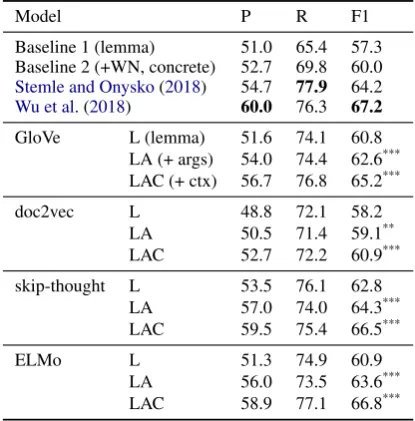
Results for our models are presented in Table 2. Interestingly, most of the simple lemma models (L) already perform at Baseline 2 level, obtaining F1 scores in the range60–62. This is likely due to the generalization made possible by dense rep-resentations of lemmas (vs. one-hot encodings) and the more powerful statistical classifier used. As expected, the addition of argument information consistently enhances performance.
Model P R F1
Baseline 1 (lemma) 51.0 65.4 57.3 Baseline 2 (+WN, concrete) 52.7 69.8 60.0
Stemle and Onysko(2018) 54.7 77.9 64.2
Wu et al.(2018) 60.0 76.3 67.2
GloVe L (lemma) 51.6 74.1 60.8
LA (+ args) 54.0 74.4 62.6***
LAC (+ ctx) 56.7 76.8 65.2***
doc2vec L 48.8 72.1 58.2
LA 50.5 71.4 59.1**
LAC 52.7 72.2 60.9***
skip-thought L 53.5 76.1 62.8
LA 57.0 74.0 64.3***
LAC 59.5 75.4 66.5***
ELMo L 51.3 74.9 60.9
LA 56.0 73.5 63.6***
LAC 58.9 77.1 66.8***
**,***Significant improvement over previous model
[image:3.595.311.519.183.394.2](p <0.01,0.001).
Table 2: Metaphor identification results.
Crucially, the addition of broader discourse context improves performance for all embedding methods. In general, we observe consistent, sta-tistically significant increases of2-3F1 points for incorporating discourse. Overall, all LAC mod-els except doc2vec exhibit high performance, and would have achieved second place in the VUA shared task. These results show a clear trend: the incorporation of discourse information leads to improvement of metaphor identification perfor-mance across models.
Table 3 displays the performance breakdown by genre in the VUA test set for our best perform-ing model (ELMo LAC) and selected comparison systems. Echoing Leong et al. (2018), we ob-serve that theConversationandFictiongenres are consistently more difficult than theAcademicand
News genres across all models. This is partially because in this dataset, metaphors in these genres are rarer, occuring 35% of the time inAcademic
and43%inNews, but only 15%inConversation
Genre Model P R F1
Academic Baseline 2 70.7 83.6 76.6
Wu et al.(2018) 74.6 76.3 75.5
ELMo LAC 65.4 86.8 74.6
Conversation Baseline 2 30.1 82.1 44.1 Wu et al.(2018) 40.3 65.6 50.3
ELMo LAC 42.6 56.0 48.4
Fiction Baseline 2 40.7 66.7 50.6
Wu et al.(2018) 54.5 78.4 57.6
ELMo LAC 48.2 63.0 54.6
News Baseline 2 67.7 68.9 68.3
Wu et al.(2018) 69.4 74.4 71.8
[image:4.595.77.283.263.362.2]ELMo LAC 65.2 80.0 71.8
Table 3: Performance breakdown by genre for ELMo LAC model and comparison systems.
Args Sentence Paragraph
Overall 40 49 11
Model errors
ELMo L 37 50 13
ELMo LA 36 49 15
ELMo LAC 39 53 8
Table 4: Types of context required to interpret metaphors in the development set, both overall (first row) and for model errors. Each row is a separate (but overlapping) sample from the development set.
shorter on average (23.8vs.97.3).
Our best performing model (ELMo LAC) is within 0.4 F1 score of the first-place model in the VUA shared task (Wu et al., 2018). The GloVe LAC model would also have obtained sec-ond place at 65.2F1, yet is considerably simpler than the systems used in the shared task, which employed ensembles of deep neural architectures and hand-engineered, metaphor-specific features.
6 Qualitative analysis
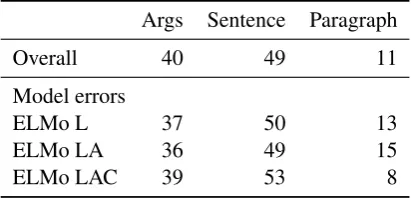
To better understand the ways in which discourse information plays a role in metaphor processing, we randomly sample 100examples from our de-velopment set and manually categorize them by the amount of context required for their inter-pretation. For instance, a verb may be inter-pretable when given just its arguments (direct sub-ject/object), it may require context from the en-closing sentence, or it may require paragraph-level context (or beyond). We also similarly analyze
100sampled errors made on the development set by the ELMo L, LA, and LAC models, to examine whether error types vary between models.
Our analysis in Table 4shows that 11%of ex-amples in the development set require paragraph-level context for correct interpretation. Indeed, while such examples are frequently misclassified by the L and LA models (13%, 15%), the error rate is halved when context is included (8%).
Table 5 further presents examples requiring at least paragraph-level context, along with gold la-bel and model predictions. Out of the31 unique such examples identified in the above analyses, we found11(35%) requiring explicit coreference res-olution of a pronoun or otherwise underspecified noun (e.g. Table5row 1) and5(16%) which ref-erence an entity or event implicitly (ellipsis; e.g. Table5row 2). However, we also observed4 er-rors (13%) due to examples with non-verbs and in-complete sentences and11examples (35%) where not even paragraph-level context was sufficient for interpretation, mostly in the Conversation genre, demonstrating the subjective and borderline nature of many of the annotations.
This analysis shows a priori the need for broader context beyond sentence-level for robust metaphor processing. Yet this is not an upper bound on performance gains; the general improve-ment of the LAC models over LA shows that even when context is not strictly necessary, it can still be a useful signal for identification.
7 Conclusion
We presented the first models which leverage rep-resentations of discourse for metaphor identifi-cation. The performance gains of these models demonstrate that incorporating broader discourse information is a powerful feature for metaphor identification systems, aligning with our quali-tative analysis and the theoretical and empirical evidence suggesting metaphor comprehension is heavily influenced by wider context.
Given the simplicity of our representations of context in these models, we are interested in fu-ture models which (1) use discourse in more so-phisticated ways, e.g. by modeling discourse rela-tions or dialog state tracking (Henderson, 2015), and (2) leverage more sophisticated neural archi-tectures (Gao et al.,2018).
Acknowledgments
Sentence Gold label LA LAC
A major complication [. . . ] is that the environment can rarely be treated as in a laboratory experiment.Giventhis, determining the nature of the interactions between the variables becomes a matter of major difficulty.
0 1 0
For example, on high policy common opinion said that there was nothing
[image:5.595.79.522.68.155.2]for it but to stay in the ERM.Hestayedin, and the recession worsened. 1 0 1
Table 5: Examples where context helps, along with gold label (0 – literal; 1 – metaphor) and model predictions (LA, LAC). Verb is bolded, arguments underlined. Additional context (needed for interpretation) in gray.
We thank the Department of Computer Science and Technology and Churchill College, Univer-sity of Cambridge for travel funding. Jesse Mu is supported by a Churchill Scholarship and an NSF Graduate Research Fellowship. Helen Yan-nakoudakis was supported by Cambridge Assess-ment, University of Cambridge. We thank the NVIDIA Corporation for the donation of the Ti-tan GPU used in this research.
References
Beata Beigman Klebanov, Chee Wee Leong, E. Dario Gutierrez, Ekaterina Shutova, and Michael Flor. 2016. Semantic classifications for detection of verb metaphors. InProceedings of the 54th Annual Meet-ing of the Association for Computational LMeet-inguistics (Volume 2: Short Papers), pages 101–106.
Tianqi Chen and Carlos Guestrin. 2016. XGBoost: A scalable tree boosting system. In Proceedings of the 22nd ACM SIGKDD International Conference on Knowledge Discovery and Data Mining, pages 785–794.
Erik-Lˆan Do Dinh and Iryna Gurevych. 2016. Token-level metaphor detection using neural networks. In
Proceedings of the Fourth Workshop on Metaphor in NLP, pages 28–33.
Morten W Fagerland, Stian Lydersen, and Petter Laake. 2013. The McNemar test for binary matched-pairs data: mid-p and asymptotic are better than exact conditional. BMC Medical Research Methodology, 13(1):91.
Ge Gao, Eunsol Choi, Yejin Choi, and Luke Zettle-moyer. 2018. Neural metaphor detection in context. In Proceedings of the 2018 Conference on Empiri-cal Methods in Natural Language Processing, pages 607–613.
Sam Glucksberg and Matthew S McGlone. 2001. Un-derstanding figurative language: From metaphor to idioms. Oxford University Press, Oxford.
Herbert P Grice. 1975. Logic and conversation. In Peter Cole and Jerry L Morgan, editors,Syntax and Semantics, volume 3, pages 41–58. Academic Press, New York.
Matthew Henderson. 2015. Machine learning for dia-log state tracking: A review. InProceedings of The First International Workshop on Machine Learning in Spoken Language Processing.
Ryan Kiros, Yukun Zhu, Ruslan R Salakhutdinov, Richard Zemel, Raquel Urtasun, Antonio Torralba, and Sanja Fidler. 2015. Skip-thought vectors. In Ad-vances in Neural Information Processing Systems, pages 3294–3302.
Ioannis Korkontzelos, Torsten Zesch, Fabio Massimo Zanzotto, and Chris Biemann. 2013. SemEval-2013 task 5: Evaluating phrasal semantics. In Second Joint Conference on Lexical and Computational Se-mantics (* SEM), Volume 2: Proceedings of the Sev-enth International Workshop on Semantic Evalua-tion (SemEval 2013), volume 2, pages 39–47.
George Lakoff and Mark Johnson. 1980. Metaphors We Live By. University of Chicago Press, Chicago.
Jey Han Lau and Timothy Baldwin. 2016. An empiri-cal evaluation of doc2vec with practiempiri-cal insights into document embedding generation. In Proceedings of the 1st Workshop on Representation Learning for NLP, pages 78–86.
Quoc Le and Tomas Mikolov. 2014. Distributed repre-sentations of sentences and documents. In Proceed-ings of the 31st International Conference on Ma-chine Learning, pages 1188–1196.
Chee Wee (Ben) Leong, Beata Beigman Klebanov, and Ekaterina Shutova. 2018. A report on the 2018 VUA metaphor detection shared task. In Proceedings of the Workshop on Figurative Language Processing, pages 56–66.
Christopher Manning, Mihai Surdeanu, John Bauer, Jenny Finkel, Steven Bethard, and David McClosky. 2014. The Stanford CoreNLP natural language pro-cessing toolkit. In Proceedings of 52nd Annual Meeting of the Association for Computational Lin-guistics: System Demonstrations, pages 55–60.
Agnieszka Mykowiecka, Aleksander Wawer, and Mal-gorzata Marciniak. 2018. Detecting figurative word occurrences using recurrent neural networks. In
Jeffrey Pennington, Richard Socher, and Christopher Manning. 2014. GloVe: Global vectors for word representation. In Proceedings of the 2014 Con-ference on Empirical Methods in Natural Language Processing, pages 1532–1543.
Matthew Peters, Mark Neumann, Mohit Iyyer, Matt Gardner, Christopher Clark, Kenton Lee, and Luke Zettlemoyer. 2018. Deep contextualized word repre-sentations. InProceedings of the 2018 Conference of the North American Chapter of the Association for Computational Linguistics: Human Language Technologies, Volume 1 (Long Papers), volume 1, pages 2227–2237.
Marek Rei, Luana Bulat, Douwe Kiela, and Ekaterina Shutova. 2017. Grasping the finer point: A su-pervised similarity network for metaphor detection. In Proceedings of the 2017 Conference on Empiri-cal Methods in Natural Language Processing, pages 1537–1546.
Ayse Pinar Saygin. 2001. Processing figurative lan-guage in a multi-lingual task: Translation, transfer and metaphor. InProceedings of the Workshop on Corpus-based and Processing Approaches to Figu-rative Language.
John Searle. 1979. Metaphor. In Expression and Meaning: Studies in the Theory of Speech Acts, pages 76–116. Cambridge University Press, Cam-bridge and New York.
Ekaterina Shutova. 2013. Metaphor identification as interpretation. InSecond Joint Conference on Lexi-cal and Computational Semantics (*SEM), Volume 1: Proceedings of the Main Conference and the Shared Task: Semantic Textual Similarity, pages 276–285.
Ekaterina Shutova, Douwe Kiela, and Jean Maillard. 2016. Black holes and white rabbits: Metaphor identification with visual features. InProceedings of the 2016 Conference of the North American Chap-ter of the Association for Computational Linguistics: Human Language Technologies, pages 160–170.
Dan Sperber and Deirdre Wilson. 1986. Relevance: Communication and cognition. Harvard University Press, Cambridge, MA.
Gerard J Steen, Aletta G Dorst, J Berenike Herrmann, Anna Kaal, Tina Krennmayr, and Trijntje Pasma. 2010. A method for linguistic metaphor identifica-tion: From MIP to MIPVU. John Benjamins Pub-lishing Company, Amsterdam.
Egon Stemle and Alexander Onysko. 2018. Using lan-guage learner data for metaphor detection. In Pro-ceedings of the Workshop on Figurative Language Processing, pages 133–138.
Krishnkant Swarnkar and Anil Kumar Singh. 2018. Di-LSTM contrast : A deep neural network for metaphor detection. InProceedings of the Workshop on Figurative Language Processing, pages 115–120.
Serra Sinem Tekiroglu, G¨ozde ¨Ozbal, and Carlo Strap-parava. 2015. Exploring sensorial features for metaphor identification. InProceedings of the Third Workshop on Metaphor in NLP, pages 31–39.
Yulia Tsvetkov, Leonid Boytsov, Anatole Gershman, Eric Nyberg, and Chris Dyer. 2014. Metaphor detec-tion with cross-lingual model transfer. In Proceed-ings of the 52nd Annual Meeting of the Association for Computational Linguistics (Volume 1: Long Pa-pers), volume 1, pages 248–258.
Peter D Turney, Yair Neuman, Dan Assaf, and Yohai Cohen. 2011. Literal and metaphorical sense iden-tification through concrete and abstract context. In
Proceedings of the Conference on Empirical Meth-ods in Natural Language Processing, pages 680– 690.
Chuhan Wu, Fangzhao Wu, Yubo Chen, Sixing Wu, Zhigang Yuan, and Yongfeng Huang. 2018. Neu-ral metaphor detecting with CNN-LSTM model. In
Proceedings of the Workshop on Figurative Lan-guage Processing, pages 110–114.