Category Levels in Hierarchical Text Categorization
Stephen D'Alessio
Keitha Murray
Robert Schiaffino
Department of Computer and Information Science
Iona College
New Rochelle, N.Y. 10801, USA
[email protected] u, [email protected], [email protected] u
Aaron Kershenbaum
Department of Computer Science
Polytechnic University
Hawthorne, N.Y. 10532, USA
[email protected]
Abstract
We consider the problem of assigning level numbers (weights) to hierarchically organized categories during text categorization. These levels control the ability of the categories to attract documents during the catego-rization process. The levels are adjusted to obtain a balance between recall and precision for each category. If a category's recall exceeds its precision, the category is too strong and its level is reduced. Conversely, a cat-egory's level is increased to strengthen it if its prelision
exceeds its recall. ·'
The categorization algorithm used is a
su~ervised
learning procedure that uses a linear classifier hewed on the category levels. We are given a set of categories: organized hierarchically. \Ve are also given a training corpus of documents already placed in one or more cat-egories. From these, we extract vocabulary, words that appear with high frequency within a given category, characterizing each subject area. Each node1s vocab-ulary is filtered and its words assigned weights with respect to the specific category. Tben, test documents are scanned and categories ranked based on the pres-ence of vocabulary terms. Documents are assigned to categories based on these rankings. We demonstrate that precision and recall can be significantly improved by solving the categorization problem taking hierarchy into account. Specifically, we show that by adjusting the category levels in a principled way, that precision can be significantly improved, from 84% to 91%, on the much-studied Reuters-21578 corpus organized in a three-level hierarchy of categories.1 Introduction and Background
The volume of online information has drastically in-creased with the explosive use of the Internet and online databases. Text retrieval systems employed by search engines for accessing this information have difficulty keeping pace with the growth in the amount of data that needs indexing and searching. Categorization of the original text is a method of organizing and mak-ing more efficient the retrieval task by sortmak-ing informa-tion into pre-specified 11
category bins11 that can then be queried against using natural language processing sys-terns.1
The, document categorization problem is one of as-signing newly arriving documents to categories within a given hierarchy of categories. In general 1 lower level categories may be part of more than one higher level category. Moreover 1 a document may belong to more than one low-level category. While the techniques de-scribed here can be applied to this more general prob-lem1 the experiments we have conducted1 to date, have been carried out on a corpus where each document is a member of a single category and the categories form a tree rather than a more general directed acyclic graph. We limited the investigation to this more specific prob-lem in order to focus the investigation on the effect of adjusting the category level numbers.
http:/ jwww.research.att.com/ lewis) has been studied extensively. Yang (Yang, 1997) compares 14 categoriza-tion algorithms applied to this Reuters corpus as a flat categorization problem on 135 categories. This same corpus has been more recently studied by others treat-ing the categories
as
a hierarchy (Chakrabarti et al., 1997)(Koller and Sahami, 1997)(Ng et al., 1997)(Yang, 1996). Yang examines a portion of the OHSUMED (Hersh et al., 1994) corpus of medical abstracts, a part of the 0iational Library of Medicine corpus that has over 9 million abstracts organized into over 10,000 categories in a taxonomy (called MeSH) which is seven levels deep in some places.We describe an algorithm for hierarchical document categorization where the vocabulary and term weights are associated with categories at each level in the tax-onomy and where the categorization process itself is iterated over levels in the hierarchy. Thus a given term may be a discriminator at one level in the taxonomy receiving a large weight and then become a stopword at another level in the hierarchy.
There are two strong motivations for taking the hi-erarchy into account. First, experience to date has demonstrated that both precision and recall decrease
as
the number of categories increases (Apte et al., 1994) (Yang, 1996). One of the reasons for this is that as the scope of the corpus increases, terms become in-creasingly polysemous. This is particularly evident for acronyms, which are limited by the number of 3- and 4-letter combinations, and which are reused from one domain to another.The second motivation for doing categorization within a hierarchical setting is it affords the ability to deal with very large problems. As the number of cat-egories grows, the need for domain-specific vocabulary grows as well. Thus, we quickly reach the point where the index no longer fits in memory and we are trading accuracy against speed and software complexity. On the other hand, by treating the problem hierarchically, we can decompose it into several problems each involv-ing a smaller number of categories and smaller domain-specific vocabularies and perhaps yield savings of sev-eral orders of magnitude.
Feature selection, deciding which terms to actually include in the indexing and categorization process, is another aspect affected by size of the corpus. Some methods remove words with low frequencies both in or-der to reduce the number of features and because such words are often unreliable. Depending on the size of the corpus, this may still leave over 10,000 features, which renders even the simplest categorization methods too slow to be of use on very large corpora and renders the more complex ones entirely infea.sible.
Methods that incorporate additional feature selection have been studied (Apte et al., 1994) (Chakrabarti et al., 1997) (Deerwester et al. 1990) (Koller and Sahami, 1996) (Lewis, 1992) (Ng et al., 1997) (Yang and Peder-son 1997). The effectiveness of these feature selection methods varies. Most reduce the size of the feature set by one to two orders of magnitude without significantly reducing precision and recall from what is obtained with larger feature sets. Some approaches assign weights to the features and then assign category ranks based on a sum of the weights of features present. Some weight the features further by their frequency in the test docu-ments. These methods are all known as linear classifiers and are computationally simplest and most efficient, but they sometimes lose accuracy because of the as-sumption they make that the features appear indepen-dently in documents. More sophisticated categorization methods base the category ranks on groups of terms (Chakrabarti et a!., 1997) (Heckerman, 1996) (Koller and Sahami, 1997) (Sahami, 1996) (Yang, 1997). The methods that approach the problem hierarchically com-pute probabilities and make the categorization decision one level in the taxonomy at a time.
Precision and recall are used by most authors a.':> a measure of the effectiveness of the algorithms. Most of the simpler methods achieved values for these near 80% for the Reuters corpus (Apte et al., 1994) (Cohen and Singer, 1996). \!lore computationally expensive meth-ods using the same corpus, achieved results near 90% (Koller and Sahami, 1997) while methods that used hi-erarchy obtained small increases in precision and large increases in speed (Ng et a!., 1997). As the number of categories increased in a corpus (OHSUMED), precision and recall decline to 60% (Yang 1996).
2 Problem Definition
2.1 General Definition of Categories
VVe are given a set of categories where sets of categories may be further organized into supercategories. We are given a training corpus and, for each document, the cat-egory to which it belongs. Documents can, in general, be members of more than one category. In that case, it is possible to consider a binary categorization problem where a decision is made whether each document is or is not in each category. Here, we examine the M-ary cat·· egorization problem where we choose a single category for each document.
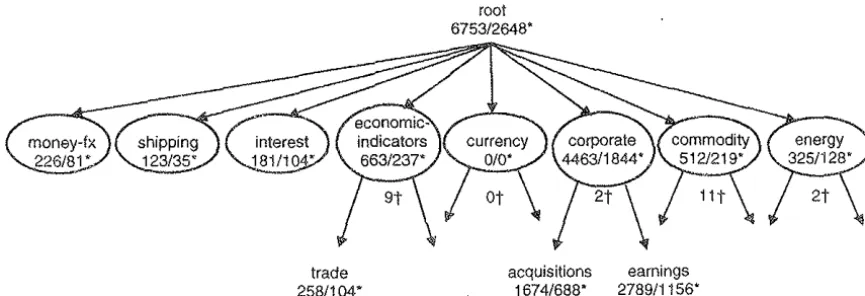
trade 258/104'
gories organized as a flat ta-<onomy. Although the col-lection does not have a pre-defined hierarchical classi-fication structure, additional information on the cat-egory sets available at Lewis's site describes an orga-nization that has 5 additional categories that become supercategories of all but 3 of the original topics cat-egories. Adding a root forms a 3-level hierarchy (see Figure 1). The number of categories per supercategory varies widely from a minimum of 2 to a maximum of 78. All of the documents in the Reuters collection are assigned to 0 or more of the original 135 topics cat-egories. In this ca..se, documents are assigned only to leaf categories of the hierarchy while, in general, this is not necessarilv the case.
root 6753/2648'
acquisitions earnings 1674/688' 2789/1156'
[image:3.602.71.504.225.373.2]" number of training/ test documents t number of subcategories in test set
Figure 1 Reuters basic hierarchy
2.2 Document Corpus and Taxonomy
. I
We use the Reuters-215 78 corpus, Distribution 1.0, which is comprised of 21578 documents, representing what remains of the original Reuters-22173 corpus af-ter the elimination of 595 duplicates by Steve Lynch and David Lewis in 1996. The size of the corpus is 28,329,337 bytes, yielding an average document size of 1,313 bytes per document. The documents are "cate-gorized'' along five axes ~ topics, people, places, organi-zations, and exchanges. VVe consider only the catego-rization along the topics a.'CiS. Close to half of the docu-ments (10,211) have no topic and as Yang (Yang, 1996) and others suggest, we do not include these documents in either our training or test sets. Note, that unlike Lewis (acting for consistency with earlier "tudies}, the documents that we consider no-category are those that have no categories listed between the topic tags in the Reuters-21578 corpus' documents. This leaves 11,367 documents with one or more topics. Most of these doc-uments (9,495) have only a single topic. The average number of topics per document is 1.26.
The Reuters-21578 collection uses 135 topics
cate-The number of training documents per category also varies widely, from a minimum of 0 (for 71 such cate-gories) to a ma.'Cimum of 2, 789 (earnings). On the other hand', document size does not vary greatly across cate-gories. In the experiments described in this paper, we only considered categorizing test documents into cat-egories having 20 or more training documents. This was done in order to focus on a problem where there was enough statistical significance in the features we extracted to make comparisons among different cate-gory levels meaningful. This limited the investigation to 27 categories and actually removed only 94 documents (less than 3.5%) from the test corpus. This increased the overall precision and recall by about 1.5%. How-ever, since we are principally interested here in study-ing the effect of varystudy-ing the category level numbers, this is not a problem as all the experiments described were carried out on the same corpus.
2.3 Performance Metrics
and recall; i.e., the ratio of correct decisions to the to-tal number of decisions and the ratio of correct deci-sions to the total number of documents, respectively. \Ve do, however, sometimes leave documents in non-leaf categories and then, in measuring precision and recall, count these as "no-category'', reducing recall but not precision.
3 Algorithm Description
3.1 Overview
We begin by creating training and test files using the 9,495 single-category documents from the Reuters-21578 corpus. While this led to somewhat higher pre-cision and recall than would have been obtained by including multicategory documents, our 91% precision and 90% recall is also higher than the roughly 80% typi-cally reported for categorization methods of comparable speed and complexity. Thus, our approach is compara-ble to those methods and serves as a reasonacompara-ble baseline against which to study the effects of the hierarchy.
The corpus is divided randomly, using a 70%/30% split, into a training corpus of 6,753 training documents and 2,742 test documents. Documents in both the training and test corpora are then divided into words using the same procedure. Non-alphabetic characters (with the exception of"-") are removed and all char-acters are lowercased. Stopwords are removed. The document is then parsed into 11Wordsn; i.e., character strings delimited by whitespace, and these words are then used as features.
Next, we count the number of times each feature ap-pears in each document and, from that, we compute the total number of times each feature appears in training documents in each category. \Ve retain only features appearing 2 or more times in a single training docu-ment or 10 or more times across the training corpus. All other features are discarded as being insufficiently reliable.
Next we use a variant of the ACTION Algorithm (Wong et a!. 1996), described in detail in Section 3.2 below, to associate features with nodes in the ta.'Con-omy. This is one of the two aspects that make our ap-proach novel. By eliminating most features from most categoriesl we gain several advantages. First, by lim-iting the appearance of a feature to a small number of categories (usually, just one) where it is an unambigu-ous discriminator, we improve the precision of the cat-egorization process. Second, by working with a small number of features, we avoid optimization over a large number of features, and have a procedure with low com-putational complexity that can be applied to large prob-lems with many categories. (Currently the number of
features is set to 50). Our feature selection procedure most closely resembles rule induction (Apte eta!., 1994) but it differs from that approach in that it considers the interactions among a larger number of features for a given amount of computational effort.
\Veights are now assigned to the surviving features in each category. We associate a weight, Wt, , with each surviving feature, f , in category c. We define Wt, by:
( 1)
where Nt, is the number of times f appears in c, M, is the maximum frequency of any feature inc, and is a parameter (currently set to 0.4).
We also assign a negative weight to features associ-ated with siblings (successors of the same parent node) of each category. A feature appearing in one or more siblings of c but not in c itself, is assigned a negative weight
( NtP)
Wt, = -(.\
+
1 - .\) M (2)p
where p is the parent of c in the hierarchy. Thus NtP is the number of times f appears in the parent of c, which is in turn the number of times f appears in all siblings of c since it does not appear in c itself at all. Alp is the maximum frequency of any feature in c's parent.
Finally, we filter the set of positive and negative words associated with each category, both leaf and inte-rior, retaining the most significant words. This process is described in the next section.
We now have an index suitable for use in the cate-gory ranking process. The index contains features and a weight, VVtc , associated with each feature in each category. Note that W 1, is implicitly 0 for any feature not a'3sociated with a particular category.
Given a document, d, a rank can now be associated with each category with respect to d. Let F be the set of features, f, in D. The ranking of category c with respect to document d, Red, is then defined to be:
R,d
=
L
NtdWf, (3) !at node c'. Thus, d is eventually placed either in a leaf category which wins a contest among its siblings or in an interior node none of whose children have a positive rank with respect to d. In this latter case, we may say that d is actually placed in the interior category, partially categorized or not categorized at alL Which of these we choose is dependent upon the application and on how much we value precision versus recall.
3.2 The ACTION Algorithm
The ACTION Algorithm was first described in (Wong et aL, 1996) as a method of associating documents with categories within a hierarchy. Here, we use it to ciate vocabulary with nodes in a hierarchy and asso-ciate documents with the nodes using the procedure described in Section 3.1 above. The original algorithm applied to problems with documents at interior and leaf nodes. Although our adaptations apply to the more general case also, we describe the algorithm with re-spect to that simpler case since the corpus we are using
has documents only at leaf nodes.
The algorithm begins by counting Ntc' the number of times feature f appears in documents associated with category c in the training set, for all f and c. There
is a level, , associated with each category, c, in the hierarchy. By convention, the root is at level 1; its immediate successors are at level 2, etc.
We then define EF1" the effective frequency of a subtree rooted at node c with respect to feature f as
EFJ, =
L
Nfi. I (
4))eSc
Thus, EF/c is the total number of occurrences off inc and all subcategories, Sc of node c.
Finally, we define Vfc, the significance value~ of c with respect to f, as
(5)
Thus, a node gets credit, in proportion to its level, for occurrences off in itself and in its successors. The far-ther down the tree a node is, the more credit it is given for its level, but the higher up the tree a node is, the larger the subtree rooted at c and the larger the credit. it gets for effective frequency. A competition thus takes place between each node and its parent (immediate pre-decessor). For each feature, f, EFfc is compared with, EFfp , where pis the parent of c and if EF/, is smaller then f is removed from node c. Thus a parent can re-move a feature from a child but not vice versa. In the case of a tie, the child loses the feature. All this com-petition proceeds from the leaves upward towards the root.
The net effect of this is that if a feature occurs in only a single child of a given parent, then the child retains the feature (as does the parent), but if the feature occurs significantly in more than one child of the same parent, then only the parent retains the feature.
Several advantages accrue from all this. First, com-mon features, including stopwords, will naturally rise to the root, where they will not participate in any rank-ings. Thus, this algorithm is a generalized version of removing stopwords. If a feature is prominent in sev-eral children of the same node, the parent will remove it from all of them. Ideally, words that are important for making fine distinctions among categories farther down in the category hierarchy, but are ambiguous at higher levels, will participate only in places where they can help.
Note that we never directly remove a feature from the parent even when the child retains it. The reason for this is that we may need the feature to get the document to the parent; if it doesn1
t reach the parent it can never reach the child. In the case where a feature strongly represents only one category, there is no harm in the parent retaining it. In the cases where it is ambiguous at the level of the parent, the grandparent removes it from the parent (its child).
Thus, at the end of the algorithm when we filter the
feature set for each category (leaf and non-leaf) retain-ing only the 50 most highly ranked positive and negative words, at non-leaf categories we also retain any words retained by their children.
3.3 Assignment of Category Level Values
'
The focus of the experiments described in Section 4 is to invbstigate the effect of modifying the category levels in the ACTION Algorithm and in the ranking process which actually selects document categories. We begin with the root at level 1 and with all other categories at a level one higher than that of their parents. We run a categorization and measure the resultant precision and recall for each category and for the corpus as a whole.
detail, to return to the issue of searching over a nar-rower grid. At this stage in the investigation, however, we felt that doing so would only obscure the main re-sults.
Actually, the category level numbers serve two pur-poses: word selection and document ranking. First, during the ACTION Algorithm (see Equation 5), they affect the competition (between parents and children) for words. A parent at level L will compete success-fully with a child at level L+D, removing a word from the child's wordlist, if the Fp/ F,, the frequencies of the word in the subtrees rooted at the parent and child, respectively, exceeds (L+D)/L. Thus, the difference in the level number of the parent and child directly affects how high the relative frequency of the word must be, in the child relative to the parent, in order for the child to retain the word. Making D smaller strengthens the parent with respect to the child. Similarly, making L smaller while leaving D the same, weakens the parent with respect to the child. But altering L is fundamen-tally different from altering D as altering L also affects the parent's strength with respect to its own parent.
Thus, in modifying level numbers we must consider this interaction. We do so simply by looking for cat-egories where the precision and recall are very differ-ent and where the interaction with other categories is marked. At each step, we consider the performance of a node relative to its parent, strengthening or weaken-ing it as appropriate to balancweaken-ing the node's precision and recall, specifically, its ability to attract the correct documents to its subtree.
Changing a node's level number also affects the rank-ing process. Again, the higher the level number, the stronger the node. Now, however, the change in level number also affects a node's strength with respect to its siblings as siblings compete directly for documents reaching their parent. We deal simply with this prlem too. By examining the dispersion matrix, we ob-serve which categories in the group under a common parent are too strong, aggressively stealing documents from their siblings, and which are victims. We begin by adjusting the node most out of kilter, or several nodes that are all out of kilter in the same direction and are not directly competing with one another. In practice this was found to be effective; experiments with more complex modification procedures did not produce sig-nificantly better results.
Actually! it is possible to consider two different level numbers, one for word selection and another for docu-ment ranking. In fact, the motivations for modifying a node's level number for word selection and for document ranking coincide thus making it reasonable to consider making similar adjustments. \Ve plan to return to this
issue as part of a broader investigation of refinements to the overall algorithm, preferring to concentrate here on the simpler case. Even using this simple approach, however, we obtained significant gains.
4 Computational Experience
There are a number of ways that the performance of a hierarchical categorization system can be tuned. Here we describe experiments performed in order to understand the effects of adjusting the level numbers (weights) of the categories within the hierarchy.
The purpose of this research is to investigate the role of a hierarchical organization of categories on the text categorization task. In particular we are considering a tree of categories with each node in the tree assigned a level number. As described above, this level number is used in evaluating the significance of features during the feature selection process, and in weighting of doc-ument features during the categorization process. The experiments reported here were conducted to determine the impact of this level number on feature selection and categorization of documents.
We begin with a base line case. We use the topics hierarchy supplied with the Reuters-21578 corpus, and consider only the leaf categories. We add a root cat-egory to make a simple tree structure. \Ve assign the root a level number of 0 and the leaves a level of 1.
VVith this organization of categories and level numbers the root is unable to remove any features from a node during the feature selection process. Therefore, it effec-tively becomes a set of nodes rather than a tree. When we apply our categorization algorithm to the test doc-uments we achieve a precision of 83.6% and a recall of 83.5%. We refer to this case as F!at-0. Note that if no category gives a document a ranking above our thresh-old, currently set to zero, then the document remains unclassified. In the Flat-0 case there are 2 unclassified documents.
We modified the base case by giving the root a level of 1, and all leaves a level of 2. The root is now capable of extracting features from the leaves during the feature selection process. VVhen we apply our categorization procedure to the same test data as above we achieve a precision of 90.6% and a recall of 87.2%. We refer to this case as Flat-!. In Flat-1 there are 99 unclassified documents, but the precision and recall are significantly improved.
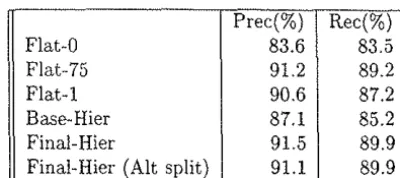
moving features from the leaves, the leaves would retain better features, resulting in better recall and precision. On the other hand, if the root has too low a level num-ber the root does not remove any features from the leaves, and as a result the leaves retain features that are noisy. We tested this hypothesis by assigning the root a level of. 75 and the leaves levels of l. 75. We refer to this case as Flat-75. Applying our feature selection and categorization algorithms as above resulted in a precision of 9!.2% and a recall of 89.2%. In this case 60 documents were unclassified but both precision and recall were improved when compared to Flat-1. The results of the experiments on the test data for the three Flat hierarchy cases are in the summary Table 3.
These results support our hypothesis that the value of the level numbers affects the ability of the root to remove features. We conducted a further experiment to confirm this conclusion. Normally our program re-moves stopwords from the training and testing docu-ments. Since we restrict the number of features at each node to 50, this insures that the retained features are useful. We modified our programs so that stopwords were not removed, then ran the feature selection and categorization processes. If our conclusions regarding the level numbers were correct, then using a level num-ber of . 75 should result in precision and recall approxi-mately equal to the results described above for Flat-75. However if we run the program with a root level of 0 the precision and recall should deteriorate since the stop-words will impede performance. \Vhen we performed these experiments we achieved a precision of 90.7
1
% and a recall of 88.9% with a root level of .75 and a precision and recall of 78.3% with a root level of 0. These results confirm that our feature selection algorithm' together with appropriate level values significantly reduces noise and improves performance.Our next objective was to determine if the level num-bers could be tuned to improve performance in the case of a more elaborate hierarchy. For this set of experi-ments we also used the topics hierarchy provided with the Reuters-21578 corpus (Figure 1). This time we included the intermediate categories, corporate, com-modities, economic indicators, energy and currency. We first established a base line for performance by assigning the root a level of . 75 and increasing the level numbers by 1 at each lower level of the tree. We refer to this or-ganization as Base-Hier. \Ve ran our feature selection program using the training data, and our categorization program using the same test data as above. The result was a precision of 87.1% and a recall of 85.2%. This result is reported in the summary Table 3. In order to tune the level numbers we repeated a process of first us-ing the trainus-ing data to select a set of features for each
node, then categorizing the training data and using the results to select new level numbers, then repeating the feature selection/categorization process on the training data until we arrived at an appropriate set of level num-bers. At that point we could judge the effectiveness of the training by comparing our results against the base line case.
We began the process by using the training data for feature selection and categorization with Base-Hier. Based on our analysis of the results from the previ-ous experiments we hypothesize that we could improve the categorization performance in two ways. First, if a category is achieving high precision and low recall, we could raise its level number; and second, if a cate-gory is achieving high recall and low precision we could lower its level number. For our first experiments we selected simple cases of nodes that were experiencing poor performance, and as we learned more about the tuning process moved onto more involved cases.
When we apply our feature selection and categoriza-tion programs to our training data using Base-Him· we get a precision of 89.2% and a recall of 87.5%. When we examine the results more closely we see that the cat-egories of interest and money-fx are candidates for tun-ing. Interest has a precision of 95% but a recall of only 23% while money-fx has a precision of 89% and a recall of 60%. Both of these categories are direct descendents of the root and have no descendents. In both cases rais-ing the level numbers should allow us to improve recall. We changed both level numbers from 1.75 to 2.75 and ran our feature selection and categorization procedures with the new hierarchy. Overall the precision and recall imptoved to 90.8% and 89.3% respectively. Interest has a precision of 98% and recall of 62% and rnoney-fx has a precision of 85% and recall of 84%. Of course these results are from categorizing the training data, however they do indicate significant improvement.
acqui-sitions category and 211 acquiacqui-sitions documents in the earnings category. In addition, 42 earnings and acquisi-tions documents are left in the corporate category since there was no positive rank. In all, this is a total of 275 mistakes, which accounts for a substantial portion of the total 650 mistakes. Clearly this set of categories is a good candidate for tuning. This case is more complex than the interestfmoney-fx case since earnings and ac-quisitions are not descendents of the root. As we tune their level values we want to improve the performance of earnings and acquisitions without having a negative impact on the performance of the corporate category.
Since many more acquisitions documents are being classified as earnings documents than the reverse and acquisitions, recall is significantly lower that its preci-sion (see Table 1), we should lower the level number of earnings relative to acquisitions in order to make ac-quisitions stronger. At this point corporate is at level
l. 75, and both earnings and acquisitions are at level 2.75. There are a number of ways that we might tune these levels, we explored three possibilities. The first alternative leaves corporate at 1. 75 and acquisitions at level 2.75 but lowers earnings to 2.5. Call this Al. The second alternative leaves corporate at 1. 75 and lowers both earnings and acquisitions, earnings to 2.25 and acquisitions to 2.5. Call this A2. The final possibility lowers corporate to 1.5 and earnings to 2.5 and leaves acquisitions at. its 2.75 level. Call this A3.
We would expect that using A1 would result in ac-quisitions getting better features and consequently also getting more of its own documents) with the possible side effect of having more earnings documents classified as acquisitions. A2 makes corporate stronger relative to both earnings and acquisitions. As we saw in the flat cases this would mean that corporate would remove fea-tures more aggressively. VVe would expect therefore that acquisitions would have fewer of its documents classi-fied as earnings, but there is the possibility that many more documents from both earnings and acquisitions will be unclassified. A3 makes both earnings and ac-quisitions stronger relative to corporate and we would expect to have fewer unclassified documents. We would also expect that fewer acquisitions documents would be classified as earnings. Since both A1 and A2 leave cor-porate at levell. 75 we would also expect that corcor-porate would continue to achieve both high recall and preci-sion. In fact, other branches of the hierctrchy should be unaffected by the changes inside the corporate tree (one of the strengths of a hierarchical approach). A3 changes the level of corporate so there is the possibility that the performance of corporate relative to the rest of the hierarchy will deteriorate in this case.
VVe ran our feature selection and classification
proce-dure for all three cases. The results are shown in the Table 1 below.
As we can see AI allows acquisitions to retain bet-ter features and its recall improves significantly. By making earnings weaker it classifies fewer acquisitions documents as earnings and earnings achieves a higher precision with a slight decrease in recall. The weaker value for earnings also results in more unclassified cor-porate documents, A2 produces similar improvements in the precision of earnings and the recall of acquisi-tions but results in many more unclassified corporate documents resulting in a slightly lower overall recall. A3 gives the fewest unclassified corporate documents. Since corporate has a lower level number in this case it does not remove features as aggressively as in the other two cases. One side effect however is that many more documents are incorrectly classified as acquisitions, and the overall performance deteriorates. Of course there are other adjustments that could be made, but our ob-jective was not to find the optimum combination, but rather to understand the effects of changing the levels. We selected A1 as the best alternative.
The next case we consider is the economic indica-tors subtree. This is a more complex case than those described above. Nine of the categories in this subtree have more than twenty training documents and are used in these experiments. Together there are 663 training documents for the categories in the subtree. Using the A1 hierarchy above the subtree achieves a recall of 88% and a precision of 84% on the training data. Within the subtree the performance is quite varied. Five of the nine subcategories have a precision of over 90% while four of the categories have recall below 70%. In some cases the difference between precision and recall is very large. The category cpi for example has a precision of 100% but a recall of only 40%. Balance of payments has a recall of 88% and a recall of only 29%. On the other hand, trade has a precision of only 73% and a recall of 88%.
Level Numbers
Corp Acq Earn Overall Earn Acq Unclass Earn Acq
Prec/Rec Prec/Rec Prec/Rec Corp Docs as Acq as Earn
Before 1.75 2.75 2.75 91/89 91/99 94/84 42 22 211
Al 1.75 2.75 2.50 93/91 96/98 92/93 55 47 55
A2 1.75 2.50 2.25 92/90 97/97 91/91 96 65 39
A3 1.50 2 75 2.50 91/89 97/94 88/93 15 160 50
Table 1: Precision, Recall, Unclassified Corporate Documents, Earnings Documents Classified as Acquisitions and Acquisitions Documents Classified as Earnings for Different Levels Number for Corporate, Acquisitions and Earnings using Training Data.
Prec(%) Rec(%)
Base-Hier 89.2 87.5
InterestjC.!oney-fx at 2.75 90.8 89.3 Earnings at 2.5 (A1) 92.7 91.0 Adjusting Econ Inds 93.0 91.7
Final-Hier 93.2 92 0
Table 2: Results Using Training Data
training data are reported in Table 2.
We then used the resulting hierarchy, Final-Hier, to categorize the test data. The result was an overall pre-cision of 91.5% and a recall of 89.9%. This compares favorably \Vith our results on the test data using Base-Hier where we achieved a precision of 87.1% and a recall of 85.2%. See Table 3 for a summary of selected corre-sponding results using the test data. ,: J.
VVe performed additional experimentS to test the ro-bustness of our final hierarchy. In all of the experiments above we restricted ourselves to categories that had at least 20 training documents. In the first test of ro-bustness we relaxed this condition and only required 10 training documents. When we applied our categorizer to the test data we achieved a precision of 91.0% and a recall of 89.4%. In our second test we relaxed the condition further and considered all the categories re-gardless of the number of training documents. When
we applied the categorizer in this case we achieved a
precision of 90.0% and a recall of 88.4%. In our next test we kept the level values of the categories the sarne but retrained the graph using only 30% of the data as training data. We then tested the categorizer on the remaining 70%. In this experiment we again required 20 training documents for a category. The result was a precision of 89.8% and a recall of 89.4%. Finally, we tested the categorizer on an alternate 70/30 random split of the corpus and obtained similar results. This final result is also reported in Table 3.
Prec(%) Rec(%)
Flat-0 83.6 83.5
Flat-75 91.2 89.2
Flat-1 90.6 87.2
Base-Hier 87.1 85.2
Final-Hier 91.5 89.9
Final-Hier (Alt split) 91.1 89.9
Table 3: Results Using Test Data
5 Summary and Conclusions
In this paper, we have explored the effect of modifying the category level numbers in an algorithm for hier-archical text categorization and have shown that it is possible to obtain substantial improvements in precision and recall by doing so. Specifically, we improved preci-sion and recall from an 84% level to over a 91% level, by adjusting the category level numbers. The procedure we used was a simply, greedy search heuristic guided by the principle that categories whose precisions signif-icantly exceeded their recall were too weak and those whose recall exceeded their precision were too strong.
[image:9.602.24.508.54.134.2] [image:9.602.289.489.194.283.2] [image:9.602.24.246.194.270.2]We have seen examples of all these cases. We illus-trated we could achieve improvements by modifying the level numbers for earnings and acquisitions or, alterna-tively (in our previous work (D'Aiessio et a!., 1998)) by altering the hierarchy by removing the intermedi-ate corporintermedi-ate cintermedi-ategory. The former approach, however, worked somewhat better. We found that we could gain by altering the level numbers of interest and money-fx or, alternatively making them children of economic in-dicators. Both approaches worked, but in this case, the latter worked better.
Based on our computational experience to date, our conclusion is that both types of adjustment are useful and that much of the obtainable gain can be achieved by making adjustments individually, focussing on simple adjustments and on those with large potential gains. Our next goal is to explore this interaction more closely and to automate the process of category level number modification. We also plan to explore the use of these techniques in problems with multi-category documents.
References
C. Apte, F. Damerau, S. M. Weiss. 1994. Automated Learning of Decision Rules for Text Categorization.
A CM Transactions on Information Systems, 233-251. S. Chakrabarti, B. Dom, R. Agarawal, P. Raghavan. 1997.
C"sing Taxonomy, Discriminants and Signatures for :\avigating in Text Databases. Pr·oceedings of the 2Srd
VLDB Conference; Athens, Greece.
W.W. Cohen and Y. Singer. 1996. Context-Sensitive Learning Niethods for Text Categorization. Proceedings of the 19th Annual ACM/SIGIR Conference.
S. D'Aiessio, A. Kershenbaum, K. Murray, R. Schiaffino.
1998. Hierarchical Text
Categorization. Technical Report CS-98-BASK (URL http:/ jpride.poly.edu/textmining).
S. Deerwester, S. Dumais, G. Furnas, T. Landauer, and R. Harshman. 1990. Indexing by Latent Semantic Anal-ysis. Joumal of the American Society for Information
Science, 41(6), pp. 391-407.
W. B. Frakes and R. Baeza-Yates. 1992. Information Re-trieval: Data Structures and Algorithms. Prentice-Hall. D. Beckerman. 1996. Bayesian Networks for Knowledge
Discovery. Advances in Knowledge Discovery and Data
Mining. Fayyad, Piatetsky-Shapiro, Smyth and Uthu-rusarny eds., MIT Press.
\V. Hersh, C. Buckley, T. Leone and D. Hickman. 1994. OHSUMED: An Interactive Retrieval Evaluation and a :\ew Large Text Collection for Research. Proceedings of
the 11th Annual International ACM SIGIR Conference on Research and Development in Infor·mation Retrieval,
Philadelphia.
D. Koller and M. Sahami. 1996. Towards Optimal Fea-ture Selection. International Conference on Machine Learning, Volume 13, Morgan-Kauffman.
D. Koller and M. Sahami. 1997. Hierarchically Classify-ing Documents usClassify-ing Very Few Words. International
Conference on Machine Learning, Volume 14,
Morgan-Kauffman, 1997.
L. Larkey and W.B. Croft. 1996. Combining Classifiers in Text Categorization. Proceedings of the 19th Annual
ACM/SIGIR Conference.
D. Lewis. 1992. Text Representation for Intelligent Text Retrieval: A Classification-Oriented View. Text-Based Intelligent Systems, P.S. Jacobs, Lawrence-Erlbaum. D. Lewis and M. Ringuette. 1994. A Comparison of Two
Learning Algorithms for text Categorization. Third Annual Symposium on Document Analysis and Infor-mation Retrieval, Las Vegas, pp. 81-93.
H.- T. Ng, W.-B. Goh and K.-L.Low. 1997. Feature Selec-tion, Perception Learning and a Usability Case Study. Proceedings of the 20th Annual International ACM SI-GIR Conference on Research and Development in In-formation Retrieval, Philadelphia, July 27-31, pp. 67-73
M. Sahami. 1996. Learning Limited Dependence Bayesian Classifiers. Proc. KDD-96, pp.335-338.
G. Salton. 1989. Automatic Text Processing: The Trans-formation, Analysis and Retrieval of Information by Computer, Addison- Wesley.
C.J. van Rijsbergen. 1979. Information Retrieval. Butter-sworth, London, second edition.
l.H. Witten, A. Moffat and T. Bell. 1994. Managing Gi-gabytes. Van Nostrand Reinhold.
J.W.T. Wong, W.K. Wan and G. Young. 1996. ACTION: Automatic Classification for Full-Text Documents. SI-GIR For-um 30(1), pp. 11-25.
Y. Yang. 1997. An Evaluation of Statistical Approaches to Text Categorization. Technical Report CMU-CS-97-127, Computer Science Department, Car-negie Mellon University.
Y. Yang. 1996. An Evaluation of Statistical Approaches to MEDLINE Indexing. Proceedings of the AMIA , pp. 358-362.
Y. Yang and C.G. Chute. 1992. A Linear Least Squares Fit Mapping Method for Information Retrieval from Nat-ural Language Texts. Proceedings of CO LING '92, pp. 447-453.
Y. Yang and J.P. Pederson. 1997. Feature Selection in Sta-tistical Learning of Text Categorization, International
Conference on Machine Learning, Volume 14:
?v1organ-Kauffman.