717
Viable Dependency Parsing as Sequence Labeling
Michalina Strzyz David Vilares Carlos G´omez-Rodr´ıguez
Universidade da Coru˜na, CITIC
FASTPARSE Lab, LyS Research Group, Departamento de Computaci´on Campus de Elvi˜na, s/n, 15071 A Coru˜na, Spain
{michalina.strzyz,david.vilares,carlos.gomez}@udc.es
Abstract
We recast dependency parsing as a sequence labeling problem, exploring several encodings of dependency trees as labels. While depen-dency parsing by means of sequence labeling had been attempted in existing work, results suggested that the technique was impractical. We show instead that with a conventionalBIL
-STM-based model it is possible to obtain fast and accurate parsers. These parsers are con-ceptually simple, not needing traditional pars-ing algorithms or auxiliary structures. How-ever, experiments on the PTB and a sample of UD treebanks show that they provide a good speed-accuracy tradeoff, with results competi-tive with more complex approaches.
1 Introduction
The application of neural architectures to syntac-tic parsing, and especially the ability of long short-term memories (LSTMs) to obtain context-aware feature representations (Hochreiter and Schmid-huber,1997), has made it possible to parse natural language with conceptually simpler models than before. For example, in dependency parsing, the rich feature models with dozens of features used in transition-based approaches (Zhang and Nivre,
2011) can be simplified when using feedforward neural networks (Chen and Manning, 2014), and even more with BiLSTM architectures (
Kiper-wasser and Goldberg, 2016), where in fact two
positional features can suffice (Shi et al., 2017). Similarly, in graph-based approaches, Dozat and
Manning (2017) have shown that an arc-factored
model can achieve state-of-the-art accuracy, with-out the need for the higher-order features used in systems like (Koo and Collins,2010).
In the same way, neural feature representations have made it possible to relax the need for struc-tured representations. This is the case of sequence-to-sequence models that translate sentences into
linearized trees, which were first applied to con-stituent (Vinyals et al., 2015) and later to depen-dency parsing (Wiseman and Rush, 2016; Zhang et al., 2017b;Li et al.,2018). Recently, G´omez-Rodr´ıguez and Vilares(2018) have shown that se-quence labeling models, where each word is asso-ciated with a label (thus simpler than sequence to sequence, where the mapping from input to output is not one to one) can learn constituent parsing.
Contribution We show that sequence labeling is useful for dependency parsing, in contrast to previ-ous work (Spoustov´a and Spousta,2010;Li et al.,
2018). We explore four different encodings to rep-resent dependency trees for a sentence of lengthn
as a set ofnlabels associated with its words. We then use these representations to perform depen-dency parsing with an off-the-shelf sequence la-beling model. The results show that we produce models with an excellent speed-accuracy tradeoff, without requiring any explicit parsing algorithm or auxiliary structure (e.g. stack or buffer). The source code is available athttps://github. com/mstrise/dep2label
2 Parsing as sequence labeling
Sequence labeling is a structured prediction prob-lem where a single output label is generated for every input token. This is the case of tasks such as PoS tagging, chunking or named-entity recog-nition, for which different approaches obtain ac-curate results (Brill,1995;Ramshaw and Marcus,
1999;Reimers and Gurevych,2017).
On the contrary, previous work on dependency parsing as sequence labeling is vague and reports results that are significantly lower than those pro-vided by transition-, graph-based or sequence-to-sequence models (Dyer et al.,2015;Kiperwasser
and Goldberg, 2016; Dozat and Manning, 2017;
(2010) encoded dependency trees using a relative PoS-based scheme to represent the head of a node, to then train an averaged perceptron. They did not provide comparable results, but claimed that the accuracy was between 5-10% below the state of the art in the pre-deep learning era. Recently,
Li et al. (2018) used a relative positional encod-ing of head indexes with respect to the target to-ken. This is used to train Bidirectional LSTM-CRF sequence-to-sequence models (Huang et al.,
2015), that make use of sub-root decomposi-tion. They compared their performance against an equivalent BiLSTM-CRF labeling model. The re-ported UAS for the sequence labeling model was 87.6% on the Penn Treebank, more than 8 points below the current best model (Ma et al., 2018), concluding that sequence-to-sequence models are required to obtain competitive results.
In this work, we show that these results can be clearly improved if simpler architectures are used.
3 Encoding of trees and labels
Given a sentence w1. . . wn, we associate the
words with nodes {0,1, . . . , n}, where the extra node0is used as a dummy root for the sentence. A dependency parser will find a set of labeled rela-tions encoded as edges of the form(h, d, l), where
h ∈ {0,1, . . . , n}is the head,d∈ {1, . . . , n}the dependent, andl a dependency label. The result-ing dependency graph must be acyclic and such that each node in{1, . . . , n}has exactly one head, so it will be a directed tree rooted at node0.
Thus, to encode a dependency tree, it suffices to encode the unique head position and dependency label associated with each word ofw1. . . wn. To
do so, we will give each wordwia discrete label of
the form(xi, li), whereli is the dependency label
andxi encodes the position of the head in one of
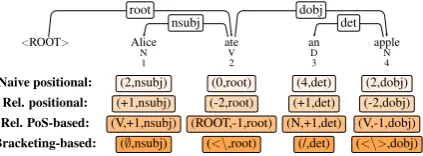
the following four ways (see also Figure1):
1. Naive positional encoding:xidirectly stores the
position of the head, i.e., a label(xi, li)encodes
an edge(xi, i, li). This is the encoding used in
the CoNLL file format.
2. Relative positional encoding: xi stores the
dif-ference between the head index minus that of the dependent, i.e., (xi, li) encodes an edge (i + xi, i, li). This was the encoding used
for the sequence-to-sequence and sequence la-beling models in (Li et al., 2018), as well as
for the sequence-to-sequence model in ( Kiper-wasser and Ballesteros,2018).
3. Relative PoS-based encoding: xi is a tuple pi, oi. Ifoi >0, the head ofwiis theoith
clos-est among the words to the right ofwithat have
PoS tagpi. Ifoi <0, the head ofwiis the−oith
closest among the words to the left ofwi that
have PoS tag pi. For example, (V,−2)means
“the second verb to the left” ofwi. This scheme
is closer to the notion of valency, and was used bySpoustov´a and Spousta(2010).
4. Bracketing-based encoding: based on ( Yli-Jyr¨a, 2012; Yli-Jyr¨a and G´omez-Rodr´ıguez,
2017). In each label (xi, li), the
compo-nent xi is a string following the regular
ex-pression(<)?((\)*|(/)*)(>)?where the presence of character<means thatwi−1has an
incoming arc from the right,kcopies of charac-ter\mean thatwi haskoutgoing arcs towards
the left,kcopies of/mean thatwi−1hask
out-going arcs towards the right, and the presence of
>means thatwi has an incoming arc from the
left. Thus, each right dependency from a word
i toj is encoded by a (/,>) pair in the label componentsxi+1 andxj, and each left
depen-dency from j toiby a (<,\) pair in the label components xi+1 and xj. Note that the
intu-ition that explains why information related to a word is encoded in a neighboring node is that eachxicorresponds to a fencepost position (i.e., xi represents the space betweenwi−1 andwi),
and the character pair associated to an arc is en-coded in the most external fencepost positions covered by that arc. These pairs act as pairs of matching brackets, which can be decoded using a stack to reconstruct the dependencies.
The first three encodings can represent any de-pendency tree, as they encode any valid head posi-tion for each node, while the bracketing encoding only supports projective trees, as it assumes that brackets are properly nested. All the encodings are total and injective, but they are not surjective: head indexes can be out of range in the first three en-codings, brackets can be unbalanced in encoding 4, and all the encodings can generate graphs with cycles. We will deal with ill-formed trees later.
4 Model
label-<ROOT> Alice ate an apple
N V D N
1 2 3 4
Naive positional: (2,nsubj) (0,root) (4,det) (2,dobj)
Rel. positional: (+1,nsubj) (-2,root) (+1,det) (-2,dobj)
Rel. PoS-based: (V,+1,nsubj) (ROOT,-1,root) (N,+1,det) (V,-1,dobj)
[image:3.595.78.290.62.140.2]Bracketing-based: (∅,nsubj) (<\,root) (/,det) (<\>,dobj) nsubj dobj det root
Figure 1: Types of encoding on an example tree.
ing works without the need of complex models.
Encoder We use bidirectional LSTMs (
Hochre-iter and Schmidhuber, 1997; Schuster and
Pali-wal, 1997). Let LSTMθ(x) be an abstraction of
a long short-term memory network that processes the sequence of vectors x = [x1, ...,x|x|], then
output for xi is defined as hi = BiLSTMθ(x, i)
= LSTMlθ(x[1:i])◦ LSTMrθ(x[|x|:i]). We consider
stacked BiLSTMs, where the output hmi of the
mth BiLSTM layer is fed as input to the m+1th layer. Unless otherwise specified, the input to-ken at a given time step is the concatenation of a word, PoS tag, and another word embedding learned through a character LSTM.
Decoder We use a feed-forward network, which is fed the output of the last BiLSTM. The output is computed asP(yi|hi)= softmax(W ·hi+b).
Well-formedness (i) Each token must be as-signed a head (one must be the dummy root), and (ii) the graph must be acyclic. If no token is the real root (no head is the dummy root), we search for candidates by relying on the three most likely labels for each token.1If none is found, we assign it to the first token of the sentence. The single-head constraint is ensured by the nature of the encodings themselves, but some of the predicted head indexes might be out of bounds. If so, we at-tach those tokens to the real root. If a cycle exists, we do the same for the leftmost token in the cycle.
5 Experiments
We use the English Penn Treebank (PTB) (Marcus et al., 1993) and its splits for parsing. We trans-form it into Stanford Dependencies (De Marn-effe et al., 2006) and obtain the predicted PoS tags using Stanford tagger (Toutanova et al.,
2003). We also select a sample of UDv2.2 tree-banks (Nivre et al., 2018): Ancient-GreekPROIEL,
CzechPDT, ChineseGSD, EnglishEWT, FinnishTDT,
1If single-rooted trees are a prerequisite, the most
proba-ble node will be selected among multiple root nodes.
Encoding UAS LAS
Li et al.(2018) (sequence labeling) 87.58 83.81
Li et al.(2018) (seq2seq) 89.16 84.99
Li et al.(2018) (seq2seq+beam+subroot) 93.84 91.86
Naive positional 45.41 42.65
Rel. positional 91.05 88.67
Rel. PoS-based 93.99 91.76
Bracketing-based 93.45 91.17
Table 1: Performance of our encodings on the PTB dev set with hyperparameters fromG´omez-Rodr´ıguez and Vilares(2018). We compare against previous sequence labeling and seq2seq models with more complex archi-tectures, beam search and subroot decomposition.
HebrewHTB, KazakhKTB and TamilTTB, as a
rep-resentative sample, following (de Lhoneux et al.,
2017). As evaluation metrics, we use Labeled (LAS) and Unlabeled Attachment Score (UAS). We measure speed in sentences/second, both on a single core of a CPU2and on a GPU3.
Setup We use NCRFpp as our sequence labeling framework (Yang and Zhang,2018). For PTB, we use the embeddings byLing et al.(2015), for com-parison to BIST parser (Kiperwasser and Gold-berg,2016), which uses a similar architecture, but also needs a parsing algorithm and auxiliary struc-tures. For UD, we follow an end-to-end setup and run UDPipe4(Straka and Strakov´a,2017) for tok-enization and tagging. We use the pretrained word embeddings byGinter et al.(2017). Appendix A
contains additional hyperparameters.
5.1 Encoding evaluation and model selection
We first examine the four encodings on the PTB dev set. Table 1shows the results and also com-pares them againstLi et al.(2018), who proposed seq2seq and sequence labeling models that use a relative positional encoding.
As the relative PoS-based encoding and bracketing-based encoding provide the best re-sults, we will conduct the rest of our experiments with these two encodings. Furthermore, we per-form a small hyperparameter search involving en-coding, number of hidden layers, their dimension and presence of character embeddings, as these parameters influence speed and accuracy. From now on, we writePx,yz for a PoS-based encoding model and Bx,yz for a bracketing-based encoding
2
Intel Core i7-7700 CPU 4.2 GHz. 3
GeForce GTX 1080.
50 100 150 200 250 300 350 Speed (sentences/sec)
93.0 93.2 93.4 93.6 93.8 94.0 94.2
UAS (%)
B
2, 250P
2, 250P
C2,250B
C2,400B
C3,400P
C2,400P
C2,600 [image:4.595.74.289.61.223.2]P
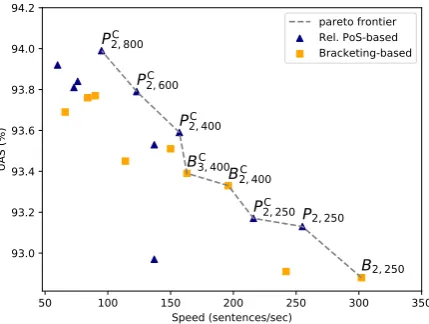
C2,800 pareto frontierRel. PoS-based Bracketing-basedFigure 2: UAS/speed Pareto front on the PTB dev set.
model, wherezindicates whether character repre-sentation was used in the model,xthe number of BiLSTM layers, andy the word hidden vector di-mension. We take as starting points (1) the hyper-parameters used by the BIST parser (Kiperwasser and Goldberg,2016), as it uses a BiLSTM archi-tecture analogous to ours, with the difference that it employs a transition-based algorithm that uses a stack data structure instead of plain sequence la-beling without explicit representation of structure, and (2) the best hyperparameters used by G´omez-Rodr´ıguez and Vilares(2018) for constituent pars-ing as sequence labelpars-ing, as it is an analogous task for a different parsing formalism.
From there, we explore different combinations of parameters and evaluate 20 models on the PTB development set, with respect to accuracy (UAS) and speed (sentences/second on a single CPU core), obtaining the Pareto front in Figure2. The two starting models based on previous literature (P2,250 andP2,800C , respectively) happen to be in
the Pareto front, confirming that they are reason-able hyperparameter choices also for this setting. In addition, we select two more models from the Pareto front (modelsP2,400C andB2,250) for our test
set experiments on PTB, as they also provide a good balance between speed and accuracy.
5.2 Results and discussion
Table 2 compares the chosen models, on the PTB test set, against state-of-the-art
mod-5
In Hebrew, UPoS and XPoS tags are the same.
6Kazakh is missing a development set. The scores are
based on the test set.
7Tamil was run on gold segmented and tokenized inputs,
as there is no pretrained UDpipe model. We did not use pre-trained word embeddings either.
Model sent/s UAS LAS
CPU GPU
P2,250 267±1 777±24 92.95 90.96
P2C,400 165±1 700±5 93.34 91.34
P2C,800 101±2 648±20 93.67 91.72
B2,250 310±30 730±53 92.64 90.59
KG (transition-based) 76±1 93.90 91.90
KG (graph-based) 80±0 93.10 91.00
CM 654 91.80 89.60
DM 411 95.74 94.08
[image:4.595.307.523.62.182.2]Ma et al.(2018) 10±0 95.87 94.19
Table 2: Comparison of models on the PTB test set. KG refers toKiperwasser and Goldberg(2016), CM to
Chen and Manning(2014) and DM toDozat and Man-ning(2017). indicates the speed is taken from their paper.
UPoS-based XPoS-based
Treebank UAS LAS # UPoS UAS LAS # XPoS
Ancient Greek 76.58 71.70 14 77.00 72.14 23
Chinese 61.01 57.28 15 60.98 57.14 42
Czech 89.82 87.63 17 88.33 85.46 1417
English 82.22 78.96 17 82.05 78.70 50
Finnish 80.31 76.39 15 80.19 76.28 12
Hebrew5 67.23 62.86 17 67.23 62.86 17
Kazakh6 32.14 17.03 15 32.93 17.07 26
Tamil 73.24 66.51 13 59.70 52.57 210
Table 3: Performance of theP2C,800model with UPoS-and XPoS-based encoding for each language on the dev set. # UPoS/XPoS represents the number of distinct UPoS/XPoS tags in the training set for each language.
els. Contrary to previous dependency-parsing-as-sequence-labeling attempts, we are competitive and provide a good speed-accuracy tradeoff. For instance, the P2,800C model runs faster than the BIST parser (Kiperwasser and Goldberg, 2016) while being almost as accurate (-0.18 LAS). This comes in spite of its simplicity. While our BiL-STM architecture is similar to that of BIST, the sequence labeling approach does not need a stack, a specific transition system or a dynamic oracle. Using the BIST hyperparameters for our model
(P2,250) yields further increases in speed, at some
cost to accuracy: 3.34x faster and -0.04 LAS score than the graph-based model, and 3.51x faster and
Treebank
PC
2,800 KG (transition-based) PoS type (sent/s) UAS LAS (sent/s) UAS LAS
CPU CPU
Ancient Greek XPOS 123±1 75.31 70.87 116±4 69.43 64.41 Chinese UPOS 105±0 63.20 59.12 73±1 64.69 60.45
Czech UPOS 125±1 89.10 86.68 94±3 89.25 86.11
English UPOS 139±1 81.48 78.64 120±2 82.22 79.00 Finnish UPOS 168±0 80.12 76.22 127±3 80.99 76.63 Hebrew equal PoS 120±0 63.04 58.66 70±1 63.56 58.80 Kazakh XPOS 283±3 32.93 17.07 178±5 23.09 12.73
Tamil7 UPOS 150
±2 71.59 64.00 127±3 75.41 68.58
[image:4.595.307.527.264.367.2]0 20 40 60 80 100
% of the original training data size
84 86 88 90 92 94
Score (%)
UAS for PC2,800
LAS for PC2,800
[image:5.595.83.269.79.227.2]UAS for BIST parser LAS for BIST parser
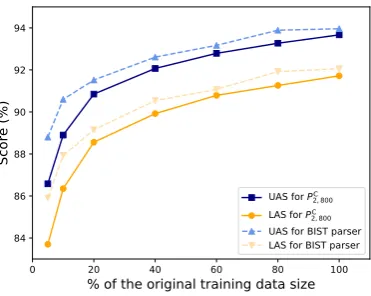
Figure 3: Impact of the PTB data size available for parsers during training on the results from the test set.
-0.94 LAS score than their transition-based one. We now extend our experiments to the sample of UD-CoNLL18 treebanks. To this end, we focus on theP2,800C model and since our PoS tag-based encoding can be influenced by the specific PoS tags used, we first conduct an experiment on the development sets to determine what tag set (UPoS, the universal PoS tag set, common to all lan-guages, or XPoS, extended language-specific PoS tags) produces the best results for each dataset.
Table3shows how the number of unique UPoS and XPoS tags found in the training set differs in various languages. The results suggest that the performance of our system can be influenced by the size of the tag set. It appears that a very large tag set (for instance the XPoS tag set for Czech and Tamil) can hurt the performance of the model and significantly slow down the system, as it results into a large number of distinct labels for the sequence labeling model, increasing sparsity and making the classification harder. In case of Ancient Greek and Kazakh, the best performance is achieved with the XPoS-based encoding. In these corpora, the tag set is slightly bigger than the UPoS tag set. One can argue that the XPoS tags in this case were possibly more fine-grained and hence provided additional useful information to the system facilitating a correct label predic-tion, without being so large as to produce exces-sive sparsity.
Table4shows experiments on the UD test sets, with the chosen PoS tag set for each corpus.P2,800C
outperforms transition-based BIST in LAS in 3 out of 8 treebanks,8and is clearly faster in all analyzed
8For Ancient Greek, this may be related to the large
languages. We believe that the variations between languages in terms of LAS difference with respect to BIST can be largely due to differences in the accuracy and granularity of predicted PoS tags, since our chosen encoding relies on them to en-code arcs. The bracketing-based encoding, which does not use PoS tags, may be more robust to this. On the other hand, finding the optimal granularity of PoS tags for the PoS-based encoding can be an interesting avenue for future work.
In this work, we have also examined the im-pact of the training data size on the performance of our system compared to the performance of BIST parser. The results in Figure 3 suggest that our model requires more data during the training than BIST parser in order to achieve similar perfor-mance. The performance is slightly worse when little training data is available, but later on our model reduces the gap when increasing the train-ing data size.
6 Conclusion
This paper has explored fast and accurate de-pendency parsing as sequence labeling. We tested four different encodings, training a stan-dard BiLSTM-based architecture. In contrast to previous work, our results on the PTB and a sub-set of UD treebanks show that this paradigm can obtain competitive results, despite not using any parsing algorithm nor external structures to parse sentences.
Acknowledgments
This work has received funding from the ropean Research Council (ERC), under the Eu-ropean Union’s Horizon 2020 research and in-novation programme (FASTPARSE, grant agree-ment No 714150), from the TELEPARES-UDC project (FFI2014-51978-C2-2-R) and the ANSWER-ASAP project (TIN2017-85160-C2-1-R) from MINECO, and from Xunta de Galicia (ED431B 2017/01). We gratefully acknowledge NVIDIA Corporation for the donation of a GTX Titan X GPU.
References
Eric Brill. 1995. Transformation-based error-driven learning and natural language processing: A case study in part-of-speech tagging. Computational lin-guistics, 21(4):543–565.
Danqi Chen and Christopher D. Manning. 2014. A fast and accurate dependency parser using neural net-works. InProceedings of the 2014 Conference on Empirical Methods in Natural Language Processing (EMNLP), pages 740–750, Doha, Qatar. Association for Computational Linguistics.
Marie-Catherine De Marneffe, Bill MacCartney, Christopher D Manning, et al. 2006. Generat-ing typed dependency parses from phrase structure parses. InLrec, volume 6, pages 449–454.
Timothy Dozat and Christopher D. Manning. 2017. Deep biaffine attention for neural dependency pars-ing. InProceedings of the 5th International Confer-ence on Learning Representations.
Chris Dyer, Miguel Ballesteros, Wang Ling, Austin Matthews, and Noah A. Smith. 2015. Transition-based dependency parsing with stack long short-term memory. InProceedings of the 53rd Annual Meeting of the Association for Computational Lin-guistics and the 7th International Joint Conference on Natural Language Processing (Volume 1: Long Papers), pages 334–343. Association for Computa-tional Linguistics.
Filip Ginter, Jan Hajiˇc, Juhani Luotolahti, Milan Straka, and Daniel Zeman. 2017. CoNLL 2017 shared task - automatically annotated raw texts and word embeddings. LINDAT/CLARIN digital li-brary at the Institute of Formal and Applied Linguis-tics ( ´UFAL), Faculty of Mathematics and Physics, Charles University.
Carlos G´omez-Rodr´ıguez and David Vilares. 2018.
Constituent parsing as sequence labeling. In Pro-ceedings of the 2018 Conference on Empirical Meth-ods in Natural Language Processing, pages 1314– 1324. Association for Computational Linguistics.
Sepp Hochreiter and J¨urgen Schmidhuber. 1997. Long short-term memory. Neural computation, 9(8):1735–1780.
Zhiheng Huang, Wei Xu, and Kai Yu. 2015. Bidi-rectional LSTM-CRF models for sequence tagging.
arXiv preprint arXiv:1508.01991.
Eliyahu Kiperwasser and Miguel Ballesteros. 2018.
Scheduled multi-task learning: From syntax to translation. Transactions of the Association for Computational Linguistics, 6:225–240.
Eliyahu Kiperwasser and Yoav Goldberg. 2016. Sim-ple and accurate dependency parsing using bidirec-tional LSTM feature representations. Transactions of the Association for Computational Linguistics, 4:313–327.
Terry Koo and Michael Collins. 2010. Efficient third-order dependency parsers. In Proceedings of the 48th Annual Meeting of the Association for Compu-tational Linguistics, pages 1–11, Uppsala, Sweden. Association for Computational Linguistics.
Miryam de Lhoneux, Sara Stymne, and Joakim Nivre. 2017. Old school vs. new school: Comparing transition-based parsers with and without neural net-work enhancement. InTLT, pages 99–110.
Zuchao Li, Jiaxun Cai, Shexia He, and Hai Zhao. 2018.
Seq2seq dependency parsing. In Proceedings of the 27th International Conference on Computational Linguistics, pages 3203–3214, Santa Fe, New Mex-ico, USA. Association for Computational Linguis-tics.
Wang Ling, Chris Dyer, Alan W Black, and Isabel Trancoso. 2015. Two/too simple adaptations of word2vec for syntax problems. In Proceedings of the 2015 Conference of the North American Chap-ter of the Association for Computational Linguistics: Human Language Technologies, pages 1299–1304. Association for Computational Linguistics.
Xuezhe Ma, Zecong Hu, Jingzhou Liu, Nanyun Peng, Graham Neubig, and Eduard Hovy. 2018. Stack-pointer networks for dependency parsing. In Pro-ceedings of the 56th Annual Meeting of the Associa-tion for ComputaAssocia-tional Linguistics (Volume 1: Long Papers), pages 1403–1414. Association for Compu-tational Linguistics.
Mitchell P Marcus, Mary Ann Marcinkiewicz, and Beatrice Santorini. 1993. Building a large annotated corpus of English: The Penn treebank. Computa-tional linguistics, 19(2):313–330.
Joakim Nivre et al. 2018. Universal dependencies 2.2. LINDAT/CLARIN digital library at the Institute of Formal and Applied Linguistics ( ´UFAL), Faculty of Mathematics and Physics, Charles University.
Lance A Ramshaw and Mitchell P Marcus. 1999. Text chunking using transformation-based learning. In
Natural language processing using very large cor-pora, pages 157–176. Springer.
Nils Reimers and Iryna Gurevych. 2017. Reporting score distributions makes a difference: Performance study of lstm-networks for sequence tagging. In
Proceedings of the 2017 Conference on Empirical Methods in Natural Language Processing, pages 338–348. Association for Computational Linguis-tics.
Mike Schuster and Kuldip K Paliwal. 1997. Bidirec-tional recurrent neural networks. IEEE Transactions on Signal Processing, 45(11):2673–2681.
Tianze Shi, Liang Huang, and Lillian Lee. 2017.
on Empirical Methods in Natural Language Pro-cessing, pages 12–23, Copenhagen, Denmark. As-sociation for Computational Linguistics.
Aaron Smith, Bernd Bohnet, Miryam de Lhoneux, Joakim Nivre, Yan Shao, and Sara Stymne. 2018.82 treebanks, 34 models: Universal dependency pars-ing with multi-treebank models. InProceedings of the CoNLL 2018 Shared Task: Multilingual Pars-ing from Raw Text to Universal Dependencies, pages 113–123. Association for Computational Linguis-tics.
Drahom´ıra Spoustov´a and Miroslav Spousta. 2010.
Dependency parsing as a sequence labeling task.
The Prague Bulletin of Mathematical Linguistics, 94(1):7–14.
Milan Straka and Jana Strakov´a. 2017. Tokenizing, pos tagging, lemmatizing and parsing ud 2.0 with udpipe. InProceedings of the CoNLL 2017 Shared Task: Multilingual Parsing from Raw Text to Univer-sal Dependencies, pages 88–99, Vancouver, Canada. Association for Computational Linguistics.
Kristina Toutanova, Dan Klein, Christopher D Man-ning, and Yoram Singer. 2003. Feature-rich part-of-speech tagging with a cyclic dependency network. InProceedings of the 2003 Conference of the North American Chapter of the Association for Computa-tional Linguistics on Human Language Technology-Volume 1, pages 173–180. Association for Compu-tational Linguistics.
Oriol Vinyals, Łukasz Kaiser, Terry Koo, Slav Petrov, Ilya Sutskever, and Geoffrey Hinton. 2015. Gram-mar as a foreign language. InAdvances in Neural Information Processing Systems, pages 2773–2781.
Sam Wiseman and Alexander M. Rush. 2016.
Sequence-to-sequence learning as beam-search opti-mization. InProceedings of the 2016 Conference on Empirical Methods in Natural Language Process-ing, pages 1296–1306, Austin, Texas. Association for Computational Linguistics.
Jie Yang and Yue Zhang. 2018. NCRF++: An open-source neural sequence labeling toolkit. In Proceed-ings of ACL 2018, System Demonstrations, pages 74–79, Melbourne, Australia. Association for Com-putational Linguistics.
Anssi Yli-Jyr¨a. 2012. On Dependency Analysis via Contractions and Weighted FSTs, pages 133–158. Springer Berlin Heidelberg, Berlin, Heidelberg.
Anssi Yli-Jyr¨a and Carlos G´omez-Rodr´ıguez. 2017.
Generic axiomatization of families of noncrossing graphs in dependency parsing. InProceedings of the 55th Annual Meeting of the Association for Com-putational Linguistics (Volume 1: Long Papers), pages 1745–1755, Vancouver, Canada. Association for Computational Linguistics.
Xingxing Zhang, Jianpeng Cheng, and Mirella Lapata. 2017a. Dependency parsing as head selection. In
Proceedings of the 15th Conference of the European Chapter of the Association for Computational Lin-guistics: Volume 1, Long Papers, volume 1, pages 665–676.
Yue Zhang and Joakim Nivre. 2011. Transition-based dependency parsing with rich non-local features. In
Proceedings of the 49th Annual Meeting of the Asso-ciation for Computational Linguistics: Human Lan-guage Technologies, pages 188–193, Portland, Ore-gon, USA. Association for Computational Linguis-tics.
Zhirui Zhang, Shujie Liu, Mu Li, Ming Zhou, and Enhong Chen. 2017b. Stack-based multi-layer at-tention for transition-based dependency parsing. In
Proceedings of the 2017 Conference on Empirical Methods in Natural Language Processing, pages 1677–1682, Copenhagen, Denmark. Association for Computational Linguistics.
A Model parameters
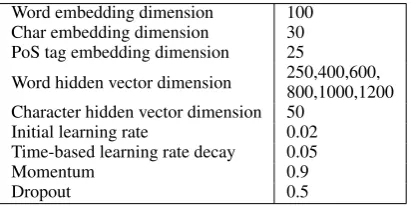
During the training we use Stochastic Gradient Descent (SGD) optimizer with a batch size of 8, and the model is trained for up to 100 iterations. We keep the model that obtains the highest UAS on the development set. Additional hyperparame-ters are shown in Table5.
Word embedding dimension 100 Char embedding dimension 30 PoS tag embedding dimension 25
Word hidden vector dimension 250,400,600, 800,1000,1200 Character hidden vector dimension 50
Initial learning rate 0.02 Time-based learning rate decay 0.05
Momentum 0.9
[image:7.595.308.514.423.526.2]Dropout 0.5