Proceedings of NAACL-HLT 2019, pages 218–227 218
How Bad are PoS Taggers in Cross-Corpora Settings? Evaluating
Annotation Divergence in the UD Project
Guillaume Wisniewski and Franc¸ois Yvon
LIMSI, CNRS, Univ. Paris-Sud, Université Paris-Saclay, F-91405 Orsay, France {guillaume.wisniewski,francois.yvon}@limsi.fr
Abstract
The performance of Part-of-Speech tagging varies significantly across the treebanks of the Universal Dependencies project. This work points out that these variations may result from divergences between the annotation of train and test sets. We show how the annotation va-riation principle, introduced by Dickinson and Meurers (2003) to automatically detect errors in gold standard, can be used to identify incon-sistencies between annotations ; we also eva-luate their impact on prediction performance.
1 Introduction
The performance of Part-of-Speech (PoS) tag-gers significantly degrades when they are applied to test sentences that depart from training data. To illustrate this claim, Table 1 reports the error rate achieved by our in-house PoS tagger on the dif-ferent combinations of train and test sets of the French treebanks of the Universal Dependencies
(UD) project (Nivre et al., 2018).1 It shows that
depending on the train and test sets considered, the performance can vary by a factor of more than 25. Many studies (Foster, 2010; Plank et al.,
2014) attribute this drop in accuracy tocovariate
shift(Shimodaira, 2000), characterizing the
diffe-rences between domains by a change in the
mar-ginal distribution p(x) of the input (e.g. increase
of out-of-vocabulary words, missing capitaliza-tion, different usage of punctuacapitaliza-tion, etc), while as-suming that the conditional label distribution re-mains unaffected.
This work adopts a different point of view : we believe that the variation in tagging performance is
due to adataset shift(Candela et al., 2009), i.e. a
change in the joint distribution of the features and labels. We assume that this change mainly results
1. See Section 2 for details regarding our experimental setting
from incoherences in the annotations between cor-pora or even within the same corpus. Indeed, en-suring inter-annotator agreement in PoS tagging is known to be a difficult task as annotation gui-delines are not always interpreted in a consistent manner (Marcus et al., 1993). For instance, Man-ning (2011) shows that many errors in the WSJ corpus are just mistakes rather than uncertainties or difficulties in the task ; Table 2 reports some
of theseannotation divergencesthat can be found
in UD project. The situation is naturally worse in cross-corpora settings, in which treebanks are an-notated by different laboratories or groups.
The contribution of this paper is threefold : — we show that, as already pointed out by
de Marneffe et al. (2017), the variation prin-ciple of Boyd et al. (2008) can be used to flag potential annotation discrepancies in the UD project. Building on this prin-ciple, we introduce, to evaluate the anno-tation consistency of a corpus, several me-thods and metrics that can be used, during the annotation to improve the quality of the corpus.
— we generalize the conclusions of Manning (2011), highlighting how error rates in PoS tagging are stemming from the poor quality of annotations and inconsistencies in the re-sources ; we also systematically quantify the impact of annotation variation on PoS tag-ging performance for a large number of lan-guages and corpora.
test→ FTB GSD ParTUT SRCMF Sequoia Spoken PUD
↓train
FTB 2.8% 7.0% 6.5% 45.4% 5.4% 18.7% 12.9%
GSD 6.7% 3.7% 7.2% 45.5% 5.4% 16.3% 10.2%
ParTUT 11.2% 10.9% 5.9% 55.7% 11.3% 22.9% 15.8%
SRCMF 38.8% 37.8% 36.2% 7.5% 37.4% 34.7% 36.1%
Sequoia 7.5% 7.5% 8.4% 48.0% 4.0% 19.3% 13.6%
Spoken 32.1% 30.3% 25.7% 51.8% 29.5% 7.9% 30.1%
Table 1: Error rate (%) achieved by a PoS tagger trained and tested on all possible combinations of the French train and test sets of the UD project. To mitigate the variability of our learning algorithm, all scores are averaged over 10 training sessions.
works do (e.g. to evaluate the quality of a domain adaptation method or the measure the difficulty of the domain adaptation task) can be flawed and that this metrics has to be corrected to take into account the annotation divergences that exists between corpora. The rest of this paper is organized as follows. We first present the corpora and the tools used in
our experiments (§2). We then describe the
anno-tation variation principle of Dickinson and
Meu-rers (2003) (§ 3) and its application to the
tree-banks of the Universal Dependencies project (§4).
We eventually assess the impact of annotation
va-riations on prediction performance (§5 and§6).
The code and annotations of all experiments are
available on the first author website.2For the sake
of clarity, we have only reported our observations for the English treebanks of the UD project and, sometimes, for the French treebanks (because it has seven treebanks). Similar results have however been observed for other languages and corpora.
2 Experimental Setting
Data All experiments presented in this work
use the Universal Dependencies (UD) 2.3 da-taset (Nivre et al., 2018) that aims at develo-ping cross-linguistically consistent treebank anno-tations for a wide array of languages.
This version of the UD project contains 129 treebanks covering 76 languages. Among those, 97 treebanks define a train set that contains between 19 sentences and 68,495 sentences and a test set that contains between 34 and 10,148 sen-tences. For 21 languages, several test sets are avai-lable : there are, for instance, 7 test sets for French,
2. https://perso.limsi.fr/wisniews/ recherche/#coherence
6 for English, 5 for Czech and 4 for Swedish, Chi-nese, JapaChi-nese, Russian and Italian. Overall, it is possible to train and test 290 taggers (i.e. there are 290 possible combinations of a train and a test set
of the same language), 191 of theseconditions(i.e.
pairs of a train set and a test set) correspond to a cross-corpus setting and can be considered for do-main adaptation experiments.
Many of these corpora3result from an
automa-tic transformation (with, for some of them, manual corrections) from existing dependency or consti-tuent treebanks (Bosco et al., 2013; Lipenkova and Souˇcek, 2014). Because most treebanks have been annotated and/or converted independently by
dif-ferent groups,4the risk of inconsistencies and
er-rors in the application of annotation guidelines is increased. There may indeed be several sources of inconsistencies in the gold annotations : in addi-tion to the divergences in the theoretical linguis-tic principles that governed the design of the ori-ginal annotation guidelines, inconsistencies may also result from automatic (pre-)processing, hu-man post-editing, or huhu-man annotation. Actually, several studies have recently pointed out that tree-banks for the same language are not consistently annotated (Vilares and Gómez-Rodríguez, 2017; Aufrant et al., 2017). In a closely related context, Wisniewski et al. (2014) have also shown that, in spite of common annotation guidelines, one of the main bottleneck in cross-lingual transfer bet-ween UD corpora is the difference in the annota-tion convenannota-tions across treebanks and languages.
3. For PoS, only 23 treebanks have been manually anno-tated natively with the Universal PoS tagset.
À With regard to the effect of the programmeon the convergence of highlevelADJtraining for
trainers ,it was not possible to make an assessment as there was not sufficient information on
the link between national strategies and the activities under Pericles .
With a view to enabling the assessment of the effect of the programme , among otherson the
convergence of highlevelNOUNtraining for trainers ,the evaluator recommends the preparation
of a strategy document , to be finalised before the new Pericles enters into effect .
Á NoticeNOUN Regarding Privacy and Confidentiality : PaineWebber reserves the right to monitor and review the content of all e-mail communications sent and or received by its employees .
NoticePROPNRegarding Privacy and Confidentiality : PaineWebber reserves the right to monitor and review the content of all e-mail communications sent and or received by its employees .
 The above applies to the Work as incorporated in a Collective Work , but this does not require
the Collective Work apart from the Work itself to be made subjectADJ to the terms of this
License.
The above applies to the Derivative Work as incorporated in a Collective Work , but this does
not require the Collective Work apart from the DerivativeWork itself to be madesubjectNOUN
[image:3.595.71.522.59.329.2]to the terms of this License .
Table 2: Examples of annotation divergences in the English Web Treebank (EWT) corpus : these sentences share some common words (in bold) that do not have the same annotation. Only the labels that differ are represented.
PoS tagger In all our experiments, we use a
history-based model (Black et al., 1992) with a LaSO-like training method (Daumé III and Marcu, 2005). This model reduces PoS tagging to a se-quence of multi-class classification problems : the PoS of the words in the sentence are predicted one after the other using an averaged perceptron. We consider the standard feature set for PoS tag-ging (Zhang and Nivre, 2011) : current word, two previous and following words, the previous two predicted labels, etc. This ‘standard’ feature set has been designed for English and has not been adapted to the other languages considered in our experiments.
Our PoS tagger achieves an average precision of 91.10% over all UD treebanks, a result comparable
to the performance of UDPipe 1.2 (Straka and
Straková, 2017), the baseline of CoNLL’17 Shared Task ‘Multilingual Parsing from Raw Text to Uni-versal Dependencies’ that achieves an average pre-cision of 91.22%. When not otherwise specified, all PoS tagging scores reported below are averaged over 10 runs (i.e. independent training of a model and evaluation of the test performance).
3 Annotation variation principle
Theannotation variation principle(Boyd et al.,
2008) states that if two identical sequences appear
with different annotations, one of these two label sequences may be inconsistently annotated. Our work relies on this principle to identify discrepan-cies in the PoS annotation of treebanks.
We callrepeata sequence of words that appears
in, at least, two sentences and suspicious repeat
a repeat that is annotated in at least two different ways. Identifying suspicious repeats requires, first, to find all sequences of words that appear in two
different sentences ; this is an instance of the
maxi-mal repeat problem : amaximal repeat, is a
sub-string that occurs at least in two different sentences and cannot be extended to the left or to right to a longer common substring. Extracting maximal re-peats allows us to find all sequence of words com-mon to at least two sentences without extracting all their substrings. This problem can be solved effi-ciently using Generalized Suffix Tree (GST)
(Gus-field, 1997) : if the corpus containsn words,
ex-tracting all the maximal repeats takes O(n) to
build the GST andO(n)to list all the repeats. PoS
annotations for these repeats can then be easily ex-tracted and the ones that are identical can be filte-red out to gather all suspicious repeats in a set of corpora. A detailed description of our implemen-tation can be found in (Wisniewski, 2018).
Filtering heuristics Suspicious repeats can of
ambiguity The early voting suggests that this time the Latin Americanswill come outtoPART vote in greater numbers , but it is unclear whether the increase will have an impact .
Keep his cage open and go on your computer , or read a book , etc and maybe he
will come outtoADPyou .
inconsistency Trudeau will extend that invitation to the 45thpresidentNOUN of the UnitedADJ
StatesNOUN, whoever he or she may be .
I am GEORGE WALKER BUSH , son of the formerpresidentPROPN of the
Uni-tedPROPNStatesPROPNof America George Herbert Walker Bush , and currently ser-ving as President of the United States of America .
Table 3: Example of an actual ambiguity and of an annotation inconsistency between the English EWT and PUD corpora. Repeated words are in bold and words with different PoS in red.
truly ambiguous. We consider two heuristics to
fil-ter out suspicious repeats. First with thesize
heu-ristic, we assume that longer suspicious repeats are more likely to result from annotation errors than shorter ones. For instance, Table 2 displays suspi-cious repeats with at least 10 words that all stem from an annotation error.
Second, with the disjoint heuristic, we assume
that actual ambiguities will be reflected in intra-corpus suspicious repeats, whereas errors will li-kely correspond to cases where differences in labe-lings are observed in different corpora. Formally,
thedisjoint heuristicflags repeatsmoccurring in
at least two corporaAandB, and such that the set
of labelings ofmobserved inAare disjoint from
the set of labelings observed inB.
For instance, in French, “la porte” can either
be a determiner and a noun (e.g. in the sentence
“la porte est fermée”— the door is closed) or a
pronoun followed by a verb (e.g. in the sentence
“je la porte”— I carry her). Observing these two
possible labelings in at least two corpora is a good sign of an actual ambiguity. The disjoint heuris-tic allows us to detect that this suspicious repeat is an actual ambiguity. To reiterate, the intuition beyond the disjoint heuristic is that for ambigui-ties, the two possible annotations will appear in, at least, one of the two corpora.
Conversely, systematic divergences in labeling observed across corpora are likely to be errors : for instance, in English, depending on the treebank, cardinal points are labeled as either proper nouns or as nouns. In this case, the set of labelings of the repeats in the first corpus is disjoint from the set of labeling in the second corpus and the the disjoint heuristic captures the annotation inconsistency.
Analyzing filtering heuristics To further
ana-lyze these two heuristics, we have manually anno-tated the suspicious repeats between the train set of the English EWT corpus and the test set of the English PUD corpus. For each suspicious repeat, we record whether it is an annotation error or an actual ambiguity. Examples of annotations are gi-ven in Table 3.
Results are in Table 4. It appears that, for the heuristics considered, a large part of the suspicious repeats correspond to annotation discrepancies ra-ther than ambiguities. In many cases, these dis-crepancies result from systematic divergences in
the interpretation of the UD guidelines.5 For
ins-tance, the contraction “n’t” is always labeled as
a particle in the train set of the EWT corpus, but either as particle or an adverb in the PUD corpus. Most of these systematic differences involve dis-tinction between nouns and proper nouns, auxilia-ries and verbs and adjectives and verbs (for past participles).
4 Quantifying Annotation Divergence in
the UD Corpora
4.1 Annotation Variations in the UD
We will first show how the annotation variation principle allows us to characterize the noise and/or the difficulty of PoS tagging. Table 5 reports the number of repeats and suspicious repeats in the English corpora of the UD project. These numbers have been calculated by applying the method des-cribed in the previous section to the concatenation of train, development and test sets of each tree-banks. To calibrate these measures, we conducted
heuristic # susp. repeats # inconsistencies
size=4 28 2278.6%
size=3 214 15371.5%
disjoint 580 40770.3%
none 2507 —
Table 4: Percentage of suspicious repeats between the EWT and PUD corpora that contain an annotation inconsistency according to a human annotator either when the disjoint heuristic is used or when only
sus-picious repeats with at leastnwords are considered.
the same experiments with the Wall Street
Jour-nal (Marcus et al., 1993),6 the iconic corpus of
PoS tagging for which a thorough manual analysis of the annotation quality is described in (Manning, 2011).
The observations reported in Table 5 show that the number of repeats varies greatly from one cor-pus to another, which is not surprising conside-ring the wide array of genres covered by the tree-banks that includes sentences written by journa-lists or learner of English (the genres with the lar-gest number of repeats) or sentences generated by users on social media (that contain far less repea-ted parts). These observations also show that the percentage of repeats that are not consistently an-notated is slightly larger in the UD treebanks than in the WSJ, a corpus in which a manual inspec-tion of the corpus reveals that many variainspec-tions are ‘mistakes’ rather than representing uncertainties or difficulties in the PoS prediction (Manning, 2011). More interestingly, Table 6 shows the
percen-Treebank # sent. % sent. repeat % var.
ESL 5,124 79.0 10.4
EWT 16,622 13.1 9.0
GUM 4,399 10.5 8.5
LinES 4,564 10.9 11.8
PUD 1,000 2.7 8.7
ParTUT 2,090 18.8 9.0
[image:5.595.77.286.544.669.2]WSJ 21,928 66.1 8.4
Table 5: Percentage of sentences with a repeat of at
least three words in the English treebanks (% sent.
repeat) and percentage of these repeats that are not
labeled consistently (% var.).
6. The Penn Treebank tagset has been manually conver-ted to the Universal PoS tagset using the mapping of (Petrov et al., 2012) generalized to the extended UD PoS tagset.
tage of repeats that are not consistently annota-ted for all possible combinations of a train and a test sets (ignoring sequences of words that do not appear at least once in both corpora). It appears that in all cases there are (sometimes significantly) more variations in annotations in cross-treebank settings than in situations where the train and the test sets belong to the same treebank. This obser-vation suggests that there may be systematic dif-ferences in the annotations of different treebanks which could make the domain adaptation setting artificially more difficult.
4.2 How do treebanks differ ?
To characterize the difference between two tree-banks, we measure the error rate of a binary clas-sifier deciding from which corpus an annotated
sentence is coming from.7 Intuitively, the higher
this error rate, the more difficult it is to distin-guish sentences of the two corpora and the more similar the treebanks are. More formally, it can be shown (Ben-David et al., 2010) that this error
rate is an estimation of the H-divergence (Kifer
et al., 2004), a metric introduced in machine lear-ning theory to quantify the impact of a change in domains by measuring the divergence between the distributions of examples sampled from two data-sets.
In our experiments, we use a Naive Bayes
clas-sifier8and three sets of features to describe a
sen-tence pair and their annotation : words, in which
each example is represented by the bag of its
1-gram and 2-gram of words ; labels, in which
examples are represented in the same way, but
this time, considering PoS ; andcombiwhich uses
the same representation after the words of all the treebanks have been concatenated with their PoS. The first set aims at capturing a potential covariate shift, the last two target divergence in annotations. To reduce the impact of the strong between-class
imbalance,9in all our experiments we sub-sample
the largest set to ensure that the two datasets we try to distinguish always have the same number of examples. All scores in this experiment are avera-ged over 20 train-test splits.
7. More precisely, the classifier analyses pairs of sen-tences and predicts whether they belong to th same corpus or not.
8. We used the implementation provided by (Pedregosa et al., 2011) without tuning any hyper-parameters. Experi-ments with a logistic regression show similar results.
↓train / test→ ESL EWT GUM LinES ParTUT WSJ PUD
ESL 10.0% 11.7% 10.6% 11.1% 10.0% 12.9% 10.9%
EWT 11.8% 8.7% 9.1% 10.1% 8.9% 18.8% 9.2%
GUM 14.3% 9.0% 8.2% 11.6% 8.5% 15.8% 11.1%
LinES 16.9% 12.8% 12.6% 12.4% 12.5% 16.6% 14.2%
ParTUT 13.8% 10.5% 9.9% 12.0% 9.0% 14.9% 12.5%
WSJ 9.0% 9.9% 9.0% 9.5% 8.5% 8.2% 9.6%
Table 6: Percentage of repeats between a train and a test sets that are not annotated consistently. In-domain settings (i.e. when the train and test sets come from the same treebank) are reported in bold ; for each train set, the most consistent setting is underlined.
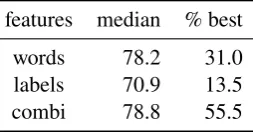
Table 7 reports the results achieved with the dif-ferent features sets averaged over all combinations of a train and a test set of the same language and gives the percentage of conditions for which each feature set achieved the best results ; Figure 1 de-tails these results for the English and French tree-banks. Results for other languages show similar patterns. These results suggest that, in many cases, it is possible to accurately identify from which treebank a sentence and its annotation are coming, although these raw numbers are difficult to in-terpret as prediction performances are averaged over many different experimental conditions. In more than 50% of the cases, combining words to their PoS results in the best performance, which is consistent to the qualitative study reported in Sec-tion 3 : some words appear in two corpora with dif-ferent PoS allowing to distinguish these corpora. This observation strongly suggests that divergence in annotations across corpora are often genuine.
5 Impact of annotation variation on
prediction performance
To study annotation divergence in the UD pro-ject, we propose to analyze suspicious repeats (i.e. sequence of repeated words with different anno-tations). We start by extracting all the suspicious repeats that can be found when considering all the possible combinations of a train set and a test
features median % best
words 78.2 31.0
labels 70.9 13.5
[image:6.595.119.246.651.717.2]combi 78.8 55.5
Table 7: Precision (%) achieved over all cross-treebank conditions by a classifier identifying to which treebank a sentence belongs to.
or development set of a given language. These matches are then filtered using the heuristics
des-cribed in§3. There are, overall,357,301matches
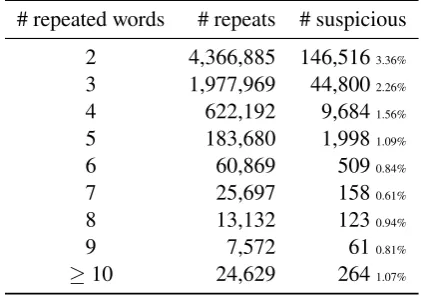
in the UD project, 69,157 of which involve 3
words or more and 14,1425 words or more ; the
disjoint heuristic selects122,634of these matches
(see Table 8 in§A).
To highlight the connection between prediction errors and annotation divergence, we compute, for each possible combination of a train and a test set (considering all languages in the UD project), the correlation between the error rate achieved on a
corpusBwhen training our PoS on a corpusAand
the number of suspicious repeats between A and
B normalized by the number of tokens in A and
B. The Spearman correlation coefficient between
these two values is 0.72 indicating a correlation
generally qualified as ‘strong’ following the inter-pretation proposed by (Cohen, 1988) : the more there are sequences of words with different an-notations in the train and test sets, the worse the tagging performance, which shows that annotation inconsistencies play an important role in explai-ning the poor performance of PoS tagger on some conditions.
For a more precise picture, we also estimate the number of suspicious repeats that contain a pre-diction error. Using the disjoint heuristics to fil-ter suspicious repeats, it appears that 70.2% (resp. 73.0%) of the suspicious repeats for English (resp. French) contain a prediction error. As expected, these numbers fall to 51.7% (resp. 49.9%) when the suspicious repeats are not filtered and therefore contain more ambiguous words. Figure 2 displays a similar trend when the suspicious repeats are fil-tered by their length ; similar results are observed for all other languages.
espe-French
FTB GSD PUD ParTUT SRCMF Sequoia Spoken test FTB GSD ParTUT Sequoia Spoken train
60.0% 69.0%80.1% 77.2% 98.3%67.8%97.9%
82.0%57.9% 69.4%75.3% 98.7%69.4%97.3%
82.8% 73.3% 82.9%68.5%98.5% 72.5% 97.5%
80.1%68.4%79.5% 74.3% 95.7%48.0%94.9%
97.1% 95.2% 99.2% 97.8% 95.3% 93.4%67.9%
features words
0.5 0.6 0.7 0.8 0.9
FTB GSD PUD ParTUT SRCMF Sequoia Spoken test FTB GSD ParTUT Sequoia Spoken train
54.2% 66.6%80.8% 75.8% 99.1%67.1%97.9%
75.1%61.1%77.8%72.3%99.6%66.7%98.1%
75.4%71.0%85.8%63.7%99.5%72.8%98.2%
71.0% 64.3%81.1%70.8%98.2%51.5%95.8%
97.3% 97.5% 98.8% 94.0% 89.1% 94.8%61.3%
features labels
0.6 0.7 0.8 0.9
FTB GSD PUD ParTUT SRCMF Sequoia Spoken test FTB GSD ParTUT Sequoia Spoken train
60.0% 71.9%85.6% 79.5% 98.2%70.7%98.4%
85.1%58.8%81.4% 73.6% 98.6%69.2%97.7%
87.1% 76.3% 87.3%68.0%98.7% 75.5% 98.1%
81.6%69.8%86.8% 73.1% 95.2%49.0%95.5%
97.7% 94.9% 99.3% 97.3% 96.4% 93.1%68.2%
features combi
0.5 0.6 0.7 0.8 0.9 English
ESL EWT GUM LinES PUD ParTUT test EWT GUM LinES ParTUT train
73.0% 62.6% 73.4% 72.3% 79.1% 76.1%
79.3% 76.0% 67.2% 75.0% 71.7% 71.3%
78.1% 79.3% 78.4% 60.4% 77.9% 73.5%
85.0% 83.8% 75.7% 78.9% 74.0% 65.6%
features words
0.65 0.70 0.75 0.80 0.85
ESL EWT GUM LinES PUD ParTUT test EWT GUM LinES ParTUT train
87.1% 59.4% 66.7% 65.9% 73.9% 78.2%
85.5% 69.3% 56.2% 67.9% 69.1% 75.3%
84.0% 73.7% 71.1% 51.1% 75.1% 73.1%
86.5% 81.1% 73.0% 74.7% 67.8% 63.5%
features labels
0.54 0.60 0.66 0.72 0.78 0.84
ESL EWT GUM LinES PUD ParTUT test EWT GUM LinES ParTUT train
87.0% 62.7% 74.1% 74.0% 77.6% 75.6%
89.2% 77.2% 66.6% 76.5% 72.7% 74.3%
87.8% 80.4% 77.9% 58.8% 78.3% 73.8%
91.3% 85.4% 78.8% 81.9% 78.6% 65.2%
features combi
[image:7.595.102.508.63.297.2]0.60 0.66 0.72 0.78 0.84 0.90
Figure 1: Precision of a classifier identifying to which French (top) or English (bottom) treebank a sentence belongs to. Train corpora are on the y-axis and test corpora on the x-axis.
cially when there are good reasons to assume that the variation actually stems from an inconsistency.
Figure 2: Percentage of suspicious repeats that contain at least one prediction error in function of their size.
6 Re-Assessing the Performance of PoS
Tagger in Cross-Corpus Setting
To evaluate the impact of annotation errors on prediction performance, we propose, for each combination of a train and a test set, to train a PoS
tagger and compareεfull, the error rate achieved on
the full test set toεignoringthe error rate achieved
ignoring errors that occur in a suspicious repeat.
More precisely,εignoringis defined as :
εignoring=
#{err} −#{err in suspicious repeats}
#{words}
(1)
where#{err in suspicious repeats}in the number
of errors in the suspicious repeats that have
survi-ved filtering. Intuitivelyεignoringcan be seen as an
[image:7.595.79.273.421.563.2]‘oracle’ score corresponding to a tagger that would always predict the labels of suspicious repeat cor-rectly. In the following, We will consider three dif-ferent filters : the disjoint heuristic, keeping only suspicious repeats with more than three words and keeping all of them.
Figure 3 reports these errors rates for French and English. Results for other languages show si-milar results. As expected, ignoring errors in sus-picious repeats significantly improve prediction
performance. It even appears that εignoring is
predic-ud lines partut test 0 2 4 6 8 10 error rat e (%) en (UD) εfull εignoring(minsize) εignoring(disjoint) εignoring(all)
ud lines partut
test 0 2 4 6 8 10 12 14 16 en (LINES) εfull εignoring(minsize) εignoring(disjoint) εignoring(all)
ud lines partut
test 0.0 2.5 5.0 7.5 10.0 12.5 15.0 17.5 en (PARTUT) εfull εignoring(minsize) εignoring(disjoint) εignoring(all)
ud ftb partut sequoia
test 0 2 4 6 8 10 error rat e (%) fr (PARTUT) εfull εignoring(minsize) εignoring(disjoint) εignoring(all)
ud ftb partut sequoia
test 0 1 2 3 4 5 6 7 8 fr (SEQUOIA) εfull εignoring(minsize) εignoring(disjoint) εignoring(all)
ud ftb partut sequoia
test 0 1 2 3 4 5 6 fr (UD) εfull
εignoring(minsize) εignoring(disjoint) εignoring(all)
ud ftb partut sequoia
[image:8.595.87.515.68.249.2]test 0 1 2 3 4 5 6 7 fr (FTB) εfull εignoring(minsize) εignoring(disjoint) εignoring(all)
Figure 3: Error rate achieved by a PoS tagger on the different English treebanks of the UD project when errors in suspicious repeats are ignored. The red line indicates the error rate on in-domain data.
tion quality.
To assess their quality, we have manually che-cked all the suspicious repeats between the train set of French UD and the test set of the French FTB correcting inconsistencies and errors (almost
2,000 PoS were modified).10When trained on the
original UD corpus, the PoS tagger achieved an er-ror rate of 6.78% on the FTB corpus (4.51% on in-domain data). After correcting inconsistencies, the out-domain error rate falls down to 5.11%. This value is close to the error rate ignoring suspicious repeats containing three and more words, showing the validity of the heuristics we have considered.
7 Conclusion
In this work, we have shown that, for PoS tag-ging, many prediction errors in cross-corpora set-tings (which is a typical domain adaptation sce-nario) stem from divergence between annotations. We have also described a method to quantify this divergence. We have only considered here corpora from the UD project and PoS annotation, but we consider that our method is very generic and can be easily applied to other corpora or tasks (e.g. to-kenization, dependency parsing, etc.) that we will address in future work. We also plan to see how the different experiments we have made to identify an-notation errors and inconsistencies can be used du-ring the annotation process to reduce the workload
10. The ‘corrected’ corpora will be made available upon publication. In this experiment, the impact of annotation er-rors is under-estimated as we have only corrected erer-rors that appear in a suspicious repeat without trying to ‘generalize’ these corrections to words that appear only in one corpus.
of annotators and help them creating high-quality corpora.
Acknowledgements
This work has been partly funded by the French
Agence Nationale de la Recherche under
Par-SiTi (ANR-16-CE33-0021) and MultiSem pro-jects (ANR-16-CE33-0013).
References
Lauriane Aufrant, Guillaume Wisniewski, and Franc¸ois
Yvon. 2017. LIMSI@CoNLL’17 : UD shared task.
In Proceedings of the CoNLL 2017 Shared Task : Multilingual Parsing from Raw Text to Universal De-pendencies, pages 163–173, Vancouver, Canada. As-sociation for Computational Linguistics.
Shai Ben-David, John Blitzer, Koby Crammer, Alex Kulesza, Fernando Pereira, and Jennifer Wortman Vaughan. 2010. A theory of learning from different
domains. Machine Learning, 79(1-2) :151–175.
Ezra Black, Fred Jelinek, John Lafferty, David M. Ma-german, Robert Mercer, and Salim Roukos. 1992. Towards history-based grammars : Using richer
mo-dels for probabilistic parsing. In Proceedings of
the Workshop on Speech and Natural Language, HLT’91, pages 134–139, Stroudsburg, PA, USA. As-sociation for Computational Linguistics.
Cristina Bosco, Simonetta Montemagni, and Maria Simi. 2013. Converting italian treebanks : Towards
an Italian stanford dependency treebank. In
Pro-ceedings of the 7th Linguistic Annotation Workshop and Interoperability with Discourse, pages 61–69, Sofia, Bulgaria. Association for Computational Lin-guistics.
treebanks. Research on Language and Computation, 6(2) :113–137.
Joaquin Q. Candela, Masashi Sugiyama, Anton
Schwaighofer, and Neil D. Lawrence. 2009.
Data-set Shift in Machine Learning. The MIT Press.
Jacob Cohen. 1988. Statistical Power Analysis for the
Behavioral Sciences. Routledge.
Hal Daumé III and Daniel Marcu. 2005. Learning
as search optimization : Approximate large margin
methods for structured prediction. In Proceedings
of the 22nd International Conference on Machine Learning, ICML’05, pages 169–176, New York, NY, USA. ACM.
Markus Dickinson and W. Detmar Meurers. 2003.
Detecting errors in part-of-speech annotation. In
Proceedings of the Tenth Conference on European Chapter of the Association for Computational Lin-guistics - Volume 1, EACL ’03, pages 107–114, Stroudsburg, PA, USA. Association for Computatio-nal Linguistics.
Jennifer Foster. 2010. “cba to check the spelling” : In-vestigating parser performance on discussion forum
posts. InHuman Language Technologies : The 2010
Annual Conference of the North American Chap-ter of the Association for Computational Linguistics, pages 381–384, Los Angeles, California. Associa-tion for ComputaAssocia-tional Linguistics.
Dan Gusfield. 1997.Algorithms on Strings, Trees, and
Sequences : Computer Science and Computational Biology. Cambridge University Press, New York, NY, USA.
Daniel Kifer, Shai Ben-David, and Johannes Gehrke.
2004. Detecting change in data streams. In
Pro-ceedings of the Thirtieth International Conference on Very Large Data Bases - Volume 30, VLDB ’04, pages 180–191. VLDB Endowment.
Janna Lipenkova and Milan Souˇcek. 2014. Conver-ting Russian dependency treebank to Stanford typed
dependencies representation. InProceedings of the
14th Conference of the European Chapter of the As-sociation for Computational Linguistics, volume 2 : Short Papers, pages 143–147, Gothenburg, Sweden. Association for Computational Linguistics.
Christopher D. Manning. 2011. Part-of-speech tagging from 97% to 100% : Is it time for some
linguis-tics ? InProceedings of the Computational
Linguis-tics and Intelligent Text Processing, 12th Interna-tional Conference, CICLing 2011, pages 171–189. Springer.
Mitchell P. Marcus, Mary Ann Marcinkiewicz, and Beatrice Santorini. 1993. Building a large
annota-ted corpus of english : The penn treebank. Comput.
Linguist., 19(2) :313–330.
Marie-Catherine de Marneffe, Matias Grioni, Jenna Kanerva, and Filip Ginter. 2017. Assessing the an-notation consistency of the universal dependencies
corpora. In Proceedings of the Fourth
Internatio-nal Conference on Dependency Linguistics (Depling 2017), pages 108–115. Link¨oping University Elec-tronic Press.
Joakim Nivre, Mitchell Abrams, ˇZeljko Agi´c, Lars
Ah-renberg, and other. 2018. Universal dependencies 2.3. LINDAT/CLARIN digital library at the Insti-tute of Formal and Applied Linguistics (ÚFAL), Fa-culty of Mathematics and Physics, Charles Univer-sity.
F. Pedregosa, G. Varoquaux, A. Gramfort, V. Michel, B. Thirion, O. Grisel, M. Blondel, P. Prettenhofer, R. Weiss, V. Dubourg, J. Vanderplas, A. Passos, D. Cournapeau, M. Brucher, M. Perrot, and E. Du-chesnay. 2011. Scikit-learn : Machine learning in
Python. Journal of Machine Learning Research,
12 :2825–2830.
Slav Petrov, Dipanjan Das, and Ryan McDonald. 2012.
A universal part-of-speech tagset. In Proceedings
of the Eighth International Conference on Language Resources and Evaluation (LREC-2012). European Language Resources Association (ELRA).
Barbara Plank, Anders Johannsen, and Anders
Søgaard. 2014. Importance weighting and
unsuper-vised domain adaptation of POS taggers : a negative
result. In Proceedings of the 2014 Conference on
Empirical Methods in Natural Language Processing (EMNLP), pages 968–973, Doha, Qatar. Association for Computational Linguistics.
Hidetoshi Shimodaira. 2000. Improving predictive in-ference under covariate shift by weighting the
log-likelihood function. Journal of Statistical Planning
and Inference, 90(2) :227 – 244.
Milan Straka and Jana Straková. 2017. Tokenizing, pos tagging, lemmatizing and parsing ud 2.0 with
ud-pipe. In Proceedings of the CoNLL 2017 Shared
Task : Multilingual Parsing from Raw Text to Univer-sal Dependencies, pages 88–99, Vancouver, Canada. Association for Computational Linguistics.
David Vilares and Carlos Gómez-Rodríguez. 2017. A non-projective greedy dependency parser with
bi-directional LSTMs. In Proceedings of the CoNLL
2017 Shared Task : Multilingual Parsing from Raw Text to Universal Dependencies, pages 152–162, Vancouver, Canada. Association for Computational Linguistics.
Guillaume Wisniewski. 2018. Errator : a tool to help detect annotation errors in the universal
dependen-cies project. InProceedings of the Eleventh
Interna-tional Conference on Language Resources and Eva-luation (LREC-2018). European Language Resource Association.
Guillaume Wisniewski, Nicolas Pécheux, Souhir Gahbiche-Braham, and Franc¸ois Yvon. 2014. Cross-lingual part-of-speech tagging through ambiguous
learning. InProceedings of the 2014 Conference on
Empirical Methods in Natural Language Processing (EMNLP), pages 1779–1785, Doha, Qatar. Associa-tion for ComputaAssocia-tional Linguistics.
A Appendices
# repeated words # repeats # suspicious
2 4,366,885 146,5163.36%
3 1,977,969 44,8002.26%
4 622,192 9,6841.56%
5 183,680 1,9981.09%
6 60,869 5090.84%
7 25,697 1580.61%
8 13,132 1230.94%
9 7,572 610.81%
[image:10.595.75.286.96.244.2]≥10 24,629 2641.07%