74
Distantly Supervised Attribute Detection from Reviews
Lisheng Fu∗
Computer Science Department New York University New York, NY 10003 USA
Pablo Barrio Google
New York, NY 10011 USA
Abstract
This work aims to detect specific attributes of a place (e.g., if it has a romantic atmosphere, or if it offers outdoor seating) from its user reviews via distant supervision: without di-rect annotation of the review text, we use the crowdsourced attribute labels of the place as labels of the review text. We then use review-level attention to pay more attention to those reviews related to the attributes. The exper-imental results show that our attention-based model predicts attributes for places from re-views with over 98% accuracy. The attention weights assigned to each review provide ex-planation of capturing relevant reviews.
1 Introduction
In selecting a product to buy, a restaurant to visit, or a hotel to stay at, people may rely on user re-views but may also filter their choices based on particular attributes (e.g., the availability of an out-door seating area or the lack of a kid-friendly at-mosphere). In limited quantities, these attributes may be collected by hand, but this may be too costly to do on a large scale. So inevitably there will be products for which we have lots of reviews but no attributes. Can these attributes be inferred automatically from the reviews?
We answer this question affirmatively, using restaurant reviews and attributes as our case study. Starting from a large set of reviews and detailed at-tributes for some of the same restaurants, we train a system to predict the attributes for restaurants for which this information is not available. This is an information extraction task and, as we will show, can be trained through a form of distant supervi-sion.
In our case study, we detect both objective and subjective attributes for restaurants. For objec-tive attributes, we extract detailed facts such as
∗
This work has been done during the internship at Google.
“has outdoor seating”. These are fine-grained factual attributes, and differ from enti-ties (e.g., people or locations), which are the focus of entity extraction, a related informa-tion extracinforma-tion task. For subjective attributes, we are detecting fine-grained opinions such as
“feels romantic”. These are either positive or negative sentiments and not the overall polarity (or rating) in existing sentiment analysis tasks. To the best of our knowledge, we are the first to per-form such attribute detection from text.
We propose to address the problem above in a sim-ple distant supervision manner by incorporating an additional data source: We use crowdsourcing to obtain annotation of attributes on places indepen-dently, which is much easier to obtain than annota-tion on the review text. Although the review text of a place does not necessarily indicate the attribute of the place, we hypothesize they are highly cor-related and we use the labels on places to be the labels on the review text (Section2).
As a result, we have a number of reviews for each attribute and place without knowing which review indicates the attribute. We propose to use a review-level attention mechanism to assign high weights to those related reviews. Our experiments show that our simple alignment of the two data sources is effective and the attributes are substantially pre-dictable from the review text. Our best model ob-tains 98.05% accuracy.
2 Attribute Detection
2.1 Data Sources
at-tributes collected through explicit prompts (a form of crowdsourcing). For instance, a user who has visited the restaurant Per Se in New York City may be prompted: “DidPer Seoffer outdoor seat-ing?”. The user can answer the question by se-lecting one of “Yes”, “No,” or “Not sure”. Due to limited answers to these questions, some restau-rants can have both multiple reviews and crowd-sourced attribute labels, while many others have only reviews—with no attributes information. Since attribute labels are crowdsourced, they can be noisy or have disagreement, especially on sub-jective attributes. In other words, a particular at-tribute may receive “Yes” and “No” answers from different users for the same restaurant. We con-firm attributes asYesorNofor a place based on an agreement model that blends the votes and other structured data from the place (e.g., cuisines, lo-cation). When the model predicts—with 95% confidence—that at least 2/3 of the voters would respond Yes, the model confirms the attribute as Yes. We use the same logic for confirming No. In this work, we remove the instances where the agreement model is uncertain (i.e., confidence is less than 95%). We use this confident set as ground truth for training and evaluation of our at-tribute detection model.
2.2 Model Setup
Our goal is to train a model on the restaurants with both reviews and attribute labels and use the model to predict attributes for those with only reviews. The input of the model is the reviews of restaurants and the attributes, while the output of the model is Yes/No labels for each attribute. We next de-scribe the basic setup of our neural models, which include an input layer, an encoder, and a decoder.
Input Layer: The input layer consists ofword embedding and attribute embedding. The input layer of the review text is similar to other text clas-sification tasks (e.g., Kim 2014). Each token is converted to a word embedding of dimensiondw. The size of the embedding table is|V| ∗dw, where |V|is the vocabulary size. For each instance, we look up its attribute embedding Ai from an
[image:2.595.359.527.386.569.2]at-tribute embedding table. The values of atat-tribute embedding are randomly initialized and trained using backpropagation. The size of the embedding table is|A| ∗dA, where|A|is the the number of attributes anddAis the embedding dimension.
Encoder: The encoder reads the word embed-ding and extracts the feature representationφ(x)
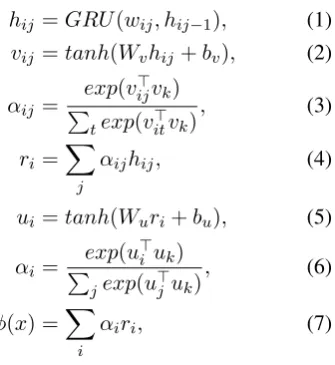
for the bag of reviews, wherexis the word tokens of all the reviews. We use a Recurrent Neural Net (RNN) with word-level attention to encode the text of one review. We use GRU (Cho et al.,2014) as the RNN cell. In a single bag, we assume that at least one review will refer to the attribute, while most of the reviews will be unrelated to the at-tribute. Thus, we use review-level attention on top of the RNN to capture the importance of different reviews. The model will learn high weights for reviews that refer to the attributes and assign al-most zero weight to those that are unrelated. This model is similar to the hierarchical attention net-work (Yang et al.,2016) with two levels of atten-tion.
Given a list of tokens from review text x, we generate a list of word embeddings wij from the input layer, whereiis the index of a review andj
is the index of a token in a review. The encoder is defined as the following:
hij =GRU(wij, hij−1), (1)
vij =tanh(Wvhij+bv), (2)
αij = exp(v
>
ijvk) P
texp(v>itvk)
, (3)
ri =
X
j
αijhij, (4)
ui =tanh(Wuri+bu), (5)
αi =
exp(u>i uk) P
jexp(u>j uk)
, (6)
φ(x) =X
i
αiri, (7)
where Wv, Wu, bv, bu are the weights for the word-level and review-level context vector projec-tions vij and ui, respectively. vk and uk are the weights of the word-level and review-level con-text vectors according to the attributek. ri is the
review embedding computed as the weighted av-erage of hij according to the importance of the word (αij) to the attribute kin the review. φ(x)
is the weighted average ofri according to the
Decoder: The decoder consists of one hidden layer (h1) with output labely:
h2 =concat(φ(x), Ai), (8)
h1=relu(W2h2+b2), (9)
y=W1h1+b1, (10)
where W1, W2, b1, b2 are the parameters for the fully connected layers.
3 Experiments
3.1 Dataset
For our case study, we use restaurants and reviews from Google Maps. We constraint the geographic scope of the restaurants to USA and the language of the reviews to English. We can easily extend our dataset to include other categories of places. The crowdsourcing of attribute labels is imple-mented as a user contribution feature from Google Maps. Those labels include both subjective at-tributes (e.g., “feels quiet”) and objective attributes (e.g., “offering alcohol”). We choose restaurants with at least 100 reviews to col-lect enough review text to train the model. In prac-tice, if a place has insufficient reviews, we may not be able to predict attributes based on reviews. Our dataset contains 17k+ of restaurants and 100+ at-tributes. Each instance consists of one restaurant, one attribute and 100+ reviews. We use 80% of instances for training, 10% for development and 10% for test. We split instances based on restau-rants to keep all review text of a single restaurant together and thus avoid overlap between training and evaluation.
3.2 Model Configurations
We use grid search to tune the hyper-parameters. We use 10000 words for the vocabulary size, 100 for the maximum review length (reviews may con-tain multiple sentences), and 100 for the number of reviews. We use 100 dimensions for both word embedding and attribute embedding. We use 256 filters with window sizes [2,3,4,5] for CNN and 128 states for RNN. We use one hidden layer with 128 units for the decoder. We train the model with the Adam optimizer (Kingma and Ba, 2014) and use cross entropy as the loss function. Our learn-ing rate is set to 0.001 and our batch size is set to 32.
3.3 Predictability from Review Text
Since the model is doing binary prediction (i.e., the model predictsYesorNofor an attribute), we use accuracy as our quality metric. It evaluates the label prediction of an attribute-restaurant pair (one instance). Since we do not have labels of all attributes for every restaurant, we do not report ac-curacy by restaurant.
We compare against multiple baselines to show the effectiveness of our model choice.
• Majority: it predicts the most frequent label for an attribute. This is equivalent to using attribute embedding alone to train the model without reviews.
• BoW: it uses the average of the word embed-dings as the review embedding, and then uses the average of review embedding as the place embedding.
• CNN: it uses CNN to extract the feature rep-resentation from the word embedding as the review embedding.
• CNN + RATT: it uses review-level atten-tion (RATT) to construct the place embed-ding from the review embedembed-ding instead of taking average.
• RNN: it uses RNN to extract the feature rep-resentation from the word embedding. The difference from our proposed model is that it does not use the review-level attention.
The input and decoder are the same for these models. The Majority baseline obtains 90.82% accuracy, which indicates the label bias in the dataset. The label bias is intrinsic for some at-tributes, and possibly increases after uncertain in-stances are removed from the dataset by the agree-ment model. More sophisticated models can per-form much better with better sentence understand-ing ability (see Table 1). We observe continu-ous improvement with more capable encoders of sentence. Moreover, attention-based aggregation for reviews further improves the accuracy for both CNN and RNN models.
Model Accuracy Majority 90.82
BOW 96.48
CNN 97.17
CNN+RATT 97.37
RNN 97.84
[image:4.595.117.246.61.157.2]RNN+RATT 98.05
Table 1: Model accuracy.
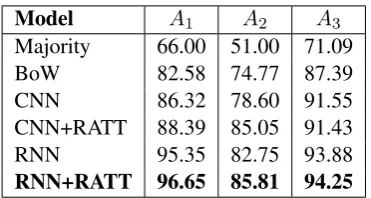
Model A1 A2 A3 Majority 66.00 51.00 71.09 BoW 82.58 74.77 87.39 CNN 86.32 78.60 91.55 CNN+RATT 88.39 85.05 91.43 RNN 95.35 82.75 93.88 RNN+RATT 96.65 85.81 94.25
Table 2: Accuracy for some ambiguous attributes.A1: usually a wait,A2: has outdoor seating,A3: serves late night food.
This confirms our hypothesis that the review text should contain the knowledge of attributes and is probably effective to predict attributes.
In the dataset, there is a substantial fraction of the attributes that are nearly always either positive or negative across places. As an example, con-sider that most restaurants can accept “pay by credit card” and are rarely “cash only” These attributes are relatively easy to predict, which causes the overall accuracy to be high. There are also attributes that are harder for simple models to predict. For those attributes, the sophis-ticated models works significantly better than the baselines (Table2). We also observe improvement by adding the review-level attention. This verifies our hypothesis that giving more weights to rele-vant reviews could help since we align labels to a bag of reviews of a place without knowing which review indicates the attribute.
We next show some examples to explain how the review-level attention works. (Table3). It of-ten captures the important one out of all the re-views in a place (e.g. the first three examples), but sometimes fails because of the misleading key-word (e.g. “2 hr” in the fourth example). There are also cases where reviews may not tell anything about the attribute (e.g. the fifth example), which is hard to avoid when we use labels not directly annotated from text. Fortunately, this does not
of-ten occur in the dataset. The sixth example in-dicates the case where the attended review does show related information about the attribute, but not enough to conclude. The model might have combined several reviews to draw the conclusion in this case.
4 Related Work
The idea of distant supervision has been proposed and used widely in Relation Extraction (Mintz et al.,2009;Riedel et al.,2010;Hoffmann et al.,
2011; Surdeanu et al., 2012), where the source of labels is an external knowledge base. The la-bel assignment is done via aligning entities from knowledge base to text. In alignment, relation extraction has the problem that not every entity pair expresses the semantic relation stored in the knowledge base. We can view our crowdsourced attribute labels as a knowledge base of places and their attributes. The label alignment in our case is much simpler, since both attributes and re-views are associated with the place. The review text, on the other hand, may or may not express the attribute acquired from crowdsourcing. Re-cently (Lin et al., 2016) used neural methods to achieve state-of-the-art for distantly supervised re-lation extraction. We thus focus on neural methods in our modeling.
The attribute detection task is also similar to the aspect-based sentiment analysis task (Pontiki et al.,2016), but contains both subjective and ob-jective aspects. We take a completely different ap-proach in this paper to tackle the problem by using distant supervision and create significantly larger amount of the training data. It might be an inter-esting direction to use this distant supervision way to create more training data for the aspect-based sentiment analysis.
5 Conclusion and Future Work
[image:4.595.89.275.197.296.2]Attribute L P A Review Text Notes usually a wait Y Y 0.08 ... Just be prepared to wait or otherwise
get lucky and find a seat at the bar ! ...
Missed by BoW
has outdoor seating Y Y 0.17 If you want to eat in front plan on waiting after signing up to the list on busy morn-ings , but the back patio is just as nice ...
Missed by BoW
requires cash only N Y 0.11 ... Remember they are Cash Only ! Wrong label usually a wait N Y 0.06 Got there after 2 hr drive and found the
owners on vacation and the place closed ...
Irrelevant
pay by credit card Y Y 0.25 Food and service is great Tanisha is a awe-some sever
No related review
[image:5.595.73.530.61.243.2]usually a wait Y Y 0.09 ...Never a long wait for to go orders... Tricky
Table 3: Attributes along with true label (L), prediction (P), review-level attention weight (A), and review text.
make attribute detection more feasible in practice. In creating the crowdsourced labels, we use an agreement model to select most agreed labels for attributes. It will be interesting future work to ex-tend this to raw user votes. We will have a more re-alistic dataset, especially for subjective attributes where users may have conflict opinions.
References
Kyunghyun Cho, Bart van Merrienboer, Caglar Gul-cehre, Dzmitry Bahdanau, Fethi Bougares, Holger Schwenk, and Yoshua Bengio. 2014. Learning phrase representations using rnn encoderdecoder for statistical machine translation. In Proceedings of EMNLP.
Raphael Hoffmann, Congle Zhang, Xiao Ling, Luke Zettlemoyer, and Daniel S Weld. 2011. Knowledge-based weak supervision for information extraction of overlapping relations. InProceedings of ACL.
Yoon Kim. 2014. Convolutional neural networks for sentence classification. InProceedings of EMNLP.
Diederik P. Kingma and Jimmy Ba. 2014. Adam: A method for stochastic optimization. InProceedings of ICLR.
Yankai Lin, Shiqi Shen, Zhiyuan Liu, Luan Huanbo, and Sun Maosong. 2016. Neural relation extraction with selective attention over instances. In Proceed-ings of ACL.
Mike Mintz, Steven Bills, Rion Snow, and Dan Juraf-sky. 2009. Distant supervision for relation extrac-tion without labeled data. InProceedings of ACL.
Maria Pontiki, Dimitris Galanis, Haris Papageor-giou, Ion Androutsopoulos, Suresh Manandhar, AL-Smadi Mohammad, Mahmoud Al-Ayyoub, Yanyan Zhao, Bing Qin, Orph´ee De Clercq, et al. 2016.
Semeval-2016 task 5: Aspect based sentiment anal-ysis. InProceedings of the 10th international work-shop on semantic evaluation (SemEval-2016), pages 19–30.
Sebastian Riedel, Limin Yao, and Andrew McCallum. 2010. Modeling relations and their mentions with-out labeled text. InProceedings of ECML.
Mihai Surdeanu, Julie Tibshirani Tibshirani, Ramesh Nallapati, and Christopher D Manning. 2012. Multi-instance multi-label learning for relation extraction. InProceedings of EMNLP.