Proceedings of the Third Conference on Machine Translation (WMT), Volume 1: Research Papers, pages 177–185
On The Alignment Problem In Multi-Head Attention-Based Neural
Machine Translation
Tamer Alkhouli, Gabriel Bretschner, and Hermann Ney
Human Language Technology and Pattern Recognition Group Computer Science Department
RWTH Aachen University D-52056 Aachen, Germany
<surname>@i6.informatik.rwth-aachen.de
Abstract
This work investigates the alignment prob-lem in state-of-the-art multi-head attention models based on the transformer architecture. We demonstrate that alignment extraction in transformer models can be improved by aug-menting an additional alignment head to the multi-head source-to-target attention compo-nent. This is used to compute sharper atten-tion weights. We describe how to use the alignment head to achieve competitive per-formance. To study the effect of adding the alignment head, we simulate a dictionary-guided translation task, where the user wants to guide translation using pre-defined dictio-nary entries. Using the proposed approach, we achieve up to 3.8% BLEU improvement
when using the dictionary, in comparison to 2.4% BLEU in the baseline case. We also
propose alignment pruning to speed up decod-ing in alignment-based neural machine trans-lation (ANMT), which speeds up transtrans-lation by a factor of1.8 without loss in translation performance. We carry out experiments on the shared WMT 2016 English→Romanian news task and the BOLT Chinese→English discus-sion forum task.
1 Introduction
Attention-based neural machine translation (NMT) (Bahdanau et al., 2015) uses an atten-tion layer to determine which part of the input sequence to focus on during decoding. This com-ponent eliminates the need for explicit alignment modeling. In conventional phrase-based statistical machine translation (Koehn et al., 2003), word alignment is modeled explicitly, making it clear which word or phrase is being translated. The lack of explicit alignment use in attention-based models makes it harder to determine which target words are generated using which source words. While this is not necessarily needed for
trans-lation itself, alignments can be useful in certain applications, e.g. when the customer wants to enforce specific translation of certain words.
One simple solution is to use maximum atten-tion weights to extract the alignment, but this can result in wrong alignments in the case where the maximum attention weight is not pointing to the word being translated. Such cases are not uncom-mon in NMT, making the use of attention weights as alignment replacement non-trivial (Chatterjee et al., 2017;Hasler et al., 2018). Alignment ex-traction is even less clear for transformer models (Vaswani et al., 2017), which currently produce state-of-the-art results. These models use multiple attention components for each of the stacked de-coder layers. In this work we focus our study on these models since they usually outperform single-attention-head recurrent neural network (RNN) at-tention models.1
Alignment-based NMT (Alkhouli et al., 2016) uses neural models trained using explicit hard alignments to generate translation. These systems include explicit alignment modeling, making them more convenient for tasks where the source-to-target alignment is needed. However, it is not clear whether these systems are able to compete with strong attention-based NMT systems. Alkhouli and Ney (2017) present results for alignment-based neural machine translation (ANMT) using models trained on CPUs, limiting them to small models of 200-node layers, and they only inves-tigate RNN models. Wang et al. (2018) present results using only one RNN encoder layer, and do not include attention layers in their models. In this work, we investigate the performance of large and deep state-of-the-art transformer models. We keep the multi-head attention component and propose to augment it with an additional alignment head, to
1The transformer models won in most of the WMT 2018 news translation tasks:http://matrix.statmt.org.
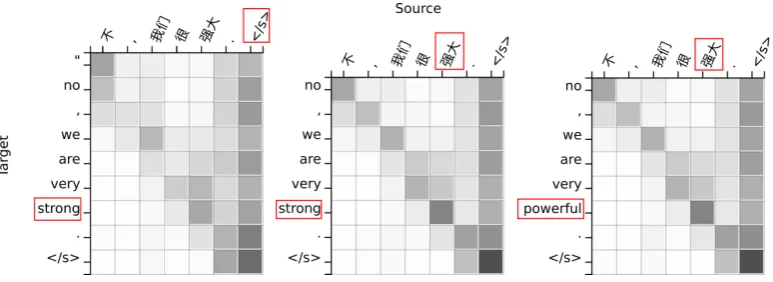
Figure 1: An example from the Chinese→English system. The figures illustrate the accumulated attention weights of the baseline transformer model (left), the alignment-assisted transformer model (middle), and the alignment-assisted model guided by a dictionary entry. We simulate a scenario where the user wants to translate the Chinese word “强大” to “powerful”. Both the baseline and alignment-assisted transformer models generate the translation “strong” instead. To enforce the translation, we use the maximum attention weight to determine the source word being translated. Left: The maximum attention of the baseline case incorrectly points to the sentence end when translating the designated Chinese word, therefore we cannot enforce the translation in this case. Middle: The alignment looks sharper because the system has an augmented alignment head. In this case the maximum attention is pointing to the correct Chinese word. Right: using the maximum attention, the translation “strong” is successfully replaced with the translation “powerful” as suggested by the user using our proposed alignment-assisted transformer.
combine the benefits of the two. We demonstrate that we can train these models to achieve compet-itive results in comparison to strong state-of-the-art baselines. Moreover, we demonstrate that this variant has clear advantage in tasks that require alignments such as dictionary-guided translation.
Translation in NMT can be performed without explicit alignment. However, there are tasks where translation needs to be constrained given spe-cific user requirements. Examples include interac-tive machine translation, and scenarios where cus-tomers demand domain-specific words or phrases to be translated according to a pre-defined dic-tionary. We demonstrate that the explicit use of alignment in ANMT can be leveraged to gener-ate guided translation. Figure (1) illustrates an ex-ample. The figures are generated using attention weights averaged over all attention components in each system.
The contribution of this work is as follows. First, we propose a method to integrate alignment information into the multi-head attention compo-nent of the transformer model (Section 3.1). We describe how such models can be trained to main-tain the strong baseline performance while also us-ing external alignment information (Section3.3). We also introduce alignment models that use self-attentive layers for faster evaluation (Section3.2).
Second, we introduce alignment pruning during search to speed up evaluation without affecting translation quality (Section 4). Third, we de-scribe how to extract alignments from multi-head attention models (Section5), and demonstrate that alignment-assisted transformer systems perform better than baseline systems in dictionary-guided translation tasks (Section7). We present speed and performance results in Section6.
2 Related Work
Alignment-based neural models have explicit de-pendence on the alignment information either at the input or at the output of the network. They have been extensively and successfully applied on top of conventional phrase-based systems ( Sun-dermeyer et al.,2014;Tamura et al.,2014;Devlin et al.,2014). In this work, we focus on using the models directly to perform standalone neural ma-chine translation.
work, we explore the use of transformer models in ANMT instead of recurrent models.
Deriving neural models for translation based on the hidden Markov model (HMM) framework can also be found in (Yang et al., 2013; Yu et al., 2017). Alignment-based neural models were also applied to perform summarization and morpho-logical inflection (Yu et al., 2016). Their work used a monotonous alignment model, where train-ing was done by marginaliztrain-ing over the align-ment hidden variables, which is computationally expensive. In this work, we use non-monotonous alignment models. In addition, we train using pre-computed Viterbi alignments which speeds up neural training. In (Yu et al., 2017), alignment-based neural models were used to model align-ment and translation from the target to the source side (inverse direction), and a language model was included in addition. They showed results on a small translation task. In this work, we present re-sults on translation tasks containing tens of mil-lions of words. We do not include a language model in any of our systems.
There is plenty of work on modifying atten-tion models to capture more complex dependen-cies.Cohn et al.(2016) introduce structural biases from word-based alignment concepts like fertility and Markov conditioning. These are internal mod-ifications that leave the model self-contained. Our modifications introduce alignments as external in-formation to the model. Arthur et al. (2016) in-clude lexical probabilities to bias attention. Chen et al.(2016) andMi et al.(2016) add an extra term dependent on the alignments to the training objec-tive function to guide neural training. This is only applied during training but not during decoding. Our work makes use of alignments during training and also during decoding.
There are several approaches to perform con-strained translation. One possibility is includ-ing this information in traininclud-ing, but this requires knowing the constraints at training time (Crego et al., 2016). Post-processing the hypotheses is another possibility, but this comes with the down-side that offline modification of the hypotheses happens out of context. A third possibility is to do constrained decoding (Hokamp and Liu,2017; Chatterjee et al., 2017; Hasler et al., 2018; Post and Vilar,2018). This does not require knowledge of the constraints at training time, and it also al-lows dynamic changes of the rest of the
hypothe-sis when the constraints are activated. We perform experiments where the translation is guided on-line during decoding. We focus on the case where translation suggestions are to be used when a word in the source sentence matches the source side of a pre-defined dictionary entry. We show that alignment-assisted transformer-based NMT out-performs standard transformer models in such a task.
3 Alignment-Based Neural Machine Translation
Alignment-based NMT divides translation into two steps: (1) alignment and (2) word genera-tion. The system is composed of an alignment model and a lexical model that can be trained jointly or separately. During translation, the align-ment is hypothesized first, and the lexical score is computed next using the hypothesized alignment (Alkhouli et al., 2016). Hence, each translation hypothesis has an underlying alignment used to generate it. The alignment model scores the align-ment path.
Formally, given a source sentence f1J =
f1...fj...fJ, a target sentence e1I = e1...ei...eI,
and an alignment sequence bI
1 = b1...bi...bI,
wherej=bi∈ {1,2, ..., J}is the source position
aligned to the target positioni ∈ {1,2, ..., I}, we
model translation using an alignment model and a lexical model:
p(eI1|f1J) =X bI
1
p(eI1, bI1|f1J) (1)
≈max bI
1 I Y
i=1
p(ei|bi, b1i−1, ei1−1, f1J)
| {z }
lexical model
·
p(bi|b1i−1, ei1−1, f1J)
| {z }
alignment model
.
Both the lexical model and the alignment model have rich dependencies including the full source contextfJ
1, the full alignment historybi−1 1, and the full target historyei1−1. The lexical model has an
extra dependence on the current source positionbi.
3.1 Transformer-Based Lexical Model
In this work we propose to use lexical models based on the transformer architecture (Vaswani et al., 2017). This architecture has the following main components:
• self-attentive layers replacing recurrent
lay-ers. These layers are parallelizable due to the lack of sequential dependencies that recurrent layers have.
• multi-head source-to-target attention: sev-eral attention heads are used to attend to the source side. Each attention head computes a normalized probability distribution over the source positions. The attention heads are concatenated. Each decoder layer in the model has its own multi-head attention com-ponent.
We propose to condition the lexical model on the alignment information. We add a special align-ment head
α(j|bi) = (
1, if j=bi
0, otherwise.
defined for the source positions j, bi ∈ {1,2, ..., J}. This is a one-hot distribution that has a value of 1 at position j that matches
the aligned position bi. This head is then
con-catenated to the rest of the attention heads as shown in Figure (2). The one-hot alignment distribution is used similar to attention weights to weight the encoded source representations, effectively selecting the representation hbi which
corresponds to the aligned word.
3.2 Self-Attentive Alignment Model
In this work we use self-attentive layers instead of RNN layers in the alignment model. This re-moves the sequential dependency of computing RNN activations and allows for parallelization. We replace the bidirectional RNN encoder of the alignment model by multi-head self-attentive lay-ers as described in (Vaswani et al.,2017). We also use multi-head self-attentive layers to replace the RNN layers in the decoder part of the network. There are two main differences when comparing this self-attentive alignment model to the trans-former architecture described in (Vaswani et al., 2017). (1) The output is a probability distribution over possible source jumps∆i = bi −bi−1, that
Scaled Dot-Product Attention
Linear Linear Linear Scaled Dot-Product Attention
Linear Linear Linear Scaled Dot-Product Attention
Linear Linear Linear K
h1, h2, ..., hJ h1, h2, ..., hJ ri−1
Concat Linear
h1, h2, ..., hJ
[image:4.595.311.525.58.238.2]Alignment hbi
Figure 2: Alignment-assisted multi-head attention component. h1, h2, ..., hJ: the encoder states at
all J source positions, hbi: the encoder state at
the aligned source position bi, ri−1: the previ-ous decoder state,K: number of attention heads.
Removing the alignment block results in the de-fault multi-head source-to-target attention compo-nent of (Vaswani et al.,2017).
is, the model predicts the likelihood of jumping from the previous source positionbi−1to the cur-rent source positionbi. (2) There is no multi-head
source-to-target attention layer as in the trans-former network. Rather, we use a single-head hard attention layer. This layer is not computed like at-tention weights, but it is constructed using the pre-vious alignment pointbi−1using
α(j|bi−1) =
(
1, if j=bi−1 0, otherwise.
defined for the source positions j, bi−1 ∈
{1,2, ..., J}. When multiplied by the source en-codings,αeffectively selects the source encoding hbi−1 of the previous aligned position. This is then
summed up with the decoder stateri−1.
3.3 Training
initial-Algorithm 1Alignment-Based Pruned Decoding 1: procedureTRANSLATE(f1J,beamSize,threshold)
2: hyps←initHyp .init. set of partial hypotheses
3: whileGETBEST(hyps)notterminated do
4: .compute alignment distribution in batch mode
5: alignDists←ALIGNMENTDIST(hyps)
6: .hypothesize source alignment points
7: activeP os← {}
8: forposFrom1toJdo
9: .position computed if at least one 10: .beam entry surpasses the threshold
11: forbFrom1tobeamSizedo
12: ifalignDists[b, pos]> thresholdthen
13: activeP os.Append(pos)
14: break
15: .evaluate all positions if none survived pruning
16: ifactiveP osis emptythen
17: activeP os← {1, ...J}
18: .compute lexical distributions of all
19: .hypotheses in hyps in batch mode
20: lexDists←LEXICALDIST(hyps,activeP os)
21: .combine lexical and alignment scores
22: hyps←Combine(lexDists, alignDists)
23: .prune to fit the beam
24: hyps←P rune(hyps, beamSize)
25: .return the best scoring hypothesis 26: returnGETBEST(hyps)
ize the alignment-assisted model training. This re-sulted in better systems compared to training from scratch. We were able to see significant perplex-ity improvements in the second stage of training indicating that the model was making use of the newly introduced information. Further details are discussed in Section6.1.
4 Alignment Pruning
Alignment-based decoding requires hypothesizing alignment positions in addition to word transla-tions. The algorithm is shown in Algorithm (1). Each lexical hypothesis has an underlying align-ment hypothesis (activeP os) that is used to
com-pute it (line20). This is done as a part of beam search. To speed up decoding, we compute the alignment model output first for all beam entries (line 5). This gives a distribution over the next possible source positions. We prune all source positions that have a probability below a fixed
threshold (lines 12–14 ). We only evaluate the
lexical model for those positions that survive the threshold. If the pruning threshold is too aggres-sive to let any of the source positions survive, pruning is disabled for that time step (lines 16– 17).
5 Alignment Extraction
We use attention weights to extract the alignments at each time step during decoding. We look up the source word having the maximum accumulated at-tention weight
j(i) = argmax
ˆj∈{1...J}
( L
X
l=1
K X
k=1
αi,k,l(ˆj) )
whereKis the number of attention heads per
de-coder layer, L is the number of decoder layers, αi,k,l(ˆj) is the attention weight at source position ˆ
j∈ {1, ..., J}for target positioniof thek-th head
computed for the thel-th decoder layer. This is
an extension of using maximum attention weights in single-head attention models (Chatterjee et al.,
2017). In the alignment-assisted transformer, the aligned position is given by:
j(i, j0) = argmax
ˆ
j∈{1...J} ( L
X
l=1
XK
k=1
αi,k,l(ˆj) +α(ˆj|j0) )
wherej0 ∈ {1, ..., J} is the hypothesized source position during search, and α(ˆj|j0) is the
align-ment indicator which is equal to 1if ˆj = j0 and
zero otherwise. This effectively gives a prefer-ence for the hypothesized position over all other positions. Note that the hypothesized positions are scored during translation using the alignment model described in Section3.2.
6 Experiments
We run experiments on the WMT 2016 English→Romanian news task,2 and on BOLT
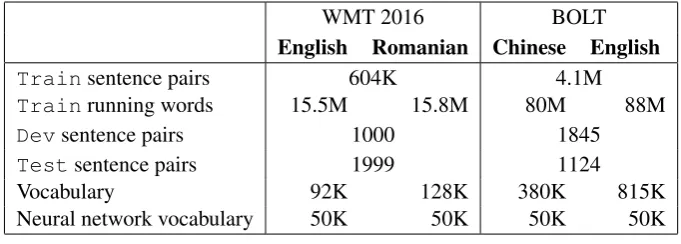
Chinese→English which is a discussion forum task. The corpora statistics are shown in Table (1). All transformer models use6encoder and6
de-coder self-attentive layers. We use 8 scaled dot
product attention heads and augment an additional alignment head to the source-to-target attention component. We use an embedding size of 512.
The size of feedforward layers is2048nodes. We
use source and target weight tying for the WMT English→Romanian task, and no tying for BOLT Chinese→English.
The structure of the RNN models is as follows. The English→Romanian lexical and alignment models use 1 bidirectional encoder layer. The
WMT 2016 BOLT English Romanian Chinese English
Trainsentence pairs 604K 4.1M
Trainrunning words 15.5M 15.8M 80M 88M
Devsentence pairs 1000 1845
Testsentence pairs 1999 1124
Vocabulary 92K 128K 380K 815K
[image:6.595.128.469.62.184.2]Neural network vocabulary 50K 50K 50K 50K
Table 1: Corpora statistics.
WMT En→Ro BOLT Zh→En
newstest2016 test # System Layer size PPL BLEU[%]
TER[%]
PPL BLEU[%]
TER[%]
baselines
1 Attention baseline 1000 10.2 24.7 58.9 8.0 20.0 65.6 2 Transformer baseline 2048 6.2 27.9 54.6 6.0 22.5 62.1
3 (Alkhouli and Ney,2017) 200 - 24.8 58.1 - -
-this work
[image:6.595.103.497.219.370.2]4 RNN Attention align.-biased 1000 7.2 26.4 56.1 5.6 19.6 62.3 5 Align.-assisted Transformer 2048 5.0 28.1 54.3 4.7 22.7 61.8
Table 2: Translation results for the WMT 2016 English→Romanian task and the BOLT Chinese→English
task. We include the lexical model perplexities.
Chinese→English models have1bidirectional
en-coder and 3 stacked unidirectional encoder lay-ers. All models use 2decoder layers. The
base-line attention models have similar structures. We use LSTM layers of 1000nodes and embeddings of size 620. We train using the Adam optimizer
(Kingma and Ba, 2015). All alignment models
predict source jumps of maximum width of 100
source positions (forward and backward).
The alignments used during training are the re-sult of IBM1/HMM/IBM4 training using GIZA++
(Och and Ney, 2003). All results are measured
in case-insensitive BLEU[%] (Papineni et al.,
2002). TER[%] scores are computed with
TER-Com (Snover et al., 2006). We implement the
models in Sockeye (Hieber et al.,2017), which al-lows efficient training of large models on GPUs.
6.1 Performance Comparison
Table (2) presents results on the two tasks. The RNN attention (row 1) and transformer (row 2) baselines are shown. The transformer baseline outperforms the attention baseline by a large mar-gin. We also include the English→Romanian system of Alkhouli and Ney (2017). This is
an alignment-based RNN attention system which uses 200-node layers. We also trained our own alignment-based RNN attention system us-ing larger layers of 1000 nodes. This is shown
in row 4. Our RNN system outperforms the pre-viously published alignment-based results (row 3) by1.6% BLEU and2.0% TER. This is due to the
increase in model size.
Our proposed alignment-assisted transformer system is shown in row 5. This system out-performs the RNN alignment-based system of row 4 by1.7% BLEU on the English→Romanian
task, establishing a new state-of-the-art result for alignment-based neural machine translation. We also achieve 3.1% BLEU improvement over our
WMT En→Ro BOLT Zh→En # Alignment #entries BLEU[%]
TER[%]
#entries BLEU[%]
TER[%]
1 Transformer baseline - 27.3 55.6 - 24.2 61.5
2 + dictionary 3.1K 29.7 55.4 4.6K 25.5 61.0
3 Alignment-assisted Transformer - 27.2 55.5 - 24.2 60.8
[image:7.595.95.503.62.153.2]4 + dictionary 3.1K 31.0 53.0 4.6K 26.4 58.6
Table 3: Improvements after using the dictionary of the development sets. The tokenized references of the English→Romanian and Chinese→English development sets have26.7K and46.6K running words
respectively.
0.9 1.2 1.5 1.8 2.1 2.4 2.7
0 0.1 0.2 0.3 0.4 0.5 0.6 0.7 0.8 0.9 22 24 26 28
speed-up
factor
BLEU[%]
threshold BLEU[%] speed-up factor
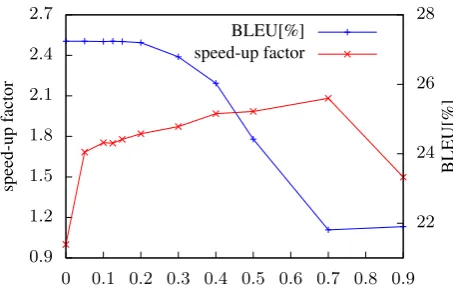
Figure 3: Speed up and translation quality in BLEU vs. pruning threshold on the WMT English→Romanian task.
on Chinese→English, indicating that the model is making use of the alignment information.
6.2 Decoding Speed Up
Figure (3) shows the speed-up factor and perfor-mance in BLEU over different threshold values. The speed-up factor is computed against the no-pruning case (i.e. threshold 0). The batch size
used in these experiments is5. We speed up
trans-lation by a factor of1.8without loss in translation
quality at threshold 0.15. Higher threshold val-ues result in more aggressive pruning and hence a degradation in translation quality. It is interesting to note that at threshold 0.05 we achieve a speed up of1.7, implying that significant pruning happens
at low threshold values. At high threshold values, speed starts to go down, since we have more cases where no alignment points survive the threshold, in which case pruning is disabled as discussed in Algorithm (1, lines16–17).
7 Dictionary Suggestions
We evaluate the use of attention weights as align-ments in a dictionary suggestion task, where a pre-defined dictionary of suggested one-to-one trans-lations is given. We perform a relaxed form of constrained translation, i.e. we do not ensure that the suggestion will make it to the translation. To this end, we use attention weights to extract the alignments at each time step during decod-ing as described in Section 5. We look up the source word fj(i) having the maximum accumu-lated attention weight in the dictionary. If the word matches the source-side of a dictionary entry, we enforce the translation to match the dictionary sug-gestion e(fj(i)) by setting an infinite cost for all
but the suggested word.
We create a simulated dictionary using the ref-erence side of the development set. We map the reference to the source words using IBM4 align-ment. The development set is concatenated with the training data to obtain good-quality alignment. We exclude English stop words,3 and only use
source words aligned one-to-one to target words. We include up to4dictionary entries per sentence,
and add reference translations only if they are not part of the baseline (i.e. unconstrained) transla-tion, similar to (Hasler et al.,2018).
Table (3) shows results for the dictionary sug-gestions task described in Section (7). The English→Romanian dictionary covers 11.6% of
the reference set, while the Chinese→English
dic-tionary has 9.9% coverage. We observe larger improvement when using the dictionary entries in the alignment-assisted transformer system in comparison to the transformer baseline systems. Our system improves BLEU by 3.8%, while the
baseline is improved only by2.4% BLEU on the
English→Romanian task. We also observe larger
[image:7.595.71.298.230.382.2]improvements in the Chinese→English case. This suggests that the maximum attention weights in alignment-assisted systems can point more accu-rately to the word being translated, allowing the use of more dictionary entries. As shown in Fig-ure (1), the accumulated attention weights are sharper when the system has an augmented align-ment head. This explains the larger improvealign-ments our systems achieve.
8 Conclusion
We proposed augmenting transformer models with an alignment head to help extract alignments in scenarios such as dictionary-guided transla-tion. We demonstrated that the alignment-assisted systems can achieve competitive per-formance compared to strong transformer base-lines. We also showed that the alignment-assisted systems outperformed standard transformer mod-els when used for dictionary-guided translation on two tasks. Finally, we achieved a speed-up factor of 1.8 by pruning alignment hypothe-ses in alignment-based decoding while maintain-ing translation quality. In future work we plan to investigate alternative pruning methods like histogram pruning. We also plan to investigate the performance of alignment-assisted transformer models in constrained decoding settings, where the user demands specific translation of certain words.
Acknowledgments
This research has received funding from the European Research Council (ERC) (under the European Union’s Horizon 2020 research and innovation programme, grant agreement No 694537, project “SEQCLAS”) and the Deutsche Forschungsgemeinschaft (DFG; grant agreement NE 572/8-1, project “CoreTec”). Tamer Alkhouli was partly funded by the 2016 Google PhD fel-lowship for North America, Europe and the Mid-dle East. The work reflects only the authors’ views and none of the funding parties is responsible for any use that may be made of the information it contains.
References
Tamer Alkhouli, Gabriel Bretschner, Jan-Thorsten Pe-ter, Mohammed Hethnawi, Andreas Guta, and Her-mann Ney. 2016. Alignment-based neural machine translation. InProceedings of the First Conference on Machine Translation, pages 54–65, Berlin, Ger-many.
Tamer Alkhouli and Hermann Ney. 2017. Biasing attention-based recurrent neural networks using ex-ternal alignment information. In EMNLP 2017 Second Conference on Machine Translation, pages 108–117, Copenhagen, Denmark.
Philip Arthur, Graham Neubig, and Satoshi Nakamura. 2016. Incorporating discrete translation lexicons into neural machine translation. In Proceedings of the 2016 Conference on Empirical Methods in Natu-ral Language Processing, pages 1557–1567, Austin, Texas.
Dzmitry Bahdanau, Kyunghyun Cho, and Yoshua Ben-gio. 2015. Neural machine translation by jointly learning to align and translate. InInternational Con-ference on Learning Representations, San Diego, Calefornia, USA.
Rajen Chatterjee, Matteo Negri, Marco Turchi, Mar-cello Federico, Lucia Specia, and Fr´ed´eric Blain. 2017. Guiding neural machine translation decod-ing with external knowledge. InProceedings of the Second Conference on Machine Translation, pages 157–168, Copenhagen, Denmark.
Wenhu Chen, Evgeny Matusov, Shahram Khadivi, and Jan-Thorsten Peter. 2016. Guided alignment train-ing for topic-aware neural machine translation. In Proceedings of the 2016 Conference of the Asso-ciation for Machine Translation in the Americas (AMTA), pages 121–134, Austin, Texas.
Trevor Cohn, Cong Duy Vu Hoang, Ekaterina Vy-molova, Kaisheng Yao, Chris Dyer, and Gholamreza Haffari. 2016. Incorporating structural alignment biases into an attentional neural translation model. InProceedings of the 2016 Conference of the North American Chapter of the Association for Computa-tional Linguistics: Human Language Technologies, pages 876–885, San Diego, California.
Josep Crego, Jungi Kim, Guillaume Klein, An-abel Rebollo, Kathy Yang, Jean Senellart, Egor Akhanov, Patrice Brunelle, Aurelien Coquard, Yongchao Deng, et al. 2016. Systran’s pure neu-ral machine translation systems. arXiv preprint arXiv:1610.05540.
Eva Hasler, Adri`a De Gisper, Gonzalo Iglesias, and Bill Byrne. 2018. Neural machine translation decoding with terminology constraints. InProceedings of the 2018 Conference of the North American Chapter of the Association for Computational Linguistics: Hu-man Language Technologies, pages 506–512, New Orleans, Louisiana, USA.
Felix Hieber, Tobias Domhan, Michael Denkowski, David Vilar, Artem Sokolov, Ann Clifton, and Matt Post. 2017. Sockeye: A toolkit for neural machine translation. arXiv preprint arXiv:1712.05690.
Chris Hokamp and Qun Liu. 2017. Lexically con-strained decoding for sequence generation using grid beam search. In Proceedings of the 55th Annual Meeting of the Association for Computational Lin-guistics (Volume 1: Long Papers), pages 1535– 1546, Vancouver, Canada.
Diederik P Kingma and Jimmy Ba. 2015. Adam: A method for stochastic optimization. In Interna-tional Conference on Learning Representations, San Diego, Calefornia, USA.
P. Koehn, F. J. Och, and D. Marcu. 2003. Statisti-cal Phrase-Based Translation. InProceedings of the 2003 Meeting of the North American chapter of the Association for Computational Linguistics (NAACL-03), pages 127–133, Edmonton, Alberta.
Haitao Mi, Zhiguo Wang, and Abe Ittycheriah. 2016. Supervised attentions for neural machine translation. In Proceedings of the 2016 Conference on Empiri-cal Methods in Natural Language Processing, pages 2283–2288, Austin, Texas.
Franz J. Och and Hermann Ney. 2003. A Systematic Comparison of Various Statistical Alignment Mod-els. Computational Linguistics, 29(1):19–51.
Kishore Papineni, Salim Roukos, Todd Ward, and Wei-Jing Zhu. 2002. Bleu: a Method for Automatic Evaluation of Machine Translation. In Proceed-ings of the 41st Annual Meeting of the Associa-tion for ComputaAssocia-tional Linguistics, pages 311–318, Philadelphia, Pennsylvania, USA.
Matt Post and David Vilar. 2018. Fast lexically con-strained decoding with dynamic beam allocation for neural machine translation. In Proceedings of the 2018 Conference of the North American Chapter of the Association for Computational Linguistics: Hu-man Language Technologies, Volume 1 (Long Pa-pers), pages 1314–1324. Association for Computa-tional Linguistics.
Matthew Snover, Bonnie Dorr, Richard Schwartz, Lin-nea Micciulla, and John Makhoul. 2006. A Study of Translation Edit Rate with Targeted Human Annota-tion. InProceedings of the 7th Conference of the As-sociation for Machine Translation in the Americas, pages 223–231, Cambridge, Massachusetts, USA.
Martin Sundermeyer, Tamer Alkhouli, Joern Wuebker, and Hermann Ney. 2014. Translation Modeling with Bidirectional Recurrent Neural Networks. In Con-ference on Empirical Methods on Natural Language Processing, pages 14–25, Doha, Qatar.
Akihiro Tamura, Taro Watanabe, and Eiichiro Sumita. 2014. Recurrent neural networks for word align-ment model. In52nd Annual Meeting of the Asso-ciation for Computational Linguistics, pages 1470– 1480, Baltimore, MD, USA.
Ashish Vaswani, Noam Shazeer, Niki Parmar, Jakob Uszkoreit, Llion Jones, Aidan N Gomez, Łukasz Kaiser, and Illia Polosukhin. 2017. Attention is all you need. InAdvances in Neural Information Pro-cessing Systems, pages 6000–6010.
Weiyue Wang, Derui Zhu, Tamer Alkhouli, Zixuan Gan, and Hermann Ney. 2018. Neural hidden markov model for machine translation. In Proceed-ings of the 56th Annual Meeting of the Associa-tion for ComputaAssocia-tional Linguistics (Volume 2: Short Papers), pages 377–382. Association for Computa-tional Linguistics.
Nan Yang, Shujie Liu, Mu Li, Ming Zhou, and Neng-hai Yu. 2013. Word alignment modeling with con-text dependent deep neural network. In51st Annual Meeting of the Association for Computational Lin-guistics, pages 166–175, Sofia, Bulgaria.
Lei Yu, Phil Blunsom, Chris Dyer, Edward Grefen-stette, and Tom´as Kocisk´y. 2017. The neural noisy channel. InProceedings of the International Conference on Learning Representations, volume abs/1611.02554.