Proceedings of the Third Conference on Machine Translation (WMT), Volume 1: Research Papers, pages 49–60
Coreference and Coherence in Neural Machine Translation:
A Study Using Oracle Experiments
Dario Stojanovski Alexander Fraser
Center for Information and Language Processing LMU Munich
{stojanovski,fraser}@cis.lmu.de
Abstract
Cross-sentence context can provide valuable information in Machine Translation and is crit-ical for translation of anaphoric pronouns and for providing consistent translations. In this paper, we devise simple oracle experiments targeting coreference and coherence. Oracles are an easy way to evaluate the effect of dif-ferent discourse-level phenomena in NMT us-ing BLEU and eliminate the necessity to man-ually define challenge sets for this purpose. We propose two context-aware NMT mod-els and compare them against modmod-els work-ing on a concatenation of consecutive sen-tences. Concatenation models perform better, but are computationally expensive. We show that NMT models taking advantage of context oracle signals can achieve considerable gains in BLEU, of up to 7.02 BLEU for corefer-ence and1.89BLEU for coherence on subti-tles translation. Access to strong signals al-lows us to make clear comparisons between context-aware models.
1 Introduction
Neural Machine Translation (NMT) (Bahdanau
et al.,2015) is a state-of-the-art approach to MT.
Standard NMT models translate an input language sentence to an output language sentence, and do not take into account discourse-level phenomena. Cross-sentence context has already proven useful
for language modeling (Ji et al., 2015;Wang and
Cho, 2016) and dialogue systems (Serban et al.,
2016). It has also been of interest in Statistical Machine Translation (SMT) research (Hardmeier,
2012;Hardmeier et al.,2013;Carpuat and Simard,
2012), and NMT research (Wang et al.,2017;Jean
et al.,2017;Tiedemann and Scherrer,2017;
Baw-den et al.,2018;Tu et al.,2017;Voita et al.,2018). Two important discourse phenomena for MT are coreference and coherence. Pronominal coref-erence relates to the issue of translating anaphoric
pronouns and is tackled in several works (Guillou,
2016;Hardmeier and Federico, 2010;Le Nagard
and Koehn,2010) and is the central motivation for
the DiscoMT shared task on cross-lingual pronoun
prediction (Lo´aiciga et al.,2017). Coherence on
the other hand, is important for producing consis-tent and coherent translations throughout a docu-ment, especially for domain-specific terminology
(Carpuat,2009;Ture et al.,2012;Gonzales et al.,
2017) and it is helpful to properly disambiguate polysemous words. Modeling discourse-level phe-nomena for MT is a challenging endeavor because of difficulties in acquiring relevant linguistic sig-nals. Measuring the effect of discourse-level phe-nomena with automatic metrics such as BLEU is
also difficult as pointed out byHardmeier(2012).
In this paper, we address these issues by propos-ing several oracle experimental setups for eval-uating the effect of coreference resolution (CR) and coherence in MT. Oracle experiments provide strong linguistic signals that enable strongly vis-ible effects on BLEU scores, thus alleviating the difficulty of using BLEU to evaluate discourse-level phenomena in MT. Oracles highlight the ca-pability of NMT systems to use context (which we call context-aware NMT) and to handle dif-ferent discourse-level phenomena. They provide a variety of scenarios that can easily be set up for any domain, dataset or language pair, unlike discourse-specific challenge sets (Bawden et al., 2018) which must be manually created. Further-more, strong linguistic signals from oracles enable us to easily study how the models use context.
Our primary task is translating subtitles from English to German. Subtitles provide for a reason-able diversity of topics necessary for testing coher-ence. They also contain a large amount of short, informal and conversational text, where anaphoric pronouns are very important. We study corefer-ence by aiding pronoun translation and cohercorefer-ence
by providing disambiguation signals for transla-tion of polysemous words. The oracles are auto-matically created and targeted for each discourse phenomenon. We additionally include a previous target sentence oracle, where the context consists of the previous target sentence, as a more generic way of including context. This is an interesting oracle, but this scenario is actually also beneficial for online post-editing, because the gold standard previous target sentence is available there.
We propose a simple, yet effective exten-sion to standard RNN models for NMT (which we refer to as NMT(RNN)) which models con-text by employing attention over word embed-dings only. We compare it against a standard NMT(RNN) model working on a concatenation of consecutive sentences (Tiedemann and Scherrer, 2017). Additionally, we evaluate the Transformer
(Vaswani et al.,2017) and propose a context-aware
NMT(Transformer) extension. Our oracles al-low us to compare the context-aware NMT mod-els with the baselines and make strong conclu-sions. Moreover, we study how comparable
ora-cles are with the challenge sets proposed by
Baw-den et al. (2018) by analyzing the performance
of our context-aware model with both approaches. Finally, we conduct a qualitative study and show the inner workings of context-aware models under different oracle settings.
Contributions: (i) We modify the data us-ing an oracle experimental setup in order to ac-commodate evaluating coreference and coherence in NMT. (ii) Our evaluation is independent of carefully constructed challenge sets, and can eas-ily be transferred across language pairs and do-mains. (iii) Results clearly show context-aware NMT(RNN) and NMT(Transformer) can improve performance over NMT models without access to context. (iv) We empirically analyze the pros and cons of the major approaches to context-aware NMT and explain how different modeling deci-sions interact with different discourse phenomena. (v) We present the trade-offs in modeling power versus speed that are important when considering multiple sentences of context.
2 Oracle Signals for Coreference and Coherence
Acquiring clean and strong context signals is a dif-ficult challenge and previous work has not pro-posed a way to do this on a larger scale. In our
work, we use oracles, where the context signals are strong and allow us to carry out clear analysis. We define three oracles which differ based on the context supplied to the model.
First, we define the previous target sentence or-acle where the context is the gold standard previ-ous target sentence. Second, we define the coref-erence or pronoun oracle where we simulate per-fect knowledge of gender and number for pronoun translation. Finally, we define the coherence or more specifically, the repeated words oracle where we help in identifying polysemous words and pro-viding the correct signal for disambiguation.
Each of these oracles is accompanied by a fair and a noisy oracle experimental setup. For the fair setup, we obtain the linguistic signals in a realis-tic way without having access to any target side knowledge. In the noisy oracle setups, we add ad-ditional target side information to the oracle sig-nals. This additional information is not necessarily relevant to the specific problem at hand (corefer-ence or coher(corefer-ence) and it is used to test the robust-ness of the models to identify the proper signals.
The oracle datasets are created in an automatic way. We only need to manually define the list of pronouns that will be taken into consideration in the coreference oracle.
Oracle Table 1 shows samples from our ora-cle setup. For each example we show the context, original source sentence, our modified oracle sen-tence and the target sensen-tence. The first two exam-ples show coreference (pronoun) oracle samexam-ples, while the third one a coherence (repeated words) oracle sample. The text in brackets shows which is the counterpart repeated target word or the gen-der of the noun the pronoun is referencing. It is not explicitly provided to the models. The text
preced-ing the special token!@#$in the oracle examples
is the input to the context part of the architecture. For coreference, we aid the model with pronoun translation as can be seen in example (c). In this
case,itrefers toRoman(meaningnovel), which is
apparent in the previous sentence (a). Without this information the model will have difficulties
gener-ating the proper translation er(the German
mas-culine pronoun agreeing withRoman).
the source pronouns with XPRONOUN and insert the target pronouns in the context of the main sen-tence, as in example (c).
The example shows that the context provides access to perfect knowledge of the coreferent, which in turn tells us the number and gender. However, the models still need to learn to use the correct pronouns. As we can see in example (g), there may be multiple pronouns in the context.
Since (g) is an imperative sentence, Sie does not
have a pronoun counterpart in the source and it is
used in conjunction with the German verb foruse.
Example (k) shows how we model the coher-ence phenomenon by using repeated words. Given
the English word source in a sentence without
helpful context, it would be impossible to disam-biguate between two possible translations of the
word:Quelle(a source of a fountain or figuratively
the source of information) or Ursprung (origin,
where something originates from). However, we see that the previous sentence (i) contains the rele-vant information to select the correct translation of
the Englishsource. The wordsourceis present in
the previous and current source sentence and
Ur-sprungis present in the previous and current target sentence. When we find at least one repeated word on both the source and target side, we mark the source word with a special token XREP and the repeated target word is used as context to the main source sentence. The intuition here follows
previ-ous work (Tu et al., 2017) where past translation
decisions are used for disambiguation. This ora-cle is admittedly weaker than the coreference one since it relies on the assumption that a polysemous word has already been seen in the text. However, if a word occurs in two consecutive sentences, it is likely that it will have the same translation.
For the previous target sentence oracle, we use the gold standard previous target sentence as con-text and don’t modify the main source sentence. We also setup experiments with 2 and 3 previous target sentences as context.
FairFor the fair coreference setup, we attempt
to acquire gender and number knowledge by using a coreference resolution tool, namely
CorefAnno-tator from Stanford CoreNLP1 (Clark and
Man-ning,2016a,b). We run the model on entire
doc-uments. We only modified sentences that contain a pronoun which has an antecedent in the previ-ous source sentence. Consequently, the pronoun is
1https://stanfordnlp.github.io/CoreNLP
context sentence
(a) Let me summarize the novel[masculine]for you.
source sentence (b) It presents a problem pronoun oracle sample
(c) er[masculine]!@#$ XPRONOUN It presents a problem.
target sentence
(d) Er pr¨asentiert ein Problem. context sentence
(e) But you have a charm[masculine]everyone else here seems
to respond to. source sentence (f) Use it. OK, sport?
multiple pronoun oracle sample
(g) Sie ihn[masculine]!@#$ Use XPRONOUN it. OK, sport?
target sentence (h) Setzen Sie ihn ein. context sentence
(i) When dealing with a crisis everyone knows you go right to the source[Ursprung].
source sentence
(j) God the source is pretty. repeated words oracle sample
(k) Ursprung !@#$ God the XREP source is pretty. target sentence
(l) Mann, so ein h¨ubscher Ursprung.
Table 1: Coreference and coherence oracle samples. For detailed explanation of the examples, refer to Section2.
marked and the antecedent is inserted into the con-text of the given sentence. In this way, we don’t utilize any target side knowledge.
For the fair coherence experiment, we don’t have access to target side information and we just put special emphasis on words that are polyse-mous candidates. As a result, we only use repeated source words. A repeated word is marked in the main sentence and it is used as context.
For the fair previous sentence experimental setup, we use the same models trained on the pre-vious target sentence oracle setup, but evaluate them by translating the previous source sentence with a baseline model and using this translation as context. Additionally, we train models where the previous sentence is from the source side.
3 Related Work
Bawden et al.(2018) is a recent work with
simi-larities to ours. They look at the scores computed by context-aware models using challenge sets, by comparing model scores on two perfect target lan-guage sentences differing only on a single choice of, e.g., gender for a pronoun, and providing two different contexts to try to obtain, e.g., masculine in the first case and feminine in the second case.
LikeBawden et al.(2018), we provide a focused
evaluation on coherence and coreference, but un-like their work, we do not depend on manually cre-ated datasets. Our simple oracles are a strong al-ternative to manually constructed challenge sets, as we can easily have a more diverse experimen-tal setup (our oracles can be defined for different languages, domains and datasets with little effort). Several approaches have been proposed for context-aware NMT that utilize a separate
mecha-nism to handle extra-sentential information.Wang
et al.(2017) integrate cross-sentence context using
gates in the decoder, which control information flow between the cross-sentence context and the current decoder state. However, the context repre-sentation is fixed at each decoding time step, while the model needs to focus on different parts of the
context.Tu et al.(2017) propose a caching
mecha-nism that stores previous translation decisions. As a result, this approach fails to take into account CR as stored translation decisions can’t be used to
address this phenomenon. Jean et al. (2017) and
Bawden et al.(2018) propose methods using a
sep-arate RNN-based context encoder.Tiedemann and
Scherrer (2017), propose concatenating the
pre-ceding sentence, both on source and target side and then using a standard NMT model. These ap-proaches are computationally expensive. They ei-ther have an extra RNN-based encoder (Jean et al.,
2017;Bawden et al., 2018) or work on very long
sentences (Tiedemann and Scherrer,2017).
A recent work by Voita et al.(2018) proposed
a context-aware Transformer model and provided an analysis of anaphora resolution in MT. Their proposed model is conceptually similar to our NMT(Transformer) model, differing in that the context is integrated in the encoder unlike our model which does it in the decoder.
We propose a simple NMT(RNN) model that only uses attention to encode the context and in-tegrates it with a gating mechanism (Wang et al., 2017). It provides for a better computational
ef-ficiency compared to models employing an extra RNN-based encoder. We also propose a context-aware Transformer model. In the experiments, we compare our models against a concatena-tion NMT(RNN) and NMT(Transformer) model
(Tiedemann and Scherrer,2017).
4 Context-Aware Models
4.1 Lightweight context-aware NMT(RNN) model
In this paper, we introduce a new lightweight context-aware model based on the attention
encoder-decoder model proposed by Bahdanau
et al. (2015). We introduce this context-aware
model to compare against the proposed model by
Tiedemann and Scherrer (2017) as an alternative
approach to handling context.
The encoder part of the model, takes the source
sentence X = (x1, x2, . . . , xTx) and generates a
set of annotation vectors{h1, h2, . . . , hTx}where
hi =
h−→
hi;←h−i
i
. −→hi and ←−hi are the i-th
hid-den states from the forward and backward recur-rent networks respectively. The decoder generates
one target symbol yi at a time by computing the
conditional probabilityp(yi|y1, y2, . . . , yi−1, x) =
f(yi−1, si, ci) where ci represents the attention
weighted sum of annotation vectors and is
com-puted as in (Bahdanau et al.,2015). Unlike
previ-ous approaches that model context by employing
an RNN-based encoder (Jean et al.,2017;Bawden
et al., 2018), we propose to utilize the capability
of the attention mechanism only. This provides for better computational efficiency, thus allowing the model to exploit larger context at a lower com-putational cost.
The context sentence is given as a sequence of
Xc = (xc
1, xc2, . . . , xcTc
x). We map the tokens to
the corresponding word embeddingswc
i. We share
all embeddings across the model, including the context ones. The attention on the cross-sentence context is conditioned on the previously generated
token yi−1 current candidate decoder state si−1
and attention weighted main sentence
representa-tion ci. Formally, the context sentence
represen-tation is computed as cc
i =
PTc x
j=1βijwj where
β ∝exp(fattc (yi−1, si−1, wj, ci)).
We integrate the context representation using
a gating mechanism (Wang et al., 2017) which
controls the flow of information between the cur-rent decoder state and the context representation.
The final decoder representation is computed as
si=fc(yi−1, si−1, ci, g⊗cci).
4.2 Transformer context-aware model
The Transformer (Vaswani et al., 2017) is an
encoder-decoder architecture which fully relies on attention. The encoder layers have two main components, a multi-head self-attention and a position-wise fully-connected feed-forward net-work. Each of these components is followed by a residual connection. In the self-attention sublayer, each word from the input sentence acts as a query, key and value when computing the attention. Each attention head uses the queries and keys to com-pute a dot product to which a softmax is applied in order to get the attention weights to score the values. Consequently, the representation of each word depends on all the others. The final repre-sentation is generated by concatenating the out-put of the separate attention heads and inout-putting it to the feed-forward network. The decoder on the other hand, has three sublayers. It starts by applying masked self-attention which is then used to compute multi-head attention over the encoder representation. This is then used as input to a feed-forward network as in the encoder.
The proposed context-aware model in this pa-per is built as an extension to the standard Trans-former. All embeddings including the context em-beddings are shared across the model. We mod-ify the encoder by sharing the parameters for the multi-head self-attention for the main and con-text sentence. However, we don’t share the feed-forward network after the self-attention.
The standard decoder computes a multi-head
at-tentionciover the main encoder representation
us-ing the output from the masked self-attentioncmi .
We add an additional multi-head attention over the
context representationcci as well. Before
comput-ing the context attention, the output of the masked self-attention is projected using a feed-forward network. The main and context multi-head self-attention representations are merged using a
gat-ing mechanism as si = gi ⊗ci + (1−gi) ⊗cci
wheregi=σ(Weci+Wccci +Wmcmi ).
5 Experiments
We train our models on OpenSubtitles2016 En-De
with ≈ 13.9M parallel sentences. The
develop-ment and test set consist of 6 and 7 docudevelop-ments ran-domly sampled from the dataset, containing 3172
and 4627 sentences respectively. In the
corefer-ence oracle setup ≈ 7.8M training samples were
modified and added the appropriate context, while
in the coherence setup only≈0.8M. The
remain-ing samples are unchanged and have no context. We apply tokenization, truecasing and BPE splitting computed jointly on both languages with 59500 operations. All sentences with length above 60 tokens are discarded. Batch size is 80. All
embeddings are tied (Press and Wolf, 2017)
in-cluding the ones in the context part of the
archi-tecture. Dropout (Gal and Ghahramani,2016) of
0.2 is applied and 0.1 on the embeddings. We
ap-ply layer (Ba et al., 2016) and weight
normaliza-tion (Salimans and Kingma, 2016). The models
are trained with early-stopping based on the de-velopment set’s cost. We report BLEU score on detokenized text.
Our RNN-based model is implemented as an
extension to Nematus2(Sennrich et al.,2017). We
used the Sockeye3(Hieber et al.,2017)
implemen-tation of the Transformer. For the Transformer we use hyper-parameters as similar as possible to the ones in the Nematus models. We additionally use label smoothing of value 0.1. Both, the base-line and context-aware model have 4 layers. We didn’t do any special hyper-parameter tuning for the context-aware models, so further performance improvements are possible. The datasets and the source code for our context-aware models are
pub-licly available4.
6 Experimental Results
6.1 Previous target sentence oracle
In this section, we discuss the effect of using
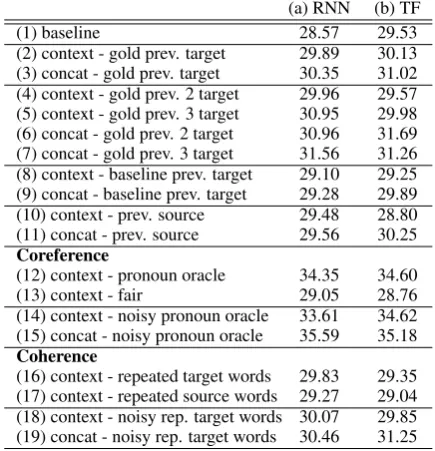
context in context-aware NMT. In Table 2 we
show the results for the three different oracle
setups. Experiment (1a) shows that a baseline
NMT(RNN) model obtains 28.57 BLEU on the
test set. The NMT(Transformer) baseline (1b)
on the other hand, achieves 29.53 BLEU. Us-ing the gold standard previous target sentence as context, provides for 1.32 BLEU improvement on the test for our context-aware NMT(RNN)
model(2a)and 1.78 BLEU for the concatenation
NMT(RNN) model (3a). Our proposed
context-2https://github.com/EdinburghNLP/
nematus
3https://github.com/awslabs/sockeye
4http://www.cis.uni-muenchen.de/
aware NMT(Transformer) model (2b) also im-proves upon the baseline, but only by 0.6 BLEU,
and the concatenation model(3b)closely follows
the RNN model, adding 1.49 BLEU.
We also evaluate the usefulness of larger
con-text. Using the previous 2 (6a) and 3 (7a)
sen-tences consistently adds ≈ 0.6 BLEU with the
concatenation NMT(RNN) model. The context-aware NMT(RNN) model, does not improve when
using 2 sentences(4a), but has large gains when
extending to 3 (5a). In our context-aware
mod-els, the larger context is handled by concatenat-ing all previous sentences. The context-aware
NMT(Transformer)(4b),(5b)was actually hurt by
the larger context. On the other hand, for the
con-catenation model(6b),(7b)we observed some
im-provements, but they were not as consistent as the gains for the NMT(RNN) model.
The results in (2ab), (3ab), (4ab), (5ab) (6ab),
(7ab)are obtained with models trained and
eval-uated with the gold standard previous target
sen-tences as context. In the fair experiments (8ab),
(9ab)we train with the gold standard previous
tar-get sentence as context, but then evaluate with translations of the previous source sentences ob-tained with the baseline model. This lowers the
performance of both NMT(RNN) models (8a),
(9a), but they still improve over the baseline.
Our context-aware NMT(Transformer) model(8b)
slightly lowers performance compared to the
base-line, unlike the concatenation model(9b).
Additionally, we train context-aware mod-els where the previous sentence is obtained
from the source side (10ab), (11ab). Even in
such a scenario, context-aware and concatena-tion NMT(RNN) models obtain improvements
over the baseline. Again, the concatenation
NMT(Transformer) shows improvements over the baseline. The context-aware NMT(Transformer) was not able to make use of the source side infor-mation. Given that the encoder representations are shared this is to some extent surprising and sug-gests that additional encoder components are nec-essary to model the contextual representation.
6.2 Coreference
Results for coreference are also shown in Table2.
Experiments(12a)and(12b)show the results we
obtained with the pronoun oracle setup. It is clear that NMT can benefit from strong coreference sig-nals. We observed a large difference between the
(a) RNN (b) TF
(1) baseline 28.57 29.53
(2) context - gold prev. target 29.89 30.13 (3) concat - gold prev. target 30.35 31.02 (4) context - gold prev. 2 target 29.96 29.57 (5) context - gold prev. 3 target 30.95 29.98 (6) concat - gold prev. 2 target 30.96 31.69 (7) concat - gold prev. 3 target 31.56 31.26 (8) context - baseline prev. target 29.10 29.25 (9) concat - baseline prev. target 29.28 29.89 (10) context - prev. source 29.48 28.80 (11) concat - prev. source 29.56 30.25
Coreference
(12) context - pronoun oracle 34.35 34.60 (13) context - fair 29.05 28.76 (14) context - noisy pronoun oracle 33.61 34.62 (15) concat - noisy pronoun oracle 35.59 35.18
Coherence
[image:6.595.307.525.63.289.2](16) context - repeated target words 29.83 29.35 (17) context - repeated source words 29.27 29.04 (18) context - noisy rep. target words 30.07 29.85 (19) concat - noisy rep. target words 30.46 31.25
Table 2: BLEU scores from all of the oracle experimental setups on the test set. Results in the first column correspond to the NMT(RNN) context-aware and concatenation models while the second column to the NMT(Transformer) ones. The number in brackets in each line is used to indicate the corre-sponding experiment throughout the text.
improvements on the development and the test set, probably because this phenomenon is not equally prominent in the datasets. In the absence of perfect CR, this setup is a reasonable proxy for obtaining coreference signals and gender information, and the context-aware models achieve large improve-ments over their respective baselines.
Experiments (13a) and (13b) show the results
for the fair coreference setup. Using a CR tool, we identified the appropriate antecedents (to current sentence pronouns) in the previous source sen-tence and used them as context. The results show small improvements on the test set. This signal
is significantly weaker. Moreover, only ≈ 0.3M
samples had a non-empty context, meaning a pro-noun was referring to a coreferent as identified by the CR tool. These results show that while weak, the context-aware NMT(RNN) model is able to utilize this signal. The NMT(Transformer) model on the other hand, was significantly hurt by this setup. We attribute this to the model not being able to handle scenarios where the majority of the sam-ples are without context information.
In the noisy pronoun oracle setup, the context consists of the previous gold standard target sen-tence to which we append the target side pronouns as in the previously outlined pronoun oracle setup.
ob-serve that the context-aware NMT(RNN) model
(14a)is actually hurt by the extra information in
the form of previous target sentence. We attribute the decrease to the model learning to strongly at-tend to all pronouns in the context. As such, in some cases, it chooses to attend to a pronoun from the previous sentence which ends up acting as noise in these models. Using oracles allowed us to easily find this important weakness in our model design. The context-aware NMT(Transformer)
model (14b) is more robust to noise and had no
problems identifying the appropriate information. Using the same setting for the concatenation
NMT(RNN) model (15a), achieves best
perfor-mance with an absolute gain of 7.02 BLEU. Based
on the obtained results in (3a), we conclude that
the effects in(15a)are a compound of the
capabil-ity of concatenation models to make use of the pre-vious sentence and target side pronouns. The same effects can be observed for the NMT(Transformer)
concatenation model as well(15b). However,
de-spite the concatenation Transformer being able to obtain better results for the previous target sen-tence and pronoun oracle than the RNN model, the compound effect is not as strong.
6.3 Coherence
Table2shows the results we obtained for the
co-herence experimental setup. For the oracle setup, we identify repeated source and target words in the previous and current sentence, mark the source words and insert the target words in the context. For the fair setup, we insert repeated source words in the context. The aim with this scenario is to em-phasize which words are potentially important for disambiguation. Moreover, in the oracle setup, we provide the presumably gold standard translation of the repeated word in the appropriate context.
Both scenarios (16a), (17a) obtain
improve-ments over the baseline with the NMT(RNN) model, although not as strong as the gains with the pronoun oracle. One reason is that the num-ber of samples with context is significantly smaller than the pronoun oracle. Another potential reason is that coherence is already modeled well by the baseline. The results indicate that obtaining coher-ence and disambiguating signals from past trans-lation decisions, whether from an oracle such as in our work or from the model itself (Tu et al., 2017) is difficult. Nevertheless, the noticeable gains in BLEU we observed in our experiments
confirm that further improvements can be made. The context-aware NMT(Transformer) is hurt by
these oracle setups as shown in experiments(16b)
and(17b)because of the lack of sufficient context.
Table 2 presents the results for the noisy
co-herence oracle. The context-aware NMT(RNN)
model (18a)obtains improvement over the
base-line of 1.5 BLEU and the concatenation model
(19a)of 1.89 BLEU. This is likely a compound
ef-fect of having access to the entire previous target
sentence as in(2a)and(3a) and the weak signals
in the form of pointers to where disambiguation is necessary. This is to some extent matched by the
Transformer experiments(18b),(19b).
6.4 Comparison with challenge sets
In order to assess the quality of our oracles, we also set them up on OpenSubtitles2016 En-Fr and compare them against the challenge sets proposed
inBawden et al.(2018). This allows us to compare
the two methods and show whether we can draw similar conclusions about a model when evaluat-ing it with both the oracles and challenge sets. For simplicity, we only evaluate our proposed context-aware NMT(RNN) model. We randomly sampled documents from the En-Fr dataset to create a de-velopment and test set. The challenge sets are used
as provided byBawden et al.(2018). We set up the
oracles in the same way as for En-De. However, in
French the pronounsle,laandlescan also be used
as definite articles. Therefore, we used MarMoT
(Mueller et al.,2013) to filter out these instances.
We compare the methods by measuring the im-provements a context-aware model achieves over a baseline, on our oracles and on the challenge sets. Since our oracles use target side knowledge, we use the version of the challenge sets where the previous sentence is from the target side. This provides for a fairer comparison. We train our context-aware model on the pronoun and repeated words oracle. In order to evaluate the model on the challenge sets, we train the model with the gold standard previous target sentence as context.
ob-pronoun oracle meine er !@#$ XPRONOUN My reading of the prophecy is that XPRONOUN it will come in 2012 reference Meine Textstudien ergeben, daß er 2012 kommen wird
baseline Mein Lesen der Prophezeiung lautet, dasses2012 kommen wird context Meine Lesung der Prophezeiung ist, dass er 2012 kommen wird repeated words
oracle Abneigung Romulaner !@#$ If you had seen them kill your parents, you would XREP understand itis always the XREP time for those XREP feelings. reference H¨oatten Sie mit angesehen, wie Ihre Eltern get¨otet werden... Meine Abneigung gegen die Romulaner
ist universell.
baseline Wenn du gesehen h¨attest, wie sie deine Eltern t¨oten w¨urden, w¨urdest du verstehen, dass es immer die Zeit f¨ur dieseGef¨uhleist.
context Wenn du gesehen h¨attest, wie sie deine Eltern get¨otet haben, w¨urdest du verstehen, dass es immer die Zeit f¨ur diese Abneigung ist.
prev. sent. oracle Er dachte, die Geschichte handelte von einem Fisch. !@#$ It isn’t? reference Tut sie nicht?
[image:8.595.307.516.268.509.2]baseline Istesnicht? context Istesnicht?
Table 3: Samples from the qualitative analysis.
tains small gains for coherence and larger ones for coreference. The context-aware model we trained with the previous target sentence as con-text, scored 63.0% and 54.0%, on the corefer-ence and cohercorefer-ence challenge set, respectively. From these results we also can conclude that our model is reasonably powerful to handle corefer-ence and marginally improves cohercorefer-ence. These results show that challenge sets and oracles pro-vide comparable results when evaluating discourse in MT. However, our oracle setups are easier to de-fine and control.
6.5 Qualitative study
In this section, we show examples from our ora-cle setups and provide visualizations of the extra-sentential attention for our context-aware and the concatenation NMT(RNN) model (Tiedemann
and Scherrer,2017). We also show the activations
of the decoder gates which control the context in-formation flow. This can help us understand how the models make decisions at each time step.
In Table3we show the pronoun, repeated words
and previous target sentence oracles and com-pare the output from a baseline and our proposed context-aware model against the reference transla-tion. For simplicity, in the visualizations for the concatenation model, we only present the atten-tion over the previous sentence and the sentence separating token SEP.
The first row in Table3shows a pronoun oracle
sample. In this case, it refers tocomet. It is
ob-vious that there is not sufficient information in the
main sentence alone to properly translateitand the
baseline model falls back to the data-driven prior,
which is to generatees.
meine er </s>
meine Les@@ ung der Prophezeiung ist , dass er 2012 kommen wird ... </s>
(a) Pronoun
Ab@@neigungRomulaner</s>
wenn du gesehen hättest , wie sie deine Eltern getötet haben , würdest du verstehen, dass es immer die Zeit für diese Ab@@ neigung ist . </s>
(b) Repeated words
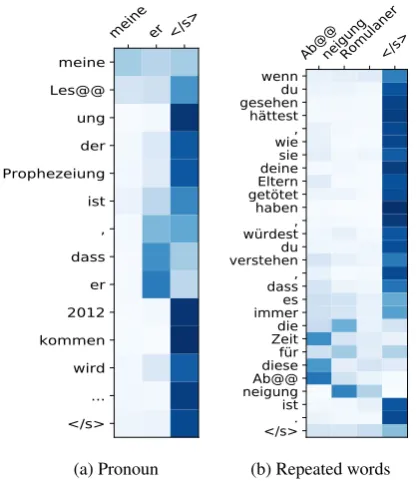
Figure 1: Context attention for the pronoun and repeated words oracles.
From the visualization in Figure1awe see that
our context-aware model pays attention to the
ap-propriate pronoun (meine,er). From Figure3we
see that for this example, the noisy oracle shows the same behavior and correctly ignores the noise.
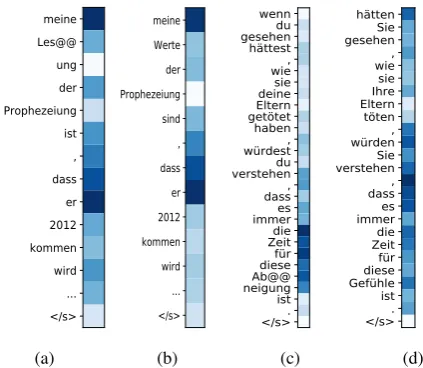
Furthermore, Figure 2a and Figure 2b show that
the gate activations follow the intuitive assump-tion that they should be high when generating pro-nouns. Our model in the noisy pronoun oracle produced a correct translation, but it still weakly paid attention to irrelevant parts of the sentence.
From Figure 4 we see that concatenation model
meine Les@@ ung der Prophezeiung ist , dass er 2012 kommen wird ... </s> (a) meine Werte der Prophezeiung sind , dass er 2012 kommen wird ... </s> (b) wenndu gesehenhättest , wie sie deine Eltern getötethaben , würdest du verstehen , dasses immerdie Zeitfür diese Ab@@ neigung ist. </s> (c) hätten Sie gesehen , wie sie Ihre Eltern töten , würden Sie verstehen , dass es immer die Zeit für diese Gefühle ist . </s> (d)
Figure 2: Gate activations for pronoun and repeated words oracles. (a) pronoun oracle, (b) noisy pronoun oracle, (c) -repeated words oracle, (d) - noisy -repeated words oracle.
ein Prinz mit wall@@ end gol@@ den@@ em Haar das ist eine Metapher für einen Kome@@ ten . meine er </s>
[image:9.595.306.522.281.459.2]meineWerte der Prophezeiung sind, dass er 2012 kommen wird ... </s>
Figure 3: Context attention of our proposed model on the noisy pronoun oracle.
ein Prinz mit wall@@ end gol@@ den@@ em Haar das ist eine Metapher für einen Kome@@ ten . meine er SEP
meine Werte der Prophezeiung sind , dass er 2012 ... </s>
Figure 4: Attention over the previous sentence of the con-catenation model on the noisy pronoun oracle.
The second sample is selected from the repeated words oracle setup. Because the reference transla-tion does not exactly match the source sentence, there is a small mismatch between the repeated words on the source and target side. However,
we see that without the contextual signal that
feel-ingsin this case refers to adverse feelings(as
in-dicated by Abneigung) the baseline falls back to
the more common translation Gef¨uhle. We also
looked at the previous sentence which did not have
any context information and both the baseline and
the context-aware model generatedGef¨uhle.
Figure 1b shows that the context-aware model
has no problem attending to the disambiguating
signal (Abneigung) and it also uses this signal
when generating the determiner dieses which is
dependent on the noun. However, we also can ob-serve that given the incorrect indication to look at
the context when translating time, it also has
at-tention activation over the context as well. This is closely followed by the gate activations in Figure 2c. The same doesn’t happen when translating the
marked source tokenunderstand. This is probably
because the model is confident that it doesn’t need
context when translatingunderstand.
ich kann Ihre XREP Ab@@ neigung gegen die XREP Romulanerbegreifen , aber Sie sollten ihr nicht folgen . </s>
[image:9.595.74.293.309.426.2]hättenSie gesehen,wie sie Ihre Eltern töten, würdenSie verstehen,dass es immerdie Zeitfür diese Gefühle ist. </s>
Figure 5: Context attention of our proposed model on the noisy repeated words oracle.
From Figure 5 and Figure 2d we see that the
context-aware model in a noisy repeated words oracle setting has difficulties identifying the co-herence information and when to use it. It tends to pay attention to certain words throughout the whole sequence generation. This is likely a side effect of having access to the previous target sen-tence which in other cases provides useful infor-mation. Although it pays attention to the
appro-priate repeated word (Abneigung), it still fails to
generate it. Since the concatenation model uses an RNN over the context, it has no problem identify-ing the disambiguatidentify-ing signal, marked with XREP
and generates it accordingly (Figure6).
We also did an analysis of the previous target sentence oracle as well as the models that use the previous source sentence as context. We looked at examples where there is an anaphoric pronoun
[image:9.595.73.290.478.577.2]ich kann Ihre XREP Ab@@ neigung gegen die XREP Romulaner begreifen , aber Sie sollten ihr nicht folgen . SEP
[image:10.595.80.292.69.243.2]wenn Sie sie gesehen hätten , würden Sie verstehen , dass es immer die Ab@@ neigung gegen die Romulaner ist . </s>
Figure 6: Attention over the previous sentence of the con-catenation model on the noisy repeated words oracle.
context-aware model tends to pay attention to a single noun, while in the previous target sentence oracle, it looks at more explicit gender informa-tion, such as pronouns, articles etc. This is
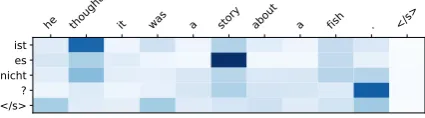
illus-trated in the last example in Table3and Figure7
and8. In this case, itrefers to die Geschichteor
story. When translatingitboth models paid atten-tion to the appropriate place in the previous sen-tence, but failed to generate the correct pronoun
sie. For this particular example, the concatenation
model paid no attention to the previous sentence.
er dachte , die Geschichtehandelte von einem Fisch . </s> ist
[image:10.595.75.291.464.529.2]es nicht ? </s>
Figure 7: Context attention of our proposed model on the previous target sentence.
he thought it was a story about a fish . </s> ist
es nicht ? </s>
Figure 8: Context attention of our proposed model on the previous source sentence.
6.6 Model inference speed
Although the concatenation model performs better than our context-aware model, an important con-sideration when working with context-aware NMT is computational efficiency. We compared infer-ence times for the RNN models on the
develop-ment set. We report times with context size of 1, 2 and 3 previous sentences.
The context model took 1233 seconds to de-code the development set, while the concatenation model 2063 seconds. The concatenation model
took additional≈900seconds for each additional
context sentence. Because our context-aware im-plementation is not tightly dependent on context length, there are no considerable drops in speed. This is a disadvantage of the concatenation ap-proach. If one is to use large context, or even entire documents, the problem quickly becomes very computationally expensive. This highlights the necessity of specialized context-aware mod-els. Since the Transformer can be more easily parallelized, there is still room for improving the computational performance of our context-aware Transformer. As a result, we leave such a compar-ison for future work.
7 Conclusion and Future Work
We used simple oracles to look at discourse-level phenomena in MT. We compared context-aware NMT models and show that these approaches pro-vide large gains in BLEU for coreference and coherence given clear oracle signals. We also showed that even when using fair signals, such as the previous source sentence or a system transla-tion of the previous target sentence, NMT mod-els benefit and make use of the extra informa-tion. Some future work in context-aware NMT can focus on using the standard NMT architecture, which performs well. However, if one requires ac-cess to larger context, vanilla NMT will have diffi-culties scaling in terms of speed and perhaps even in modeling ability. For this reason, a promising way forward is studying different ways of model-ing and integratmodel-ing context that support fast infer-ence. Oracle experiments will allow us to quickly test interesting modeling differences.
Acknowledgments
We would like to thank the anonymous review-ers for their valuable input and Daniel Ledda for his help with examples. This project has re-ceived funding from the European Research Coun-cil (ERC) under the European Union’s Horizon 2020 research and innovation programme (grant
[image:10.595.76.289.569.628.2]References
Jimmy Lei Ba, Jamie Ryan Kiros, and Geoffrey E Hin-ton. 2016. Layer normalization. arXiv preprint arXiv:1607.06450.
Dzmitry Bahdanau, Kyunghyun Cho, and Yoshua Ben-gio. 2015. Neural machine translation by jointly learning to align and translate. In Proceedings of the 3rd International Conference on Learning Rep-resentations, ICLR ’15. ArXiv: 1409.0473.
Rachel Bawden, Rico Sennrich, Alexandra Birch, and Barry Haddow. 2018. Evaluating Discourse Phe-nomena in Neural Machine Translation. InNAACL 2018, New Orleans, USA.
Marine Carpuat. 2009. One translation per discourse. InProceedings of the Workshop on Semantic Evalu-ations: Recent Achievements and Future Directions, pages 19–27.
Marine Carpuat and Michel Simard. 2012. The trouble with smt consistency. InProceedings of the Seventh Workshop on Statistical Machine Translation, pages 442–449.
Kevin Clark and Christopher D. Manning. 2016a. Deep reinforcement learning for mention-ranking coreference models. In Proceedings of the 2016 Conference on Empirical Methods in Natural Lan-guage Processing, pages 2256–2262.
Kevin Clark and Christopher D. Manning. 2016b. Im-proving coreference resolution by learning entity-level distributed representations. InProceedings of the 54th Annual Meeting of the Association for Com-putational Linguistics (Volume 1: Long Papers), pages 643–653.
Yarin Gal and Zoubin Ghahramani. 2016. A theoret-ically grounded application of dropout in recurrent neural networks. InAdvances in neural information processing systems, pages 1019–1027.
Annette Rios Gonzales, Laura Mascarell, and Rico Sennrich. 2017. Improving word sense disambigua-tion in neural machine transladisambigua-tion with sense embed-dings. InProceedings of the Second Conference on Machine Translation, pages 11–19.
Liane Kirsten Guillou. 2016. Incorporating pronoun function into statistical machine translation. Ph.D. thesis, The University of Edinburgh, UK.
Christian Hardmeier. 2012. Discourse in statistical ma-chine translation. a survey and a case study. Dis-cours. Revue de linguistique, psycholinguistique et informatique. A journal of linguistics, psycholin-guistics and computational linpsycholin-guistics, (11). Christian Hardmeier and Marcello Federico. 2010.
Modelling pronominal anaphora in statistical ma-chine translation. In IWSLT (International Work-shop on Spoken Language Translation); Paris, France; December 2nd and 3rd, 2010., pages 283– 289.
Christian Hardmeier, Sara Stymne, J¨org Tiedemann, and Joakim Nivre. 2013. Docent: A document-level decoder for phrase-based statistical machine trans-lation. In ACL 2013 (51st Annual Meeting of the Association for Computational Linguistics); 4-9 Au-gust 2013; Sofia, Bulgaria, pages 193–198.
Felix Hieber, Tobias Domhan, Michael Denkowski, David Vilar, Artem Sokolov, Ann Clifton, and Matt Post. 2017. Sockeye: A Toolkit for Neural Machine Translation. ArXiv e-prints.
Sebastien Jean, Stanislas Lauly, Orhan Firat, and Kyunghyun Cho. 2017. Does neural machine trans-lation benefit from larger context? arXiv preprint arXiv:1704.05135.
Yangfeng Ji, Trevor Cohn, Lingpeng Kong, Chris Dyer, and Jacob Eisenstein. 2015. Document context lan-guage models. arXiv preprint arXiv:1511.03962.
Ronan Le Nagard and Philipp Koehn. 2010. Aiding pronoun translation with co-reference resolution. In
Proceedings of the Joint Fifth Workshop on Statis-tical Machine Translation and MetricsMATR, pages 252–261.
Sharid Lo´aiciga, Sara Stymne, Preslav Nakov, Chris-tian Hardmeier, J¨org Tiedemann, Mauro Cettolo, and Yannick Versley. 2017. Findings of the 2017 discomt shared task on cross-lingual pronoun pre-diction. InThe Third Workshop on Discourse in Ma-chine Translation.
Thomas Mueller, Helmut Schmid, and Hinrich Sch¨utze. 2013. Efficient higher-order CRFs for mor-phological tagging. In Proceedings of the 2013 Conference on Empirical Methods in Natural Lan-guage Processing, pages 322–332, Seattle, Wash-ington, USA.
Ofir Press and Lior Wolf. 2017. Using the output em-bedding to improve language models. In Proceed-ings of the 15th Conference of the European Chap-ter of the Association for Computational Linguistics: Volume 2, Short Papers, pages 157–163.
Tim Salimans and Diederik P Kingma. 2016. Weight normalization: A simple reparameterization to ac-celerate training of deep neural networks. In Ad-vances in Neural Information Processing Systems, pages 901–909.
Rico Sennrich, Orhan Firat, Kyunghyun Cho, Alexan-dra Birch, Barry Haddow, Julian Hitschler, Marcin Junczys-Dowmunt, Samuel L¨aubli, Antonio Valerio Miceli Barone, Jozef Mokry, and Maria Nadejde. 2017. Nematus: a toolkit for neural machine trans-lation. InProceedings of the Software Demonstra-tions of the 15th Conference of the European Chap-ter of the Association for Computational Linguistics, pages 65–68.
Building end-to-end dialogue systems using gener-ative hierarchical neural network models. InAAAI, pages 3776–3784.
J¨org Tiedemann and Yves Scherrer. 2017. Neural ma-chine translation with extended context. In Proceed-ings of the Third Workshop on Discourse in Machine Translation, pages 82–92.
Zhaopeng Tu, Yang Liu, Shuming Shi, and Tong Zhang. 2017. Learning to remember translation history with a continuous cache. arXiv preprint arXiv:1711.09367.
Ferhan Ture, Douglas W Oard, and Philip Resnik. 2012. Encouraging consistent translation choices. InProceedings of the 2012 Conference of the North American Chapter of the Association for Computa-tional Linguistics: Human Language Technologies, pages 417–426.
Ashish Vaswani, Noam Shazeer, Niki Parmar, Jakob Uszkoreit, Llion Jones, Aidan N Gomez, Łukasz Kaiser, and Illia Polosukhin. 2017. Attention is all you need. InAdvances in Neural Information Pro-cessing Systems, pages 6000–6010.
Elena Voita, Pavel Serdyukov, Rico Sennrich, and Ivan Titov. 2018. Context-Aware Neural Machine Trans-lation Learns Anaphora Resolution. In Proceed-ings of the 56th Annual Meeting of the Association for Computational Linguistics (Volume 1: Long Pa-pers), pages 1264–1274, Melbourne, Australia.
Longyue Wang, Zhaopeng Tu, Andy Way, and Qun Liu. 2017. Exploiting cross-sentence context for neural machine translation. In Proceedings of the 2017 Conference on Empirical Methods in Natural Language Processing, pages 2826–2831.