Proceedings of the Third Conference on Machine Translation (WMT), Volume 2: Shared Task Papers, pages 809–815
Alibaba Submission for WMT18 Quality Estimation Task
Jiayi Wang∗, Kai Fan∗, Bo Li, Fengming Zhou, Boxing Chen, Yangbin Shi, Luo Si
Machine Intelligence Technology Lab, Alibaba Group Hangzhou, China
{joanne.wjy, k.fan, shiji.lb, zfm104435, boxing.cbx, taiwu.syb, luo.si}@alibaba-inc.com
Abstract
The goal of WMT 2018 Shared Task on Trans-lation Quality Estimation is to investigate au-tomatic methods for estimating the quality of machine translation results without reference translations. This paper presents the QE Brain system, which proposes the neural Bilingual Expert model as a feature extractor based on conditional target language model with a bidi-rectional transformer and then processes the semantic representations of source and the translation output with a Bi-LSTM predictive model for automatic quality estimation. The system has been applied to the sentence-level scoring and ranking tasks as well as the word-level tasks for finding errors for each word in translations. An extensive set of experimen-tal results have shown that our system outper-formed the best results in WMT 2017 Qual-ity Estimation tasks and obtained top results in WMT 2018.
1 Introduction
Quality Estimation (QE) is a task to estimate the quality of a Machine Translation (MT) system without the presence of any manually annotated reference translations. It can serve in a vari-ety of computer-aided scenarios such as tion results screening before release or transla-tion quality comparison between different MT sys-tems. Currently, the classical and widely-used method to evaluate an MT system is measured by BLEU (Papineni et al., 2002), a statistical language-independent metric that requires human golden references for validation. What if we ex-pect to efficiently get the detailed quality evalua-tion feedbacks (e.g. sentence or token-wise scor-ing) from an extremely large number of machine translation outputs? An automatic method with no access to any reference is highly appreciated.
∗
* indicates equal contribution.
The common approach to automatic translation quality estimation is to transform the problem into a supervised regression or classification task for sentence-level scoring and word-level labeling re-spectively. Traditional baseline models in WMT 12-17 have two modules: human-crafted rule-based feature extraction model via QuEst++ ( Spe-cia et al.,2015) (sentence-level task) or Marmot1
(word-level task); and an SVM regression with an RBF kernel as well as grid search algorithms for predicting how much effort is needed to fix translations to acceptable results (sentence-level task) or a sequence-labeling model with CRFSuit toolkit to predict which word in the translation output needs to be edited (word-level task). A recently proposed predictor-estimator model with stack propagation (Kim et al., 2017) is a recur-rent neural network (RNN) based feature extrac-tor and quality prediction model that ranked first place in WMT17. Another novel method is to train an Automatic Post-Editing (APE) system and adapt it to predict sentence-level quality scores and word-level quality labels (Martins et al.,2017). A promising APE system can serve as a guidance to QE system by explicitly explaining errors in the translation output.
Our submitted system for sentence and word level QE tasks in WMT18, namedQE Brain has two phases: feature extraction and quality estima-tion. In the phase of feature extraction, it extracts high-level latent joint semantics and alignment in-formation between the source and the translation output, relying on the “neural Bilingual Expert model” introduced byFan et al.(2018) as a prior knowledge model, which is trained on a large par-allel corpus. The high-level latent semantic tures and manually designed mis-matching fea-tures (Fan et al., 2018) exported from the prior
1https://github.com/qe-team/marmot
knowledge model are fed into a predictive model in the phase of quality estimation, with which the scoring prediction for the sentence-level task and erroneous or missing word predictions for the word-level task are targeted. This paper presents our submissions for the WMT18 Quality Estima-tion English-German and German-English Shared Tasks, namely, (i) a sentence-level QE scoring pre-diction system and (ii) a word-level QE labeling prediction system including word predictions and gap predictions. Since both systems are supposed to understand the complex semantic relationship between the source and the translation output, the features produced by a pre-trained neural Bilin-gual Expert model can be shared by the two level tasks per language direction.
In Section 3, we will discuss several techniques to boost our system’s performance. We make use of extra human-crafted baseline features including basic descriptive statistics, language model (LM) probabilities and alignments information of the source and the translation output. They are com-bined with features from the neural Bilingual Ex-pert model to predict the sentence-level scores. In addition, to make up the shortage of QE train-ing data, we apply the round-trip translation tech-nique to generate some artificial QE data that in-creases the error diversity and prevents overfitting. To further enhance our model’s performance, we use a greedy algorithm based ensemble selection method to decrease the individual error among a bunch of single quality estimation models.
2 QE Brain Baseline Model
QE Brain base single model contains a feature ex-tractor and a quality estimator. The feature extrac-tor relies on the Bilingual Expert model to extract features representing latent semantic information of the source and translation pair. These features will be fed into a quality estimator to estimate the translation quality.
The Bilingual Expert model uses self-attention mechanism and transformer neural networks to construct a bidirectional transformer architecture (Fan et al., 2018), serving as a conditional lan-guage model. It is used to predict every sin-gle word in the target sentence given the entire source sentence and its context . The Bilingual Expert model consists of three modules: (i) trans-former self-attention based encoder for the source sentence, (ii) forward and backward encoders for
the target sentence with the masked self-attention in the transformer decoder module, (iii) recon-struction for the target sentence. Once the model is fully trained, we can use the prior knowledge learned from the Bilingual Expert model to extract the features for the subsequent translation quality estimator. There are two kinds of features upon the Bilingual Expert model defined by Fan et al.
(2018): model derived features of latent represen-tations and manually extracted mismatching fea-tures.
When we perform quality estimation on a source and translation pair, we need to obtain the semantics information of the source and the translation output and their alignment informa-tion. We can assume that it is more likely for the model to predict a correct target word if only few words around it are incorrect. Fan et al. (2018) claims that both the latent representations of the k-th word in the translation output and its mis-matching features that reflect the error severity if it is a mistake are sufficiently beneficial to the down-stream quality predictive model. Choices of the quality estimation models are compared as well. It is found that the bi-directional LSTM (Graves and Schmidhuber,2005) will be appropriate in the QE situation. We treat the feature extraction model based on the neural Bilingual Expert model and the quality estimation based on Bi-LSTM model as our baseline system.
3 Boosting the QE Model Performance
3.1 Human-crafted Features
Along with the features produced by the Bilingual Expert model, we extract another 17 QE baseline features for the sentence-level task using QuEst++ and additional resources (source and target cor-pora, language models, ngram counts and lexical translation tables) provided on the WMT18 QE website2. Kozlova et al. (2016) verifies the
sig-nificance of these features using Random Forest (Breiman,2001). Four of them are the most cru-cial among all according to their degrees of impor-tance.
- percentage of trigrams in quartile 4 of fre-quency of source words in a corpus of the source language
- LM probability of source sentence 2http://www.statmt.org/wmt18/
- percentage of bigrams in quartile 4 of fre-quency of source words in a corpus of the source language
- average number of translations per source word in the sentence
Language models (LM) assign probabilities to generate hypotheses in the target language in-forming lexical selection in statistical machine translation (SMT). It is reasonable that three of the above four baseline features are derived from the LM. Moreover, alignment models can essen-tially help SMTs determine translational corre-spondences between the N-grams in the source with those of the same meanings in the target. Par-ticularly, a satisfying translation result can contain as many translated words as possible, according to an alignment model, IBM model 1 or 2. Conse-quently, average number of translations per source word in the sentence becomes large.
Fan et al.(2018) proposed to use the concatena-tion of the model derived and mis-matching fea-tures as input of a Bi-LSTM quality predictive model. The sentence-level score prediction can be formulated as a regression problem with the objec-tive function,
arg min
h−sigmoidw>[h−→T;←−hT] 2
2 (1)
where−→hT and←−hT are the hidden states of the last
time stamps of the Bi-LSTM’s output,hrepresents the translation score (HTER) and w is a vector.
Alternatively, we introduce the human-crafted fea-tures as additional linear components for the pre-dictive layer with a sigmoid activation function. Therefore, the objective function can be rewritten as,
arg minh−sigmoidw>[h−→T;←−hT;fh] 2
2 (2)
where fh is the 17-dimensional QE baseline
fea-tures.
3.2 Artificial QE Data Construction
[image:3.595.310.513.76.233.2]Unlike stacking of an APE-based QE system and a “pure” QE system trained only on the provided QE training dataset (Martins et al.,2017), we came up with the idea to take advantage of the artificial training data augmentation technique ( Junczys-Dowmunt and Grundkiewicz, 2016) in the APE task to provide more supplementary training data,
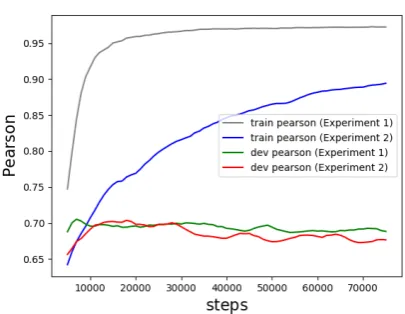
Figure 1: Robustness analysis on English-German QE model. Experiment 1: model trained with real QE data; Experiment 2: model trained with real and artificial QE data
aiming to increase the diversity of erroneous trans-lations during the training process so that it can re-duce the overfitting of our model. We trained two English-German quality estimation models with (i) the real QE training data alone or (ii) the real and artificial QE data, and evaluated them on the development data and the data made up with 1800 random samples from the real QE training data to investigate the robustness of them. As shown in Fig1, the model trained with (ii) (Experiment 2) is more robust than the model trained with (i) (Ex-periment 1), but can achieve comparable perfor-mance on the development data.
The round-trip translation process can produce literal translations that may be similar to post-edited triplets including sources (SRC), translation outputs (MT) and post editions (PE). In order to mimic the QE data, we randomly pick triplets gen-erated by the round-trip translation technique ac-cording to the distribution of HTERs in the real QE training and development data.
3.3 Greedy Ensemble Selection
In the sentence level, adding human-crafted fea-tures can be optional when we make different as-sumptions about the features of source and trans-lation pairs. Under this situation, heterogeneous models can be derived from performing the same learning algorithm on different datasets. We can also use the Byte-Pair Encoding (BPE) tokeniza-tion as a substitutokeniza-tion for a word tokenizatokeniza-tion in text pre-processing. Fan et al. (2018) compared the performance of the word and BPE tokeniza-tion on both sentence and word levels in WMT 18 and the results show that the models with BPE tok-enization can produce comparable or better results than those with word tokenization.
In general, the ensemble output of K single models can be produced by the following objec-tive function,
arg max
tk K X
k=1
wkmk(X =x, T =tk) (3)
wheremk is thek-th single model that has
prob-ability distributionmk(x, tk)with its
correspond-ing weightwk. X represents the feature instance
of a single model, andT represents the HTER or the word label wheretkcan be a continuous
qual-ity score or an OK/BAD label respectively. We assign equal weights to every single model in our case for simplicity.
Since not every single model in the ensemble is always needed for the optimized prediction, it is appropriate to select a subset from all candidate models. We follow the greedy ensemble selec-tion algorithm, Focused Ensemble Selecselec-tion (FES ) (Partalas et al.,2008), to reduce the size of av-eraging ensembles but improve its efficiency and predictive performance.
In the sentence level, FES’s output is averaging HTER scores of selected single models. However, in the word level, the ensemble can be made by majority voting of the binary predictions for se-lected single models or averaging their probabili-ties of predicting the word as OK. We use the de-velopment data for evaluation under the assump-tion that the development data and the test data are from the same distribution, even if it might be sus-ceptible to overfitting. However, we did not ob-serve this phenomena in results released for the test data in WMT18 QE task.
4 Experiments
4.1 Experimental Settings
4.1.1 Data for Bilingual Expert Model
We evaluated our system, QE Brain, for the WMT17/18 QE task for sentence/word-level in English-German and German-English. The fol-lowings are data resources that we used for train-ing the neural Biltrain-ingual Expert model,
- parallel corpora released for the WMT17/18 News Machine Translation Task3
- UFAL Medical Corpus and Khresmoi devel-opment data release for the WMT18 Biomed-ical Translation Task4
- source and target corpora MT training data released in the additional resources for the WMT18 QE Task
- src-pe pairs for for the WMT17/18 QE Task
We filtered all the corpora except src-pe pairs with basic rules to guarantee the quality. A “high-quality” sentence pair should both start with a Uni-code letter character, the lengths of them are equal to or less than 70, and the length ratio of the source sentence and the target one should be bounded by 1/3 and 3. The total resulting qualifying parallel corpora roughly include 13 million for WMT17 QE tasks and 29 million for WMT18 QE tasks.
4.1.2 Data for Quality Estimation Model
The data for quality estimation contains two parts: (i) real QE data provided by WMT QE organiz-ers; (ii) artificial QE data generated by the round-trip translation technique (Junczys-Dowmunt and Grundkiewicz,2016). We first combined the real QE data with the artificial QE data to train a baseline quality estimation model, then fine tuned the model with the real QE data alone. The English-German IT domain artificial QE data can be obtained directly from the additional resources of WMT18 Auto Post-Editing task5 created by
Junczys-Dowmunt and Grundkiewicz(2016). We applied the English-German artificial QE data on
3http://www.statmt.org/wmt18/
translation-task.html
4http://www.statmt.org/wmt18/
biomedical-translation-task.html
5http://www.statmt.org/wmt18/ape-task.
test 2017 en-de test 2017 de-en
[image:5.595.73.529.62.153.2]Method Pearson’sr↑ MAE↓ RMSE↓ Spearman’sρ↑ DeltaAvg↑ Pearson’sr↑ MAE↓ RMSE↓ Spearman’sρ↑ DeltaAvg↑ Baseline 0.397 0.136 0.175 0.425 0.0745 0.441 0.128 0.175 0.45 0.0681 Unbabel 0.641 0.128 0.169 0.652 0.1136 0.626 0.121 0.179 0.61 0.974 POSTECH Single-Ensemble 0.6731 0.1067 0.1412 0.7029 0.1198 0.7146 0.0942 0.1359 0.6327 0.1044 POSTECH Multi-Ensemble 0.6954 0.1019 0.1371 0.7253 0.1232 0.7280 0.0911 0.1332 0.6542 0.1064 QE Brain Base Single Model 0.6837 0.1001 0.1441 0.7091 0.1200 0.7099 0.0927 0.1394 0.6424 0.1018 + HF 0.6842 0.1013 0.1449 0.7150 0.1213 0.7085 0.0901 0.1406 0.6551 0.1040 + FT 0.6957 0.1001 0.1420 0.7205 0.1208 0.7128 0.0933 0.1394 0.6422 0.1013 + HF/FT 0.6813 0.1021 0.1460 0.7070 0.1197 0.7149 0.0889 0.1385 0.6596 0.1026 QE Brain Ensemble 0.7159 0.0965 0.1384 0.7402 0.1247 0.7338 0.0882 0.1333 0.6700 0.105
Table 1: Results of sentence-level scoring and ranking on WMT17. HF: human features; FT: fine-tune strategy with artificial QE data.
the SMT QE task. For the neural machine transla-tion (NMT) QE task, we followed the same pro-cedure but trained two NMT models (German-English and (German-English-German) instead.
Similarly, when generating German-English Pharmacy domain artificial QE data, we first applied domain data selection to the English monolingual corpus admissible for the WMT18 News and Biomedical Translation data with cross-entropy filtering method and seed data set – post-editing training data and the English biomedical data. In total, we got 5 million domain-like sen-tences for the round-trip translation. Afterwards, we created two phrase-based translation models, English-German and German-English, using the parallel bilingual corpora for the WMT18 News and Biomedial Translation tasks but with different language models. The 5 million domain-like sen-tences as PEs would be first translated to German as SRCs and the SRCs would be then translated to English as MTs. Finally, we would have 5 lion artificial APE training data, leading to 5 mil-lion artificial QE training data with corresponding HTERs and word labels via the TER tool.
We filtered the English-German and German-English artificial QE data according to the HTER distribution of the combination of QE training and development data, and randomly pick 300,000 triplets per language pair.
Pearson’sr↑ MAE↓ RMSE↓ Spearman’sρ↑ Method test 2018 en-de SMT
Baseline 0.3653 0.1402 0.1772 0.3809 UNQE 0.7000 0.0962 0.1382 0.7244 QE Brain Ensemble 1 0.7308 0.0953 0.1383 0.7470 QE Brain Ensemble 2 0.7397 0.0937 0.1362 0.7543
Method test 2018 en-de NMT Baseline 0.2874 0.1286 0.1886 0.4195
UNQE 0.5129 0.1114 0.1749 0.6052
QE Brain Ensemble 1 0.5005 0.1134 0.1734 0.6002 QE Brain Ensemble 2 0.5012 0.1131 0.1742 0.6049
Method test 2018 de-en SMT Baseline 0.3323 0.1508 0.1928 0.3247
UNQE 0.7667 0.0945 0.1315 0.7261 QE Brain Ensemble 1 0.7539 0.0981 0.1355 0.7222 QE Brain Ensemble 2 0.7631 0.0962 0.1328 0.7318
Table 2: Results of sent level QE on WMT2018
F1-BAD F1-OK F1-Multi
Method test 2017 en-de Baseline 0.407 0.886 0.361
DCU 0.614 0.910 0.559 Unbabel 0.625 0.906 0.566 POSTECH Ensemble 0.628 0.904 0.568 QE Brain Base Single Model 0.6407 0.9045 0.5795 + FT 0.6410 0.9083 0.5826 QE Brain Ensemble 0.6616 0.9128 0.6039
Method test 2017 de-en Baseline 0.365 0.939 0.342 POSTECH Single-Ensemble 0.552 0.936 0.516 Unbabel 0.562 0.941 0.529 POSTECH Multi-Ensemble 0.569 0.940 0.535 QE Brain Base Single Model 0.5750 0.9471 0.5446 + FT 0.5816 0.9470 0.5507 QE Brain Ensemble 0.5924 0.9475 0.5613
Method test 2018 en-de SMT Baseline 0.4115 0.8821 0.3630 SHEF-PT 0.5080 0.8460 0.4298 QE Brain Ensemble 1 0.6616 0.9168 0.6066 QE Brain Ensemble 2 0.6808 0.9175 0.6246
Method test 2018 en-de NMT Baseline 0.1973 0.9184 0.1812 SHEF-PT 0.3353 0.8691 0.2914 QE Brain Ensemble 1 0.4750 0.9152 0.4361
QE Brain Ensemble 2 0.4767 0.9149 0.4347 Method test 2018 de-en SMT Baseline 0.4850 0.9015 0.4373 SHEF-PT 0.4853 0.8741 0.4242 QE Brain Ensemble 1 0.6475 0.9162 0.5932 QE Brain Ensemble 2 0.6523 0.9217 0.6012
Table 3: Results of word-level word prediction on WMT17/18
Method F1-BAD F1-OK F1-Multi
UAlacante SBI 0.1997 0.9444 0.1886 SHEF-bRNN 0.2710 0.9552 0.2589 SHEF-PT 0.2937 0.9618 0.2824 QE Brain 0.5109 0.9783 0.4999
Table 4: Results of word-level gap prediction on WMT18 En-De SMT
4.1.3 Model Settings
[image:5.595.316.517.204.465.2] [image:5.595.337.497.518.563.2] [image:5.595.74.286.612.745.2]from 2018, since the training data of 2018 includes some test data of 2017. The same setting is applied to all following experiments associated with 2017. We tuned all the hyper-parameters of our model on the development dataset to obtain the best sin-gle model, and report the corresponding results for test data.
We increased the model diversity from two per-spectives. First, in terms of data resources, we experienced with three strategies: word/BPE to-kenization, w/ or w/o artificial QE data and w/ or w/o human-crafted features for the sentence-level task. Secondly, we tuned the number of units for Bi-LSTM with 96 or 128 and training batch size with 32 or 64 from the model’s perspective.
4.2 Evaluation Results
In this section, we will report the experimen-tal results of our approach for WMT 2017 and 2018. For WMT17 QE task, we tried to verify our proposed strategies. For WMT18 QE task, we mainly participated in the sentence-level scoring and ranking tasks and the word-level word pre-diction tasks for German SMT, English-German NMT and English-German-English SMT. In ad-dition, we also submitted results for the word-level gap predictions for English-German SMT. In Table 2, part of Table 3 and Table 4, results of WMT18 QE tasks are listed according to the WMT18 QE website.
4.2.1 Ablation Study on WMT17 QE Task
Since we can access the translation outputs of hu-man post-editing for test data, it provides an ideal held-out test data to verify our proposed strategies. We illustrated our results in Table1and part of Ta-ble3 on WMT17 QE Task. The competitors are POSTECH, DCU and Unbabel. Their results can be found in (Bojar et al.,2017) , Section 4.4 and Section 4.5. We also listed the WMT QE baseline results for reference. The QE Brain base single model follows the exact training scheme in (Fan et al.,2018) with model derived features and mis-matching features. In sentence level, either incor-porating human features or the use of artificial QE data will positively contribute to the metrics. For Pearson’sr, the single fine-tuning strategy yields the improvement +0.01 on English-German and +0.003 on German-English. For Spearman’s ρ, the single model with human features improves the performance by +0.006 in English-German and+0.013in German-English.
In word level, we did not use any human fea-tures, but we found fine-tune strategy can al-ways improve the performance. For F1-Multi, the single fine-tuning strategy yields the improve-ment+0.003on English-German and+0.006on German-English. In general, with all these strate-gies, our single models can be comparable or bet-ter than the state-of-the-art (SOTA) ensemble sys-tems of WMT17 QE task. Our ensemble models significantly outperform all of the SOTA systems.
4.3 Ensemble Analysis on WMT18 QE Task
As we discussed previously, we tried both word and BPE tokenization for the data pre-processing. Thus, we submitted two types of ensemble mod-els, where Ensemble 1 is referred to the model en-sembles trained with word tokenization and En-semble 2 is the model enEn-sembles trained with both word and BPE tokenizations. Training with BPE tokenization can naturally increase the model di-versity, so it makes sense that Ensemble 2 per-forms better than Ensemble 1, except for English-German NMT word-level task, which is very likely due to the small data size (<14000).
5 Conclusion
This paper introduces our machine translation quality estimation system, QE Brain, for both the sentence-level and word-level tasks in WMT 2018 Quality Estimation. The system proposes the neu-ral Bilingual Expert model to extract semantic fea-tures from both the source and translation out-put for estimating translation quality with a bi-directional LSTM predictive model. In particular, three important strategies are utilized for obtaining positive results as incorporating human-crafted features, artificial QE data augmentation for more diversified training data and model ensemble with a greedy algorithm. The results of our system ob-tained No.1. in the English-German SMT scoring and ranking tasks as well as the German-English SMT ranking tasks. Furthermore, our system also produced the best results in all word-level English-German and English-German-English word and gap pre-diction tasks.
References
Post, Raphael Rubino, Lucia Specia, and Marco Turchi. 2017. Findings of the 2017 conference on machine translation (WMT17). InProceedings of the Second Conference on Machine Translation, WMT 2017, Copenhagen, Denmark, September 7-8, 2017, pages 169–214.
Leo Breiman. 2001. Random forests. Machine Learn-ing, 45(1):5–32.
Zhiming Chen, Yiming Tan, Chenlin Zhang, Qingyu Xiang, Lilin Zhang, Maoxi Li, and Mingwen Wang. 2017. Improving machine translation quality esti-mation with neural network features. In Proceed-ings of the Second Conference on Machine Transla-tion, WMT 2017, Copenhagen, Denmark, September 7-8, 2017, pages 551–555.
Kai Fan, Bo Li, Fengming Zhou, and Jiayi Wang. 2018. “bilingual expert” can find translation errors. arXiv preprint arXiv:1807.09433.
Alex Graves and J¨urgen Schmidhuber. 2005. Frame-wise phoneme classification with bidirectional LSTM and other neural network architectures. Neu-ral Networks, 18(5-6):602–610.
Marcin Junczys-Dowmunt and Roman Grundkiewicz. 2016. Log-linear combinations of monolingual and bilingual neural machine translation models for au-tomatic post-editing.CoRR, abs/1605.04800. Hyun Kim, Jong-Hyeok Lee, and Seung-Hoon Na.
2017. Predictor-estimator using multilevel task learning with stack propagation for neural quality estimation. In Proceedings of the Second Confer-ence on Machine Translation, WMT 2017, Copen-hagen, Denmark, September 7-8, 2017, pages 562– 568.
Anna Kozlova, Mariya Shmatova, and Anton Frolov. 2016. YSDA participation in the wmt’16 quality es-timation shared task. In Proceedings of the First Conference on Machine Translation, WMT 2016, colocated with ACL 2016, August 11-12, Berlin, Germany, pages 793–799.
Andr´e FT Martins, Fabio Kepler, and Jose Monteiro. 2017. Unbabel’s participation in the wmt17 transla-tion quality estimatransla-tion shared task. InProceedings of the Second Conference on Machine Translation, pages 569–574.
Kishore Papineni, Salim Roukos, Todd Ward, and Wei-Jing Zhu. 2002. Bleu: a method for automatic eval-uation of machine translation. InProceedings of the 40th Annual Meeting of the Association for Compu-tational Linguistics, July 6-12, 2002, Philadelphia, PA, USA., pages 311–318.
Ioannis Partalas, Grigorios Tsoumakas, and Ioannis P. Vlahavas. 2008. Focused ensemble selection: A diversity-based method for greedy ensemble selec-tion. In ECAI 2008 - 18th European Conference on Artificial Intelligence, Patras, Greece, July 21-25, 2008, Proceedings, pages 117–121.