Relation Schema Induction using Tensor Factorization with Side
Information
Madhav Nimishakavi Indian Institute of Science
Bangalore, India
Uday Singh Saini Indian Institute of Science
Bangalore, India
Partha Talukdar Indian Institute of Science
Bangalore, India
Abstract
Given a set of documents from a specific do-main (e.g., medical research journals), how do we automatically build a Knowledge Graph (KG) for that domain? Automatic identifica-tion of relaidentifica-tions and their schemas, i.e., type signature of arguments of relations (e.g., un-dergo(Patient, Surgery)), is an important first step towards this goal. We refer to this prob-lem as Relation Schema Induction (RSI). In this paper, we propose Schema Induction us-ing Coupled Tensor Factorization (SICTF), a novel tensor factorization method for relation schema induction. SICTF factorizes Open Information Extraction (OpenIE) triples ex-tracted from a domain corpus along with ad-ditional side information in a principled way to induce relation schemas. To the best of our knowledge, this is the first application of tensor factorization for the RSI problem. Through extensive experiments on multiple real-world datasets, we find that SICTF is not only more accurate than state-of-the-art base-lines, but also significantly faster (about 14x faster).
1 Introduction
Over the last few years, several techniques to build Knowledge Graphs (KGs) from large unstructured text corpus have been proposed, examples include NELL (Mitchell et al., 2015) and Google Knowl-edge Vault (Dong et al., 2014). Such KGs con-sist of millions of entities (e.g.,Oslo, Norway, etc.),
their types (e.g.,isA(Oslo, City),isA(Norway, Coun-try)), and relationships among them (e.g., cityLo-catedInCountry(Oslo, Norway)). These KG con-struction techniques are called ontology-guided as they require as input list of relations, their schemas (i.e., their type signatures, e.g., cityLocatedInCoun-try(City, Country)), and seed instances of each such relation. Listing of such relations and their schemas are usually prepared by human domain experts.
The reliance on domain expertise poses signif-icant challenges when such ontology-guided KG construction techniques are applied to domains where domain experts are either not available or are too expensive to employ. Even when such a domain expert may be available for a limited time, she may be able to provide only a partial listing of relations and their schemas relevant to that particular domain. Moreover, this expert-mediated model is not scal-able when new data in the domain becomes avail-able, bringing with it potential new relations of in-terest. In order to overcome these challenges, we need automatic techniques which can discover rela-tions and their schemas from unstructured text data itself, without requiring extensive human input. We refer to this problem asRelation Schema Induction (RSI).
In contrast to ontology-guided KG construction techniques mentioned above, Open Information Ex-traction (OpenIE) techniques (Etzioni et al., 2011) aim to extract surface-level triples from unstructured text. Such OpenIE triples may provide a suitable starting point for the RSI problem. In fact, KB-LDA,
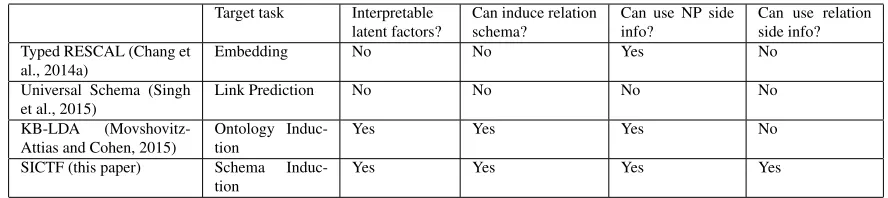
Target task Interpretable
latent factors? Can induce relationschema? Can use NP sideinfo? Can use relationside info? Typed RESCAL (Chang et
al., 2014a) Embedding No No Yes No
Universal Schema (Singh
et al., 2015) Link Prediction No No No No
KB-LDA
(Movshovitz-Attias and Cohen, 2015) Ontology Induc-tion Yes Yes Yes No SICTF (this paper) Schema
[image:2.612.83.527.56.155.2]Induc-tion Yes Yes Yes Yes
Table 1: Comparison among SICTF (this paper) and other related methods. KB-LDA is the most related prior method which is extensively compared against SICTF in Section 4
a topic modeling-based method for inducing an on-tology from SVO (Subject-Verb-Object) triples was recently proposed in (Movshovitz-Attias and Cohen, 2015). We note that ontology induction (Velardi et al., 2013) is a more general problem than RSI, as we are primarily interested in identifying categories and relations from a domain corpus, and not necessar-ily any hierarchy over them. Nonetheless, KB-LDA maybe used for the RSI problem and we use it as a representative of the state-of-the-art of this area.
Instead of a topic modeling approach, we take a tensor factorization-based approach for RSI in this paper. Tensors are a higher order generalization of matrices and they provide a natural way to rep-resent OpenIE triples. Applying tensor factoriza-tion methods over OpenIE triples to identify relafactoriza-tion schemas is a natural approach, but one that has not been explored so far. Also, a tensor factorization-based approach presents a flexible and principled way to incorporate various types of side informa-tion. Moreover, as we shall see in Section 4, com-pared to state-of-the-art baselines such as KB-LDA, tensor factorization-based approach results in better and faster solution for the RSI problem. In this pa-per, we make the following contributions:
• We present Schema Induction using Coupled Tensor Factorization (SICTF), a novel and principled tensor factorization method which jointly factorizes a tensor constructed out of OpenIE triples extracted from a domain corpus, along with various types of additional side in-formation for relation schema induction.
• We compare SICTF against state-of-the-art baseline on various real-world datasets from diverse domains. We observe that SICTF is not only significantly more accurate than such
baselines, but also much faster. For example, SICTF achieves 14x speedup over KB-LDA (Movshovitz-Attias and Cohen, 2015).
• We have made the data and code available1.
2 Related Work
Schema Induction: Properties of SICTF and other related methods are summarized in Table 12. A method for inducing (binary) relations and the cat-egories they connect was proposed by (Mohamed et al., 2011). However, in that work, categories and their instances were known a-priori. In contrast, in case of SICTF, both categories and relations are to be induced. A method for event schema induc-tion, the task of learning high-level representations of complex events and their entity roles from unla-beled text, was proposed in (Chambers, 2013). This gives the schemas of slots per event, but our goal is to find schemas of relations. (Chen et al., 2013) and (Chen et al., 2015) deal with the problem of finding semantic slots for unsupervised spoken lan-guage understanding, but we are interested in find-ing schemas of relations relevant for a given domain. Methods for link prediction in the Universal Schema setting using matrix and a combination of matrix and tensor factorization are proposed in (Riedel et al., 2013) and (Singh et al., 2015), respectively. In-stead of link prediction where relation schemas are assumed to be given, SICTF focuses on discovering such relation schemas. Moreover, in contrast to such
1https://github.com/malllabiisc/sictf
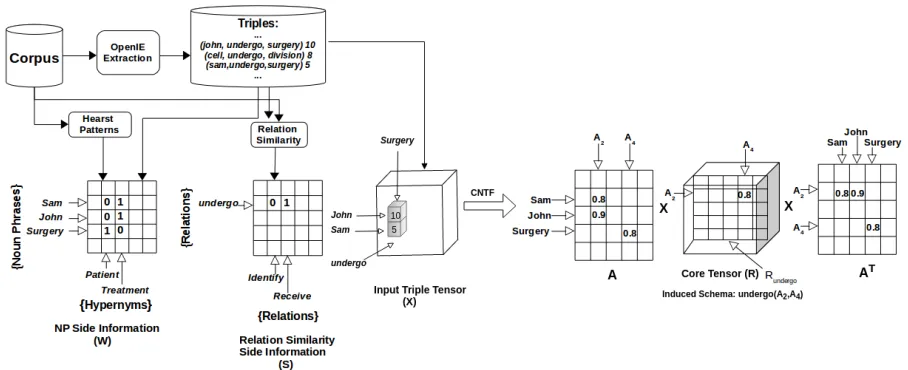
Figure 1:Relation Schema Induction (RSI) by SICTF, the proposed method. First, a tensor (X) is constructed to represent OpenIE triples extracted from a domain corpus. Noun phrase side information in the form of (noun phrase, hypernym), and relation-relation similarity side information are separately calculated and stored in two separate matrices (W andS, respectively). SICTF then performs coupled factorization of the tensor and the two side information matrices to identify relation schemas which are stored in the core tensor (R) in the output. Please see Section 3 for details.
methods which assume access to existing KGs, the setting in this paper is unsupervised.
Tensor Factorization: Due to their flexibility of representation and effectiveness, tensor factor-ization methods have seen increased application in Knowledge Graph (KG) related problems over the last few years. Methods for decomposing ontolog-ical KGs such as YAGO (Suchanek et al., 2007) were proposed in (Nickel et al., 2012; Chang et al., 2014b; Chang et al., 2014a). In these cases, rela-tion schemas are known in advance, while we are interested in inducing such relation schemas from unstructured text. A PARAFAC (Harshman, 1970) based method for jointly factorizing a matrix and tensor for data fusion was proposed in (Acar et al., 2013). In such cases, the matrix is used to provide auxiliary information (Narita et al., 2012; Erdos and Miettinen, 2013). Similar PARAFAC-based ideas are explored in Rubik (Wang et al., 2015) to fac-torize structured electronic health records. In con-trast to such structured data sources, SICTF aims at inducing relation schemas from unstructured text data. Propstore, a tensor-based model for distribu-tional semantics, a problem different from RSI, was presented in (Goyal et al., 2013). Even though cou-pled factorization of tensor and matrices constructed out of unstructured text corpus provide a natural and
plausible approach for the RSI problem, they have not yet been explored – we fill this gap in this paper.
Ontology Induction: Relation Schema Induc-tion can be considered a sub problem of Ontol-ogy Induction (Velardi et al., 2013). Instead of building a full-fledged hierarchy over categories and relations as in ontology induction, we are par-ticularly interested in finding relations and their schemas from unstructured text corpus. We consider KB-LDA3 (Movshovitz-Attias and Cohen, 2015), a topic-modeling based approach for ontology induc-tion, as a representative of this area. Among all prior work, KB-LDA is most related to SICTF. While both KB-LDA and SICTF make use of noun phrase side information, SICTF is also able to exploit rela-tional side information in a principled manner. In Section 4, through experiments on multiple real-world datasets, we observe that SICTF is not only more accurate than KB-LDA but also significantly faster with a speedup of 14x.
A method for canonicalizing noun and relation phrases in OpenIE triples was recently proposed in (Gal´arraga et al., 2014). The main focus of this ap-proach is to cluster lexical variants of asingleentity or relation. This is not directly relevant for RSI, as
we are interested in groupingmultipleentities of the same type into one cluster, and use that to induce relation schema.
3 Our Approach: Schema Induction using Coupled Tensor Factorization (SICTF) 3.1 Overview
SICTF poses the relation schema induction problem as a coupled factorization of a tensor along with ma-trices containing relevant side information. Over-all architecture of the SICTF system is presented in Figure 1. First, a tensor X ∈ Rn×n×m
+ is
con-structed to store OpenIE triples and their scores ex-tracted from the text corpus4. Here, n andm rep-resent the number of NPs and relation phrases, re-spectively. Following (Movshovitz-Attias and Co-hen, 2015), SICTF makes use of noun phrase (NP) side information in the form of (noun phrase, hyper-nym). Additionally, SICTF also exploits relation-relation similarity side information. These two side information are stored in matricesW ∈ {0,1}n×h andS ∈ {0,1}m×m, wherehis the number of hy-pernyms extracted from the corpus. SICTF then per-forms collective non-negative factorization overX, W, andS to output matrixA ∈ Rn+×cand the core
tensor R ∈ Rc+×c×m. Each row in A corresponds to an NP, while each column corresponds to an in-duced category (latent factor). For brevity, we shall refer to the induced category corresponding to the
qthcolumn ofAasAq. Each entryApq in the out-put matrix provides a membership score for NP p
in induced category Aq. Please note that each in-duced category is represented using the NPs partic-ipating in it, with the NPs ranked by their member-ship scores in the induced category. In Figure 1, A2 = [(John,0.9),(Sam,0.8), . . .]is an induced
cat-egory.
Each slice of the core tensorR is a matrix which
corresponds to a specific relation, e.g., the matrix
Rundergo highlighted in Figure 1 corresponds to the relation undergo. Each cell in this matrix corre-sponds to an induced schema connecting two in-duced categories (two columns of the A matrix),
with the cell value representing model’s score of the induced schema. For example, in Figure 1,
undergo(A2,A4)is an induced relation schema with
4R
+is the set of non-negative reals.
MEDLINE
(hypertension, disease), (hypertension, state), (hypertension, disorder) , (neutrophil, blood element), (neutrophil, effector cell), (neutrophil, cell type)
StackOverflow
(image, resource), (image, content), (image, file), (perl, lan-guage), (perl, script), (perl, programs)
Table 2: Noun Phrase (NP) side information in the form of (Noun Phrase, Hypernym) pairs extracted using Hearst patterns from two different datasets. Please see Section 3.2 for details.
MEDLINE StackOverflow (evaluate, analyze), (evaluate,
examine), (indicate, confirm), (indicate, suggest)
(provides, confirms), (pro-vides, offers), (allows, lets), (allows, enables)
Table 3:Examples of relation similarity side information in the form of automatically identified similar relation pairs. Please see Section 3.2 for details.
score 0.8 involving relation undergo and induced
categoriesA2andA4.
In Section 3.2, we present details of the side in-formation used by SICTF, and then in Section 3.3 present details of the optimization problem solved by SICTF.
3.2 Side Information
• Noun Phrase Side Information: Through this type of side information, we would like to cap-ture type information of as many noun phrases (NPs) as possible. We apply Hearst patterns (Hearst, 1992), e.g., ”<Hypernym> such as
<NP>”, over the corpus to extract such (NP,
Hypernym)pairs. Please note that neither hy-pernyms nor NPs are pre-specified, and they are all extracted from the data by the patterns. Ex-amples of a few such pairs extracted from two different datasets are shown in Table 2. These extracted tuples are stored in a matrix Wn×h whose rows correspond to NPs and columns correspond to extracted hypernyms. We define,
Wij =
1, if NPibelongs to Hypernymj 0, otherwise .
Please note that we don’t expectW to be a fully
specified matrix, i.e., we don’t assume that we know all possible hypernyms for a given NP.
like to take prior knowledge about textual rela-tions into account during factorization. For ex-ample, if we know two relations to be similar to one another, then we also expect their induced schemas to be similar as well. Consider the following sentences”Mary purchased a stuffed animal toy.“and ”Janet bought a toy car for her son.”. From these we can say that both re-lationspurchaseandbuyhave the schema (Per-son, Item). Even if one of these relations is more abundant than the other in the corpus, we still want to learn similar schemata for both the relations. As mentioned before,S ∈ Rm×m
+ is
the relation similarity matrix, where m is the
number of textual relations. We define,
Sij =
1, if Similarity(Reli, Relj)≥γ 0, otherwise
where γ is a threshold5. For the experiments
in this paper, we use cosine similarity over word2vec (Mikolov et al., 2013) vector repre-sentations of the relational phrases. Examples of a few similar relation pairs are shown in Ta-ble 3.
3.3 SICTF Model Details
SICTF performs coupled non-negative factorization of the input triple tensor Xn×n×m along with the two side information matricesWn×h andSm×m by solving the following optimization problem.
min A,V,R
m
X
k=1
f(Xk, A, Rk) +fnp(W, A, V) +frel(S, R)
(1) where,
f(Xk, A, Rk) =kX:,:,k−AR:,:,kAT k2F +λRkR:,:,kk2F
fnp(W, A, V) =λnpkW −AV k2F +λAkAk2F +λV kV k2F
frel(S, R) =λrel m X i=1 m X j=1
Sij kR:,:,i−R:,:,j k2F
Ai,j≥0,Vj,r≥0, Rp,q,k≥0 (non negative)
∀1≤i≤n,1≤r≤h,
1≤j, p, q≤c,1≤k≤m
5For the experiments in this paper, we set γ = 0.7, a relatively high value, to focus on highly similar relations and thereby justifying the binarySmatrix.
In the objective above, the first termf(Xk, A, Rk) minimizes reconstruction error for thekth relation, with additional regularization on theR:,:,k matrix6. The second term, fnp(W, A, V), factorizes the NP side information matrix Wn×h into two matrices
An×cand Vc×h, wherec is the number of induced categories. We also enforce A to be non-negative.
Typically, we requirec hto get a lower
dimen-sional embedding of each NP (rows ofA). Finally, the third term frel(S, R) enforces the requirement that two similar relations as given by the matrixS
should have similar signatures (given by the corre-sponding R matrix). Additionally, we require V
andR to be non-negative, as marked by the
(non-negative) constraints. In this objective,λR,λnp,λA,
λV, andλrelare all hyper-parameters.
We derive non-negative multiplicative updates for
A, Rk and V following the rules proposed in (Lee and Seung, 2000), which has the following general form:
θi=θi
∂C(θ)− ∂θi ∂C(θ)+
∂θi
α
HereC(θ)represents the cost function of the
non-negative variablesθand ∂C∂θ(θ)−
i and ∂C(θ)−
∂θi are the negative and positive parts of the derivative ofC(θ)
(Mørup et al., 2008). (Lee and Seung, 2000) proved that forα= 1, the cost functionC(θ)monotonically
decreases with the multiplicative updates7.C(θ)for SICTF is given in equation (1). The above procedure will give the following updates:
A ← A∗
P
k
(XkARTk +XkTARk) +λnpW VT
A( ˜B+λAI+λnpV VT) ˜
B = X k
(RkATARTk +RTkATARk)
Rk ← Rk∗
ATX
kA+ 2λrel m
P
j=1
RjSkj
ATAR
kATA+ ˜D
˜
D = 2λrelRk m
X
j=1
Skj+λRRk
V ← V ∗ λnpA
TW
λnpATAV +λVV
6For brevity, we also refer to R
:,:,k as Rk, and similarly X:,:,kasXk
Dataset # Docs # Triples
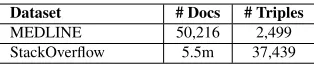
[image:6.612.107.264.56.88.2]MEDLINE 50,216 2,499 StackOverflow 5.5m 37,439
Table 4:Datasets used in the experiments.
In the equations above, ∗ is the Hadamard or element-wise product8. In all our experiments, we find the iterative updates above to converge in about 10-20 iterations.
4 Experiments
In this section, we evaluate performance of differ-ent methods on the Relation Schema Induction (RSI) task. Specifically, we address the following ques-tions.
• Which method is most effective on the RSI task? (Section 4.3.1)
• How important are the additional side informa-tion for RSI? (Secinforma-tion 4.3.2)
• What is the importance of non-negativity in RSI with tensor factorization? (Section 4.3.3)
4.1 Experimental Setup
Datasets: We used two datasets for the experi-ments in this paper, they are summarized in Table 4. For MEDLINE dataset, we used Stanford CoreNLP (Manning et al., 2014) for coreference resolution and Open IE v4.09for triple extraction. Triples with Noun Phrases that have Hypernym information were retained. We obtained the StackOverflow triples di-rectly from the authors of (Movshovitz-Attias and Cohen, 2015), which were also prepared using a very similar process. In both datasets, we use cor-pus frequency of triples for constructing the tensor.
Side Information: Seven Hearst patterns such as ”<hypernym> such as <NP>”, ”<NP> or
other <hypernym>” etc., given in (Hearst, 1992) were used to extract NP side information from the MEDLINE documents. NP side information for the StackOverflow dataset was obtained from the au-thors of (Movshovitz-Attias and Cohen, 2015).
As described in Section 3, word2vec embeddings of the relation phrases were used to extract relation-similarity based side-information. This was done for
8(A
∗B)i,j=Ai,j×Bi,j
9Open IE v4.0:http://knowitall.github.io/openie/
both datasets. Cosine similarity threshold ofγ = 0.7
was used for the experiments in the paper.
Samples of side information used in the experi-ments are shown in Table 2 and Table 3. A total of 2067 unique NP-hypernym pairs were extracted from MEDLINE data and 16,639 were from Stack-Overflow data. 25 unique pairs of relation phrases out of 1172 were found to be similar in MEDLINE data, whereas 280 unique pairs of relation phrases out of approximately 3200 were found similar in StackOverflow data.
Hyperparameters were tuned using grid search and the set which gives minimum reconstruction er-ror for bothX andW was chosen. We set λnp =
λrel = 100for StackOverflow, andλnp = 0.05and
λrel = 0.001for Medline and we usec= 50for our experiments. Please note that our setting is unsuper-vised, and hence there is no separate train, dev and test sets.
4.2 Evaluation Protocol
In this section, we shall describe how the induced schemas are presented to human annotators and how final accuracies are calculated. In factorizations produced by SICTF and other ablated versions of SICTF, we first select a few top relations with best reconstruction score. The schemas induced for each selected relationkis represented by the matrix slice Rk of the core tensor obtained after factorization (see Section 3). From each such matrix, we iden-tify the indices (i, j) with highest values. The
in-dices i and j select columns of the matrix A. A
few top ranking NPs from the columns Ai andAj along with the relation k are presented to the
hu-man annotator, who then evaluates whether the tuple
Relationk(Ai, Aj)constitutes a valid schema for re-lation k. Examples of a few relation schemas
in-duced by SICTF are presented in Table 5. A human annotator would see the first and second columns of this table and then offer judgment as indicated in the third column of the table. All such judgments across all top-reconstructed relations are aggregated to get the final accuracy score. This evaluation pro-tocol was also used in (Movshovitz-Attias and Co-hen, 2015) to measure learned relation accuracy.
anno-Relation Schema Top 3 NPs in Induced Categories which were presented to annotators Annotator Judgment StackOveflow
clicks(A0, A1) AA0:users, client, person valid 1:link, image, item
refreshes(A19, A13) AA19:browser, window, tab valid 13:page, activity, app
can parse(A41, A17) AA41:access, permission, ability invalid 17:image file, header file, zip file
MEDLINE
suffer from(A38, A40) AA38:patient, first patient, anesthetized patient valid 40:viral disease, renal disease, von recklin ghausen’s disease
have undergo(A3, A37) AA3:fifth patient, third patient, sixth patient valid 37:initial liver biopsy, gun biopsy, lymph node biopsy
[image:7.612.100.514.254.369.2]have discontinue(A41, A20) AA41:patient, group, no patient invalid 20:endemic area, this area, fiber area
Table 5:Examples of relation schemas induced by SICTF from the StackOverflow and MEDLINE datasets. Top NPs from each of the induced categories, along with human judgment of the induced schema are also shown. See Section 4.3.1 for more details.
(a) (b)
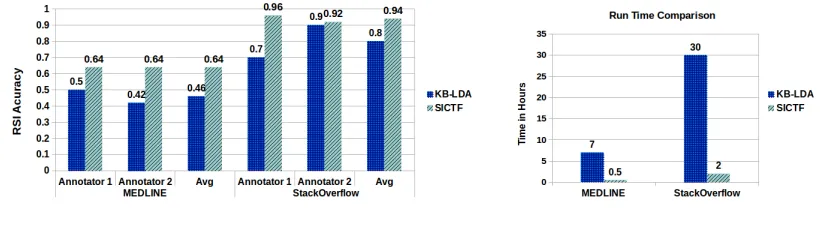
Figure 2:(a) Relation Schema Induction (RSI) accuracies of different methods on the two datasets. SICTF, our proposed method, significantly outperforms state-of-the-art method KBLDA. This is the main result of the paper. Results for KB-LDA on StackOve-flow are directly taken from the paper. Please see Section 4.3.1 for details. (b) Runtime comparison between KB-LDA and SICTF. We observe that SICTF results in 14x speedup over KB-LDA. Please see Section 4.3.1 (Runtime Comparison) for details.
tators are experts in software domain and has high-school level knowledge in medical domain. Though recall is a desirable statistic to measure, it is very challenging to calculate it in our setting due to the non-availability of relation schema annotated text on large scale.
4.3 Results
4.3.1 Effectiveness of SICTF
Experimental results comparing performance of various methods on the RSI task in the two datasets are presented in Figure 2(a). RSI accuracy is cal-culated based on the evaluation protocol described in Section 4.2. Performance number of KB-LDA for StackOveflow dataset is taken directly from the (Movshovitz-Attias and Cohen, 2015) paper, we used our implementation of KB-LDA for the MED-LINE dataset. Annotation accuracies from two an-notators were averaged to get the final accuracy.
From Figure 2(a), we observe that SICTF outper-forms KB-LDA on the RSI task. Please note that the inter-annotator agreement for SICTF is 88% and 97% for MEDLINE and StackOverflow datasets re-spectively. This is the main result of the paper.
In addition to KB-LDA, we also compared SICTF with PARAFAC, a standard tensor factorization method. PARAFAC induced extremely poor and small number of relation schemas, and hence we didn’t consider it any further.
Runtime comparison: Runtimes of SICTF and KB-LDA over both datasets are compared in Fig-ure 2(b). From this figFig-ure, we find that SICTF is able to achieve a 14x speedup on average over KB-LDA10. In other words, SICTF is not only able to
Ablation A1MEDLINEA2 Avg A1StackOverflowA2 Avg
SICTF 0.64 0.64 0.64 0.96 0.92 0.94
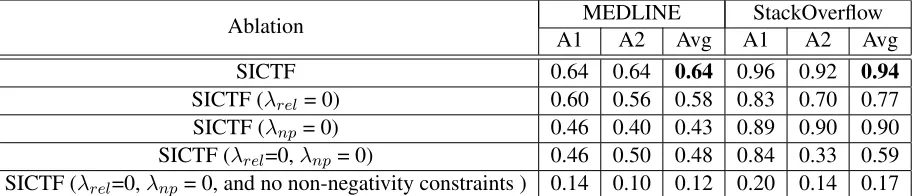
[image:8.612.80.537.58.156.2]SICTF (λrel= 0) 0.60 0.56 0.58 0.83 0.70 0.77 SICTF (λnp= 0) 0.46 0.40 0.43 0.89 0.90 0.90 SICTF (λrel=0,λnp= 0) 0.46 0.50 0.48 0.84 0.33 0.59 SICTF (λrel=0,λnp= 0, and no non-negativity constraints ) 0.14 0.10 0.12 0.20 0.14 0.17
Table 6:RSI accuracy comparison of SICTF with its ablated versions when no relation side information is used (λrel= 0), when no NP side information is used (λnp= 0), when no side information of any kind is used (λrel= 0,λnp= 0), and when additionally there are no non-negative constraints. From this, we observe that additional side information improves performance, validating one of the central thesis of this paper. Please see Section 4.3.2 and Section 4.3.3 for details.
induce better relation schemas, but also do so at a significantly faster speed.
4.3.2 Importance of Side Information
One of the central hypothesis of our approach is that coupled factorization through additional side formation should result in better relation schema in-duction. In order to evaluate this thesis further, we compare performance of SICTF with its ablated ver-sions: (1) SICTF (λrel = 0), which corresponds to the setting when no relation side information is used, (2) SICTF (λnp = 0), which corresponds to the set-ting when no noun phrases side information is used, and (3) SICTF (λrel = 0, λnp = 0), which corre-sponds to the setting when no side information of any kind is used. Hyperparameters are separately tuned for the variants of SICTF. Results are pre-sented in the first four rows of Table 6. From this, we observe that additional coupling through the side information significantly helps improve SICTF per-formance. This further validates the central thesis of our paper.
4.3.3 Importance of Non-Negativity on Relation Schema Induction
In the last row of Table 6, we also present an ablated version of SICTF when no side informa-tion no non-negativity constraints are used. Com-paring the last two rows of this table, we observe that non-negativity constraints over the A matrix
and core tensorR result in significant improvement
in performance. We note that the last row in Ta-ble 6 is equivalent to RESCAL (Nickel et al., 2011) and the fourth row is equivalent to Non-Negative RESCAL (Krompaß et al., 2013), two tensor
factor-ization techniques. We also note that none of these tensor factorization techniques have been previously used for the relation schema induction problem.
The reason for this improved performance may be explained by the fact that absence of non-negativity constraint results in an under constrained factoriza-tion problem where the model often overgenerates incorrect triples, and then compensates for this over-generation by using negative latent factor weights. In contrast, imposition of non-negativity constraints restricts the model further forcing it to commit to specific semantics of the latent factors in A. This
improved interpretability also results in better RSI accuracy as we have seen above. Similar benefits of non-negativity on interpretability have also been ob-served in matrix factorization (Murphy et al., 2012).
5 Conclusion
as-sign labels to induced categories, and also apply the model to more domains.
Acknowledgement
Thanks to the members of MALL Lab, IISc who read our drafts and gave valuable feedback and we also thank the reviewers for their constructive re-views. This research has been supported in part by Bosch Engineering and Business Solutions and Google.
References
Evrim Acar, Morten Arendt Rasmussen, Francesco Savo-rani, Tormod Ns, and Rasmus Bro. 2013. Understand-ing data fusion within the framework of coupled ma-trix and tensor factorizations. Chemometrics and In-telligent Laboratory Systems, 129(Complete):53–63. Nathanael Chambers. 2013. Event schema induction
with a probabilistic entity-driven model. InEMNLP, pages 1797–1807. ACL.
Kai-Wei Chang, Wen tau Yih, Bishan Yang, and Christo-pher Meek. 2014a. Typed tensor decomposition of knowledge bases for relation extraction. In Proceed-ings of the 2014 Conference on Empirical Methods in Natural Language Processing. ACL Association for Computational Linguistics, October.
Kai-Wei Chang, Wen-tau Yih, Bishan Yang, and Christo-pher Meek. 2014b. Typed tensor decomposition of knowledge bases for relation extraction. In Proceed-ings of the 2014 Conference on Empirical Methods in Natural Language Processing (EMNLP), pages 1568– 1579.
Yun-Nung Chen, William Y. Wang, and Alexander I. Rudnicky. 2013. Unsupervised induction and fill-ing of semantic slots for spoken dialogue systems us-ing frame-semantic parsus-ing. In2013 IEEE Workshop on Automatic Speech Recognition and Understanding (ASRU), pages 120–125. IEEE.
Yun-Nung Chen, William Yang Wang, Anatole Gersh-man, and Alexander I. Rudnicky. 2015. Matrix fac-torization with knowledge graph propagation for unsu-pervised spoken language understanding. InACL (1), pages 483–494. The Association for Computer Lin-guistics.
Xin Dong, Evgeniy Gabrilovich, Geremy Heitz, Wilko Horn, Ni Lao, Kevin Murphy, Thomas Strohmann, Shaohua Sun, and Wei Zhang. 2014. Knowledge vault: A web-scale approach to probabilistic knowl-edge fusion. InProceedings of the 20th ACM SIGKDD international conference on Knowledge discovery and data mining, pages 601–610. ACM.
Dora Erdos and Pauli Miettinen. 2013. Discovering facts with boolean tensor tucker decomposition. In Pro-ceedings of the 22Nd ACM International Conference on Information & Knowledge Management, CIKM ’13, pages 1569–1572, New York, NY, USA. ACM. Oren Etzioni, Anthony Fader, Janara Christensen,
Stephen Soderland, and Mausam Mausam. 2011. Open information extraction: The second generation. InIJCAI, volume 11, pages 3–10.
Luis Gal´arraga, Geremy Heitz, Kevin Murphy, and Fabian Suchanek. 2014. Canonicalizing Open Knowl-edge Bases. CIKM.
Kartik Goyal, Sujay Kumar, Jauhar Huiying, Li Mrin-maya, Sachan Shashank, and Srivastava Eduard Hovy. 2013. A structured distributional semantic model: In-tegrating structure with semantics.
R. A. Harshman. 1970. Foundations of the PARAFAC procedure: Models and conditions for an” explana-tory” multi-modal factor analysis. UCLA Working Pa-pers in Phonetics, 16(1):84.
Marti A. Hearst. 1992. Automatic acquisition of hy-ponyms from large text corpora. InIn Proceedings of the 14th International Conference on Computational Linguistics, pages 539–545.
Denis Krompaß, Maximilian Nickel, Xueyan Jiang, and Volker Tresp. 2013. Non-negative tensor factorization with rescal. Tensor Methods for Machine Learning, ECML workshop.
Daniel D. Lee and H. Sebastian Seung. 2000. Algo-rithms for non-negative matrix factorization. In In NIPS, pages 556–562. MIT Press.
Christopher D. Manning, Mihai Surdeanu, John Bauer, Jenny Finkel, Steven J. Bethard, and David McClosky. 2014. The Stanford CoreNLP natural language pro-cessing toolkit. InProceedings of 52nd Annual Meet-ing of the Association for Computational LMeet-inguistics: System Demonstrations, pages 55–60.
Tomas Mikolov, Ilya Sutskever, Kai Chen, Greg S Cor-rado, and Jeff Dean. 2013. Distributed representations of words and phrases and their compositionality. In C.J.C. Burges, L. Bottou, M. Welling, Z. Ghahramani, and K.Q. Weinberger, editors,Advances in Neural In-formation Processing Systems 26, pages 3111–3119. Curran Associates, Inc.
T. Mitchell, W. Cohen, E. Hruschka, P. Talukdar, J. Bet-teridge, A. Carlson, B. Dalvi, M. Gardner, B. Kisiel, J. Krishnamurthy, N. Lao, K. Mazaitis, T. Mohamed, N. Nakashole, E. Platanios, A. Ritter, M. Samadi, B. Settles, R. Wang, D. Wijaya, A. Gupta, X. Chen, A. Saparov, M. Greaves, and J. Welling. 2015. Never-ending learning. InProceedings of AAAI.
be-tween noun categories. InProceedings of the Confer-ence on Empirical Methods in Natural Language Pro-cessing, EMNLP ’11, pages 1447–1455, Stroudsburg, PA, USA. Association for Computational Linguistics. M. Mørup, L. K. Hansen, and S. M. Arnfred. 2008.
Al-gorithms for sparse non-negative TUCKER. Neural Computation, 20(8):2112–2131, aug.
Dana Movshovitz-Attias and William W. Cohen. 2015. Kb-lda: Jointly learning a knowledge base of hierar-chy, relations, and facts. InProceedings of the 53rd Annual Meeting of the Association for Computational Linguistics. Association for Computational Linguis-tics.
Brian Murphy, Partha Pratim Talukdar, and Tom M Mitchell. 2012. Learning effective and interpretable semantic models using non-negative sparse embed-ding. InCOLING, pages 1933–1950.
Atsuhiro Narita, Kohei Hayashi, Ryota Tomioka, and Hisashi Kashima. 2012. Tensor factorization using auxiliary information. Data Mining and Knowledge Discovery, 25(2):298–324.
Maximilian Nickel, Volker Tresp, and Hans-Peter Kriegel. 2011. A three-way model for collective learning on multi-relational data. In Lise Getoor and Tobias Scheffer, editors, Proceedings of the 28th In-ternational Conference on Machine Learning (ICML-11), ICML ’11, pages 809–816, New York, NY, USA, June. ACM.
Maximilian Nickel, Volker Tresp, and Hans-Peter Kriegel. 2012. Factorizing yago: Scalable machine learning for linked data. In Proceedings of the 21st International Conference on World Wide Web, WWW ’12, pages 271–280, New York, NY, USA. ACM. Sebastian Riedel, Limin Yao, Andrew McCallum, and
Benjamin M. Marlin. 2013. Relation extraction with matrix factorization and universal schemas. In Human Language Technologies: Conference of the North American Chapter of the Association of Com-putational Linguistics, Proceedings, June 9-14, 2013, Westin Peachtree Plaza Hotel, Atlanta, Georgia, USA, pages 74–84.
Sameer Singh, Tim Rockt¨aschel, and Sebastian Riedel. 2015. Towards Combined Matrix and Tensor Factor-ization for Universal Schema Relation Extraction. In NAACL Workshop on Vector Space Modeling for NLP (VSM).
Fabian M Suchanek, Gjergji Kasneci, and Gerhard Weikum. 2007. Yago: a core of semantic knowledge. InProceedings of WWW.
Paola Velardi, Stefano Faralli, and Roberto Navigli. 2013. Ontolearn reloaded: A graph-based algorithm for taxonomy induction. Computational Linguistics, 39(3):665–707.