An Leabharlann 24–2 October 2015
Page 10 of 41
Abstract
Twitter has changed the dynamic of the academic conference. Before Twitter, delegate participation was primarily dependent on attendance and feedback was limited to post-event survey. With Twitter, delegates have become active
participants. They pass comment, share reactions and critique presentations, all the while generating a running commentary. This study examines this phenomenon using the Academic & Special Libraries (A&SL) conference 2015 (hashtag# asl2015) as a case study. A post-conference survey was undertaken asking delegates how and why they used Twitter at #asl2015. A content and conceptual analysis of tweets was conducted using Topsy and Storify. This analysis examined how delegates interacted with presentations, which sessions generated most activ-ity on the timeline and the type of content shared. Actual tweet activactiv-ity and volume per presentation was compared to survey responses. Finally, recommendations on Twitter engagement for conference organisers and presenters are provided.
Keywords: Social Media, Twitter, Conferences
“It’s just like passing notes in class…”:
a content analysis of the use
of Twitter at #asl2015
Laura Rooney Ferris and Martin O’Connor
An Leabharlann 24–2 October 2015
Page 11 of 41
Introduction
Twitter usage at conferences is becoming stand-ard practice (Roland et al., 2015: 210). Active usage at Irish Library and Information Services (LIS) conferences is growing and a number of recent Irish LIS conferences trended nationally (#asl2015,
#conul2015, #dbslib2015). By using an agreed hashtag (#), a dynamic, real time virtual conversa-tion space is created – this virtual space has been called a ‘back-channel space’ (Ross, 2011). This back channel allows for dialogue between delegate and presenter, delegate and other delegates. Dialogue from beyond the conference centre can also be included simply by following the relevant hashtag,
Tweeting on a conference hashtag generates a live stream of conversation from and of multiple perspectives. A content and conceptual analysis of tweets on #asl2015 was conducted to deter-mine the sessions generating the highest volume of Twitter engagement. A post event survey was also distributed to attendees inviting feedback on motivations for tweeting.
What is Twitter?
Twitter is “a microblogging site for exchanging messages under 140 characters long” (Neal, 2012: 25). These messages are called Tweets. According to the Twitter site a tweet is “an expression of a moment or idea. It can contain text, photos, and videos.” A tweet is, in essence, a nugget of infor-mation and, by extension, Twitter a tool for the sharing and dissemination of information.
A&SL Conference
The Academic and Special Libraries (A&SL) annual conference has become one of the largest annual events for information professionals in Ireland. It attracts delegates, from Ireland and abroad, from a wide range of Library and Information environ-ments. The @ASLIBRARIES account is integral to the marketing and promotion of the conference.
Engagement by delegates is actively encouraged in the lead up to and during the confer-ence and the hash-tag is included in all promotional mate-rial and communi-cations about the event.
Figure 1 #ASL2015 Poster
Integration of Twitter into the A&SL conference promotion and the growing number of Irish infor-mation professionals using Twitter has resulted in a steady increase in Twitter activity on the confer-ence hashtag over the last three years.2 Since
2013 the conference plenary sessions have been live streamed online facilitating a growing virtual audience. This virtual attendance option has in turn opened up additional conversation around
2 Archived tweets from 2013, 2014, 2015 available at
https://storify.com/ASLIBRARIES2014
the hashtag. Physical and virtual attendees feeding back their thoughts on presentations and shar-ing insight in real time has now become a central feature of the A&SL conference experience.
Rationale
While live tweeting LIS conferences has been happening for a number of years, its adoption as a core activity and conference measurement tool is relatively recent. Ross noted that the bulk of activity on conference hashtags was attributable to a small percentage with the majority taking more passive or lurking3 roles (Ross et al, 2010: 221).
Therefore, it is no surprise then that Dalton’s (2013) study indicated residual reticence amongst the wider Irish information professional community around the use of Twitter. Despite this caution, a dedicated and prolific core of Twitter users has developed in the Irish LIS community.4
Increased usage volume at Irish LIS conferences would seem to indicate an engagement tipping point has been passed. The surge in Twitter activity generated at LIS conferences implies an increased normalising of live tweeting. To date little empir-ical examination has been undertaken on how
3 A lurker is somebody who reads web messages with-out getting involved in the discussion. In the case of Twitter a lurker would read the tweets but not share, retweet or engage in dialogue with the Tweet or person who tweeted.
4 https://twitter.com/libfocus/lists/librarians-in-ireland/ members
An Leabharlann 24–2 October 2015
Page 12 of 41
and why delegates use Twitter during conferences and their perceived benefits in so doing. There is a particular lack of studies on Irish LIS profession-als’ motivations for conference tweeting. Some evidence to date suggests the bulk of activity is attributable to a small core of primary tweeters motivated to share information in a community of practice (Ross et al., 2010: 217).
Reinhardt et al. (2009) highlight some of the benefits and motivations for Twitter usage at conferences and an emerging number of studies have been conducted among medical profession-als on its value for conference communication and the transfer of knowledge (Nason et al., 2015, McKendrick et al., 2012). Dissemination of infor-mation and the integration of new technology to share ideas are fundamental to the information profession. Much focus has been given to detailing benefits of Twitter for library services, options for inclusion in service provision and its potential as a knowledge gathering tool (Milstein, 2009, Del Bosque et al., 2012, Vassilakaki & Garoufallou, 2015). Studies probing information professionals’ motiva-tions for live tweeting conferences and the nature and content of conference tweets are scarce.
Methodology
The volume of tweeting and attendees’ motives for tweeting during the conference were examined. A mixed methods approach was employed combin-ing quantitative measurcombin-ing, content analysis of tweets and a post-event survey questionnaire
to examine motivations. Use of the pre-assigned conference hashtag #asl2015 enabled collation of all tweets featuring this dedicated hashtag. Since the introduction of Twitter’s hashtag func-tion in 2009 a range of hashtag tracking tools has emerged. Tracking of
#asl2015 was done in real time during the event with a detailed analysis of the captured body of tweets conducted post event. Real time impact and usage of the hashtag was monitored during the conference using Twitter’s analytics function and Hootsuite,5 a social
media management and monitoring tool.
A post event archive to
capture all individual tweets on the hashtag was created using Storify.6 To ensure captured tweets
focused on the days of the conference an inclu-sion range was determined as February 25th to March 1st spanning the two days of the confer-ence (February 26th & 27th) and the days before
5 Hootsuite is a social media management system that allows you to manage many social media channels all from the one place
6 Storify is a tool that permits you to find, collect, and share what people are saying all over the web. It allows you to gather together all items on a particular topic for example, a hashtag
and after. Tweets captured in Storify7 were edited
to remove unrelated tweets on the hashtag and Retweeted (RT) items. Using the social media analytics tool Topsy8 the volume of tweets on the
hashtag was measured in the same inclusion date range.
The Storify archive was filtered for duplication and irrelevant items removed. Tweets were searched and counted manu-ally. The tweet archive was then reviewed and a quantitative listing of tweets per individual conference session created. Only original content tweets, directly associated with the session were counted in the quantification of tweets per session, retweeted items were not included. A content analysis of these tweets was conducted to determine the type of information shared.
To get qualitative insight on the nature of the Twitter activity on the hashtag a survey question-naire was distributed to conference attendees by email and via the @ASLIBRARIES Twitter account. The questionnaire consisted of ten questions, to be answered anonymously. Questions were
7 https://storify.com/ASLIBRARIES2014/
asl2015-the-inside-out-library-collaboration-insp
8 Topsy is a free social analytics tool– it allows you to search, analyse and draw insights from conversations and trends on Twitter
An Leabharlann 24–2 October 2015
Page 13 of 41
largely multiple choice or rating scales with one open question. The survey invited respondents to indicate perceived volume of tweeting during the conference, the sessions they tweeted about and what their motivations were for tweeting. The survey also asked respondents about their general use of Twitter, the primary purpose of their account, what was most likely to prompt them to tweet and which sessions they tweeted about most. Respondents were invited to outline any specific benefits of tweeting at #asl2015 via an open question.
Survey responses were compared to the tweets per session to determine any correlation between the actual and reported volume of Twitter activity per session.
Results
Using theT opsyTwitter analytics tool 1,840 tweets were registered on the #asl2015 hashtag in the February 25 to March 1 date range (Fig. 2).The volume and density of
activ-ity on the hashtag accelerated through day one with activity peaking late morning on the second day (Feb 27). The bulk of the Twitter activity consisted of live tweeting insights and commentary on plenary and parallel sessions.
Figure 2 Tweets registered in Topsy
The analysis of the tweet dataset in Storify closely reflected the trends and volume seen in Topsy. Initial activity during the conference opening remarks and the first sessions was slow with tweets in this time frame coming from a small number of accounts. Much of the activity in this time frame
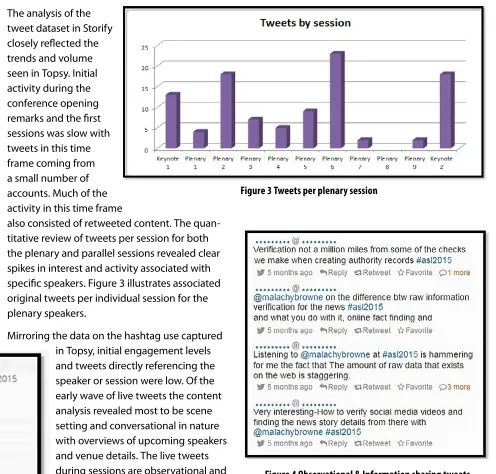
also consisted of retweeted content. The quan-titative review of tweets per session for both the plenary and parallel sessions revealed clear spikes in interest and activity associated with specific speakers. Figure 3 illustrates associated original tweets per individual session for the plenary speakers.
[image:4.842.274.770.40.514.2]Mirroring the data on the hashtag use captured in Topsy, initial engagement levels and tweets directly referencing the speaker or session were low. Of the early wave of live tweets the content analysis revealed most to be scene setting and conversational in nature with overviews of upcoming speakers and venue details. The live tweets during sessions are observational and information sharing in nature (Figure 4).
Figure 3 Tweets per plenary session
Figure 4 Observational & Information sharing tweets
[image:4.842.275.765.51.279.2]An Leabharlann 24–2 October 2015
Page 14 of 41
Review of the volume and content of tweets revealed that sessions or speakers for which high volumes of tweets were produced were highly visual. For sessions generating high numbers of tweets the content anal-ysis showed most tweets related to these sessions featured pictures. Pictures in these tweet were largely of the presentations slides or images or items associated with the presentation.
Survey Responses
The survey had an overall response rate of 25.17% (n.36). Of the respondents 71.43% (n. 25) indicated attending the conference in person and 28.57% (n. 11) viewed the live stream and followed via Twitter.
Respondents self-reported average Twitter usage was relatively high with 48% (n. 12) indicating they tweeted several times per day or several times per week. The link between Twitter usage and conferences or events was highlighted with 20% reporting that they tweeted ‘Only for specific occa-sions or events (conferences)’.
[image:5.842.383.750.40.499.2]The survey asked respondents to define the primary purpose of their Twitter accounts by selecting from a range of options. Figure 7 illustrates responses were consistent with the existing literature on information profes-sionals’ use of Twitter as a knowledge and information sharing tool. These responses are also consistent with the nature and content of the tweets in the content
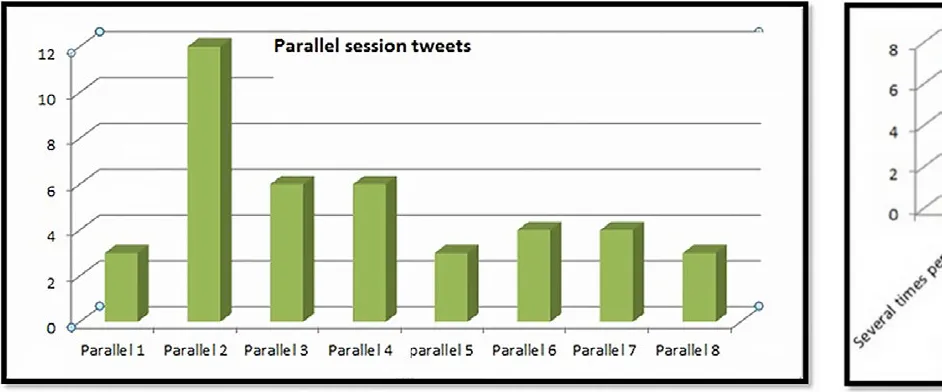
Figure 5 Tweets per parallel session Figure 6 Average Twitter usage
Figure 7 Primary purpose of Twitter account
[image:5.842.35.506.47.243.2]An Leabharlann 24–2 October 2015
Page 15 of 41
analysis. Twitter accounts were largely reported as being for the purpose of profes-sional knowledge sharing (88.77%) and news and infor-mation gathering (50%).
Two survey questions directly questioned motives and specific inspiration for tweeting
during #asl2015. Respondents were asked about primary reasons for tweeting and specific aspects of the confer-ence which encouraged tweeting. Answers to these questions were largely consistent with trends in the tweet content analysis. Desire to both make a ‘real time’
record of events and give feedback was cited by 40% and 50% of respondents respectively. Contributing to a body of knowledge by adding to discussion on the hashtag was the dominant motivation with 75% of respondents.
Overall, presentation content and inspirational presenters were most likely to prompt tweets with 92.31% and 69.23 % respectively citing these as motivational factors (Fig.9).
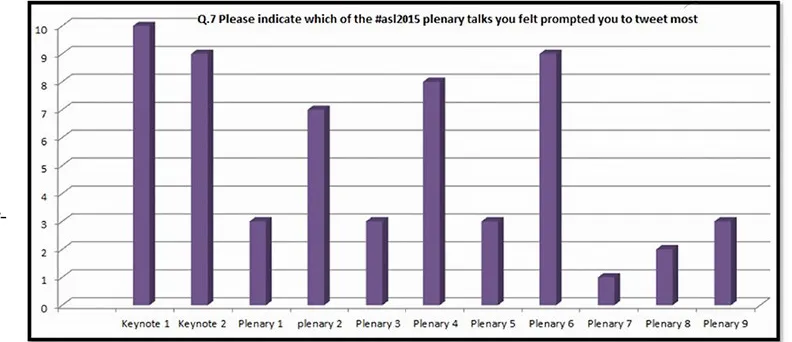
The peaks in volume and number of tweets associated with specific presentations for plenary and parallel sessions evidenced in the content analysis were mirrored in survey responses. Respondents were invited to indi-cate the plenary and parallel session they felt they tweeted about most. With the notable exception of the first sessions where survey reported Twitter activity did not reflect actual activity the survey responses correlate closely to actual activity levels (Fig. 10 & 11).
[image:6.842.368.764.50.221.2]Figure 9 Aspects prompting tweets Figure 8 Respondents primary reasons for
tweeting Figure 10
Survey reported plenary session tweets
Figure 11 Survey reported parallel session tweets
An Leabharlann 24–2 October 2015
Page 16 of 41
Overall Findings
The tweet archive of #asl2015 provides a useful snapshot of the observations and responses of delegates to conference sessions. It illustrates the nature and flow of Twitter conference interactions. The gradual build up of activity on the hashtag indicates a ‘warming-up’ phase in live tweeting sessions. Analysis of actual tweets and reported survey responses also revealed a true connection between the actual activity – the tweets and their survey responses –and what people said they tweeted about. The Survey reported activity and volume of tweets were correlated per session for the majority of sessions.
A small number of respondents (n.2) highlighted the potentially distracting nature of live tweeting. Potential duplication or dilution of the message when viewing live tweets for a session attended-was also cited as a possibility. However, the vast majority of respondents were overwhelmingly positive citing Twitter engagement at conferences as adding to a sense of community, generating dialogue and contributing to a body of knowledge.
However the vast majority of respondents were overwhelmingly positive citing Twitter engage-ment at conferences as adding to a sense of community, generating dialogue and contributing to a body of knowledge:
• Respondent 2: It’s great seeing other people’s reactions to and interpretations of the topics being discussed
• Respondent 6: It is a really effective time capsule. The information is captured raw with-out filtering it gives an authentic quality that is not possible with any other communication tool
• Respondent 12: Love being able to read them at a later stage, don’t have enough time during the conference
• Respondent 13: It makes you feel part of the community who are physically and virtually attending the event.
Recommendations
Twitter interaction has become integral to confer-ence participation as it allows you to actively participate both physically and virtually. Organisers and presenters should be cognisant of its potential
to enhance the experience and aware of the ecosystem of conference twitter interaction.
Ross (2010) highlights the potential negative impact of the Twitter ‘backchannel’. There are also other possible negatives. People not involved in live tweeting, or those not used to Twitter might find the sight of people typing away on their devices distracting. People tweeting the event may misrepresent what a speaker is saying. And people tweeting may miss the substantive parts of papers because they are so engaged in tweeting.
[image:7.842.388.763.331.538.2]While the tweet content analysis for #asl2015 revealed little negative backchannel activity, or negative feedback from survey respondents about the tweeting taking place, the negative possibil-ity is something to be conscious of in promoting Twitter engagement.
Figure 12 Visual content as a prompt for tweets
An Leabharlann 24–2 October 2015
Page 17 of 41
Reviewing tweets provides valuable insight for presenters on the dissemination of their message. It is evidenced in the quantitative and qualitative analysis that inspiring presenters and appealing visuals are a catalyst for twitter activity.
As an initial warming up or ‘lurking’ phase is evident, a strong Twitter voice from confer-ence organisers is recommended to encourage engagement.
Conclusion
This paper aimed to address a gap in understand-ing conference live tweetunderstand-ing. Despite an increasunderstand-ing amount of literature on Twitter use at conferences (Ross. 2010. 232; McKendrick. 2012; Nason et al. 2012) there is a paucity of material examining use of Twitter by Library and information professionals. This paper aimed to provide empirical evidence of how people tweeted at #asl2015 and through the post conference survey it gave qualitative insight into why people tweeted.
Findings demonstrate how Twitter can make the conference experience more interactive and richer and take that dialogue beyond the conference centre walls to a global audience.
Laura Rooney Ferris, MA, PGDipLiS, Information & Library Manager, Irish Hospice Foundation / Communications Officer, Academic & Special Libraries, and
Martin O’Connor,MA, PGDipLiS, Senior Library Assistant, Academic & Student Engagement, Boole Library, UCC / Editor & Blogger, Libfocus
Bibliography
• Dalton, M. (2013) ‘What would I tweet? Exploring new professionals’ attitudes towards Twitter as a tool for professional development’ in Library Innovation vol. 4 (2): 101-110 accessed at http://www.libraryinnovation. org/article/view/296 (30.07.2015)
• Del Bosque, D. Leif, S A &Skarl, S. (2012) ‘Libraries atwitter: trends in academic library tweeting’ in Reference Services Review 40 (2): 199-213 DOI: 10.1108/00907321211228246
• McKendrick D R, Cumming G P, Lee A J (2012) ‘Increased use of Twitter at a medical conference: A report and a review of the educational opportunities’ in Journal of Medical Internet Research 14(6) DOI: 10.2196/jmir.2144.
• Milstein S. (2009) ‘Twitter for libraries (and librarians)’ in Computers in Libraries 29 (5). 17-18 accessed at http:// www.infotoday.com/cilmag/may09/Milstein.shtml
(30.07.2015)
• Nason, G J et al, (2015) ‘Twitter expands the reach and engagement of a national scientific meeting’ in The Irish Society of Urology DOI: 10.1007/s11845-015-1277-6 · 0.57 • Neal, D R. (Ed) 2012.Social media for academics: a
practi-cal guide. Oxford: Chandos Publishing
• Reinhardt, W., et al (2009) ‘How People are using Twitter during Conferences’, in Creativity and Innovation Competencies on the Web, Hornung-Prähauser, V., Luckmann, M. (Ed.) Proceeding of 5th EduMedia confer-ence: 145-156, Salzburg accessed at http://lamp.tu-graz. ac.at/~i203/ebner/publication/09_edumedia.pdf
(30.07.2015)
• Roland. D et al. (2015) ‘Will social media make or break medical conferences?’ in British Journal of Hospital Medicine 76 (6) : 318-319 DOI: http://dx.doi.org/10.12968/ hmed.2015.76.6.318
• Ross, C. et al, 2011 ‘Enabled backchannel: confer-ence Twitter use by digital humanists’ in Journal of Documentation 67(2) pp. 214-237 http://dx.doi. org/10.1108/00220411111109449
• Soder, C. 2010 ‘Conference organizers embrace Twitter as #conversation tool’ in Crain’s Cleveland Business 31(42) Accession Number: 510940651
• Vassilakaki, E & Garoufallou (2015) ‘The impact of Twitter on libraries: a critical review of the literature’ in The Electronic Library 33(4): 795 – 809 DOI: http://dx.doi. org/10.1108/EL-03-2014-0051