Context-Aware Graph Segmentation for Graph-Based Translation
Liangyou Li and Andy Way and Qun Liu ADAPT Centre, School of Computing
Dublin City University, Ireland
{liangyou.li,andy.way,qun.liu}@adaptcentre.ie
Abstract
In this paper, we present an improved graph-based translation model which seg-ments an input graph into node-induced subgraphs by taking source context into consideration. Translations are generated by combining subgraph translations left-to-right using beam search. Experiments on Chinese–English and German–English demonstrate that the context-aware segmen-tation significantly improves the baseline graph-based model.
1 Introduction
The well-known phrase-based statistical transla-tion model (Koehn et al., 2003) extends the basic translation units from single words to continuous phrases to capture local phenomena. However, one of its significant weaknesses is that it cannot learn generalizations (Quirk et al., 2005; Galley and Manning, 2010). To allow discontinuous phrases (any subset of words of an input sentence), depen-dency treelets (Menezes and Quirk, 2005; Quirk et al., 2005; Xiong et al., 2007) can be used, which are connected subgraphs on trees. However, con-tinuous phrases which are not connected on trees and thus excluded could in fact be extremely im-portant to system performance (Koehn et al., 2003; Hanneman and Lavie, 2009).
To make use of the merits of both phrase-based models and treelet-based models, Li et al. (2016) proposed a graph-based translation model as in Equation (1):
p(tI1 |gI1) =
I Y
i=1
p(ti|gai)×d(gai, gai−1) (1)
where ti is a continuous target phrase which is
the translation of a node-induced and connected
source subgraph gai.1 d is a distance-based
re-ordering function which penalizes discontinuous phrases that have relatively long gaps (Galley and Manning, 2010). The model translates an input graph by segmenting it into subgraphs and gener-ates a complete translation by combining subgraph translations left-to-right. However, the model treats different graph segmentations equally.
Therefore, in this paper we propose a context-aware graph segmentation (Section 2): (i) we add contextual information to each translation rule dur-ing traindur-ing (Section 2.2); (ii) durdur-ing decoddur-ing, when a rule is applied, the input context should match with the rule context (Section 2.3). Ex-periments (Section 3) on Chinese–English (ZH– EN) and German–English (DE–EN) tasks show that our method significantly improves the graph-based model. As observed in our experiments, the context-aware segmentation brings two benefits to our system: (i) it helps to select a better subgraph to translate; and (ii) it selects a better target phrase for a subgraph.
2 Context-Aware Graph Segmentation and Translation
Our model extends the graph-based translation model by considering source context during seg-menting input graphs, as in Equation (2):
p(tI1 |gI1) =
I Y
i=1
p(ti |gai, cai)
×d(gai, gai−1)
(2)
wherecai denotes the context of the subgraphgai, which is represented as a set of connections (i.e. edges) betweengai and[gai+1,· · ·, gaI].
1All subgraphs in this paper are connected and
node-induced.
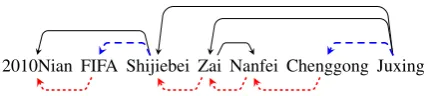
2010Nian FIFA Shijiebei Zai Nanfei Chenggong Juxing
Figure 1: An example graph for a Chinese sentence. Dotted lines are bigram relations. Solid lines are dependency relations. Dashed lines are shared by bigram and dependency relations.
2.1 Building Graphs
The graph used in this paper combines a sequence and a dependency tree as in Li et al. (2016). Each graph contains two kinds of links: dependency linksfrom dependency trees which model syntac-tic and semansyntac-tic relations between words, and bi-gram linkswhich provide local and sequential in-formation on pairs of continuous words. Figure 1 shows an example graph. Given such graphs, we can make use of both continuous and linguistically informed discontinuous phrases as long as they are connected on graphs. In this paper, we do not dis-tinguish the two kinds of relations, because our preliminary experiments showed no improvement when considering edge types.
2.2 Training
During training, given a word-aligned graph– string pair hg, t, ai, we extract translation rules
hgai, cai, tii, each of which consists of a contin-uous target phraseti, a source subgraphgaialigned toti, and a source contextcai. We first findinitial pairs. hs˜ai, tiiis an initial pair, iff it is consistent with the word alignmenta(Och and Ney, 2004).
˜
saj is a set of source words which are aligned toti. Then, the set of rules satisfies the following:
1. Ifhs˜ai, tiiis an initial pair and˜sai is covered by a subgraph gai which is connected, then
hgai,∗, tii is abasic rule. cai =∗means that a basic rule is applied without considering con-text to make sure that at least one translation is produced for any inputs during decoding. There-fore, basic rules are the same as rules in the con-ventional graph-based model. Rule (3) shows an example of a basic rule:
2010Nian FIFA Shijiebei 2010 FIFA World Cup
(3)
2. Assume hgai,∗, tii is a basic rule and hs˜ai+1, ti+1i is an initial pair whereti+1 is on
the right of and adjacent toti. If there are edges
betweengai and ˜sai+1, then hgai, cai, tii is a segmenting rule, wherecaiis the set of edges between gai and s˜ai+1 by treating ˜sai+1 as a
single nodex. Rule (4) is an example of a seg-menting rule:
2010Nian FIFA x 2010 FIFA (4)
where dashed links are contextual connections. During decoding, when the context matches, rule (4) translates a subgraph over2010Nian FIFAinto a target phrase2010 FIFA. For exam-ple, it can be applied to graph (5) where Shi-jiebei Zai Nanfei (in the dashed rectangle) is treated asx:
2010Nian FIFA Shijiebei Zai Nanfei (5)
3. If there are no edges betweengaiands˜ai+1, then
cai is equal to∅andhgai,∅, tiiis a translation rule, called aselecting rulein this paper. Dur-ing decodDur-ing, the untranslated input could be a set of subgraphs which are disjoint with each other. A selecting rule is used to select one of them. For example, rule (6) can be applied to (7) to translate2010Nian FIFA to2010 FIFA. In this example, thexin rule (6) matches with
Chenggong Juxing(in the dashed rectangle) in (7).
2010Nian FIFA x 2010 FIFA (6)
2010Nian FIFA Chenggong Juxing (7)
Algorithm 1:An algorithm for extracting trans-lation rules from a graph–string pair.
Data: Word-aligned graph–string pairhg, t, ai
Result:A set of translation rulesR 1 find a set of initial pairsP;
2 foreachp=hsai, tiiinPdo 3 ifsji is connectedthen
// basic rules
4 addhgai),∗, tiitoR;
// segmenting and selecting rules
5 for q =hsai+1, ti+1iinP do 6 cis the set of edges betweengai
andsai+1 ;
7 addhgai, c, tiitoR;
8 end
9 end
10 end
rules are then used to generate segmenting and selecting rules by extending them with contextual connections (Lines 5–8).
2.3 Model and Decoding
Following Li et al. (2016), we define our model in the well-known log-linear framework (Och and Ney, 2002). In our experiments, we use the follow-ing standard features: two translation probabilities p(g, c|t)andp(t|g, c), two lexical translation prob-abilities plex(g, c|t) and plex(t|g, c), a language
model p(t), a rule penalty, a word penalty, and a distortion function as defined in Galley and Man-ning (2010). In addition, we add one more feature into our system: a basic-rule penalty to distinguish basic rules from segmenting and selecting rules.
Our decoder is very similar to the one in the conventional graph-based model, which generates hypotheses left-to-right using beam search. A hy-pothesis can be extended on the right by translating an uncovered source subgraph. The translation pro-cess ends when all source words have been trans-lated.
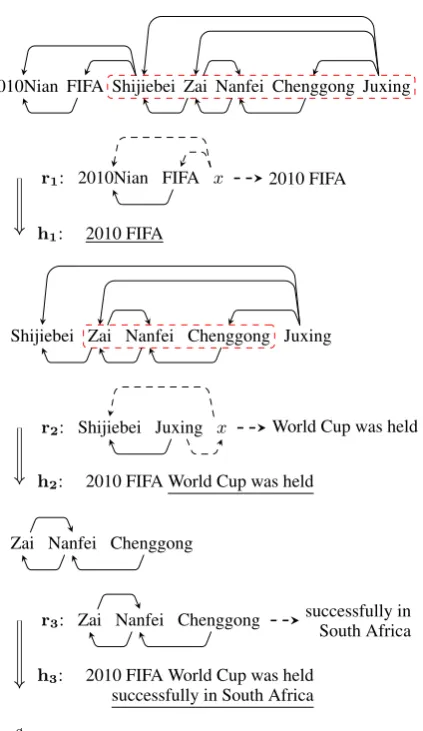
However, when extending a hypothesis, our de-coder considers the context of the translated sub-graph, i.e. edges connecting it with the remaining untranslated source words. Figure 2 shows a deriva-tion which translates an input graph in Chinese to an English string. In this example, both rulesr1
andr2 are segmenting rules.
2010Nian FIFA Shijiebei Zai Nanfei Chenggong Juxing
r1: 2010Nian FIFA x 2010 FIFA
h1: 2010 FIFA
Shijiebei Zai Nanfei Chenggong Juxing
r2: Shijiebei Juxing x World Cup was held
h2: 2010 FIFA World Cup was held
Zai Nanfei Chenggong
r3: Zai Nanfei Chenggong successfully inSouth Africa
h3: 2010 FIFA World Cup was held
successfully in South Africa
[image:3.595.313.525.59.425.2]∅
Figure 2: Example of translating an input graph. Each rule ri generates a new hypothesis hi by
appending translations on the right. Edges con-nected toxdenote contextual information. Nodes in dashed rectangles are treated asxduring decod-ing for matchdecod-ing contexts.
3 Experiments
We conduct experiments on ZH–EN and DE–EN corpora.
3.1 Data and Settings
System MT04ZH–ENMT05 WMT12DE–ENWMT13
PBMT 33.2 31.8 19.5 21.9
TBMT 33.8∗ 31.7 19.6 22.1∗ GBMT 34.7∗+ 32.4∗+ 19.8∗+ 22.4∗+
[image:4.595.333.500.61.137.2]GBMTctx 35.4∗+ 33.7∗+ 20.1∗+ 22.8∗+
Table 1: BLEU scores of all systems. Bold figures mean GBMTctxis significantly better than GBMT
at p ≤ 0.01. ∗ means a system is significantly better than PBMT atp≤0.01.+means a system is significantly better than TBMT atp≤0.01.
Following Li et al. (2016), Chinese and German sentences are parsed into projective dependency trees which are then converted to graphs by adding bigram edges. Word alignment is performed by GIZA++ (Och and Ney, 2003) with the heuris-tic functiongrow-diag-final-and. We use SRILM (Stolcke, 2002) to train a 5-gram language model on the Xinhua portion of the English Gigaword corpus 5th edition with modified Kneser-Ney dis-counting (Chen and Goodman, 1996). Batch MIRA (Cherry and Foster, 2012) is used to tune feature weights. We report BLEU (Papineni et al., 2002) scores averaged on three runs of MIRA (Clark et al., 2011).
We compare our systemGBMTctxwith several other systems. A systemPBMTis built using the phrase-based model in Moses (Koehn et al., 2007). GBMTis the graph-based translation system de-scribed in Li et al. (2016). To examine the influence of bigram links, GBMT is also used to translate de-pendency trees where treelets (Menezes and Quirk, 2005; Quirk et al., 2005; Xiong et al., 2007) are the basic translation units. Accordingly, we name the systemTBMT. All systems are implemented in Moses.
3.2 Results and Discussion
Table 1 shows BLEU scores of all systems. We found that GBMTctxis better than PBMT across
all test sets. Specifically, the improvements are +2.0/+0.7 BLEU on average on ZH–EN and DE–
EN, respectively. This improvement is reason-able as our system allows discontinuous phrases which can reduce data sparsity and handle long-distance relations (Galley and Manning, 2010). In addition, the system TBMT does not show consis-tent improvements over PBMT while both GBMT and GBMTctx achieve better BLEU scores than
TBMT on both ZH–EN (+1.8 BLEU, in terms of
Rule Type ZH–EN# RulesDE–EN
Basic Rule 84.7M+ 115.7M+ Segmenting Rule 128.4M+ 167.3M+ Selecting Rule 30.2M+ 35.7M+
[image:4.595.76.287.62.135.2]Total 243.5M+ 318.9M+
Table 2: The number of rules in GBMTctx
accord-ing to their type
GBMTctx) and DE–EN (+0.6 BLEU, in terms of
GBMTctx). This suggests that continuous phrases
connected by bigram links are essential to system performance since they help to improve phrase cov-erage (Hanneman and Lavie, 2009).
We also found that GBMTctxis significantly
bet-ter than GBMT on both ZH–EN (+1.0 BLEU) and DE–EN (+0.4 BLEU), which indicates that explic-itly modeling a segmentation using context is help-ful. The main reason for the improvement is that context helps to select proper subgraphs and target phrases. Figure 3 shows example translations. We found that in Figure 3a, after translating a paren-thesis, GBMTctxcorrectly selects a subgraphGang
Ao Tai and generates a target phrase hong kong, macao and taiwan. In Figure 3b, both GBMT and GBMTctxchoose to translate the subgraphWoMen
Ye ZhiLi. However, given the context of the sub-graph, GBMTctxselects a correct target phrasewe
are also committed tofor it.
3.3 Influence of Different Types of Rules Recall that, compared with GBMT, GBMTctx
con-tains three types of rules: basic rules, segmenting rules, and selecting rules. While basic rules exist in both systems, segmenting and selecting rules make GBMTctxcontext-aware. Table 2 shows the
num-ber of rules in GBMTctxaccording to their types.
We found that on both language pairs 35%–36% of rules are basic rules. While the proportion of segmenting rules is∼53%, selecting rules only ac-count for 11%–12%. This is because segmenting rules contain richer contextual information than selecting rules.
Table 3 shows BLEU scores of GBMTctxwhen
( hong kong macao taiwan ) hong kong spring festival retail business rise 10% ( Gang Ao Tai ) XiangGang XinChun LingShou ShengYi ShangSheng YiCheng
Ref: GBMT: GBMTctx:
(hong kong , macao and taiwan) hong kong’s retail sales up 10% during spring festival (the spring festival) hong kong retail business in hong kong, macao and taiwan rose by 10% (hong kong , macao and taiwan) hong kong spring retail business will increase by 10%
(a) subgraph selection
we also dedicate protect and improve living emvironment . WoMen Ye ZhiLi BaoHu He GaiShan JuZhu HuanJing .
Ref: GBMT: GBMTctx:
we are also committed to protect and improve our living environment. we have worked hard to protect and improve the living environment. we are also committed to protect and improve the living environment.
[image:5.595.105.482.66.329.2](b) target-phrase selection
Figure 3: Example translations of GBMT and GBMTctx
System MT04ZH–ENMT05 WMT12DE–ENWMT13
Basic Rule 34.7 32.4 19.8 22.4 +Seg. Rule 34.9 33.0 20.2 23.0 +Sel. Rule 34.8 32.5 20.0 22.7
All 35.4 33.7 20.1 22.8
Table 3: BLEU scores of GBMTctx when
differ-ent types of rules are used, including Basic Rule, Segmenting (Seg.) Rule, and Selecting (Sel.) Rule. Bold figures mean a system is significantly better than the one only using basic rules atp≤0.01.
the number of segmenting rules is much larger than the number of selecting rules. We further observed that, while our system achieves the best perfor-mance when all rules are used on ZH–EN, the com-bination of basic rules and segmenting rules on DE–EN results in the best system. This is prob-ably because reordering (including long-distance reordering) is performed less often in DE–EN than in ZH–EN (Li et al., 2016) which makes selecting rules less preferable on DE–EN.
4 Conclusion
In this paper, we present a graph-based model which takes subgraphs as the basic translation units and considers source context during segmenting graphs into subgraphs. Experiments on Chinese–
English and German–English show that our model is significantly better than the conventional graph-based model which equally treats different graph segmentations.
In this paper, source context is used as hard con-straints during decoding. In future, we would like to try soft constraints. In addition, it would also be interesting to extend this model using a syn-chronous graph grammar.
Acknowledgments
This research has received funding from the Euro-pean Union’s Horizon 2020 research and innova-tion programme under grant agreement no645452
(QT21). The ADAPT Centre for Digital Content Technology is funded under the SFI Research Cen-tres Programme (Grant 13/RC/2106) and is co-funded under the European Regional Development Fund. The authors thank all anonymous reviewers for their insightful comments and suggestions.
References
Colin Cherry and George Foster. 2012. Batch Tun-ing Strategies for Statistical Machine Translation. In
Proceedings of the 2012 Conference of the North American Chapter of the Association for Computa-tional Linguistics: Human Language Technologies, pages 427–436, Montreal, Canada, June.
Jonathan H. Clark, Chris Dyer, Alon Lavie, and Noah A. Smith. 2011. Better Hypothesis Testing for Statistical Machine Translation: Controlling for Optimizer Instability. InProceedings of the 49th An-nual Meeting of the Association for Computational Linguistics: Human Language Technologies: Short Papers - Volume 2, pages 176–181, Portland, Ore-gon, June.
Michel Galley and Christopher D. Manning. 2010. Ac-curate Non-hierarchical Phrase-Based Translation. In Human Language Technologies: The 2010 An-nual Conference of the North American Chapter of the Association for Computational Linguistics, pages 966–974, Los Angeles, California, June. Greg Hanneman and Alon Lavie. 2009. Decoding with
Syntactic and Non-syntactic Phrases in a Syntax-based Machine Translation System. In Proceed-ings of the Third Workshop on Syntax and Structure in Statistical Translation, pages 1–9, Boulder, Col-orado, June.
Philipp Koehn, Franz Josef Och, and Daniel Marcu. 2003. Statistical Phrase-Based Translation. In Pro-ceedings of the 2003 Conference of the North Amer-ican Chapter of the Association for Computational Linguistics on Human Language Technology - Vol-ume 1, pages 48–54, Edmonton, Canada, July. Philipp Koehn, Hieu Hoang, Alexandra Birch, Chris
Callison-Burch, Marcello Federico, Nicola Bertoldi, Brooke Cowan, Wade Shen, Christine Moran, Richard Zens, Chris Dyer, Ondej Bojar, Alexan-dra Constantin, and Evan Herbst. 2007. Moses: Open Source Toolkit for Statistical Machine Trans-lation. InProceedings of the 45th Annual Meeting of the ACL on Interactive Poster and Demonstration Sessions, pages 177–180, Prague, Czech Republic, June.
Liangyou Li, Andy Way, and Qun Liu. 2016. Graph-Based Translation Via Graph Segmentation. In Pro-ceedings of the 54th Annual Meeting of the Associa-tion for ComputaAssocia-tional Linguistics (Volume 1: Long Papers), pages 97–107, Berlin, Germany, August. Arul Menezes and Chris Quirk. 2005. Dependency
Treelet Translation: The Convergence of Statistical and Example-Based Machine-translation? In Pro-ceedings of the Workshop on Example-based Ma-chine Translation at MT Summit X, September. Franz Josef Och and Hermann Ney. 2002.
Discrimi-native Training and Maximum Entropy Models for Statistical Machine Translation. In Proceedings of the 40th Annual Meeting on Association for Com-putational Linguistics, pages 295–302, Philadelphia, PA, USA, July.
Franz Josef Och and Hermann Ney. 2003. A System-atic Comparison of Various Statistical Alignment Models. Computational Linguistics, 29(1):19–51, March.
Franz Josef Och and Hermann Ney. 2004. The Align-ment Template Approach to Statistical Machine Translation. Computational Linguistics, 30(4):417– 449, December.
Kishore Papineni, Salim Roukos, Todd Ward, and Wei-Jing Zhu. 2002. BLEU: A Method for Automatic Evaluation of Machine Translation. InProceedings of the 40th Annual Meeting on Association for Com-putational Linguistics, pages 311–318, Philadelphia, Pennsylvania, July.
Chris Quirk, Arul Menezes, and Colin Cherry. 2005. Dependency Treelet Translation: Syntactically In-formed Phrasal SMT. InProceedings of the 43rd An-nual Meeting of the Association for Computational Linguistics (ACL’05), pages 271–279, Ann Arbor, Michigan, June.
Andreas Stolcke. 2002. SRILM An Extensible Lan-guage Modeling Toolkit. InProceedings of the Inter-national Conference Spoken Language Processing, pages 901–904, Denver, CO.