3006
Learning to Decipher Hate Symbols
Jing Qian, Mai ElSherief, Elizabeth Belding, William Yang Wang Department of Computer Science
University of California, Santa Barbara Santa Barbara, CA 93106 USA
{jing qian,mayelsherif,ebelding,william}@cs.ucsb.edu
Abstract
Existing computational models to understand hate speech typically frame the problem as a simple classification task, bypassing the un-derstanding of hate symbols (e.g., 14 words, kigy) and their secret connotations. In this pa-per, we propose a novel task of deciphering hate symbols. To do this, we leverage the Ur-ban Dictionary and collected a new, symbol-rich Twitter corpus of hate speech. We investi-gate neural network latent context models for deciphering hate symbols. More specifically, we study Sequence-to-Sequence models and show how they are able to crack the ciphers based on context. Furthermore, we propose a novel Variational Decipher and show how it can generalize better to unseen hate symbols in a more challenging testing setting.
1 Introduction
The statistics are sobering. The Federal Bureau of Investigation of United States1 reported over 6,000 criminal incidents motivated by bias against race, ethnicity, ancestry, religion, sexual orienta-tion, disability, gender, and gender identity dur-ing 2016. The most recent 2016 report shows an alarming 4.6% increase, compared with 2015 data2. In addition to these reported cases, thou-sands of Internet users, including celebrities, are forced out of social media due to abuse, hate speech, cyberbullying, and online threats. While such social media data is abundantly available, the broad question we are asking is—What can ma-chine learning and natural language processing do to help and prevent online hate speech?
The vast quantity of hate speech on social me-dia can be analyzed to study online abuse. In
1
https://www.fbi.gov/news/stories/2016-hate-crime-statistics
2
https://www.fbi.gov/news/stories/2015-hate-crime-statistics-released
Figure 1: An example tweet with hate symbols.
recent years, there has been a growing trend of developing computational models of hate speech. However, the majority of the prior studies focus solely on modeling hate speech as a binary or multiclass classification task (Djuric et al., 2015; Waseem and Hovy, 2016;Burnap and Williams, 2016; Wulczyn et al., 2017; Pavlopoulos et al., 2017).
While developing new features for hate speech detection certainly has merits, we believe that un-derstanding hate speech requires us to design com-putational models that can decipher hate sym-bols that are commonly used by hate groups. Figure 1 shows an example usage of hate sym-bols in an otherwise seemingly harmless tweet that promotes hate. For example, Aryan War-rior is a longstanding racist prison gang based in the Nevada prison system. WPWW is the acronym for White Pride World Wide. The hate symbols 1488 and 2316 are more implicit. 14
symbolizes the 14 words: “WE MUST SECURE THE EXISTENCE OF OUR PEOPLE AND A FUTURE FOR WHITE CHILDREN”, spoken by members of the Order neo-Nazi movement. H
In this work, we propose the first models for de-ciphering hate symbols. We investigate two fami-lies of neural network approaches: the Sequence-to-Sequence models (Sutskever et al.,2014;Cho et al., 2014) and a novel Variational Decipher based on the Conditional Variational Autoen-coders (Kingma and Welling, 2014; Sohn et al., 2015;Larsen et al., 2016). We show how these neural network models are able to guess the mean-ing of hate symbols based on context embeddmean-ings and even generalize to unseen hate symbols during testing. Our contributions are three-fold:
• We propose a novel task of learning to deci-pher hate symbols, which moves beyond the standard formulation of hate speech classifi-cation settings.
• We introduce a new, symbol-rich tweet dataset for developing computational models of hate speech analysis, leveraging the Urban Dictionary.
• We investigate a sequence-to-sequence neu-ral network model and show how it is able to encode context and crack the hate symbols. We also introduce a novel Variational Deci-pher, which generalizes better in a more chal-lenging setting.
In the next section, we outline related work in text normalization, machine translation, conditional variational autoencoders, and hate speech analy-sis. In Section3, we introduce our new dataset for deciphering hate speech. Next, in Section 4, we describe the design of two neural network mod-els for the decipherment problem. Quantitative and qualitative experimental results are presented in Section5. Finally, we conclude in Section6.
2 Related Work
2.1 Text Normalization in Social Media
The proposed task is related to text normal-ization focusing on the problems presented by user-generated content in online sources, such as misspelling, rapidly changing out-of-vocabulary slang, short-forms and acronyms, punctuation er-rors or omissions, etc. These problems usually appear as out-of-vocabulary words. Extensive re-search has focused on this task (Beaufort et al., 2010;Liu et al., 2011; Gouws et al., 2011; Han and Baldwin, 2011; Han et al., 2012;Liu et al.,
2012;Chrupała,2014). However, our task is dif-ferent from the general text normalization in so-cial media in that instead of the out-of-vocabulary words, we focus on the symbols conveying hateful meaning. These hate symbols can go beyond lex-ical variants of the vocabulary and thus are more challenging to understand.
2.2 Machine Translation
An extensive body of work has been dedi-cated to machine translation.Knight et al.(2006) study a number of natural language decipherment problems using unsupervised learning. Ravi and Knight (2011) further frame the task of machine translation as decipherment and tackle it without parallel training data. Machine translation using deep learning (Neural Machine Translation) has been proposed in recent years. Sutskever et al. (2014) andCho et al.(2014) use Sequence to Se-quence (Seq2Seq) learning with Recurrent Neu-ral Networks (RNN).Bahdanau et al.(2015) fur-ther improve translation performance using the attention mechanism. Google’s Neural Machine Translation System (GNMT) employs a deep at-tentional LSTM network with residual connec-tions (Wu et al.,2016). Recently, machine transla-tion techniques have been also applied to explain non-standard English expressions (Ni and Wang, 2017). However, our deciphering task is not the same as machine translation in that hate symbols are short and cannot be modeled as language.
Our task is more closely related to (Hill et al., 2016) and (Noraset et al.,2017). Hill et al.(2016) propose using neural language embedding mod-els to map the dictionary definitions to the word representations, which is the inverse of our task. Noraset et al.(2017) propose the definition mod-eling task. However, in their task, for each word to be defined, its pre-trained word embedding is required as an input, which is actually the prior knowledge of the words. However, such kind of prior knowledge is not available in our decipher-ment task. Therefore, our task is more challenging and is not simply a definition modeling task.
2.3 Conditional Variational Autoencoder
digits (Kingma and Welling,2014;Salimans et al., 2015), faces (Kingma and Welling,2014;Rezende et al., 2014), and machine translation (Zhang et al., 2016). Conditional Variational Autoen-coder (Larsen et al.,2016;Sohn et al.,2015) ex-tends the original VAE framework by incorporat-ing conditions durincorporat-ing generation. In addition to image generation, CVAE has been successfully applied to some NLP tasks. For example, Zhao et al. (2017) apply CVAE to dialog generation, while Guu et al. (2018) use CVAE for sentence generation.
2.4 Hate Speech Analysis
Closely related to our work arePavlopoulos et al. (2017); Gao et al. (2017). Pavlopoulos et al. (2017) build an RNN supplemented by an at-tention mechanism that outperforms the previous state of the art system in user comment moder-ation (Wulczyn et al., 2017). Gao et al. (2017) propose a weakly-supervised approach that jointly trains a slur learner and a hate speech classifier. While their work contributes to the automation of harmful content detection and the highlighting of suspicious words, our work builds upon these con-tributions by providing a learning mechanism that deciphers suspicious hate symbols used by com-munities of hate to bypass automated content mod-eration systems.
3 Dataset
In this section, we describe the dataset we col-lected for hate symbol decipherment.
3.1 Hate Symbols
We first collect hate symbols and the correspond-ing definitions from the Urban Dictionary. Each term with one of the following hashtags: #hate, #racism, #racist, #sexism, #sexist, #nazi is se-lected as a candidate and added to the setS0. We
collected a total of 1,590 terms. Next, we expand this set by different surface forms using the Urban Dictionary API. For each termsiin setS0, we
ob-tain a set of terms Ri that have the same
mean-ing as si but with different surface forms. For
example, for the termbrown shirt, there are four terms with different surface forms: brown shirt, brown shirts, Brownshirts, brownshirt. Each term inRi has its own definition in Urban Dictionary,
but since these terms have exactly the same mean-ing, we select a definition di with maximum
up-vote/downvote ratio for all the terms in Ri. For
example, for each term in the setRi={brown shirt,
brown shirts, Brownshirts, brownshirt}, the corre-sponding definition is“Soldiers in Hitler’s storm trooper army, SA during the Nazi regime...” After expanding, we obtain 2,105 distinct hate symbol terms and their corresponding definitions. On av-erage, each symbol consists of 9.9 characters, 1.5 words. Each definition consists of 96.8 characters, 17.0 words.
3.2 Tweet Collection
For each of the hate symbols, we collect all tweets from 2011-01-01 to 2017-12-31 that contain ex-actly the same surface form of hate symbol in the text. Since we only focus on hate speech, we train an SVM (Cortes and Vapnik, 1995) classi-fier to filter the collected tweets. The SVM model is trained on the dataset published by Waseem and Hovy(2016). Their original dataset contains three labels: Sexism, Racism, and None. Since the SVM model is used to filter the non-hate speech, we merge the instances labeled as sexism and racism, then train the SVM model to do binary classification. After filtering out all the tweets classified as non-hate, our final dataset consists of 18,667 (tweet, hate symbol, definition) tuples.
4 Our Approach
We formulate hate symbol deciphering as the fol-lowing equation:
Obj= X
(u,s,d∗)∈X
logp(d∗|(u, s)) (1)
X is the dataset, (u, s, d∗) is the (tweet, symbol, definition) tuple in the dataset. The inputs are the tweet and the hate symbol in this tweet. The out-put is the definition of the symbol. Our objective is to maximize the probability of the definition given the (tweet, symbol) pair. This objective function is very similar to that of machine translation. So we first try to tackle it based on the Sequence-to-Sequence model, which is commonly used in ma-chine translation.
4.1 Sequence-to-Sequence Model
Figure 2: Our Seq2Seq model.u,sware the word em-beddings of the tweet text and hate symbol. sc is the character embedding of the symbol. cuis the encoded tweet andhis the concatenated hidden states. dis the generated text. Detailed explanation is in section4.1.
and Schmidhuber, 1997) performs better on our task. Therefore, our Seq2Seq model uses LSTM encoders and GRU decoders. An overview of our Seq2Seq model is shown in Figure2. The compu-tation process is shown as the following equations:
cu, hu=fu(u) (2)
csw, hsw =fsw(sw) (3)
csc, hsc =fsc(sc) (4)
u is the word embedding of the tweet text,sw is
the word embedding of the hate symbol,scis the
character embedding of the symbol. fu, fsw, and
fsc are LSTM functions. cu,csw,csc are the
out-puts of the LSTMs at the last time step and hu,
hsw, hsc are the hidden states of the LSTMs at
all time steps. We use two RNN encoders to en-code the symbol, one enen-codes at the word level and the other one encodes at the character level. The character-level encoded hate symbol is used to provide the feature of the surface form of the hate symbol while the word-level encoded hate symbol is used to provide the semantic information of the hate symbol. The hidden states of the two RNN encoders for hate symbols are concatenated:
h=hsw⊕hsc (5)
cu is the vector of encoded tweet text. The tweet
text is the context of the hate symbol, which provides additional information during decoding. Therefore, the encoded tweet text it is also fed into
the RNN decoder. The detailed attention mecha-nism and decoding process at time step t are as follows:
wt=σ(lw(dt−1⊕et−1)) (6)
at= T
X
i=1
wtihi (7)
bt=σ(lc(dt−1⊕at)) (8)
ot, et=k(cu⊕bt, et−1) (9)
p(dt|u, s) =σ(lo(ot)) (10)
wtis the attention weights at time step tandwti
is theithweight ofwt.dt−1is the generated word
at last time step andet−1 is the hidden state of the
decoder at last time step. hi is the ith time step
segment of h. lw, lc, andlo are linear functions.
σis a nonlinear activation function. kis the GRU function.otis the output andetis the hidden state
of the GRU.p(dt|u, s)is the probability
distribu-tion of the vocabulary at time stept. The attention weightswt are computed based on the decoder’s
hidden state and the generated word at time step
t−1. Then the computed weights are applied to the concatenated hidden stateshof encoders. The result at is the context vector for the decoder at
time stept. The context vector and the last gen-erated word are combined by a linear functionlc
followed by a nonlinear activation function. The result bt is concatenated with the encoded tweet
contextcu, and then fed into GRU together with
the decoder’s last hidden state et−1. Finally, the
probability of each vocabulary word is computed fromot.
4.2 Variational Decipher
The Variational Decipher is based on the CVAE model, which is another model that can be used to parametrize the conditional probability
p(d∗|(u, s)) in the objective function (Equation 1). Unlike the Seq2Seq model, which directly parametrizesp(d∗|(u, s)), our variational decipher formulates the task as follows:
Obj= X
(u,s,d∗)∈X
logp(d∗|(u, s))
= X
(u,s,d∗)∈X log
Z
z
p(d∗|z)p(z|(u, s))dz
(11)
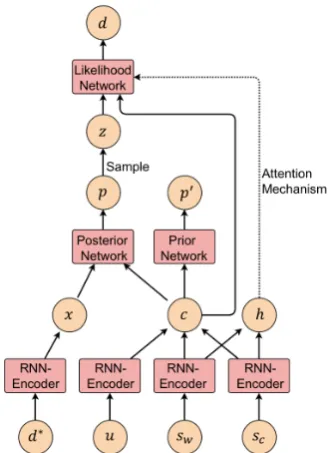
Figure 3: The Variational Decipher. Note that this structure is used during training. During testing, the structure is slightly different. d∗ is the word embed-dings of the definition. x is the encoded definition. c is the concatenation of the encoded tweet and hate symbol. pandp0 are output distributions. zis the la-tent variable. The definitions of other variables are the same as those in Figure2. Detailed explanation is in section4.2.
overz is intractable, we instead try to maximize the evidence lower bound (ELBO). Our variational lower bound objective is in the following form:
Obj =E[logpϕ(d∗|z, u, s)]−
DKL[pα(z|d∗, u, s)||pβ(z|u, s)]
(12)
where pϕ(d∗|z, u, s) is the likelihood,
pα(z|d∗, u, s) is the posterior, pβ(z|u, s) is
the prior, andDKL is the Kullback-Leibler (KL)
divergence. We use three neural networks to model these three probability distributions. An overview of our variational decipher is shown in Figure 3. We first use four recurrent neural networks to encode the (tweet, symbol, definition) pair in the dataset. Similar to what we do in the Seq2Seq model, there are two encoders for the hate symbol. One is at the word level and the other is at the character level. The encoding of symbols and tweets are exactly the same as in our Seq2Seq model (see Equations 2-4). The difference is that we also need to encode definitions for the Variational Decipher.
x, hd=fd(d∗) (13)
Here,fdis the LSTM function. xis the output of
the LSTM at the last time step andhdis the hidden
state of the LSTM at all time steps. The condition vectorcis the concatenation of the encoded sym-bol words, symsym-bol characters, and the tweet text:
c=cu⊕csw⊕csc (14)
We use multi-layer perceptron (MLP) to model the posterior and the prior in the objective func-tion. The posterior network and the prior network have the same structure and both output a prob-ability distribution of latent variablez. The only difference is that the input of the posterior net-work is the concatenation of the encoded defini-tion x and the condition vectorcwhile the input of the prior network is only the condition vector
c. Therefore, the output of the posterior network
p=pα(z|d∗, u, s)and the output of the prior
net-workp0 =pβ(z|u, s). By assuming the latent
vari-ablezhas a multivariate Gaussian distribution, the actual outputs of the posterior and prior networks are the mean and variance: (µ,Σ) for the posterior network and (µ0,Σ0) for the prior network.
µ,Σ =g(x⊕c) (15)
µ0,Σ0 =g0(c) (16)
gis the MLP function of the posterior network and
g0 is that of the prior network. During training, the latent variable z is randomly sampled from the Gaussian distribution N(µ,Σ) and fed into the likelihood network. During testing, the pos-terior network is replaced by the prior network, soz is sampled fromN(µ0,Σ0). The likelihood network is modeled by an RNN decoder with at-tention mechanism, very similar to the decoder of our Seq2Seq model. The only difference lies in the input for the GRU. The decoder in our Varia-tional Decipher model is to model the likelihood
pϕ(d∗|z, u, s), which is conditioned on the latent
variable, tweet context, and the symbol. There-fore, for the Variational Decipher, the condition vectorcand the sampled latent variablez are fed into the decoder.
ot, et=k(z⊕c⊕bt, et−1) (17)
et−1is the hidden state of the RNN decoder at the
last time step. k is the GRU function. ot is its
output andetis its hidden state. Detailed decoding
According to the objective function in Equation 12, the loss function of the Variational Decipher is as follows:
L=LREC+LKL
=Ez∼pα(z|d∗,u,s)[−logpϕ(d
∗|
z, u, s)]+
DKL[pα(z|d∗, u, s)||pβ(z|u, s)]
(18)
It consists of two parts. The first part LREC
is called reconstruction loss. Optimizing LREC
can push the sentences generated by the posterior network and the likelihood network closer to the given definitions. The second partLKL is the KL
divergence loss. Optimizing this loss can push the output Gaussian Distributions of the prior net-work closer to that of the posterior netnet-work. This means we teach the prior network to learn the same knowledge learned by the posterior network, such that during testing time, when the referen-tial definitiond∗ is no longer available for gener-ating the latent variable z, the prior network can still output a reasonable probability distribution over the latent variable z. The complete training and testing process for the Variational Decipher is shown in Algorithm1. M is the predefined maxi-mum length of the generated text. BCE refers to the Binary Cross Entropy loss.
5 Experiments
5.1 Experimental Settings
We use the dataset collected as described in sec-tion 3 for training and testing. We randomly se-lected 2,440 tuples for testing and use the remain-ing 16,227 tuples for trainremain-ing. Note that there are no overlapping hate symbols between the training datasetU and the testing datasetD.
We split the 2,440 tuples of the testing datasetD
into two separate parts,DsandDd.Dsconsists of
1,681 examples andDdconsists of 759 examples.
In the first testing datasetDs, although each hate
symbol does not appear in the training dataset, the corresponding definition appears in the training dataset. In the second testing dataset Dd, neither
the hate symbols nor the corresponding definitions appear in the training dataset. We do this split be-cause deciphering hate symbols in these two cases has different levels of difficulty.
This split criterion means that for each hate symbol in Ds, there exists some symbol in the
training dataset that has the same meaning but in different surface forms. For example, the hate
Algorithm 1Train & Test Variational Decipher
1: functionTRAIN(U)
2: randomly initialize network parametersϕ,α,β; 3: forepoch= 1, Edo
4: for(tweet, symbol, def inition)inUdo
5: get embeddingsu,sw,sc,d∗;
6: computex,candhwith RNN encoders; 7: computeµ,Σwith the posterior network; 8: computeµ0,Σ0with the prior network; 9: compute KL-divergence lossLKL;
10: samplez=reparameterize(µ,Σ); 11: initialize the decoder statee0=c;
12: LREC= 0;
13: fort= 1, Mdo
14: compute attention weightswt;
15: computeot,etandp(dt|z, u, s);
16: dt=indmax(p(dt|z, u, s));
17: LREC+ =BCE(dt, d∗t);
18: ifdt==EOSthen
19: break;
20: end if
21: end for
22: updateϕ,α,βonL=LREC+LKL;
23: end for
24: end for
25: end function
26:
27: functionTEST(V)
28: for(tweet, symbol, def inition)inV do
29: get embeddingsu,sw,sc;
30: computecandhwith RNN encoders; 31: computeµ0,Σ0with the prior network; 32: samplez=reparameterize(µ0,Σ0); 33: initialize the decoder statee0=c;
34: fort= 1, Mdo
35: compute attention weightsw; 36: computeot,etandp(dt|z, u, s);
37: dt=indmax(p(dt|z, u, s));
38: ifdt==EOSthen
39: break;
40: end if
41: end for
42: end for
43: end function
symbolwigwogandWig Woghave the same def-inition but one is in the training dataset, the other is in the first testing dataset. We assume that such types of hate symbols share similar surface forms or similar tweet contexts. Therefore, the first test-ing datasetDs is to evaluate how well the model
captures the semantic similarities among the tweet contexts in different examples or the similarities among different surface forms of a hate symbol.
Deciphering the hate symbols in the second test-ing dataset Dd is more challenging. Both the
unseen hate symbols and definitions require the model to have the ability to accurately capture the semantic information in the tweet context and then make a reasonable prediction. The second testing datasetDdis used to evaluate how well the model
Dataset Method BLEU ROUGE-L METEOR
Ds Seq2Seq 37.80 41.05 36.67
VD 34.77 32.96 31.03
Dd Seq2Seq 25.44 12.96 5.54
VD 28.38 14.01 5.41
D Seq2Seq 33.96 32.32 26.98
[image:7.595.72.291.61.136.2]VD 32.75 27.00 23.16
Table 1: The BLEU, ROUGE-L and METEOR scores on testing datasets. VD refers to the Variational Deci-pher.Dis the entire testing dataset.Dsis the first part ofDandDd is the second part. The better results are in bold.
For the Seq2Seq model, we use negative log-likelihood loss for training. Both models are op-timized using Adam optimizer (Kingma and Ba, 2015). The hyper-parameters of two models are exactly the same. We set the maximum generation lengthM = 50. The hidden size of the encoders is 64. The size of the word embedding is 200 and that of character embedding is 100. The word em-beddings and character emem-beddings are randomly initialized. Each model is trained for 50 epochs. We report the deciphering results of two models on three testing datasetsD,DsandDd.
5.2 Experimental Results
Quantitative Results: We use equally weighted BLEU score for up to 4-grams (Papineni et al., 2002), ROUGE-L (Lin, 2004) and METEOR (Banerjee and Lavie, 2005) to evaluate the deci-pherment results. The results are shown in Ta-ble 1. Figure 4 shows the BLEU score achieved by the two models on three testing datasets D,
DsandDdduring the training process. Both our
Seq2Seq model and Variational Decipher achieve reasonable BLEU scores on the testing datasets. The Seq2Seq model outperforms the Variational Decipher on Ds while Variational Decipher
out-performs Seq2Seq onDd. Note that Ds is more
than twice the size ofDd. Therefore, Seq2Seq
out-performs Variational Decipher on the entire testing dataset D. The different performance of the two models onDsandDdis more obvious in Figure4.
The gap between the performance of the Seq2Seq model onDsandDdis much larger than that
be-tween the performance of the Variational Decipher on these two datasets.
[image:7.595.306.525.62.211.2]Human Evaluation: We employed crowd-sourced workers to evaluate the deciphering re-sults of two models. We randomly sampled 100 items of deciphering results fromDs and another
Figure 4: BLEU scores of two models on the testing dataset D,Ds andDd. The three dotted curves rep-resent the performance of the Seq2Seq model while the three solid curves represent the performance of the Variational Decipher.
Dataset Seq2Seq Lose Seq2Seq Win Tie
Ds 31.0% 32.0% 37.0%
Dd 30.5% 22.0% 47.5%
Table 2: The results of human evaluation on two sepa-rate testing datasetsDsandDd.
100 items fromDd. Each item composes a choice
question and each choice question is assigned to five workers on Amazon Mechanical Turk. In each choice question, the workers are given the hate symbol, the referential definition, the origi-nal tweet and two machine-generated plain texts from the Seq2Seq model and Variational Decipher. Workers are asked to select the more reasonable of the two results. In each choice question, the order of the results from the two models is per-muted. Ties are permitted for answers. We batch five items in one assignment and insert an artificial item with two identical outputs as a sanity check. The workers who fail to choose “tie” for that item are rejected from our test. The human evaluation results are shown in Table2, which coincide with the results in Table1and Figure4.
[image:7.595.315.518.294.327.2]con-Figure 5: Some example errors in the generated results of our Seq2Seq model and Variational Decipher.
text information and the definition of the symbol. Therefore, the different performances of two mod-els on the two testing datasets Ds and Dd
indi-cate that the Seq2Seq model is better at captur-ing the similarities among different surface forms of a hate symbol, while the Variational Decipher is better at capturing the semantic relationship be-tween the tweet context and the hate symbol. The Sequence-to-Sequence model tries to capture such kinds of relationships by compressing all the con-text information into a fixed length vector, so its deciphering strategy is actually behavior cloning. On the other hand, the Variational Decipher cap-tures such relationships by explicitly modeling the posterior and likelihood distributions. The mod-eled distributions provide higher-level semantic information compared to the compressed context, which allows the Variational Decipher to general-ize better to the symbols with unseen definitions. This explains why the gap between the perfor-mance of the Seq2Seq model on two datasets is larger.
5.3 Error Analysis
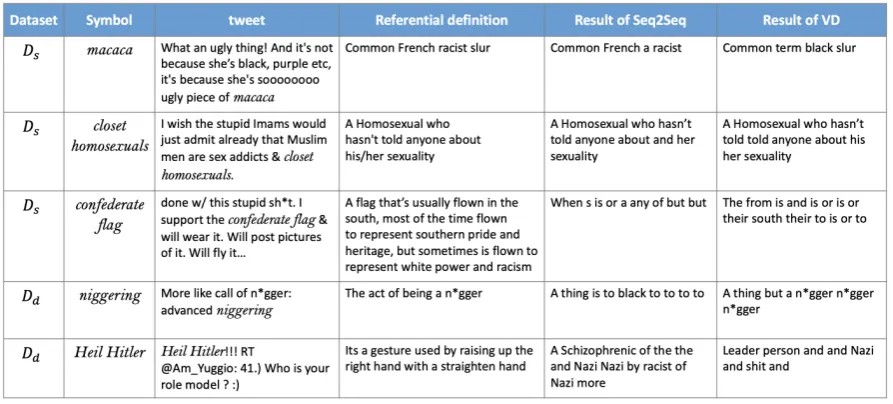
Figure5shows some example errors of the deci-phering results of our Seq2Seq model and Varia-tional Decipher. One problem with the decipher-ing results is that the generated sentences have poor grammatical structure, as shown in Figure5. This is mainly because the size of our dataset is small, and the models need a much larger corpus to learn the grammar. We anticipate that the gener-ation performance will be improved with a larger dataset.
For the hate symbols inDs, the deciphering
re-sults are of high quality when the length of refer-ential definitions are relatively short. An example ismacaca, a French slur shows in Figure5. The deciphering result of the Seq2Seq model is close to the referential definition. As to the Variational Decipher, although the result is not literally the same as the definition, the meaning is close.closet homosexualsin Figure5is another example. How-ever, when the length of the referential definition increases, the performance of both models tends to be unsatisfactory, as the third exampleconfederate flagshows in Figure5. Although there exists the symbolConfederate Flagwith the same definition in the training set, both models fail on this exam-ple. One possible reason is that the complexity of generating the referential definition grows sub-stantially with the increasing length, so when the tweet context and the symbol itself cannot provide enough information, the generation model cannot learn the relationship between the symbol and its definition.
Deciphering hate symbols inDdis much more
[image:8.595.76.523.62.264.2]6 Conclusion
We propose a new task of learning to decipher hate symbols and create a symbol-rich tweet dataset. We split the testing dataset into two parts to ana-lyze the characteristics of the Seq2Seq model and the Variational Decipher. The different perfor-mance of these two models indicates that the mod-els can be applied to different scenarios of hate symbol deciphering. The Seq2Seq model outper-forms the Variational Decipher for deciphering the hate symbols with similar definitions to that in the training dataset. This means the Seq2Seq model can better explain the hate symbols when Twitter users intentionally misspell or abbreviate common slur terms. On the other hand, the Variational De-cipher tends to be better at deDe-ciphering hate sym-bols with unseen definitions, so it can be applied to explain newly created hate symbols on Twitter. Although both models show promising decipher-ing results, there still exists much room for im-provement.
References
Dzmitry Bahdanau, Kyunghyun Cho, and Yoshua Ben-gio. 2015. Neural machine translation by jointly learning to align and translate. In Proceedings of the 3rd International Conference on Learning Rep-resentations.
Satanjeev Banerjee and Alon Lavie. 2005. Meteor: An automatic metric for MT evaluation with im-proved correlation with human judgments. In Pro-ceedings of the ACL workshop on intrinsic and ex-trinsic evaluation measures for machine translation and/or summarization, pages 65–72.
Richard Beaufort, Sophie Roekhaut, Louise-Am´elie Cougnon, and C´edrick Fairon. 2010. A hybrid rule/model-based finite-state framework for normal-izing SMS messages. InProceedings of the 48th An-nual Meeting of the Association for Computational Linguistics, pages 770–779. Association for Com-putational Linguistics.
Pete Burnap and Matthew L Williams. 2016. Us and them: identifying cyber hate on Twitter across mul-tiple protected characteristics. EPJ Data Science, 5(1):11.
Kyunghyun Cho, Bart van Merrienboer, Caglar Gul-cehre, Dzmitry Bahdanau, Fethi Bougares, Holger Schwenk, and Yoshua Bengio. 2014. Learning phrase representations using RNN encoder–decoder for statistical machine translation. InProceedings of the 2014 Conference on Empirical Methods in Nat-ural Language Processing (EMNLP), pages 1724– 1734.
Grzegorz Chrupała. 2014. Normalizing tweets with edit scripts and recurrent neural embeddings. In Proceedings of the 52nd Annual Meeting of the As-sociation for Computational Linguistics (Volume 2: Short Papers), volume 2, pages 680–686.
Corinna Cortes and Vladimir Vapnik. 1995. Support-vector networks. Machine Learning, 20(3):273– 297.
Nemanja Djuric, Jing Zhou, Robin Morris, Mihajlo Gr-bovic, Vladan Radosavljevic, and Narayan Bhamidi-pati. 2015. Hate speech detection with comment embeddings. In Proceedings of the 24th ACM In-ternational Conference on World Wide Web, pages 29–30.
Lei Gao, Alexis Kuppersmith, and Ruihong Huang. 2017. Recognizing explicit and implicit hate speech using a weakly supervised two-path bootstrapping approach. In Proceedings of the Eighth Interna-tional Joint Conference on Natural Language Pro-cessing, pages 774–782.
Stephan Gouws, Dirk Hovy, and Donald Metzler. 2011. Unsupervised mining of lexical variants from noisy text. InProceedings of the First workshop on Unsu-pervised Learning in NLP, pages 82–90. Association for Computational Linguistics.
Kelvin Guu, Tatsunori B Hashimoto, Yonatan Oren, and Percy Liang. 2018. Generating sentences by editing prototypes. Transactions of the Association of Computational Linguistics, 6:437–450.
Bo Han and Timothy Baldwin. 2011. Lexical normali-sation of short text messages: Makn sens a# twitter. In Proceedings of the 49th Annual Meeting of the Association for Computational Linguistics: Human Language Technologies-Volume 1, pages 368–378. Association for Computational Linguistics.
Bo Han, Paul Cook, and Timothy Baldwin. 2012. Au-tomatically constructing a normalisation dictionary for microblogs. In Proceedings of the 2012 Joint Conference on Empirical Methods in Natural guage Processing and Computational Natural Lan-guage Learning, pages 421–432. Association for Computational Linguistics.
Felix Hill, KyungHyun Cho, Anna Korhonen, and Yoshua Bengio. 2016. Learning to understand phrases by embedding the dictionary. Transac-tions of the Association of Computational Linguis-tics, 4:17–30.
Sepp Hochreiter and J¨urgen Schmidhuber. 1997. Long short-term memory. Neural Computation, 9(8):1735–1780.
Diederik P. Kingma and Max Welling. 2014. Auto-encoding variational bayes. InProceedings of the 2nd International Conference on Learning Repre-sentations.
Kevin Knight, Anish Nair, Nishit Rathod, and Kenji Yamada. 2006. Unsupervised analysis for decipher-ment problems. InProceedings of the 21st Interna-tional Conference on ComputaInterna-tional Linguistics and 44th Annual Meeting of the Association for Compu-tational Linguistics, pages 499–506.
Anders Boesen Lindbo Larsen, Søren Kaae Sønderby, Hugo Larochelle, and Ole Winther. 2016. Autoen-coding beyond pixels using a learned similarity met-ric. InProceedings of the 33nd International Con-ference on Machine Learning, pages 1558–1566.
Chin-Yew Lin. 2004. Rouge: A package for auto-matic evaluation of summaries. Text Summarization Branches Out.
Fei Liu, Fuliang Weng, and Xiao Jiang. 2012. A broad-coverage normalization system for social media lan-guage. In Proceedings of the 50th Annual Meet-ing of the Association for Computational LMeet-inguis- Linguis-tics: Long Papers-Volume 1, pages 1035–1044. As-sociation for Computational Linguistics.
Fei Liu, Fuliang Weng, Bingqing Wang, and Yang Liu. 2011. Insertion, deletion, or substitution?: nor-malizing text messages without pre-categorization nor supervision. In Proceedings of the 49th An-nual Meeting of the Association for Computational Linguistics: Human Language Technologies: short papers-Volume 2, pages 71–76. Association for Computational Linguistics.
Ke Ni and William Yang Wang. 2017. Learning to ex-plain non-standard english words and phrases. In Proceedings of the Eighth International Joint Con-ference on Natural Language Processing (Volume 2: Short Papers), volume 2, pages 413–417.
Thanapon Noraset, Chen Liang, Larry Birnbaum, and Doug Downey. 2017. Definition modeling: Learn-ing to define word embeddLearn-ings in natural language. InThirty-First AAAI Conference on Artificial Intel-ligence.
Kishore Papineni, Salim Roukos, Todd Ward, and Wei-Jing Zhu. 2002. BLEU: a method for automatic evaluation of machine translation. In Proceedings of the 40th Annual Meeting on Association for Com-putational Linguistics, pages 311–318. Association for Computational Linguistics.
John Pavlopoulos, Prodromos Malakasiotis, and Ion Androutsopoulos. 2017. Deeper attention to abu-sive user content moderation. InProceedings of the 2017 Conference on Empirical Methods in Natural Language Processing, pages 1125–1135.
Sujith Ravi and Kevin Knight. 2011. Deciphering for-eign language. In Proceedings of the 49th Annual
Meeting of the Association for Computational Lin-guistics: Human Language Technologies-Volume 1, pages 12–21. Association for Computational Lin-guistics.
Danilo Jimenez Rezende, Shakir Mohamed, and Daan Wierstra. 2014. Stochastic backpropagation and ap-proximate inference in deep generative models. In Proceedings of the 31st International Conference on International Conference on Machine Learning, pages 1278–1286.
Tim Salimans, Diederik Kingma, and Max Welling. 2015. Markov chain monte carlo and variational in-ference: Bridging the gap. In Proceedings of the 32nd International Conference on Machine Learn-ing, pages 1218–1226.
Kihyuk Sohn, Honglak Lee, and Xinchen Yan. 2015. Learning structured output representation using deep conditional generative models. InAdvances in Neural Information Processing Systems 28: Annual Conference on Neural Information Processing Sys-tems 2015, pages 3483–3491.
Ilya Sutskever, Oriol Vinyals, and Quoc V Le. 2014. Sequence to sequence learning with neural net-works. InAdvances in Neural Information Process-ing Systems 27: Annual Conference on Neural Infor-mation Processing Systems 2014, pages 3104–3112.
Zeerak Waseem and Dirk Hovy. 2016. Hateful sym-bols or hateful people? predictive features for hate speech detection on Twitter. In Proceed-ings of the Student Research Workshop, SRW@HLT-NAACL 2016, pages 88–93.
Yonghui Wu, Mike Schuster, Zhifeng Chen, Quoc V Le, Mohammad Norouzi, Wolfgang Macherey, Maxim Krikun, Yuan Cao, Qin Gao, Klaus Macherey, et al. 2016. Google’s neural ma-chine translation system: Bridging the gap between human and machine translation. arXiv preprint arXiv:1609.08144.
Ellery Wulczyn, Nithum Thain, and Lucas Dixon. 2017. Ex machina: Personal attacks seen at scale. InProceedings of the 26th International Conference on World Wide Web, pages 1391–1399.
Biao Zhang, Deyi Xiong, Hong Duan, Min Zhang, et al. 2016. Variational neural machine translation. In Proceedings of the 2016 Conference on Empiri-cal Methods in Natural Language Processing, pages 521–530.