2390
Highly Effective Arabic Diacritization using
Sequence to Sequence Modeling
Hamdy Mubarak Ahmed Abdelali Hassan Sajjad Younes Samih Kareem Darwish Qatar Computing Research Institute, HBKU Research Complex, Doha 5825, Qatar
{hmubarak,aabdelali,hsajjad,ysamih,kdarwish}@qf.org.qa
Abstract
Arabic text is typically written without short vowels (or diacritics). However, their pres-ence is required for properly verbalizing Ara-bic and is hence essential for applications such as text to speech. There are two types of dia-critics, namely core-word diacritics and case-endings. Most previous works on automatic Arabic diacritic recovery rely on a large num-ber of manually engineered features, particu-larly for case-endings. In this work, we present a unified character level sequence-to-sequence deep learning model that recovers both types of diacritics without the use of explicit fea-ture engineering. Specifically, we employ a standard neural machine translation setup on overlapping windows of words (broken down into characters), and then we use voting to se-lect the most likely diacritized form of a word. The proposed model outperforms all previ-ous state-of-the-art systems. Our best settings achieve a word error rate (WER) of 4.49% compared to the state-of-the-art of 12.25% on a standard dataset.
1 Introduction
Arabic uses two types of vowels, namely long vowels, which are explicitly placed in the text, and short vowels, which are diacritic marks that are typically omitted during writing. In order to read Arabic words properly, readers need to rein-troduce the missing diacritics. Therefore, accu-rate diacritic recovery is essential for some ap-plications such as text-to-speech. There are, in turn, two types of Arabic diacritics, namely core-word diacritics (CW), which specify lexical se-lection, and case endings (CE), which typically indicate syntactic role. For example, the word “AlElm”1 can accept many possible core-word diacritics depending on the intended meaning
1In this paper, we use Buckwalter transliteration.
such as: “AaloEalam” (the flag) and “AaloEilom” (the knowledge/science). In our training corpus, 17.1% of the word-cores have more than one valid diacritized form. In the sentence “Zahara AaloEalamu” (the flag appeared), “AaloEalamu” is the subject and takes the case ending “u”, and in the sentence “ra>ayotu AaloEalama” (I saw the flag), “AaloEalama” is the object and takes the case ending “a”. Aside from function words, past tense and accusative verb forms, and for-eign names, most words can accept different case-endings depending on context.
In this paper, we introduce a unified model for both diacritic types while improving upon the state-of-the-art. Specifically, we approached the task as a sequence-to-sequence (seq2seq) prob-lem (Cho et al.,2014); taking advantage of the re-cent advancements in Neural Machine Translation (NMT) (Britz et al.,2017;Kuchaiev et al.,2018) among other applications where seq2seq models made a breakthrough (Yu et al.,2016;Witten et al., 2016;Abadi et al.,2016). Using the analogy of translation which employs a sequential encoder and a sequential decoder, the input undiacritized text will be encoded and then decoded into dia-critized form.
suffi-cient context to properly guess proper diacritized forms, while stinting the aforementioned undesir-able word operations. Further, the use of voting has the effect of picking the most frequent dia-critized form obtained from applying the model on different contexts. The resultant system makes full use of NMT machinery to achieve error rates that are 63.3% lower than the best state-of-the-art sys-tem2.
The contributions in this paper are:
• Adaptation of neural machine translation for Arabic diacritic recovery with voting.
• Unified model to handle both core-diacritics and case-endings.
• Substantial improvement over state-of-the-art with 4.49% word error rate compared to 12.25%.
2 Background
One of the first approaches to Arabic diacritiza-tion used a Hidden Markov Model (Gal, 2002; Elshafei et al., 2006) that was applied to the Qur’an achieving double digit word error rates (WER).Vergyri and Kirchhoff(2004) used acous-tic features in conjunction with morphological and contextual constrains to train a diacritizer and re-ported a 9% and 28% diacritics error rate (DER) without and with CEs. Since words are com-posed of multiple letters with corresponding dia-critics, DER values are typically lower than WER values. Nelken and Shieber (2005) used a cas-cade of word-level, character-level, and morpho-logical models finite state transducers to attain a Word Error Rate (WER) of 7.33% without CE and and 23.61% WER with CE. Zitouni et al. (2006) trained a maximum entropy model for se-quence classification using the LDCs Arabic Tree-bank (ATB) and attained a WER of 18% (with CE) on 600 articles from An-Nahar Newspaper.
Habash and Rambow (2005); Rashwan et al. (2011); Bebah et al. (2014); Pasha et al.(2014); Metwally et al. (2016); Darwish et al. (2017) combined morphological features along with POS tagging information and n-gram language mod-els. MADA-D system (Habash and Rambow, 2007) achieved a 5.5% and 14.9% WER respec-tively without and with CE. MADAMIRA (Pasha et al.,2014) ranks a list of candidate analyses from
2Patent pending.
the Buckwalter analyzer (Buckwalter,2004) using an SVM classifier and achieves 19.0% and 6.7% WER with and without CE respectively. Similarly, Microsoft Arabic Toolkit Services (ATKS) dia-critizer (Said et al.,2013) uses a rule-based mor-phological analyzer that produces possible anal-yses and an HMM in conjunction with rules to guess the most likely analysis. They report WER of 11.4% and 4.4% with and without CE. Dar-wish et al.(2017) used a Viterbi decoder to guess core word diacritics and SVM-rank to guess case-endings and their system achieves a WER of 3.29% and 12.77% for words without and with CE. They trained their system using a large cor-pus of roughly 4.5 million words.
More recent work employed different neural ar-chitectures to model the diacritization problem. Abandah et al. (2015) used a biLSTM-based re-current neural network trained on the same dataset as (Zitouni et al., 2006), and they report a WER of 9.1% including CE on ATB. Similar architec-tures were explored but with lower results ( Rash-wan et al.,2015;Belinkov and Glass,2015).Azmi and Almajed(2015);Osama Hamed(2017) survey recent work on Arabic diacritization. They con-cluded that: reported results are often incompara-ble due to the usage of different test sets; a large unigram LM for CW diacritic recovery is compet-itive with many of the systems in the literature. In this paper, we compare our results to those ofSaid et al. (2013); Pasha et al.(2014); Rashwan et al. (2015);Belinkov and Glass(2015);Darwish et al. (2017) on standard test set.
3 Methodology
Representation Unit. The diacritization of Ara-bic is a word-internal property dependent on both character and word-level contexts. Therefore, we consider characters as units of representa-tion. We represent source sentences as a se-quence of characters by adding a space after ev-ery character and a word boundary “ ” between words. The target side, which is fully diacritized, is split into a sequence of subword units each consisting of a letter and its diacritic(s). For example, source word “AlElm” would be rep-resented as “A/l/E/l/m” and its diacritized target “AaloEalamu” as “Aa/lo/Ea/la/mu”.
words into subword units simplifies the problem as there will be identical number of source and target tokens in a parallel sentence. Later, we support our design decisions with results in the experiments section. Subwords (BPE (Sennrich et al., 2016)) have been used as a defacto standard in building NMT systems. They are a natural choice to han-dle unknown words. However, BPE does not fit in our scenario as it may create source and target seg-ments of different lengths. In the Arabic diacriti-zation problem, both source and target words and characters are strictly tied to each other and loos-ening it would result in sub-optimal performance and may generate unexpected errors.
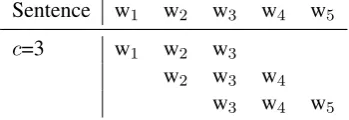
Context Window. The diacritization of Arabic words is highly sensitive to context. Character rep-resentations significantly increase the size of the source and target sequences. This leads to a well known limitation of character-based LSTM-based models, namely poor handling of long range de-pendencies (Sennrich,2017). An easy fix is to split sentences greater than a certain length into multi-ple lines. However, boundary words may loose context in the newly created sequences. To handle this, we propose to keep a fixed size context win-dowc for every word. Given a sentence, we use a sliding context window to split it into segments of overlapping windows of size c as in Table 1. This fixes the problems of both long range depen-dencies and context of neighboring words. We are further aided by the fact that local context can con-clusively determine the correct diacritization in the vast majority of cases.
Voting. As shown in Table1, the sliding window approach replicates a word present in a sentencec
times. At test time, a word may get different dia-critized forms from different contexts. We use vot-ing to choose the most frequent diacritized form from thec predictions. In case of a tie, we favor the context where the word appears in the middle.
Sentence w1 w2 w3 w4 w5
c=3 w1 w2 w3
w2 w3 w4
[image:3.595.310.523.62.109.2]w3 w4 w5
Table 1: Example sentence: w1w2w3w4w5with
con-text windowcof size 3.
Train Test Total Uniq Total Uniq OOV
[image:3.595.94.269.647.707.2]Diacritized 4.5M 333k 18.3k 7.9k 5.0% Undiacritized 209k 6.8k 3.3%
Table 2: Number of tokens in training and test data.
Seq2Seq Model. We use a seq2seq model con-sisting of three main components: i) Encoder, ii) Decoder, and iii) Attention. Given a source sentence s = w1, ..., wN and a target sentence t = v1, ..., vN, the encoder models the source sen-tence and computes a set of hidden states h =
h1, ..., hN. The attention mechanism (Bahdanau et al.,2014) computes a weighted average of these hidden states from the previous decoder state, known as the context vector ci, while decoder models the target sentence. The seq2seq model is trained jointly on a large parallel corpus by maxi-mizing the log-likelihood of the data:
log p(t|s) =X
i
|ti| X
j=1
log p(vij|vi1, ..., vji−1, si)
(1) wheresi andti are theithsource and target sen-tences. In addition, we experiment with a Trans-former model (Vaswani et al.,2017), which is an attention based architecture without LSTM, and compare its results to the aforementioned seq2seq model with attention.
4 Experimental Setup and Results
Data. We used a modern diacritized corpus of 4.5 million tokens that covers a wide range of top-ics such as polittop-ics, religion, sport, health, and economics. For testing, we used the freely avail-able WikiNews corpus (18,300 words) (Darwish et al., 2017) as a test set, which covers a variety of genres. Table2reports the size of the training and test sets including the unique diacritized and undiacritized tokens and the percentage of OOVs in the test set that don’t appear in the training set. We randomly used 10% of the train data for val-idation and the rest for training. We used a se-quence length of 100, 500 and 7 tokens for word-, character-word-, and window-based systems respec-tively. The vocabulary is restricted to 100k words types and 1,000 character units.
Exp Description Core WER% CE WER% WER% DER% OOV% 01 Baseline Word 44.29 54.95 54.31 41.62 13.03 02 Baseline Char 41.29 41.95 48.31 36.62 0.00
03 Word 7g 14.83 19.01 20.69 18.92 11.04 04 Char 7g 2.78 6.11 8.32 2.19 0.00
05 Word 7g+overlap 14.50 16.57 18.05 18.14 10.97 06 Char 7g+overlap 2.04 3.23 4.94 1.34 0.00
07 Char 3g+overlap+voting 2.31 5.97 7.79 2.01 0.00 08 Char 5g+overlap+voting 2.37 3.57 5.49 1.49 0.00
∗
09 Char 7g+overlap+voting 1.99 3.07 4.77 1.30 0.00 10 Char 11g+overlap+voting 3.03 3.93 6.40 1.78 0.00
†
11 Char 7g+overlap+voting (Transformer) 2.05 3.04 4.77 1.29 0.00
[image:4.595.90.506.66.224.2]12 Combination∗09 +†11 1.89 2.89 4.49 1.21 0.00
Table 3: Diacritization results: *g represents ngram size e.g. 7g means 7-gram context. Experiment 09 and 11 are comparing NMT models – LSTM-based architecture with attention mechanism and Transformer model
and dropout rate =0.3. The setting for the Trans-former were: 6 encoder and 6 decoder layers each of size 512; number of attention heads = 8; feed forward dimension = 2048; and dropout = 0.1. We used the OpenNMT (Klein et al.,2017) implemen-tation with tensorflow for all experiments.
System Runs. We conducted a variety of exper-iments as follows, namely: Word-level experi-mentswhere the input is a sequence of words and the output is a sequence of diacritized words: – Baseline Word: uses the full sentences and shows the deficiency of using NMT directly. – Word 7g: uses non-overlapping windows of 7 words to compare to our best character-level model, which also uses a window of length 7. – Word 7g+overlap: uses a sliding window of 7 words.
Character-level experiments where the input is represented as a sequence of character and the out-put as a sequence of diacritized characters: – Baseline Char: uses the full sentence.
– Char 7g: uses non-overlapping sequences of 7 words.
– Char 7g+overlap: uses a sliding window of 7 words without voting.
– Charng-overlap+voting: uses a sliding window of n words with voting, where we varied n to equal 3, 5, 7, and 11. When n = 7, we exper-imented with a seq2seq model with attention, a Transformer model, and a combination of both.
Results. Table 3 summarizes the results of our experiments. As the results clearly show, us-ing an NMT model at word or character level produced unusable results. Both Baselines
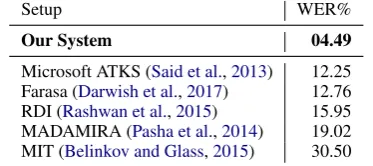
suf-Setup WER%
Our System 04.49
Microsoft ATKS (Said et al.,2013) 12.25 Farasa (Darwish et al.,2017) 12.76 RDI (Rashwan et al.,2015) 15.95 MADAMIRA (Pasha et al.,2014) 19.02 MIT (Belinkov and Glass,2015) 30.50
Table 4: Comparison to other systems for full diacriti-zation (Darwish et al.,2017).
fer also from excessive repetition of charac-ters that are often meaningless hallucination (e.g. “AalofaA}iti AaloHaAdiy waAlt∼awaAliy Aaloayoiy AloanohaAti AaloanohaAti”). When we limited the context to 7 words, the results im-proved dramatically, nonetheless, the output still suffered from a high ratio of OOVs. Using char-acters instead alleviated the OOV problem. The results improved dramatically with contexts of length 7 yielding the best results. Using voting lowered WER rate further, leading to a 4.77% WER. Using a Transformer model led to nearly identical WER to using our NMT model with at-tention. However their results are somewhat com-plimentary. Thus, voting on the predictions across both systems improved the results further with a 4.49% WER. Table 4 compares our best system with other systems. The WER of our best system is 63.3% lower than the state-of-the-art.
[image:4.595.323.510.279.362.2]of errors; confusion between different syntactic functions (e.g. N N vs. N ADJ or V Subj vs. V Obj) – 22%; wrong selection of morphological analysis (e.g. present tense vs. past tense) – 20%; and named entities (NEs) – 16%. For long dis-tance dependencies, increasing context size may help in some case, but may introduce additional errors (see Table3). Perhaps combining multiple context sizes may help. As for word-core, the top 4 errors were: incorrect selection for ambiguous words, where most of these errors were related to active vs. passive voice – 60%; NEs – 32%; bor-rowed words – 4%; and words with multiple valid diacritized words – 4%.
5 Conclusion
In this paper, we adapted a seq2seq model to build a unified model for Arabic diacritic recovery. We trained the model on a fixed length sliding win-dow of n words that are represented using their characters. We further employed voting to pick the most common diacritized form of a word in differ-ent contexts. The adaptation yielded a word error rate of 4.49%, which is 63.3% lower than the best state-of-the-art system. One possible future direc-tion is to use a system combinadirec-tion with varying context sizes with a weighted voting scheme. Fur-ther, the explicit inclusion of a large gazetteer of diacritized NEs in the training set would help di-acritize them properly. We also want to examine the effect of training data size to determine if more data would yield better results.
References
Mart´ın Abadi, Paul Barham, Jianmin Chen, Zhifeng Chen, Andy Davis, Jeffrey Dean, Matthieu Devin, Sanjay Ghemawat, Geoffrey Irving, Michael Isard, et al. 2016. Tensorflow: a system for large-scale machine learning. InOSDI, volume 16, pages 265– 283.
Gheith A Abandah, Alex Graves, Balkees Al-Shagoor, Alaa Arabiyat, Fuad Jamour, and Majid Al-Taee. 2015. Automatic diacritization of arabic text us-ing recurrent neural networks.International Journal on Document Analysis and Recognition (IJDAR), 18(2):183–197.
Aqil M Azmi and Reham S Almajed. 2015. A survey of automatic arabic diacritization techniques. Natu-ral Language Engineering, 21(03):477–495.
Dzmitry Bahdanau, Kyunghyun Cho, and Yoshua Ben-gio. 2014. Neural machine translation by jointly
learning to align and translate. arXiv preprint arXiv:1409.0473.
Mohamed Bebah, Chennoufi Amine, Mazroui Azzed-dine, and Lakhouaja Abdelhak. 2014. Hybrid ap-proaches for automatic vowelization of arabic texts. arXiv preprint arXiv:1410.2646.
Yonatan Belinkov and James Glass. 2015. Arabic di-acritization with recurrent neural networks. In Pro-ceedings of the 2015 Conference on Empirical Meth-ods in Natural Language Processing, pages 2281– 2285, Lisbon, Portugal.
Denny Britz, Anna Goldie, Thang Luong, and Quoc Le. 2017. Massive Exploration of Neural Machine Translation Architectures.ArXiv e-prints.
Tim Buckwalter. 2004. Buckwalter arabic morpho-logical analyzer version 2.0. LDC catalog number LDC2004L02, ISBN 1-58563-324-0.
Kyunghyun Cho, Bart Van Merri¨enboer, Caglar Gul-cehre, Dzmitry Bahdanau, Fethi Bougares, Holger Schwenk, and Yoshua Bengio. 2014. Learning phrase representations using rnn encoder-decoder for statistical machine translation. arXiv preprint arXiv:1406.1078.
Kareem Darwish, Hamdy Mubarak, and Ahmed Abde-lali. 2017. Arabic diacritization: Stats, rules, and hacks. InProceedings of the Third Arabic Natural Language Processing Workshop, pages 9–17.
Moustafa Elshafei, Husni Al-Muhtaseb, and Mansour Alghamdi. 2006. Statistical methods for automatic diacritization of arabic text. InThe Saudi 18th Na-tional Computer Conference. Riyadh, volume 18, pages 301–306.
Ya’akov Gal. 2002. An hmm approach to vowel restoration in arabic and hebrew. InProceedings of the ACL-02 workshop on Computational approaches to Semitic languages, pages 1–7. Association for Computational Linguistics.
Nizar Habash and Owen Rambow. 2005. Arabic tok-enization, part-of-speech tagging and morphological disambiguation in one fell swoop. InProceedings of the 43rd Annual Meeting on Association for Compu-tational Linguistics, pages 573–580. Association for Computational Linguistics.
Nizar Habash and Owen Rambow. 2007. Arabic di-acritization through full morphological tagging. In Human Language Technologies 2007: The Confer-ence of the North American Chapter of the Asso-ciation for Computational Linguistics; Companion Volume, Short Papers, pages 53–56. Association for Computational Linguistics.
Oleksii Kuchaiev, Boris Ginsburg, Igor Gitman, Vi-taly Lavrukhin, Carl Case, and Paulius Micike-vicius. 2018. Openseq2seq: extensible toolkit for distributed and mixed precision training of sequence-to-sequence models. arXiv preprint arXiv:1805.10387.
Aya S Metwally, Mohsen A Rashwan, and Amir F Atiya. 2016. A multi-layered approach for ara-bic text diacritization. In Cloud Computing and Big Data Analysis (ICCCBDA), 2016 IEEE Interna-tional Conference on, pages 389–393. IEEE.
Rani Nelken and Stuart M Shieber. 2005. Arabic di-acritization using weighted finite-state transducers. In Proceedings of the ACL Workshop on Computa-tional Approaches to Semitic Languages, pages 79– 86. Association for Computational Linguistics.
Torsten Zesch Osama Hamed. 2017. A Survey and Comparative Study of Arabic Diacritization Tools. JLCL, 32(1):27–47.
Arfath Pasha, Mohamed Al-Badrashiny, Mona Diab, Ahmed El Kholy, Ramy Eskander, Nizar Habash, Manoj Pooleery, Owen Rambow, and Ryan M Roth. 2014. Madamira: A fast, comprehensive tool for morphological analysis and disambiguation of ara-bic. InLREC-2014, Reykjavik, Iceland.
Mohsen Rashwan, Ahmad Al Sallab, M. Raafat, and Ahmed Rafea. 2015. Deep learning framework with confused sub-set resolution architecture for auto-matic arabic diacritization. In IEEE Transactions on Audio, Speech, and Language Processing, pages 505–516.
Mohsen AA Rashwan, Mohamed ASAA
Al-Badrashiny, Mohamed Attia, Sherif M Abdou, and Ahmed Rafea. 2011. A stochastic arabic diacritizer based on a hybrid of factorized and unfactorized textual features. IEEE Transactions on Audio, Speech, and Language Processing, 19(1):166–175.
Ahmed Said, Mohamed El-Sharqwi, Achraf Chalabi, and Eslam Kamal. 2013. A hybrid approach for ara-bic diacritization. InNatural Language Processing and Information Systems, pages 53–64, Berlin, Hei-delberg. Springer Berlin HeiHei-delberg.
Rico Sennrich. 2017. How grammatical is character-level neural machine translation? assessing mt qual-ity with contrastive translation pairs. InProceedings of the 15th Conference of the European Chapter of the Association for Computational Linguistics: Vol-ume 2, Short Papers.
Rico Sennrich, Barry Haddow, and Alexandra Birch. 2016. Neural Machine Translation of Rare Words with Subword Units. InProceedings of the 54th An-nual Meeting of the Association for Computational Linguistics (Volume 1: Long Papers), pages 1715– 1725, Berlin, Germany. Association for Computa-tional Linguistics.
Ashish Vaswani, Noam Shazeer, Niki Parmar, Jakob Uszkoreit, Llion Jones, Aidan N Gomez, ukasz Kaiser, and Illia Polosukhin. 2017. Attention is All
you Need. In I. Guyon, U. V. Luxburg, S. Bengio,
H. Wallach, R. Fergus, S. Vishwanathan, and R. Gar-nett, editors, Advances in Neural Information Pro-cessing Systems 30, pages 5998–6008. Curran As-sociates, Inc.
Dimitra Vergyri and Katrin Kirchhoff. 2004. Au-tomatic diacritization of arabic for acoustic mod-eling in speech recognition. In Proceedings of the workshop on computational approaches to Ara-bic script-based languages, COLING’04, pages 66– 73, Geneva, Switzerland. Association for Computa-tional Linguistics.
Ian H Witten, Eibe Frank, Mark A Hall, and Christo-pher J Pal. 2016. Data Mining: Practical machine learning tools and techniques. Morgan Kaufmann.
Haonan Yu, Jiang Wang, Zhiheng Huang, Yi Yang, and Wei Xu. 2016. Video paragraph captioning using hierarchical recurrent neural networks. In Proceed-ings of the IEEE conference on computer vision and pattern recognition, pages 4584–4593.