32
Graph Convolution for Multimodal Information Extraction
from Visually Rich Documents
Xiaojing Liu, Feiyu Gao, Qiong Zhang, Huasha Zhao
Alibaba Group
{huqiang.lxj,feiyu.gfy,qz.zhang,huasha.zhao}@alibaba-inc.com
Abstract
Visually rich documents (VRDs) are ubiqui-tous in daily business and life. Examples are purchase receipts, insurance policy docu-ments, custom declaration forms and so on. In VRDs, visual and layout information is critical for document understanding, and texts in such documents cannot be serialized into the one-dimensional sequence without losing information. Classic information extraction models such as BiLSTM-CRF typically op-erate on text sequences and do not incorpo-rate visual features. In this paper, we intro-duce a graph convolution based model to com-bine textual and visual information presented in VRDs. Graph embeddings are trained to summarize the context of a text segment in the document, and further combined with text em-beddings for entity extraction. Extensive ex-periments have been conducted to show that our method outperforms BiLSTM-CRF base-lines by significant margins, on two real-world datasets. Additionally, ablation studies are also performed to evaluate the effectiveness of each component of our model.
1 Introduction
Information Extraction (IE) is the process of ex-tracting structured information from unstructured documents. IE is a classic and fundamental Nat-ural Language Processing (NLP) task, and exten-sive research has been made in this area. Tradi-tionally, IE research focuses on extracting entities and relationships from plain texts, where informa-tion is primarily expressed in the format of natural language text. However, a large amount of infor-mation remains untapped in VRDs.
VRDs present information in the form of both text and vision. The semantic structure of the doc-ument is not only determined by the text within it but also the visual features such as layout, tabular structure and font size of the document. Examples
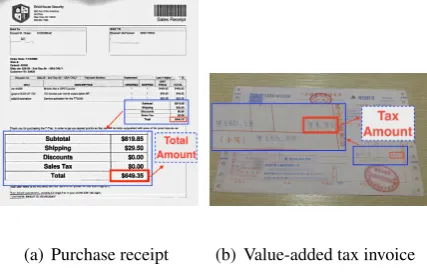
[image:1.595.311.525.223.359.2](a) Purchase receipt (b) Value-added tax invoice
Figure 1: Examples of VRDs and example entities to extract.
of VRDs are purchase receipts, insurance policy documents, custom declaration forms and so on. Figure 1 shows example VRDs and example enti-ties to extract.
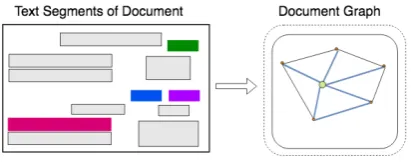
VRDs can be represented as a graph oftext seg-ments(Figure 2), where each text segment is com-prised of the position of the segment and the text within it. The position of the text segment is de-termined by the four coordinates that generate the bounding box of the text. There are other poten-tially useful visual features in VRDs, such as fonts and colors, which are complementary to the posi-tion of the text. They are out of the scope of this paper, and we leave them to future works.
1.1 Challenges
IE from VRDs is a challenging task, and the dif-ficulties mainly arise from how to effectively in-corporate visual cues from the document and the scalability of the task.
First, text alone is not adequate to represent the semantic meaning in VRDs, and the contexts of the texts are usually expressed in visual cues. For example, there might be multiple dates in the pur-chase receipts. However, it is up to the visual part of the model to distinguish between the Invoice Date, Transaction Date, and Due Date. Another example is the tax amount in value-added tax in-voice, as shown in Figure 1(b). There are multiple “money” entities in the document, and there is a lack of any textual context to determine which one is tax amount. To extract the tax amount correctly, we have to leverage the (relative) position of the text segment and visual features of the document in general.
Template matching based algorithms ( Chiti-cariu et al.,2013;Dengel and Klein,2002; Schus-ter et al.,2013) utilize visual features of the doc-ument to extract entities; however, we argue that they are mostly not scalable for the task in real-world business settings. There are easily thou-sands of vendors on the market, and the templates of purchase receipts from each vendor are not the same. Thousands of templates need to be created and maintained in this single scenario. It requires substantial efforts to update the template and make sure it’s not conflicting with the rest every time a new template comes in, and the process is error-prone. Besides, user uploaded pictures introduce another dimension of variance from the template. An example is shown in Figure 1(b). Value-added tax invoice is a nation-wide tax document, and the layout is fixed. However, pictures taken by users are usually distorted, often blurred and sometimes contain interfering objects in the image. A simple template-based system performs poorly in such a scenario, while sophisticated rules require signif-icant engineering efforts for each scenario, which we believe is not scalable.
1.2 Contributions
In this paper, we present a novel method for IE from VRDs. The method first computes graph em-beddings for each text segment in the document using graph convolution. The graph embeddings represent the context of the current text segment
where the convolution operation combines both textual and visual features of the context. Then the graph embeddings are combined with text em-beddings to feed into a standard BiLSTM for in-formation extraction.
Extensive experiments have been conducted to show our method outperforms BiLSTM-CRF baselines by significant margins, on two real-world datasets. Additionally, ablation studies are also performed to evaluate the effectiveness of each component of our model. Furthermore, we also provide analysis and intuitions on why and how individual components work in our experi-ments.
2 Related Works
Our work is inspired by recent research in the area of graph convolution and information extraction.
2.1 Graph Convolution Network
Neural network architectures such as CNN and RNNs have demonstrated huge success on many artificial intelligence tasks where the underly-ing data has grid-like or sequential structure (Krizhevsky et al.,2012; Kim et al., 2016;Kim,
2014). Recently, there is a surge of interest in studying the neural network structure operating on graphs (Kipf and Welling, 2016;Hamilton et al.,
2017), since much data in the real world is natu-rally represented as graphs. Many works attempt to generalize convolution on the graph structure. Some use a spectrum based approach where the learned model depends on the structure of the graph. As a result, the approach does not work well on dynamic graph structures. The others de-fine convolution directly on the graph (Veliˇckovi´c et al.,2017;Hamilton et al.,2017;Xu et al.,2018;
Johnson et al.,2018;Duvenaud et al.,2015). We follow the latter approach in our work to model the text segment graph of VRDs.
2.2 Information Extraction
Recently, significant progress has been made in in-formation extraction from unstructured or semi-structured text. However, most works focus on plain text documents (Peng et al., 2017; Lam-ple et al., 2016; Ma and Hovy, 2016; Chiu and Nichols, 2016). For information extraction from VRDs, (Palm et al.,2017) which uses a recurrent neural network (RNN) to extract entities of in-terest from VRDs (invoices) is the closest to our work, but does not take visual features into ac-count. Besides, some of the studies (d’Andecy et al., 2018; Medvet et al., 2011; Rusinol et al.,
2013) in the area of document understanding deal with a similar problem to our work, and explore using visual features to aid text extraction from VRDs; however, approaches they proposed are based on a large amount of heuristic knowledge and human-designed features, as well as limited in known templates, which are not scalable in real-world business settings. We also acknowl-edge a concurrent work of (Katti et al., 2018), which models 2-D document using convolution networks. However, there are several key differ-ences. Our neural network architecture is graph-based, and our model operates on text segments instead of characters as in (Katti et al.,2018).
Besides, information extraction based on the graph structure has been developed most recently. (Peng et al., 2017; Song et al., 2018) present a graph LSTM to capture various dependencies among the input words and (Wang et al.,2018) de-signs a novel graph schema to extract entities and relations jointly. However, their models are not concerned with visual information directly.
3 Model Architecture
[image:3.595.312.518.62.145.2]This section describes the document model and the architecture of our proposed model. Our model first encodes each text segment in the document into graph embedding, using multiple layers of graph convolution. The embedding represents the information in the text segment given its visual and textual context. By visual context, we refer to the layout of the document and relative positions of the individual segment to other segments. Tex-tual context is the aggregate of text information in the document overall; our model learns to assign higher weights on texts from neighbor segments. Then we combine the graph embeddings with text embeddings and apply a standard BiLSTM-CRF
Figure 2: Document graph. Every node in the graph is fully connected to each other.
model for entity extraction.
3.1 Document Modeling
We model each document as a graph of text seg-ments (see Figure 2), where each text segment is comprised of the position of the segment and the text within it. The graph is comprised of nodes that represent text segments, and edges that repre-sent visual dependencies, such as relative shapes and distance, between two nodes. Text segments are generated using an in-house Optical Character Recognition (OCR) system.
Mathematically, a document D is a tuple
(T, E), where T = {t1, t2,· · ·, tn}, ti ∈ T is a set of n text boxes/nodes, R =
{ri1, ri2,· · · , rij}, rij ∈ R is a set of edges, and E =T ×R×T is a set of directed edges of the form(ti, rij, tj)whereti, tj ∈T andrij ∈R. In our experiments, every node is connected to each other.
3.2 Feature Extraction
For nodeti, we calculate node embeddingti us-ing a sus-ingle layer Bi-LSTM (Schuster and Paliwal,
1997) to extract features from the text content in the segment.
Edge embedding between nodetiand nodetjis defined as follows,
rij = [xij, yij, wi hi
,hj hi
,wj hi
], (1)
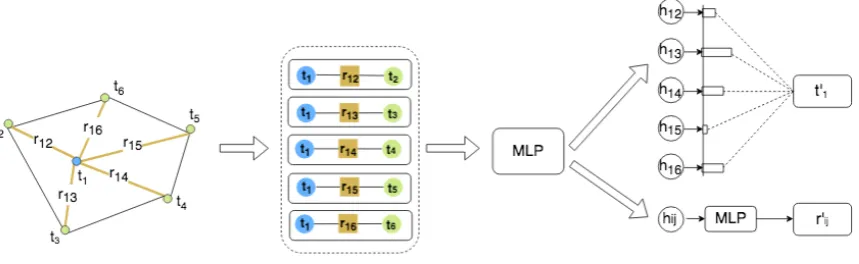
Figure 3: Graph convolution of document graph. Convolution is defined on node-edge-node triplets(ti, rij, tj). Each layer produces new embeddings for both nodes and edges.
closer in one document, such as the key and value of an entity. Moreover, the shape of the text seg-ment plays a critical role in representing seman-tic meanings. For example, the length of the text segment which has address information is usually longer than that of one which has a buyer name. Therefore, we use edge embedding to encode in-formation regarding the visual distance between two segments, the shape of the source node, and the relative size of the destination node.
To summarize, node embedding encodes textual features, while edge embedding primarily repre-sents visual features.
3.3 Graph Convolution
Graph convolution is applied to compute visual text embeddings of text segments in the graph, as shown in Figure 3. Different from existing works, we define convolution on the node-edge-node triplets (ti, rij, tj) instead of on the node alone. We compare the performances of the mod-els using nodes only and node-edge-node triplets in Section 5.3. For nodeti, we extract featureshij for each neighbourtj using a multi-layer percep-tron (MLP) network,
hij =g(ti,rij,tj) =MLP([tikrijktj]), (2)
where k is the concatenate operation. There are several benefits of using this triplet feature set. First, it combines visual features directly into the neighbor representation. Furthermore, the infor-mation of the current node is copied across the neighbors. As a result, the neighbor features can potentially learn where to attend given the current node.
In our model, graph convolution is defined based on the self-attention mechanism. The idea
is to compute the output hidden representation of each node by attending to its neighbors. In its most general form, each node can attend to all the other nodes, assuming a fully connected graph.
Concretely the output embeddingt0iof the layer for nodetiis computed by,
t0i =σ( X
j∈{1,···,n}
αijhij), (3)
where αij are the attention coefficients, andσ is an activation function. In our experiments, the attention mechanism is designed as the follows,
αij =
exp(LeakyRelu(wT ahij))
P
j∈{1,···,n}exp(LeakyRelu(wTahij)) ,
(4)
where wa is a shared attention weight vector. We apply the LeakyRelu activation function to avoid the “dying Relu” problem and to increase the “contrast” of the attention coefficients poten-tially.
The edge embedding output of the graph convo-lution layer is defined as,
r0ij =MLP(hij). (5)
Outputst0i,r0ijare fed as inputs to the next layer of graph convolution (as computed in equation 2) or network modules for downstream tasks.
3.4 BiLSTM-CRF with Graph Embeddings
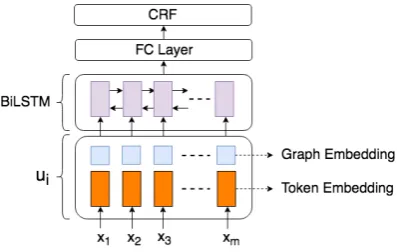
Figure 4: BiLSTM-CRF with graph embeddings.
concatenated to each token embedding of the in-put sequence; Intuitively, graph embedding adds contextual information to the input sequence.
Formally, assume for node ti, the input token sequence of the text segment is x1, x2,· · · , xm, and the graph embedding of the node is t0i. The input embeddinguiis defined as,
ui=e(xi)kt0i (6)
where e is token embedding lookup function, and Word2Vec vectors are used as token embed-dings in our experiments.
Then the input embeddings are fed into a Bi-LSTM network to be encoded, and the output is further passed to a fully connected network and then a CRF layer.
4 Model Supervision and Training
We build an annotation system to facilitate the la-beling of the ground truth data. For each docu-ment, we label the values for each pre-defined en-tity, and their locations (bounding boxes). To gen-erate training data, we first identify the text seg-ment each entity belongs to, and then we label the text in the segment according to IOB tagging for-mat (Sang and Veenstra,1999). We assign label O to all tokens in empty text segments.
Since human annotated bounding boxes can-not match OCR detected box exactly, we ap-ply a simple heuristic to determine which text segment an entity belongs to based on over-lap area. A text segment is considered to con-tain an entity if Aoverlap/min(Aannotator, Aocr) is bigger than a manually set threshold; Here Aannotator, Aocr, Aoverlap are the area of the an-notated box of the corresponding entity, the area of the ocr detected box and the area of the overlap between the two boxes respectively.
In our experiments, the graph convolution layers and BiLSTM-CRF extractors are trained jointly. Furthermore, to improve prediction accu-racy, we add the segment classification task which classifies each text segment into a pre-defined tag as an auxiliary task and discuss the effect of multi-task learning in Section 5.4.3. We feed the graph embedding of each text segment into a sigmoid classifier to predict the tag. Since the parame-ters of the graph convolution layers are shared across the extraction task and segment classifi-cation task, we employ a multi-task learning ap-proach for model training. In multi-task training, the goal is to optimize the weighted sum of the two losses. In our experiments, the weight is de-termined using a principled approach as described in (Kendall et al.,2017). The idea is to adjust each task’s relative weight in the loss function by con-sidering task-dependant uncertainties.
5 Experiments
We apply our model for information extraction from two real-world datasets. They are Value-Added Tax Invoices (VATI) and International Pur-chase Receipts (IPR).
5.1 Datasets Description
VATI consists of 3000 user-uploaded pictures and has 16 entities to exact. Example entities are the names of buyer/seller, date and tax amount. The invoices are in Chinese, and it has a fixed template since it is national standard invoice. However, there are many noises in the documents which in-clude distracting objects in the image and skewed document orientation to name a few. IPR is a data set of 1500 scanned receipt documents in English which has 4 entities to exact (Invoice Number, Vendor Name, Payer Name and Total Amount). There exist 146 templates for the receipts. Vari-able templates introduce additional difficulties to the IPR dataset. For both datasets, we assign 70% of each dataset for training, 15% for validation and 15% for the test. The number of text segments varies per document from 100 to 300.
5.2 Baselines
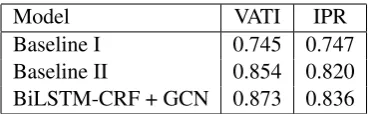
Model VATI IPR Baseline I 0.745 0.747 Baseline II 0.854 0.820 BiLSTM-CRF + GCN 0.873 0.836
Table 1:F1score. Performance comparisons.
[image:6.595.324.513.60.131.2]Entities Baseline I Baseline II Our model Invoice # 0.952 0.961 0.975 Date 0.962 0.963 0.963 Price 0.527 0.910 0.943 Tax 0.584 0.902 0.924 Buyer 0.402 0.797 0.833 Seller 0.681 0.731 0.782
Table 2: F1score. Performance comparisons for
indi-vidual entities from VATI dataset.
document. Text segments in a document are con-catenated from left to right and from top to bottom according to (Palm et al.,2017). Baseline II incor-porates a one-dimensional textual context to the model.
5.3 Results
We use theF1 score to evaluate the performances of our model in all experiments. The main results are shown in Table 1. As we can see, our pro-posed model outperforms both baselines by sig-nificant margins. Capturing patterns from VRDs with one-dimensional text sequence is difficult. More specifically, we present performance com-parisons of six entities from VATI dataset in Table 2. It can be seen that compared with two baselines, our model performs almost identical on “simple” entities which can be distinguished by the text seg-ment’s text feature alone (i.e., Invoice Number and Date) where visual features and context in-formation are not necessary. However, our pro-posed model clearly outperforms baselines on en-tities which can not be represented by text alone, such as Price, Tax, Buyer, and Seller.
To further examine the contributions made by each sub-component of the graph convolution net-work, we perform the following ablation studies. In each study, we exclude visual features (edge embeddings), textual features (node embeddings) and the use of attention mechanism respectively, to see their impacts on F1 scores on both two datasets. As presented in Table 3, it can be seen that visual features play a critical role in the per-formance of our model; they lead to more than
[image:6.595.89.277.61.118.2]Configurations/Datasets VATI IPR Full model 0.873 0.836 w/o vis. features 0.808 0.775 w/o text features 0.871 0.817 w/o attention 0.872 0.821
Table 3:F1score. Ablation studies of individual
com-ponent of graph convolution.
5% performance drop in both datasets. Intuitively, visual features provide more information about contexts of the text segments, so it improves the performance by discriminating between text seg-ments with similar semantic meanings. Moreover, textual features make similar contributions. Fur-thermore, the attention mechanism shows more ef-fectiveness on variable template datasets, which results in 1.5% performance gains. However, it makes no contribution to fixed layout datasets. We make further discussions on attention in the next section.
5.4 Discussions
5.4.1 Attention Analysis
To better understand how attention works in our model, we study the attention weights (on all other text segments) of each text segment in the docu-ment graph. Interestingly, for the VATI dataset, we find that attention weights are usually concen-trated on a fixed text segment with strong textual features (the segment contains address informa-tion) regardless of the text segment studied. The reason behind that may be attention mechanism tries to find an anchor point of the document, and one anchor is enough as VATI documents all share the same template. Strong textual features help lo-cate the anchor more accurately.
For variable layout documents, more attention is paid to nearby text segments, which reflects the local structure of the document. Specifically, at-tention weights of the left and upper segments are even higher. Furthermore, segments that contain slot keywords such as “address”, “amount” and “name” receive higher attention weights.
5.4.2 The Number of Graph Convolution Layers
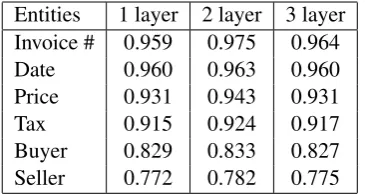
Entities 1 layer 2 layer 3 layer Invoice # 0.959 0.975 0.964 Date 0.960 0.963 0.960 Price 0.931 0.943 0.931 Tax 0.915 0.924 0.917 Buyer 0.829 0.833 0.827 Seller 0.772 0.782 0.775
Table 4: F1 score. Performance comparisons of
dif-ferent graph convolution layers for individual entities from VATI dataset.
Model VATI IPR BiLSTM-CRF + GCN 0.873 0.836
+ Multi-task 0.881 0.849
Table 5:F1score. Effectiveness of multi-task learning
approach.
types of the VATI dataset, and the results are pre-sented in Table 4. As we can see, additional layers in the network do not help simple tasks. By sim-ple task, we mean that task achieves high accuracy with single layer graph convolution. However, more layers indeed improve the performances of more difficult tasks. As shown in the table, the op-timal number of layers is two for our task, as three layers overfit the model. Ideally, the number of graph convolution layers used should be adaptive to the specific task, of which we leave the study to future works.
5.4.3 Multi-Task Learning
As shown in Table 5, our task benefits from the segment classification task and multi-task learn-ing method in both datasets. The two tasks in our experiments are complementary, and compared with the single task model, the multi-task learn-ing model may have better generalization perfor-mance by adopting more information. Further-more, we find that the multi-task learning helps the training converge much faster.
6 Conclusions and Future Works
This paper studies the problem of entity extraction from VRDs. A graph convolution architecture is proposed to encode text embeddings given visu-ally rich context. BiLSTM-CRF is applied to ex-tract the final results. We manually annotated two real-world datasets of VRDs, and perform com-prehensive experiments and analysis. Our sys-tem outperforms BiLSTM baselines and presents a
novel method for IE from VRDs. Furthermore, we plan to extend the graph convolution framework to other tasks in VRDs, such as document classifica-tion.
Acknowledgments
We thank the OCR team of Alibaba Group for pro-viding us OCR service support and anonymous re-viewers for their helpful comments.
References
Laura Chiticariu, Yunyao Li, and Frederick R Reiss. 2013. Rule-based information extraction is dead! long live rule-based information extraction systems! InProceedings of the 2013 conference on empirical methods in natural language processing, pages 827– 832.
Jason PC Chiu and Eric Nichols. 2016. Named entity recognition with bidirectional lstm-cnns. Transac-tions of the Association for Computational Linguis-tics, 4:357–370.
Vincent Poulain d’Andecy, Emmanuel Hartmann, and Marc¸al Rusi˜nol. 2018. Field extraction by hybrid incremental and a-priori structural templates. In
2018 13th IAPR International Workshop on Docu-ment Analysis Systems (DAS), pages 251–256. IEEE.
Andreas R Dengel and Bertin Klein. 2002. smart-fix: A requirements-driven system for document analysis and understanding. InInternational Work-shop on Document Analysis Systems, pages 433– 444. Springer.
David K Duvenaud, Dougal Maclaurin, Jorge Ipar-raguirre, Rafael Bombarell, Timothy Hirzel, Al´an Aspuru-Guzik, and Ryan P Adams. 2015. Convo-lutional networks on graphs for learning molecular fingerprints. InAdvances in neural information pro-cessing systems, pages 2224–2232.
Will Hamilton, Zhitao Ying, and Jure Leskovec. 2017. Inductive representation learning on large graphs. InAdvances in Neural Information Processing Sys-tems, pages 1024–1034.
Justin Johnson, Agrim Gupta, and Li Fei-Fei. 2018. Image generation from scene graphs. arXiv preprint.
Anoop Raveendra Katti, Christian Reisswig, Cordula Guder, Sebastian Brarda, Steffen Bickel, Johannes H¨ohne, and Jean Baptiste Faddoul. 2018. Char-grid: Towards understanding 2d documents. arXiv preprint arXiv:1809.08799.
[image:7.595.87.277.216.260.2]Yoon Kim. 2014. Convolutional neural net-works for sentence classification. arXiv preprint arXiv:1408.5882.
Yoon Kim, Yacine Jernite, David Sontag, and Alexan-der M Rush. 2016. Character-aware neural language models. InAAAI, pages 2741–2749.
Thomas N Kipf and Max Welling. 2016. Semi-supervised classification with graph convolutional networks. arXiv preprint arXiv:1609.02907.
Alex Krizhevsky, Ilya Sutskever, and Geoffrey E Hin-ton. 2012. Imagenet classification with deep con-volutional neural networks. In Advances in neural information processing systems, pages 1097–1105.
Guillaume Lample, Miguel Ballesteros, Sandeep Sub-ramanian, Kazuya Kawakami, and Chris Dyer. 2016. Neural architectures for named entity recognition.
arXiv preprint arXiv:1603.01360.
Xuezhe Ma and Eduard Hovy. 2016. End-to-end sequence labeling via bi-directional lstm-cnns-crf.
arXiv preprint arXiv:1603.01354.
Eric Medvet, Alberto Bartoli, and Giorgio Davanzo. 2011. A probabilistic approach to printed document understanding. International Journal on Document Analysis and Recognition (IJDAR), 14(4):335–347.
Rasmus Berg Palm, Ole Winther, and Florian Laws. 2017. Cloudscan-a configuration-free invoice anal-ysis system using recurrent neural networks. arXiv preprint arXiv:1708.07403.
Nanyun Peng, Hoifung Poon, Chris Quirk, Kristina Toutanova, and Wen-tau Yih. 2017. Cross-sentence n-ary relation extraction with graph lstms. arXiv preprint arXiv:1708.03743.
Marc¸al Rusinol, Tayeb Benkhelfallah, and Vincent Poulain dAndecy. 2013. Field extraction from ad-ministrative documents by incremental structural templates. InDocument Analysis and Recognition (ICDAR), 2013 12th International Conference on, pages 1100–1104. IEEE.
Erik F Sang and Jorn Veenstra. 1999. Representing text chunks. In Proceedings of the ninth conference on European chapter of the Association for Computa-tional Linguistics, pages 173–179. Association for Computational Linguistics.
Daniel Schuster, Klemens Muthmann, Daniel Esser, Alexander Schill, Michael Berger, Christoph Wei-dling, Kamil Aliyev, and Andreas Hofmeier. 2013. Intellix–end-user trained information extraction for document archiving. In 2013 12th International Conference on Document Analysis and Recognition, pages 101–105. IEEE.
Mike Schuster and Kuldip K Paliwal. 1997. Bidirec-tional recurrent neural networks. IEEE TRANSAC-TIONS ON SIGNAL PROCESSING, 45(11):2673.
Linfeng Song, Yue Zhang, Zhiguo Wang, and Daniel Gildea. 2018. N-ary relation extraction using graph state lstm.arXiv preprint arXiv:1808.09101.
Ashish Vaswani, Noam Shazeer, Niki Parmar, Jakob Uszkoreit, Llion Jones, Aidan N Gomez, Łukasz Kaiser, and Illia Polosukhin. 2017. Attention is all you need. InAdvances in Neural Information Pro-cessing Systems, pages 5998–6008.
Petar Veliˇckovi´c, Guillem Cucurull, Arantxa Casanova, Adriana Romero, Pietro Li`o, and Yoshua Bengio. 2017. Graph attention networks. arXiv preprint arXiv:1710.10903.
Shaolei Wang, Yue Zhang, Wanxiang Che, and Ting Liu. 2018. Joint extraction of entities and relations based on a novel graph scheme. In IJCAI, pages 4461–4467.
Kun Xu, Lingfei Wu, Zhiguo Wang, and Vadim Sheinin. 2018. Graph2seq: Graph to sequence learning with attention-based neural networks.