3762
Top-Down Structurally-Constrained Neural Response Generation with
Lexicalized Probabilistic Context-Free Grammar
Wenchao Du
Language Technologies Institute Carnegie Mellon University
Pittsburgh, PA 15213
Alan W Black
Language Technologies Institute Carnegie Mellon University
Pittsburgh, PA 15213
Abstract
We consider neural language generation un-der a novel problem setting: generating the words of a sentence according to the order of their first appearance in its lexicalized PCFG parse tree, in a depth-first, left-to-right man-ner. Unlike previous tree-based language gen-eration methods, our approach is both (i) top-down and (ii) explicitly generating syntactic structure at the same time. In addition, our method combines neural model with symbolic approach: word choice at each step is con-strained by its predicted syntactic function. We applied our model to the task of dialog re-sponse generation, and found it significantly improves over sequence-to-sequence baseline, in terms of diversity and relevance. We also investigated the effect of lexicalization on lan-guage generation, and found that lexicalization schemes that give priority to content words have certain advantages over those focusing on dependency relations.
1 Introduction
Neural encoder-decoder architectures have shown promise and become very popular for natural language generation. Over the past few years, there has seen a surging interest in sequence-to-sequence learning for dialog response generation using neural encoder-decoder models (Vinyals and Le, 2015; Serban et al., 2017). Typically, an encoder encodes conversational context (source side) information into vector representations, and a decoder auto-regressively generates word tokens conditioned on the source vectors and previously generated words.
Two problems arise with the standard left-to-right decoding mechanism. First, no future in-formation is available at any step of the decoding process, while the study of linguistic dependency structure shows that certain words depend on the
others that come right to them. Second, preced-ing words define the context for followpreced-ing words in left-to-right, auto-regressive language models, while linguistic theories may prefer other hierar-chies (e.g., adjectives modifying nouns, adverbs modifying verbs). Psycho-linguistics studies also suggest that human may first generate the abstract representation of the things to say, and then lin-earize them into sentences (Dell et al.,1999).
Therefore, it is appealing to consider language generation in alternative orders. This poses a greater challenge because a mechanism in ex-tra to word generation is needed for deciding the position of each word. Some recent works adopt a syntax-free approach to address this prob-lem. (Mehri and Sigal,2018) proposed a middle-out decoder that starts from the middle of sen-tences and finishes the rest in forward and back-ward directions. (Mou et al., 2016) and (Li and Sun, 2018) start with one or two predicted key-words and generate the rest of sentences in a sim-ilar fashion. Others incorporate tree structures without syntactic relations and categories. (Zhou et al., 2018) canonicalizes the dependency struc-tures of sentences into ternary trees, and gener-ate only the words top-down. Yet another line of work aim to model the full syntactic trees. (G¯u et al.,2018) generates phrase structures and part-of-speech tags along with words for machine translation. (Dyer et al., 2016) generates shift-reduce action sequences of context-free grammars in addition to words for language model and pars-ing. But words are still generated in left-to-right order in their approaches.
likely to be used in a request state), so modelling phrase structures can potentially help capturing discourse level information. In order to be able to generate complete syntactic trees, while be flexi-ble about word generation order at the same time, the use of lexicalized grammar becomes a natural choice.
2 Related Work
Recent years has seen works in language model and generation through alternative orders. (Zhang et al., 2016) developed a top-down neural archi-tecture for language model that alternates between four LSTM decoders according to given depen-dency relations. (Ford et al., 2018) proposed a two-stage language model, of which the first stage is a language model that generates templates, and the second stage is a translation model that fills in the blanks. Word generation order varies with the choice of words that are generated at different stages.
Language generation with tree structures has been explored more thoroughly for neural ma-chine translation. (Eriguchi et al.,2017) and ( Aha-roni and Goldberg, 2017) generate CFG trees in bracketed form. (Wu et al., 2017) generates the sequence of transitions to form dependency trees. More recent works have focused on explicitly gen-erating tree structures (Wang et al.,2018;G¯u et al., 2018).
Regarding neural architectures for tree gener-ation in the field of natural language process-ing, (Dong and Lapata,2016) and (Yin and Neu-big, 2017) use a single decoder with parent-feeding mechanism to generate logical forms and programming codes. (G¯u et al., 2018) applied the doubly-recurrent neural networks of ( Alvarez-Melis and Jaakkola, 2016) with attention mech-anism to machine translation. Their model uses two decoders, of which one memorizes the ances-tors, and the other remembers the siblings. (Wang et al.,2018) also uses two decoders, but one for generating words and the other for generating syn-tax trees.
In the domain of dialog response generation, the use of syntactic structures is under-studied. (Mou et al., 2016) and (Li and Sun, 2018) considered starting with keywords, and finish the sentences in forward and backward directions. Their models in principle are not tree-structured. The closest thing to our knowledge is by (Zhou et al.,2018). They
proposed to convert dependency trees to ternary trees, but ignore the type of dependency relations. In other words, they modelled on trees of which the nodes and edges have no labels. The key dif-ference between their approach and ours is that we generate syntax trees with labels, and word choices are also constrained by the labels.
3 Design Choices
We first consider the following three requirements when generating an L-PCFG syntax tree:
Deciding the structure of children. Several mechanisms have been proposed for deciding the structure of children of each node in the context of tree generation. One of them decide tree topology by using a sequence model to generate children one by one and predict stopping tokens ( Alvarez-Melis and Jaakkola,2016). Then there is a simpler approach that treats each combination of the la-bels of the children as one token, and predict such tokens when generating the parent node (Yin and Neubig,2017). For language generation, we adopt the second approach and predict the combination of the labels of children, i.e. the rules, for two rea-sons: (i) the space of grammar rules is generally sparse even when its dimensionality is exponen-tial of the number of labels, and (ii) with sequen-tial generation of labels, as in the first approach, it is hard to enforce the labels of the children to form a valid grammar rule.
Deciding the heir of a node.Recall the defini-tion of lexicalized PCFG: letW,N,Rbe the sets of lexicons, labels, and rules, where each rule is one of the following forms:
• X(h)→h
• X(h) → Y1(h1). . . Yk(hk) such that there existsi,hi =h.
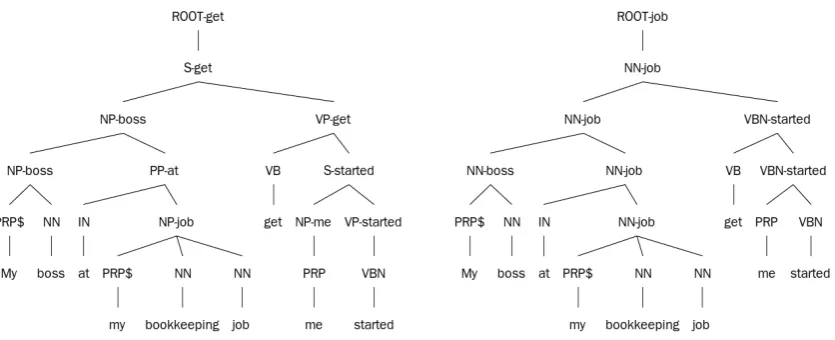
Figure 1: The first tree is the result of Stanford parser. The second one is obtained by performing content-based lexicalization on the first tree. All labels are replaced by part-of-speech tags of heirs. Unary rules NP-me→PRP and VP-started→VBN are removed.
• X(h) → Y1(h1). . . Yk(hk) such that there existsi,hi =handYi=X.
In other words, the heir would inherit both the lex-icalization and the label of the parent (with the possible exception that the root node may produce children that are not labeled with “root”). When generating a parent node and its children, we re-strict the choice of rules to those containing the la-bel of the parent, so the heir can be inferred from the chosen rules by looking for the child that has the same label as its parent (in case there are mul-tiple children that have the same label, we choose the rightmost one; other heuristics are possible). Note that under such restriction we end up with parse trees in which all labels are part-of-speech tags.
Sequentialization of a tree. Previous works adopt various construction orders of trees. (Zhang et al., 2016), (Zhou et al., 2018), (Alvarez-Melis and Jaakkola,2016), and (G¯u et al.,2018) generate trees through level-order traversal (breadth-first, left-to-right), whereas (Yin and Neubig,2017) and (Wang et al., 2018) generate trees through pre-order traversal (depth-first, left-to-right). ( Kun-coro et al.,2018) also experimented with bottom-up and left-corner construction orders for lan-guage model. While finding the optimal order of generating trees is beyond the scope of this work, we follow (Yin and Neubig, 2017) and (Wang et al.,2018), and generate lexicalized PCFG syn-tax trees through pre-order traversal.
4 Methods
4.1 Definitions
In this paper, we give the following graph-theoretic definition of L-PCFG syntax trees. Let
W andN be the sets of lexicons and labels. Let
R = S∞
k=1Nk be the set of production rules. Then an L-PCFG syntax treeT is anordered tree defined by the triple of verticesv ∈ V ⊂ W ×
N ×R×N, edgese ∈ E ⊂ V ×V, and bijec-tionf :V ×N+→V such that(v, f(v, j))∈E, wherejrange from 1 to the number of children of
v. The fourth coordinate of v is the index of its heir, that is,
(w, n, r, i) =f((w0, n0, r0, i0), i0)
=⇒w=w0, n0=n
We say a node v = (w, n, r, i) is a leaf if r is unary:
v is a leaf ⇐⇒ r∈N
The parent of vk is denoted by vp(k) =
(wp(k), mp(k), np(k), ip(k)).
4.2 Generation Procedure
Following previous work, we sequentialize L-PCFG parse trees and generate its content in an auto-regressive manner. When gen-erating kth node, we predict the lexicaliza-tion wk and the rule rk. The pre-order his-tory available when generating kth node is
Hk. The label “ROOT” is given at the start of gen-eration. The label of thekthnode is inferred from the production rule of its parent and the order of
kth node among its siblings, and is used as input together withHk. When a leaf node is reached, the program backtraces until it finds an ancestor that has unfinished child, and proceeds to the first such child.
We factor the joint probability of wk and rk into two component: a word model and a syntax model, as follow:
P(wk, rk|nk, Hk) =
P(wk|nk, Hk)·P(rk |nk, Hk)
The details of both models are given in the follow-ing sections.
4.3 Lexicalization Schemes
We parse the responses in training corpus using the lexicalized parser by (Klein and Manning,2003) (which we call Stanford parser for the rest of this paper). We then replace the label of each node with that of their heir in a bottom-up man-ner. Unary rules at non-leaf nodes are removed as they become redundant given our definition of lexiclaized PCFG.
Stanford parser lexicalizes PCFG phrase struc-tures by looking for the most likely combination of phrase structure and dependency structure. While their approach is optimized for parsing, the syntax trees lexicalized this way has a drawback for the purpose of generation. Empirically, their parser tends to lexicalize the first few nodes with auxil-iary verbs or common verbs (e.g. be, must), and in some cases prefer function words over content words (e.g. in preposition phrases). We hypoth-esize that choosing content words over functions, or infrequent words over frequent words as lex-icalization heads will help making the generation more specific and meaningful. Hence, we consider two alternative lexicalization schemes:
Content-based lexicalization. We rank words according to their part-of-speech in the sentence by the following order: nouns> verbs = adjec-tives >adverbs>everything else. If two words have the same rank, we give priority to the right-most one. See Figure1for an example.
Frequency-based lexicalization. We ignore part-of-speech information and rank all words by their frequencies. We regard less frequent words as more important.
4.4 Encoding Tree Histories
To represent the state of a tree node by encoding its pre-order historyHk, we use 3 LSTMs to mem-orize the lexical and grammatical contents inHk.
Encoding lexicalization history. We use 2 LSTMs to encode the lexicalization history, i.e.
w1· · ·wk−1: a surface decoder, Ls, which takes the lexicalization of the leaves in the history as in-puts; and anancestordecoder,La, which is given the lexicalization of the ancestors of the current node. This is another form of doubly-recurrent neural networks. Different from (Alvarez-Melis and Jaakkola, 2016), we chose to encode leaves instead of siblings. Denote the lexicalizaiton of leaves and ancestors in Hk by {wl(k)i} and {wa(k)i}. We show that for an L-PCFG syntax tree, {wl(k)i} and{wa(k)i} sufficiently cover the lexical content ofHk:
Proposition. For any index set Ik ⊂ {1,2, . . . , k−1}, ifwn∈ {wj}j∈Ikfor alln < k, then {l(k)i}S{a(k)i} ⊂ Ik, i.e. {l(k)i} and {a(k)i}together is the minimal index set to cover
w1· · ·wk−1.
Encoding syntactic history. We encode the previous labels and rules using the full history with a single LSTM,Lg. At stepk, the input toLgis the concatenation of the embeddings ofnk, the rule of parent node rp(k), and depth of the node d. The depths of nodes deeper than 10 are rounded down to 10.
4.5 Encoding Source and Attention Mechanism
We adopt attention mechanism into our architec-ture for response generation. We use a one-layered LSTM to encode the dialog history, which is the concatenation of the last few utterances. The ini-tial hidden states ofLs, La, andLg is computed from the last hidden state of source encoder using 2 fully-connected layers with rectified linear ac-tivation. At time step t, the concatenation of the hidden states of Ls andLa at stept−1 is used as the key for querying the source. The attention weights are the inner products of the key and the hidden states at source side, normalized by soft-max function. The weighted sum of source hidden states results in the attention context,c(k)
4.6 Decoding
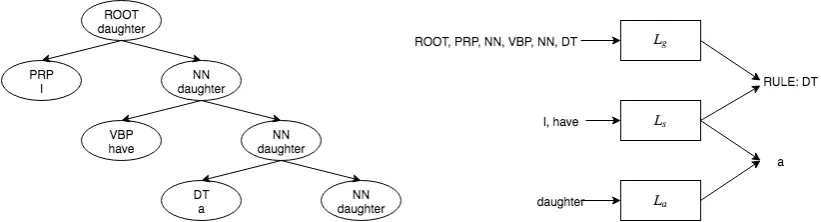
func-Figure 2: Demonstration of inputs and outputs at node DT. The sequence of inputs to each encoder are shown in the graph. The inputs toLgis a sequence of labels, rules of parents, and tree depths (only labels are shown). Ls
andLaare used for predicting the word for DT.LsandLgare used for predicting the rule for DT. “RULE: DT”
indicates DT will be a leaf node since the number of symbols is 1. In this tree, words are generated in the order: daughter - I - have - a.
tion byσ. Ew ∈R|W|×dw andEr ∈ R|P|×dr are embedding matrices for words, labels, and rules.
Aw ∈ Rnw×dw and Ar ∈ Rnp×dr are weight matrices (nw, np are the dimensions of input neu-rons). We use weight tying (Press and Wolf,2017) to limit the search space for parameters.
Word prediction.To decode forwk, we use the the hidden states of surface decoderLsand ances-tor decoderLa. Ifvkis a heir, then
P(wk|nk, Hk) =
(
1 wk=wp(k)
0 wk6=wp(k)
Otherwise, the probability ofwkis given by:
P(wk|nk, Hk) =
σ(tanh([hs(k);ha(k);c(k)]Aw)EwT)
At decoding time, we impose an additional con-straint thatwkbe a valid word for labelnk, to en-force grammaticality. This is estimated from the co-occurrence ofwkandnkin the tagged training corpus. We only use those words whose frequency of co-occurrence with the given label is above a certain threshold.
Rule prediction. The probability ofrkis given by
P(rk|nk, Hk) =
σ(tanh([hs(k);hg(k);c(k)]Ar)ErT)
Given the definition of L-PCFG syntax tree, we only consider rules that contain nk at decoding time. There is one exception: at “ROOT” node, only unary rules are considered, and they do not have to contain the label “ROOT”.
Hence, we train our architecture by minimizing the negative log-likelihood of words and rules:
−logP(T) =
− 1
|W(T)|
X
k vk6=f(vp(k),ip(k))
logP(wk|nk, Hk)
− 1 |T|
X
k
logP(rk|nk, Hk)
where|W(T)|is the number of non-heir nodes (or the number of words in the original sentence), and |T|is the number of nodes inT. Note that the log probability of each word in the sentence appears exactly once in the above equation. At test time, we conduct beam search and use the same equa-tion to score each generaequa-tion for selecting words and rules.
In our experiments, we use unlexicalized PCFG as an additional baseline. We still replace the la-bels of each node with their heirs’ in the parse tree returned from Stanford parser, but words are gen-erated only at leaf nodes. This baseline has syn-tactic structure while generating words from left to right. We use it as a test against top-down gen-eration of words with syntax.
4.7 Training Details
[image:5.595.93.504.63.174.2]Stand. Depend. Content Nouns 8.21 7.70 6.25
Verbs 9.56 7.07 7.03
Adjectives 7.38 7.82 7.77
Adverbs 6.38 6.99 7.29
[image:6.595.78.285.62.147.2]Other 5.64 6.23 6.62
Table 1: Average absolute positions of different type of words.
Stand. Depend. Freq. 1 .0262 .0095 .0002
2 .0149 .0274 .0238
3 .0147 .0116 .0156
4 .0133 .0145 .0147
[image:6.595.338.496.62.132.2]5 .0134 .0131 .0146
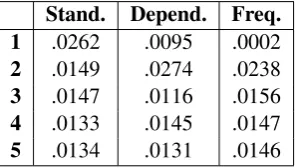
Table 2: Average frequency of first five words in differ-ent generation orders.
5 Experiments and Analysis
5.1 Data
We evaluate our model for dialog response gen-eration on Persona dataset ((Zhang et al., 2018)). Each person is give a list of persona descriptions in simple sentences, and they are required to con-verse according to the given persona. We use last 3 utterances for each response as source. We prepend persona descriptions to source. We use global attention over persona descriptions to com-pute context vectors. During pre-processing, we truncate all trailing punctuations.
5.2 Positional Statistics
We measure how early do each type of words ap-pear in different generation orders – standard left-to-right order, dependency-based lexicalization (as in Stanford parser), and content-based lexicaliza-tion. The earlier a word appear, the less context there is for predicting it. As shown in Table 1, content-based lexicalization can make nouns and verbs appear much earlier, while delaying function words.
To verify frequency-based lexicalization is making infrequent words appear earlier, we show the average frequencies of the first five words. The first few words are more important since they decide the context for generating the follow-ing words. In Table 2, the first two words of each parse tree under frequency-based
lexicaliza-Seq2seq Ours
[image:6.595.108.256.197.281.2]Standard 3.682 N/A Dependency 4.015 3.964 Content 4.115 3.865 Frequency 4.088 3.827
Table 3: Perplexities.
tion are much less frequent.
5.3 Perplexity
We compare per word likelihood given different generation orders and architectures. For left-to-right sequence decoder, the non-standard gener-ation orders are obtained by linearizing L-PCFG parse trees in pre-order traversal, and words of heirs are not repeated in the linearization. Note that our word model generates word without us-ing rules and labels as inputs to its networks. As can be seen from Table 3, alternative word gen-eration orders all make it harder for standard left-to-right sequence decoder to learn to predict the next word. On the other hand, using a doubly-recurrent architecture, specifically the surface de-coder and the ancestor dede-coder, can improve per-plexity scores for top-down word generation over the left-to-right decoder. While our word model with top-down word generation orders has higher perplexity scores than simple model with standard generation order, we emphasize that perplexity is not an appropriate measure for generation tasks.
5.4 Evaluation Metrics
Word Overlap Based Metrics. We use BLEU (Papineni et al.,2002), ROUGE (Lin,2004), and METEOR (Banerjee and Lavie, 2005) scores as automatic evaluation metrics. While the reliabil-ity of such metrics has been criticized (Liu et al., 2016), there is also evidence that for task-oriented domains, these metrics correlate with human judg-ment to a certain extent (Sharma et al.,2017).
Human Baseline PCFG L-PCFG (Dependency)
L-PCFG (Content)
L-PCFG (Frequency)
Length 10.35 7.21 9.39 8.96 11.04 9.74
BLEU N/A 0.1926 0.2041 0.2038 0.2093 0.2028 ROUGE-L N/A 0.1639 0.1448 0.1571 0.1565 0.1624
METEOR N/A 0.0718 0.0704 0.0721 0.0777 0.0739 Cos. Sim. to targets N/A 0.0913 0.0385 0.0824 0.0964 0.0883 Cos. Sim. to last utterance 0.1108 0.0880 0.0714 0.0921 0.1113 0.0971 Cos. Sim. to persona 0.1489 0.0206 0.0455 0.0796 0.0691 0.0605
Distinct uni-gram 6327 678 725 891 813 874
Distinct bi-gram 44376 2802 3368 5306 5427 3680 Distinct tri-gram 77884 4844 6061 10348 10787 6441
Inertia 11771 4385 5027 6319 3756 3959
[image:7.595.73.532.60.270.2]BLEU to training set 0.4334 0.8471 0.5320 0.5874 0.5402 0.6331 ROUGE to training set 0.4728 0.8970 0.5837 0.6701 0.6226 0.7175
Table 4: Evaluation results on Persona dataset.
Context Human Seq2seq L-PCFG
i am great . i just got back from the club
this is my favorite time of the year season wise
that is cool what do you do for a living
awesome ! i am getting ready to go to the club sure i like tv ,
what do you watch ?
really anything ,
what about you ? i watch a lot of tv
i watch lot of tv movies . i like to watch tv
oh . tell me something about yourself .
well i do not like heights very much and i love animals . what about you ?
i am an accountant . what do you do
i am trying to learn how to work with animals
i live in texas . i love riding my bike here .
are you a christian ? i am jewish
i have never been to the west coast . do you have any hobbies
i do too ! i wish i was there so i can do that for school
Table 5: Examples of generated responses.
Novelty and diversity.We measure word over-lapping between generated responses and the re-sponses in training set using BLEU and ROUGE as a proxy for novelty. The responses in training set with most common words with generated re-sponses are used as references. For diversity, we count the number of distinct n-grams. In addi-tion, we perform a k-means clustering on the sen-tence embeddings of responses into 10 clusters, and measure average squared Euclidean distance between members of each cluster (Inertia). The larger the number, the harder it is to separate em-beddings into 10 clusters, thus the greater the di-versity.
5.5 Main Results
5.5.1 Quantitative Analysis
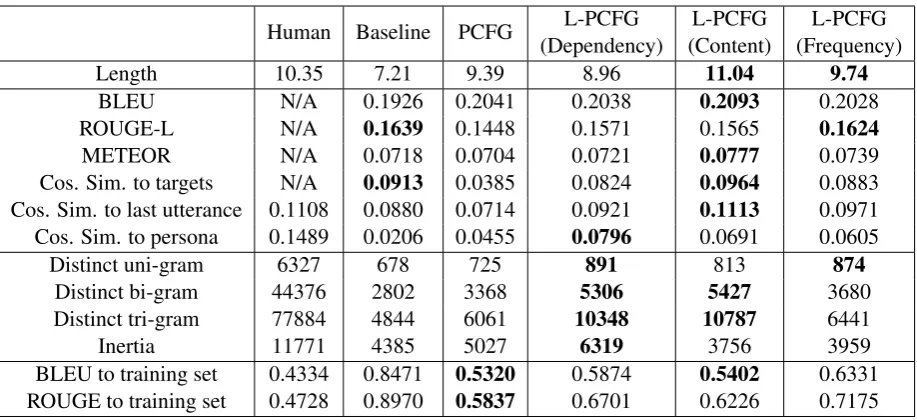
Evaluation results are shown in Table4. For met-rics that are not measured using ground truth
re-sponse as reference, we consider the closer to the number for human responses the better. We first look at measures for overall generation quality. We can see modelling syntactic structures is capa-ble of generating longer responses. BLEU scores are positively correlated with lengths. While syn-tactic models do better on BLEU, and slightly bet-ter on METEOR than sequence-to-sequence base-line, they are generally not on par with the baseline in terms of ROUGE-L, except for frequency-based lexicalization. Among grammar models, lexical-ized grammars out-performed unlexicallexical-ized gram-mar.
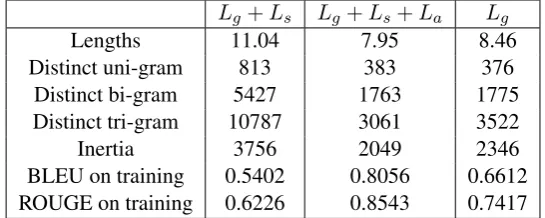
[image:7.595.70.540.301.454.2]Lg+Ls Lg+Ls+La Lg
Lengths 11.04 7.95 8.46
Distinct uni-gram 813 383 376 Distinct bi-gram 5427 1763 1775 Distinct tri-gram 10787 3061 3522
Inertia 3756 2049 2346
[image:8.595.162.435.63.172.2]BLEU on training 0.5402 0.8056 0.6612 ROUGE on training 0.6226 0.8543 0.7417
Table 6: Ablation studies.
and frequence-based lexicalization. Dependency-based lexicalization is best at being adherent to personas than the other two lexicalization schemes.
All syntactic models generate more novel re-sponses than sequence-to-sequence baseline, as reflected in the last two rows in 4. This is consistent with the observation that sequence-to-sequence model exhibits retrieval-like behaviour, selecting what is most common in the training cor-pus. Syntactic models also have larger vocabular-ies. As for cluster analysis, unlexicalized grammar model and dependency-based lexicalized gram-mar model have better diversity than sequence-to-sequence model; content-based and frequency-based lexicalization have slightly smaller inertia than the baseline.
5.5.2 Qualitative Analysis
We present a few examples generated by sequence-to-sequence baseline and L-PCFG model. There is a clear difference of how left-to-right decoder and L-PCFG tree decoder do conjunctions. Most of the time, standard LSTM decoder combine sentences with periods, while tree decoders learn to use conjunction words, or even clauses.
We also performed an error analysis on the gen-erated responses by L-PCFG, and in Table7we se-lected the most peculiar and representative. These examples are all syntactically fine, but they do not follow the convention of the language or common sense. The first example contains the most com-mon errors in the responses generated by L-PCFG: misuse of prepositions and determiners. It can be fixed by replacing “as a” with “for”. The error of other two examples have even less to do with syn-tax. The second one misuses the verb “be”, which is probably caused by the high frequency of the word in the corpus. The error of the third
exam-ple is beyond surface level. Note that phrases such as “cooking as a dinner” and “be a dog” never ap-pear in the corpus. It is clear that L-PCFG models are learning to make compositions of words and phrases, unlike standard LSTM decoder, which seems to only memorize word combinations.
i am doing well . just finished cooking as a dinner i am sure it is nice . i am going to be a dog i like to ride my horses on my bike
Table 7: Some peculiar examples generated by L-PCFG models.
5.6 Ablation Studies
We perform ablation studies on our architecture, with content-based lexicalization. Specifically, we consider two alternative ways of making rule prediciton. The first one takes only the hidden state of Lg for predicting rules, hence making the prediction of rules entirely independent from words. The second one takes both the hidden states ofLsandLa, together withLg, for predict-ing rules, in which way future lexical information is used for the construction of syntax trees.
For rule prediction using the hidden states of both surface decoder and ancestor decoder, we no-ticed a significant drop in diversity in generated responses. The model over-predicts “what do you do for a living” for than 50% of the time, and the lengths of responses tend to be shorter.
The proportion of simple sentences are also larger.
6 Conclusion
We consider the problem of generating natural lan-guage in alternative orders and with syntactic tree structures, with the use of lexicalized grammar. By incorporating syntactic structures, our models are capable of generating longer sentences. By changing lexicalizaion schemes and making con-tent words appear earlier in generation process, our models are able to make word choices that are more relevant to source. Furthermore, incorpo-rating syntax facilitates response generation with richer vocabularies and more complex structures. On the other hand, as shown in our error analysis, there is still room for improvement on discourse and pragmatics level.
Acknowledgments
This material is based upon work partially sup-ported by the National Science Foundation (Award # 1722822). Any opinions, findings, and conclu-sions or recommendations expressed in this mate-rial are those of the author(s) and do not neces-sarily reflect the views of National Science Foun-dation, and no official endorsement should be in-ferred.
References
Roee Aharoni and Yoav Goldberg. 2017. Towards string-to-tree neural machine translation. In Pro-ceedings of the 55th Annual Meeting of the Associa-tion for ComputaAssocia-tional Linguistics (Volume 2: Short Papers), volume 2, pages 132–140.
David Alvarez-Melis and Tommi S Jaakkola. 2016. Tree-structured decoding with doubly-recurrent neural networks.
Sanjeev Arora, Yingyu Liang, and Tengyu Ma. 2016. A simple but tough-to-beat baseline for sentence em-beddings.
Satanjeev Banerjee and Alon Lavie. 2005. Meteor: An automatic metric for mt evaluation with improved correlation with human judgments. InProceedings of the acl workshop on intrinsic and extrinsic evalu-ation measures for machine translevalu-ation and/or sum-marization, pages 65–72.
Gary S Dell, Franklin Chang, and Zenzi M Grif-fin. 1999. Connectionist models of language pro-duction: Lexical access and grammatical encoding.
Cognitive Science, 23(4):517–542.
Li Dong and Mirella Lapata. 2016. Language to logi-cal form with neural attention. InProceedings of the 54th Annual Meeting of the Association for Compu-tational Linguistics (Volume 1: Long Papers), vol-ume 1, pages 33–43.
Chris Dyer, Adhiguna Kuncoro, Miguel Ballesteros, and Noah A Smith. 2016. Recurrent neural network grammars. InProceedings of the 2016 Conference of the North American Chapter of the Association for Computational Linguistics: Human Language Technologies, pages 199–209.
Akiko Eriguchi, Yoshimasa Tsuruoka, and Kyunghyun Cho. 2017. Learning to parse and translate improves neural machine translation. In Proceedings of the 55th Annual Meeting of the Association for Compu-tational Linguistics (Volume 2: Short Papers), vol-ume 2, pages 72–78.
Nicolas Ford, Daniel Duckworth, Mohammad Norouzi, and George Dahl. 2018. The importance of generation order in language modeling. In
Proceedings of the 2018 Conference on Empirical
Methods in Natural Language Processing, pages
2942–2946.
Jetic G¯u, Hassan S Shavarani, and Anoop Sarkar. 2018. Top-down tree structured decoding with syntactic connections for neural machine translation and pars-ing. InProceedings of the 2018 Conference on
Em-pirical Methods in Natural Language Processing,
pages 401–413.
Dan Klein and Christopher D Manning. 2003. Fast ex-act inference with a fex-actored model for natural lan-guage parsing. InAdvances in neural information processing systems, pages 3–10.
Adhiguna Kuncoro, Chris Dyer, John Hale, Dani Yo-gatama, Stephen Clark, and Phil Blunsom. 2018. Lstms can learn syntax-sensitive dependencies well, but modeling structure makes them better. In Pro-ceedings of the 56th Annual Meeting of the Associa-tion for ComputaAssocia-tional Linguistics (Volume 1: Long
Papers), volume 1, pages 1426–1436.
Jingyuan Li and Xiao Sun. 2018. A syntactically con-strained bidirectional-asynchronous approach for emotional conversation generation. InProceedings of the 2018 Conference on Empirical Methods in
Natural Language Processing, pages 678–683.
Chin-Yew Lin. 2004. Rouge: A package for automatic evaluation of summaries. In Text Summarization Branches Out.
Chia-Wei Liu, Ryan Lowe, Iulian Serban, Mike Nose-worthy, Laurent Charlin, and Joelle Pineau. 2016.
How not to evaluate your dialogue system: An em-pirical study of unsupervised evaluation metrics for dialogue response generation. InProceedings of the 2016 Conference on Empirical Methods in Natural
Language Processing, pages 2122–2132.
Shikib Mehri and Leonid Sigal. 2018. Middle-out de-coding. InAdvances in Neural Information Process-ing Systems, pages 5519–5530.
Lili Mou, Yiping Song, Rui Yan, Ge Li, Lu Zhang, and Zhi Jin. 2016. Sequence to backward and for-ward sequences: A content-introducing approach to generative short-text conversation. InProceedings of COLING 2016, the 26th International Confer-ence on Computational Linguistics: Technical Pa-pers, pages 3349–3358.
Kishore Papineni, Salim Roukos, Todd Ward, and Wei-Jing Zhu. 2002. Bleu: a method for automatic eval-uation of machine translation. InProceedings of the 40th Annual Meeting of the Association for Compu-tational Linguistics.
Ofir Press and Lior Wolf. 2017. Using the output em-bedding to improve language models. In Proceed-ings of the 15th Conference of the European Chap-ter of the Association for Computational Linguistics: Volume 2, Short Papers, pages 157–163. Association for Computational Linguistics.
Iulian Vlad Serban, Alessandro Sordoni, Ryan Lowe, Laurent Charlin, Joelle Pineau, Aaron C Courville, and Yoshua Bengio. 2017. A hierarchical latent variable encoder-decoder model for generating di-alogues. InAAAI, pages 3295–3301.
Shikhar Sharma, Layla El Asri, Hannes Schulz, and Jeremie Zumer. 2017. Relevance of unsupervised metrics in task-oriented dialogue for evaluating nat-ural language generation. CoRR, abs/1706.09799.
Oriol Vinyals and Quoc Le. 2015. A neural conversa-tional model. arXiv preprint arXiv:1506.05869.
Xinyi Wang, Hieu Pham, Pengcheng Yin, and Graham Neubig. 2018. A tree-based decoder for neural ma-chine translation. InProceedings of the 2018 Con-ference on Empirical Methods in Natural Language
Processing, pages 4772–4777.
Shuangzhi Wu, Dongdong Zhang, Nan Yang, Mu Li, and Ming Zhou. 2017. Sequence-to-dependency neural machine translation. In Proceedings of the 55th Annual Meeting of the Association for Compu-tational Linguistics (Volume 1: Long Papers), vol-ume 1, pages 698–707.
Pengcheng Yin and Graham Neubig. 2017. A syntactic neural model for general-purpose code generation.
In Proceedings of the 55th Annual Meeting of the
Association for Computational Linguistics (Volume
1: Long Papers), volume 1, pages 440–450.
Saizheng Zhang, Emily Dinan, Jack Urbanek, Arthur Szlam, Douwe Kiela, and Jason Weston. 2018. Per-sonalizing dialogue agents: I have a dog, do you have pets too? In Proceedings of the 56th An-nual Meeting of the Association for Computational
Linguistics (Volume 1: Long Papers), pages 2204–
2213. Association for Computational Linguistics.
Xingxing Zhang, Liang Lu, and Mirella Lapata. 2016. Top-down tree long short-term memory networks.
InProceedings of the 2016 Conference of the North
American Chapter of the Association for
Computa-tional Linguistics: Human Language Technologies,
pages 310–320.
Ganbin Zhou, Ping Luo, Rongyu Cao, Yijun Xiao, Fen Lin, Bo Chen, and Qing He. 2018. Tree-structured neural machine for linguistics-aware sen-tence generation. In Proceedings of the Thirty-Second AAAI Conference on Artificial Intelligence, (AAAI-18), the 30th innovative Applications of Arti-ficial Intelligence (IAAI-18), and the 8th AAAI Sym-posium on Educational Advances in Artificial Intel-ligence (EAAI-18), New Orleans, Louisiana, USA,
February 2-7, 2018, pages 5722–5729. AAAI Press.
A Appendices
A.1 Proof sketch forPropositionin Section 4.4
We prove by contradiction. Suppose there is a nodenk, whose lexicalization is not in the leaves before node k, nor in the ancestors of node nk. There must be a leaflinheriting the lexicalization of nodenk. Sincenkis not an ancestor of nodek,