Generating Lexical Analogies Using Dependency Relations
Andy Chiu, Pascal Poupart, and Chrysanne DiMarco
David R. Cheriton School of Computer Science University of Waterloo
Waterloo, Ontario, Canada
{pachiu,ppoupart,cdimarco}@uwaterloo.ca
Abstract
A lexical analogy is a pair of word-pairs that share a similar semantic relation. Lex-ical analogies occur frequently in text and are useful in various natural language pro-cessing tasks. In this study, we present a system that generates lexical analogies au-tomatically from text data. Our system dis-covers semantically related pairs of words by using dependency relations, and applies novel machine learning algorithms to match these word-pairs to form lexical analogies. Empirical evaluation shows that our system generates valid lexical analogies with a pre-cision of 70%, and produces quality output although not at the level of the best human-generated lexical analogies.
1 Introduction
Analogy discovery and analogical reasoning are ac-tive research areas in a multitude of disciplines, in-cluding philosophy, psychology, cognitive science, linguistics, and artificial intelligence. A type of anal-ogy that is of particular interest in natural language processing islexical analogy. A lexical analogy is a pair of word-pairs that share a similar semantic rela-tion. For example, the word-pairs (dalmatian,dog) and (trout,fish) form a lexical analogy because dal-matian is a subspecies of dog just as trout is a sub-species of fish, and the word-pairs (metal, electric-ity) and (air,sound) form a lexical analogy because in both cases the initial word serves as a conductor for the second word. Lexical analogies occur
fre-quently in text and are useful in various natural lan-guage processing tasks. For example, understanding metaphoric language such as “the printer died” re-quires the recognition of implicit lexical analogies, in this case between (printer,malfunction) and ( per-son, death). Lexical analogies also have applica-tions in word sense disambiguation, information ex-traction, question-answering, and semantic relation classification (see (Turney, 2006)).
In this study, we present a novel system for gen-erating lexical analogies directly from a text cor-pus without relying on dictionaries or other seman-tic resources. Our system uses dependency relations to characterize pairs of semantically related words, then compares the similarity of their semantic rela-tions using two machine learning algorithms. We also present an empirical evaluation that shows our system generates valid lexical analogies with a pre-cision of 70%. Section 2 provides a list of defini-tions, notadefini-tions, and necessary background materi-als. Section 3 describes the methods used in our system. Section 4 presents our empirical evalua-tion. Section 5 reviews selected related work. Fi-nally, Section 6 concludes the paper with suggested future work and a brief conclusion.
2 Definitions
Aword-pairis a pair of entities, where each entity is a single word or a multi-word named entity. The
underlying relationsof a word-pair(w1, w2)are the
semantic relations1 betweenw1 andw2. For
exam-1
Here ‘semantic relations’ include bothclassical relations such as synonymy and meronymy, andnon-classical relations as defined by Morris and Hirst (2004).
ple, the underlying relations of (poet,poem) include
produces,writes,enjoys, andunderstands. Alexical analogyis a pair of word-pairs that share at least one identical or similar underlying relation.
A key linguistic formalism we use isdependency grammar (Tesni`ere, 1959). A dependency gram-mar describes the syntactic structure of a sentence in a manner similar to the familiar phrase-structure grammar. However, unlike phrase-structure gram-mars which associate each word of a sentence to the syntactic phrase in which the word is contained, a dependency grammar associates each word to its syntactic superordinate as determined by a set of rules. Each pair of depending words is called a
dependency. Within a dependency, the word being depended on is called the governor, and the word depending on the governor is called thedependent. Each dependency is also labelled with the syntac-tic relation between the governor and the dependent. Dependency grammars require that each word of a sentence have exactly one governor, except for one word called thehead wordwhich has no governor at all. A propositionpthat is governor to exactly one word w1 and dependent of exactly one word w2 is
oftencollapsed (Lin and Pantel, 2001); that is, the two dependencies involvingpare replaced by a sin-gle dependency betweenw1 andw2labelledp.
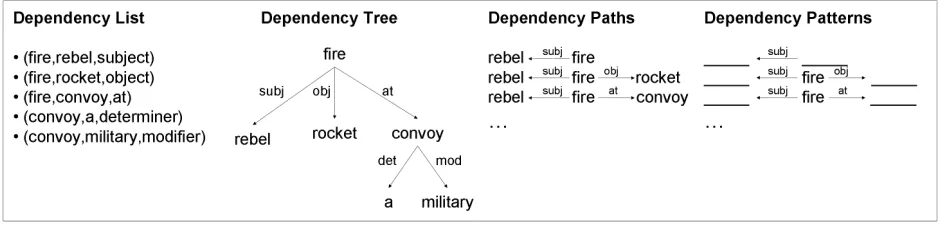
The dependency structure of a sentence can be concisely represented by a dependency tree, in which each word is a node, each dependent is a child of its governor, and the head word is the root. A de-pendency path is an undirected path through a de-pendency tree, and adependency patternis a depen-dency path with both ends replaced by slots (Lin and Pantel, 2001). Figure 1 illustrates various depen-dency structures of the sentence,rebels fired rockets at a military convoy, after each word is lemmatized.
3 Methods
We consider lexical analogy generation as a se-quence of two key problems: data extraction and
relation-matching. Data extraction involves the identification and extraction of pairs of semantically related words, as well as features that characterize their relations. Relation-matching involves match-ing word-pairs with similar features to form lexi-cal analogies. We describe our methods for solving
these two problems in the following subsections.
3.1 Data Extraction
Extracting Word-Pairs
To identify semantically related words, we rely on the assumption that highly syntactically related words also tend to be semantically related — a hy-pothesis that is supported by works such as Levin’s (1993) study of English verbs. As such, the de-pendency structure of a sentence can be used to ap-proximate the semantic relatedness between its con-stituent words. Our system uses a dependency parser to parse the input text into a set of dependency trees, then searches through these trees to extract depen-dency paths satisfying the following constraints:
1. The path must be of the formnoun-verb-noun.
2. One of the nouns must be the subject of the clause to which it belongs.
Each of these paths is then turned into a word-pair by taking its two nouns. The path constraints that we use are suggested by thesubject-verb-object(SVO) pattern commonly used in various relation extraction algorithms. However, our constraints allow signifi-cantly more flexibility than the SVO pattern in two important aspects. First, our constraints allow an arbitrary relation between the verb and the second noun, not just the object relation. Hence, word-pairs can be formed from a clause’s subject and its loca-tion, time, instrument, and other arguments, which are clearly semantically related to the subject. Sec-ondly, searching in the space of dependency trees in-stead of raw text data means that we are able to find semantically related words that are not necessarily adjacent to each other in the sentence.
It is important to note that, although these con-straints improve the precision of our system and tend to identify effectively the most relevant word-pairs, they are not strictly necessary. Our system would be fully functional using alternative sets of constraints tailored for specific applications, or even with no constraints at all.
Using the sentence in Figure 1 as an example, our system would extract the dependency paths “rebel
subj
← fire obj→ rocket” and “rebel subj← fire →at con-voy”, and would thus generate the word-pairs (rebel,
Figure 1: Dependency structures of “rebels fired rockets at a military convoy” after lemmatization
Extracting Features
Recall that each word-pair originates from a de-pendency path. The path, and in particular the mid-dle verb, provides a connection between the two words of the word-pair, and hence is a good in-dication of their semantic relation. Therefore, for each word-pair extracted, we also extract the dency pattern derived from the word-pair’s depen-dency path as a feature for the word-pair. We further justify this choice of feature by noting that the use of dependency patterns have previously been shown to be effective at characterizing lexico-syntactic re-lations (Lin and Pantel, 2001; Snow et al., 2004).
Using Figure 1 as an example again, the
depen-dency patterns “ subj← fireobj→ ” and “ subj←
fire→at ” would be extracted as a feature of (rebel,
rocket) and (rebel,convoy), respectively.
Filtering
Word-pairs and features extracted using only de-pendency relations tend to be crude in several as-pects. First, they contain a significant amount of noise, such as word-pairs that have no meaningful underlying relations. Noise comes from grammati-cal and spelling mistakes in the original input data, imperfect parsing, as well as the fact that depen-dency structure only approximates semantic related-ness. Secondly, some of the extracted word-pairs contain underlying relations that are too general or too obscure for the purpose of lexical analogy gen-eration. For example, consider the word-pair ( com-pany, right) from the sentence “the company exer-cised the right to terminate his contract”. The two words are clearly semantically related, however the relation (have or entitled-to) is very general and it is difficult to construct satisfying lexical analogies
from the word-pair. Lastly, some features are also
subject to the same problem. The feature “ subj←
sayobj→ ”, for example, has very little characteri-zation power because almost any pair of words can occur with this feature.
In order to retain only the most relevant word-pairs and features, we employ a series of refining filters. All of our filters rely on the occurrence statistics of the word-pairs and features. LetW =
{wp1, wp2, ..., wpn}be the set of all word-pairs and
F ={f1, f2, ..., fm}the set of all features. LetFwp
be the set of features of word-pair wp, and let Wf be the set of word-pairs associated with featuref. Let O(wp) be the total number of occurrences of word-pair wp, O(f) be the total number of occur-rences of featuref, andO(wp, f)be the number of occurrences of word-pair wp with feature f. The following filters are used:
1. Occurrence filter: Eliminate word-pair wp if O(wp) is less than some constant Kf1, and
eliminate feature f if O(f) is less than some constantKf2. This filter is inspired by the
sim-ple observation that valid word-pairs and fea-tures tend to occur repeatedly.
2. Generalization filter: Eliminate feature f if |Wf|is greater than some constantKf3. This
filter ensures that features associated with too many word-pairs are not kept. A feature that occurs with many word-pairs tend to describe overly general relations. An example of such
3. Data sufficiency filter: Eliminate word-pairwp if|Fwp|is less than some constant Kf4. This
filter ensures that all word-pairs have sufficient features to be compared meaningfully.
4. Entropy filter: Eliminate word-pair wp if its
normalized entropy is greater than some con-stantKf5. We compute a word-pair’s entropy
by considering it as a distribution over features, in a manner that is analogous to thefeature en-tropy defined in (Turney, 2006). Specifically, the normalized entropy of a word-pairwpis:
−
P
f∈Fwpp(f|wp) log (p(f|wp))
log|Fwp|
where p(f|wp) = OO(wp,f(wp)) is the conditional probability offoccurring in the context ofwp. The normalized entropy of a word-pair ranges from zero to one, and is at its highest when the distribution of the word-pair’s occurrences over its features is the most random. The justifica-tion behind this filter is that word-pairs with strong underlying relations tend to have just a few dominant features that characterize those relations, whereas word-pairs that have many non-dominant features tend to have overly gen-eral underlying relations that can be character-ized in many different ways.
3.2 Relation-Matching
Central to the problem of relation-matching is that of arelational similarity function: a function that com-putes the degree of similarity between two word-pairs’ underlying relations. Given such a function, relation-matching reduces to simply computing the relational similarity between every pair of word-pairs, and outputting the pairs scoring higher than some threshold Kth as lexical analogies. Our
sys-tem incorporates two relational similarity functions, as discussed in the following subsections.
Latent Relational Analysis
The baseline algorithm that we use to compute relational similarity is a modified version of Latent Relational Analysis (LRA) (Turney, 2006), that con-sists of the following steps:
1. Construct an n-by-m matrix A such that the ith row maps to word-pairwpi, thejth column
maps to featurefj, andAi,j =O(wpi, fj).
2. Reduce the dimensionality of A to a con-stant Ksvd using Singular Value
Decomposi-tion (SVD) (Golub and van Loan, 1996). SVD produces a matrix Aˆ of rank Ksvd that is the
best approximation ofAamong all matrices of rank Ksvd. The use of SVD to compress the
feature space was pioneered in Latent Semantic Analysis (Deerwester et al., 1990) and has be-come a popular technique in feature-based sim-ilarity computation. The compressed space is believed to be a semantic space that minimizes artificial surface differences.
3. The relational similarity between two word-pairs is the cosine measure of their correspond-ing row vectors in the reduced feature space. Specifically, letAˆidenote theith row vector of
ˆ
A, then the relational similarity between word-pairswpi1 andwpi2 is:
ˆ
Ai1 ·Aˆi2
Aˆi1
2+
Aˆi2
2
The primary difference between our algorithm and LRA is that LRA also includes each word’s synonyms in the computation. Synonym inclusion greatly increases the size of the problem space, which leads to computational issues for our system as it operates at a much larger scale than previous work in relational similarity. Turney’s (2006) exten-sive evaluation of LRA on SAT verbal analogy ques-tions, for example, involves roughly ten thousand re-lational similarity computations2. In contrast, our system typically requires millions of relational sim-ilarity computations because every pair of extracted word-pairs needs to be compared. We call our algo-rithm LRA-S (LRA Without Synonyms) to differen-tiate it from the original LRA.
Similarity Graph Traversal
While LRA has been shown to perform well in computing relational similarity, it suffers from two
2
limitations. First, the use of SVD is difficult to inter-pret from an analytical point of view as there is no formal analysis demonstrating that the compressed space really corresponds to a semantic space. Sec-ondly, even LRA-S does not scale up well to large data sets due to SVD being an expensive operation — computing SVD is in generalO(mn·min(m, n))
(Koyuturk et al., 2005), wherem,nare the number of matrix rows and columns, respectively.
To counter these limitations, we propose an alter-native algorithm for computing relational similarity — Similarity Graph Traversal (SGT). The intuition behind SGT is as follows. Suppose we know that wp1 andwp2 are relationally similar, and that wp2
and wp3 are relationally similar. Then, by
transi-tivity, wp1 and wp3 are also likely to be
relation-ally similar. In other words, the relational similar-ity between two word-pairs can be reinforced by other word-pairs through transitivity. The actual al-gorithm involves the following steps:
1. Construct asimilarity graph as follows. Each word-pair corresponds to a node in the graph. An edge exists from wp1 to wp2 if and only
if the cosine measure of the two word-pairs’ feature vectors is greater than or equal to some thresholdKsgt, in which case, the cosine
mea-sure is assigned as thestrengthof the edge.
2. Define a similarity path of length k, or k -path, fromwp1 towp2 to be a directed acyclic
path of length k from wp1 to wp2, and
de-fine the strength s(p) of a path p to be the product of the strength of all of the path’s edges. Denote the set of allk-paths fromwp1
towp2 asP(k, wp1, wp2), and denote the sum
of the strength of all paths inP(k, wp1, wp2)
asS(k, wp1, wp2).
3. The relational similarity between word-pairs wpi1 andwpi2 is:
α1S(1, wp1, wp2) +
α2S(2, wp1, wp2) +
. . .
αKlS(Kl, wp1, wp2)
whereKlis the maximum path length to
con-sider, and α1, . . ., αKl are weights that are
learned using least-squares regression on a small set of hand-labelled lexical analogies.
A natural concern for SGT is that relational simi-larity is not always transitive, and hence some paths may be invalid. For example, although (teacher,
student) is relationally similar to both (shepherd,
sheep) and (boss, employee), the latter two word-pairs are not relationally similar. The reason that this is not a problem for SGT is because truly simi-lar word-pairs tend to be connected by many transi-tive paths, while invalid paths tend to occur in iso-lation. As such, while a single path may not be in-dicative, a collection of many paths likely signifies a true common relation. The weights in step 3 en-sure that SGT assigns a high similarity score to two word-pairs only if there are sufficiently many tran-sitive paths (which are sufficiently strong) between them.
Analogy Filters
As a final step in both LSA-R and SGT, we fil-ter out lexical analogies of the form (w1,w2) and
(w1,w3), as such lexical analogies tend to express
the near-synonymy betweenw2 and w3 more than
they express the relational similarity between the two word-pairs. We also keep only one permuta-tionof each lexical analogy: (w1,w2) and (w3,w4),
(w3,w4) and (w1,w2), (w2,w1) and (w4,w3), and
(w4,w3) and (w2,w1) are different permutations of
the same lexical analogy.
4 Evaluation
Our evaluation consisted of two parts. First, we eval-uated the performance of the system, using LRA-S for relation-matching. Then, we evaluated the SGT algorithm, in particular, how it compares to LRA-S.
4.1 System Evaluation
Experimental Setup
We implemented our system in Sun JDK 1.5. We also used MXTerminator (Reynar and Ratnaparkhi, 1997) for sentence segmentation, MINIPAR (Lin, 1993) for lemmatization and dependency parsing, and MATLAB3 for SVD computation. The exper-iment was conducted on a 2.1 GHz processor, with
3
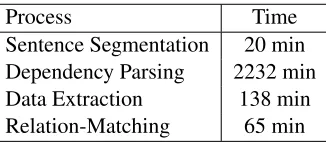
the exception of SVD computation which was car-ried out in MATLAB running on a single 2.4 GHz processor within a 64-processor cluster. The input corpus consisted of the following collections in the Text Retrieval Conference Dataset4: AP Newswire 1988–1990, LA Times 1989–1990, and San Jose Mercury 1991. In total, 1196 megabytes of text data were used for the experiment. Table 1 summarizes the running times of the experiment.
Process Time
Sentence Segmentation 20 min Dependency Parsing 2232 min
Data Extraction 138 min
[image:6.612.105.268.193.264.2]Relation-Matching 65 min
Table 1: Experiment Running Times
The parameter values selected for the experiment are listed in Table 2. The filter parameters were se-lected mostly through trial-and-error — various pa-rameter values were tried and filtration results exam-ined. We used a threshold valueKth= 0.80 to
gener-ate the lexical analogies, but the evaluation was per-formed at ten different thresholds from 0.98 to 0.80 in 0.02 decrements.
Kf1 Kf2 Kf3 Kf4 Kf5 Ksvd
35 10 100 10 0.995 600
Table 2: Experiment Parameter Values
Evaluation Protocol
An objective evaluation of our system is difficult for two reasons. First, lexical analogies are by defi-nition subjective; what constitutes a ‘good’ lexical analogy is debatable. Secondly, there is no gold standard of lexical analogies to which we can com-pare. For these reasons, we adopted a subjective evaluation protocol that involved human judges rat-ing the quality of the lexical analogies generated. Such a manual evaluation protocol, however, meant that it was impractical to evaluate the entire output set (which was well in the thousands). Instead, we evaluated random samples from the output and in-terpolated the results.
4
http://trec.nist.gov/
In total, 22 human judges participated in the eval-uation. All judges were graduate or senior under-graduate students in English, Sociology, or Psychol-ogy, and all were highly competent English speak-ers. Each judge was given a survey containing 105 lexical analogies, 100 of which were randomly sam-pled from our output, and the remaining five were sampled from a control set of ten human-generated lexical analogies. All entries in the control set were taken from the Verbal Analogy section of the Stan-dard Aptitude Test5 and represented the best possi-ble lexical analogies. The judges were instructed to grade each lexical analogy with a score from zero to 10, with zero representing an invalid lexical analogy (i.e., when the two word-pairs share no meaningful underlying relation) and ten representing a perfect lexical analogy. To minimize inter-judge subjectiv-ity, all judges were given detailed instructions con-taining the definition and examples of lexical analo-gies. In all, 1000 samples out of the 8373 generated were graded, each by at least two different judges.
We evaluated the output at ten threshold values, from 0.98 to 0.80 in 0.02 decrements. For each threshold, we collected all samples down to that threshold and computed the following metrics:
1. Coverage: The number of lexical analogies generated at the current threshold over the number of lexical analogies generated at the lowest threshold (8373).
2. Precision: The proportion of samples at the current threshold that scored higher than three. These are considered valid lexical analogies. Note that this is significantly more conservative than the survey scoring. We want to ensure very poor lexical analogies were excluded, even if they were ‘valid’ according to the judges.
3. Quality: The average score of all samples at the current threshold, divided by ten to be in the same scale as the other metrics.
4. Goodness: The proportion of samples at the current threshold that scored within 10% of the average score of the control set. These are con-sidered human quality.
5
Note that recall was not an evaluation metric be-cause there does not exist a method to determine the true number of lexical analogies in the input corpus.
Result
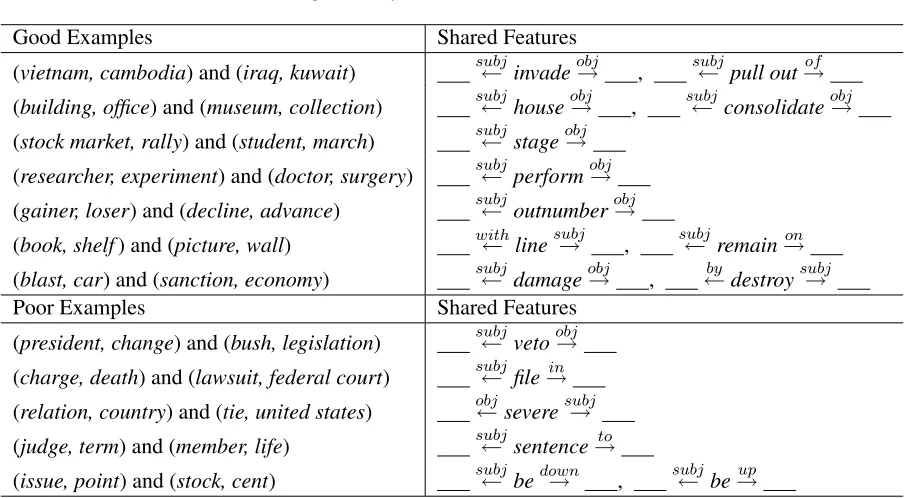
Table 3 summarizes the result of the control set, and Figure 2:Left summarizes the result of the lex-ical analogies our system generated. Table 4 lists some good and some poor lexical analogies our sys-tem generated, along with some of their shared fea-tures.
Coverage Precision Quality Goodness
N/A 1.00 0.97 0.90
Table 3: Result of the Control Set
As Figure 2 shows, our system performed fairly well, generating valid lexical analogies with a preci-sion around 70%. The quality of the generated lex-ical analogies was reasonable, although not at the level of human-generation. On the other hand, a small portion (19% at the highest threshold) of our output was of very high quality, comparable to the best human-generated lexical analogies.
Our result also showed that there was a correspon-dence between the score our system assigned to each generated lexical analogy and its quality. Precision, quality, and goodness all declined steadily toward lower thresholds: precision 0.70–0.66, quality 0.54– 0.49, and goodness 0.19–0.14.
Error Analysis
Despite our aggressive filtration of irrelevant word-pairs and features, noise was still the most sig-nificant problem in our output. Most low-scoring samples contained at least one word-pair that did not have a meaningful and clear underlying relation; for examples, (guy, ball) and (issue, point). As men-tioned, noise originated from mistakes in the input data, errors in sentence segmentation and parsing, as well as mismatches between dependencies and semantic relatedness. An example of the latter in-volved the frequent usage of the proposition “of” in various constructs. In the sentence “the com-pany takes advantage of the new legislation”, for example, the dependency structure associates com-panywithadvantage, whereas the semantic relation clearly lies between company andlegislation. All
three of our evaluation metrics (precision, quality, and goodness) were negatively affected by noise.
Polysemic words, as well as words which were heavily context-dependent, also posed a problem. For example, one of the lexical analogies generated in the experiment was (resolution,house) and ( leg-islation, senate). This lexical analogy only makes sense if “house” is recognized as referring to the House of Representatives, which is often abbrevi-ated as “the House” in news articles. Polysemy also negatively affected all three of our evaluation met-rics, although to a lesser extent for precision.
Finally, our system had difficulties differentiat-ing semantic relations of different granularity. The underlying relations of (relation, country) and (tie,
united states), for example, are similar, yet they do not form a good lexical analogy because the rela-tions are at different levels of granularity (countries in general in the former, and a particular country in the latter). Undifferentiated granularity affected quality and goodness, but it did not have a signifi-cant effect on precision.
4.2 SGT Evaluation
To evaluate how SGT compares to LRA-S, we repeated the experiment using SGT for relation-matching. We setKl(maximum path length) to 3,
andKsgt(cosine threshold) to 0.2; these values were
again determined largely through trial-and-error. To train SGT, we used 90 lexical analogies graded by human judges from the previous experiment. In or-der to facilitate a fair comparison to LRA-S, we se-lectedKthvalues that allowed SGT to generate the
same number of lexical analogies as LRA-S did at each threshold interval.
Running on the same 2.1 GHz processor, SGT finished in just over eight minutes, which is almost a magnitude faster than LRA-S’ 65 minutes. SGT also used significantly less memory, as the similar-ity graph was efficiently stored in an adjacency list. The sets of lexical analogies generated by the two algorithms were quite similar, overlapping approxi-mately 50% at all threshold levels.
Figure 2: System Evaluation Results
Good Examples Shared Features
(vietnam, cambodia) and (iraq, kuwait) subj← invadeobj→ , subj← pull out→of
(building, office) and (museum, collection) subj← houseobj→ , subj← consolidateobj→
(stock market, rally) and (student, march) subj← stageobj→
(researcher, experiment) and (doctor, surgery) subj← performobj→
(gainer, loser) and (decline, advance) subj← outnumberobj→
(book, shelf) and (picture, wall) with← linesubj→ , subj← remain→on
(blast, car) and (sanction, economy) subj← damageobj→ , ←by destroysubj→
Poor Examples Shared Features
(president, change) and (bush, legislation) subj← vetoobj→
(charge, death) and (lawsuit, federal court) subj← file→in
(relation, country) and (tie, united states) obj←severesubj→
(judge, term) and (member, life) subj← sentence→to
(issue, point) and (stock, cent) subj← bedown→ , subj← be→up
Table 4: Examples of Good and Poor Lexical Analogies Generated
had also been generated by SGT, and used these samples as the evaluation data points for SGT. At the lowest threshold (where 8373 lexical analogies were generated), we were able to reuse 533 samples out of the original 1000 samples. Figure 2:Right sum-marizes the performance of the system using SGT for relation-matching.
As the figure shows, SGT performed very simi-larly to LRA-S. Both SGT’s precision and quality scores were slightly higher than LRA-S, but the dif-ferences were very small and hence were likely due to sample variation. The goodness scores between the two algorithms were also comparable. In the case of SGT, however, the score fluctuated instead
of monotonically decreased. We attribute the fluctu-ation to the smaller sample size.
[image:8.612.80.533.226.475.2]the results from the two sets were comparable with small differences. Moreover, the differences were in favour of the SGT-only portion. Therefore, either there was no sampling bias at all, or the sampling bias negatively affected the result. As such, SGT’s actual performance was at least as good as reported, and may have been slightly higher.
Precision Quality Goodness
Overlap 0.76 0.56 0.28
SGT-Only 0.88 0.62 0.2
Table 5: Overlap vs. SGT-Only
We conclude that SGT is indeed a viable alter-native to LRA-S. SGT generates lexical analogies that are of the same quality as LRA-S, while be-ing significantly faster and more scalable. On the other hand, an obvious limitation of SGT is that it is a supervised algorithm requiring manually labelled training data. We claim this is not a severe limitation because there are only a few variables to train (i.e., the weights), hence only a small set of training data is required. Moreover, a supervised algorithm can be advantageous in some situations; for example, it is easier to tailor SGT to a particular input corpus.
5 Related Work
The study of analogy in the artificial intelligence community has historically focused on computa-tional models of analogy-making. French (2002) and Hall (1989) provide two of the most complete surveys of such models. Veale (2004; 2005) gen-erates lexical analogies from WordNet (Fellbaum, 1998) and HowNet (Dong, 1988) by dynamically creating new type hierarchies from the semantic information stored in these lexicons. Unlike our corpus-based generation system, Veale’s algorithms are limited by the lexicons in which they oper-ate, and generally are only able to generate near-analogies such as (Christian, Bible) and (Muslim,
Koran). Turney’s (2006) Latent Relational Analy-sis is a corpus-based algorithm that computes the re-lational similarity between word-pairs with remark-ably high accuracy. However, LRA is focused solely on the relation-matching problem, and by itself is in-sufficient for lexical analogy generation.
6 Conclusion and Future Work
We have presented a system that is, to the best of our knowledge, the first system capable of generating lexical analogies from unstructured text data. Em-pirical evaluation shows that our system performed fairly well, generating valid lexical analogies with a precision of about 70%. The quality of the gen-erated lexical analogies was reasonable, although not at the level of human performance. As part of the system, we have also developed a novel al-gorithm for computing relational similarity that ri-vals the performance of the current state-of-the-art while being significantly faster and more scalable. One of our immediate tasks is to complement depen-dency patterns with additional features. In particu-lar, we expect semantic features such as word defini-tions from machine-readable dictionaries to improve our system’s ability to differentiate between differ-ent senses of polysemic words, as well as differdiffer-ent granularities of semantic relations. We also plan to take advantage of our system’s flexibility and relax the constraints on dependency paths so as to gen-erate more-varied lexical analogies, e.g., analogies involving verbs and adjectives.
A potential application of our system, and the original inspiration for this research, would be to use the system to automatically enrich ontologies by spreading semantic relations between lexical ana-logues. For example, if wordsw1andw2are related
by relationr, and (w1,w2) and (w3,w4) form a
lex-ical analogy, then it is likely thatw3andw4are also
related byr. A dictionary of lexical analogies there-fore would allow an ontology to grow from a small set of seed relations. In this way, lexical analogies become bridges through which semantic relations flow in a sea of ontological concepts.
Acknowledgments
References
Scott Deerwester, Susan T. Dumais, George W. Furnas, Thomas K. Landauer, and Richard Harshman. 1990. Indexing by latent semantic analysis. Journal of the American Society for Information Science, 41:391– 407.
Dong Zhen Dong. 1988. What, how and who? Pro-ceedings of the International Symposium on Electronic Dictionaries. Tokyo, Japan.
Christine Fellbaum, editor. 1998. WordNet — An Elec-tronic Lexical Database. MIT Press.
Robert French. 2002. The computational modeling of analogy-making. Trends in Cognitive Sciences, 6(5):200–205.
Gene Golub and Charles van Loan. 1996. Matrix Com-putations. Johns Hopkins University Press, third edi-tion.
Rogers Hall. 1989. Computational approaches to ana-logical reasoning: A comparative analysis. Artificial Intelligence, 39:39–120.
Mehmet Koyuturk, Ananth Grama, and Naren Ramakr-ishnan. 2005. Compression, clustering, and pattern discovery in very high-dimensional discrete-attribute data sets. IEEE Transactions on Knowledge and Data Engineering, 17(4):447–461.
Beth Levin 1993. English Verb Classes and Alter-nations: A Preliminary Investigation. University of Chicago Press.
Dekang Lin. 1993. Principle-based parsing without overgeneration. Proceedings of the 31st Annual Meet-ing on ACL, pp 112–120. Columbus, USA.
Dekang Lin and Patrick Pantel. 2001. Discovery of infer-ence rules for question answering. Natural Language Engineering, 7(4):343–360.
Jane Morris and Graeme Hirst. 2004. Non-classical lex-ical semantic relations. Proceedings of the Compu-tational Lexical Semantics Workshop at HLT-NAACL 2004, pp 46–51. Boston, USA.
Jeffrey C. Reynar and Adwait Ratnaparkhi. 1997. A maximum entropy approach to identifying sentence boundaries. Proceedings of the 5th Conference on Ap-plied Natural Language Processing, pp 16–19. Wash-ington, USA.
Gerard Salton, A. Wong, and C.S. Yang. 1975. A vector space model for automatic indexing. Communications of the ACM, 13(11):613–620.
Rion Snow, Daniel Jurafsky, and Andrew Ng. 2004. Learning syntactic patterns for automatic hypernym discovery. Proceedings of the 2004 Neural Infor-mation Processing Systems Conference. Vancouver, Canada.
Lucien Tesni`ere. 1959.El´ements de Syntaxe Structurale´ . Librairie C. Klincksieck, Paris.
Peter D. Turney. 2006. Similarity of semantic relations. Computational Linguistics, 32(3):379–416.
Tony Veale, Jer Hayes, and Nuno Seco. 2004. The Bible is the Christian Koran: Discovering simple analogical compounds. Proceedings of the Workshop on Com-putational Creativity in 2004 European Conference on Case-Based Reasoning. Madrid, Spain.