Future Human Performance Model for
Malaysian Train Driver
Mohd Azlis Sani & Siti Zawiah Md Dawal
Abstract - Safety is important as technology advancement increasing daily. Accidents in transportation industry happen every day and given bad impact to the industry. Public transports become an alternative to the urban people, as the traffic congestion getting worse today which will results on increasing number of locomotives, as to fulfill the service demands, at the same time will increase number of train drivers, shifts, rail traffic congestion and other challenges. Another important issue will rise from this situation; safety. It is important for us to understand and investigate the performance of the train driver in order to ensure safety. Human performance and reliability become very important today when error and accident causation sometimes were blamed to the human. The purpose of this paper is to review human performance related to industries as well as the railway industry and discuss the importance of human performance studies for Malaysia train drivers. The review adopts a comprehensive literature review from numerous published sources via journals, books and electronic databases. The paper provides fresh literature on human performance models developed by other researchers to offer innovative ideas and concepts during the process of understanding the existing problems and issues.
Index terms- human performance, rail ergonomics, human performance modeling, human factors
I. INTRODUCTION
Safety is important as technology advancement increasing daily. Modern machines and vehicles are faster than before in order to cope with the increasing demands. The faster a vehicle runs the higher risk of accident to be occurred. Accidents in transportation industry happen every day and sometimes involved bigger number of injuries, casualties and devastation.
Demand and requirements for safety and safety assurance are escalating. In transportation industries, every stakeholder including passengers, drivers, system
Manuscript received Dec 31, 2009. This work is supported by the UM Research University Special Grant.
Mohd Azlis Sani is on study leave from Faculty of Mechanical and Manufacturing Engineering, Universiti Tun Hussein Onn Malaysia
(UTHM). He is now doing postgraduate study under Department of Engineering Design and Manufacturing, University of Malaya. (6019-211 2692, email: [email protected])
Siti Zawiah Md Dawal is an Associate Professor at Department of Engineering Design and Manufacturing, University of Malaya. (603-7967 5382, fax 603-7957 5330, email: [email protected])
operators and controllers and the organization demand to have a safe journey and working environment. As the stakeholders demand for safer environment (working and journey), they also contribute to achieve required level of safety as they play significant role in the system.
Apart from design and overall system operations, human error always been cited as a cause in disaster and accident in various industries including transportation. Human performance and reliability become very significant today when error and accident causation sometimes were blamed to the human [1].
Thus, the aim of this study is to develop a new human performance model tailored for Malaysia train driver.
II. HUMAN PERFORMANCE
Performance of the job, task and a system is widely recognized very important but factors affecting performance were not well understood by researchers and engineers [2]. Job performance and system usually rated through speed or tempo of the output, and the oldest and most widely used rating systems was Westinghouse system evaluating operators skill, effort, conditions and consistency [3]. Previously, human factors was left behind and be considered as independent factors with very less contribution to the overall system performance [4]. In fact, performance modeling software usually used in manufacturing sectors has limitation on the ability to adequately model the people‟s behavior in manufacturing system [5].
Recently, more investigations on human performance factors are conducted and influence the overall performance measurement and study ranging from the air traffic control system, design process at the factories, train driving activities and ship navigation [2, 5-7]. Awareness on importance of human performance studies are increasing and consideration on human performance factors come earlier during design stage. Previous practices showed study was conducted when system was implemented and established [5]. The development of human performance will enable the consideration of potentially conflicting task demands in a systematic and structured ways as the earliest stages in a design [1].
In principal, study on human performance will raise two questions; „what are the appropriate direct worker activities and associated performance measures on which a framework should be based?‟ and „what factors are most likely to have an impact on these measures?‟[2].
the performance. With this review, commonality and differences can be listed.
III. HUMAN PERFORMANCE MODELS IN
INDUSTRIES
A. Transportation – Train driver
The CTA Model
The model by Hamilton & Clarke, [8] presented in Fig. 1 known as CTA (Cognitive Task Analysis) model emphasize on the train driver performance in interaction with infrastructure features and operational conditions. It also intended to assess infrastructure and cab drivability with their intention to develop general tool for drivability assessment.
By utilizing cognitive theory and modeling techniques (CTA), this model measured performance of the driver‟s ability to interact and process the information between infrastructures at the lineside and cab interfaces. Train speed is the major parameter to be measured, as it results from the driver‟s action as well as perception and cognition. This model is capable to predict performance time, workload and error proneness in different operational conditions.
[image:2.595.317.558.167.338.2]CTA model will benefit signals passed at danger (SPAD) risk management strategies and the designer of cab and infrastructure.
Fig. 1: Human capabilities and the recognize-act cycle in CTA model
The Situational Model
The Situational Model developed by McLeod, Walker and Moray [9] depict an analysis of train driver performance with Automatic Warning System (AWS). Objective of this model presented in Fig. 2 was to understand and assess the risks of driver unreliability associated with extended uses of AWS where existing simple information-processing based models were considered inadequate. The extended AWS may creates a number of cognitive complexities to the driver as the system depends on the driver to interpret the alert, inaccurate signals in-cab visual reminder and time period is varies for the „active‟ information from few seconds to many minutes.
[image:2.595.63.268.393.550.2]It is important to understand performance and cognition of the driver in the context and situation at the time a signal is intended to influence driver behavior. This situational model was used as a guide for assessing to identify factors that might be important influences on the driver‟s state of mind leading up to the time the AWS signal is encountered. The CTA model focused the driving performance at a specific time, in a specific situation and specific content in regards to AWS.
Fig. 2: Situational model of driver performance in interacting with AWS
B. Transportation – Pilot
The human performance models of pilot behavior
There are various models can be chosen and applied for investigating human performance. NASA had chosen five modeling teams to develop human performance models (HPMs) of pilots performing taxi operations and runway instrument approaches with and without advanced displays [10]. Every single task and maneuver in aviation is critical and responsibilities to avoid and reduce error are compulsory.
This program introduced five effective HPMs to be reviewed by the experts from industry and academia. The models of HPMs were:
a. Attention-Situation Awareness (A-SA)
b. ACT-R Version 5.0 (Adaptive Control of Thought – Rational )
c. Air-MIDAS (Man Machine Integrated Design and Analysis System)
d. D-OMAR (Distributed Operator Model Architecture)
e. IMPRINT/ACT-R (Improved Performance Research Integration Tool/ Adaptive Control of Thought – Rational)
C. Manufacturing
The human performance modeling theoretical framework
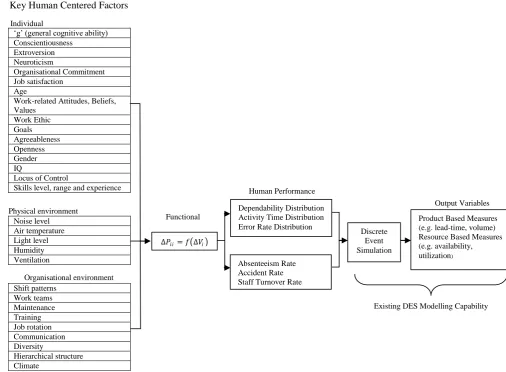
This framework as depict in Fig. 3 developed theoretically for manufacturing system designs by Baines
et al.[2]. During the process of manufacturing system design, this framework will enable human performance modeling. It is important to identify influential factors during the process of manufacturing system design as many factors can be easily and inexpensively modified. However, awareness on impact of human factors needs to be improved as previously engineer frequently overestimating how efficiently or effectively their workers will work. As the result, this framework provides basis for a modeling tool that facilitate the assessment of key human factors early in the process of manufacturing system design. An extensive review had been conducted on variety of existing theoretical frameworks and obviously simpler framework is needed with consideration on human factors.
The authors screened and identified 65 potential factors trough over 800 references. The potential factors were classified into 3 categories of key human centered factors;
a. Individual factors b. Physical environment c. Organizational environment
This is qualitative representation of manufacturing worker performance where functional relationship is at the final element of the framework. It will describe the effects on the performance measures of changes in the key variables.
IV. IMPORTANCE OF HUMAN PERFORMANCE IN
RAILWAY INDUSTRY
Among other industries, rail ergonomics become forgotten branch of transport ergonomics, where so many years rail business evolved slowly compared to others [11]. Level of awareness on importance of human factors in the railway is increasing and it is very crucial for improving system reliability and human performance as well as safety [1]. Safety has a vital impact in every aspect of researches in rail system. Every stakeholder involved directly or indirectly can impact on the safety of the network as a whole [11, 12]. Train drivers are one of the important stakeholders for ensuring safety of passengers, the train and the journey. At the same time, it is essential to the management to track their drivers‟ performance.
Performance could be indicated by assessing employees‟ workload where determination of workload plays an important role in designing and evaluating an existing man – machine system [13, 14]. Chang & Chen (2006) indicated a long-term heavy workload can affect an employee‟s physical or mental health, performance or productivity.
V. RELATED ISSUES IN RAIL HUMAN PERFORMANCE
Workload
One of the most widely debated notions in ergonomics/human factors is that of workload. There are no universally accepted definitions for workload, nor is there agreement on any one measurement approach or tool [11, 12]. Workload is principally a matter of human mental abilities, of how information is received and processed, and the decisions and measures to which this lead [15].
To say that workload has been studied so extensively in other industries there is an absence of contributions to the human factors literature on workload and the railways [11]. Pickup et al. [16] had proposed a new workload analytical and empirical assessment tools named integrated workload scale (IWS) develop and tested for signalers. IWS is a 9-point work level scale checklist differentiates by colour (colour codes run from blue for not demanding to red for work too demanding). To conduct the study every participants will undertake a scenario in accordance with the rule book, complete the IWS ratings when required and complete a short questionnaire at the end of the trial. Ratings will be showed by graphs. The graphs produced from the results show peaks and troughs in workload across the recording intervals. Participants reported that they found the tool did reflect how hard they felt they were working and gave an accurate representation of their workload.
On practical aspect to railway safety, Hamilton and Clarke [8] conducted a study based on cognitive task analysis technique to predict the human work behavior. They describe workload with respect to the conceptual three-dimensional space represent workload as time pressure, workload as cognitive demand and workload as behavioural conflicts. Results shows that drivers‟ may manage their task to avoid workload by rescheduling task and time sharing with other drivers‟. Bridger [17] use heart rate as it guidance to measure a workers workload. The research was based on the workers work capacity. He discovers that work capacity depends on the ability to take up oxygen and deliver it to the cells for use in the oxidation of foodstuffs.
Fatigue
Fig. 3: The human performance modeling theoretical framework
Dorrian et al. [21] believes that sleep loss and fatigue are becoming recognized internationally as fundamental safety problems in the rail industry. For this reason, they have investigated the performance of twenty train drivers during the influence on low, moderate and high fatigue levels at the Queensland Rail Driver Training Centre (DTC), Rockhampton. They were expecting to observe similar, clear declines in simulator driving performance from such previous research they read. It means that driving performance would show reduced efficiency with increasing fatigue. As predicted, alertness, psychomotor vigilance reaction times (PVT), extreme speed violations (25% above the limit) and penalty brake applications increased with increasing fatigue level. In contrast, fuel use, draft (stretch) forces and braking errors were highest at moderate fatigue levels. Anyway, there is in fact a substantial decrease in driving safety from the effect of fatigue [19].
While in UK, a research program conducted by Stone B [20] was undertaken to understand the risks of current shift patterns in UK train drivers and develop strategies for risk reduction and control. The main component of the programmed involved the collection of information from the drivers themselves, by means of two surveys. The first survey was a questionnaire relating principally to the drivers‟ shift patterns and attitudes to various aspects of shift work. The second survey was in the form of a diary of drivers‟ sleep and duty, which was completed over 28
consecutive duty periods. An investigation of accident risk based on the occurrence of Signals Passed at Danger (SPADs) was undertaken. In the end, they developed a guideline which they believe if implemented, would reduce the risks associated with demanding shift patterns.
Stress
Stress in its negative sense implies an imbalance between the demands of the environment and the capacity of the individual to cope, or that the individual‟s expectations exceed what is offered by the environment [15]. Although the word “stress” have become part of our nomenclature, there appears to be little consensus among researchers regarding the value of the term stress [22]. There is no single universally agreement to the definition of stress; and also no single measuring method that will tell us when a person is stressed or operating under stressful conditions. Stress is a fact of life, and stress, can have serious adverse effects of human cognition and performance [23].
In the late nineties, Margiotta [22] investigate the effect of person under train (PUT) incidents. She used a survey approach of questionnaire devised specifically for this study in order to assess the psychological responses of locomotive engineers who are involved in incidents of human injury and death cause by train they are operating. The research was conducted in the state of New York. She discovers that there would be a greater level of stress
„g‟ (general cognitive ability) Conscientiousness
Extroversion Neuroticism
Organisational Commitment Job satisfaction
Age
Work-related Attitudes, Beliefs, Values
Work Ethic Goals Agreeableness Openness Gender IQ
Locus of Control
Skills level, range and experience
Noise level Air temperature Light level Humidity Ventilation Shift patterns Work teams Maintenance Training Job rotation Communication Diversity
Hierarchical structure Climate
∆𝑃𝑖𝑗= 𝑓 ∆𝑉𝑗
Dependability Distribution Activity Time Distribution Error Rate Distribution
Absenteeism Rate Accident Rate Staff Turnover Rate
Discrete Event Simulation
Product Based Measures (e.g. lead-time, volume) Resource Based Measures (e.g. availability, utilization)
Individual
Physical environment
Organisational environment
Functional
Human Performance
Output Variables
Existing DES Modelling Capability
reported by those engineers who have had one or more PUT incidents than by those who have not had a PUT incident. Other than that, there was no difference in self-reported level of stress self-reported regards to gender or ethnicity.
Working Hours
Study on Fatigue and Shift Work in UK train drivers by Stone B [20] revealed that the duration of the shift length is a key factor leading to fatigue. The research indicates that accident rates in shift workers are 25% higher on 12-hour compared with eight-12-hour shifts. It is therefore important to restrict the amount of overtime taken at the end of a shift. Moreover, the impacts of long duty periods on fatigue are likely to be most severe on night and early morning shifts. Continuous driving time in particular, long periods of continuous duty without a break are particularly fatiguing. It is therefore important to ensure that rest breaks at appropriate times are taken in order to reduce risk. Ideally, breaks should be of at least 15 minutes duration and free from any work-related activities.
Göran Kecklund [15] stated that as far as workload is concerned, it is important to study the components of shifts over a 24-hour period. One point of particular importance is the influence of working hours on the normal circadian rhythm of wakefulness and sleep. Dahlgren [24] conducted an experiment field study in which participants were followed for one workweek with normal hours (8 hours) and one week of overtime with 4 extra hours of regular work (12 hours) without any external stress. It was only the working time that was manipulated while workload and stress was held constant. Work hours were simply extended in time and work was performed at normal pace. This was done in order to optimize the possibility of detecting effects of work hours. The results showed that one week of overtime work with a moderate level of workload was not associated with any main effect of physiological stress markers. Nevertheless, sleep was negatively affected, with shorter sleeps during overtime work, and greater problems with fatigue and sleepiness.
Sleep Behaviour
Sleepiness is defined as tendency or drive to fall asleep whereas fatigue is a vaguer concept and lack accepted definition. Generally fatigue is indicating reduce energy and passes after a resting period, whereas sleepiness passes after sleep. Sleepiness follows the circadian rhythm with low level of sleepiness during the morning and higher levels during the evening and night [24]. Studies of chronic restriction indicate that when the period of restriction is not extended beyond 5 nights, the reduction of sleep to 5–6 h per night does not typically result in waking behavioural deficits. Individuals could restrict their sleep to 4.7 h per night for up to 5 nights, or to as little as 2.9 h per night for 2 nights, before behavioral deficits occurred [25].
Stone B [20] through his discovery revealed that it is particularly important to have sufficient time between consecutive night shifts to allow for a nap before the night shift, especially when sleep after the preceding shift has been insufficient. It is therefore recommended that
there is adequate rest between shifts. A 12-hour minimum rest period is the current requirement, and if adhered to, this should be sufficient for most shift types. A rest period of 14 hours between consecutive night shifts would be desirable to allow sufficient recovery.
VI. FUTURE HUMAN PERFORMANCE IN
MALAYSIAN RAIL
UK and other Europe countries extensively conducting studies in evaluating and assessing train drivers‟ workloads, its effects and factors contributing to performance decrement (e.g. workload, fatigue, sleepiness, task analysis etc) [8], [9],[11],[12],[16],[19], [21],[26], [27].
Awareness and interest among professionals including human factors experts in Europe for human performance aspects on railway industry increased after the Ladbroke Grove accident [28]. The accident become catalyst and safety at every level and function are important as accepted by the rail industry professionals [1].
However, no research has been done regarding this issue for Malaysian train drivers, which may differ from the findings in other countries. This study will extends previous research around the globe by investigating the human performance issues in Malaysian context. Malaysia has some dissimilarity compared to UK and Europe in terms of culture and working behavior and weather, just to name few.
Based on the review of the literature, the author‟s ultimate goal is to develop performance model on Malaysian train drivers. The following measurable objectives have been defined:
a) To identify significant „performance criteria‟ of Malaysian train driver;
b) To determine factors affecting performance of the driver;
c) To develop train driver performance model. d) To validate the developed model.
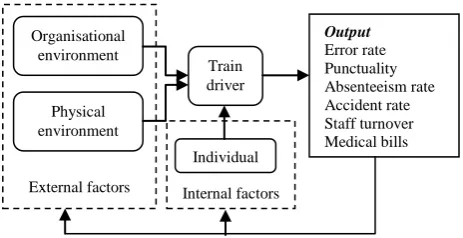
Performance model of Malaysia train driver is based on theoretical framework of human performance modeling developed by Baines et. al [2] as shown in Fig. 4. Sixty five key human centered factors which screened and identified by the author in 3 categories in manufacturing industries will be used as basic ground „affecting factors‟ to the train driver.
Fig. 4: Proposed Malaysia train driver performance model
VII.CONCLUSION
Perhaps, this study will provide practical benefits in the form of advice, recommendations, guidelines and standards emerge that can have a demonstrable effect on the efficiency, effectiveness, reliability, quality and safety of the railways [11]. The valuable data and information could be shared and provided among researches, Government of Malaysia and rail services to improve their design of workplace and tasks, train infrastructure as well as raise level of awareness among employees. It can help the company remain profitable and competitive, keeping up with the technology, and prevent employees overworked. The proposed model, approaches, methods and tools could avoid over reliance on the adaptation of those developed in different domains thus capable of increase knowledge on this field in the future.
ACKNOWLEDGEMENTS
The main author is currently on study leave at University of Malaya and supported by the Universiti Tun Hussein Onn Malaysia and Ministry of Higher Education, Malaysia. We also would like to thank Keretapi Tanah Melayu Berhad (KTMB) on their contribution and participation in this study.
REFERENCES
[1] Clarke, T., The Ergonomics Programme at Network Rail, in Rail
Human Factors: Supporting the Integrated Railway, J.R. Wilson,
et al., Editors. 2005, Ashgate. p. 19 - 21.
[2] Baines, T.S., et al., Towards a theoretical framework for human performance modelling within manufacturing systems design.
Simulation Modelling Practice and Theory, 2005. 13(6): p. 486-504.
[3] Niebel, B. and A. Freivalds, Methods, Standards and Work
Design. 10 ed. 1999: McGraw-Hill.
[4] Chang, Y.-H. and C.-H. Yeh, Human performance interfaces in
air traffic control. Applied Ergonomics, 2009. In Press,
Corrected Proof.
[5] Mason, S., et al., Improving the Design Process for Factories:
Modeling Human Performance Variation. Journal of
Manufacturing Systems, 2005. 24(1): p. 47 - 54.
[6] Gore, B.F. and J.D. Smith, Risk assessment and human performance modelling: the need for an integrated systems
approach. International Journal of Human Factors Modelling and
Simulation, 2006. 1(1): p. 119-139.
[7] Gould, K.S., et al., Effects of navigation method on workload and
performance in simulated high-speed ship navigation. Applied
Ergonomics, 2009. 40(1): p. 103-114.
[8] Hamilton, W.I. and T. Clarke, Driver performance modelling and its practical application to railway safety. Applied Ergonomics, 2005. 36(6): p. 661-670.
[9] McLeod, R.W., G.H. Walker, and N. Moray, Analysing and
modelling train driver performance. Applied Ergonomics, 2005.
36(6): p. 671-680.
[10] Foyle, D.C., et al. Human Performance Models of Pilot Behavior.
in Human Factors and Ergonomics Society 49th Annual Meeting.
2005.
[11] Wilson, J.R. and B.J. Norris, Rail human factors: Past, present
and future. Applied Ergonomics, 2005. 36(6): p. 649-660.
[12] Wilson, J.R., Interaction with virtual environments. International Journal of Human-Computer Studies, 2006. 64(3): p. 157-157. [13] Jung, H.S. and H.-S. Jung, Establishment of overall workload
assessment technique for various tasks and workplaces.
International Journal of Industrial Ergonomics, 2001. 28(6): p. 341-353.
[14] Chang, S.-Y. and T.-H. Chen, Discriminating relative workload
level by data envelopment analysis. International Journal of
Industrial Ergonomics, 2006. 36(9): p. 773-778.
[15] Göran Kecklund, T.Å., Michael Ingre and Marie Söderström Train drivers’ working conditions and their impact on safety, stress and sleepiness: a literature review, analyses of accidents and schedules, in Stress Research Report No. 288. 1999, National Institute for Psychosocial Factors and Health (IPM), Department of Public Health Sciences, Division for Psychosocial Factors and Health, Karolinska Institutet: Stockholm, Sweden.
[16] Pickup, L., et al., The Integrated Workload Scale (IWS): A new self-report tool to assess railway signaller workload. Applied Ergonomics, 2005. 36(6): p. 681-693.
[17] Bridger, R.S., Introduction to ergonomics. 1995: Mc-Graw Hill. [18] Yung-Ching Liu, T.-J.W., Ching-Heng Ho A comparison study of
fatigue effects of complex and monotonous roadway environments upon drivers' driving behavior and task performance, in A grant
report. 2005, Department of Industrial Engineering and
Management National Yunlin University of Science and Technology, Taiwan.
[19] Dorrian, J., et al., Simulated train driving: Fatigue, self-awareness
and cognitive disengagement. Applied Ergonomics, 2007. 38(2):
p. 155-166.
[20] Stone B, A.M., Mick Spencer, Claire Turner & Ann Mills, Fatigue
and shiftwork in UK train drivers. 2005, QinetiQ Centre for
Human Sciences, Farnborough,United Kingdom and Railway Safety and Standards Board London, United Kingdom.
[21] Dorrian, J., et al., The effects of fatigue on train handling during
speed restrictions. Transportation Research Part F: Traffic
Psychology and Behaviour, 2006. 9(4): p. 243-257.
[22] Margiotta, S.M., Dissertation effects of ‘person-under-train’
incidents on locomotive engineers, in Smith College School for
Social Work. 2000: Northampton.
[23] Bourne, L.a.Y., RA Stress and cognition: A cognitive psychological perspective, in Final Report National Aeronautics
and Space Administration Grant Number NAG2-1561. 2003.
[24] Dahlgren, A., Work stress and overtime work – effects on cortisol, sleep, sleepiness and health, in Department of Psychology. 2006, Stockholm University.
[25] Lamond, N., D. Darwent, and D. Dawson, Train drivers' sleep and
alertness during short relay operations. Applied Ergonomics,
2005. 36(3): p. 313-318.
[26] Luke, T., Brook-Carter,N, Parkes, AM, Grimes, E and Mills, A An investigation of train driver visual strategies. Cogn Tech Work 2006(8): p. 15–29.
[27] Makishita, H. and K. Matsunaga, Differences of drivers' reaction
times according to age and mental workload. Accident Analysis &
Prevention, 2008. 40(2): p. 567-575.
[28] Mills, A., The RSSB Human Factors Programme, in Rail Human Factors: Supporting the Integrated Railway, J.R. Wilson, et al., Editors. 2005, Ashgate. p. 13 - 18.
Organisational environment
Physical environment
Train driver
Individual
Output