Abstract—Design of hip prosthesis is believed to be an important factor to minimize the aseptic loosening problems and to encourage long term stability. The numerous changes in the cemented femoral stem design have been intended to improve the long term performance of the implants, although have had other negative consequences. In this study, a finite element model of the implanted proximal femur to examine stresses behaviors in cemented hip arthroplasty with different tapered design of prosthesis. The calculated stress distribution is discussed with respect to stress shielding and bone remodeling issues in THR femur case. The taper of the prosthesis were design to be 3° at anterior/posterior, 3° at medial/lateral and 10° from wide lateral to narrow medial. Two different load cases representing walking (toe-off phase) and stair-climbing activities are investigated. Proper stress and strain distribution along the femur will enhance bone growth and keep the femur to function as normal as intact femur.
Index Terms— aseptic loosening, hip arthroplasty, stem tapers, stress shielding.
I. INTRODUCTION
Cemented hip arthroplasty become popular since it was introduced by John Charnley in 1972. The long-term clinical follow-up studies have demonstrated outstanding performance of Charnley’s prosthesis. However, the challenge of aseptic loosening of prosthesis remains, frequently reported in young and active patients. It is due to heavy mechanical demands on their reconstructed joints. The design of hip prosthesis is believed to be an important factor to minimize the aseptic loosening problems and to encourage long term stability. Aseptic loosening may occurred due to biomechanical factors such as osteolysis induced by wear debris of bone cement, cement mantle fracture, and poor bone remodeling triggered by stress shielding [1-2].
Nowadays, the Charnley prosthesis is still the most commonly implant used and is regarded as the reference designs. A large number of long term clinical follow up
Manuscript received December 21, 2009. This work was financially supported by the Universiti Teknologi MARA Malaysia.
A.H. Abdullah is with the Faculty of Mechanical Engineering, Universiti
Teknologi MARA, 40450 Shah Alam, MALAYSIA (phone:
603-5543-6468; fax: 603-5543-5160; e-mail: [email protected]). M.N. Mohd Asri is with the Faculty of Mechanical Engineering, Universiti Teknologi MARA, 40450 Shah Alam, MALAYSIA (e-mail: [email protected]).
M.S. Alias is with the Faculty of Mechanical Engineering, Universiti Teknologi MARA, 40450 Shah Alam, MALAYSIA (e-mail: [email protected]).
T. Giha is with the Mechanical Engineering Department, Politeknik Sultan Salahuddin Abdul Aziz Shah, Ministry of Higher Education, 40150 Shah Alam, MALAYSIA (e-mail: [email protected]).
studies have shown that the Charnley prosthesis, especially its femoral component with polished surface finish, has greatly performed. Its also became a main references of evolutionary in new designs of femoral stem. For example, more than a hundred different type of prosthesis were used in Sweden from 1967 to 1990 [3]. The numerous changes in the cemented femoral stem design have been intended to improve the long term performance of the implants, although have had other negative consequences. In many cases, in attempting to solve on particular problem, another problem has inadvertently been introduced [4].
Revolutionary of prosthesis design continues with improvement of Charnley prosthesis with taper in the anterior/posterior plane and it was known as Charnley’s Flatback. Later in early 1970s, Robin Ling designed a double tapered prosthesis which identically had a second taper in medial/lateral plane [5]. The prosthesis was highly polished, collarless, and stainless steel was also known as Exeter prosthesis. It is reported that it was successfully reduced aseptic loosening problems after 21 years follow-up period [4]. In conjunction to the successor of prosthesis design, Wroblewski has design and implanted a collarless, polished and triple tapered prosthesis since early 1990s. Results at 5 years suggested that the theoretical benefits of the stem are being realized clinically [5]. The modifications were keep established by improving different designs and parameters such as taper stems, stem sizes, materials used and surface roughness. Every modified parameter is believed to improve overall performance but it may also contribute to others failure.
The aim of this study was to use a finite element model of the implanted proximal femur to examine stresses behaviors in cemented hip arthroplasty with different tapered design of prosthesis. The calculated stress distribution is discussed with respect to stress shielding and bone remodeling issues in THR femur cases.
II. FINITE ELEMENT MODEL
Finite element (FE) model of the intact femur was reconstructed from a normal healthy bone dataset [6]. The model was reconstructed and rigorously examined for the biomechanics responses to physiological loads. Since the top-half region of the femur is of particular interest, only this part was considered in the analysis. The femur model was discretized into 44,714 elements using ten-node quadratic tetrahedron elements. Similar femur geometry was modified to represents THR femur cases with Charnley’s prosthesis. Effects of different types of taper prosthesis on the resulting
Finite Element Analysis of Cemented Hip
Arthroplasty: Influence of Stem Tapers
stresses were considered using two additional FE models. Different prosthesis geometry is illustrated in Figure 1 which represent single taper, double taper and triple taper prosthesis while straight prosthesis as reference. The taper of the prosthesis were design to be 3° at anterior/posterior, 3° at medial/lateral and 10° from wide lateral to narrow medial. All the model were discretized into 31 490, 35 819, 42 475 and 42 838 elements for straight, single taper, double taper and triple taper THR model, respectively. A uniform thin layer (1 mm) of PMMA bone cement fills the interface between the prosthesis and the bone. All contact surfaces were assumed to be perfectly bonded. All models were design based on original Charnley prosthesis which differs at taper bar only.
(a) (b)
(c) (d)
Figure 1. Different designs of prosthesis (a) straight, (b) single taper, (c) double taper and (d) triple taper
A. Materials Properties
The bone is assumed to consist of the cortical or hard shell and cancellous or spongy core. The prosthesis is made of Ti-6Al-4V alloy while the bone cement is polymethyl-methacrylate (PMMA). Elastic moduli and Poisson ratios of these materials are shown in Table 1 [1,7]. All materials were assumed to behave elastically throughout the loading.
TABLE I. MECHANICAL PROPERTY OF MATERIALS USED IN FE MODEL
Mechanical Property E (GPa) ν
Cortical bone 17 0.33
Cancellous bone 1.5 0.33
Ti-6Al-4V 110 0.30
PMMA 2 0.33
B. Loading and Boundary Conditions
[image:2.612.87.279.206.526.2]Two different load cases representing walking (toe-off phase) and stair-climbing activities are investigated. These loads represent combination of joint contact forces and muscles forces that are equilibrated by the forces in the knee joint [8]. Cartesian force components from various active muscles are listed in Table 2 for the two activities of walking and stair-climbing. These values are derived from previous work involving in-vitro tests of hip joints for a person with nominal body weight of 800 N [9,10]. The corresponding loads are applied at various points on the model while the middle section of the femur (plane 1-2) is assumed to be a fixed end of the model, as illustrated in Figure 2. Such assumed boundary condition will introduced high stresses in the locality.
Figure 2. Idealized loading points representing active muscle forces and
boundary condition
TABLE II. LOCATION AND MAGNITUDE OF HIP JOINT CONTACT AND
MUSCLES FORCES DURING (A) WALKING AND (B) STAIR- CLIMBING ACTIVITY
(BODY WEIGHT =800N)
(a) Walking (Toe-off phase) Point
Forces (N) X Y Z
P0 Joint contact force -433,8 -263,8 -1841,3
Abductor 465,9 34,5 695
Tensor fascia lata,
proximal part 57,8 93,2 106
Tensor fascia lata, P1
distal part -4 -5,6 -152,6
P2 Vastus Lateralis -7,2 148,6 -746,3
Point (b) Stair-climbing
Forces (N) X Y Z
P0 Joint contact force -476,4 -486,8 -1898,3
Abductor 563,1 231,4 682,1
Ilio-tibial tract, P1
proximal part 84,4 -24,1 102,8
[image:2.612.382.488.234.451.2]Ilio-tibial tract,
distal part -4 -6,4 -135,0
Tensor fascia lata,
proximal part 24,9 39,4 23,3
Tensor fascia lata,
distal part -1,6 -2,4 -52,2
P2 Vastus Lateralis -17,7 180 -1085,3 P3 Vastus Medialis -70,7 318,1 -2145,8
III. RESULT & DISCUSSION
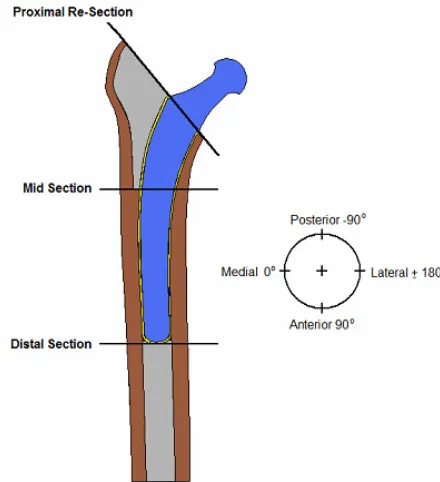
[image:3.612.69.302.46.158.2]Results of the analysis are presented and discussed in terms of Tresca stress distribution and maximum principal stress. Three different levels in each model are focused that are (1) the proximal resection level, (2) the midsection and (3) the distal level of prosthesis as in Figure 3. All respected level represents optimum results due to bending stress effects. The stress analyses are plotted for cortical surfaces and interfaces during walking (toe-off phase) and stair-climbing load cases.
Figure 3. Different respective level of THR femur
A. Variation of Tresca Stress Distribution
[image:3.612.322.549.53.255.2]Both walking and stair climbing load cases experienced similar trends of stress distribution along the cortical bone. Figure 4 shows the stress distribution along the intact femur which represents the normal stress distributed under walking and stair climbing activities. Basically, the trends of stress distribution quiet similar on both loading and magnitude of stress in stair climbing remain higher. Higher stresses are predicted for stair-climbing load case which is subjected to additional forces from ilio-tibial tract and vastus medialis muscles.
[image:3.612.81.301.265.506.2](a) walking (b) stair climbing
Figure 4. Tresca stress distribution in intact femur under different loading
Implantation of hip prosthesis causes the load transfer and stress state within the treated femur to be altered [11]. Different types of prosthesis will give different results. Taper prosthesis is believed to give the most similar trends as intact femur and capable to reduce stress shielding problem. Contour plots as illustrated in Figure 5 and Figure 6 shows the results of THR femur in different prosthesis in walking and stair climbing load cases, respectively. Triple taper prosthesis experienced the highest Tresca stress as compared to the others. For straight and single taper prosthesis, the stress was concentrated at the neck of the prosthesis. But, there were different for double and triple prosthesis. The stress was high and concentrated to the distal of the prosthesis. This phenomenon will decreased the load transfer at the medial region of the cortical. Hence, it will encourage the prosthesis to fail and then triggered loosening especially at the distal of prosthesis. The taper prosthesis was failed to transfer the load to cortical bone. Furthermore, it s only encouraged stress shielding and bone resorption problems.
B. Maximum Principal Stress Distribution
(a) straight (b) single taper (c) double taper (d) triple taper
Figure 5. Tresca stress distribution in THR femur for different types of prosthesis at walking load case
(a) straight (b) single taper (c) double taper (d) triple taper
Figure 6. Tresca stress distribution in THR femur for different types of prosthesis at stair climbing load case
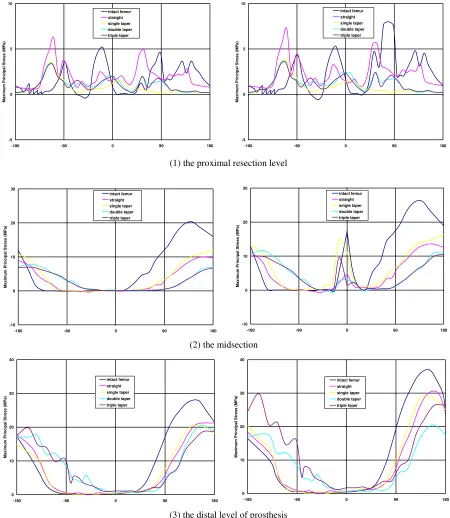
The low stress at the most proximal region especially at the medial aspect explains why clinical results always report extensive bone resorption at that corresponding area [12]. This phenomenon is known as stress shielding effect, where that particular femur region is not being stressed properly. Consequently, it will become weak and therefore fracture easily. Bone loss is identified as the major reason of stem loosening. Such mechanical failure will also cause pain on the patient [13]. The results shows that the stress difference between intact femur and THR femur in the proximal region were higher in taper prosthesis. The different in straight prosthesis was only 25pct but it became higher in taper prosthesis. Double and triple taper prosthesis increased the difference up to 50-60 pct. These results were remains similar for both loading cases.
The midsection (2) level or vicinity of the start of the tapered stem region shows the critical difference. The difference in proximal resection (1) level was not too obvious while distal prosthesis (3) level focused on stress concentration due to bending stress.
Distal region shows quiet similar results with higher stress in all THR femurs. The high stress will leads to bone thickening at that region. Both bone loss and bone thickening phenomenon happen due to the different stiffness of the implant compared to the intact femur that causes stiffness mismatch [13]. The implant which is much stiffer than bone carries the majority of the load. Therefore, the load will be transferred down along the implant until the distal tip of the stem. Then, only that it will being highly transferred to the cortical bone.
[image:4.612.89.550.284.479.2](1) the proximal resection level
(2) the midsection
[image:5.612.82.532.51.569.2](3) the distal level of prosthesis
Figure 7. Variation of maximum principal stresses in cortical surface at different level for walking load case (left) and stair climbing (right)
Based on the results, taper prosthesis was not a good solution to reduce stress shielding problems in proximal region but also make it worst. In conjunction, it will also encourage the aseptic loosening and instability of the prosthesis. These results were contrast with some other findings. Wroblewski has designed a collarless, polished, triple-tapered stem which based on laboratory result; the stem has shown superior axial and torsional initial and final stability when compared with other taper stems. Theoretically, taper prosthesis wills minimizes friction at the cement-implant interface, and allows for the axial load to be converted by the tapers into radial compressive forces that
load the entire femur. Besides, it is also capable to maintain proximal bone quality and avoid the stress shielding that inevitably occurs in all forms of femoral stem fixation [5].
The contrast results between this study and others researchers may due to different prosthesis models. In this study, all prosthesis was modeled based on original Charnley prosthesis and the only different is the different taper bar to avoid other parameter infections. Unlike other studies that used different models of taper prosthesis in their analysis. This models differs in few parameter such as sizes, neck section and else. For examples, Charnley flatback is commonly used for single taper analysis, while Exeter and C-stem used for double and triple taper, respectively.
0 10 20 30 40
-180 -90 0 90 180
M a x im u m P ri n c ip a l S tr e s s ( M P a ) intact femur straight single taper double taper triple taper -10 0 10 20 30
-180 -90 0 90 180
M a x im u m P ri n c ip a l S tr e s s ( M P a ) intact femur straight single taper double taper triple taper -5 0 5 10
-180 -90 0 90 180
M a x im u m P ri n c ip a l S tr e s s ( M P a ) intact femur straight single taper double taper triple taper -5 0 5 10
-180 -90 0 90 180
M a x im u m P ri n c ip a l S tr e s s ( M P a ) intact femur straight single taper double taper triple taper -10 0 10 20 30
-180 -90 0 90 180
M a x im u m P ri n c ip a l S tr e s s ( M P a ) intact femur straight single taper double taper triple taper 0 10 20 30 40
-180 -90 0 90 180
Different approach of certain design may need a total change to get better results. In this case, different design is needed in order to build up better taper prosthesis. Taper design of prosthesis may give better results on correlations with other approaches.
IV. CONCLUSION
Proper stress and strain distribution along the femur will enhance bone growth and keep the femur to function as normal as intact femur. The design of the prosthesis plays a big role in order to reduce stress shielding problems. Taper prosthesis is not a promise to enhance stem stability and to reduce aseptic loosening.
ACKNOWLEDGMENT
The authors would like to thank all colleagues that somehow contributed to this work especially to Prof. Mohd Nasir Tamin (CSMLab, Universiti Teknologi Malaysia). Financial support was provided by Universiti Teknologi MARA Malaysia.
REFERENCES
[1] N.A. Ramaniraka, L.R. Rakotomanana, and P.F. Leyvraz, “The
Fixation of The Cemented Femoral Component: Effects of Stem Stiffness, Cement Thickness and Roughness of the Cement-Bone Surface,” The Journal of Bone and Joint Surgery, vol. 82-b, no. 2, 2000.
[2] E.L. Masterson, C.A. Busch, C.P. Duncan and K. Drabu, “Impaction
allografting of the proximal femur using a Charnley-type stem: A cement mantle analysis,” The Journal of Arthroplasty, vol 14, no. 1, 1999, pp. 59-63.
[3] H. Malchau, P. Herberts and L. Ahnieit, “Prognosis of total hip replacement in Sweden: Follow-up of 9267.5 operations performed 1978-1990,” Acta Orthop Scand, vol. 64, 1993, pp. 497-506. [4] Z. Lu, Finite Element Analysis of the Effects of Stem Geometry,
Surface Finish and Cement Viscoelasticity on Debonding and Subsidence of Total Hip Prosthesis, PhD thesis, Faculty of the Graduate School, University of Southern California, 2001.
[5] A.I. Spitzer, “The Triple-Tapered Stem: The Evolution of The Next Generation of Cemented Total Hip Arthroplasty,” Orthopaedic Technology Review, vol. 3, no. 4, 2001.
[6] Abdul Halim Abdullah, Mohd Asri Mohd Nor and Alias Mohd Saman,
“Stress and Strain Distribution in Cemented Total Hip Arthroplasty for Walking Load Case,” Proc. Int. Conference on Computer Technology and Development (ICCTD 09), Nov. 2009.
[7] D.T. Reilly, A.H. Burrstein, and V.H. Frankel, “The Elastic Modulus
for Bone,” Journal of Biomechanics, vol. 7, 1974.
[8] P. Kowlczyk, “Design optimization of cementless femoral hip
prostheses using finite element analysis,” Journal of Biomechanical Engineering, vol. 123, 2001, pp. 396-402.
[9] B. Mahaisavariya, K. Sitthiseripratip, and J. Suwanprateeb, “Finite Element Study of the Proximal Femur with Retained Trochanteric Gamma Nail and After Removal of Nail,” Int. J. Care Injured, vol. 37, 2006.
[10] M. Morlock, E. Schneider, A. Bluhm, M. Vollmer, G. Bergmann, V.
Muller and M. Honl, “Duration and frequency of everyday activities in total hip patients,” Journal of Biomechanics, vol. 34, 2001, pp. 873-881.
[11] N. Goetzen, “Loadshift-Numerical Evaluation of a New Design
Philosophy for Uncemented Hip Prosthesis,” Proc. 10th Annual
Symposium on Computational Methods in Orthopaedic
Biomechanics, 2002.
[12] C.J. Sychterz and C.A. Engh, “The Influence of Clinical Factors on Periprosthetic Bone Remodeling,” Clinical Orthopaedics and Related Research, 1996, pp. 285-292.
[13] R.D. Jamison, “Fabrication and Characterization of a Composite
Material Human Hip Prosthesis,” Proc. The Third Joint ASCE/ASME Mechanics Conference, 1989.