Proceedings of the 2007 Joint Conference on Empirical Methods in Natural Language Processing and Computational
Large Margin Synchronous Generation
and its Application to Sentence Compression
Trevor Cohn and Mirella Lapata
School of Informatics University of Edinburgh Edinburgh, United Kingdom
{tcohn,mlap}@inf.ed.ac.uk
Abstract
This paper presents a tree-to-tree transduc-tion method for text rewriting. Our model is based on synchronous tree substitution grammar, a formalism that allows local dis-tortion of the tree topology and can thus naturally capture structural mismatches. We describe an algorithm for decoding in this framework and show how the model can be trained discriminatively within a large margin framework. Experimental results on sentence compression bring significant im-provements over a state-of-the-art model.
1 Introduction
Recent years have witnessed increasing interest in text-to-text generation methods for many natural language processing applications ranging from text summarisation to question answering and machine translation. At the heart of these methods lies the ability to perform rewriting operations according to a set of prespecified constraints. For example, text simplification identifies which phrases or sentences in a document will pose reading difficulty for a given user and substitutes them with simpler alternatives (Carroll et al., 1999). Sentence compression pro-duces a summary of a single sentence that retains the most important information while remaining gram-matical (Jing, 2000).
Ideally, we would like a text-to-text rewriting sys-tem that is not application specific. Given a parallel corpus of training examples, we should be able to learn rewrite rules and how to combine them in order to generate new text. A great deal of previous work has focused on the rule induction problem (Barzilay
and McKeown, 2001; Pang et al., 2003; Lin and Pan-tel, 2001; Shinyama et al., 2002), whereas relatively little emphasis has been placed on the actual gen-eration task (Quirk et al., 2004). A notable excep-tion is sentence compression for which end-to-end rewriting systems are commonly developed (Knight and Marcu, 2002; Turner and Charniak, 2005; Gal-ley and McKeown, 2007; Riezler et al., 2003; Mc-Donald, 2006). The appeal of this task lies in its simplified formulation as a single rewrite operation, namely word deletion (Knight and Marcu, 2002).
Solutions to the compression task have been cast mostly in a supervised learning setting (but see Clarke and Lapata (2006a), Hori and Furui (2004), and Turner and Charniak (2005) for unsupervised methods). Rewrite rules are learnt from a parsed parallel corpus and subsequently used to find the best compression from the set of all possible com-pressions for a given sentence. A common assump-tion is that the tree structures representing long sen-tences and their compressions areisomorphic. Con-sequently, the models are not generally applicable to other text rewriting problems since they cannot readily handle structural mismatches and more com-plex rewriting operations such as substitutions or insertions. A related issue is that the tree structure of the compressed sentences is often poor; most al-gorithms delete words or constituents without pay-ing too much attention to the structure of the com-pressed sentence. However, without an explicit gen-eration mechanism that allows tree transformations, there is no guarantee that the compressions will have well-formed syntactic structures. And it will not be easy to process them for subsequent generation or analysis tasks.
In this paper we present a text-to-text rewriting
model that scales tonon-isomorphiccases and can thus naturally account for structural and lexical di-vergences. Our approach is inspired bysynchronous
tree substitution grammar (STSG, Eisner (2003))
a formalism that allows local distortion of the tree topology. We show how such a grammar can be in-duced from a parallel corpus and propose a large margin model for the rewriting task which can be viewed as a weighted tree-to-tree transducer. Our learning framework makes use of the algorithm put forward by Tsochantaridis et al. (2005) which ef-ficiently learns a prediction function to minimise a given loss function. Experiments on sentence com-pression show significant improvements over the state-of-the-art. Beyond sentence compression and related text-to-text generation problems (e.g., para-phrasing), our model is generally applicable to tasks involving structural mapping. Examples include ma-chine translation (Eisner, 2003) or semantic parsing (Zettlemoyer and Collins, 2005).
2 Related Work
Knight and Marcu (2002) proposed a noisy-channel formulation of sentence compression based on syn-chronous context-free grammar (SCFG). The lat-ter is a generalisation of the context-free grammar (CFG) formalism to simultaneously produce strings in two languages. In the case of sentence compres-sion, the grammar rules have two right hand sides, one corresponding to thesource(long) sentence and the other to itstargetcompression. The synchronous derivations are learnt from a parallel corpus and their probabilities are estimated generatively.
Given a long sentence, l, the aim is to find the corresponding compressed sentence,s, which max-imises P(s)P(l|s) (here P(s) is the source model andP(l|s)the channel model.) Modifications of this model are reported in Turner and Charniak (2005) and Galley and McKeown (2007) with improved re-sults. The channel model is limited to tree deletion and does not allow any type of tree re-organisation.
Non-isomorphic tree structures are common when translating between languages. It is therefore not surprising that most previous work on tree rewrit-ing falls within the realm of machine translation. Proposals include Eisner’s (2003) synchronous tree substitution grammar (STSG), Melamed’s (2004)
multitext grammar, and Graehl and Knight’s (2004) tree-to-tree transducers. Despite differences in for-malism, all these approaches model the translation process using tree-based probabilistic transduction rules. The grammar induction process requires EM training which can be computationally expensive es-pecially if all synchronous rules are considered.
Our work formulates sentence compression in the framework of STSG (Eisner, 2003). We propose a novel grammar induction algorithm that does not require EM training and is coupled with a sepa-rate large margin training process (Tsochantaridis et al., 2005) for weighting each rule. McDonald (2006) also presents a sentence compression model that uses a discriminative large margin algorithm. However, we differ in two important respects. First, our generation algorithm is more powerful, perform-ing complex tree transformations, whereas McDon-ald only considers simple word deletion. Being tree-based, the generation algorithm is better able to pre-serve the grammaticality of the compressed output. Second, our model can be tuned to a wider range of loss functions (e.g.,tree-based measures).
3 Problem Formulation
We formulate sentence compression as an instance of the general problem of learning a mapping from input patterns x∈
X
to discrete structured objectsy∈
Y
. Our training sample consists of a parallel corpus of input (uncompressed) and output (com-pressed) pairs (x1,y1). . .(xn,yn)∈X
×Y
and our task is to predict a target labelled tree y from a source labelled tree x. As we describe below, y is not precisely a target tree, but instead derivations which generate both the source and the target tree. We model the dependency between x and y as a weighted STSG. Grammar rules are of the form hX,Yi → hγ,α,βi where γ and α are elementarytrees composed of a mixture of terminal and
non-terminals rooted with non-non-terminalsXandY respec-tively, and β is a set of variable correspondences
between pairs of frontier non-terminals in γandα.
A grammar rule specifies that we can substitute the treesγandαfor correspondingXandY nodes in the
source and target trees respectively. For example, the rule:
allows adjective phrases to be dropped from the source tree within an NP. The indices x are used to
specify the variable correspondences,β.
Each grammar rule has a score from which the overall score of a compression y for sentence x
can be derived. These scores are learnt discrimina-tively using the large margin technique proposed by Tsochantaridis et al. (2005). The synchronous rules are combined using a chart-based parsing algorithm (Eisner, 2003) to generate the derivation (i.e., com-pressed tree) with the highest score.
We begin by describing our STSG generation al-gorithm in Section 3.1. We next explain how a syn-chronous grammar is induced from a parallel corpus of original sentences and their compressions (Sec-tion 3.2) and give the details of our learning frame-work (Section 3.3).
3.1 Generation
Generation aims to find the best target tree for a given source tree using the transformations specified by the synchronous grammar. (We discuss how we obtain this grammar in the following section.)
y∗=max
y∈Y score(x,y;w) (1)
whereyranges over all target derivations (and there-fore trees), wis a parameter vector and score(·) is an objective function measuring the quality of the derivation. In common with many parsing methods, we encounter a problem with spurious ambiguity: i.e., there may be many derivations (sequences of rule applications) which produce the same target tree. Ideally we would sum up the scores over all these derivations, however for the sake of tractability we instead take the maximum score. This allows us to pose the maximisation problem over derivations
rather than target trees.
The generation algorithm uses a dynamic pro-gram defined over the constituents in the source tree as shown in Figure 1 (see also Eisner (2003)). The algorithm makes the assumption that the scor-ing function decomposes with the derivation, such that a partial score can be evaluated at each step, i.e., score(x,y;w) = ∑r∈yscore(r;w) where r are the rules used in the derivation. This method builds
a chart of the best scoring partial derivation for
each source subtree headed by a given target non-terminal. The inductive step is applied recursively
1: for allnodes,n, in source tree (bottom-up)do
2: for allrules,rwith left side matching node,nr=ndo 3: s=score(r)
4: for allvariablesvinrdo 5: score=score+chart[nv,cv]
6: end for
7: updatechart[n,cr]with score,s, if better than current 8: end for
9: end for
10: cbest=argmaxcchart[root,c]
[image:3.612.349.506.260.346.2]11: find best derivation using back-pointers from(root,cbest)
Figure 1: Generation algorithm to find the best derivation.nr andnv are the source nodes indexed by the rule’s source side (root and variable), while
crandcvare the non-terminal categories of the rule’s target side (root and variable).
is very good and includes ... AUX RB JJ CC
VP
VP
ADJP
VP
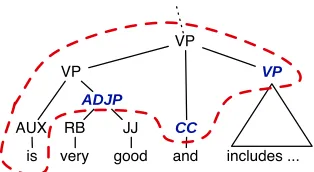
Figure 2: Example of a rule application during gen-eration. The dashed area shows a matching rule for theV Pnode.
bottom-up, and involves applying a grammar rule to a node in the source tree. Rules with substitution variables in their frontier are scored with reference to the chart for the matching nodes and target non-terminal categories. Once the process is complete, we can read the best score from the chart cell for the root node, and the best derivation can be constructed by traversingback-pointersalso stored in the chart. This is illustrated in Figure 2 where the rule
hV P,V Pi → h[[isAU XADJP1]V PCC V P]V P,[isAU XNP1]V Pi is
applied to the topV Pnode. The score of the result-ing tree would reference the chart to calculate the score for the best target tree at theADJPnode with syntactic categoryNP.
3.2 Grammar Induction
ex-tracts tree pairs from word aligned text by choos-ing aligned constituents in the source and the tar-get. These pairs are then generalised using subtrees which are also extracted, resulting in synchronous rules with variable nodes. The set of aligned tree pairs are extracted using the alignment template method (Och and Ney, 2004), constrained to syntac-tic constituent pairs:
C
={(nS,nT),(∃(s,t)∈A
∧s∈Y(nS)∧t∈Y(nT))∧(@(s,t)∈
A
∧(s∈Y(nS)Yt∈Y(nT)))}where nS and nT are source and target tree nodes (subtrees),
A
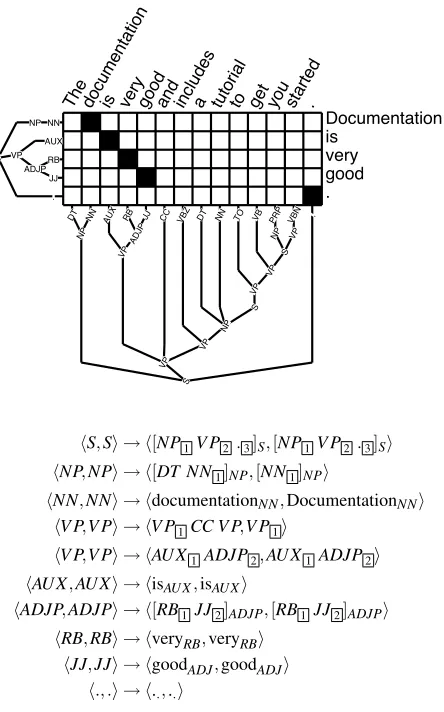
={(s,t)}is the set of word alignments (pairs of word-indices),Y(·)returns the yield span for a subtree andYis the exclusive-or operator.The next step is to generalise the candidate pairs by replacing subtrees with variable nodes. We could fully trust the word alignments and adopt a strat-egy in which the rules are generalised as much as possible and thus include little lexicalisation. Fig-ure 3 shows a simple sentence pair and the result-ing synchronous rules accordresult-ing to this generalisa-tion strategy. Alternatively, we could extract every possible rule by including unlexicalised rules, lexi-calised rules and their combination. The downside here is that the total number of possible rules is fac-torial in the size of the candidate set. We address this problem by limiting the number of variables and the recursion depth, and by filtering out singleton rules. There is no guarantee that the induced rules will generalise well to a testing set. For example, the test-ing data may have a rule which was not seen in the training set (e.g., a new terminal or non terminal). In this case no rule can be applied and subsequently generation fails. For this reason we allow the model to duplicate any CFG production from the source tree, and uses a feature to flag that this rule was un-seen in training. These SCFG rules are then merged with the induced rules and fed into the feature detec-tion module (see Secdetec-tion 3.3 for details).
3.3 The Large Margin Model
We now describe how the parameters of our STSG generation system are fit to a supervised training set. For a given source tree, the space of sister target trees implied by the synchronous grammar is often very large, and the majority of these trees are
un-The documentationis very goodand includesa tutorialto get you started.
Documentation is
very good .
S
.
VP VP
NP S VP
VP S
VP VBN NP PRP VB TO NN DT VBZ CC
VP ADJP
JJ RB AUX NP
NN DT S
. VP
ADJP JJ RB AUX NP NN
hS,Si → h[NP1V P2 .3]S,[NP1V P2 .3]Si hNP,NPi → h[DT NN1]NP,[NN1]NPi
hNN,NNi → hdocumentationNN,DocumentationNNi hV P,V Pi → hV P1CC V P,V P1i
hV P,V Pi → hAU X1 ADJP2,AU X1 ADJP2i hAU X,AU Xi → hisAU X,isAU Xi
hADJP,ADJPi → h[RB1JJ2]ADJP,[RB1 JJ2]ADJPi hRB,RBi → hveryRB,veryRBi
[image:4.612.317.539.58.414.2]hJJ,JJi → hgoodADJ,goodADJi h., .i → h..,..i
Figure 3: Induced synchronous grammar from a sen-tence pair using a strategy that extracts general rules.
grammatical or are poor compressions. The train-ing procedure learns weights such that the model can discriminate between these trees and predict a good target tree. For this we develop a discriminative training process which learns a weighted tree-to-tree transducer. Our model is based on Tsochantaridis et al.’s (2005) framework for learning Support Vector Machines (SVMs) with structured output spaces, us-ing the SVMstruct implementation.1We briefly sum-marise the approach below; for a more detailed de-scription we refer the interested reader to Tsochan-taridis et al. (2005).
Traditionally SVMs learn a linear classifier that separates two or more classes with the largest pos-sible margin. Analogously, structured SVMs at-tempt to separate the correct structure from all other
structures with a large margin. Given an input in-stancex, we search for the optimum outputyunder the assumption that x andy can be adequately de-scribed using a combined feature vector representa-tionΨ(x,y). Recall thatxare the source trees andy
are synchronous derivations which generate bothx
and a target tree.
f(x;w) =argmax y∈Y
hw,Ψ(x,y)i (2)
The goal of the training procedure is to find a param-eter vectorwsuch that it satisfies the condition:
∀i,∀y∈
Y
\yi:hw,Ψ(xi,yi)−Ψ(xi,y)i ≥0 (3)wherexi,yi are the ith training source tree and tar-get derivation. To obtain a unique solution — there will be several parameter vectors w satisfying (3) if the training instances are linearly separable — Tsochantaridis et al. (2005) select the wthat max-imises the minimum distance between yi and the closest runner-up structure.
The framework also incorporates a loss function. This property is particularly appealing in the context of sentence compression and generally text-to-text generation. For example, a compression that differs from the gold standard with respect to one or two words should be treated differently from a compres-sion that bears no resemblance to it. Another impor-tant factor is the length of the compression. Com-pressions whose length is similar to the gold stan-dard should be be preferable to longer or shorter output. A loss function∆(yi,y)quantifies the accu-racy of predictiony with respect to the true output value yi. We give details of the loss functions we employed for the compression task below.
We are now ready to state the learning objective for the structured SVM. We use the soft-margin for-mulation which allows errors in the training set, via the slack variablesξi:
min w,ξ
1 2||w||
2+C
n
n
∑
i=1ξi,ξi≥0 (4)
∀i,∀y∈
Y
\yi:hw,δΨ(y)i ≥1− ξi ∆(yi,y)Slack variablesξiare introduced here for each train-ing example xi, C is a constant that controls the trade-off between training error minimisation and
margin maximisation, andδΨ(y)is a shorthand for Ψ(xi,yi)−Ψ(xi,y) (see (3)). Note that slack vari-ables are rescaled with the inverse loss incurred in each of the linear constraints.2
The optimisation problem in (4) is approximated using a polynomial time cutting plane algorithm (Tsochantaridis et al., 2005). This optimisation cru-cially relies on finding the constraint incurring the maximum cost. The cost function for slack rescaling can be formulated as:
H(y) = (1− hδΨi(y),wi)∆(yi,y) (5)
In order to adapt this framework to our genera-tion problem, we must provide the feature map-ping Ψ(x,y), a loss function ∆(yi,y), and a max-imiser ˆy=argmaxy∈YH(y)(see (5)). The following sections describe how these are instantiated in the sentence compression task.
Feature Mapping We devised a general feature set suitable for compression and paraphrasing. Our feature space is defined over source trees (x) and target derivations (y). All features apply to a single grammar rule; a feature vector for a derivation is ex-pressed as the sum of the feature vectors for each rule in this derivation.
We make use of syntactic, lexical, and com-pression specific features. Our simplest syntac-tic feature is the identity of a synchronous rule. Specifically, we record its source tree, its target tree and their combination. We also include rule frequencies φ(target|source), φ(source|target) and
φ(source,target). Another feature records the
fre-quencies of the CFG productions used in the tar-get side of a rule. This allows the model to learn the weights of a CFG generation grammar, as a proxy for a language model. Using scores from a pre-trained CFG grammar or an n-gram language model might be preferable when the training sample is small, however we leave this as future work. Our last syntactic feature keeps track of the source root and the target root non-terminals. Our lexical fea-tures contain the list of tokens in the source yield, target yield, and both. We also use words as features.
2Alternatively, the loss function can be used to rescale the
Finally, we have implemented a set of compression-specific features. These include a feature that detects if the yield of the target side of a synchronous rule is a subset of the yield of its source. We also take note of the edit operations (i.e., removal, insertion) required to transform the source side into the target. Edit operations are recorded separately for trees and their yields. In order to encourage compression, we also count the number of words on the target, the number of rules used in the derivation and the number of dropped variables.
Loss Functions The large margin configuration sketched above is quite modular and in theory a wide range of loss functions could be specified. Examples include edit-distance, precision, F-score, BLEU and tree-based measures. In practice, the loss function should be compatible with our maximisation algo-rithm which requires the objective function to de-compose along the same lines as the tree derivation.3 Given this restriction, we define a loss based on position-independent unigram precision (Prec) which penalises errors in the yield independently for each word. Although fairly intuitive, this loss is far from ideal. First, it maximally rewards re-peatedly predicting the same word if the latter is in the reference target tree. Secondly, it may bias towards overly short output which drops core in-formation — one-word compressions will tend to have higher precision than longer output. To coun-teract this, we introduce two brevity penalty mea-sures (BP) inspired by BLEU (Papineni et al., 2002) which we incorporate into the loss function, using a product,loss=1−Prec·BP:
BP1=exp(1−max(1,r
c)) (6)
BP2=exp(1−max(c r,
r c))
whereris the reference length andcis the candidate length.
BP1 is asymmetric, it has value one when c≥r
and decays to zero whenc<r. Note that precision should decay whenc>r as extra output will often not match the reference. BP2 is two-sided: it has
3Optimising non-decompositional loss functions
compli-cates the objective function, which then cannot be solved ef-ficiently using a dynamic program.
value one when c=r and decays towards zero for
c<r and c>r. In both cases, brevity is assessed against the gold standard target (not the source) to allow the system to learn the correct degree of com-pression from the training data.
Maximisation Algorithm Our algorithm finds the maximising derivation forH(y)in (5). This deriva-tion will have a high loss and a high score under the model, and therefore represents the most-violated constraint which is then added to the SVM’s work-ing set of constraints (see (4)).
The standard generation method from Section 3.1 cannot be used without modification to find the best scoring derivation since it does not account for the loss function or the gold standard derivation. In-stead, westratifythe generation chart with the num-ber of true and false positive tokens predicted, as de-scribed in Joachims (2005). These contingency val-ues allow us to compute the precision and brevity penalty (see (6)) for each complete derivation. This is then combined with the derivation score and the gold standard derivation score to giveH(y).
The gold standard derivation features, Ψ(xi,yi), must be calculated from a derivation linking the source tree to the gold target tree. As there may be many such derivations, we find aunique deriva-tion using the smallest rules possible (for maximum generality). This is done using a dynamic program, similar to the inside-outside algorithm used in pars-ing. Other strategies are also possible, however we leave this to future work. Finally, we can find the global maximum H(y) by maximising over all the root chart entries.
4 Evaluation Set-up
In this section we present our experimental set-up for assessing the performance of the max margin model described above. We give details of the cor-pora used, briefly introduce McDonald’s (2006) sen-tence compression model used for comparison with our approach, and explain how system output was evaluated.
Ziff-Davis corpus. Previous compression work has al-most exclusively used this corpus. Our experiments follow Knight and Marcu’s partition of training, test, and development sets (1,002/36/12 instances). We also present results on Clarke and Lapata’s (2006a) Broadcast News corpus.4 This corpus was created manually (annotators were asked to produce com-pressions for 50 Broadcast news stories) and poses more of a challenge than Ziff-Davis. Being a speech corpus, it often contains incomplete and ungram-matical utterances and speech artefacts such as dis-fluencies, false starts and hesitations. Furthermore, spoken utterances have varying lengths, some are very wordy whereas others cannot be reduced any further. Thus a hypothetical compression system trained on this domain should be able to leave some sentences uncompressed. Again we used Clarke and Lapata’s training, test, and development set split (882/410/78 instances).
Comparison with State-of-the-art We evaluated our approach against McDonald’s (2006) discrimi-native model. This model is a good basis for compar-ison for several reasons. First, it achieves compet-itive performance with Knight and Marcu’s (2002) decision tree and noisy channel models. Second, it also uses large margin learning. Sentence compres-sion is formulated as a string-to-substring mapping problem with a deletion-based Hamming loss. Re-call that our formulation involves a tree-to-tree map-ping. Third, it uses a feature space complementary to ours. For example features are defined between ad-jacent words, and syntactic evidence is incorporated indirectly into the model. In contrast our model re-lies on synchronous rules to generate valid compres-sions and does not explicitly incorporate adjacency features. We used an implementation of McDonald (2006) for comparison of results (Clarke and Lapata, 2007).
Evaluation Measures In line with previous work we assessed our model’s output by eliciting hu-man judgements. Participants were presented with an original sentence and its compression and asked to rate the latter on a five point scale based on the in-formation retained and its grammaticality. We con-ducted two separate elicitation studies, one for the
4The corpus can be downloaded fromhttp://homepages.
inf.ed.ac.uk/s0460084/data/.
O: I just wish my parents and my other teachers could be like this teacher, so we could communicate. M: I wish my teachers could be like this teacher. S: I wish my teachers could be like this, so we could
communicate.
G: I wish my parents and other teachers could be like this, so we could communicate.
O: Earlier this week, in a conference call with analysts, the bank said it boosted credit card reserves by $350 million.
M: Earlier said credit card reserves by $350 million. S: In a conference call with analysts, the bank boosted
card reserves by $350 million.
[image:7.612.315.525.59.212.2]G: In a conference call with analysts the bank said it boosted credit card reserves by $350 million.
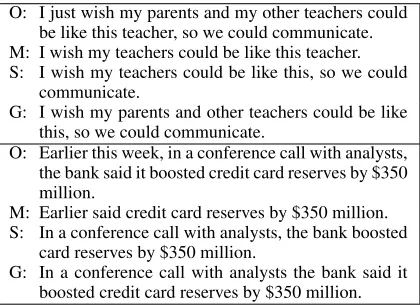
Table 1: Compression examples from the Broadcast news corpus (O: original sentence, M: McDonald (2006), S: STSG, G: gold standard)
Ziff-Davis and one for the Broadcast news dataset. In both cases our materials consisted of 96 source-target sentences. These included gold standard com-pressions and the output of our system and Mc-Donald’s (2006). We were able to obtain ratings on the entire Ziff-Davis test set as it has only 32 in-stances; this was not possible for Broadcast news as the test section consists of 410 instances. Conse-quently, we randomly selected 32 source-target sen-tences to match the size of the Ziff-Davis test set.5 We collected ratings from 60 unpaid volunteers, all self reported native English speakers. Both studies were conducted over the Internet. Examples of our experimental items are given in Table 1.
We also report results using F1 computed over grammatical relations (Riezler et al., 2003). We chose F1 (as opposed to accuracy or edit distance-based measures) as Clarke and Lapata (2006b) show that it correlates reliably with human judgements.
5 Experiments
The framework presented in Section 3 is quite flex-ible. Depending on the grammar induction strategy, choice of features, loss function and maximisation algorithm, different classes of models can be de-rived. Before presenting our results in detail we dis-cuss the specific model employed in our experiments and explain how its parameters were instantiated.
In order to build a compression model we need
5A Latin square design ensured that subjects did not see two
60 65 70 75 80 85
45
50
55
60
compression rate
F1
● ●
●
●
[image:8.612.74.285.58.210.2]Prec Prec.BP1 Prec.BP2
Figure 4: Compression rate vs. grammatical rela-tions F1 using unigram precision alone and in com-bination with two brevity penalties.
a parallel corpus of syntax trees. We obtained syn-tactic analyses for source and target sentences with Bikel’s (2002) parser. Our corpora were automat-ically aligned with Giza++ (Och et al., 1999) in both directions between source and target and sym-metrised using the intersection heuristic (Koehn et al., 2003). Each word in the lexicon was also aligned with itself. This was necessary in order to inform Giza++ about word identity. Unparseable sentences and those longer than 50 tokens were removed from the data set.
We induced a synchronous tree substitution gram-mar from the Ziff-Davis and Broadcast news cor-pora using the method described in Section 3.2. We extracted all maximally general synchronous rules. These were complemented with more specific rules from conjoining pairs of general rules. The specific rules were pruned to remove singletons and those rules with more than 3 variables. Grammar rules were represented by the features described in Sec-tion 3.3.
An important parameter for our compression task is the appropriate choice of loss function. Ideally, we would like a loss function that encourages compres-sion without overly aggressive information loss. Fig-ure 4 plots compression rate against grammatical re-lations F1 using each of the loss functions presented in Section 3.3 on the Ziff-Davis development set.6 As can be seen with unigram precision alone (Prec)
6We obtained a similar plot for the Broadcast News corpus
but omit it due to lack of space.
Ziff-Davis CompR RelF1
McDonald06 66.2 45.8
STSG 56.8 54.3
Gold standard 57.2 —
Broadcast News CompR RelF1
McDonald06 68.6 47.6
STSG 73.7 53.4∗
[image:8.612.340.512.59.190.2]Gold standard 76.1 —
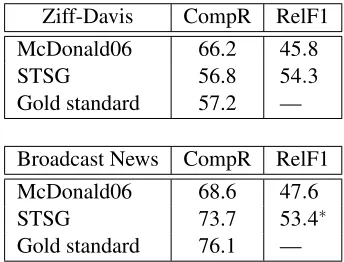
Table 2: Results using grammatical relations F1 (∗: sig. diff. from McDonald06; p<0.01 using the Studentttest)
the system produces overly short output, whereas the one-sided brevity penalty (BP1) achieves the op-posite effect. The two-sided brevity penalty (BP2) seems to strike the right balance: it encourages com-pression while achieving good F-scores. This sug-gests that important information is retained in spite of significant compression. We also varied the regu-larisation parameterC(see (4)) over a range of val-ues on the development set and found that setting it to 0.01 yields overall good performance across cor-pora and loss functions.
We now present our results on the test set. These were obtained with a model that uses slack rescal-ing and a precision-based loss function with a two-sided brevity penalty (C=0.01). Table 2 shows the average compression rates (CompR) for McDonald (2006) and our model (STSG) as well as their perfor-mance according to grammatical relations F1. The row ‘Gold standard’ displays human-produced pression rates. Notice that our model obtains com-pression rates similar to the gold standard, whereas McDonald tends to compress less on Ziff-Davis and more on Broadcast news. As far as F1 is concerned, we see that STSG outperforms McDonald on both corpora. The difference in F1 is statistically signifi-cant on Broadcast news but not on Ziff-Davis (which consists solely of 32 sentences).
Model Ziff-Davis Broadcast news
McDonald06 2.82† 2.16†
STSG 3.20†∗ 2.63∗
[image:9.612.80.292.60.119.2]Gold standard 3.72 3.05
Table 3: Mean ratings on compression output elicited by humans (∗: sig. diff. from McDon-ald06 (α<0.05); † sig. diff. from Gold standard
(α<0.01); using post-hoc Tukey tests)
examine whether the mean ratings for each sys-tem differed significantly. The Tukey tests showed that STSG is perceived as significantly better than McDonald06. There is no significant difference be-tween STSG and the gold standard compressions on the Broadcast news; both systems are significantly worse than the gold standard on Ziff-Davis.
These results are encouraging, indicating that our highly expressive framework is a good model for sentence compression. Under several experimental conditions we obtain better performance than previ-ous work. Importantly, the model described here is not compression-specific, it could be easily adapted to other tasks, corpora or languages (for which syntactic analysis tools are available). Being su-pervised, our model learns to fit the compression rate of the training data. In this sense, it is some-what inflexible as it cannot easily adapt to a spe-cific rate given by a user or imposed by an appli-cation (e.g.,when displaying text on small screens). Compression rate can be indirectly manipulated by adopting loss functions that encourage or discourage compression (see Figure 4), but admittedly in other frameworks (e.g., Clarke and Lapata (2006a)) the length of the compression can be influenced more naturally.
In our formulation of the compression problem, a derivation is characterised by a single inventory of features. This entails that the feature space can-not in principle distinguish between derivations that use the same rules, applied in a different order. Al-though, this situation does not arise often in our dataset, we believe that it can be ameliorated by in-tersecting a language model with our generation al-gorithm (Chiang, 2005).
6 Conclusions and Future Work
In this paper we have presented a novel method for sentence compression cast in the framework of structured learning. We develop a system that gener-ates compressions using a synchronous tree substi-tution grammar whose weights are discriminatively trained within a large margin model. We also de-scribe an appropriate algorithm than can be used in both training (i.e., learning the model weights) and decoding (i.e., finding the most plausible compres-sion under the model). The proposed formulation al-lows us to capture rewriting operations that go be-yond word deletion and can be easily tuned to spe-cific loss functions directly related to the problem at hand. We empirically evaluate our approach against a state-of-the art model (McDonald, 2006) and show performance gains on two compression corpora.
Future research will follow three directions. First, we will extend the framework to incorporate po-sition dependent loss functions. Examples include the Hamming distance or more sophisticated func-tions that take the tree structure of the source and target sentences into account. Such functions can be supported by augmenting our generation algo-rithm with a beam search. Secondly, the present pa-per used a relatively simple feature set. Our inten-tion was to examine our model’s performance with-out extensive feature engineering. Nevertheless, im-provements should be possible by incorporating fea-tures defined overn-grams and dependencies (Mc-Donald, 2006). Finally, the experiments presented in this work use a grammar acquired from the train-ing corpus. However, there is nothtrain-ing inherent in our formalisation that restricts us to this particular gram-mar. We therefore plan to investigate the potential of our method with unsupervised or semi-supervised grammar induction techniques for additional rewrit-ing tasks includrewrit-ing paraphrase generation and ma-chine translation.
References
R. Barzilay, K. McKeown. 2001. Extracting paraphrases from a parallel corpus. InProceedings of ACL/EACL, 50–57, Toulouse, France.
D. Bikel. 2002. Design of a multi-lingual, parallel-processing statistical parsing engine. InProceedings of HLT, 24–27, San Diego, CA.
J. Carroll, G. Minnen, D. Pearce, Y. Canning, S. Devlin, J. Tait. 1999. Simplifying text for language impaired readers. InProceedings of EACL, 269–270, Bergen, Norway.
D. Chiang. 2005. A hierarchical phrase-based model for statistical machine translation. InProceedings of the 43rd ACL, 263–270, Ann Arbor, MI.
J. Clarke, M. Lapata. 2006a. Constraint-based sentence compression: An integer programming approach. In
Proceedings of COLING/ACL Main Conference Poster Sessions, 144–151, Sydney, Australia.
J. Clarke, M. Lapata. 2006b. Models for sentence com-pression: A comparison across domains, training re-quirements and evaluation measures. InProceedings of COLING/ACL, 377–384, Sydney, Australia.
J. Clarke, M. Lapata. 2007. Modelling compression with discourse constraints. InProceedings of EMNLP-CoNLL, Prague, Czech Republic.
J. Eisner. 2003. Learning non-isomorphic tree mappings for machine translation. In Proceedings of the ACL Interactive Poster/Demonstration Sessions, 205–208, Sapporo, Japan.
M. Galley, K. McKeown. 2007. Lexicalized Markov grammars for sentence compression. InProceedings of NAACL/HLT, 180–187, Rochester, NY.
J. Grael, K. Knight. 2004. Training tree transducers. In
Proceedings of NAACL/HLT, 105–112, Boston, MA.
C. Hori, S. Furui. 2004. Speech summarization: an ap-proach through word extraction and a method for eval-uation. IEICE Transactions on Information and Sys-tems, E87-D(1):15–25.
H. Jing. 2000. Sentence reduction for automatic text summarization. In Proceedings of ANLP, 310–315, Seattle, WA.
T. Joachims. 2005. A support vector method for mul-tivariate performance measures. In Proceedings of ICML, 377–384, Bonn, Germany.
K. Knight, D. Marcu. 2002. Summarization beyond sen-tence extraction: a probabilistic approach to sensen-tence compression. Artificial Intelligence, 139(1):91–107.
P. Koehn, F. J. Och, D. Marcu. 2003. Statistical phrase-based translation. InProceedings of HLT/NAACL, 48– 54, Edmonton, Canada.
D. Lin, P. Pantel. 2001. Discovery of inference rules for question answering. Natural Language Engineering, 7(4):342–360.
R. McDonald. 2006. Discriminative sentence compres-sion with soft syntactic constraints. InProceedings of EACL, 297–304, Trento, Italy.
I. D. Melamed. 2004. Statistical machine translation by parsing. InProceedings of ACL, 653–660, Barcelona, Spain.
F. J. Och, H. Ney. 2004. The alignment template ap-proach to statistical machine translation. Computa-tional Linguistics, 30(4):417–449.
F. J. Och, C. Tillmann, H. Ney. 1999. Improved align-ment models for statistical machine translation. In
Proceedings of EMNLP/VLC, 20–28, College Park, MD.
B. Pang, K. Knight, D. Marcu. 2003. Syntax-based alignment of multiple translations: Extracting para-phrases and generating new sentences. InProceedings of NAACL, 181–188, Edmonton, Canada.
K. Papineni, S. Roukos, T. Ward, W.-J. Zhu. 2002. BLEU: a method for automatic evaluation of ma-chine translation. In Proceedings of ACL, 311–318, Philadelphia, PA.
C. Quirk, C. Brockett, W. Dolan. 2004. Monolingual machine translation for paraphrase generation. In Pro-ceedings of EMNLP, 142–149, Barcelona, Spain.
S. Riezler, T. H. King, R. Crouch, A. Zaenen. 2003. Sta-tistical sentence condensation using ambiguity pack-ing and stochastic disambiguation methods for lexical-functional grammar. InProceedings of HLT/NAACL, 118–125, Edmonton, Canada.
Y. Shinyama, S. Sekine, K. Sudo, R. Grishman. 2002. Automatic paraphrase acquisition from news articles. InProceedings of HLT, 40–46, San Diego, CA.
I. Tsochantaridis, T. Joachims, T. Hofmann, Y. Altun. 2005. Large margin methods for structured and in-terdependent output variables. Journal of Machine Learning Research, 6:1453–1484.
J. Turner, E. Charniak. 2005. Supervised and unsuper-vised learning for sentence compression. In Proceed-ings of ACL, 290–297, Ann Arbor, MI.