Semantic Role Recognition using Kernels on Weighted Marked Ordered
Labeled Trees
Jun’ichi Kazama and Kentaro Torisawa
Japan Advanced Institute of Science and Technology (JAIST) Asahidai 1-1, Nomi, Ishikawa, 923-1292 Japan
{kazama, torisawa}@jaist.ac.jp
Abstract
We present a method for recognizing se-mantic role arguments using a kernel on weighted marked ordered labeled trees
(the WMOLT kernel). We extend the
kernels on marked ordered labeled trees (Kazama and Torisawa, 2005) so that the mark can be weighted according to its
im-portance. We improve the accuracy by
giving more weights on subtrees that con-tain the predicate and the argument nodes with this ability. Although Kazama and Torisawa (2005) presented fast training with tree kernels, the slow classification during runtime remained to be solved. In this paper, we give a solution that uses an efficient DP updating procedure applica-ble in argument recognition. We demon-strate that the WMOLT kernel improves the accuracy, and our speed-up method makes the recognition more than 40 times faster than the naive classification.
1 Introduction
Semantic role labeling (SRL) is a task that recog-nizes the arguments of a predicate (verb) in a sen-tence and assigns the correct role to each argument. As this task is recognized as an important step after (or the last step of) syntactic analysis, many stud-ies have been conducted to achieve accurate seman-tic role labeling (Gildea and Jurafsky, 2002; Mos-chitti, 2004; Hacioglu et al., 2004; Punyakanok et al., 2004; Pradhan et al., 2005a; Pradhan et al., 2005b; Toutanova et al., 2005).
Most of the studies have focused on machine learning because of the availability of standard datasets, such as PropBank (Kingsbury and Palmer, 2002). Naturally, the usefulness of parse trees in
this task can be anticipated. For example, the recent CoNLL 2005 shared task (Carreras and M`arquez, 2005) provided parse trees for use and their useful-ness was ensured. Most of the methods heuristically extract features from parse trees, and from other sources, and use them in machine learning methods based on feature vector representation. As a result, these methods depend on feature engineering, which is time-consuming.
Tree kernels (Collins and Duffy, 2001; Kashima and Koyanagi, 2002) have been proposed to directly handle trees in kernel-based methods, such as SVMs (Vapnik, 1995). Tree kernels calculate the similar-ity between trees, taking into consideration all of the subtrees, and, therefore there is no need for such fea-ture engineering.
Moschitti and Bejan (2004) extensively studied tree kernels for semantic role labeling. However, they reported that they could not successfully build an accurate argument recognizer, although the role assignment was improved. Although Moschitti et al. (2005) reported on argument recognition using tree kernels, it was a preliminary evaluation because they used oracle parse trees.
Kazama and Torisawa (2005) proposed a new tree kernel for node relation labeling, as which SRL can be cast. This kernel is defined on marked ordered la-beled trees, where a node can have a mark to indicate the existence of a relation. We refer to this kernel as the MOLT kernel. Compared to (Moschitti and Bejan, 2004) where tree fragments are heuristically extracted before applying tree kernels, the MOLT kernel is general and desirable since it does not re-quire such fragment extraction. However, the eval-uation conducted by Kazama and Torisawa (2005) was limited to preliminary experiments for role as-signment. In this study, we first evaluated the per-formance of the MOLT kernel for argument recogni-tion, and found that the MOLT kernel cannot achieve a high accuracy if used in its original form.
a cat
I saw in the park
DT NN
PRP VBD IN DT NN NP
S NP VP
NP PP (a)
a cat
I saw in the park
DT NN
PRP VBD IN DT NN
NP S
NP VP
NP PP
(b)
a cat
I saw in the park
DT NN
PRP VBD IN DT NN NP
S NP VP
NP PP (c)
a cat
I saw in the park DT NN
PRP VBD IN DT NN
NP S
NP VP
NP PP
(a')
*0 *1
Figure 1: (a)-(c): Argument recognition as node relation recognition. (a’): relation (a) represented as marked ordered tree.
Therefore, in this paper we propose a modifica-tion of the MOLT kernel, which greatly improves the accuracy. The problem with the original MOLT kernel is that it treats subtrees with one mark, i.e., those including only the argument or the predicate node, and subtrees with two marks, i.e., those in-cluding both the argument and the predicate nodes equally, although the latter is likely to be more im-portant for distinguishing difficult arguments. Thus, we modified the MOLT kernel so that the marks can be weighted in order to give large weights to the sub-trees with many marks. We call the modified kernel
the WMOLT kernel (the kernel onweighted marked
ordered labeled trees). We show that this modifica-tion greatly improves the accuracy when the weights for marks are properly tuned.
One of the issues that arises when using tree ker-nels is time complexity. In general, tree kerker-nels can
be calculated inO(|T1||T2|) time, where|Ti|is the
number of nodes in treeTi, using dynamic
program-ming (DP) procedures (Collins and Duffy, 2001; Kashima and Koyanagi, 2002). However, this cost is not negligible in practice. Kazama and Torisawa (2005) proposed a method that drastically speeds up the calculation during training by converting trees into efficient vectors using a tree mining algorithm. However, the slow classification during runtime re-mained an open problem.
We propose a method for speeding up the runtime classification for argument recognition. In argument recognition, we determine whether a node is an ar-gument or not for all the nodes in a tree . This requires a series of calculations between a support vector tree and a tree with slightly different mark-ing. By exploiting this property, we can efficiently update DP cells to obtain the kernel value with less computational cost.
In the experiments, we demonstrated that the WMOLT kernel drastically improved the accuracy
and that our speed-up method enabled more than 40 times faster argument recognition. Despite these successes, the performance of our current system is
F1 = 78.22on the CoNLL 2005 evaluation set when
using the Charniak parse trees, which is far worse than the state-of-the-art system. We will present possible reasons and future directions.
2 Semantic Role Labeling
Semantic role labeling (SRL) recognizes the argu-ments of a given predicate and assigns the correct role to each argument. For example, the sentence “I saw a cat in the park” will be labeled as follows with respect to the predicate “see”.
[A0 I] [V saw] [A1 a cat] [AM-LOC in the park]
In the example, A0, A1, and AM-LOC are the roles
assigned to the arguments. In the CoNLL 2005
dataset, there are the numbered arguments (AX)
whose semantics are predicate dependent, the
ad-juncts (AM-X), and the references (R-X) for
rel-ative clauses.
Many previous studies employed two-step SRL methods, where (1) we first recognize the argu-ments, and then (2) classify the argument to the cor-rect role. We also assume this two-step processing and focus on the argument recognition.
[image:2.612.76.535.65.128.2]Since the task is the classification of trees with node relations, tree kernels for usual ordered la-beled trees, such as those proposed by Collins and Duffy (2001) and Kashima and Koyanagi (2002), are not useful. Kazama and Torisawa (2005) pro-posed to represent a node relation in a tree as a marked ordered labeled tree and presented a kernel for it (MOLT kernel). We adopted the MOLT kernel and extend it for accurate argument recognition.
3 Kernels for Argument Recognition
3.1 Kernel-based classification
Kernel-based methods, such as support vector ma-chines (SVMs) (Vapnik, 1995), consider a mapping
Φ(x) that maps the object x into a, (usually
high-dimensional), feature space and learn a classifier in
this space. A kernel functionK(xi, xj)is a function
that calculates the inner product 〈Φ(xi),Φ(xj)〉 in
the feature space without explicitly computingΦ(x),
which is sometimes intractable. Then, any classifier that is represented by using only the inner products between the vectors in a feature space can be re-written using the kernel function. For example, an SVM classifier has the form:
f(x) =∑ i
αiK(xi, x) +b,
where αi and b are the parameters learned in the
training. With kernel-based methods, we can con-struct a powerful classifier in a high-dimensional
feature space. In addition, objects x do not need
to be vectors as long as a kernel function is defined
(e.g.,xcan be strings, trees, or graphs).
3.2 MOLT kernel
A marked ordered labeled tree (Kazama and Tori-sawa, 2005) is an ordered labeled tree in which each node can have a mark in addition to a label. We can
encode ak-node relation by usingkdistinct marks.
In this study, we determine an argument node with-out considering other arguments of the same pred-icate, i.e., we represent an argument relation as a two-node relation using two marks. For example, the relation (a) in Figure 1 can be represented as the
marked ordered labeled tree (a’).1
1
[image:3.612.324.538.79.226.2]Note that we use mark *0 for the predicate node and mark *1 for the argument node.
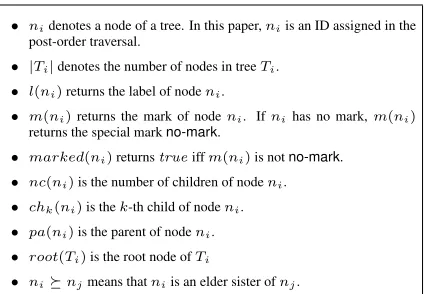
Table 1: Notations for MOLT kernel.
• nidenotes a node of a tree. In this paper,niis an ID assigned in the
post-order traversal.
• |Ti|denotes the number of nodes in treeTi.
• l(ni)returns the label of nodeni.
• m(ni)returns the mark of nodeni. Ifnihas no mark,m(ni)
returns the special markno-mark.
• marked(ni)returnstrueiffm(ni)is notno-mark.
• nc(ni)is the number of children of nodeni.
• chk(ni)is thek-th child of nodeni.
• pa(ni)is the parent of nodeni.
• root(Ti)is the root node ofTi
• ni≽njmeans thatniis an elder sister ofnj.
Kazama and Torisawa (2005) presented a kernel on marked ordered trees (the MOLT kernel), which
is defined as:2
K(T1, T2) = E ∑
i=1
W(Si)·#Si(T1)·#Si(T2),
where Si is a possible subtree and #Si(Tj) is
the number of times Si is included in Tj. The
mapping corresponding to this kernel is Φ(T) =
(√W(S1)#S1(T),· · · , √
W(SE)#SE(T)), which
maps the tree into the feature space of all the possi-ble subtrees.
The tree inclusion is defined in many ways. For example, Kashima and Koyanagi (2002) presented the following type of inclusion.
1 DEFINITION S is included inT iff there exists a
one-to-one function ψ from a node of S to a node of T, such that (i) pa(ψ(ni)) = ψ(pa(ni)), (ii) ψ(ni) ≽ ψ(nj) iffni ≽ nj, , and (iii)l(ψ(ni)) = l(ni)(andm(ψ(ni)) =m(ni)in the MOLT kernel).
See Table 1 for the meaning of each function. This definition means that any subtrees preserving the parent-child relation, the sibling relation, and label-marks, are allowed. In this paper, we employ this definition, since Kazama and Torisawa (2005) re-ported that the MOLT kernel with this definition has a higher accuracy than one with the definition pre-sented by Collins and Duffy (2001).
W(Si) is the weight of subtree Si. The
weight-ing in Kazama and Torisawa (2005) is written as
fol-2
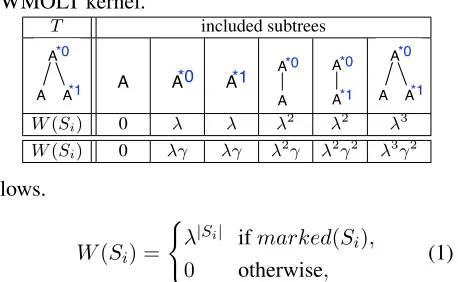
Table 2: Example of subtree inclusion and sub-tree weights. The last row shows the weights for WMOLT kernel.
T included subtrees
W(Si) 0 λ λ λ2 λ2 λ3 W(Si) 0 λγ λγ λ2γ λ2γ2 λ3γ2
lows.
W(Si) = {
λ|Si| ifmarked(Si),
0 otherwise, (1)
wheremarked(Si)returns trueiffmarked(ni) =
truefor at least one node in treeSi. By this
weight-ing, only the subtrees with at least one mark are con-sidered. The idea behind this is that subtrees having no marks are not useful for relation recognition or
labeling.λ(0≤λ≤1) is a factor to prevent the
ker-nel values from becoming too large, which has been used in previous studies (Collins and Duffy, 2001; Kashima and Koyanagi, 2002).
Table 2 shows an example of subtree inclusion and the weights given to each included subtree. Note that the subtrees are treated differently when the markings are different, even if the labels are the same.
Although the dimension of the feature space is exponential, tree kernels can be calculated in
O(|T1||T2|)time using dynamic programming (DP)
procedures (Collins and Duffy, 2001; Kashima and Koyanagi, 2002). The MOLT kernel also has an
O(|T1||T2|) DP procedure (Kazama and Torisawa,
2005).
3.3 WMOLT kernel
Although Kazama and Torisawa (2005) evaluated the MOLT kernel for SRL, the evaluation was only on the role assignment task and was preliminary. We evaluated the MOLT kernel for argument recogni-tion, and found that the MOLT kernel cannot achieve a high accuracy for argument recognition.
The problem is that the MOLT kernel treats sub-trees with one mark and subsub-trees with two marks equally, although the latter seems to be more impor-tant in distinguishing difficult arguments.
Consider the sentence, “He said industry should
build plants”. For “say”, we have the following la-beling.
[A0 He] [V said] [A1 industry should build plants]
On the other hand, for “build”, we have
He said [A0 industry] [AM-MOD should] [V build] [A1 plants].
As can be seen, “he” is the A0 argument of “say”, but not an argument of “build”. Thus, our classifier should return a +1 for the tree where “he” is marked when the predicate is “say”, and a -1 when the pred-icate is “build”. Although the subtrees around the node for “say” and “build” are different, the subtrees around the node for “he” are identical for both cases. If “he” is often the A0 argument in the corpus, it is likely that the classifier returns a +1 even for “build”. Although the subtrees containing both the predicate and the argument nodes are considered in the MOLT kernel, they are given relatively small weights by Eq. (1), since such subtrees are large.
Thus, we modify the MOLT kernel so that the mark can be weighted according to its importance and the more marks the subtrees contain, the more weights they get. The modification is simple. We
change the definition ofW(Si)as follows.
W(Si) = {
λ|Si|∏ni∈S
iγ(m(ni)) ifmarked(Si),
0 otherwise,
where γ(m) (≥ 1) is the weight of mark m. We
call a kernel with this weight the WMOLT kernel.
In this study, we assume γ(no-mark) = 1 and
γ(*0) = γ(*1) = γ. Then, the weight is
simpli-fied as follows.
W(Si) = {
λ|Si|γ#m(Si) ifmarked(S
i),
0 otherwise,
where #m(Si) is the number of marked nodes in
Si. The last row in Table 2 shows how the subtree
weights change by introducing this mark weighting.
For the WMOLT kernel, we can derive
O(|T1||T2|) DP procedure by slightly
modify-ing the procedure presented by Kazama and
Torisawa (2005). The method for speeding up
Algorithm 3.1: WMOLT-KERNEL(T1, T2)
forn1←1to|T1|do // nodes are ordered by the post-order traversal
m←marked(n1)
forn2←1to|T2|do // actually iterate only onn2withl(n1) =l(n2)
(A) 8 > > > > > > > > > > > > > > > > > > > > < > > > > > > > > > > > > > > > > > > > > :
ifl(n1)̸=l(n2)orm(n1)̸=m(n2)then
C(n1, n2)←0 Cr(n1, n2)←0 else ifn1andn2are leaf nodesthen
ifm thenC(n1, n2)←λ·γ; Cr(n1, n2)←λ·γ elseC(n1, n2)←λ; Cr(n1, n2)←0 else
S(0, j)←1, S(i,0)←1 (i∈[0, nc(n1)], j∈[0, nc(n2)])
ifm then Sr(0, j)←1, Sr(i,0)←1 else Sr(0, j)←0, Sr(i,0)←0
fori←1tonc(n1)do forj←1tonc(n2)do
S(i, j)←S(i−1, j) +S(i, j−1)−S(i−1, j−1) +S(i−1, j−1)·C(chi(n1), chj(n2))
Sr(i, j)←Sr(i−1, j) +Sr(i, j−1)−Sr(i−1, j−1) +Sr(i−1, j−1)·C(chi(n1), chj(n2))
+S(i−1, j−1)·Cr(chi(n
1), chj(n2))−Sr(i−1, j−1)·Cr(chi(n1), chj(n2)) ifm thenC(n1, n2)←λ·γ·S(nc(n1), nc(n2)) elseC(n1, n2)←λ·S(nc(n1), nc(n2)) ifm thenCr(n
1, n2)←λ·γ·Sr(nc(n1), nc(n2)) elseCr(n1, n2)←λ·Sr(nc(n1), nc(n2)) return(P|T1|
n1=1 P|T2|
n2=1C
r
(n1, n2))
We describe this DP procedure in some detail. The key is the use of two DP matrices of size
|T1| × |T2|. The first isC(n1, n2)defined as:
C(n1, n2)≡PSiW
′(Si)·#
Si(T1△n1)·#Si(T2△n2),
where#Si(Tj △nk)represents the number of times
subtreeSiis included in treeTj withψ(root(Si)) =
nk. W′(Si) is defined as W′(Si) = λ|Si|γ#m(Si).
This means that this matrix records the values that
ignore whether marked(Si) = true or not. The
second isCr(n1, n2)defined as:
Cr(n1, n2)≡PSiW(Si)·#Si(T1△n1)·#Si(T2△n2).
With these matrices, the kernel is calculated as:
K(T1, T2) = ∑
n1∈T1 ∑
n2∈T2
Cr(n1, n2).
C(n1, n2) and Cr(n1, n2) are calculated
recur-sively, starting from the leaves of the trees. The re-cursive procedure is shown in Algorithm 3.1. See also Table 1 for the meaning of the functions used.
4 Fast Argument Recognition
We use the SVMs for the classifiers in argument recognition in this study and describe the fast
clas-sification method based on SVMs.3 We denote a
marked ordered labeled tree where node nk of an
ordered labeled treeU is marked by markX,nlby
Y, and so on, byU@{nk =X, nl=Y, . . .}.
3
The method can be applied to a wide range of kernel-based methods that have the same structure as SVMs.
Algorithm 4.1: CALCULATE-T(U, Tj)
procedureFAST-UPDATE(nk) diff ←0, m(nk)←*1, U ←φ
forn2←1to|Tj|dochange(n2)← true
n1←nk
while8 n1̸=nildo
> > > > > > > > > > > > > > > > < > > > > > > > > > > > > > > > > :
forn2←1to|Tj|do
// actually iterate only onn2withl(pa(n1)) =l(n2)
nchange(n2)← false forn2←1to|Tj|do
// actually iterate only onn2withl(n1) =l(n2) ifchange(n2)then
pre←Cr(n1, n2), U ← U ∪(n1, n2) updateC(n1, n2)andCr(n1, n2)
using (A) of Algorithm 3.1
diff + = (Cr(n1, n2)−pre)
ifpa(n2)̸=nil thennchange(pa(n2))← true
n1←pa(n1), change←nchange for(n1, n2)∈ Udo//restore DP cells
C(n1, n2)←C′(n1, n2), Cr(n1, n2)←Cr′(n1, n2)
m(nk)←no-mark
return(diff)
main
m(nv)← ∗0, k←WMOLT-KERNEL(U, Tj)
C′(n1, n2)←C(n1, n2), Cr′(n1, n2)←Cr(n1, n2) fornk←1to|U|do (nk̸=nv)
diff ←FAST-UPDATE(nk), t(nk)←k+diff
Given a sentence represented by tree U and the
node for the target predicatenv, the argument
recog-nition requires the calculation of:
s(nk) = ∑
Tj∈SV
αjK(U@{nv=*0, nk=*1}, Tj)+b,
(2)
for all nk ∈ U (̸= nv), where SV represents the
support vectors. Naively, this requires O(|U| ×
However, if we exploit the fact that U@{nv =
*0, nk=*1}is different fromU@{nv=*0}at one
node, we can greatly speed up the above calculation.
At first, we calculate K(U@{nv =*0}, Tj) using
the DP procedure presented in the previous section,
and then calculate K(U@{nv =*0, nk=*1}, Tj)
using a more efficient DP that updates only the val-ues of the necessary DP cells of the first DP. More specifically, we only need to update the DP cells
in-volving the ancestor nodes ofnk.
Here we show the procedure for calculating
t(nk) = K(U@{nv = *0, nk = *1}, Tj) for all
nk for a given support vector Tj, which will
suf-fice for calculatings(nk). Algorithm 4.1 shows the
procedure. For each nk, this procedure updates at
most(nk’s depth)× |Tj|cells, which is much less
than |U| × |Tj| cells. In addition, when updating
the cells for(n1, n2), we only need to update them
when the cells for any child ofn2have been updated
in the calculation of the cells for the children ofn1.
To achieve this,change(n2)in the algorithm stores
whether the cells of any child ofn2 have been
up-dated. This technique will also reduce the number of updated cells.
5 Non-overlapping Constraint
Finally, in argument recognition, there is a strong constraint that the arguments for a given predicate do not overlap each other. To enforce this constraint, we employ the approach presented by Toutanova et al. (2005). Given the local classification
proba-bility p(nk = Xk) (Xk ∈ {ARG,NO-ARG}),
this method finds the assignment that maximizes
∏
kp(nk = Xk) while satisfying the above
non-overlapping constraint, by using a dynamic pro-gramming procedure. Since the output of SVMs is not a probability value, in this study we obtain the probability value by converting the output from the
SVM,s(nk), using the sigmoid function:4
p(nk=ARG) = 1/(1 + exp(−s(nk))).
6 Evaluation
6.1 Setting
For our evaluation we used the dataset pro-vided for the CoNLL 2005 SRL shared task
4
Parameter fitting (Platt, 1999) is not performed.
(www.lsi.upc.edu/˜srlconll). We used only the train-ing part and divided it into our traintrain-ing, develop-ment, and test sets (23,899, 7,966, and 7,967 sen-tences, respectively). We used the outputs of the Charniak parser provided with the dataset. We also used POS tags, which were also provided, by insert-ing the nodes labeled by POS tags above the word nodes. The words were downcased.
We used TinySVM5as the implementation of the
SVMs, adding the WMOLT kernel. We normalized
the kernel as:K(Ti, Tj)/
√
K(Ti, Ti)×K(Tj, Tj).
To train the classifiers, for a positive example we used the marked ordered labeled tree that encodes an argument in the training set. Although nodes other than the argument nodes were potentially neg-ative examples, we used 1/5 of these nodes that were randomly-sampled, since the number of such nodes is so large that the training cannot be performed in practice. Note that we ignored the arguments that do not match any node in the tree (the rate of such arguments was about 3.5% in the training set).
6.2 Effect of mark weighting
We first evaluated the effect of the mark
weight-ing of the WMOLT kernel. For several fixedγ, we
tunedλand the soft-margin constant of the SVM,C,
and evaluated the recognition accuracy. We tested
30 different values of C ∈ [0.1. . .500] for each
λ∈ [0.05,0.1,0.15,0.2,0.25,0.3]. The tuning was performed using the method for speeding up the training with tree kernels described by Kazama and Torisawa (2005). We conducted the above experi-ment for several training sizes.
Table 3 shows the results. This table shows the
best setting ofλandC, the performance on the
de-velopment set with the best setting, and the perfor-mance on the test set. The perforperfor-mance is shown
in theF1 measure. Note that we treated the region
labeled C-kin the CoNLL 2005 dataset as an
inde-pendent argument.
We can see that the mark weighting greatly im-proves the accuracy over the original MOLT kernel
(i.e.,γ = 1). In addition, we can see that the best
setting for γ is somewhere aroundγ = 4,000. In
this experiment, we could only test up to 1,000 sen-tences due to the cost of SVM training, which were
5
Table 3: Effect ofγ in mark weighting of WMOLT kernel.
training size (No. of sentences)
250 500 700 1,000
setting dev test setting dev test setting dev test setting dev test
γ (λ,C) (F1) (F1) (λ,C) (F1) (F1) (λ,C) (F1) (F1) (λ,C) (F1) (F1)
1 0.15, 20.50 63.66 65.13 0.2, 20.50 69.01 70.33 0.2, 20.50 72.11 73.57 0.25, 12.04 75.38 76.25
100 0.3, 12.04 80.13 80.85 0.3,500 82.25 82.98 0.3, 34.92 83.93 84.72 0.3, 3.18 85.09 85.85
1,000 0.2, 2.438 82.65 83.36 0.2, 2.438 84.80 85.45 0.2, 3.182 85.58 86.20 0.2, 7.071 86.40 86.80
2,000 0.2, 2.438 83.43 84.12 0.2, 2.438 85.56 86.24 0.2, 2.438 86.23 86.80 0.2, 12.04 86.61 87.18
4,000 0.2, 2.438 83.87 84.50 0.15, 4.15 84.94 85.61 0.15, 7.07 85.84 86.32 0.2, 12.04 86.82 87.31
4,000 (w/o) 80.81 81.41 80.71 81.51 81.86 82.33 84.27 84.63
empiricallyO(L2) whereLis the number of
train-ing examples, regardless of the use of the speed-up method (Kazama and Torisawa, 2005), However, we can observe that the WMOLT kernel achieves a high accuracy even when the training data is very small.
6.3 Effect of non-overlapping constraint
Additionally, we observed how the accuracy
changes when we do not use the method described in Section 5 and instead consider the node to be an
argument when s(nk) > 0. The last row in
Ta-ble 3 shows the accuracy for the model obtained
with γ = 4,000. We could observe that the
non-overlapping constraint also improves the accuracy.
6.4 Recognition speed-up
Next, we examined the method for fast argument recognition described in Section 4. Using the
clas-sifiers with γ = 4,000, we measured the time
re-quired for recognizing the arguments for 200 sen-tences with the naive classification of Eq. (2) and with the fast update procedure shown in Algorithm 4.1. The time was measured using a computer with 2.2-GHz dual-core Opterons and 8-GB of RAM.
Table 4 shows the results. We can see a constant speed-up by a factor of more than 40, although the time was increased for both methods as the size of the training data increases (due to the increase in the number of support vectors).
Table 4: Recognition time (sec.) with naive classifi-cation and proposed fast update.
training size (No. of sentences)
250 500 750 1,000
naive 11,266 13,008 18,313 30,226
proposed 226 310 442 731
speed-up 49.84 41.96 41.43 41.34
6.5 Evaluation on CoNLL 2005 evaluation set
To compare the performance of our system with other systems, we conducted the evaluation on the official evaluation set of the CoNLL 2005 shared task. We used a model trained using 2,000
sen-tences (57,547 examples) with (γ = 4,000, λ =
0.2, C = 12.04), the best setting in the previous
ex-periments. This is the largest model we have
suc-cessfully trained so far, and hasF1 = 88.00on the
test set in the previous experiments.
The accuracy of this model on the official
evalua-tion set wasF1 = 79.96using the criterion from the
previous experiments where we treated a C-k
argu-ment as an independent arguargu-ment. The official
eval-uation script returnedF1 = 78.22. This difference
is caused because the official script takes C-k
argu-ments into consideration, while our system cannot
output C-k labels since it is just an argument
rec-ognizer. Therefore, the performance will become
slightly higher thanF1 = 78.22 if we perform the
role assignment step. However, our current system is worse than the systems reported in the CoNLL 2005 shared task in any case, since it is reported that
they hadF1 = 79.92to83.78argument recognition
accuracy (Carreras and M`arquez, 2005).
7 Discussion
Although we have improved the accuracy by intro-ducing the WMOLT kernel, the accuracy for the offi-cial evaluation set was not satisfactory. One possible reason is the accuracy of the parser. Since the Char-niak parser is trained on the same set with the train-ing set of the CoNLL 2005 shared task, the pars-ing accuracy is worse for the official evaluation set than for the training set. For example, the rate of the arguments that do not match any node of the parse
evaluation set. This, to some extent, explains why
our system, which achievedF1 = 88.00for our test
set, could only achievedF1 = 79.96. To achieve a
higher accuracy, we need to make the system more robust to parsing errors. Some of the non-matching arguments are caused by incorrect treatment of quo-tation marks and commas. These errors seem to be solved by using simple pre-processing. Other major non-matching arguments are caused by PP attach-ment errors. To solve these errors, we need to
ex-plore more, such as usingn-best parses and the use
of several syntactic views (Pradhan et al., 2005b). Another reason for the low accuracy is the size of the training data. In this study, we could train the SVM with 2,000 sentences (this took more than 30 hours including the conversion of trees), but this is a very small fraction of the entire training set. We need to explore the methods for incorporating a large training set within a reasonable training time. For example, the combination of small SVMs (Shen et al., 2003) is a possible direction.
The contribution of this study is not the accuracy achieved. The first contribution is the demonstration of the drastic effect of the mark weighting. We will explore more accurate kernels based on the WMOLT kernel. For example, we are planning to use dif-ferent weights depending on the marks. The sec-ond contribution is the method of speeding-up argu-ment recognition. This is of great importance, since the proposed method can be applied to other tasks where all nodes in a tree should be classified. In ad-dition, this method became possible because of the WMOLT kernel, and it is hard to apply to Moschitti and Bejan (2004) where the tree structure changes during recognition. Thus, the architecture that uses the WMOLT kernel is promising, if we assume fur-ther progress is possible with the kernel design.
8 Conclusion
We proposed a method for recognizing semantic role
arguments using the WMOLT kernel. The mark
weighting introduced in the WMOLT kernel greatly improved the accuracy. In addition, we presented a method for speeding up the recognition, which re-sulted in more than a 40 times faster recognition. Al-though the accuracy of the current system is worse than the state-of-the-art system, we expect to further improve our system.
References
X. Carreras and L. M`arquez. 2005. Introduction to the CoNLL-2005 shared task: Semantic role labeling. In
CoNLL 2005.
M. Collins and N. Duffy. 2001. Convolution kernels for natural language. InNIPS 2001.
D. Gildea and D. Jurafsky. 2002. Automatic labeling of semantic roles.Computational Linguistics, 28(3).
K. Hacioglu, S. Pradhan, W. Ward, J. H. Martin, and D. Jurafsky. 2004. Semantic role labeling by tagging syntactic chunks. InCoNLL 2004.
H. Kashima and T. Koyanagi. 2002. Kernels for semi-structured data. InICML 2002, pages 291–298.
J. Kazama and K. Torisawa. 2005. Speeding up training with tree kernels for node relation labeling. InEMNLP 2005.
P. Kingsbury and M. Palmer. 2002. From treebank to propbank. InLREC 02.
A. Moschitti and C. A. Bejan. 2004. A semantic kernels for predicate argument classification. InCoNLL 2004.
A. Moschitti, B. Coppola, D. Pighin, and B. Basili. 2005. Engineering of syntactic features for shallow semantic parsing. InACL 2005 Workshop on Feature Enginner-ing for Machine LearnEnginner-ing in Natural Language Pro-cessing.
A. Moschitti. 2004. A study on convolution kernels for shallow semantic parsing. InACL 2004.
J. C. Platt. 1999. Probabilistic outputs for support vector machines and comparisons to regularized likelihood methods. Advances in Large Margin Classifiers.
S. Pradhan, K. Hacioglu, W. Ward, D. Jurafsky, and J. H. Martin. 2005a. Support vector learning for semantic argument classification.Machine Learning, 60(1).
S. Pradhan, W. Ward, K. Hacioglu, J. H. Martin, and D. Jurafsky. 2005b. Semantic role labeling using dif-ferent syntactic views. InACL 2005.
V. Punyakanok, D. Roth, W. Yih, and D. Zimak. 2004. Semantic role labeling via integer linear programming inference. InCOLING 2004.
L. Shen, A. Sarkar, and A. K. Joshi. 2003. Using LTAG based features in parse reranking. InEMNLP 2003.
K. Toutanova, A. Haghighi, and C. D. Manning. 2005. Joint learning improves semantic role labeling. InACL 2005.